Dr KARL SHUKER

Zoologist, media consultant, and science writer, Dr Karl Shuker is also one of the best known cryptozoologists in the world. He is the author of such seminal works as Mystery Cats of the World (1989), The Lost Ark: New and Rediscovered Animals of the 20th Century (1993; greatly expanded in 2012 as The Encyclopaedia of New and Rediscovered Animals), Dragons: A Natural History (1995), In Search of Prehistoric Survivors (1995), The Unexplained (1996), From Flying Toads To Snakes With Wings (1997), Mysteries of Planet Earth (1999), The Hidden Powers of Animals (2001), The Beasts That Hide From Man (2003), Extraordinary Animals Revisited (2007), Dr Shuker's Casebook (2008), Karl Shuker's Alien Zoo: From the Pages of Fortean Times (2010), Cats of Magic, Mythology, and Mystery (2012), Mirabilis: A Carnival of Cryptozoology and Unnatural History (2013), Dragons in Zoology, Cryptozoology, and Culture (2013), The Menagerie of Marvels (2014), A Manifestation of Monsters (2015), Here's Nessie! (2016), and what is widely considered to be his cryptozoological magnum opus, Still In Search Of Prehistoric Survivors (2016) - plus, very excitingly, his four long-awaited, much-requested ShukerNature blog books (2019-2024).

Dr Karl Shuker's Official Website - http://www.karlshuker.com/index.htm

IMPORTANT: To view a complete, regularly-updated listing of my ShukerNature blog's articles (each one instantly clickable), please click HERE!

IMPORTANT: To view a complete, regularly-updated listing of my published books (each one instantly clickable), please click HERE!

IMPORTANT: To view a complete, regularly-updated listing of my Eclectarium blog's articles (each one instantly clickable), please click HERE!

IMPORTANT: To view a complete, regularly-updated listing of my Starsteeds blog's poetry and other lyrical writings (each one instantly clickable), please click HERE!

IMPORTANT: To view a complete, regularly-updated listing of my Shuker In MovieLand blog's articles (each one instantly clickable), please click HERE!

IMPORTANT: To view a complete, regularly-updated listing of my RebelBikerDude's AI Biker Art blog's thematic text & picture galleries (each one instantly clickable), please click HERE!

Search This Blog


PLEASE COME IN, I'VE BEEN EXPECTING YOU...

PLEASE COME IN, I'VE BEEN EXPECTING YOU...
WELCOME TO SHUKERNATURE - ENJOY YOUR VISIT - BEWARE OF THE RAPTOR!


Saturday, 29 April 2023

THE SIPHONOPHORE FISH AND THE GIBBER FISH - TOTALLY DIFFERENT, YET ONE AND THE SAME!

 
A siphonophore fish depicted on an unofficial postage stamp released by the self-proclaimed Georgian state of Abkhazia in 1998 (NB – its erstwhile genus has been misspelled on this stamp as Kasidorom, instead of Kasidoron) (public domain)

Appearances can deceive, in more ways than one, as exemplified here by the truly remarkable case of two very different fishes that turned out to be one and the same. Let me explain.

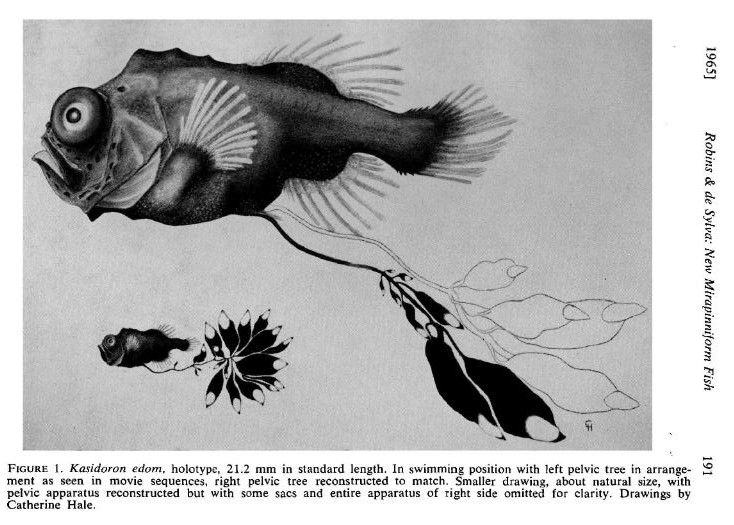
In 1965, a small but spectacular fish called Kasidoron edom was described in a Bulletin of Marine Science paper by C. Richard Robins and Donald P. de Sylva from the University of Miami's Institute of Marine Science (click here to access this paper). Sole member of a totally new genus and taxonomic family (until a second, similar species, K. latifrons, was recorded in 1969, from the western Indian Ocean), it became known as the siphonophore fish.

 
Drawings by Catherine Hale of the siphonophore fish, from the above-mentioned Bulletin of Marine Science paper by C. Richard Robins and Donald P. de Sylva (© Catherine Hale/C. Richard Robins/Donald P. de Sylva/Bulletin of Marine Science – reproduced here on a strictly non-commercial fair use basis for educational/review purposes only)

This was due to its astonishing pelvic fins. These were greatly modified, the third ray in each one having transformed into a long, multi-branched tree-like organ dubbed the pelvic tree, hanging underneath its body, terminating in a series of luminous(?), leaf-like sacs, and closely resembling the tentacular appendages of those superficially jellyfish-like composite creatures the siphonophores (exemplified by the famous Portuguese man-o'-war Physalia).

Known at that time only from waters of around 6-165 ft depth, about 150 miles east of Florida's Cape Canaveral and northeast of Bermuda, this 1.25-in-long velvet-black fish attracted appreciable interest, on account of its conjoined pelvic fins' unique, extraordinary structure. This was assumed to be a device for warding off predators, as they would be likely to mistake its harmless form for the deadly stinging tentacles of genuine siphonophores.

 
Two siphonophore fish photographs discovered by me recently here on the Quora website (No copyright/ownership details for them are given there, and despite considerable online searches I have been unable to locate any either, so I am including these photos on a strictly non-commercial Fair Use basis for educational/review purposes only)

After a time, however, the remainder of this fish's anatomy began to receive attention too, and researches ultimately disclosed that in spite of its distinctive appearance the siphonophore fish was not a new species at all.

On the contrary, it was unmasked as the hitherto-unknown juvenile form of an odd little species called the gibber fish (aka gibberfish) Gibberichthyes pumilus, which had been formally described and named in 1933. It had been discovered in the waters around Bermuda and the Bahamas.

 
Sketch of the gibber fish G. pumilus (Haplochromis/Wikipedia – public domain); click here to view a colour photograph of a gibber fish.

Previously known only from four specimens, this deepwater denizen attains a total length of 4.5 in, and inhabits the western North Atlantic, as well as the South Pacific waters close to the Samoan Islands. With a very large head, a deep, laterally flattened body, and perfectly normal fins lacking any vestige of its juvenile's astounding tentacle-impersonating pelvic tree, the gibber fish is placed within a taxonomic family of its own, most akin to the squirrelfishes and slimeheads.

Moreover, as the second siphonophore fish species, K. latifrons, has also been reclassified as a gibber fish, it is now known as G. latifrons.

 
The full set of unofficial Abkhazia postage stamps, which includes not only the siphonophore fish stamp (bottom left) but also a stamp depicting the hairy fish [see below for details] (top left) (public domain)

Interestingly, a very similar scenario of extreme metamorphosis from juvenile to adult was more recently revealed with another enigmatic, highly distinctive little fish that had long puzzled ichthyologists – the so-called hairy fish Mirapinna esau. You can read about its own very intriguing history here on ShukerNature, and also here in an early cryptozoology article of mine reproduced on ShukerNature.

This ShukerNature blog article is expanded from my book The Encyclopaedia of New and Rediscovered Animals.


Tuesday, 28 March 2023

MOUNT POPA’S ERSTWHILE MYSTERY DOG, AND AUSTRALIA’S STILL-UNEXPLAINED YOKYN – A COUPLE OF CURIOUS CANINE CRYPTIDS

 
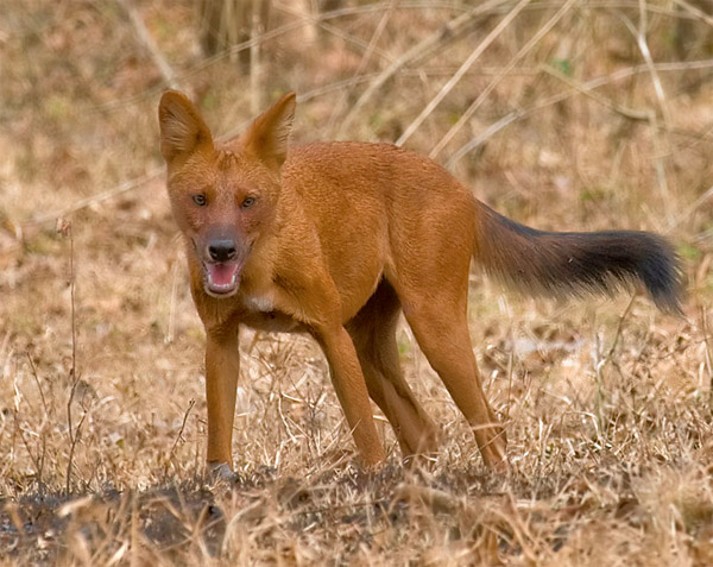
A Burmese dhole – this dhole subspecies was not scientifically described until 1941, when its existence was finally accepted (© Yathin S. Krishnappa/Wikipedia – CC BY-SA 3.0 licence)

Down through the decades, I have documented a wide range of canine cryptids, but two of the least-known examples are those presented here, making their ShukerNature debut. One is now a former mystery canid, the other remains an enigma.

A wild dog of once-controversial scientific status was a mysterious specimen discovered on Mount Popa, a dormant volcano in the region of Mandalay in central Burma (now Myanmar). Renowned British zoologist Reginald I. Pocock stated in 1936 that no specimens of Asia's very distinctive wild red dog or dhole Cuon alpinus had ever been obtained from Burma, but shortly afterwards he learnt that acclaimed mammalogist and animal collector Guy C. Shortridge had secured a specimen on Mount Popa.

Naturally, Pocock was anxious to examine this unique example, an adult female, especially as Shortridge alleged that it only had five pairs of teats (female dholes have 6-8 pairs), and weighed only 19 lb (unusually light for a dhole). However, after studying its skull, uncovered at the British Museum, Pocock recognized that it had been nothing more than an old, small domestic dog Canis familiaris, with a high crown and short muzzle. But, ironically, genuine Burmese dholes were obtained later, and in 1941 Pocock christened their subspecies C. a. adustus – a taxonomic classification still recognised today.

 
A dingo – the identity of Australia's elusive yokyn? (Katy Platt/Wikipedia – copyright-free)

As for the yokyn – this still-unexplained canine cryptid is a strange dog-like beast reputedly well-known to Australian aboriginals and farmers. Said to be approximately half the size of a full-grown dingo, with disproportionately long claws, a stocky, muscular  build, and a very variable pelage (sometimes brindled, sometimes even multi-coloured), a specimen has yet to be formally examined, so its identity remains uncertain (Fate, May 1977; also click here for additional details online).

An unknown species, an odd type of feral domestic dog, a dingo Canis dingo (aka C. lupus dingo aka C. familiaris dingo), a dog-dingo crossbreed, and even a surviving mainland race of the marsupial Tasmanian wolf Thylacinus cynocephalus are among those identities on offer. If anyone reading this ShukerNature article has further information concerning the yokyn, I'd love to receive details.

This ShukerNature article is excerpted and updated from my book Extraordinary Animals Revisited.


Friday, 20 January 2023

ON THE ROAD FOR GIANT TOADS

 
Artistic representation of a giant toad (© Richard Svensson)

Today is the 14th anniversary of my ShukerNature blog's official launch (20 January 2009), so now, almost 800 ShukerNature articles later, here is my latest one, to mark this auspicious occasion, and inspired by a fascinating news report that I read just a few hours ago.

The news report in question (which can be accessed directly here) reveals the recent discovery and capture in Queensland, Australia, of a truly gigantic specimen of cane toad Bufo marinus (=Rhinella marina). Weighing a colossal 2.7 kg/6 lb (six times that of normal specimens), and dubbed Toadzilla, it may be the biggest toad of any kind ever officially recorded (but keep my use of the word 'officially' in mind, for reasons to be revealed here shortly).

Native to South America and recognized to be the world's largest toad species, the cane toad was introduced into Australia during the 1930s in a bid to control sugar cane-devouring beetles here. Alarmingly, however, it ultimately proved itself as serious an ecological blight as its intended prey. This is due not only to its skin being toxic but also to various toxin-secreting glands on its back and especially to the pair of very sizeable parotoid glands sited on its warty skin's shoulders, which secrete a potent cardiac toxin called bufotoxin  - this highly deleterious suite of secretions collectively causing anything attempting to eat one of these toads to die a swift and usually certain death, including Australia's various native (and mostly endangered) marsupial carnivores, and even creatures as large as goannas (monitor lizards). To make matters worse, this toad also actively preys upon the smaller marsupial carnivore species, such as the shrew-like marsupial mice.

Moreover, because of its very effective deterrent against potential attackers, the cane toad has no predators here, causing its numbers to swell out of all proportion and thereby posing an increasingly severe threat to this island continent's unique indigenous fauna.

 
A cane toad, with its lethal pair of shoulder-sited toxin-secreting parotoid glands clearly visible (© Froggydarb/Wikipedia – CC BY-SA 3.0 licence)

Having said that, in recent times one native Australian species, the black-necked ibis Threskiornis molucca, has seemingly conceived a remarkable means of side-stepping the cane toad's hitherto unassailable defence mechanism – these ibises have been seen throwing toads in the air, which distresses them, thus inducing them to release their skin glands' toxic secretions, after which the ibises wipe the toads on wet grass or rinse them in a water source, washing off the poison from the toads' skin, and then repeat the entire process, until the toads' glands and skin are eventually drained of toxin, after which the ibises swallow the toads whole, with no resulting ill effects.

Certain other canny avians, such as crows and hawks, have learned to flip the toads onto their back and then devour their internal organs, leaving their lethal shoulder and back glands untouched. Who said that birds are bird-brained?! More information on toad-tackling birds here.

Anyway, as noted above, the cane toad is officially the world's largest species of toad. Unofficially, however, there may be reason to question this assumption, judging at least from certain intriguing reports contained in the cryptozoological archives.

The native Indian peoples inhabiting various tropical valleys in the Chilean and Peruvian Andes frequently report the existence there of a greatly-feared, giant form of toad called the sapo de loma ('toad of the hills'). It is said to be deadly poisonous and capable of preying upon creatures as large as medium-sized birds and rodents.

 
Taxiderm specimen of Blomberg's giant toad Bufo blombergi (© Markus Bühler)

Science has yet to examine a sapo de loma, but as I have pointed out in my book The Encyclopaedia of New and Rediscovered Animals (2012) and its two predecessors (The New Zoo, 2002, and The Lost Ark, 1993), there is a major precedent for discovering batrachian behemoths in South America. Rolf Blomberg (1912-1996) was a Swedish explorer, photographer, and writer, and in 1950 he was instrumental in bringing to scientific attention a hitherto-undescribed species of giant toad native to southwestern Colombia. He achieved this significant feat by capturing a huge specimen there that he brought back with him to his home in neighbouring Ecuador, and which became the type specimen of this spectacular new species – duly dubbed Bufo blombergi in his honour a year later. Blomberg's giant toad (aka the Colombian giant toad) can attain a total snout-to-vent length of up to 10 in, which is greater even than that of the heavier, more massively-built cane toad.

Incidentally, German cryptozoological correspondent Markus Bühler has informed me that while browsing through a series of yearbooks from the 1970s for Stuttgart's Wilhelma Zoo, he noticed that the 1971 volume mentioned the chance birth at the zoo some years earlier of hybrids between a female B. blombergi and a male B. marinus. They were apparently indistinguishable from the paternal species, but exhibited unusually strong growth – no doubt a result of hybrid vigour. Bearing in mind that they were crossbreeds of the world's longest toad species and the world's largest toad species, it is a great pity that the book did not contain any additional information concerning them, because they must surely have had the potential to become veritable mega-toads!

In any event, mindful of the relatively belated scientific discovery of Blomberg's giant toad, it would be rash to rule out entirely the possibility that a comparable species still awaits discovery in remote, rarely-visited Andean valleys not too far to the south of the latter species' distribution range.

Moreover, there are also claims among the Mapuche people relating to a supposedly immense species of toad indigenous to various lakes, lagoons, and irrigation channels in southern Chile and southwestern Argentina. Known as the arumco ('big water frog') in Argentina and the vilú in Chile, it is said to measure up to 3 ft long. One such creature, dwelling in a lake, reputedly devoured a horse that was attempting to wade across, but whether this story is true or merely native folklore or hyperbole remains unresolved.

 
Unidentified newspaper article published on 11 August 1987, p. 11, regarding the mystery Wuhan giant toads (or frogs?) please click picture to enlarge for reading purposes (source unknown to me despite many searches for information concerning this article – reproduced here on a strictly non-commercial Fair Use basis for educational/review purposes only)

However, it does remind me of a comparable report that emerged from China. A team of nine scientists from Peking (now Beijing) University, led by 58-year-old biologist Prof. Chen Mok Chun, travelled to some very large, deep mountain pools (one of which is named Bao Fung Lake) near Wuhan in China's Hubei Province during August 1987 in order to film the area and its wildlife. While setting up their television cameras, however, they were allegedly treated to an exhibition of local wildlife far beyond anything that even their wildest imaginations – or worst nightmares – could have conceived.

In full view of the scientists, three huge creatures supposedly rose up out of one of these pools and moved towards the pool's edge nearest to them. Their stunned eyewitnesses likened these grotesque monsters to giant toads or frogs, with greyish-white skins, mouths that were said to be about 6 ft wide, and eyes "bigger than rice bowls".

According to Prof. Chen, they silently watched the scientists for a short time. Then one of them opened its huge mouth and swiftly extended an enormous tongue, estimated at 20 ft long, which it wrapped around the cameras on tripods. As it promptly engulfed the tripods, its two companions let forth some eldritch screams, and then all three monsters submerged, disappearing from view. The delayed-shock reaction experienced by the scientists was so great that one of them dropped to his knees and was physically sick, according to Chinese reports, summarised in various overseas media accounts, including an unidentified American newspaper report included here (if anyone can identify its source, please let me know, thanks!)

This incident seems so utterly incredible that one would surely feel justified in dismissing it entirely as a hoax of the sensationalist supermarket tabloid kind – were it not for the fact that the eyewitnesses in question were all trained scientists, including a major name in Chinese biological research, and all from the country's leading university. Moreover, reports of such creatures being sighted in this same locality by local fishermen date back at least as far as 1962.

 
Finally: included here for no reason whatsoever other than I happen to like it is a bizarre sculpture from the late 1800s of a hook-beaked, warty-skinned, rabbit-eared frog – or toad! (© Markus Bühler)

For more information concerning mega-toads, not to mention mega-frogs too (and click here for one such example of the latter category of amphibian cryptid as documented by me on ShukerNature), be sure to check out my book A Manifestation of Monsters.


Wednesday, 4 January 2023

STREWTH! IS STRUTHIO THE AUSSIE SPINIFEX MAN?

 
Vintage illustration from 1792 of a male specimen of Struthio camelus, the African ostrich – but is this species alive and well and living in Australia too? (public domain)

During summer 1970, dingo hunter Peter Muir found and photographed some strange two-toed tracks in the spinifex (a spiny-seed grass) desert area near Laverton, Western Australia. Local aboriginals claimed that they were from an ogre-like monster – the tjangara or spinifex man.

 
Emu (© Donald Hobern/Wikipedia CC BY 2.0 licence)

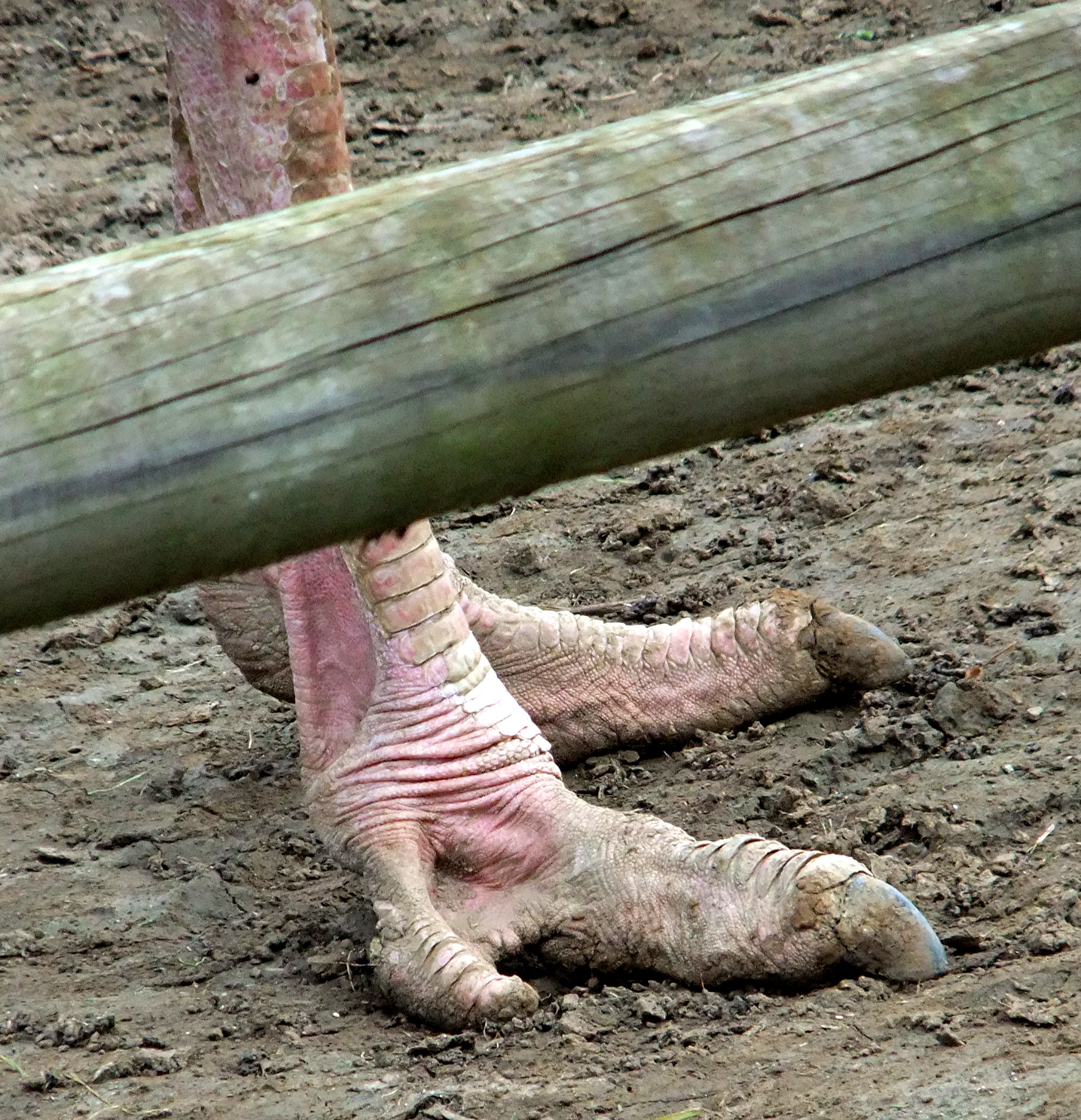
Scientists initially assumed that these were merely tracks of the common Australian emu Dromaius novaehollandiae, but swiftly retracted this view – because emus leave three-toed versions. Only one known creature produces two-toed tracks like those at Laverton – Struthio camelus, the African ostrich!

 
Close-up of ostrich foot showing its fundamentally two-toed format – its very small third toe is too short to leave any noticeable impression in footprints (© Dr Karl Shuker)

Yet the concept of ostriches living wild in Australia is by no means ludicrous – far from it. Small populations of feral (run-wild) ostriches still persist north of Adelaide, South Australia, for instance, descended from specimens released by ostrich farmers after World War I, when the feather market collapsed.

 
Ostriches were formerly maintained in captivity on Australian farms for their once highly-valued plumes (© Dr Karl Shuker)

As the ostrich is a desert-hardy bird that can travel great distances in short periods of time, in 1971 veteran American zoologist and cryptozoologist Ivan T. Sanderson suggested in a short Pursuit article that some ex-farm specimens may not only have survived and bred but also have discreetly extended their range across the intervening desertlands into Western Australia, and thence to Laverton.  (Incidentally, it is known that ostriches were released in Western Australia before 1912, but these 'officially' died out without establishing a population.)

 
Female ostrich (© Dr Karl Shuker)

This would offer a plausible explanation for the mystery of the two-toed tracks and their unseen originator(s) – aptly dubbed by Australian wags 'the abominable spinifex man'. Indeed, if the Laverton environs were not so sparsely populated, the existence of ostriches there may have been confirmed by now.

 
Vintage curio photograph of an ostrich-drawn cart (public domain)

This ShukerNature article is excerpted from my book The Beasts That Hide From Man (2003).


Saturday, 24 December 2022

LISTING THE FULL CONTENTS FOR FORTEAN STUDIES - THE ERSTWHILE SISTER SCHOLARLY JOURNAL OF FORTEAN TIMES

 
Front covers of Vols 1-4 of Fortean StudiesFortean Times/John Brown Publishing – reproduced here on a strictly non-commercial Fair Use basis for educational/review purposes only)

I recently received an enquiry from Facebook follower Mike Robe, asking if I knew of anywhere online that contained a complete list of contents for each of the seven published volumes of Fortean Studies – the scholarly journal published annually-ish from 1994 to 2001 inclusive by John Brown Publishing of London for the long-running monthly British magazine Fortean Times, which is famously devoted to all matters of a mysterious, inexplicable, and truly Fortean nature. After spending some time checking online, I was very surprised to discover that such listings were indeed conspicuous only by their apparent absence there.

Having been fortunate enough to contribute to virtually every Fortean Studies volume an article of my own (each of which I have subsequently expanded, updated, and included as a chapter in one of my books), I'm very familiar with this journal's contents and their outstanding scholarly merit, collectively constituting a very sizeable corpus of in-depth, extensively-researched  contributions too lengthy and specialized for publication in Fortean Times, thus explaining why Fortean Studies was established. It's a great pity that it ceased publication after just seven volumes, but at least many copies of each of these still exist, offering an authoritative, highly-informative, fascinating read for everyone interested in Fortean phenomena.

Consequently, as a response both to Mike's enquiry and to what I feel to be a necessity that the contents of Fortean Studies should, very deservedly, be brought to the widespread attention of online readers, I am presenting herewith a series of scans of the front cover and, on the back cover, the list of contents for each Fortean Studies volume from my own library.

NB – Please note that Vol. 1 does contain an article of mine, 'A Belfy of Crypto-Bats', positioned directly after Michel Raynal's giant octopus article, but for some unexplained reason it was omitted from the list of contents.


Fortean Studies, Volume 1, 1994 – click to expand for reading purposes (© Fortean Times/John Brown Publishing – reproduced here on a strictly non-commercial Fair Use basis for educational/review purposes only)


Fortean Studies, Volume 2, 1995 – click to expand for reading purposes (© Fortean Times/John Brown Publishing – reproduced here on a strictly non-commercial Fair Use basis for educational/review purposes only)


Fortean Studies, Volume 3, 1996 – click to expand for reading purposes (© Fortean Times/John Brown Publishing – reproduced here on a strictly non-commercial Fair Use basis for educational/review purposes only)


Fortean Studies, Volume 4, 1998 [for 1997] – click to expand for reading purposes (© Fortean Times/John Brown Publishing – reproduced here on a strictly non-commercial Fair Use basis for educational/review purposes only)


Fortean Studies, Volume 5, 1998 – click to expand for reading purposes (© Fortean Times/John Brown Publishing – reproduced here on a strictly non-commercial Fair Use basis for educational/review purposes only)


Fortean Studies, Volume 6, 1999 – click to expand for reading purposes (© Fortean Times/John Brown Publishing – reproduced here on a strictly non-commercial Fair Use basis for educational/review purposes only)


Fortean Studies, Volume 7, 2001 – click to expand for reading purposes (© Fortean Times/John Brown Publishing – reproduced here on a strictly non-commercial Fair Use basis for educational/review purposes only)
 

Exceptional pressures of work meant that I was unable to contribute an article to Vol. 6, whereas the article on winged cats that I was planning for Vol. 7 proved so arduous in terms of length and required research that I couldn't complete it in time to meet its publication deadline (it finally appeared almost a decade later, in my book Dr Shuker's Casebook). Nevertheless, I did still contribute to Vol. 7, inasmuch as I was nominated as a reviewer by its editors to evaluate Darren Naish's sea serpent article in manuscript form and offer my opinion as to whether it should be published in Fortean Studies. After reading it, I stated that it should be, so it was.

Second-hand copies of Fortean Studies still appear for sale quite frequently on online auction and bookstore sites, but such listings rarely provide full details of these publications' contents. So I hope that this present ShukerNature post will be of benefit to readers who are thinking of purchasing any Fortean Studies volumes but until now have been deterred from doing so by being uncertain of what they contain.

I wish to thank most sincerely my longstanding friend and fellow cryptozoology enthusiast Mike Playfair for very kindly gifting me his spare copy of Fortean Studies Vol. 7 after learning that this was the one volume that I hadn't been able to track down.

I also wish to pay tribute to the memory of the late Steve Moore, who edited all but that final, seventh volume, for encouraging me to contribute to Fortean Studies and also for being another longstanding friend of mine within the Fortean community.

 
Front covers of Vols 5-7 of Fortean StudiesFortean Times/John Brown Publishing – reproduced here on a strictly non-commercial Fair Use basis for educational/review purposes only)


Friday, 23 December 2022

PERUVIAN BANDICOOTS, UNDISCOVERED TAPIRS, ZEBRA-STRIPED CARROT CREATURES, AND OTHER NEOTROPICAL NOVELTIES, COURTESY OF LEQUANDA & THIÉBAUT

 
Is this a bilby I see before me – in Peru?? (public domain)

In my previous ShukerNature blog article (click here to access it), I documented two unexpected creatures depicted in a magnificent mural-format pictorial encyclopaedia entitled Quadro de Historia Natural, Civil y Geografica del Reyno del Peru ('Painting of the Natural, Civil and Geographical History of the Kingdom of Peru'), or QHNCGRP for convenience hereafter in this present article. Consisting of numerous miniature oil paintings and accompanying text on a wood panel, it measures a very impressive 128 x 45.25 inches (325 x 115 cm).

Completed in Madrid, Spain, in 1799 and now on display at the Museo Nacional de Ciencias Naturales in Madrid (Spain's national museum of natural history), which has produced an exquisite,  lavishly-illustrated website devoted specifically to it (click here), QHNCGRP was authored by Basque-born but (for three decades) Peru-based scholar José Ignacio Lequanda, who commissioned French artist Louis Thiébaut to produce the 194 paintings illustrating it. As noted above, most of these are miniatures, with tiny but voluminous text by Lequanda accompanying all of the 160 miniatures depicting fauna and flora of Peru or its South American environs.

The vast majority of these miniatures depict readily-recognisable Neotropical species, including a large spotted rodent named the paca, a South American zorro or 'fox' (actually a species of Dusicyon canid), an otter, tapir, manatee, various monkeys, trumpeter bird, cock of the rock, spoonbill, hummingbird, Humboldt's penguin, skunk, caiman, giant anteater, fulgorid lantern-fly, llama, vicuna, armadillos, coati, and opossum, to mention but a few.

 
View of QHNCGRP in its entirety – click to enlarge for viewing purposes (© Museo Nacional de Ciencias Naturales – reproduced here on a strictly non-commercial Fair Use basis for educational/review purposes only)

Also present, however, are certain decidedly mystifying zoological portraits, such as that of a dramatically out-of-place Madagascan black-and-white ruffed lemur and one of a putative living ground sloth, both of which I documented in my previous QHNCGRP article.

Since writing that, I have been paying further close attention to this marvelous pictorial menagerie, and I've spotted several additional examples included within it that are nothing if not curious or controversial, for various differing but equally interesting reasons. So here they are – make of them what you will!

Take, for instance, the very distinctive creature portrayed in the QHNCGRP miniature that opens this present ShukerNature article. Whereas I am not aware of any South American mammal matching its morphology (Lequanda claimed it to be a vizcacha, and others have suggested the latter rodent's relative the chinchilla, but these bear little in the case of the chinchilla or no in the case of the vizcacha – resemblance to it, I am aware that it does bear a remarkable similarity to a certain species of exclusively Australian marsupial. Namely, the lesser bilby (aka lesser rabbit-eared bandicoot) Macrotis leucura.

 
Mystery big-eared, long-snouted, plume-tailed QHNCGRP mammal (above) and a painting of a lesser bilby from English zoologist Oldfield Thomas's Catalogue of the Monotremes and Marsupials in the British Museum (Natural History) (below) (public domain)

Certainly, its long snout, lengthy plumed tail, and very sizeable ears all correspond very closely to those of the latter species. True, its forelimbs are much the same size as its hind ones, whereas those of the lesser bilby are shorter, and its fur is white rather than brown like the bilby's. However, the limb discrepancy may simply be an error on Thiébaut's part, especially if his subject's preserved skin had become distorted via shrinkage. Moreover, preserved skins frequently blanch if exposed too long to light (the taxiderm thylacine that was on public display in London's Natural History Museum when I visited in 2014, for example, was so faded, predominantly cream in colour all over, that its diagnostic stripes had vanished).

Deriving its English name from its very large, slender, rabbit-like ears, and characterized by its tail's long white hairy plume, the lesser bilby was once native to the deserts of central Australia, but has not been conclusively sighted since the 1950s, so is now deemed extinct. Back when QHNCGRP was created, however, it was still in existence, with preserved specimens in museums.

As apparently happened with the ruffed lemur, is it possible, therefore, that Lequanda and/or Thiébaut saw a museum specimen of the lesser bilby at Madrid's celebrated Royal Natural History Cabinet (founded in 1771, opened to the public in 1776, and whose contents were very familiar to Lequanda), or even elsewhere, and mistakenly assumed that it was a Neotropical species? Or might Thiébaut have based his miniature upon some pre-existing artwork by another artist? There is a notable QHNCGRP–linked precedent for this latter possibility.

 
Thiébaut's zebra-striped QHNCGRP mystery monkey (top left), Compañon's earlier artwork upon which Thiébaut's was based (top right), and a South American tree porcupine (below) (public domain / public domain / (© Eric Kilby/Wikipedia –
CC BY-SA 2.0 licence)

One of the several monkeys depicted as miniatures in QHNCGRP by Thiébaut is the extraordinary-looking striped example shown above. Its bold zebra-like body and limb markings instantly set it apart from any currently-known monkey species, as does the mid-dorsal row of spines running down its back. These are also alluded to by Lequanda, in his accompanying text. He referred to this fascinating fasciated creature as a casacuillo, and also mentioned that it lived upon fruit.

Rather than basing his illustration of this casacuillo upon first-hand observations of a living or preserved animal, however, Thiébaut used as his inspiration a pre-existing 18th-Century illustration. Namely, a water-colour prepared some years earlier with 1,410 others for inclusion in the Codex Martínez Compañon, a sumptuous nine-volume manuscript made by Baltasar Jaime Martínez Compañon, Bishop of Trujillo, Peru. This water-colour is also shown here, for comparison purposes alongside Thiébaut's oil painting.

Moreover, according to writer Carmen Martínez, writing in an online article from June 2021 devoted to QHNCGRP (click here to access it), this creature is not a monkey at all, but is instead a South American tree porcupine or coendou, of which there are many species, all sporting a prehensile tail. However, to me it looks no more like a tree porcupine than it does a monkey! Coendous are not striped and their fine spines are present profusely over their entire body, not merely along their back. So I am unconvinced by this identification.

 
A striped carrot on legs!! Another of Triébaut's bemusing mystery beasts included by him in QHNCGRP (public domain)

And speaking of zebra-patterned mystery beasts depicted in QHNCGRP, what are we to make of the example shown above? It looks for all the world like a striped carrot on legs! It seems to be furry, eared, and whiskered, and is included in the left-hand block of 30 mammal miniatures (according to Lequanda, moreover, it is, once again, a coendou!), so we must assume that it is indeed mammalian – or should we?

After all, also included in this same block of miniatures is the following bizarre beast, popularly if improbably(?) deemed to be a portrait of an iguana according to various sources consulted by me

Yet this latter beast is itself a major mystery. For it seems to possess a stiff pointed tail wholly unlike the highly flexible tail of an iguana, as well as long curved fangs emerging from its jaws, and what looks like a pair of wings pressed tightly against its flanks! Apparently, like the striped monkey/coendou illustration, Thiébaut based his miniature upon one from the Codex Martínez Compañon that was labelled as an iguana. Really??

 
A supposed iguana depiction by Thiébaut in QHNCGRP (above) and the original version in the Codex (below) (public domain)

Most improbable of all, however, must surely be the next example presented here. What on earth (or in the air!) is this extraordinary squirrel-like entity that sports not only two pairs of limbs and a bushy tail but also a pair of wings – and which are clearly functional, given that Thiébaut has portrayed it flying above a somewhat larger, rodent-like mammal in the same miniature?

Might it be the inaccurate result of Thiébaut painting not from direct observation of some physical specimen, but instead merely from a verbal description of a flying squirrel? True, the name of these rodents is something of a misnomer, seeing that they become airborne not with the assistance of wings but instead via a pair of gliding membranes (patagia), linking their wrist and ankle on each side of their body. But if a verbal description of such a creature does not make this distinction clear to an artist seeking to depict it, the result might well be an illustration of a squirrel-like creature boasting a pair of bona fide wings.

Yet even if that were true, there is still a fundamental problem in applying it as an explanation for this aerial anomaly as portrayed here, because although flying squirrels are widely distributed in North America, they do not occur anywhere in South America. So why would Thiébaut have depicted one in QHNCGRP? Yet another instance of someone wrongly assuming that a given creature is Neotropical when it definitely is not? Having said that, Thiébaut's illustration is yet again a copy of one from the Codex Martínez Compañon, but in that version the flying entity looks far more like a bird than a mammal, so why did Thiébaut convert it into one in his copied version? Conversely, at least according to Lequanda's accompanying description of it in QHNCGRP, it is indeed a rodent with wings, and is referred to by him as a mutmut. All very strange!

 
Thiébaut's bewildering winged squirrel in QHNCGRP (above) and the original bird-like version in the Codex (below) (public domain)

My concern with the ostensibly unidentifiable mystery creatures from QHNCGRP documented by me here is that, as already noted, most of the animals depicted in it by Thiébaut are readily recognisable. So as those were all accurately represented by him, why should the mystery beasts here not be too, unless he was indulging in some sly humour at Lequanda's expense, perhaps? Yet if they are accurate representations, why can we not identify them?

Might at least some of them not have arisen through misapprehensions regarding the origins of specimens utilized as subjects, or even as a result of poor verbal descriptions of such, but instead be bona fide native Neotropical species that have become extinct before ever becoming known to European scientists, so their morphological appearance is wholly unfamiliar to us?

The last anomalous animal to be considered here may provide key evidence that some of Thiébaut's miniatures depict significant creatures that were still unknown to science at the time when he depicted them.

 
The supposed lowland tapir depicted in QHNCGRP (public domain).

Just a few hours after I posted my previous QHNCGRP-themed ShukerNature article, on 22 December 2022, I received a very interesting, thought-provoking comment from a reader with the Google username Andrew, and which I duly posted beneath my article. It concerns the QHNCGRP miniature of what is officially assumed to be a specimen of the lowland (Brazilian) tapir Tapirus terrestris, the largest species of native mammal known to be alive today in South America, and occurring widely here, including in Peru. Here is Andrew's comment:

Thiébaut's depiction of the tapir looks like it could have been based on descriptions of the then-undiscovered mountain tapir, rather than the lowland species. It has no crest, its coat is almost black with a slight chestnut tint, and it seems to have white lips.

Smaller and darker in colour than the lowland tapir, the mountain tapir T. pinchaque is a very distinctive species that is indeed uncrested and white-lipped. It is also noticeably woolly, and looking at the tapir miniature in close-up its body surface does appear to be hairy. Moreover, of particular historical note is that this species, which is indeed native to Peru (occurring in its far north's montane cloud forests), was not formally described by science until 1829 – 30 years after the creation of QHNCGRP.

 
A lowland tapir (top) and a mountain tapir (bottom) (© Dr Karl Shuker / (© Richard Sifry/Wikipedia –
CC BY 2.0 licence)

In short, if the tapir miniature in QHNCGRP actually depicts a mountain tapir rather than a lowland tapir, this means that Thiébaut had portrayed a major mammalian species three decades before its official discovery. This in turn begs the question: what specimen was utilized by Thiébaut as the subject for his illustration?

Whichever it was, and wherever it was, its taxonomic significance as representing a dramatic new species had clearly not been recognized or appreciated by scientists of the day.

As I have revealed many times in my trio of books on new and rediscovered animals, this is a sad situation that has occurred countless times down through the centuries, with obscure museum specimens having been long overlooked before belatedly receiving serious attention, only for them then to be revealed as extraordinary new species whose existence had never previously even been suspected, let alone confirmed. So the potential example documented above has plenty of precedents, that's for certain!

 
My three books on new and rediscovered animals (© Dr Karl Shuker/HarperCollins/Stratus Publishing/Coachwhip Publications)