Dr KARL SHUKER

Zoologist, media consultant, and science writer, Dr Karl Shuker is also one of the best known cryptozoologists in the world. He is the author of such seminal works as Mystery Cats of the World (1989), The Lost Ark: New and Rediscovered Animals of the 20th Century (1993; greatly expanded in 2012 as The Encyclopaedia of New and Rediscovered Animals), Dragons: A Natural History (1995), In Search of Prehistoric Survivors (1995), The Unexplained (1996), From Flying Toads To Snakes With Wings (1997), Mysteries of Planet Earth (1999), The Hidden Powers of Animals (2001), The Beasts That Hide From Man (2003), Extraordinary Animals Revisited (2007), Dr Shuker's Casebook (2008), Karl Shuker's Alien Zoo: From the Pages of Fortean Times (2010), Cats of Magic, Mythology, and Mystery (2012), Mirabilis: A Carnival of Cryptozoology and Unnatural History (2013), Dragons in Zoology, Cryptozoology, and Culture (2013), The Menagerie of Marvels (2014), A Manifestation of Monsters (2015), Here's Nessie! (2016), and what is widely considered to be his cryptozoological magnum opus, Still In Search Of Prehistoric Survivors (2016) - plus, very excitingly, his four long-awaited, much-requested ShukerNature blog books (2019-2024).

Dr Karl Shuker's Official Website - http://www.karlshuker.com/index.htm

IMPORTANT: To view a complete, regularly-updated listing of my ShukerNature blog's articles (each one instantly clickable), please click HERE!

IMPORTANT: To view a complete, regularly-updated listing of my published books (each one instantly clickable), please click HERE!

IMPORTANT: To view a complete, regularly-updated listing of my Eclectarium blog's articles (each one instantly clickable), please click HERE!

IMPORTANT: To view a complete, regularly-updated listing of my Starsteeds blog's poetry and other lyrical writings (each one instantly clickable), please click HERE!

IMPORTANT: To view a complete, regularly-updated listing of my Shuker In MovieLand blog's articles (each one instantly clickable), please click HERE!

IMPORTANT: To view a complete, regularly-updated listing of my RebelBikerDude's AI Biker Art blog's thematic text & picture galleries (each one instantly clickable), please click HERE!

Search This Blog


PLEASE COME IN, I'VE BEEN EXPECTING YOU...

PLEASE COME IN, I'VE BEEN EXPECTING YOU...
WELCOME TO SHUKERNATURE - ENJOY YOUR VISIT - BEWARE OF THE RAPTOR!


Wednesday, 9 August 2023

IS A LARGE NON-AVIAN DINOSAUR ALIVE AND WELL AND LIVING IN PAPUA NEW GUINEA?

 
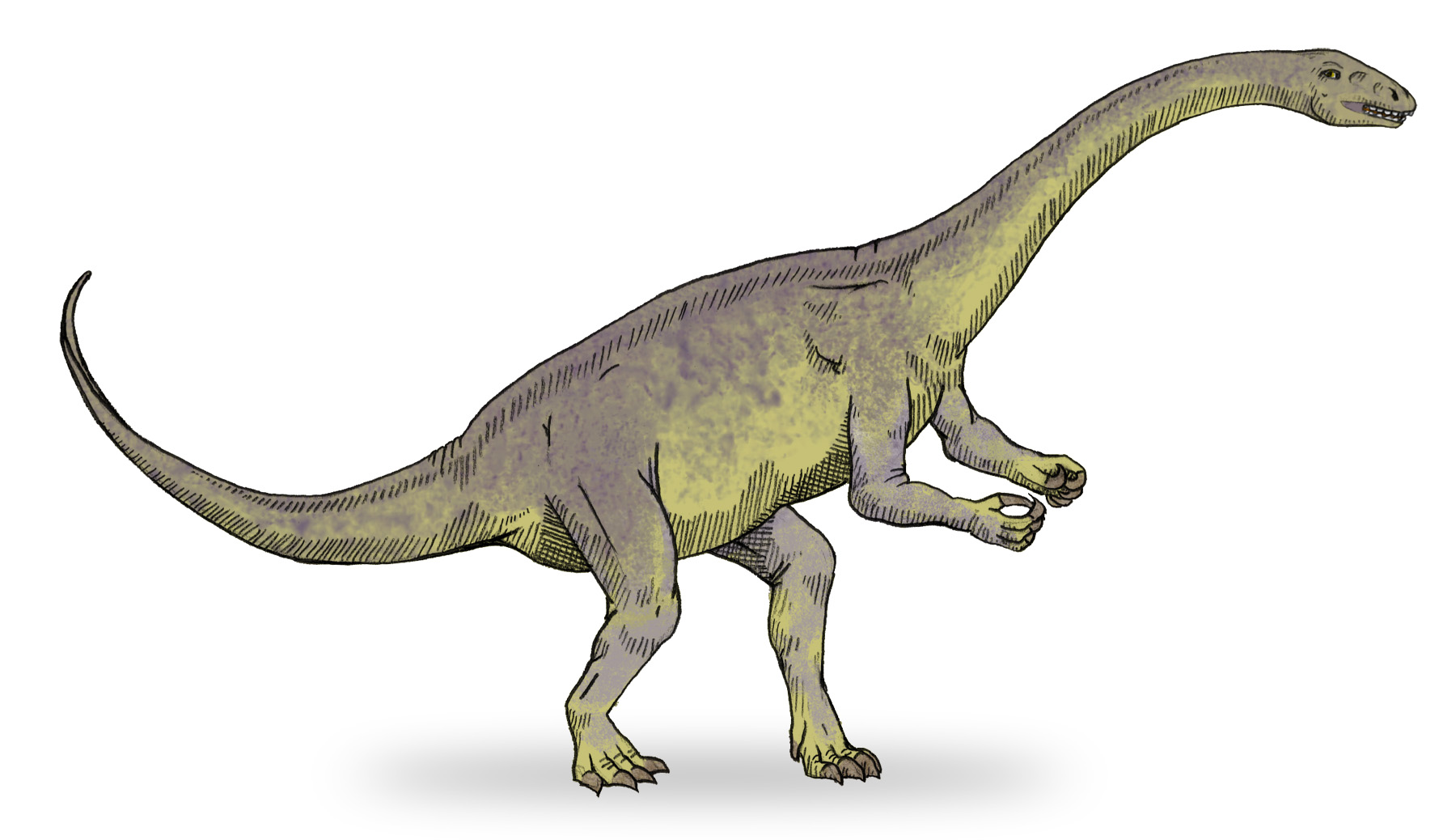
Modern-day reconstruction of what Lufengosaurus may have looked like in life (© Debivort/Wikipedia – CC BY-SA 3.0 licence)

On 13 March 2019, I blogged here on ShukerNature about various reports emanating from New Guinea and its smaller neighbouring islands (especially New Britain) concerning large unidentified creatures that have sometimes been likened to living non-avian dinosaurs. In particular, I documented some searches made during this present century for such cryptids by mystery beast investigators Brian Irwin and Todd Jurasek (click here to access this ShukerNature article of mine).

Lately, moreover, Brian has kindly made freely available to me for full use on ShukerNature an extensive report written by him that not only covers some of the incidents recorded by me in my previous article but also contains much additional, fresh information, including details relating to further, more recent searches by him. Consequently, and with Brian's kind permission, I now have pleasure in reproducing below his complete report, which includes a number of illustrations all supplied by him and whose copyright, unless otherwise noted, belongs to him. Thanks Brian!


Is A Large Theropod Still Alive In Papua New Guinea?

By Brian Irwin


Tim Neville is an Australian who worked for the Wallindi Plantation Resort at Kimbe, West New Britain in Papua New Guinea. In 1992-93, Tim was diving off the east coast of Alage (Aui) Island, located off the south coast of West New Britain between Kandrian and Gasmata. While diving, Tim observed some large three toed foot prints of an unknown animal in the mud on the ocean floor. Tim later enquired at the neighbouring Ambungi and Sep Sep Islands about the existence of a living dinosaur. No one at these islands had knowledge of any such creature at that time. However, sightings of an animal resembling a theropod dinosaur commenced around Ambungi Island a couple of years later.1

The author has travelled to West New Britain numerous times.2 With the exception of Alphones Likky, all eyewitnesses in this report were interviewed during an expedition in November 2022. Alphones was interviewed by the author in 2012.

The three islands located on the south of West New Britain between Kandrian and Gasmata where the reptilian creature has been sighted. Each square on the map represents one square kilometre.


Alphones Likky’s sighting in 1995

Alphones was spear fishing on the reef on the east side of Ambungi Island in 1995. While he was underwater on the bottom of the reef and facing south, he heard something crashing into the coral behind him. When Alphones turned around he was startled to see a large animal only about 5 metres away and fully submersed. The animal had a long neck and tail, with large rear legs and duck-like feet. The forelimbs were much smaller than the rear legs. The skin was dark brown and the head was small and snake-like. A dermal frill (‘saw’) was seen on the animal’s back and tail, but not on the neck. The animal was bipedal and walked slowly with its neck horizontal. The tail was observed to be moving considerably while the animal was walking. The creature was approximately 4 metres in length from the front limbs to the end of the tail and the height was 2 to 3 metres. The sighting may have lasted up to 10 seconds before Alphones surfaced and left the area in fear. There are some small caves on the east of Ambungi Island and Alphones said the animal was heading in the direction of one of the caves. However the animal was not observed to enter the cave and it is unlikely an animal of the size described by Alphones could enter the relatively small caves on the east side of Ambungi Island. Afterwards a local school library reference book with animals was found and Alphones identified a dinosaur with large rear legs and smaller forelimbs as the kind of animal he observed near Ambungi Island.3

Alphones Likky (left) on the mainland of West New Britain in 2012.


Alice Pasingan’s sighting in 1999

One morning in 1999 around 6-7 am, Alice was alone in her garden at the south of Ambungi Island near the sea. She was astonished to see a large bipedal reptilian animal walking slowly about 12 metres away to the south. The animal was estimated to be 1.9 metres tall and had a dermal frill from the back of the head to the end of the tail. Alice’s husband, Martin, later drew a picture of the creature under instruction from Alice (see drawing below). The colour was brown and the belly was red. The animal’s body and tail moved from side to side and the neck was upright as it walked. No sound was heard from the creature. When the animal saw Alice, it seemed frightened and it opened its mouth to reveal sharp teeth. The creature then turned around and walked slowly down an incline to a 2-metre cliff then jumped into the sea. Alice watched the animal from a rock ledge near the incline (see photo below) as it headed towards the sea. The sighting lasted about 2 minutes, during which time Alice’s dog ran away. This is the only known sighting of this kind of animal on the land at Ambungi Island.


 Martin’s (Alice’s husband) drawing of the animal seen by Alice in her garden.

It took 3-4 attempts till Alice was happy with the drawing.


The path the animal took down to the sea when it was disturbed by Alice.


Another view of the incline the animal walked down towards the sea.

Alice watched the animal from the rock ledge where the photo was taken.

The animal jumped off the 2-metre cliff into the sea.


Alice’s garden looking north from the rock ledge.


Alice and Martin Pasingan with their grandchildren.


Robert Biket’s sighting in 2006

One afternoon at Easter (April) 2006, Robert was walking south along the coastline on the eastern side of Ambungi Island. It was high tide. As Robert rounded a corner and at a distance of about 20 metres, he was amazed to see a large, bipedal reptilian creature standing on rocks near the shoreline. The animal was feeding on the leaves and fruit of trees and was eating with short, powerful teeth. The creature had a long neck with a head resembling a turtle’s head, large rear legs and small forelimbs, and a long flat tail. The webbed feet were black and were similar to those of a duck. While eating, the neck was vertical, the forelimbs and tail were not moving and the fingers were closed. There was no dermal frill. It was estimated the creature was 4.5 metres tall and its colour was medium grey. The skin appeared smooth, with fine hairs on the body. The feet were visible because the animal was standing on shore some of the time while eating. Robert said the size of the cryptid’s head was larger than the diameter of the neck. Robert started yelling to anyone onshore. However, the animal did not take any notice of Robert. After watching the creature eating for a few minutes, Robert hurried back ashore to the ravine where the reptile was eating (see photo below). It may have taken 5 minutes for Robert to get to the ravine from the sea. When he reached the ravine, Tony Avil and Rapheel Sange joined Robert in watching the animal as it continued to eat. After finishing eating, the creature travelled south a few metres from the shore and the three men moved down the ravine to the water and watched as the animal moved slowly into deeper water. The animal walked upright, with the body moving from side to side and with the tail moving noticeably. After the sighting, the school teachers on Ambungi Island did not initially believe Robert’s account of the sighting and made him swear on the Bible in the Catholic Church that he was telling the truth. From the author’s copy of the book Dinosaurs And Prehistoric Life (written by Hazel Richardson), Robert identified the Lufengosaurus theropod4 as the closest match to the reptile he observed.

Tony Avil sighted the animal from the top of a ravine at a distance of about 30 metres for about 15 minutes. He only saw the head and neck of the creature while it was eating, with the head being shaped like that of a turkey and the neck always vertical as it was moving forward eating leaves and fruit from trees. Tony stated the skin colour was brown/silver and smooth.


 Robert standing at the location where the large bipedal reptilian creature was sighted.


Another view of the sighting location in the morning at low tide. The tree foliage can be seen.


The animal was seen eating the leaves and fruit (shown above) from this tree, which has been tentatively identified as Ficus ingens [the red-leaved fig tree].

.

Jasinta Pitim’s sighting in 2007

One afternoon in 2007, Jasinta was walking south on the rocks on the west side of Ambungi Island. It was high tide and it was raining. Rounding a corner at a distance of about 25 metres, Jasinta observed the large body of an animal in the water between rocks (see picture below). The head, legs and tail of the creature were not seen, however a dermal frill (‘saw’) was seen on the animal’s back, the skin was rough and the colour was dark brown. The creature quickly moved away from Jasinta into deeper water. Jasinta hurried back to the village after sighting the animal and no one returned to the location where the sighting occurred for five days because the animal was considered dangerous.


Location of Jasinta’s sighting at the south-west of Ambungi Island at low tide.


Joe and Jasinta Pitim’s sighting in 2014

In June or July 2014 at around 8 am, Joe and Jasinta were travelling west back to Ambungi Island from Malengo Island5 in a canoe. From a distance of about 30 metres they observed the head, long neck, forelimbs and back of an animal that had had head like a dog and no ears. The neck was vertical and the visible part of the creature was about one metre above the water. There was a dermal frill (‘saw’) on the head, along the neck and the back of the animal. The colour was dark brown and the skin was rough looking. The size of the head was described as being larger than the diameter of the neck. The mouth was closed and the animal was stationary and did not turn its head. The animal made no sound during the sighting. After about two minutes the creature submerged and the canoe passed over the place where animal was last seen. Joe and Jasinta were very afraid of the creature and Jasinta believes this animal is the same kind of animal she observed on the south west side of Ambungi Island in 2007.

The author (left) with Joe, Jasinta and Mark Pitim at Ambungi Island.


Gabriel Lilo’s sighting in 2021

Gabriel Lilo is from Malengo Island and had a sighting of the creature while fishing half a kilometre from the eastern side of Ambungi Island. The sighting was in August 2021, around 4 pm at a distance of 40-50 metres for a few minutes. Gabriel observed the head, neck and front limbs of the animal and noted that it had a dermal frill. The colour was dark green and the animal was walking slowly on the reef with its head and body moving side-to-side. The texture of the skin could not be determined and the animal’s teeth were not visible. Gabriel eventually paddled away, afraid. This was Gabriel’s only sighting of this animal.

Gabriel Lilo (right) with Jerome Lunga at Melengo Island. Jerome helped translate from Pidgin to English.


Mark Pitim’s sighting in 2022

Mark had a probable sighting of this creature on 4th November 2022 around 5 pm while canoeing from Alage (Aiu) Island to Ambungi Island with his son. The back of an animal was sighted as it travelled west to east at a distance of approximately 20 metres. The visible length of the creature was about 3 metres, with 50 cm being above the water. The colour was described as very dark and the animal had no dermal frill. The sighting lasted about a minute before the animal submerged. Mark was certain the animal was not a dugong.


Mark holding a wood carving similar to the creature that has been sighted around Ambungi Island.


Discussion

The sightings around Ambungi Island all seem to be of the same kind of creature and there have been numerous other sightings not included here. The common features of this animal include:

1.       A long neck

2.       Smallish head with larger diameter than the neck

3.       Large body

4.       Bipedal, with hind feet being duck-like with three toes

5.       Small front limbs

6.       Long tail

7.       Reptilian appearance

8.       Herbivorous

The only noticeable difference between sightings is the lack of a dermal frill on some animals. The Lufengosaurus dinosaur matches the creature sighted around Ambungi Island, although other theropods may fit the description also. There is no known animal alive today that fits the description of this creature.

There may be a small population involved and it is encouraging to know that there have been recent sightings of this creature. There has been only one confirmed land sighting of the animal at Ambungi Island (Alice Pasingan) and this may have been a juvenile, judging by its height. Most of the sightings are to the east and south of Ambungi Island. At neighbouring Amge (Sep Sep) Island there have been no sightings of this animal. At Alage (Aiu) Island there is only one family living there and they do not have knowledge of the animal, although there are reports that previous inhabitants may have sighted this animal occasionally. The animals involved may be attracted to Ambungi Island because of the fruit on the Ficus ingens trees and perhaps the fruit of other trees. The Ficus ingens normally fruits in February to April and June in the southern hemisphere. At Ambungi Island, there are some tree branches overhanging into the sea, so the animal may not need to venture onto land to feed. It is unknown where these reptiles may be laying their eggs. Hopefully, further research will result in more information about this cryptid and lead to its eventual discovery.


Endnotes

1.       John Lunga, an elder at Ambungi Island, provided the information about Tim Neville. The staff at Wallindi Plantation Resort at Kimbe, WNB did not have any additional information about Tim.

2.       Todd Jurasek, Joey Massang, Russell Cook and Matt Clarke have also travelled to Ambungi Island over the last 10 years to investigate this animal.

3.       John Lunga provided the information about Alphones identifying the animal from a book.

4.       The author interviewed Robert Biket briefly in 2008 where he identified the Therizinosaurus from the same book as the bipedal reptilian creature he sighted. During the 2022 expedition when more time was available, Robert identified the Lufengosaurus theropod as a better match to the animal he observed in 2006.

5.       Malengo Island is located approximately 8 kilometres east of Ambungi Island.


What a fascinating account! Before commenting further, however, certain specifics need to be clarified. Although in her book Dinosaurs and Prehistoric Life (2003), Hazel Richardson allegedly referred to Lufengosaurus as a theropod dinosaur (I haven't seen her book, so I can't confirm this myself), opinions have changed. Lufengosaurus is nowadays classed as a sauropodomorph, i.e. belonging to a separate taxonomic group from theropods (although sauropodomorphs and theropods collectively constitute the higher taxonomic group Eusaurischia). Conversely, the earlier-mentioned Therizinosaurus is indeed a theropod, albeit a herbivorous one.

Not that such taxonomic details are significant in this particular instance, however; Lufengosaurus was selected by the cryptid's eyewitness, Robert Biket, merely because its outward appearance as portrayed in Richardson's book was more similar to the cryptid that he'd seen than were any of the other dinosaur depictions, nothing else.

In a previous ShukerNature article (click here to read it), I documented an array of reports and sightings appertaining to the artrellia or Papuan dragon, based upon what appear to be exceptionally large specimens of varanid (monitor lizard) living in New Guinea, much bigger than the currently confirmed 15-ft maximum length for this island's resident giant varanid species, Salvadori's monitor Varanus salvadorii. I think it likely that some supposed dinosaur sightings may in reality feature extra-large varanids, some species of which are even able to raise themselves up onto their hind legs and walk bipedally for a short time.

 
Salvadori's monitor, the world's longest known species of varanid, and a resident of New Guinea (public domain)

Having said that, the creature described by the eyewitnesses recorded above in Brian's report seems markedly different in form and also behaviour – especially its aquatic predilection – from Salvadori's monitor. Equally, bearing in mind that based upon current palaeontological evidence it would appear that dinosaurs were predominantly terrestrial, if one such lineage has somehow actually survived into the present day it is not impossible that during the 64 million years spanning the end of the Cretaceous (and officially the end of all non-avian dinosaurs) and the present day the lineage in question may have yielded aquatic species. Of course, this is all total speculation, but is very interesting nonetheless.

What is clearly needed here now is evidence of a much more tangible nature than has hitherto been obtained for this cryptid's existence. Eyewitness reports and drawings, however detailed they may be, are merely anecdotal. We need photos, footprint casts, and above all DNA samples, to confirm not only that such a creature exists but also its taxonomic identity.

My most sincere thanks once again to Brian Irwin for so kindly permitting me to reproduce his report here on ShukerNature.

 
Close-up of the head of a Salvadori's monitor (Wikipedia/copyright-free)


Monday, 31 July 2023

A CENTENARY CELEBRATION FOR THE INACCESSIBLE ISLAND RAIL - A FLIGHTLESS MINI-BIRD FROM ATLANTIS!

 
Illustration of the Inaccessible Island rail (public domain)

A hundred years ago this very same month, one of the most diminutive but delightful of all living birds was formally added to the zoological catalogue of recognised species. So here, as a centenary celebration of this remarkable little creature's official unveiling, is a concise history of its discovery.

Inaccessible Island is a tiny islet of the Tristan da Cunha group, sited in the south Atlantic roughly midway between southern Argentina and South Africa, and would have little claim to fame, were it not for a very peculiar member of its avifauna. The species in question is a miniscule rail, only 5 in long (little larger than a newly-hatched chicken), and with such tiny, poorly-formed wings that it is totally flightless, making it the world’s smallest extant species of flightless bird.

 
Remaining elusive among its island's abundant tussock grass (© Brian Gratwicke/Wikipedia – CC BY 2.0 licence)

Its habit of scampering swiftly through the island's wide expanses of dense tussock grass thus makes it seem to the casual observer more akin to a mouse than to a bird. This illusion is enhanced by its strange feathers, which are decomposed (i.e. atrophied) and hair-like. Its upperparts are reddish-brown, its underparts are dark grey, and its belly, flanks, and wing-covert feathers bear paler bands. 

A remote spot, not readily reached, Inaccessible Island was well-named. Due to its inaccessibility, its minute rail (found nowhere else in the world) escaped formal scientific recognition until 1923, when the Reverend H.M.C. Rogers, resident chaplain on Tristan da Cunha, collected some skins of it in response to a request made by the Shackleton-Rowett Expedition's naturalist, a Mr Wilkins. The expedition had visited the island group a little earlier, and had heard the locals speak about the tiny 'island hen' of Inaccessible, but had been unable to travel there to seek it out.

 
Portrayed in Rose Annie Rogers's book The Lonely Island, published in 1927 (public domain)

Nor was that the first scientific expedition to have learned about this mysterious mini-bird without succeeding in procuring a specimen to confirm its reality. In 1905, Lord Crawford had sailed to its island homeland aboard his yacht Valhalla with the express purpose of collecting a specimen after learning of its existence there, but he failed to accomplish his goal. Earlier still, in October 1873, the famous Challenger Expedition of 1872-1876 had visited Inaccessible Island, where its chief scientist, Sir Charles Wyville Thomson, learned of its diminutive denizen and recorded observations that had been made here by two German brothers, the Stoltenhoffs, while residing there during the past two years, but he was unable to obtain a specimen. (Consequently, this elusive bird was actually a cryptid during that 50-year time span, from 1873 to 1923 – known to the locals but officially unconfirmed by science.)

Happily, however, these unsuccessful attempts no longer mattered when, on 5 July 1923, two of the skins collected by Rogers arrived at what was then the British Museum (Natural History), and were described that same year by Percy R. Lowe, who named the new species Atlantisia rogersi. 'Atlantisia' alludes to the belief by some workers that the Tristan da Cunha islands are remnants of the fabled sunken continent of Atlantis.

 
Hand-held, highlighting its tiny size (© Brian Gratwicke/Wikipedia – CC BY 2.0 licence)

Previously little-studied, during the 1980s A. rogersi was the subject of a detailed field survey by South African researchers Drs M.J. Fraser and W.R.J. Dean, and Dr I.C. Best from Bahrain, published in 1992. More recently, in 2018, a further study proposed that this species should vacate its memorable monotypic genus, Atlantisia, and instead be rehomed within the pre-existing genus Laterallus, hitherto containing 12 species of crake. Consequently, it is now known as Laterallus rogersi, which may be more accurate taxonomically but is much less romantic – give me Rogers's bird from Atlantis any time!

This ShukerNature blog article is excerpted and expanded from my book The Encyclopaedia of New and Rediscovered Animals.


Friday, 30 June 2023

HAGGLING OVER THE HAFGUFA

 
The hafgufa, as depicted in a medieval manuscript, namely the British Library MS. Harley 3244, fol. 65r, 1236, c.1250, (public domain)

The hafgufa is a mysterious sea monster described in Konungs skuggsjá ('The King's Mirror'), which is a mid-13th-Century Old Norse manuscripts – but that is not all. It has actually been traced back as far as an account in a 2nd-Century-AD text from Alexandria, Egypt, entitled Physiologus, whose text is accompanied by illustrations of a whale-like creature termed the aspidochelone, depicted with its huge mouth wide open and fishes jumping into it.

According to The King's Mirror:

It is said of the nature of this fish [the hafgufa] that, when it goes to feed, it gives a great belch out of its throat, along with which comes a great deal of food. All sorts of nearby fish gather, both small and large, seeking there to acquire food and good sustenance. But the big fish keeps its mouth open for a time, no more or less wide than a large sound or fjord, and unknowing and unheeding, the fish rush in in their numbers. And when its belly and mouth are full, [it] closes its mouth, thus catching and hiding inside it all the prey that had come seeking food”

The hafgufa is also mentioned in various other Norse manuscripts from this same period. Moreover, a similar description for the aspidochelone is given as follows in Physiologus:

When it is hungry it opens its mouth and exhales a certain kind of good-smelling odor from its mouth, the smell of which, once the smaller fish have perceived it, they gather themselves in its mouth. But when his mouth is filled with diverse little fish, he suddenly closes his mouth and swallows them.

In the scientific age, there has been much speculation and dispute as to whether the hafgufa was based upon a real creature, and, if so, what that creature might be, with the consensus being that it was probably some kraken-like monster.

 
An aspidochelone from a French manuscript, c.1270, held at the J. Paul Getty Museum (public domain)

Now, however, this maritime mystery beast's true nature may at last have been revealed, thanks to the publicising of a remarkable mode of feeding behaviour practised by various rorqual whales.

Known as trap feeding and first scientifically recorded in 2010, various humpback whales Megaptera novaeangliae and Bryde's whales Balaenoptera brydei have been observed waiting motionless at the water surface in an upright position with their huge mouths wide open, into which shoals of fishes unsuspectingly swim to their doom, fatally mistaking the whales' gaping jaws for shelter, until the jaws close, engulfing them!

Moreover, this eyecatching activity has lately attracted worldwide attention thanks to an Instagram video clip of a Bryde's whale performing it that went vital after featuring in a 2021 BBC wildlife documentary (click here to view this clip).

According to the Norse manuscripts, as noted above, the hafgufa behaves in a similar manner, even actively attracting shoals of fishes to swim into its open mouth by emitting a specific perfume. And sure enough, when seeking to lure fishes into their mouths by regurgitating food, both the humpback and Bryde's whales produce a distinct smell.

A detailed study examining and comparing medieval Norse accounts of the hafgufa with modern-day reports of trap feeding by rorquals was published on 28 February 2023 in the journal Marine Mammal Science (click here to read it). The paper was co-authored by maritime archaeologist John McCarthy, from the College of Humanities, Arts and Social Sciences at Flinders University in Australia, who had become interested in this correlation after reading about the hafgufa in traditional Norse mythology.

Once again, therefore, it seems likely that an ostensibly fabulous monster of mythology can lay claim to a firm basis in mainstream zoological fact after all.

 
Another illustration of the hafgufa, this time from Ortelius's 1658 map of Iceland (public domain)
 

Friday, 9 June 2023

AN 'ELL OF AN EEL?

 
Just how big can moray eels get? A vintage illustration of the Mediterranean moray (aka Roman eel) Muraena helena (public domain)

Extra-large, even giant-sized, eels are frequently cited as potential identities for all manner of freshwater and maritime monsters around the world, including Britain's very own Nessie. Down through the years, I've documented a fair few of these reports, from such disparate, far-flung locations as North America, New Zealand, and the Mascarene Islands. Now, another location, Vietnam, can apparently be added to that list.

Longstanding Loch Ness Monster researcher Steve Feltham hosts a very interesting and informative public Facebook group entitled 'Steve Feltham, Nessie Hunter, Interactive Collective', which acts as a forum for sharing relevant information relevant to this pre-eminent cryptid. On 13 October 2022, group member Mike Gavan from New Zealand posted the following fascinating account of what may have been a truly gigantic eel encountered underwater off Vietnam by one of his friends:

I’ve just had a visit from an older friend of mine, Tim.

Tim was a deep sea diver in the 1970s, working from a bell at an average depth of 200 m [656 ft], his work was in the area of undersea recovery, maintenance for the oil industry world wide.

Around 1974, Tim was diving on a recovery job at 220 m [722 ft] off the coast of Nha Trang, Vietnam.

His job was to recover a length of special purpose ducting that had been lost overboard, he was to locate it, tie it and await a winch.

About 10 minutes into his dive from the bell Tim saw what he believed was part of the ducting and proceeded towards it, [but] as he got close enough to touch it he realised that it was not ducting!

"It was soft and felt like an eel or fish, the girth was around 6 ft, when I did actually touch it a large head looking like a snake or reptile appeared in my lamps, I contacted the top and asked if they were seeing what I was seeing as I had a camera attached to my dive suit, yes was the reply. ”Go to the bell now Tim, repeat, go to the bell now!” was their reply, I estimated the creature to be over 100ft, possibly 120-130 ft in length, I turned and headed bell asap, which wasn’t quickly due to my dive suit and gear, it was terrifying and I never looked back, I’ve seen giant sharks, strange lights etc but that snake thing was the weirdest thing I ever saw in my tenure as a deep sea diver!"

Tim is now 78 years old, honest and trustworthy & also sound of mind.

He lives on a back country farm of 4000 acres in solitude now.

This was relayed to me literally 2 hours ago.

The creature that immediately came to mind when I read this report was a moray eel or muraenid, of which there are over 200 species found in tropical and temperate waters worldwide, often in coastal regions, and are famously serpentine in appearance. However, the longest known species, the slender giant moray Strophidion sathete, is 'only' up to 13 ft long, a far cry indeed from the immense length cited by eyewitness Tim for the elongate entity that he allegedly encountered at very close range (and even allowing for possibly a sizeable degree of over-estimation on Tim's part due to the extreme shock and fear that he'd clearly experienced).

But could there be exceptional individuals far greater in size than any recorded by science existing incognito in our oceans, their huge dimensions buoyed by their liquid environment? If so, they would indeed be veritable monsters. I wonder what happened to the film that Tim's camera recorded of this creature, as viewed by his above-surface team? That would certainly be well worth a watch!

 
A vivid illustration from 1801 of Gymnothorax favagineus, the aptly-named leopard moray eel (public domain)
 

Friday, 19 May 2023

FORTEAN TIMES PRESENTS MONSTER HUNTERS: IN SEARCH OF UNKNOWN ANIMALS - MY LATEST MAJOR CRYPTO-CONTRIBUTION

 
The front cover of the new cryptozoology-themed Fortean Times bookazine Monster HuntersFortean Times/Diamond Publishing Limited – reproduced here on a strictly non-commercial Fair Use basis for educational/review purposes only)

Bookazines are increasingly popular and prevalent in bookstores and on news stands nowadays, constituting a handy publication format that, as its name suggests, is midway between a magazine and a book. They sell well too, which is why I am currently involved in what, if all ultimately transpires according to plan, will be a series of bookazines featuring various of my animal anomaly writings from down through the years – but more about that some other time.

Instead, this present ShukerNature blog article focuses upon what is to my knowledge the first UK bookazine concentrating specifically upon cryptozoological subjects, and with which I am extremely happy to be associated via my varied contributions to it.

Published by the UK's veteran strange phenomena periodical Fortean Times, its full title is Fortean Time Presents Monster Hunters: In Search of Unknown Animals, and contains 12 classic cryptozoology-themed articles published by FT down through the years. Some of these are the result of field expeditions, others the product of bibliographical researches.

Moreover, as its in-house cryptozoologist for over 30 years now, I was very kindly invited by FT to prepare not only a general introduction to this bookazine but also a concise summary/update for each of its articles, thereby fulfilling much the same role as performed by the late Arthur C. Clarke for each episode in his famous 1980s TV show Arthur C. Clarke's Mysterious World.

The authors and co-authors of the articles are: Neil Arnold, Loren Coleman, Edward Crabtree, Adam Davies (two articles), Richard Freeman, Martin Gately, Sharon Hill, Ruby Lang, Stu Neville, Todd Prescott, Benjamin Radford, Richard Svensson, Michael Williams, and yours truly (two articles).

To avoid spoiling the many surprises in store when you read Monster Hunters, I don't want to give too much away here, so I'll leave you to pair up the articles' authors with their subjects, but the subjects are: bigfoot, British mystery cats, Loch Ness monster, mokele-mbembe, Mongolian death worm, Nandi bear, Russian yeti, Scape Ore Lizard Man, Swedish lindorms, Tajikistan ghul, Trunko, and yowie.

All of the articles are reproduced here in all of their original full-colour glory, which together with my introduction yields an 80-page bookazine that surveys a vast, global range of cryptids in what is unquestionably one of the most engrossing crypto-compendia that I have read for a very long time. Consequently, I unquestionably recommend anyone who has an interest in mystery beasts, or knows someone else who does, to buy (at just £6.99 in shops, or online here at £8.25 including p&p directly from FT) this masterfully-compiled (and bargain-priced!) anthology of very notable crypto-creatures. I guarantee that you won't regret it!

To give you some additional ideas of what to expect, here is FT's own publicity blurb for Monster Hunters:

From the archives of FORTEAN TIMES, the world’s foremost journal of strange phenomena, comes a new collection exploring the world of cryptozoology – the search for unknown animals.

Join us on expeditions to far-flung Mongolia to find the dreaded DEATH WORM of the Gobi Desert, to the Congo in search of a LIVING DINOSAUR and to Tajikistan on the trail of TERRIFYING APE MEN. Explore the wilds of the USA on the track of BIGFOOT and the South Carolina LIZARD MAN, or venture to the marshes of Sweden to investigate sightings of GIANT SERPENTS. And sign up for closer-to-home hunts for NESSIE and BRITAIN’S MYSTERY BIG CATS, including the infamous ‘Essex Lion’. MONSTER HUNTERS takes readers on an exciting round-the-world quest to track the most amazing, elusive and sometimes unbelievable crypto-creatures. Plus, the collection includes an introduction and updates and commentary on each article by renowned cryptozoologist DR KARL SHUKER.

See also its own dedicated page here on my official website.

Finally: I mentioned above that I've written a summary/update for all 12 of this bookazine's articles, but due to reasons of space one of them had to be omitted – my piece for the Nessie article. So now, as a ShukerNature exclusive, I am including it here, together with the illustration (as seen in the bookazine) that it refers to:

Perusing this article, I noted two very different aspects that resonate with my own Nessie associations. First and foremost is his statement that "people can see the monster in anything". This is extremely pertinent, because just as I've documented elsewhere in this bookazine [regarding another cryptid], eyewitness descriptions of what they claim to have been the LNM are so immensely varied that it should be instantly apparent that no single type of creature is being reported. Instead, a diverse range of different animal species, plus all manner of non-living entities (boats, waves, atmospheric mirages, etc), have been sighted on the loch down through the decades but have been erroneously combined by media reports and others to yield a single impossibly-varied and therefore non-existent composite beast known to us all as Nessie. Having said that, some of the separate, component creatures that have been mistakenly united to yield Nessie may themselves be novel beasts – extra-large eels, for instance, much longer than officially-recognised specimens, and/or covertly-introduced specimens of the European giant catfish (wels). But what of the alleged LNM land sightings, where unfamiliar-looking beasts have supposedly been seen in their entirety? If genuine, these cannot be explained via a composite-identity theory, which is why they intrigue me so much, and deserve far more attention than they generally receive. This article's second aspect of personal relevance to me is its illustration of three people looking across the loch at a classic 'head, neck, and hump' Nessie swimming by. That very same illustration was contained in a book chapter that as a child first made me aware of the LNM – but that's not all. The book, Stranger Than People, published in 1968, also opened my eyes to many other mysteries, lighting within me the flame of fascination for all things Fortean that has burned unabatedly ever since [click here to read more by me re Stranger Than People]. So I have a lot to thank it for!

 
The LNM illustration in question, as contained in Monster HuntersFortean Times/Diamond Publishing Limited – reproduced here on a strictly non-commercial Fair Use basis for educational/review purposes only)


Saturday, 29 April 2023

THE SIPHONOPHORE FISH AND THE GIBBER FISH - TOTALLY DIFFERENT, YET ONE AND THE SAME!

 
A siphonophore fish depicted on an unofficial postage stamp released by the self-proclaimed Georgian state of Abkhazia in 1998 (NB – its erstwhile genus has been misspelled on this stamp as Kasidorom, instead of Kasidoron) (public domain)

Appearances can deceive, in more ways than one, as exemplified here by the truly remarkable case of two very different fishes that turned out to be one and the same. Let me explain.

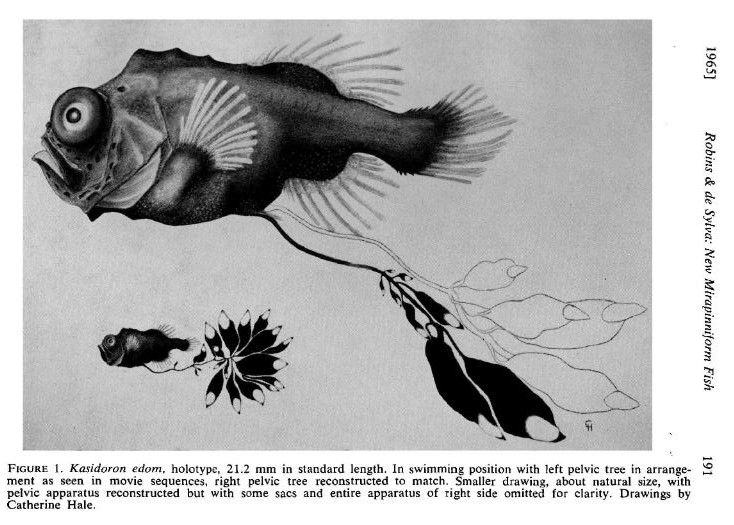
In 1965, a small but spectacular fish called Kasidoron edom was described in a Bulletin of Marine Science paper by C. Richard Robins and Donald P. de Sylva from the University of Miami's Institute of Marine Science (click here to access this paper). Sole member of a totally new genus and taxonomic family (until a second, similar species, K. latifrons, was recorded in 1969, from the western Indian Ocean), it became known as the siphonophore fish.

 
Drawings by Catherine Hale of the siphonophore fish, from the above-mentioned Bulletin of Marine Science paper by C. Richard Robins and Donald P. de Sylva (© Catherine Hale/C. Richard Robins/Donald P. de Sylva/Bulletin of Marine Science – reproduced here on a strictly non-commercial fair use basis for educational/review purposes only)

This was due to its astonishing pelvic fins. These were greatly modified, the third ray in each one having transformed into a long, multi-branched tree-like organ dubbed the pelvic tree, hanging underneath its body, terminating in a series of luminous(?), leaf-like sacs, and closely resembling the tentacular appendages of those superficially jellyfish-like composite creatures the siphonophores (exemplified by the famous Portuguese man-o'-war Physalia).

Known at that time only from waters of around 6-165 ft depth, about 150 miles east of Florida's Cape Canaveral and northeast of Bermuda, this 1.25-in-long velvet-black fish attracted appreciable interest, on account of its conjoined pelvic fins' unique, extraordinary structure. This was assumed to be a device for warding off predators, as they would be likely to mistake its harmless form for the deadly stinging tentacles of genuine siphonophores.

 
Two siphonophore fish photographs discovered by me recently here on the Quora website (No copyright/ownership details for them are given there, and despite considerable online searches I have been unable to locate any either, so I am including these photos on a strictly non-commercial Fair Use basis for educational/review purposes only)

After a time, however, the remainder of this fish's anatomy began to receive attention too, and researches ultimately disclosed that in spite of its distinctive appearance the siphonophore fish was not a new species at all.

On the contrary, it was unmasked as the hitherto-unknown juvenile form of an odd little species called the gibber fish (aka gibberfish) Gibberichthyes pumilus, which had been formally described and named in 1933. It had been discovered in the waters around Bermuda and the Bahamas.

 
Sketch of the gibber fish G. pumilus (Haplochromis/Wikipedia – public domain); click here to view a colour photograph of a gibber fish.

Previously known only from four specimens, this deepwater denizen attains a total length of 4.5 in, and inhabits the western North Atlantic, as well as the South Pacific waters close to the Samoan Islands. With a very large head, a deep, laterally flattened body, and perfectly normal fins lacking any vestige of its juvenile's astounding tentacle-impersonating pelvic tree, the gibber fish is placed within a taxonomic family of its own, most akin to the squirrelfishes and slimeheads.

Moreover, as the second siphonophore fish species, K. latifrons, has also been reclassified as a gibber fish, it is now known as G. latifrons.

 
The full set of unofficial Abkhazia postage stamps, which includes not only the siphonophore fish stamp (bottom left) but also a stamp depicting the hairy fish [see below for details] (top left) (public domain)

Interestingly, a very similar scenario of extreme metamorphosis from juvenile to adult was more recently revealed with another enigmatic, highly distinctive little fish that had long puzzled ichthyologists – the so-called hairy fish Mirapinna esau. You can read about its own very intriguing history here on ShukerNature, and also here in an early cryptozoology article of mine reproduced on ShukerNature.

This ShukerNature blog article is expanded from my book The Encyclopaedia of New and Rediscovered Animals.


Tuesday, 28 March 2023

MOUNT POPA’S ERSTWHILE MYSTERY DOG, AND AUSTRALIA’S STILL-UNEXPLAINED YOKYN – A COUPLE OF CURIOUS CANINE CRYPTIDS

 
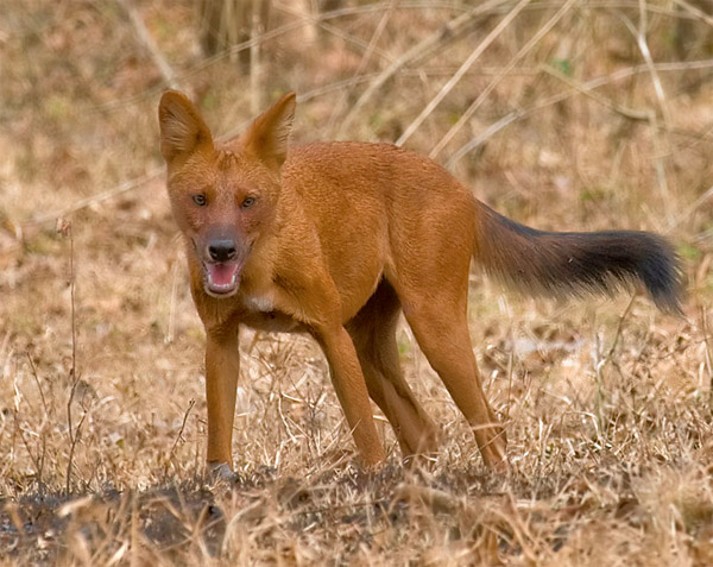
A Burmese dhole – this dhole subspecies was not scientifically described until 1941, when its existence was finally accepted (© Yathin S. Krishnappa/Wikipedia – CC BY-SA 3.0 licence)

Down through the decades, I have documented a wide range of canine cryptids, but two of the least-known examples are those presented here, making their ShukerNature debut. One is now a former mystery canid, the other remains an enigma.

A wild dog of once-controversial scientific status was a mysterious specimen discovered on Mount Popa, a dormant volcano in the region of Mandalay in central Burma (now Myanmar). Renowned British zoologist Reginald I. Pocock stated in 1936 that no specimens of Asia's very distinctive wild red dog or dhole Cuon alpinus had ever been obtained from Burma, but shortly afterwards he learnt that acclaimed mammalogist and animal collector Guy C. Shortridge had secured a specimen on Mount Popa.

Naturally, Pocock was anxious to examine this unique example, an adult female, especially as Shortridge alleged that it only had five pairs of teats (female dholes have 6-8 pairs), and weighed only 19 lb (unusually light for a dhole). However, after studying its skull, uncovered at the British Museum, Pocock recognized that it had been nothing more than an old, small domestic dog Canis familiaris, with a high crown and short muzzle. But, ironically, genuine Burmese dholes were obtained later, and in 1941 Pocock christened their subspecies C. a. adustus – a taxonomic classification still recognised today.

 
A dingo – the identity of Australia's elusive yokyn? (Katy Platt/Wikipedia – copyright-free)

As for the yokyn – this still-unexplained canine cryptid is a strange dog-like beast reputedly well-known to Australian aboriginals and farmers. Said to be approximately half the size of a full-grown dingo, with disproportionately long claws, a stocky, muscular  build, and a very variable pelage (sometimes brindled, sometimes even multi-coloured), a specimen has yet to be formally examined, so its identity remains uncertain (Fate, May 1977; also click here for additional details online).

An unknown species, an odd type of feral domestic dog, a dingo Canis dingo (aka C. lupus dingo aka C. familiaris dingo), a dog-dingo crossbreed, and even a surviving mainland race of the marsupial Tasmanian wolf Thylacinus cynocephalus are among those identities on offer. If anyone reading this ShukerNature article has further information concerning the yokyn, I'd love to receive details.

This ShukerNature article is excerpted and updated from my book Extraordinary Animals Revisited.