Dr KARL SHUKER

Zoologist, media consultant, and science writer, Dr Karl Shuker is also one of the best known cryptozoologists in the world. He is the author of such seminal works as Mystery Cats of the World (1989), The Lost Ark: New and Rediscovered Animals of the 20th Century (1993; greatly expanded in 2012 as The Encyclopaedia of New and Rediscovered Animals), Dragons: A Natural History (1995), In Search of Prehistoric Survivors (1995), The Unexplained (1996), From Flying Toads To Snakes With Wings (1997), Mysteries of Planet Earth (1999), The Hidden Powers of Animals (2001), The Beasts That Hide From Man (2003), Extraordinary Animals Revisited (2007), Dr Shuker's Casebook (2008), Karl Shuker's Alien Zoo: From the Pages of Fortean Times (2010), Cats of Magic, Mythology, and Mystery (2012), Mirabilis: A Carnival of Cryptozoology and Unnatural History (2013), Dragons in Zoology, Cryptozoology, and Culture (2013), The Menagerie of Marvels (2014), A Manifestation of Monsters (2015), Here's Nessie! (2016), and what is widely considered to be his cryptozoological magnum opus, Still In Search Of Prehistoric Survivors (2016) - plus, very excitingly, his four long-awaited, much-requested ShukerNature blog books (2019-2024).

Dr Karl Shuker's Official Website - http://www.karlshuker.com/index.htm

IMPORTANT: To view a complete, regularly-updated listing of my ShukerNature blog's articles (each one instantly clickable), please click HERE!

IMPORTANT: To view a complete, regularly-updated listing of my published books (each one instantly clickable), please click HERE!

IMPORTANT: To view a complete, regularly-updated listing of my Eclectarium blog's articles (each one instantly clickable), please click HERE!

IMPORTANT: To view a complete, regularly-updated listing of my Starsteeds blog's poetry and other lyrical writings (each one instantly clickable), please click HERE!

IMPORTANT: To view a complete, regularly-updated listing of my Shuker In MovieLand blog's articles (each one instantly clickable), please click HERE!

IMPORTANT: To view a complete, regularly-updated listing of my RebelBikerDude's AI Biker Art blog's thematic text & picture galleries (each one instantly clickable), please click HERE!

Search This Blog


PLEASE COME IN, I'VE BEEN EXPECTING YOU...

PLEASE COME IN, I'VE BEEN EXPECTING YOU...
WELCOME TO SHUKERNATURE - ENJOY YOUR VISIT - BEWARE OF THE RAPTOR!


Showing posts with label April Fool. Show all posts

Friday, 1 April 2011

A PERFECT DAY FOR THE OOZLUM BIRD, THE OOH-AAH BIRD, AND THE TASMANIAN MOCK WALRUS

The oozlum bird, in 'Carry On Up The Jungle' (Rank Films)

After much soul-searching, today seems a very appropriate time for me to divulge just how much – or, indeed, exactly how little – I know about three of my all-time favourite creatures of contention.


THE OOZLUM BIRD AND THE OOH-AAH BIRD

Reputedly related to the ostrich, but much smaller and renowned for its brilliantly-hued plumage, the oozlum bird has been unreliably reported from many regions of the world, including South America, Australia, and even the British Isles. Yet although its origin remains uncertain, there can be no room for doubt concerning its ultimate destination.

Just like its famous above-noted relative never does, the oozlum bird is very fond of burying its head when threatened – but not in the sand. This exceptionally shy species prefers a much more intimate hiding place for it. Similarly, it is much given to flying round and round in ever-decreasing circles until, eventually and inevitably, there is only that single, selfsame place left for it to go. And go there it does, head first, with astonishing abruptness and rapidity, until nothing of it remains at all – having quite literally vanished up itself. This very intriguing (if physically impossible) behaviour may help to explain why preserved specimens of the oozlum bird are just as elusive as living ones. Even photos and videos of it are conspicuous only by their absence.

This has led the more unimaginative and mean-spirited members of the ornithological community to suggest that perhaps this wonderful species is, at best, extinct; or, at worst, is wholly legendary, i.e. the oozlum bird does not actually exist. What nonsense! After all, you may as well say the same about the unicorn, centaur, sphinx, or mermaid!

Happily, after long and diligent research, I successfully uncovered a short clip of film testifying to the oozlum bird’s reality. It had been cleverly incorporated into that delightful British comedy movie ‘Carry On Up The Jungle’, no doubt in a bid to conceal it from sceptics and doubters, but I recognised it straight away. So I have included at the opening of this present ShukerNature blog post a still from that film, revealing the oozlum bird in all of its (all-too-) brief glory. In addition, I have been informed that this particular individual is clearly a male specimen, as its oozle is readily visible.

So if there is anyone out there who still harbours any suspicion as to the authenticity of this marvellous species, may I very respectfully suggest that they lose no time in imitating its most celebrated activity?

Incidentally, an equally scurrilous rumour concerns the oozlum bird’s remarkable cousin, the ooh-aah bird – named after the distinctive (and very loud) cry that it gives voice to while laying its unique (and very large) square eggs. However, I can assure you that any such claim is wicked, small-minded, and a complete fabrication – unlike the ooh-aah bird, which is of course neither wicked nor small-minded... :-)


THE TASMANIAN MOCK WALRUS

No less fascinating a creature of controversy is the Tasmanian mock walrus. It was first brought to attention in 1984, within an exclusive report by the Orlando Sentinel, a daily newspaper in Florida. According to the report, this extraordinary little creature resembled a bona fide walrus on account of its two very large, protruding tusks, but was only 4 in long, purred like a cat, and had the temperament of a hamster. Moreover, it never needed to be walked or bathed, could be readily trained to use a litter box, and its favourite food was cockroaches – which it ate with such rapacious delight and speed that a single mock walrus would very swiftly rid a house entirely of these verminous insects.

As it was evident that such a creature had the makings of an almost perfect pet, not to mention a highly efficient pest controller, during the early 1980s some mock walruses had allegedly been smuggled into the USA from various lakes in their native Tasmania, and efforts were now being made to breed them. However, this plan had encountered a serious obstacle – the vehement opposition of the American pest-control industry. This was because its cockroach-exterminator members feared for their jobs if the mock walrus became established here, and so were pressuring the US government to ban this species’ legal introduction. Undaunted by such attempts to thwart the mock walrus’s transformation into a popular new pet, however, dozens of readers soon inundated the Orlando Sentinel with calls, enquiring where they could obtain a specimen.

Yet despite such interest in them, no mock walruses were ever forthcoming. A clue to this very odd situation probably lay in the photograph of a mock walrus that was published within the Orlando Sentinel’s report (see photo below). For it showed a creature so similar in appearance to the African naked mole-rat Heterocephalus glaber that it could easily have been mistaken for one - though as the creature in the photo was indeed a naked mole-rat anyway, this wouldn’t have been very surprising.


A second, even more direct clue to the mock walrus’s surprising failure to materialise could be found simply by noting the day on which, in 1984, this report and photo had been published within the Orlando Sentinel newspaper – which, by an extraordinary coincidence, just so happened to be the same day as today... :-)

Friday, 2 April 2010

APRIL FOOL'S FAUNA


Lirpa loof (Philippa Foster)


What do you call a newly-found hairless mole-like creature from the Antarctic, with a heat-emitting bony plate on its brow for melting tunnels in the ice beneath unsuspecting penguins, which the creature can then seize and devour? A successful April Fool joke, that's what!

The story of the hot-headed naked ice borer, a 6-inch-long surprise recently revealed in the frozen southern continent, was featured in the April 1995 issue of the American science magazine Discover, and even included an impressive photo. Such a distinctive new species naturally attracted a lot of interest, and reports subsequently appeared in several other publications - until June 1995, that is, when Discover's editors triumphantly exposed the ice-borer as a spoof. In the true spirit of the event, however, the original Discover article had contained a quite obvious clue as to the ice-borer's real identity. The name of the wildlife biologist who had supposedly found it was given as Aprile Pazzo - Italian for 'April Fool'!

Even at the best of times, cryptozoology is perpetually on the lookout for frauds and hoaxes when assessing reports of mysterious animals. It must always be especially vigilant near the onset of the fourth month, however, because the unveiling of sensational new species is a perennially popular choice for an April Fool spoof. Some of them, moreover, have become classics in their field, like the following example.

In spring 1984, London Zoo received a wonderful new animal, which immediately became a popular star - and for good reason. How many animals can you think of that can perfectly mimic their human observers? Yet this remarkable creature, standing upright on its back legs, would wave when the crowd waved, and even clapped its front paws together when the crowd applauded. It resembled a shaggy bear, dark on top with a white chest, white toes, and a long white mandarin-like moustache that drooped down over its cheeks. According to the label on its enclosure, it was from an eastern Himalayan locality a few hundred miles north of Bangladesh, and the local people there called it a lir-pa loof. Zoologically, it was the only known member of a new mammalian family, and had been dubbed Eccevita mimicus.

The lir-pa loof generated an incredible amount of public interest. During the first week after its arrival, London Zoo received around 1000 telephone calls from people requesting further information about it, and the Natural History Museum and the BBC were similarly bombarded. When you're as famous as this, there is only one thing to do - make your television debut. And that is precisely what the lir-pa loof did - appearing with its keeper, George Callard, on the popular BBC show 'That's Life', hosted by Esther Rantzen.

By now, there were ample clues for exposing the secret of this creature (whose loose-fitting skin could so easily conceal a child or kneeling adult!). Spelled backwards, 'lir-pa loof' becomes 'april fool'. The date of its debut on 'That's Life' was April 1. And for the more classically-minded, the lir-pa loof's generic name, Eccevita, is Latin for 'That's life'.

Amazingly, however, there were still a surprising number of people who believed in the lir-pa loof's authenticity - until the very next 'That's Life' show. That featured the second (and final) appearance of this marvellous mammal and its keeper, singing "We apologise".

Animal April Fools come in many forms. Some are simple, slapstick fun, like Charlie the 'chickpanzee'. This genetically-engineered miracle combined the DNAs of a chicken and a tamarin monkey, and appeared in London's Daily Mirror newspaper on April 1 1991. More deceptive was George - a vicious crossbreed between a goldfish and a piranha but outwardly resembling true goldfishes. Photographed in the Daily Mail on April 1 1987, George appeared alongside his 12-year-old owner, Amanda Baker - nursing a bandaged finger. People who were not experienced fish fanciers probably didn't realise that piranhas and goldfish are far too distantly related to yield hybrid offspring, but the Daily Mail owned up on April 2 - enabling goldfish owners everywhere to breathe a sigh of relief again at feeding time.

On April 1 1989, London's Today newspaper included an amusing spoof concerning the arrival at London Zoo of a living sauropod-type dinosaur from Guinea - clearly inspired by real reports of the mokele-mbembe from the People's Republic of Congo. Also in 1989, the April 1 issue of Garden News featured a front-page special on the astounding germination of a prehistoric plant from fossilised dinosaur droppings. Aptly dubbed the dinosaur vine, it was being studied by Professor Adge Ufult - just say his name outloud!

Appropriately, however, the most famous cryptozoological April Fool involved the most famous cryptozoological creature - the Loch Ness monster. On April 1 1972, newspapers worldwide reported the astonishing discovery of a 9-ft-long seal-like beast, weighing over half a ton, that had been found dead at the side of the loch. Soon afterwards, police intercepted a van transporting the body south to Flamingo Zoo Park in Yorkshire.

When examined, it was found to be the carcase of a dead bull elephant seal, which had been deep-frozen for several days, giving it a peculiar greenish hue. Its whiskers had been shaved off too, and its cheeks had been stuffed with rocks.

On April 2, Flamingo Zoo Park's public relations officer, John Shields, confessed that it was an April Fool hoax, which he had secretly set up as a joke directed at the managing director of the company owning the zoo. Shields had used the body of an elephant seal that had died a week earlier at Dudley Zoo, owned by the same company.

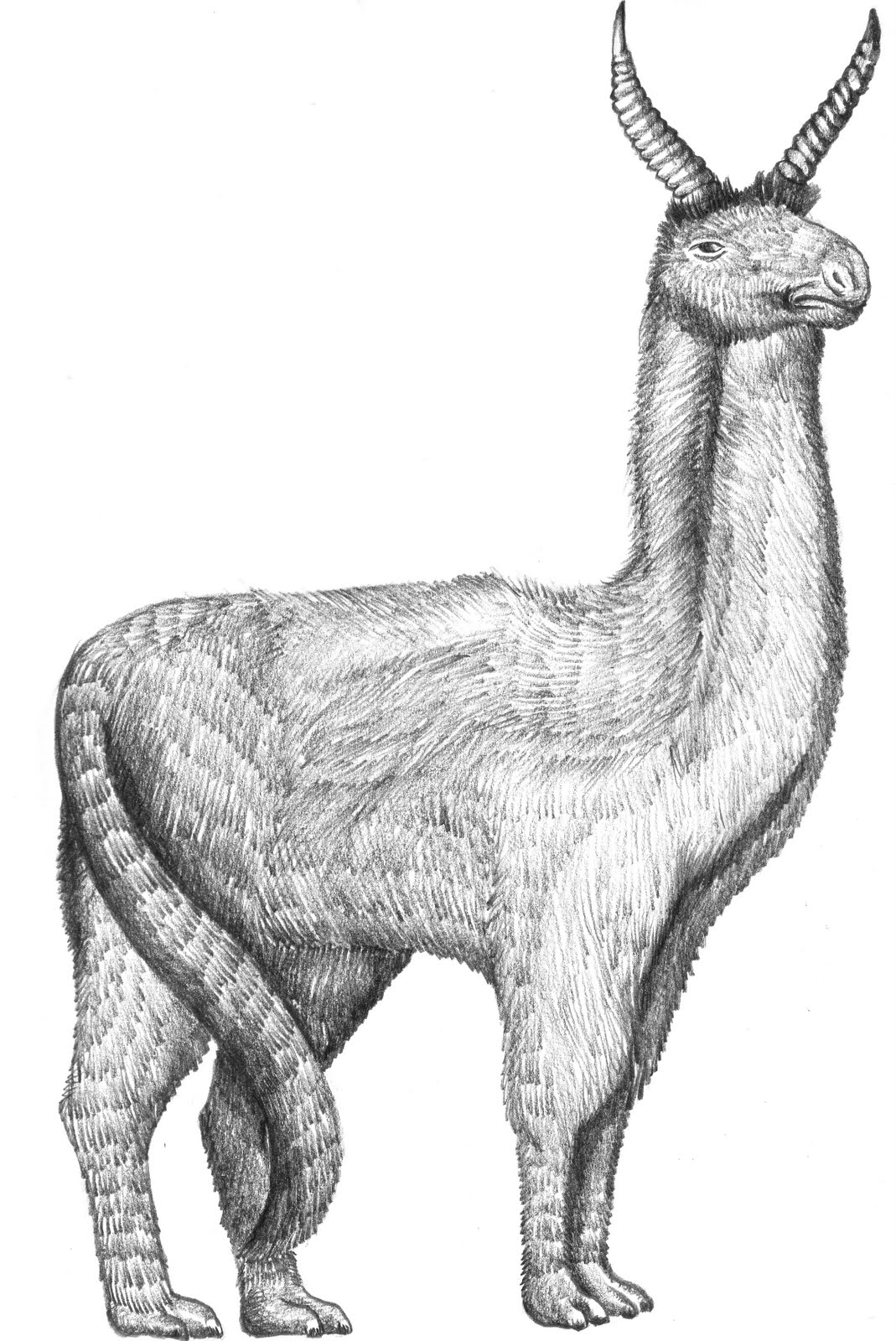
Lastly, a modern-day online classic. On 1 April 2008, the nowpublic.com website published a news report by Bill Adler announcing the escape from Washington DC's National Zoo of a particularly rare creature known as the loof lirpa. Its photo revealed it to be a llama-like beast but sporting a pair of long slender gazelle-like horns. Native to Patagonia, it is further distinguished by its distinctive odour, likened to cheap cologne, and although usually a mild-mannered species, this particular individual, an adult male, had been ready to mate when it escaped and so may well be feeling aggressive. Needless to say, however, there was no need to be alarmed - as long as you took the trouble to notice which phrase this exotic animal's name spelt out if read backwards!


Loof lirpa (Tim Morris)