Dr KARL SHUKER

Zoologist, media consultant, and science writer, Dr Karl Shuker is also one of the best known cryptozoologists in the world. He is the author of such seminal works as Mystery Cats of the World (1989), The Lost Ark: New and Rediscovered Animals of the 20th Century (1993; greatly expanded in 2012 as The Encyclopaedia of New and Rediscovered Animals), Dragons: A Natural History (1995), In Search of Prehistoric Survivors (1995), The Unexplained (1996), From Flying Toads To Snakes With Wings (1997), Mysteries of Planet Earth (1999), The Hidden Powers of Animals (2001), The Beasts That Hide From Man (2003), Extraordinary Animals Revisited (2007), Dr Shuker's Casebook (2008), Karl Shuker's Alien Zoo: From the Pages of Fortean Times (2010), Cats of Magic, Mythology, and Mystery (2012), Mirabilis: A Carnival of Cryptozoology and Unnatural History (2013), Dragons in Zoology, Cryptozoology, and Culture (2013), The Menagerie of Marvels (2014), A Manifestation of Monsters (2015), Here's Nessie! (2016), and what is widely considered to be his cryptozoological magnum opus, Still In Search Of Prehistoric Survivors (2016) - plus, very excitingly, his four long-awaited, much-requested ShukerNature blog books (2019-2024).

Dr Karl Shuker's Official Website - http://www.karlshuker.com/index.htm

IMPORTANT: To view a complete, regularly-updated listing of my ShukerNature blog's articles (each one instantly clickable), please click HERE!

IMPORTANT: To view a complete, regularly-updated listing of my published books (each one instantly clickable), please click HERE!

IMPORTANT: To view a complete, regularly-updated listing of my Eclectarium blog's articles (each one instantly clickable), please click HERE!

IMPORTANT: To view a complete, regularly-updated listing of my Starsteeds blog's poetry and other lyrical writings (each one instantly clickable), please click HERE!

IMPORTANT: To view a complete, regularly-updated listing of my Shuker In MovieLand blog's articles (each one instantly clickable), please click HERE!

IMPORTANT: To view a complete, regularly-updated listing of my RebelBikerDude's AI Biker Art blog's thematic text & picture galleries (each one instantly clickable), please click HERE!

Search This Blog


PLEASE COME IN, I'VE BEEN EXPECTING YOU...

PLEASE COME IN, I'VE BEEN EXPECTING YOU...
WELCOME TO SHUKERNATURE - ENJOY YOUR VISIT - BEWARE OF THE RAPTOR!


Showing posts with label curupira. Show all posts

Monday, 31 July 2017

A PICTURE OF MONKEY BUSINESS - OR, HOW A SMALL FURRY PET BECAME A GIANT MYSTERY APE. PART 2: THE TRUE HISTORY OF AMERANTHROPOIDES LOYSI


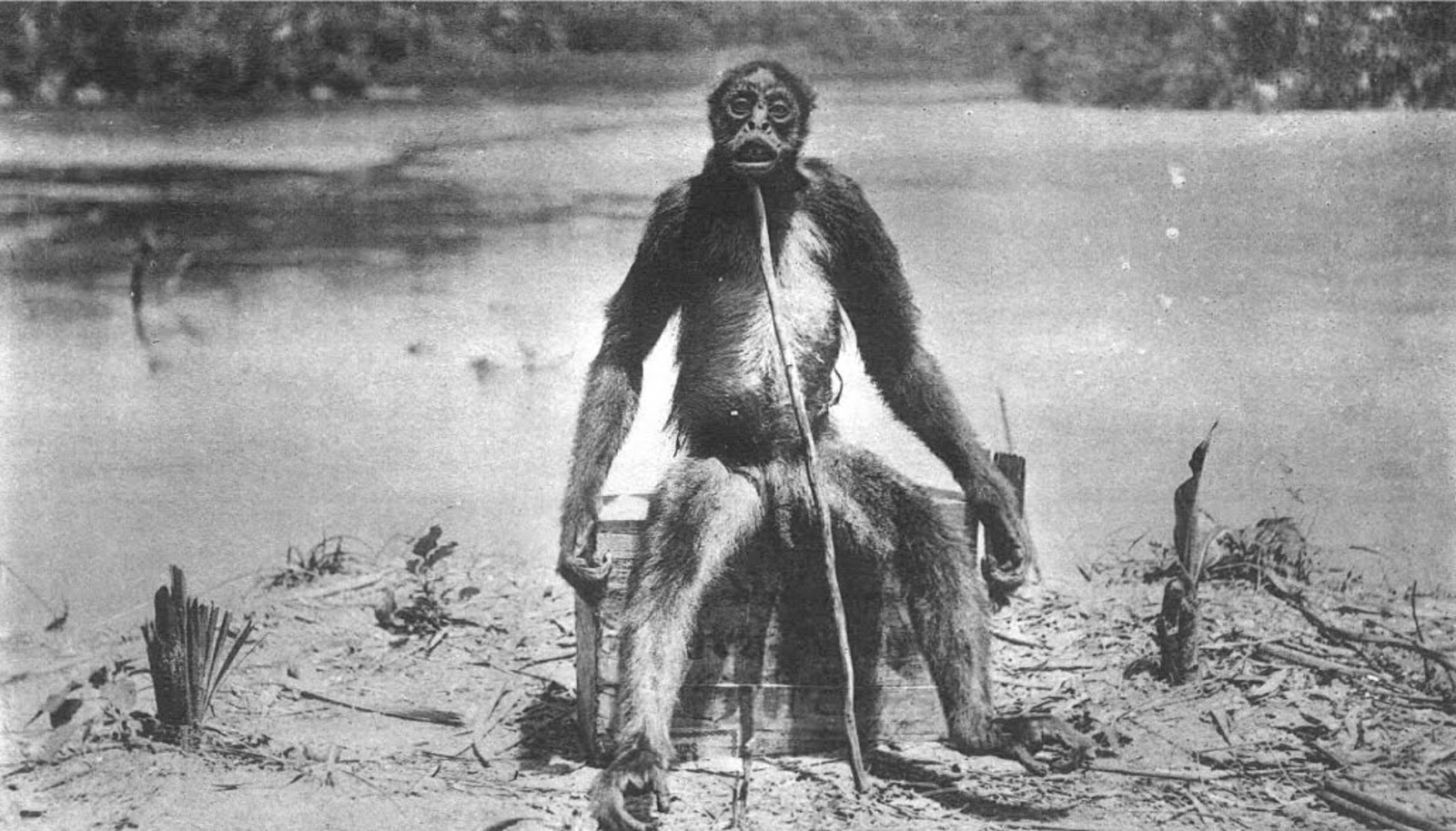
The uncropped version of Dr François de Loys's photograph of the supposed South American ape Ameranthropoides loysi – one of the most controversial cryptozoological images of all time (public domain)

Welcome to my 600th post on ShukerNature! Befitting of such a momentous occasion, the subject documented by me in this post is of profound cryptozoological significance – revealing how one of the most infamous mystery beast frauds of all time was finally exposed. In Part 1 (click here) of this two-part ShukerNature article, I documented the 'official' history of a truly extraordinary mystery creature - a supposedly genuine, tailless, bipedal South American ape, reputedly encountered and killed in the Venezuelan jungle almost exactly a century ago by a team of geologists led by one Dr François de Loys, and subsequently dubbed Ameranthropoides loysi ('Loys's American ape') by a radical French zoologist called Prof. George Montandon who held very extreme, controversial views concerning human evolution. Now it's time to document this creature's true history, by presenting the crucial yet all-too-long-overlooked information that conclusively exposed the entire Ameranthropoides episode as a blatant, deliberate hoax.

The 'official' history of Ameranthropoides loysi began to unravel on 16 July 1962. This was when the Caracas, Venezuela, newspaper El Universal's historian Guillermo José Schael published in the paper a telegram lately received from the village of Casigua, in the Tarra River region of Venezuela, concerning a supposed giant spider that had allegedly strangled to death a ranch worker named Juancho. Not surprisingly, this dramatic news attracted considerable interest from readers, and elicited a letter from a hunter named Jerónimo Martínez-Mendoza, which was published on 18 July by El Universal.

In it, Martínez-Mendoza suggested that the report was mistaken, that it had probably been a giant spider monkey which had attacked and killed Juancho, and he drew comparisons in his letter with the Ameranthropoides incident from 1917. This letter was in turn read by Dr Enrique Tejera Guevara (1899-1980), a Venezuelan-born friend of de Loys in the field (as well as a decorated tropical physician and pathologist, ambassador, and minister in the Venezuelan government), who lost no time in replying via a letter of his own, but which contained a truly sensational disclosure.

Enrique Tejera Guevara (Wikipedia CC BY 4.0 licence)

Published in El Universal on 19 July 1962, Dr Tejera's letter revealed that back on 11 March 1929 (mistakenly given as 1919 in the newspaper-published version of his letter) he had attended a lecture at the Academy of Sciences in Paris, France, given by Montandon concerning Ameranthropoides, but that he had been very surprised to hear Montandon's claims about the creature being a very tall, bipedal, tailless South American ape. Consequently, at the end of the lecture Tejera had stood up, and, to a hushed audience, had brusquely dismissed Montandon's claims as nonsense.

Tejera informed them that he had actually been in the company of de Loys in 1917 when the famous encounter with the two apes and the shooting of one of them had supposedly taken place – but affirmed that no such encounter or shooting had in fact occurred. Instead, the creature in the photograph was nothing more than de Loys's own normal-sized pet marimonda spider monkey, which he had dubbed 'the monkey-man', and whose tail had been amputated after it had become infected. Moreover, after his pet spider monkey had later died, and again in the presence of Tejera, de Loys had decided, as a joke, to take a photo of its body propped upright and sitting on a crate.

And as the climax of his dramatic exposé, Tejera proclaimed that it was this joke picture that had subsequently become known as the now-infamous Ameranthropoides 'ape' photograph, thanks to Montandon, and which with Frankensteinian vigour had swiftly raged out of its creator's control - until in order to preserve his reputation as a serious scientist, a highly embarrassed de Loys, seeing no way of extricating himself from this most unwelcome situation without looking very foolish indeed, had thereby found himself unable to confess the truth.

Banana trees (public domain)

But that was not all. Far from being in an area of wild, uncharted jungle in peril from attacks by Motilone Indians at the time when the photograph was taken as claimed by de Loys, he and his party were actually in an oil exploration camp very close to civilisation. Furthermore, there was vital, conclusive proof of this statement contained in the uncropped version of the Ameranthropoides photograph, yet which had been overlooked by everyone for decades, even after Tejera's earth-shattering announcement in front of a shocked and stunned Montandon back in 1929.

The proof was the presence in this picture of a banana crop on the opposite side of the river from where the dead spider monkey was propped up and photographed. Banana trees are of Asian and Australasian origin, they are not native to the New World, having been introduced there by humans, and they can only grow near civilisation, not in the wild jungle region of South America where de Loys had averred that the photograph had been snapped. So the presence of banana trees in that picture verified that it had been snapped in the former location, not in the latter one that de Loys had alleged. This in turn also negates a claim made by him that whilst supposedly in the remote jungle, no fewer than 17 of his men had died due to the inhospitable conditions and the hostile Motilone Indians (in reality, there is no independent confirmation of this). In addition, Tejera revealed that rather than de Loys having led a single 4-year expedition to the Tarra River region as so frequently claimed in subsequent accounts of the Ameranthropoides case, he had instead led several much shorter ones (Tejera even provided their respective specific dates), and rarely beyond the perimeter of civilisation, as demonstrated, for instance, by the presence of banana trees in the Ameranthropoides photo.

Having said that, the portion of the photograph showing these trees is sufficiently blurred for their conclusive identification to be somewhat tricky. Tejera was there when the photo was taken, so obviously he could clearly discern their true nature, but the evidence for them from the photo alone is less certain. Happily, however, there is one additional aspect of this image that vindicates his statement. In the lower right quadrant of the photo, alongside the monkey in the foreground, a leafy shoot is present that is identifiable as a chopped-down but now-regenerating banana tree (I have shown this to various friends who have kept banana trees, and they have all affirmed that this shoot is indeed one). I have arrowed it in the uncropped photo reproduced below.

De Loys's full, uncropped Ameranthropoides photograph with the banana tree shoot in the foreground arrowed (public domain)

In addition, an aspect that, very surprisingly, seems not to have been considered previously is that for a creature supposedly killed by a hail of bullets, it seems in the photograph to be remarkably free of bullet holes or wounds, especially as it was supposedly shot from the front, not from the back or side. This of course is readily explained by the fact that, thanks to Tejera, we now know that the creature wasn't an attacking ape that had been shot, it was merely a pet monkey that had died of natural causes.

Equally, as the photographed 'ape' specimen was merely a marimonda spider monkey after all, de Loys's allegation that its dentition was different from that of spider monkeys was clearly yet another falsehood. And no doubt his so-convenient explanation of why the skull had not been retained for formal scientific examination (he claimed that the camp cook had converted it into a salt container and that it had then fallen apart), which of course would have readily identified its true taxonomic nature and exposed his dentition claim as false, was also a blatant lie. Little wonder, then, why de Loys was not able to escape from the web of deceit that he had spun when carrying out his joke, and which had ultimately and inextricably enveloped him.

But that was still not everything. At least two years before penning to El Universal his devastating letter outing and condemning Montandon and the entire Ameranthropoides charade, Tejera had actually revealed all of this to fellow medical practitioner Dr Raymond Fiasson, who had documented it in his book Des Indiens et des Mouches: Dans les Llanos du Vénézuela (1960). Yet this too had escaped attention from cryptozoologists and zoologists alike. So also had a section included by American physical anthropologist Prof. Earnest A. Hooton in his book Man's Poor Relations (1942) – a significant but hitherto-overlooked snippet until French cryptozoologist Michel Raynal had rediscovered it in 2007 (during that same year, Michel had also been instrumental in bringing Fiasson's documentation to public notice). Prof. Hooton had revealed that in late 1932, American geologist A. James Durlacher had written to him announcing that in 1927 he had spoken to various former members of de Loys's expeditions and had learnt from them that Ameranthropoides had indeed merely been a marimonda spider monkey. Even more frustrating, in 2001 Spanish researchers Bernardo Urbani, Dr Ángel L. Viloria, and Franco Urbani had presented much of this key information in a paper published by the Venezuelan journal Anartia, Publicaciones Ocasionales del Museo de Biologia de La Universidad del Zulia, in which they had concluded that the Ameranthropoides saga was certainly a hoax – but yet again, this revelation had somehow evaded widespread attention! (It is even possible that Tejera's dramatic intervention at the end of Montandon's lecture back in 1929 was subsequently documented in some French newspaper(s) and/or periodical(s), but if so these too failed to attract any public notice and still await rediscovery.)

The revelatory book by Bernardo Urbani and Dr Ángel L. Viloria – Ameranthropoides loysi Montandon 1929: The History of a Primatological Fraud (© Bernardo Urbani and Dr Ángel L. Viloria/Editorial LibrosEnRed – reproduced here on a strictly educational, non-commercial Fair Use basis only)

Happily, however, their skilful detective work uncovering this hoax was at last given its long-deserved international attention when, in 2008, Bernardo Urbani and Dr Viloria published all of their findings in book form – Ameranthropoides loysi Montandon 1929: The History of a Primatological Fraud. The book's text was presented in two separate languages, English and Spanish, and was fully referenced, thus constituting the most comprehensive, and now-definitive, study and exposé of the whole sorry Ameranthropoides saga.

One final point to consider here, which I haven't seen mentioned before but which has intrigued me for some time, is whether de Loys was at least partly inspired when setting up his hoax photo by a very distinctive illustration that was still famous back then, although much less so today.

In 1758, eminent English naturalist and wildlife painter George Edwards wrote and illustrated Gleanings of Natural History, an authoritative tome that would remain a major work on that subject for well over a century. One of its illustrations was a hand-coloured copper engraving by Edwards of a young orang utan, among the first pictures ever prepared of this great ape, in which the orang utan was portrayed sitting upright on a wooden bench holding a long tall wooden stick in one hand. If this illustration is compared with the iconic Ameranthropoides photo, a number of striking similarities can be seen, including the orientation and/or form of the feet, limbs, facial expression, and even the stick (albeit utilised for different purposes).

Comparison of the Ameranthropoides loysi photograph with the George Edwards illustration of an orang utan (public domain)

Consequently, as Gleanings of Natural History was still well known during the early 20th Century, it is not beyond the realms of possibility that de Loys had seen Edwards's orang utan illustration in it and had elected to reconstruct it using the dead spider monkey, but for practical purposes had transformed the stick into a supporting prop in his photo.

Ameranthropoides loysi RIP...? Although this specific case was a fraud from beginning to end, it should be noted that mystery animal researchers are well aware that large ape-like creatures, walking bipedally and lacking tails, have been frequently reported by natives and Western explorers alike from many parts of Central and South America, where they are referred to locally and variously by such names as the sisimite (in Belize), xipe (Nicaragua), shiru (Colombia), vasitri (Venezuela), didi (Guyana), tarma (Peru), mono rey (Bolivia), caipora and curupira (Brazil), and others too. Detailed documentation of such sightings lies outside the scope of this present article, but one extremely noteworthy, representative encounter occurred as recently as 1987, so is deserving of inclusion here.

That was when New York Botanical Gardens mycologist Gary Samuels was crouching down on the forest floor in Guyana, investigating fungi. Looking up, he was very startled to see a 5-ft-tall hairy ape-man, walking by at close range on its hind legs but seemingly unaware of him as he stayed kneeling, concealed on the ground. This remarkable entity, which uttered an occasional "hoo" cry as it passed by him, was presumably a didi.

O Curupira, by Brazilian painter Manoel Santiago, produced in 1926 and depicting the mythical(?) red-haired man-beast of Brazil known as the curupira (Wikipedia CC BY 4.0 licence)

Explorer Simon Chapman's book, The Monster of the Madidi: Searching For the Giant Ape of the Bolivian Jungle (2001), documented his search in Bolivia's Madidi region for the mono rey. Although he failed to find it, his book does contain a couple of tantalising snippets that were new to me. One was his claim that until recently, a local Bolivian actually owned a pelt from a mono rey, which was then purchased by "a gringo" (European) who took it home and sent it (or samples from it) off for DNA analysis, but the results (if any) were never revealed. No details were given in his book as to who the "gringo" was, where he came from, or where he sent the pelt/samples. The other snippet, which Chapman had apparently attempted unsuccessfully to substantiate, was that a living mono rey had allegedly once been exhibited at Bolivia's Santa Cruz Zoo! (This zoo is known in full as the Santa Cruz de la Sierra Municipal Zoo to distinguish it from others.)

Also worthy of note here is the existence of centuries-old carvings and statues depicting large, tailless, ape-like beasts, found among the crumbling relics from long-gone civilisations in various South American (and also Mexican) localities. Just coincidence – or representations of genuine creatures? There is even an unequivocally ape-like mask preserved at Chicago's Field Museum of Natural History, which had been carved in stone by Costa Rica's Guetar Indians and dates from 1200 to 1500 AD.

At one time, a major zoological stumbling block to accepting the possibility that any such entities actually do exist today in Latin America was the absence of fossil precedents. That all changed in 1995, however, with the publication of a paper by American anthropologist Dr Walter Hartwig in the Journal of Human Evolution, which documented the remains of a very sizeable Pleistocene monkey discovered in the Lagoa Santa cave system of Minas Gerais in southeastern Brazil. In fact, this large-bodied species had originally been described as long ago as 1838, by Danish naturalist Peter Lund, who had named the extinct species Protopithecus brasiliensis. However, later publications concerning it had not examined the original fossils and had underestimated this species' actual size. In his paper, however, Hartwig rectified that error, and estimated that P. brasiliensis may well have been more than twice as massive as any living New World monkey.

Reconstruction of Cartelles coimbrafilhoi (© Hodari Nundu)

Just a year later, on 23 May 1996, Hartwig published a second Protopithecus paper, this time in Nature and co-authored with Brazilian palaeontologist Dr Castor Cartelle. In it, they described a near-complete skeleton, which had been found in 1992 within Pleistocene cave deposits in Brazil's 60-mile-long Toca da Boa Vista, the longest cave in the Southern Hemisphere, located in the Brazilian state of Bahia. Intriguingly, this skeleton combined a howler monkey-like vocal sac with a spider monkey-like cranium, and sported a robust body with limbs adapted for brachiation (arm-swinging locomotion), similar to both spider monkeys and woolly monkeys (and also Old World gibbons).

The giant species represented by it, which would have weighed around 50 lb (in comparison, a marimonda spider monkey weighs 13-23 lb), is now housed within the spider monkey subfamily, Atelinae. Moreover, after detailed studies it was considered sufficiently distinct from the earlier Protopithecus material to warrant its reclassification as a new species (and genus) in its own right, which in 2013 was formally christened Cartelles coimbrafilhoi in a Journal of Human Evolution paper written by Drs Lauren B. Halenar and Alfred L. Rosenberger.

Also found in that same cave and at the same time was a near-complete skeleton of another, hitherto-unknown, species of giant Pleistocene ateline monkey. In a Proceedings of the National Academy of Science, USA paper published on 25 June 1996, Cartelle and Hartwig duly christened this new species Caipora bambuiorum (after the caipora, a small, peccary-riding humanoid entity in Brazilian Tupi-Guarani mythology), which would have weighed around 45 lb in life. And in 2000, after co-leading a palaeontological expedition to Toca de Boa Vista, Hartwig announced that thousands of fossils, mostly from extinct mammals, had been unearthed there – including the skull of a 55-lb giant spider monkey, over twice the size of any species alive today.

Artistic representation of a caipora riding a peccary (© Jakared/Wikipedia CC BY-SA 3.0 licence)

So perhaps it is premature after all to dismiss entirely the prospect that the Neotropical (platyrrhine) primate lineage may indeed have evolved a larger, ape-like representative via convergent evolution, one that occupies some of the ecological niches filled in the Old World by the apes, and which still awaits formal zoological discovery and recognition.

A very exciting possibility if true, that's for sure!

Further information concerning the history of Ameranthropoides loysi (including evidence supporting the intriguing prospect that some additional photographs taken by de Loys of his spider monkey in Ameranthropoides pose may also exist - click here for my examination of this possibility on ShukerNature too) can be found in my book Extraordinary Animals Revisited. It also features on its front cover a colourised version of de Loys's notorious yet never-to-be-forgotten South American 'ape' photograph – truly a cryptozoological icon, albeit for all the wrong reasons.


Thursday, 4 August 2016

THE STOA, THE SUWA, AND THE WASHORIWE – A TRIO OF PREHISTORIC SURVIVORS FROM THE REAL 'LOST WORLD'?


Front and back cover from my much-read, greatly-treasured 1970s paperback edition of Sir Arthur Conan Doyle's classic crypto-novel The Lost World (Cover illustration © Pan Books – reproduced here on a strictly non-commercial Fair Use Policy only basis)

It is not widely known, but when writing his famous novel The Lost World (published in 1912), in which dinosaurs, pterosaurs, and other Mesozoic reptiles have survived into the present day amid a totally isolated realm present on the plateau at the summit of a very high tepui (a vertically-sided, flat-topped or table-topped mountain in South America), one of Sir Arthur Conan Doyle's inspirations was a real but still highly mysterious tepui known as Kurupira.

It was named after the curupira, a legendary Amazonian man-beast-like entity. This particular tepui stands 3,435 ft above sea level, and is situated on the Venezuelan-Brazilian border.

The curupira, as depicted in the painting 'O Curupira' by Manoel Santago, 1926 (public domain)

Conan Doyle had learnt about Kurupira from the famous, subsequently-lost explorer Lt-Col. Percy H. Fawcett. In 1908, he led an expedition to some great sandstone tepuis in Bolivia known as the Franco Ricardo hills .

There are more than 100 tepuis in South America, and at 9,220 ft above sea level Mount Roraima is the highest (and also the largest) in the Pakaraima chain on the borders of Brazil, Venezuela, and Guyana.

Sir Arthur Conan Doyle (left) and Lieut-Col. Percy H. Fawcett (right) (public domain)

Although they did not encounter any prehistoric creatures, Fawcett and his team did receive various native reports of frightening monsters said to inhabit Kurupira and its environs by the local Waiká Indians who inhabit the jungle area around the vicinity of its base. It was Fawcett's recollections of these reports that provided Conan Doyle with further plot ideas during his novel's preparation,.

In particular, he was enthralled by Fawcett's tales of an exceedingly voracious bipedal reptile known to the Waiká as the stoa, which was investigated more recently by Czech zoologist Jaroslav Mareš, who documented some of his findings in his cryptozoological encyclopaedia Svět Tajemných Zvířat ('The World of Mysterious Animals'), published in 1997. Mareš spent time residing at Kurupira's base during an expedition there in 1978 (sadly, their attempts to scale this tepui's steep sides proved unsuccessful), and he learnt about the Waiká Indians' belief in the stoa and other alleged monsters here.

My copy of Jaroslav Mareš's cryptozoological encyclopaedia Svět Tajemných Zvířat ('The World of Mysterious Animals') (© Jaroslav Mareš/Littera Bohemica)

They described the stoa as measuring up to 25 ft long and superficially resembling a giant-sized caiman (several species of these South American freshwater alligator relatives are known, but all are of far smaller size). However, they also stated that it can be readily distinguished from such reptiles by way of the following major differences.

First and foremost of these was the very notable fact that the stoa is exclusively bipedal, moving entirely upon its two gigantic hind legs, because its front limbs are so short that it cannot stand upon them. Its jaws are much shorter than a caiman's too, but its head is taller, and it bears a pair of prominent horns above its eyes, which are somewhat reminiscent of those sported by the South American horned frogs Ceratophrys spp.

Horned frog Ceratophrys ornata (public domain)

The Waiká likened its body colouration to theirs too (i.e. green or golden-brown with darker markings), but its mouth is not as wide as that of these famously wide-mouthed frogs, and its skin is covered with hard, non-overlapping, tubercular scales. Above all, they affirmed that there is never any hope of escape if pursued by a stoa.

Moreover, Mareš revealed that this Indian account was confirmed by the missionaries from the Porto da Maloca settlement on the upper Rio Mapulau, located approximately 15 miles from Kurupira as the crow flies. However, they did not believe that the stoa is real. For them, it is just a part of Waiká mythology.

Artistic rendition of the possible appearance in life of the stoa, alongside a human for scale purposes (© Connor Lachmanec)

Mareš has also written three books specifically devoted to Kurupira and its mysteries - Hledání Ztraceného Světa ('In Search of The Lost World'), which documented his 1978 expedition and was published in 1992; Hrůza Zvaná Kurupira ('The Horror Named Kurupira'), published in 2001; and Kurupira: Zlověstné Tajemství ('Kurupira: Sinister Secrets'), published in 2005. In the second of these three, Mareš mentioned meeting during spring 1997 at Boa Vista (capital of Roraima, Brazil's northernmost state) a Scottish gold-prospector whose real name Mareš has not publicly disclosed, referring to him instead only by the pseudonym 'Reginald Riggs'.

Mareš had previously met Riggs in 1978, during his above-mentioned expedition to Mount Kurupira. In his 2001 book, Mareš revealed that while Riggs was prospecting in the vicinity of Kurupira he had befriended a Waiká tribesman named Retewa, who supplied him with information concerning the stoa, another dinosaurian cryptid called the suwa, and a pterosaur-like beast termed the washoriwe.

Hrůza Zvaná Kurupira (2001) and Kurupira: Zlověstné Tajemství (2005) (© Jaroslav Mareš)

According to Retewa (via Riggs), the stoa's most common prey are tapirs. Apparently, it conceals itself in dense forest close to a riverbank where these large horse-related ungulates bathe, then abruptly emerges to attack them when they arrive there. It will also devour capybaras, those sizeable pig-like rodents that occur here too. One account related by Retewa to Riggs concerned a reputed confrontation between some hunters from his village and a stoa that they inadvertently encountered while it was looking out for prey. They shot at it with their arrows, but they failed to penetrate its hard, scale-protected skin, and the enraged stoa killed several of them before the others fled.

In an attempt to explain both the origin of the Waiká's firm belief in the stoa and (as he also discovered during his investigations) the complete absence of any such belief among Indian tribes living further out from Kurupira, Mareš has cautiously offered the following thought-provoking theory. He suggests that if the stoa is indeed real, perhaps its species is normally confined entirely to this tepui's lofty isolated plateau, but that a single individual may very occasionally find its way into their ground-level territory via a crack or fracture leading down the tepui from its summit to its base, after which the Waiká live in great fear of it, even after its eventual death, thereby maintaining and reinforcing its presence in their minds and lore for another generation or so until the next accidental stoa visitation occurs.

Restoration of the possible appearance in life of Carnotaurus (© Lida Xing and Yi Liu/Wikipedia CC BY 2.5 licence)

As for what the stoa may be, taxonomically speaking, if it does truly exist: in his cryptozoological encyclopaedia, Mareš noted that during the Cretaceous, South America was home to a taxonomic family of theropod dinosaurs known as the abelisaurids, which were bipedal, carnivorous, and, in some cases, extremely large. The most famous abelisaurid was Carnotaurus sastrei, which was up to 30 ft long, and as noted by Mareš it also happens to be potentially relevant to the stoa for two very different but equally intriguing morphology-based reasons. Firstly: dating from the late Cretaceous and disinterred in 1984 from the La Colonia Formation in Argentina's Chubut Province, its only recorded but exceptionally well-preserved fossilised skeleton shows that this particular abelisaurid species bore a pair of sharp pointed horns above its eyes, just like the stoa (Carnotaurus translates as 'flesh-eating bull'). Secondly: this skeleton is so well preserved that it reveals that the skin of Carnotaurus bore hard non-overlapping scales all over it, just like the stoa.

Coupled with the overall similarity in outward form and size between Carnotaurus and the stoa, these more specific, unexpectedly-matching features led Mareš to speculate as to whether this abelisaurid's lineage may have escaped the mass extinction at the end of the Cretaceous and has possibly lingered on through the Cenozoic Era into the present-day here in this very remote South American location, isolated atop a high tepui except for rare occasions when one might find its way down into the junglelands at Kurupira's base.

The still-classic (if scientifically-superseded) restoration of sauropods by Charles Knight, 1897 (public domain)

The stoa was not the only putative dinosaur of Kurupira spoken about by Retewa to Riggs. He also claimed that up on this tepui's plateau lives another very strange creature, known to the Waitá as the suwa, a picture of which he drew in the sand for Riggs to see, and a copy of which Riggs in turn drew in his diary, later seen by Mareš. The picture shows a bulky, long-necked, quadrupedal creature, which Riggs likened to a sauropod dinosaur or even a plesiosaur (however, its limbs were clearly portrayed in the drawing as legs, not flippers).

According to the Waiká, moreover, a third mystery creature, called by them the washoriwe, would sometimes swoop down from Kurupira's high summit into the jungle at its base, skimming through this Indian tribe's territory on huge wings that boasted a span of 20 ft or more. In addition, it bore a long bony backward-pointing crest upon its head, and sported a very long pointed beak.

Plateau on top of the tepui in The Lost World (1912) (public domain)

Waiká lore attests that this terrifying entity is the immortal forefather of all vampire bats. Yet whereas the immortal forefathers of all other creatures in their lore closely resemble their respective descendants (except for the much greater size of the forefathers), the long-beaked, bony-crested washoriwe bears scant resemblance to the short-faced, crestless vampire bats. Moreover, whereas these latter bats are strictly nocturnal, the washoriwe reputedly flies only during the daytime.

After highlighting these significant morphological and behavioural discrepancies in his cryptozoological encyclopaedia, Mareš pointed out how, in stark contrast, the washoriwe seemed to be very similar in form and lifestyle to certain pterosaurs. He also commented upon the curious coincidence of how frequently the finding of complete, perfectly-preserved fossil pterosaurs by palaeontologists had occurred in this same region in modern times.

Prof. Challenger vs the pterosaurs in The Lost World (© Richard Svensson)

Might the Waiká's belief in the washoriwe have been inspired, therefore, by their own possible finding of fossil pterosaur remains here from time to time? Or might it even be, as again pondered by Mareš, that the abundance of such remains in this region lends support to the possibility that a pterosaurian lineage has persisted here right into the present day, currently undiscovered by science but well known to the local Indians, who refer to these airborne prehistoric survivors as washoriwes?

When Mareš met Riggs in Boa Vista, Roraima (Brazil's northernmost state), during spring 1997, he learnt that, near a waterfall at Kurupira, Riggs had caught sight of a mysterious flying creature that Retewa had identified as a washoriwe. Moreover, in his cryptozoological encyclopaedia, Mareš stated that other gold-prospectors in this same area have also claimed to have seen such creatures here, flying high above the jungle's tree tops, and some have even sworn that they have been attacked by them.

Do pterosaurs swoop down to the ground from Kurupira's plateau? (© Dr Karl Shuker)

Yet amidst all of these claims of Mesozoic monsters alive and well and living in splendid isolation on Kurupira's lofty plateau, there is a key question desperately needing to be asked. For even if we actually accept that a stoa may very occasionally find its way down from this tepui's summit to its base, and that washoriwes might indeed sometimes wing their way down too, the very burly, quadupedal, sauropod-like form of the suwa unequivocally debars this cryptid from following suit – so how can the Waiká be aware of its existence? Interestingly, Riggs actually asked Retewa how his people could know what exists on the plateau at the top of Kurupira, but Retewa was unable to provide an answer. So perhaps – as surmised by the missionaries – all of their claims regarding monsters are truly based upon nothing more substantial than traditional Waiká mythology, with no foundation in reality.

Alternatively, could it be that at least in earlier days, some of the Waiká's bravest warriors actually scaled Kurupira's daunting height, explored its plateau, and then returned to their tribe back on the ground with stories (exaggerated or otherwise) of what they had seen there? And, if so, perhaps what they saw there was so terrifying that they have never returned, but the original eyewitness reports have been preserved in their tribal lore down through succeeding generations. Who can say?

Mini-poster for The Lost World, 1925 film (public domain)

I wish to take this opportunity to thank very sincerely my friend Miroslav 'Mirek' Fišmeister from the Czech Republic for so kindly translating into English for me all of the relevant passages regarding Kurupira and the stoa, suwa, and washoriwe from Mareš's books. This has enabled me to present here the most extensive, accurate coverage of these cryptids ever produced in English.

Previously, the only English-language reports concerning them that I had been aware of, all of them online, were sparse, confused, and sometimes entirely inaccurate. The principal reason for this inaccuracy stemmed from the fact that a prehistoric monster called the stoa actually appears in Conan Doyle's novel The Lost World, in which it is described as a warty-skinned, toad-like reptile, leaping on its hind legs, but larger than the largest elephant, and of frightful, horrible appearance.

The stoa as depicted in The Lost World film of 1925 (public domain)

This has inspired some erroneous online speculation, i.e. that there is no cryptozoological basis for the stoa, that it is entirely fictitious, a baseless invention of Conan Doyle for his novel. In reality, however, as I have now revealed here, it is the exact reverse that is true. Namely, that the stoa in his novel was directly inspired by reports of Kurupira's cryptozoological stoa as told to him by Fawcett.

Yet another longstanding example of online cryptozoological confusion is finally elucidated and resolved.

This ShukerNature blog article is exclusively adapted from my forthcoming book Still In Search Of Prehistoric Survivors.


Sunday, 6 July 2014

BIRD-HEADED FISH-MEN AND PIG-RIDING MAN-BEASTS - MORE PERPLEXING PORTRAYALS FROM THE CENTRAL AFRICAN REPUBLIC

A red river hog (aka bush pig), a species of wild pig habitually ridden through the Central African Republic's forests by dwarf hairy man-beasts…allegedly! (© Dr Karl Shuker)

In my previous ShukerNature blog article (click here), I documented a remarkable drawing by the late artist Jean Claude Thibault, a Frenchman resident for many years in the Central African Republic (CAR). It depicts what appears to be the mysterious emela-ntouka or 'killer of elephants' – a horned aquatic cryptid also reported elsewhere in Africa under such names as the chipekwe and irizima.

Thibault's emela-ntouka drawing (© Jean Claude Thibault)

Moreover, this was just one of four pictures depicting intriguing CAR entities that had been drawn by Thibault (sometime during the early 1990s or late 1980s), and which were shown to me in August 2012 by Anette Stichnoth. She was working at that time for the Dzanga-Sangha Protected Areas (APDS) – a region of especial conservation significance in the CAR (check out its website here). The drawings had lately been displayed in an art exhibition held by the APDS, not long after Thibault had died (about three years ago), and Anette was enquiring about the entities illustrated in them. A year later, she received some illuminating information concerning these entities from a CAR local who was very knowledgeable about his country's traditional lore and legends.

So now, with Anette's kind permission, this present ShukerNature blog article exclusively unveils Thibault's three other drawings online, accompanied by the information that she received concerning them, together with my own thoughts.

The mondjoli-mbembe - a bird-headed fish-man from the folklore of the Central African Republic (© Jean Claude Thibault)

Above is the first of these drawings. It depicts a truly bizarre entity known as the mondjoli-mbembe or, more simply, the fish-man. According to Anette's CAR informant, this bird-headed humanoid is a paranormal being that lives in marshes and swamps, feeding upon fishes, from which he obtains his mystical powers that enable him to vanish from one place and appear instantly somewhere else. Sometimes, moreover, he makes fishermen disappear who want to fish in the watery terrain that he inhabits. When he kills fishes, he leaves them in a heap, and if a fisherman should find that heap the mondjoli-mbembe has no objection to the man taking half of the fishes away. But he must not take all of them – otherwise the angry mondjoli-mbembe will follow him to his village and take his revenge, which is not a pleasant sight to behold!

Red river hogs, with one of them ridden by a pig genie (© Jean-Claude Thibault)

This second drawing by Thibault depicts a hairy bipedal humanoid entity of diminutive stature riding a species of central and western African wild pig known as the red river hog or bush pig Potamochoerus porcus (not to be confused with the closely-related and similarly-named but less visually-colourful bushpig P. larvatus of eastern and southern Africa). According to Anette's CAR informant, such entities as this individual are supernatural dwarf beings known as pig genii or pig ghosts, which act as pig-herds to the red river hogs, walking in front of them in the forest, and even riding on their backs. Moreover, should a hog refuse to allow one of these beings to ride it, the pig genie will punish it, and chase it away from the other hogs towards the traps set by human hunters.

The third Thibault drawing presented here also depicts pig genii, but this time they are about to take part alongside some humans in a ritual known as boyebe. Before human hunters set out on a foray, they supposedly perform boyebe, which consists of dancing around a fire with the pig genii, because the men believe that this will ensure that they achieve success in their hunting.

Human hunters and pig genii about to take part together in the pre-hunting ritual of boyebe (© Jean Claude Thibault)

There seems little doubt that the mondjoli-mbembe is entirely mythical, a grotesque, composite bird-man equipped with magical powers and confined exclusively to the CAR's corpus of traditional folklore. Conversely, the pig genii are very similar indeed in basic form to a number of dwarf hairy bipedal man-beasts of possible hominoid identity reported widely across tropical Africa. These include such cryptozoologically familiar forms as the agogwe of Tanzania and Mozambique, the fating 'ho of Senegal, the Congolese kakundakari, and the séhité of the Ivory Coast.

Les Bêtes Humaines d'Afrique (front cover illustration © Alika Lindbergh/Plon Publishing)

According to veteran cryptozoologist Dr Bernard Heuvelmans, who devoted a major section to them in his book Les Bêtes Humaines d'Afrique (1980), these primate cryptids could variously be surviving gracile australopithecines (early bipedal African hominids known to have existed from 3.9 million to 1.7 million years ago), proto-pygmies, and/or proto-bushmen. Other suggestions include chimpanzees Pan troglodytes that have become more bipedal than is typical for their species, or bonobos P. paniscus – which walk upright quite commonly anyway. Some of these entities are deemed by their superstitious human neighbours to be preternatural, but descriptions of them given by Western eyewitnesses suggest otherwise – that they are corporeal yet highly elusive, currently-unclassified hominoids, exactly as proposed by Heuvelmans.

The CAR pig genii may well fall into this category too, with their pig-riding, pig-herding proclivities and their fire-dancing, pre-hunting rituals alongside humans owing rather more to native imagination than to ethnological interaction. Interestingly, according to traditional lore in Brazil a short hairy man-beast inhabiting its jungles and called the curupira (click here to see a painting depicting it) is said to ride those wild pig-like ungulates known as peccaries and even small deer called brockets or mazamas. So such folklore motifs are clearly not confined to Africa.

If any ShukerNature reader has additional information concerning the CAR entities depicted in Thibault's drawings, I'd welcome any details that you could send me or post here – thanks very much!

Restoration of Australopithecus africanus, a species of gracile australopithecine that existed from around 3.03 million to 2.04 million years ago (© Nachosan/Wikipedia)