A colourised version of one of Sir
John Tenniel's famous original illustrations of the Mock Turtle with the
Gryphon and Alice, from Alice's Adventures In
Wonderland, 1865 (public domain)
Written by Lewis Carroll (the pen name of a
socially shy Oxford University mathematician called Charles Lutwidge Dodgson), and
originally published in 1865, one of my favourite childhood novels was Alice's
Adventures In Wonderland (or Alice In Wonderland, to call it by its
nowadays more commonly used shortened title). As is universally known, it was
based upon an impromptu story told by Carroll to family friend Dean Henry
Liddell's three young daughters one summer afternoon in July 1862 while he and
the Reverend Robinson Duckworth were taking them on a rowing-boat ride along
the Isis river (part of the Thames) not far from their home.

Photographed by Lewis Carroll in 1860, Alice Liddell as a 7-year-old child, the child
who would later inspire Alice's Adventures In Wonderland (public domain)
One of the children was Alice Liddell, aged 10 at
that time, whom Carroll made the heroine of the story after she'd asked him to
tell them one that featured her in it. At the end of their boat ride, Alice begged Carroll to write the story down for her so
that she would always have it, and so that same evening he duly began drafting
out what would become three years later one of the best-loved children's novels
of all time. Moreover, it would be followed in 1871 by an equally popular
Alice-starring sequel, Through the Looking-Glass and What Alice Found There
(which I actually liked even more than the first novel).

Lewis Carroll, photographed in 1863,
just two years before the publication of his now-immortal children's novel (public
domain)
Very fond of literary nonsense, witticisms,
riddles, puns, and other word play, Carroll included many such examples in both
of his Alice books. And as someone who read them countless
times as a child and has always derived comparable pleasure from verbal
drolleries, I greatly enjoyed spotting and making sense of them.

The first picture of the Mock Turtle
that I ever saw, from my much-loved Marjorie Torrey-illustrated Alice In
Wonderland book that my mother Mary Shuker bought for me when I was a very small
child (© Marjorie Torrey/Random House – included here on a strictly
non-commercial Fair Use basis only)
However, there was one example that not only
delighted me due to the fact that it concerned a seemingly fictitious creature
that I'd never heard of before (even as a child, mysterious monsters and
mythical beasts always fascinated me – clearly a cryptozoologist in the making!),
but also had long mystified me. This was because I felt quite sure that its
unusual name and even more unusual form embodied more significance than I had perceived
as a child, yet I couldn't decide just what that significance might be. Appearing
towards the end of the first Alice novel (or AAIW, for short, as used
hereafter in this article), in tandem with an example of that very famous
legendary beast the griffin (or gryphon, a more classical spelling, used by
Carroll in that book), the perplexing creature in question was referred to by
Carroll as a mock turtle.
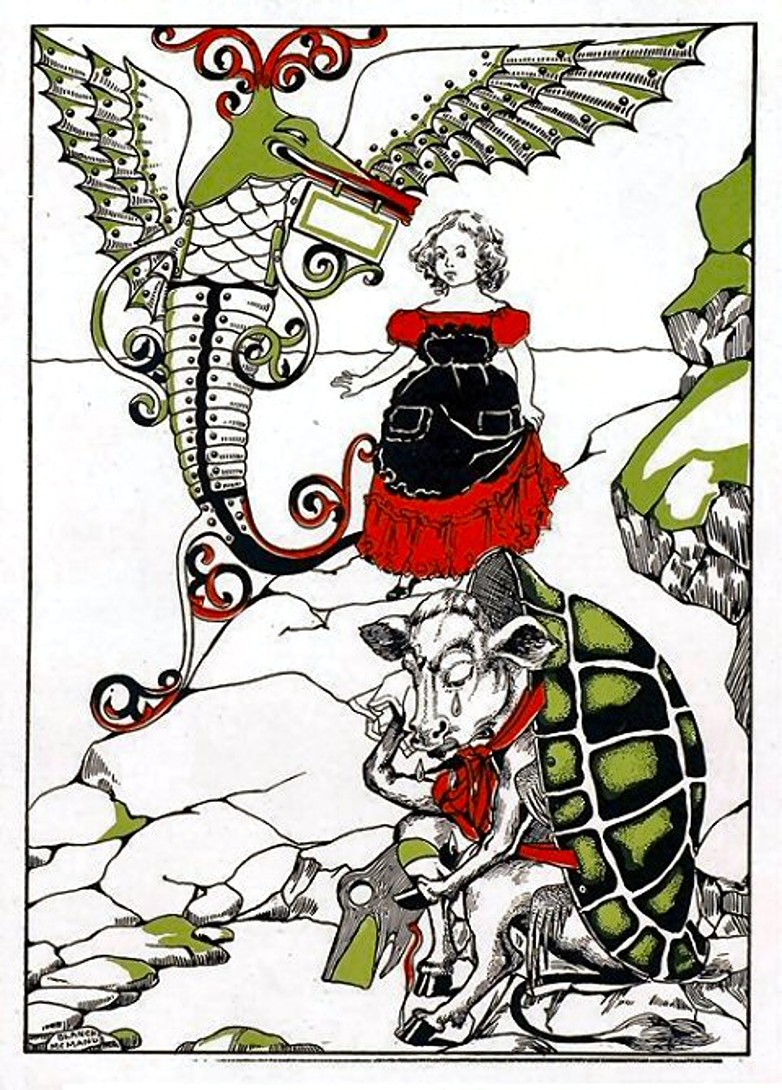
An exquisite Art Nouveau-inspired
portrayal of the Mock Turtle and Gryphon, by Blanche McManus, 1899 (public
domain)
In Carroll's account of the Gryphon and the Mock
Turtle that the Queen of Hearts had taken Alice to meet, nothing of note concerning the morphology
of either of them was included by him (devoting much of his coverage instead to
their reciting and performing the Lobster Quadrille, a most unusual dance).
Instead, all such details were imparted to the reader entirely by way of some
excellent line drawings prepared by the renowned illustrator Sir John Tenniel
working in strict accordance with Carroll's very exacting instructions. Carroll
had initially planned to illustrate the book himself, and did so in a
preliminary, then-unpublished, handwritten version entitled Alice's
Adventures Under Ground (AAUG), which he presented to Alice Liddell
on 26 November 1864.
However, he recognised that his artistry was not of a sufficiently high
standard for publication purposes, so he engaged Tenniel to prepare the
required artwork for the final, longer version that became AAIW. (This
was evidently a wise decision, judging at least from Carroll's bizarre
illustration of the Mock Turtle that appeared in AAUG, in which its head
resembled that of a seal, and its long, slender body looked as if it were
composed entirely of overlapping roof tiles!)

Lewis Carroll's decidedly odd-looking
drawing of the Mock Turtle, from Alice's Adventures Under Ground (public
domain)
In Tenniel's drawings, the Gryphon was depicted in
typical griffin form, as a composite of eagle and lion, deftly amalgamating the
beaked head, taloned forelimbs, and plumed wings of the former with the furry
body, clawed hind limbs, and long tuft-tipped tail of the latter. Conversely,
whereas the Mock Turtle also appeared to be a composite creature, it did not
resemble anything known to me from either fable or fact. Nor had I even heard
of a mock turtle before. Evidently, therefore, I reasoned, unless it were an
exceedingly obscure mythical beast it must have been one of Carroll's own
inventions, but what had inspired him to fashion it in the extraordinary form
that he had done, and where had its very distinctive, memorable name originated?
These were the two questions that puzzled me for so long (back in those now far-distant
days before the information super-highway of the internet had come into being!).

Sir John Tenniel's most famous
depiction of the Mock Turtle and Gryphon, 1865 (public domain)
For in Tenniel's illustrations, this remarkable
creature was portrayed with the familiar body shell and scaly front flippers of
a real turtle, but sported the big-eared head, hoofed hind legs, and long
tufted tail of a calf. In my youthful naivety, I simply assumed that the 'mock'
aspect of its name related to the fact that because of these bovine attributes it
wasn't a genuine turtle, with the latter attributes merely being humorous but
hardly meaningful creations by Carroll. I now know of course that had I been
alive during Victorian times when AAIW was written and published, I
would have been readily aware of the true derivation of this term and the
attendant significance of those attributes – especially as, albeit unrealised
by me back in my childhood, Carroll had actually provided the answer to one of
my afore-mentioned questions in his text:
Then the Queen left
off, quite out of breath, and said to Alice, "Have you seen
the Mock Turtle yet?"
"No," said Alice. "I don't even
know what a Mock Turtle is."
"It's the thing
Mock Turtle Soup is made from," said the Queen.
"I never saw one,
or heard of one," said Alice.
Neither had I, but nor had I ever heard of mock
turtle soup either, so I had assumed that this too was just another Carrollian invention.
Many years later, however, I finally stripped bare the mystery surrounding the 'mock'
moniker, and uncovered at last the truth behind this very tantalising turtle.

A colourised version of Tenniel's
second original illustration of the Mock Turtle and Gryphon with Alice, 1865 (public domain)
It turned out that mock turtle soup was actually a
bona fide dish, an English soup originally created during the mid-1700s but very
commonly served in Victorian times. It earned its name from the fact that it
was actually a cheap substitute for genuine turtle soup, which was a very
expensive delicacy that few could afford. Instead of containing turtle flesh as
its primary ingredient, mock turtle soup contained calf meat (veal), taken especially
from those parts of a calf that were otherwise usually discarded, i.e. the
head, hooves, and tail, and which therefore cost a lot less to produce than
real turtle soup.

Classic illustration by Arthur
Rackham of the Mock Turtle, Gryphon, and Alice, 1907 (public domain)
Suddenly, all became clear. His fondness for
humorous word games, puns, and other literary trickery had clearly inspired
Carroll to dream up a character that was then playfully put forward by him when
recounting his story as the (non-existent) creature from which was derived a certain
very common veal-containing dish from his time whose memorable name would be
familiar to his young listeners and thus make them laugh – namely, mock turtle
soup. That was why the Mock Turtle had a turtle's shell and front flippers but
a calf's head, hind limbs, and tail – with typically witty Carrollian
absurdity, it was the visual embodiment of what mock turtle soup pretended to
contain (turtle) and what it actually did contain (the calf elements listed
above).

In this illustration from 1916, the
Gryphon and a particularly tearful Mock Turtle perform the Lobster Quadrille for
a somewhat bemused Alice (public domain)
One further feature that was a major component of
the Mock Turtle was its extremely lugubrious, sobbing demeanour. When Alice asked the Gryphon why his chelonian companion was
so sorrowful, the Gryphon replied very dismissively that it was "all his
fancy", that he didn't actually have any sorrow. Yet because the Mock
Turtle briefly mentioned that he had once been a real turtle (but without
providing any clues as to why he no longer was), there has been much
speculation among Carrollian scholars as to whether this was the reason for his
tearful melancholia, coupled perhaps with what may have been a poverty-stricken
upbringing (when recounting his history to Alice, the Mock Turtle intimated
that he was poor when young, revealing that he couldn't afford to study any
extra subjects at school, only the regular ones).

The Mock Turtle is no less mournful
in this illustration either, by Gwynedd Hudson, 1922, but Alice looks distinctly perturbed by their terpsichorean exuberance! (public domain)
As a wildlife enthusiast from the earliest of ages,
however, it occurred to me a long time ago that a more likely origin for this
particular characteristic of the Mock Turtle was that real turtles, which are
all exclusively marine in the strict definition of the term 'turtle'
traditionally employed in British English, rid their bodies of excess salt (derived
from drinking seawater) by excreting it in the form of salty tear-like
exudation trickling from glands near to their eyes, so that they look very much
as if they are weeping profusely. Quite apart from being a mathematician and
storyteller, Carroll was also a keen amateur naturalist (and is known to have
made a particular study of those animals featuring in his Alice novels to ensure that his accounts of them were
accurate). Consequently, he was assuredly aware of this specific behavioural occurrence
in turtles, and had cleverly incorporated it with altered meaning into the Mock
Turtle's persona, transforming it from a practical osmoregulatory activity into
an entirely anthropomorphic emotional outpouring instead.

The Mock Turtle managed to be doleful
even when dancing, as seen here in this lantern slide image from the early
1900s (public domain)
More than 150 years have passed since the Mock
Turtle was introduced to the world in AAIW, and it has been depicted by
over 70 artists within the numerous illustrated editions that have been published
since the original one from 1865, containing Tenniel's drawings. It has also
appeared in a considerable number of films and TV adaptations, in which it has
been played by the likes of Cary Grant, Sir John Gielgud, Sir Michael Hordern,
Donald O'Connor, Gene Wilder, and Ringo Starr, as well as being voiced by Alan
Bennett in the 1985 film Dreamchild.

What is particularly interesting, however, is that
whereas earlier portrayals generally retained its appearance as originated by
Tenniel following Carroll's instructions to him, there have been various later
depictions that have strayed significantly from this. Moreover, the way in
which they have strayed seems to indicate that those responsible may not have
realised why this character's appearance was what it was in the original book,
thereby, albeit inadvertently, making a veritable mockery of the Mock Turtle.

The reason for my suspecting this to be the case is that the Mock Turtle has sometimes been depicted not as a half-turtle half-calf composite, but merely as a normal, ordinary turtle, i.e. with not just a turtle's body shell and front flippers but also a turtle's head, hind flippers, and tail – thereby entirely missing the etymological significance and origin of this Carrollian character. After all, if the Mock Turtle is presented as being exactly the same in appearance as a genuine turtle, how can the term 'mock' be justifiably applied to it? Equally, the crucial fact that it was specifically created by Carroll as the creature from which mock turtle soup is supposedly derived is wholly concealed visually if it is depicted simply as a totally normal-looking turtle. Consequently, I can only assume that those who have produced these latter images do not know about mock turtle soup. In a different but no less bizarre vein, I have also seen the Mock Turtle portrayed with the head, trotters, and curly tail of a pig, which if anything makes even less sense than depictions of it as a genuine turtle!

An illustration from 1907 by W.H. Walker featuring an accurately-depicted Mock Turtle but a very predatory-looking Gryphon in worryingly close proximity to Alice! (public domain)
The reason for my suspecting this to be the case is that the Mock Turtle has sometimes been depicted not as a half-turtle half-calf composite, but merely as a normal, ordinary turtle, i.e. with not just a turtle's body shell and front flippers but also a turtle's head, hind flippers, and tail – thereby entirely missing the etymological significance and origin of this Carrollian character. After all, if the Mock Turtle is presented as being exactly the same in appearance as a genuine turtle, how can the term 'mock' be justifiably applied to it? Equally, the crucial fact that it was specifically created by Carroll as the creature from which mock turtle soup is supposedly derived is wholly concealed visually if it is depicted simply as a totally normal-looking turtle. Consequently, I can only assume that those who have produced these latter images do not know about mock turtle soup. In a different but no less bizarre vein, I have also seen the Mock Turtle portrayed with the head, trotters, and curly tail of a pig, which if anything makes even less sense than depictions of it as a genuine turtle!

An unusual but thoroughly charming
illustration from 1926 by A.L. Bowley, in which not only Alice but also apparently
both the Mock Turtle and the Gryphon are depicted as youngsters (public domain)
Today, the Mock Turtle's fame stretches far beyond
the confines of Carroll's beloved novel, appearing in a number of works by
other authors inspired by Wonderland and its many strange but memorable
inhabitants. As noted earlier, it features in many movie and TV dramatisations
of AAIW too, as well as in various songs, and it has even lent its name
to a popular Indie rock band, The Mock Turtles, hailing from Greater Manchester,
England.

Still more dancing, but no sign of Alice in this illustration from 1928 –
perhaps she'd become bored of it all by now and went home! (© Copyright holder
and original source of this illustration presently unknown to me – reproduced here
on a strictly non-commercial Fair Use basis only)
Nevertheless, at least for me there is one major
disappointment associated with this memorable character – that it didn’t appear
in Walt Disney's very colourful, classic animated film, Alice in Wonderland,
first released in 1951. Very recently, however, I was most interested to
discover that in fact, along with the Gryphon, the Mock Turtle had indeed been
due to feature in it. In fact, cartoon versions of their characters had been
produced, and were scheduled to appear in one scene, with the Mock Turtle even
singing two specially-penned songs ('Beautiful Soup', sung to the tune of 'The
Blue Danube', and 'Will You Join The Dance?', based upon the 'Lobster
Quadrille' poem recited by this character in the novel'). Just before the film's
completion, however, their scene and songs were axed. Happily, though, all was
not entirely lost, because later on in the 1950s Disney produced an animated
Wonderland-based commercial for Jell-O gelatin desserts in which the Mock
Turtle and Gryphon did feature, together with Alice.

A very beautiful, colourful rendition
of the Mock Turtle, Alice, and a fiery-plumed Gryphon by Harry
Rountree, 1928 (© Harry Rountree, reproduced here on a strictly non-commercial
Fair Use basis only)
Even so, failing to make the final cut in one of
Disney's most delightful animated films would be enough, surely, to make anyone
cry, let alone someone as famously weepy as the mournful Mock Turtle!

The Nursery "Alice" – a special edition of AAIW
for very young children, simplified by Lewis Carroll and illustrated by Sir
John Tenniel; it was published in 1890 and included both the Mock Turtle and the
Gryphon on its front cover, prepared by one of Carroll's friends, E. Gertrude Thomson (public domain)
To read a previous ShukerNature blog article
concerning another of my favourite AAIW animal characters, the iconic and
decidedly idiosyncratic Cheshire Cat, please click here.

One of my all-time favourite AAIW-inspired
artworks, an absolutely spectacular and very original futuristic/fantasy take
on the Mock Turtle, Gryphon, and Alice, by the world-renowned fantasy artist
Rodney Matthews (© Rodney Matthews, included here on a strictly non-commercial
Fair Use basis only)


 Posts
Posts