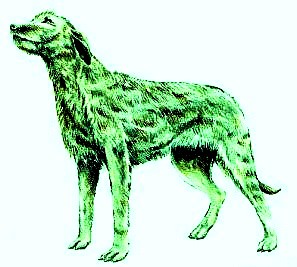
A fairy hound, one of the Cwn Annwn - the hounds of Annwn, the Celtic
Otherworld (© Simon Wyatt)
Characterised
by their sable-hued pelage, blazing red eyes, spectral nature, and their
traditional association with disaster and death, the zooform phenomena known as Black Dogs have been
extensively documented. Equally mysterious, but far less familiar, are their
pallid counterparts, the White Dogs and fairy hounds. Nevertheless, these
canine phantoms are by no means rare.
One of
Great Britain's most famous White Dogs is Gally-trot, reported in the North
Country and Suffolk, which resembles a bullock-sized dog with a white shaggy
coat. Gally-trot earns its name from its tendency to chase after anyone who
runs away from it, and from its fearsome demeanour ('Gally' translates as 'to
frighten'). What may be the same apparition has also been recorded specifically
from a marshy pool near Burgh, in Suffolk, called Bath Slough.
During the
years leading up to World War II, a White Dog was often seen racing across the
road linking the Norfolk villages of Great and Little Snoring, and on one
occasion an unsuspecting motorist drove directly through it! Equally intangible
is the white hound of Cator Common, Dartmoor, which, in one particularly
memorable modern-day instance, abruptly disappeared in full view of a lady who
had stretched out her hand to stroke it.

A pack of White Dogs
Even more
extraordinary, as brought to my notice by cryptozoologist Jan Williams, is the White
Dog reported from Leek Brook in Staffordshire. Just like its Black Dog
equivalent, East Anglia's Old Shuck, this particular White Dog has no head!
Another Black Dog trait mirrored by certain White Dogs is their association
with chains - as demonstrated by the white hound of Bunbury, Cheshire, which is
normally observed dragging a length of chain behind it.
A few Black
Dogs have actually materialised inside churches, and there is at least one White
Dog on file with a similar claim to fame. Resembling a ghostly white hound,
this preternatural beast reputedly appears inside the church at Pluckley, Kent
- not too surprising a locality, perhaps, as Pluckley is popularly deemed 'the
most haunted village in England'.
Mystery
beast investigator Neil Arnold has publicised a fascinating but hitherto
little-known, present-day sighting of a White Dog. One evening during the early
1950s, a soldier based at an army camp inside Richmond Park was returning to
the camp after visiting London when he noticed that the park's deer seemed
unusually disturbed. Suddenly, several deer raced by him in a state of great
panic, and when he looked behind them he was amazed to see a huge, pure-white
hound, of hideous appearance with immense teeth, chasing after them. However,
it was no normal, corporeal dog. Instead of running across the ground, this
uncanny entity was racing through the air, at a height of about 1 ft above the ground!

The Richmond Park White Dog (© C. Martin)
Although
most reports of White Dogs emanate from Great Britain, there are varied
traditions elsewhere too. For instance: Lamper, the Hebridean death dog, is
white, and runs round in circles to warn of an impending death. Werewolf lore
has it that the loup-garou (French werewolf) can assume the guise of a White
Dog. And in Romania, gypsies claim that many cemeteries here are occupied by
white spirit wolves, which guard the living by discovering and destroying any
vampires that may arise within these graveyards.
In his
book Animal Ghosts (1913), veteran
ghost investigator Elliott O'Donnell recalled how an acquaintance called
Rappaport had encountered a pack of spectral hounds one winter's night on the
slope of Russia's Ural Mountains. Headed towards a lake, Rappaport had been
riding aboard a horse-drawn coach when a fierce pack of wolves had begun
pursuing it. Despite his success in shooting some of them, however, Rappaport
and the coach driver, Ivan, feared that they would soon be overwhelmed by the
savage, snarling horde. Then, without any warning, the air was filled with a
loud baying sound. Racing towards their coach was another canine pack. However,
this one was composed not of wolves but of enormous white hounds. At the sight
of these weird beasts, the wolves turned tail and fled:
"On came the hounds - more beautiful dogs I had
never seen; as they swept by, more than one brushed against my knees, though I
could feel nothing save intense cold. When they were about twenty yards ahead
of us, they slowed down, and maintained that distance in front of us till we
arrived on the shores of the lake. There they halted, and throwing back their
heads, bayed as if in farewell, and suddenly vanished. We knew then that they
were no earthly hounds, but spirit ones, sent by a merciful Providence to save
us from a cruel death."
Lancashire's
gabriel hounds are phantom dogs that race through the air, rather like the
Richmond Park beast, and are sometimes said to be luminous white in colour, but
are readily distinguished from 'normal' canine spectres (white or otherwise) by
having human heads.

A fire-breathing White Dog (Johannes Gehrts)
Another
pack of ghostly White Dogs has been reported near Wellington in Somerset, whose
open-mouthed members allegedly emit flame from between their jaws as they race
along. This case has been investigated by renowned British folklorist Ruth L.
Tongue, who has linked it to the longstanding British tradition of fairy
hounds.
Also known
as hounds of the hill, fairy hounds are said to be the hunting dogs of the
Little People, who dwell in hollow hills. And according to Welsh mythology, a
pack of these ethereal creatures, known as the Cwn Annwn, was also owned by Arawn, King of Annwn - the Celtic
Otherworld. Resembling large white hounds with long slim legs, they are
characterised by their ruby-red ears and eyes.

Celtic fairy hounds - the Cwn Annwn (© Roger Garland)
Researching
Somerset fairy hounds, Ruth Tongue noted a modern sighting near Priddy. The
eyewitness was a man who had seen two huge dogs, taller than Irish wolfhounds
but with a rough white coat and red ears, walking by him, on the other side of
the road, making no noise. According to local lore, he had been very lucky,
because if they had walked by him on the same side of the road, or had uttered
any sound, he would have surely died.
In her
book Forgotten Folk-Tales of the English
Counties (1970), Tongue included a story recalled in 1917 by a Mrs Foden of
Long Mynd, and also known in Cheshire, with a similar variant in Irish folklore. It concerns a labourer's young assistant
who was going home from work late one night when he saw a huge dog, larger than
a calf, with a rough white coat and red ears, lying in some bushes. Thinking at
first that it was a foot-sore foxhound, he collected some soothing dock leaves
to wrap around its feet. After collecting them and calling the dog to him,
however, he realised that it was "...one of the fairy hounds from the hill
who bring death or ill-luck".
Although
badly frightened, the boy boldly bandaged the animal's paws, then wished it
good night before continuing his journey home. Nothing untoward happened to
him, but one dark evening in November he was going back home along that same
road when a huge demonic goat-like beast confronted him, with glowing green
eyes. Transfixed with fear, the boy was certain that he would be killed - when
suddenly a huge White Dog with red ears appeared from nowhere and ferociously
attacked the goat-beast, enabling the boy to escape. Click here for my own detailed retelling of this
folktale in an earlier ShukerNature post.

A porcelain fairy hound (© Dr Karl Shuker)
Of course,
such tales as this could be dismissed as nothing more than charming but wholly
fictitious folklore...except for the fact that such animals are still being
reported today. Each year at sunrise on Midsummer Day, a ghostly priest
reputedly enters West Kennet Long Barrow, a Neolithic tomb overlooking Silbury
Hill in Wiltshire, and is followed by a spectral White Dog with red ears. A
similar beast with fiery eyes is said to appear each evening at midnight in a
Neolithic burial chamber called the Devil's Den, at Fyfield, also in Wiltshire.
Old
traditions die hard, and those featuring White Dogs and fairy hounds are no
exception.

A White Dog




 Posts
Posts