Zoologist, media consultant, and science writer, Dr Karl Shuker is also one of the best known cryptozoologists in the world. He is the author of such seminal works as Mystery Cats of the World (1989), The Lost Ark: New and Rediscovered Animals of the 20th Century (1993; greatly expanded in 2012 as The Encyclopaedia of New and Rediscovered Animals), Dragons: A Natural History (1995), In Search of Prehistoric Survivors (1995), The Unexplained (1996), From Flying Toads To Snakes With Wings (1997), Mysteries of Planet Earth (1999), The Hidden Powers of Animals (2001), The Beasts That Hide From Man (2003), Extraordinary Animals Revisited (2007), Dr Shuker's Casebook (2008), Karl Shuker's Alien Zoo: From the Pages of Fortean Times (2010), Cats of Magic, Mythology, and Mystery (2012), Mirabilis: A Carnival of Cryptozoology and Unnatural History (2013), Dragons in Zoology, Cryptozoology, and Culture (2013), The Menagerie of Marvels (2014), A Manifestation of Monsters (2015), Here's Nessie! (2016), and what is widely considered to be his cryptozoological magnum opus, Still In Search Of Prehistoric Survivors (2016) - plus, very excitingly, his four long-awaited, much-requested ShukerNature blog books (2019-2024).
IMPORTANT:To view a complete, regularly-updated listing of my ShukerNature blog's articles (each one instantly clickable), please clickHERE!
IMPORTANT:To view a complete, regularly-updated listing of my published books (each one instantly clickable), please clickHERE!
IMPORTANT:To view a complete, regularly-updated listing of my Eclectarium blog's articles (each one instantly clickable), please clickHERE!
IMPORTANT:To view a complete, regularly-updated listing of my Starsteeds blog's poetry and other lyrical writings (each one instantly clickable), please clickHERE!
IMPORTANT:To view a complete, regularly-updated listing of my Shuker In MovieLand blog's articles (each one instantly clickable), please clickHERE!
IMPORTANT:To view a complete, regularly-updated listing of my RebelBikerDude's AI Biker Art blog's thematic text & picture galleries (each one instantly clickable), please clickHERE!
Search This Blog
PLEASE COME IN, I'VE BEEN EXPECTING YOU...
WELCOME TO SHUKERNATURE - ENJOY YOUR VISIT - BEWARE OF THE RAPTOR!
Showing posts with label A Manifestation of Monsters. Show all posts
Showing posts with label A Manifestation of Monsters. Show all posts
Today is the 14th anniversary
of my ShukerNature blog's official launch (20 January 2009), so now, almost 800
ShukerNature articles later, here is my latest one, to mark this auspicious occasion,
and inspired by a fascinating news report that I read just a few hours ago.
The news report in question (which can be
accessed directly here)
reveals the recent discovery and capture in Queensland, Australia, of a truly
gigantic specimen of cane toad Bufo marinus
(=Rhinella marina). Weighing a
colossal 2.7 kg/6 lb (six times that of normal specimens), and dubbed Toadzilla, it
may be the biggest toad of any kind ever officially recorded (but keep my use
of the word 'officially' in mind, for reasons to be revealed here shortly).
Native to South America and recognized to
be the world's largest toad species, the cane toad was introduced into
Australia during the 1930s in a bid to control sugar cane-devouring beetles
here. Alarmingly, however, it ultimately proved itself as serious an ecological
blight as its intended prey. This is due not only to its skin being toxic but also to various toxin-secreting glands on its back and especially to the pair of very sizeable parotoid glands
sited on its warty skin's shoulders, which secrete a potent cardiac toxin called bufotoxin - this highly deleterious suite of secretions collectively causing
anything attempting to eat one of these toads to die a swift and usually
certain death, including Australia's various native (and mostly endangered)
marsupial carnivores, and even creatures as large as goannas (monitor lizards).
To make matters worse, this toad also actively preys upon the smaller marsupial
carnivore species, such as the shrew-like marsupial mice.
Moreover, because of its very effective deterrent
against potential attackers, the cane toad has no predators here, causing its
numbers to swell out of all proportion and thereby posing an increasingly
severe threat to this island continent's unique indigenous fauna.
Having said that, in recent times one native
Australian species, the black-necked ibis Threskiornis
molucca, has seemingly conceived a remarkable means of side-stepping the cane
toad's hitherto unassailable defence mechanism – these ibises have been seen throwing
toads in the air, which distresses them, thus inducing them to release their skin glands' toxic secretions, after which the ibises wipe the toads on wet grass or rinse
them in a water source, washing off the poison from the toads' skin, and then
repeat the entire process, until the toads' glands and skin are eventually
drained of toxin, after which the ibises swallow the toads whole, with no resulting
ill effects.
Certain other canny avians, such as crows
and hawks, have learned to flip the toads onto their back and then devour their
internal organs, leaving their lethal shoulder and back glands untouched. Who said that
birds are bird-brained?! More information on toad-tackling birds here.
Anyway, as noted above, the cane toad is
officially the world's largest species of toad. Unofficially, however, there
may be reason to question this assumption, judging at least from certain
intriguing reports contained in the cryptozoological archives.
The native Indian peoples inhabiting
various tropical valleys in the Chilean and Peruvian Andes frequently report
the existence there of a greatly-feared, giant form of toad called the sapo de
loma ('toad of the hills'). It is said to be deadly poisonous and capable of
preying upon creatures as large as medium-sized birds and rodents.
Science has yet to examine a sapo de
loma, but as I have pointed out in my book The Encyclopaedia of New and Rediscovered Animals
(2012) and its two predecessors (The New Zoo, 2002, and The Lost Ark,
1993), there is a major precedent for discovering batrachian behemoths in South
America. Rolf Blomberg (1912-1996) was a Swedish explorer, photographer, and
writer, and in 1950 he was instrumental in bringing to scientific attention a
hitherto-undescribed species of giant toad native to southwestern Colombia. He
achieved this significant feat by capturing a huge specimen there that he
brought back with him to his home in neighbouring Ecuador, and which became the
type specimen of this spectacular new species – duly dubbed Bufo blombergi in
his honour a year later. Blomberg's giant toad (aka the Colombian giant toad) can
attain a total snout-to-vent length of up to 10 in, which is greater even than
that of the heavier, more massively-built cane toad.
Incidentally, German cryptozoological
correspondent Markus Bühler has informed me that while browsing through a
series of yearbooks from the 1970s for Stuttgart's Wilhelma Zoo, he noticed
that the 1971 volume mentioned the chance birth at the zoo some years earlier
of hybrids between a female B. blombergi and a male B. marinus.
They were apparently indistinguishable from the paternal species, but exhibited
unusually strong growth – no doubt a result of hybrid vigour. Bearing in mind
that they were crossbreeds of the world's longest toad species and the world's
largest toad species, it is a great pity that the book did not contain any
additional information concerning them, because they must surely have had the
potential to become veritable mega-toads!
In any event, mindful of the relatively
belated scientific discovery of Blomberg's giant toad, it would be rash to rule
out entirely the possibility that a comparable species still awaits discovery
in remote, rarely-visited Andean valleys not too far to the south of the latter
species' distribution range.
Moreover, there are also claims among the
Mapuche people relating to a supposedly immense species of toad indigenous to various
lakes, lagoons, and irrigation channels in southern Chile and southwestern
Argentina. Known as the arumco ('big water frog') in Argentina and the vilú in
Chile, it is said to measure up to 3 ft long. One such creature, dwelling in a
lake, reputedly devoured a horse that was attempting to wade across, but
whether this story is true or merely native folklore or hyperbole remains
unresolved.
Unidentified
newspaper article published on 11 August 1987, p. 11, regarding the mystery Wuhan
giant toads (or frogs?) – please click picture to enlarge for reading purposes (source unknown to me despite many searches for information
concerning this article – reproduced here on a strictly non-commercial Fair Use
basis for educational/review purposes only)
However, it does remind me of a
comparable report that emerged from China. A team of nine scientists from
Peking (now Beijing) University, led by 58-year-old biologist Prof. Chen Mok
Chun, travelled to some very large, deep mountain pools (one of which is named
Bao Fung Lake) near Wuhan in China's Hubei Province during August 1987 in order
to film the area and its wildlife. While setting up their television cameras,
however, they were allegedly treated to an exhibition of local wildlife far
beyond anything that even their wildest imaginations – or worst nightmares –
could have conceived.
In full view of the scientists, three
huge creatures supposedly rose up out of one of these pools and moved towards
the pool's edge nearest to them. Their stunned eyewitnesses likened these
grotesque monsters to giant toads or frogs, with greyish-white skins, mouths
that were said to be about 6 ft wide, and eyes "bigger than rice bowls".
According to Prof. Chen, they silently
watched the scientists for a short time. Then one of them opened its huge mouth
and swiftly extended an enormous tongue, estimated at 20 ft long, which it
wrapped around the cameras on tripods. As it promptly engulfed the tripods, its
two companions let forth some eldritch screams, and then all three monsters
submerged, disappearing from view. The delayed-shock reaction experienced by
the scientists was so great that one of them dropped to his knees and was
physically sick, according to Chinese reports, summarised in various overseas
media accounts, including an unidentified American newspaper report included here
(if anyone can identify its source, please let me know, thanks!)
This incident seems so utterly incredible
that one would surely feel justified in dismissing it entirely as a hoax of the sensationalist supermarket tabloid kind – were
it not for the fact that the eyewitnesses in question were all trained
scientists, including a major name in Chinese biological research, and all from
the country's leading university. Moreover, reports of such creatures being
sighted in this same locality by local fishermen date back at least as far as
1962.
For more information concerning
mega-toads, not to mention mega-frogs too (and click here
for one such example of the latter category of amphibian cryptid as documented
by me on ShukerNature), be sure to check out my book A
Manifestation of Monsters.
The famous ancient Greek marble statue, 'Laocoön and His Sons', unearthed
within an Italian vineyard in 1506, depicting the Trojan priest Laocoön and his
twin sons being slain by a pair of huge serpents (public domain/Wikipedia)
In
February 1506, a magnificent, mostly-intact marble statue in the Hellenistic
baroque style was unearthed within the grounds of a vineyard owned by a Felice
de Fredis, near Santa Maria Maggiore, Italy. As his great interest in classical
works was well known, Pope Julius II was duly informed of the statue's
discovery, and he in turn swiftly sent a team of experts to the vineyard in
order to evaluate it personally and report back to him; the team included a
young Michelangelo.
The
statue consisted of three human figures, of which the central, adult male
figure was approximately life-sized, whereas the two male youths flanking him
were slightly less so, thereby enhancing the central figure's dramatic
appearance. The faces and bodies of all three figures were contorted and
twisted with tortured agony and fear – and for good reason. Two huge snakes
were coiled around this unfortunate human trio, savagely attacking them with
lethal intent. The statue was taken to the Vatican, where it has remained on
public display ever since in one of its museums.
There
has been much controversy as to whether this very dynamic work of art is one
and the same as a certain statue written about in ancient works, and which
dated back to the 2nd Century BC; or whether it is a somewhat later
copy of that early statue (which some believe may actually have been created
from bronze, not marble); or whether it is a much later, original work,
possibly inspired by but not a direct copy of the 2nd-Century BC
statue. One or other of the last two options is now deemed the most likely
identity.
A vintage engraving of the
statue 'Laocoön and His Sons', in which the illustrator has restored the
missing portions to portray how the statue may have originally appeared when
complete and unbroken (public domain)
The
time period of this vineyard-unearthed statue's creation has also attracted
dissension, with proffered dates ranging from c.200 BC to the 70s AD, with an
approximate time-span of 27-BC-68 AD being the most favoured nowadays.
Moreover, it is believed to have spent some time adorning the palace of the
Roman Emperor Titus (reigned 79-81 AD). Its creators may have been a trio of
Greek sculptors from Rhodes – namely, Agesander, Athenodoros, and Polydorus.
One
aspect concerning the vineyard statue for which there is absolutely no
controversy, however, is who and what it depicts, because the fraught scene in
question is one of the most famous in all of classical Graeco-Trojan mythology.
The central figure is the Trojan priest Laocoön, and the two youths are his
twin sons Antiphantes (aka Antiphas) and Thymbraeus. Accordingly, the title by
which this statue is officially known in the art world is 'Laocoön and His
Sons'.
But
what is of particular interest and relevance to this present ShukerNature
article is the zoological nature of the giant serpents lethally encircling the
doomed trio's bodies, which are named Porces and Chariboea (aka Curissia or
Periboea). Based upon the statue alone, they simply look like muscular,
constricting snakes, quite possibly inspired by the African rock python Python sebae, often kept as a pet in
ancient Greece and Rome too. Consequently, they have been readily accepted as
such by some authors. Conversely, ancient written accounts of their morphology
and origin suggest something rather more exotic.
An African rock python
(public domain)
As
with the specific identity and age of the statue, there is contention regarding
the precise background of Laocoön and why the snakes – or whatever they are –
were attacking him and his sons, with different ancient sources making
differing claims. As this is not the relevant place to examine and discuss in
detail each of these sources and claims, suffice it to say therefore that the
three major claims are that Laocoön was:
A
Trojan priest who warned the Trojans not to trust the huge wooden horse offered
to them as a gift by the opposing Greeks; his warning went unheeded and the
Trojans fatally wheeled the horse into their city, thereby precipitating their
destruction at the hands of the Greek soldiers concealed inside it, but to
punish him for trying to prevent the horse from being accepted, the goddess
Athena (the Greeks' divine supporter) sent two giant snakes to kill him and his
sons.
Or: A
Trojan priest of Apollo who broke his oath of celibacy by fathering his sons,
so as a punishment Apollo sent two giant snakes to kill him and his sons.
Or: A
Trojan priest of Poseidon who desecrated his temple by indulging in sexual
intercourse within its perimeter, so as a punishment Poseidon sent forth two
great serpents of the sea across the waves to kill him and his sons.
Engraving of Laocoön and his
sons being attacked by giant snakes from the sea, in Speculum Romanae Magnificentiae, c.1516-20 (public domain)
Of
these, the third version is the one most commonly cited and favoured, and is
featured dramatically within ancient Roman poet Virgil's classic epic The Aeneid (written 29-19 BC):
Two snakes from Tenedos (I shudder to think of it) come on over the
peaceful sea unwinding their huge coils and swim abreast towards the shore.
Their breasts rise among the billows, their bloody crests tower over the waves;
their flanks skim the abyss, and their vast tails curve in sinuous coils, the waves
carrying the spume. Already they have reached the beach: their burning eyes
shine, red with blood and flame; their tongues, like a dart, flicker in their
mouths, which they lick, hissing...
Tenedos
is an island in Turkey where according to legend the Greeks hid their army, to
fool the Trojans into believing that the war between their two nations was
finally over – a treacherous ruse augmented by their deceitful gifting to the
Trojans of the Trojan Horse.
Vintage illustration of the
oarfish (aka giant oarfish or ribbonfish) (public domain)
Way
back in the 1970s, I studied sections of The
Aeneid (including the above one) as part of my Latin O-Level course, and I
can still well remember thinking how very reminiscent Poseidon's fire-crested
sea serpents were of a certain huge and highly distinctive species of marine
fish. Moreover, when I subsequently acquired and read veteran cryptozoologist
Dr Bernard Heuvelmans's classic tome In
the Wake of the Sea-Serpents (1968), I discovered that I wasn't the only
one to have recognised this similarity. Here is what Heuvelmans wrote:
The colour of these snakes' crests makes one suspect that Virgil's
terrific picture may be inspired, in parts at least, by one of the most mysterious
of the world's larger fishes, the oarfish Regalecus
glesne...It is long and serpentine, and right along its spine is a crest of
bright coral red which it can raise into a sort of plume on its head.
Just
how long this surreal but wholly inoffensive ribbon-like fish can be is very
much a matter for conjecture, as I examined in an entire chapter devoted to it
within my book A Manifestation of
Monsters (2015), and also here on ShukerNature. It is certainly known to measure over 30 ft long, but some
plausible if unconfirmed lengths of up to 50 ft have also been documented.
Consequently,
whereas the vineyard statue's visual portrayal of Laocoön and his sons'
dreadful fate at the coils of their constricting nemeses was probably more
naturalistic, merely inspired by pythons, verbal versions of the Laocoön legend
like that of Virgil in which the giant serpents were huge crested snakes of the
sea sent across the waves by Poseidon were more melodramatic, and conceivably
inspired by rare sightings and strandings ashore of the spectacular oarfish.
(They certainly do not recall any of the known, elapid species of sea snake
currently documented.) Or, as Heuvelmans put it:
It is therefore more likely that the two serpents from Tenedos
whose "bloody crests tower over the waves" were modelled on oarfish.
There is even less doubt that these huge fragile fish could not have done the
least harm, even to a newborn baby left upon the beach. But poetic licence will
explain much...
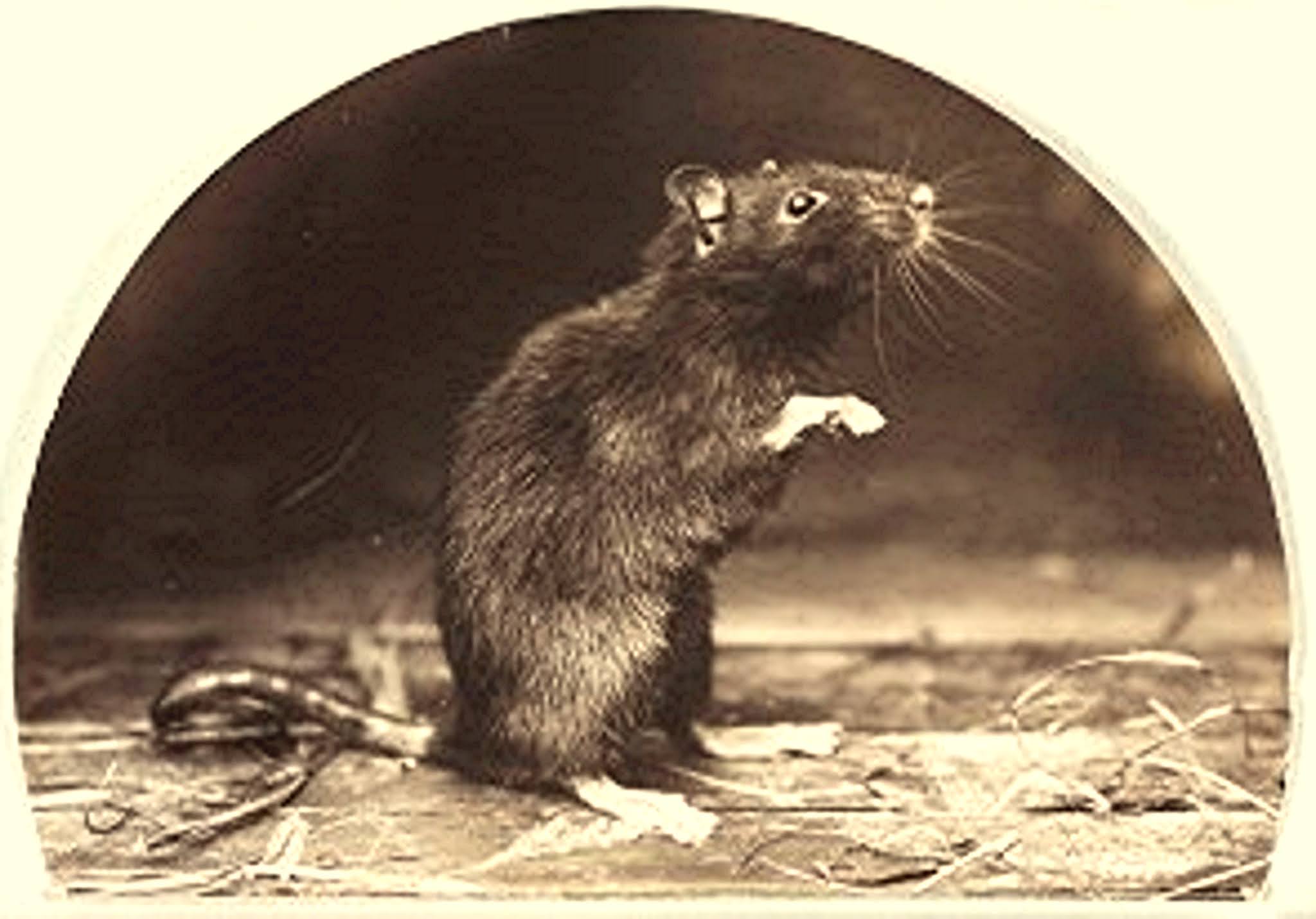
Vintage sepia photograph
of a black rat, the species almost uniquely responsible for the surprising number of perplexing, tangle-tailed rat kings on record (public domain)
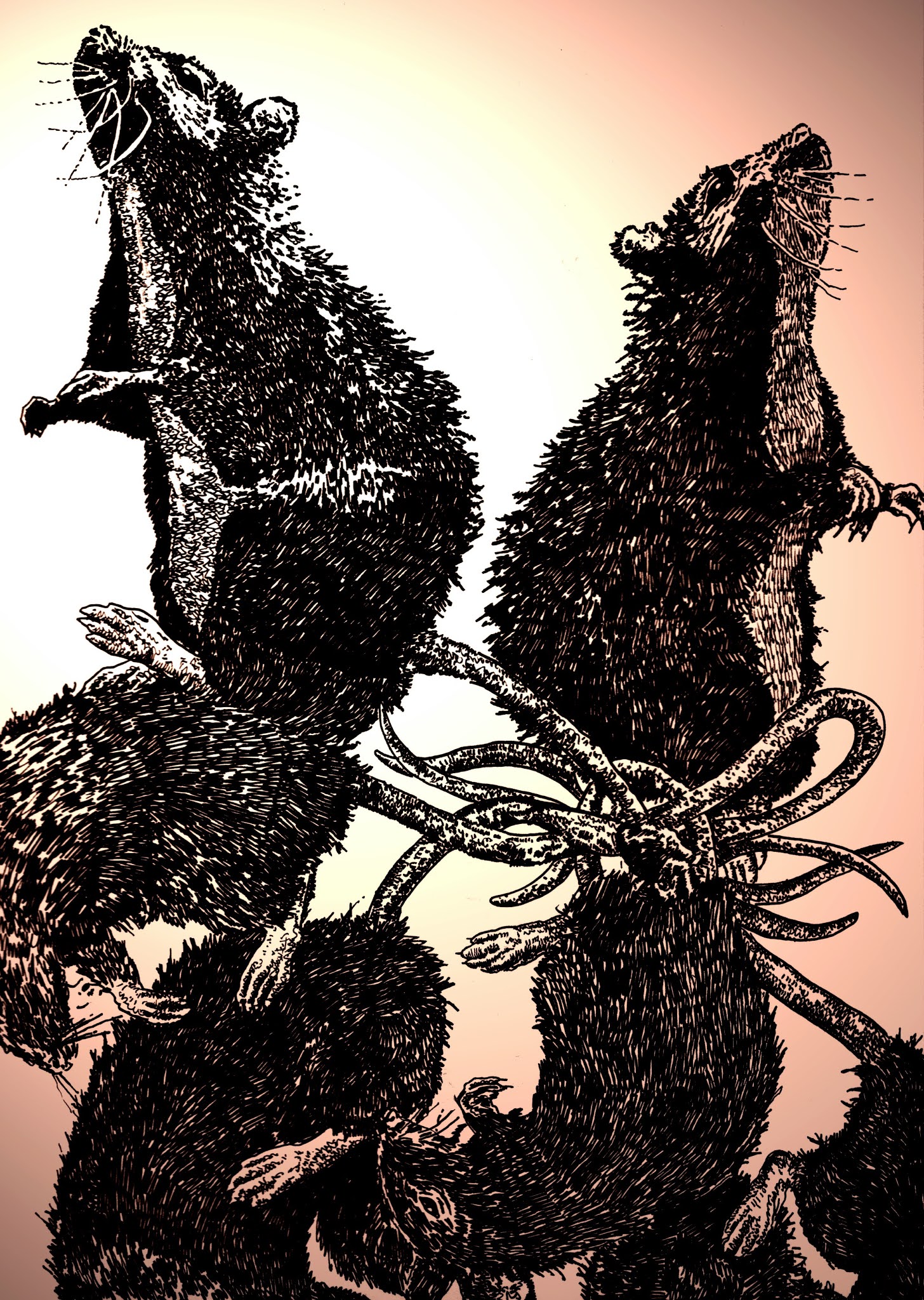
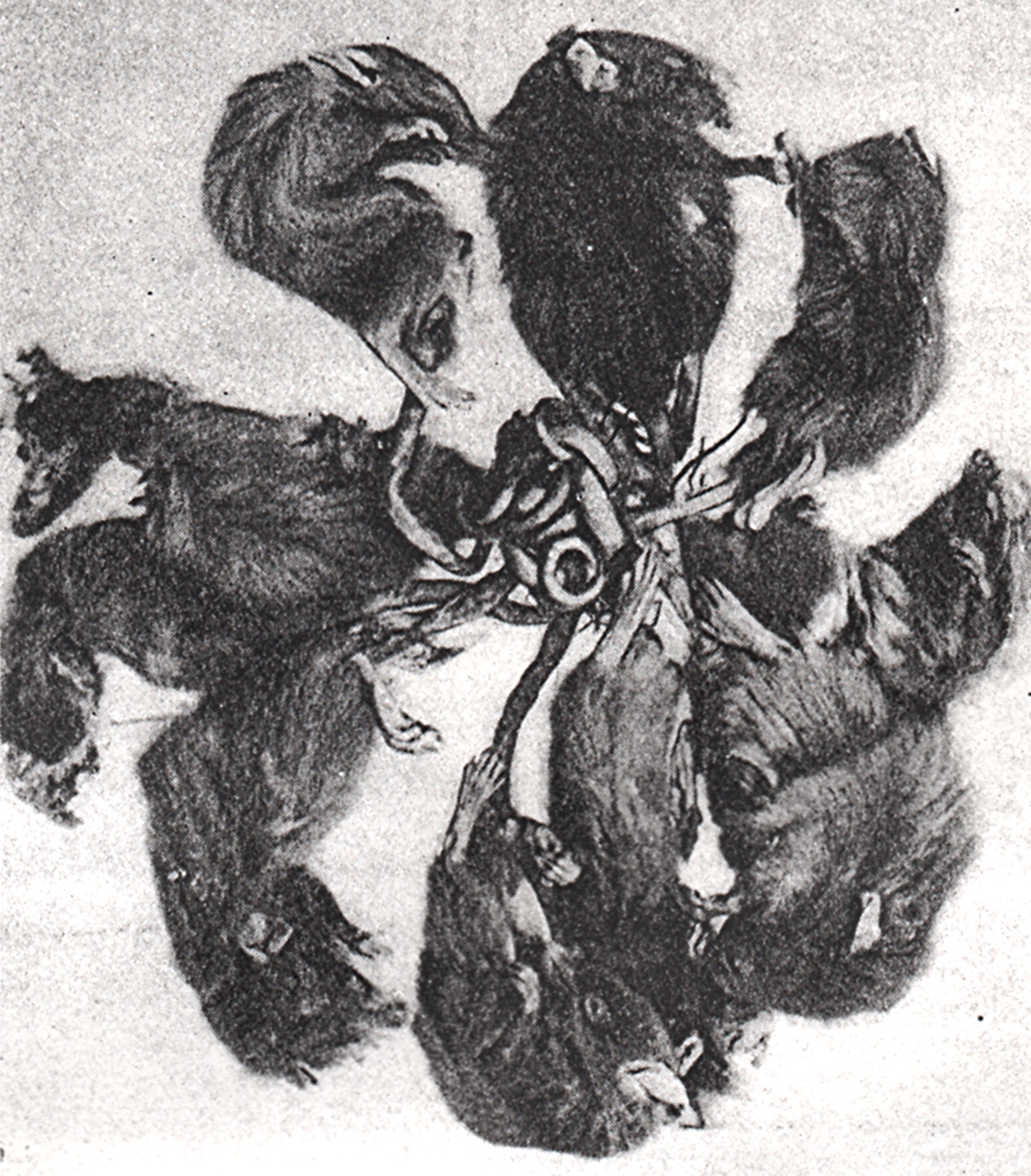
Among the most unusual but prized museum specimens are preserved
aggregations of black rats Rattus rattus inextricably linked to one
another by their tails - which are so thoroughly entangled that the rats have
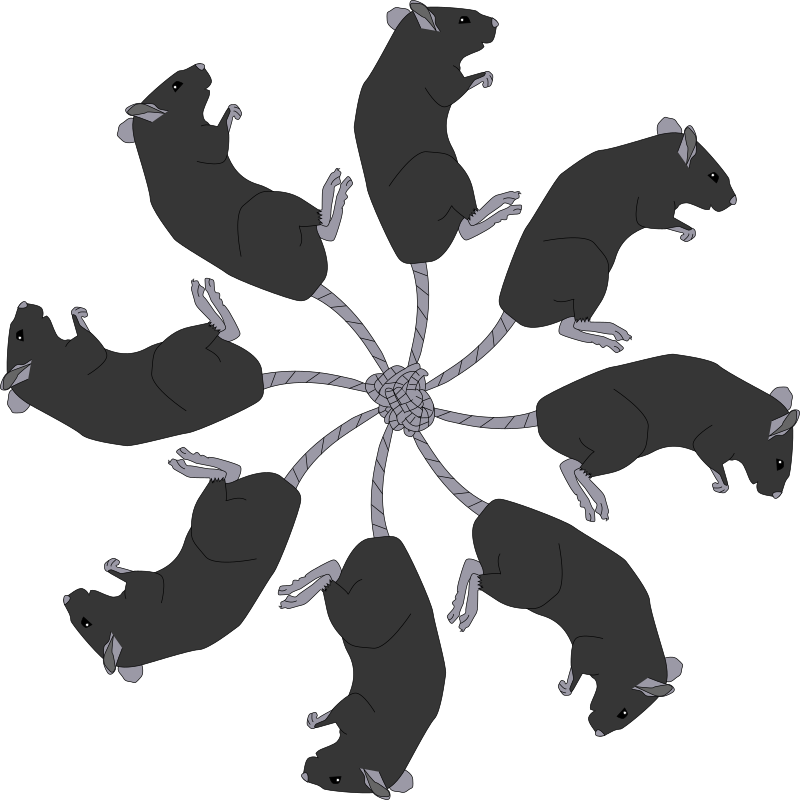
been unable to disentangle themselves and escape. A grotesque, tail-entwined
aggregation of this type is termed a rat king or 'roi de rats'. This is possibly
a corruption of the French 'rouet de rats' - 'rat wheel' – as the tails when
straightened out radiate outwards from the central uniting knot like the spokes
of a wheel radiating out from the wheel's central hub. Yet despite centuries of
reports and occasional captures, the mystery of how their tails become so
intertwined remains unsolved.
MORE THAN FOUR CENTURIES OF RAT KINGS
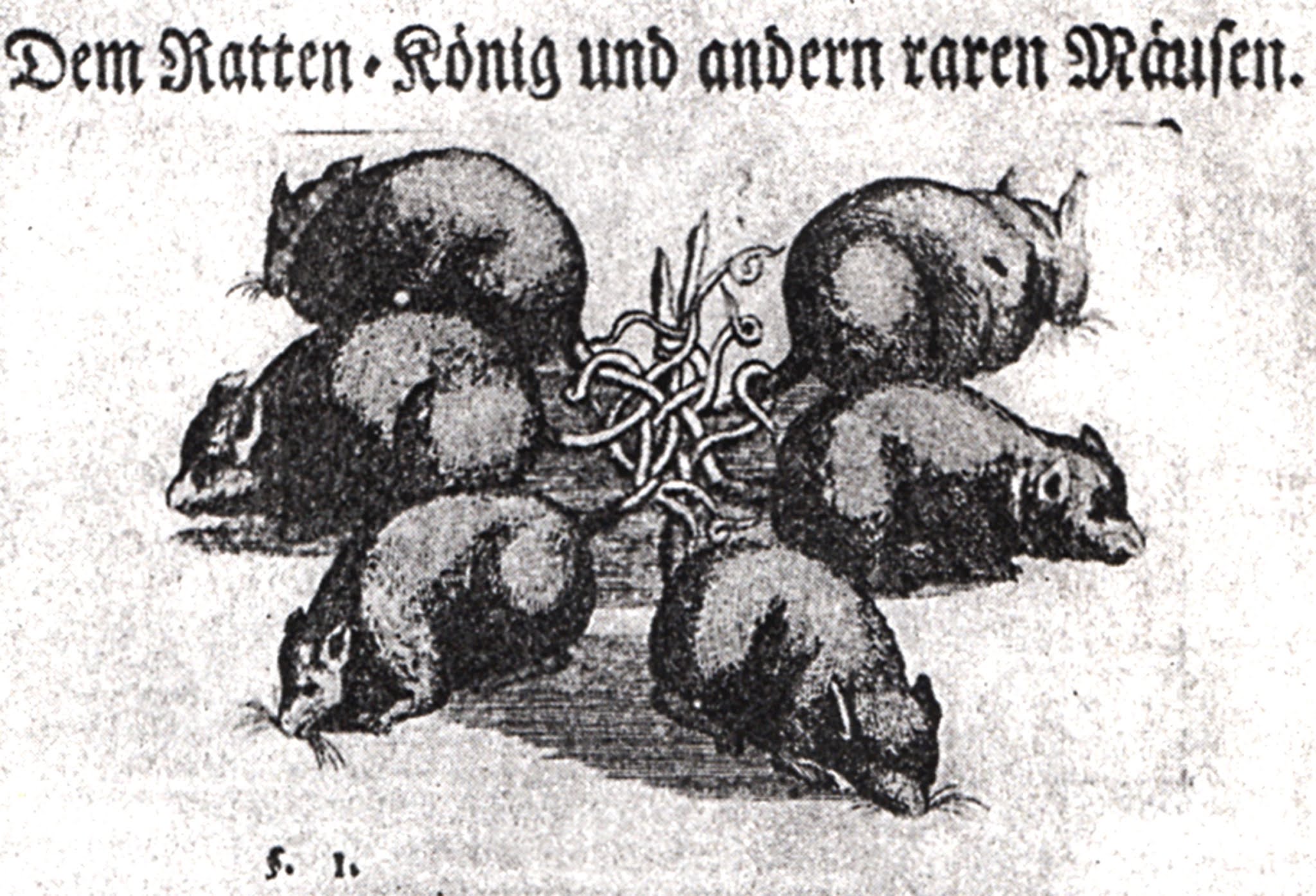
The earliest currently-documented record of a rat king dates
from 1564, more than four centuries ago. It takes the form of a woodcut
illustrating a poem in the monumental emblem book authored by renowned
Hungarian scholar-historian Johannes Sambucus, entitled Emblemata cum aliquot nummis antiqui
operis, Ioannis Sambuci Tirnaviensis Pannonii. The poem tells of a rodent-plagued man
whose servant discovers seven rats with their tails inextricably tangled
together, and this rat king (though not referred to by that term in the poem)
is depicted as alive and in some detail within the engraving. The accuracy of
the depiction shows that rat kings were known as far back as the 1500s, and
suggests that it was based upon a specific example, though no written documentation
of this example apparently exists.
The 1564 woodcut illustrating a living rat king composed
of 7 specimens (public domain)
Since then, more than 60 specimens have
been recorded, spanning the time period 1612-2005, though at least 18 of them are
of dubious authenticity (some rat kings have been
fraudulently created as unusual - and expensive! - souvenirs for the unwary
traveller or curio collector). Furthermore, despite being associated with superstitions
that their discovery is a portent of the plague and other evils, several rat
kings are greatly-prized exhibits in various museums.
Intriguingly, most reported rat kings are
of German origin, though why this should be is unclear (unless German writers
took greater pains to chronicle any such anomalous finds in their own country than
writers of other nationalities have done regarding rat kings found in theirs?).
The single most comprehensive source of rat king information is Martin Hart's
book Rats, which devotes an entire and very extensive chapter to the
subject (once again, moreover, Hart is German, and his book was originally published
in German, with an English translation appearing in 1982).
Rat king, early 1700s engraving (public domain)
Space considerations obviously prevent me
from covering within this present ShukerNature blog article every single rat
king on record, but a representative selection, including the most dramatic and
unusual cases, appear in the following review.
A RAT KING REVIEW
The first on the total list of specimens on record is a nine-rat
example that was discovered on 20 March 1612 behind a partition in a loft in
Danzig (now Gdansk), Poland, by a local professor. All of the rats were adult,
appeared well-fed, and were alive when found. Its details were included in a
letter from the professor to a colleague in Basle, Switzerland. This was
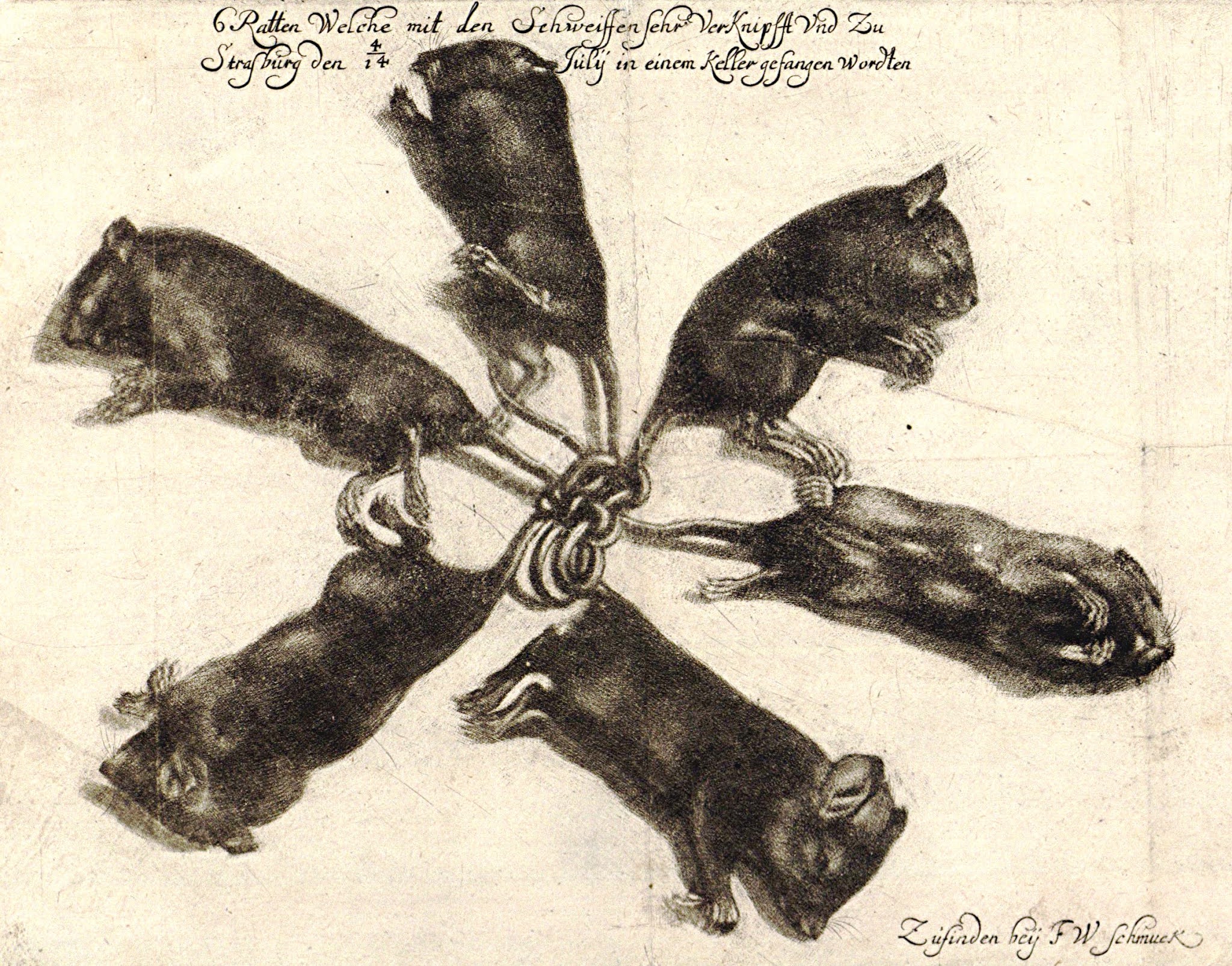
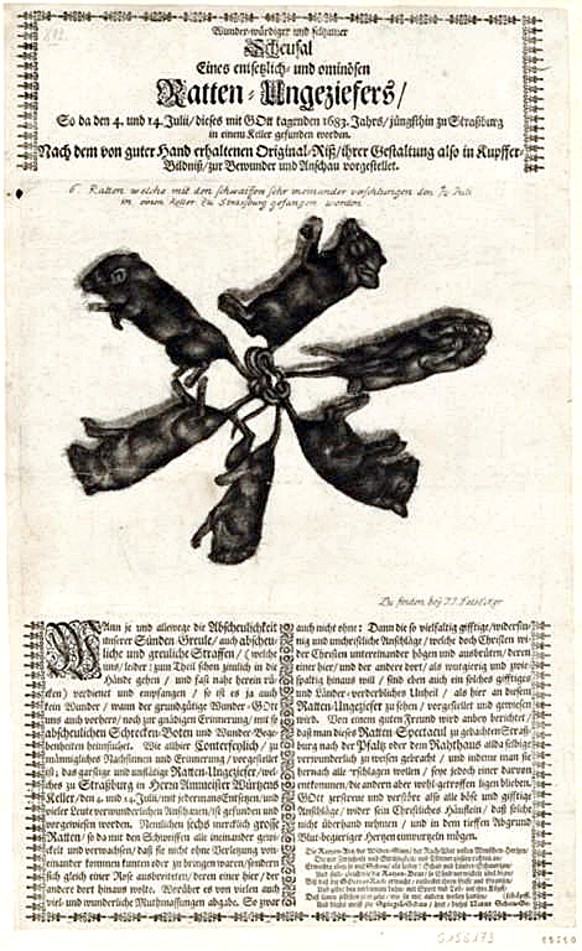
followed 71 years later by the finding of a six-rat king in Strasbourg on 4
July 1683; these rats were all juveniles.
Strasbourg
rat king from 1683 (public domain)
A very remarkable example was the 18-rat king discovered on 12
or 13 July 1748 by miller Johann Heinrich Jäger at Grossballhausen (also spelt
'Gross Ballheiser') in Germany, when it fell from between two stones underneath
his mill's cogwheels. Strangely, a famous, beautifully-executed copper engraving
of this very noteworthy rat king depicts it with only nine rats present
(unless, perhaps, the other nine are hidden beneath the nine portrayed?).
Copper
engraving depicting a 9-rat version of the 18-rat Gross Ballheiser rat king from
July 1748 (public domain)
Also controversial in terms of its visual portrayal is the rat
king discovered in Erfurt, Germany, in 1772. For whereas in his book Hart lists
it as a 12-rat king, a detailed engraving of this example dating back to the early
1800s portrays it as containing only ten rats - but also with a very stylised,
unnatural-looking knot. Consequently, this picture may have been intended
merely as a general rat king representation, rather than as a specific depiction
of the Erfurt example.
Illustration
depicting a 10-rat version of the 12-rat Erfurt rat king from 1772 (public
domain)
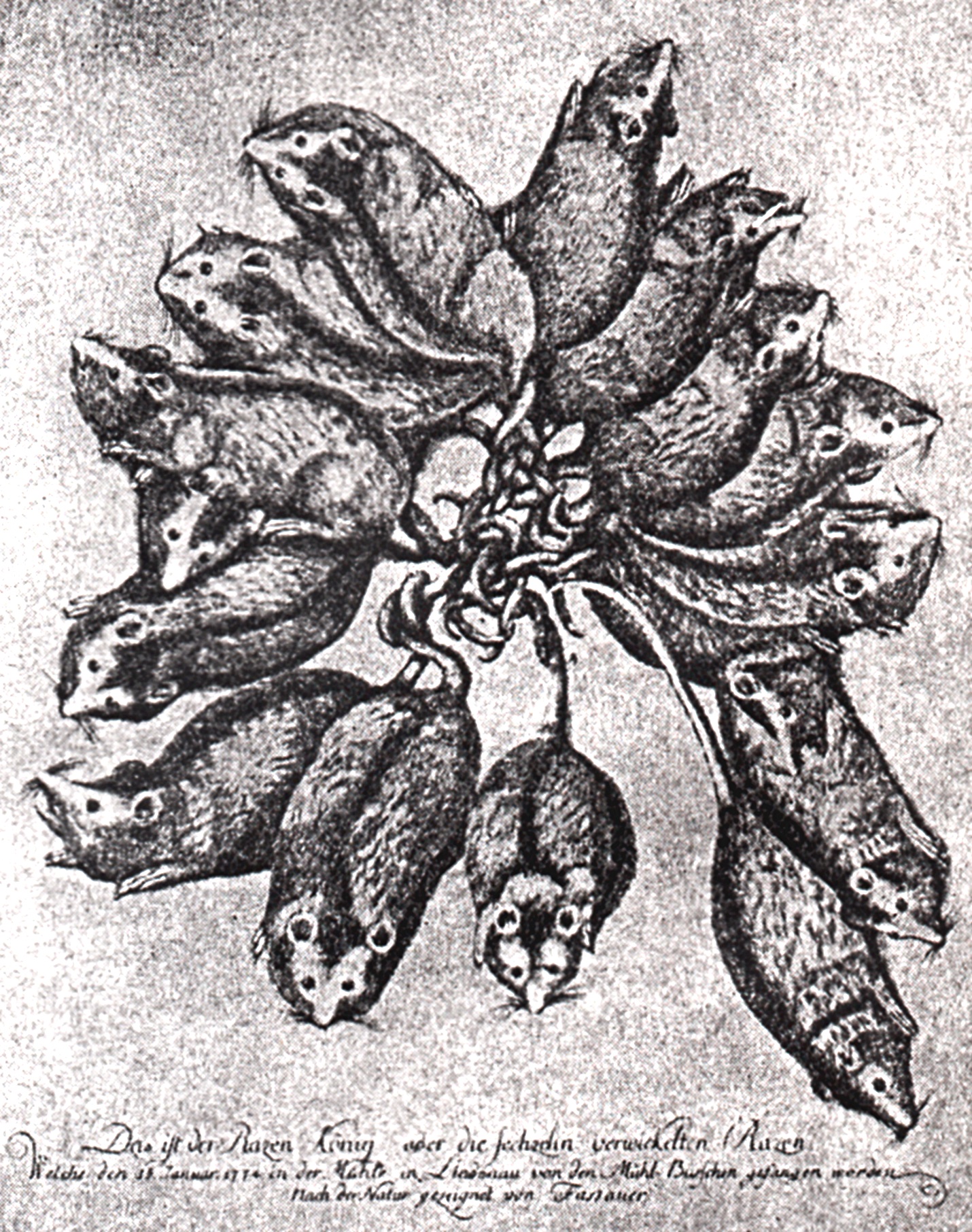
On 11/12 January 1774, an amazing 16-rat king was found in a
windmill at Lindenau, Germany, with all of its rats still alive. After they had
been killed, the king was subsequently displayed in Leipzig, and it proved to
be a very popular attraction.
Illustration
of the Lindenau rat king from January 1774 (public domain)
Even more extraordinary was the discovery made during December
1822 at the village of Döllstadt in eastern Germany, when some threshers on a
farm found two separate rat kings within a hollow beam in a barn roof attic. In
both of these kings, the rats were all adult, alive, and apparently healthy.
One of the kings consisted of 28 rats, the other consisted of 14 rats. The
threshers killed all of them with their threshing flails and then, after great
difficulty, the rats in each king were separated. Of particular interest, as
originally noted by a forester who witnessed the rats' separation, is that the
tail of each freed rat clearly bore the impression of the tails of the other
rats in its king, thus demonstrating how tightly their tails had been entwined.
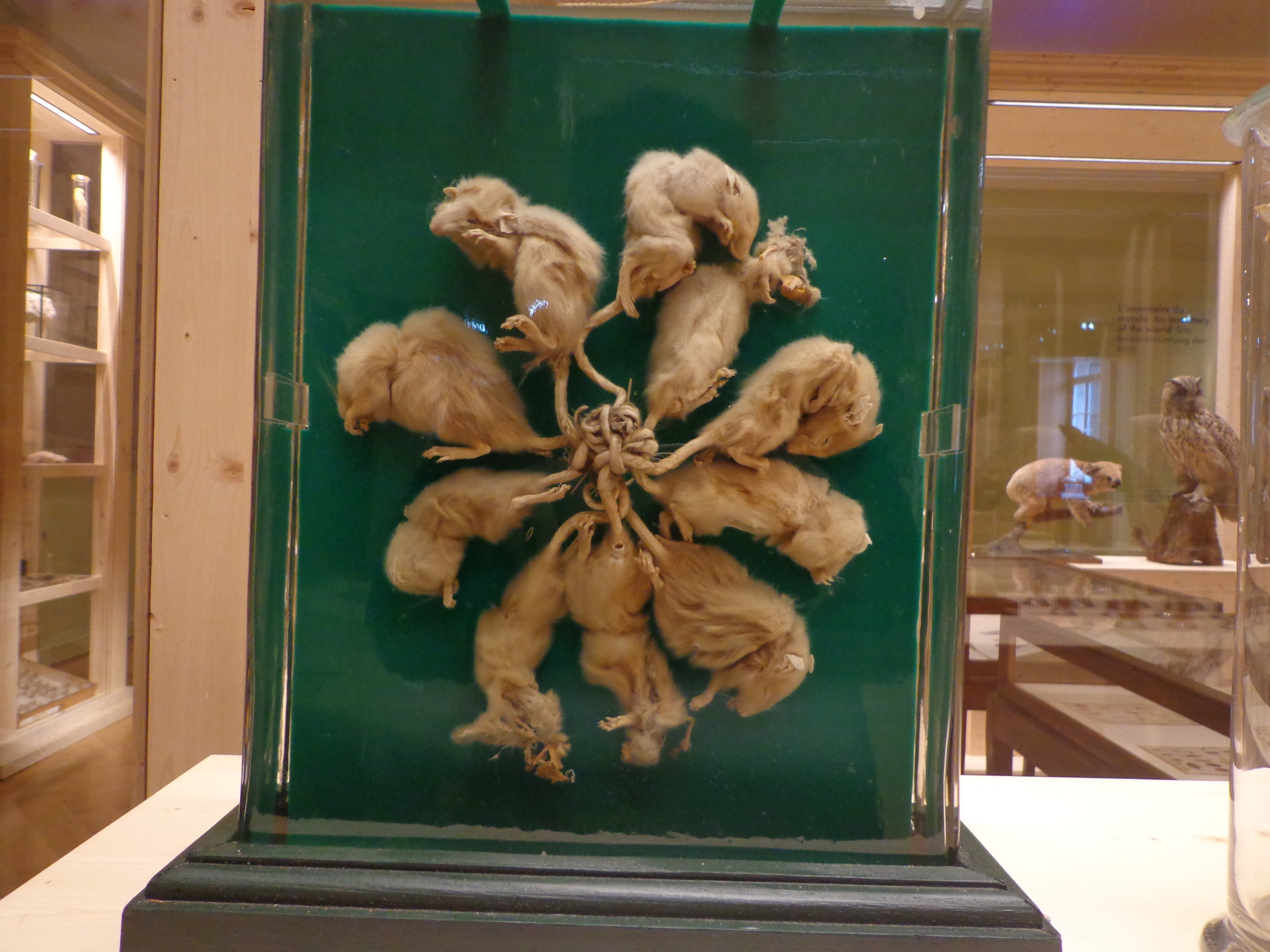
The most spectacular, monstrous rat king on record, however, was
discovered inside the chimney of a miller named Steinbruck at Buchheim,
Germany, in May 1828. Incredibly, it contained no less than 32 rats, although
they were probably not adults, which were hairless, desiccated, and inescapably
bound to one another by their Gordian-knotted tails. This exceptional rat king
- indeed, a veritable rat emperor! - is today a much-valued specimen in the Mauritianum,
a natural history museum in Altenburg, Germany.
Another preserved rat king can be found in Strasbourg Museum.
This is a ten-rat example, whose rats were all juveniles and discovered in a
frozen condition under a bale of hay during April 1894 in Dellfeld, Germany.
Three of the rats had bite marks, indicating that they may have been bitten by
others in the king, or had been attacked in their defenceless state by free
rats.
Yet another, more recent preserved example is the rat king
discovered in 1907 at Ruderhausen, near Germany's Harz Mountains. It resides
today in the collections of Göttingen's Zoological Institute. Indeed, this
institute may once have possessed a second rat king too, obtained in the very
same year, because a number of sources of rat king information list a specimen
formerly held at this establishment that was reputedly found in January 1907 at
the village of Capelle, near Hamm, Westphalia, in Germany, and brought to
scientific attention by the local pastor, called Wigger. If these sources are
correct, however, it must have since been lost, as no such specimen exists
today.
A rat king consisting of eight juveniles has been on public display
for several decades in a jar of preserving fluid at New Zealand's Otago Museum.
Sometime during the 1930s, it fell down onto the
ground, alive, from the rafters of the company shed of Keith Ramsey Ltd on
Birch Street, Otago – followed swiftly by a parent rat that defended them
vigorously. The rats' tails were bound together not only by one another but
also by horse hair, which is used as nesting material by rats.
In February 1963, a seven-rat king was found by farmer P. van
Nijnatten partly concealed under a pile of bean sticks in his barn at Rucphen,
in North Brabant, Holland. In the hope of uncovering its secret, after its rats
(all adults) had been killed this king was x-rayed, revealing some tail
fractures and signs of a callus formation - all indicating that the knot of
tails had occurred quite some time ago.
More recent still is the rat king found by some gamebird rearers
on 10 April 1986 in the municipality of Mache near Aizenay Vendée, France, and
now preserved in alcohol at the natural history museum at Nantes. This king was
originally composed of 12 rats, but three subsequently became detached, and it
is the resulting 9-rat version that is preserved. The only other preserved
French rat king is one that was discovered in November 1889 at Châteaudun and
duly presented to its museum where it is still retained today; photographs of
it show that it contains six rats, but I have read reports testifying that
there were seven originally.
Most recent of all, however, is an Estonian rat king, consisting
of 16 rats, nine or so of which were still alive when the king was discovered
alive by farmer Rein Kõiv on 16 January 2005, squeaking loudly upon the sandy
floor of his shed in the village of Saru. Kõiv killed them all, and on 10 March
2005 the king was taken to the Natural History (Zoological) Museum at the
University of Tartu, where it was preserved in alcohol and is now on display. Prior
to this, however, two of the rats had been eaten by a predator and a third had
been thrown away by Kõiv himself. Two other Estonian rat kings have been
reported, both during the 20th Century, but neither of them was
preserved.
A KNOTTY PROBLEM
A number of explanations for the formation of rat kings have
been offered. One of the most popular is that if rats huddle together for
warmth in damp or freezing surroundings, with their tails pressed against one
another, their tails become sticky (possibly from the rats' own urine) and soon adhere to or become frozen against
one another, becoming ever more entangled and fixed as the rats thereafter
strive to pull free. However, if this were indeed the correct explanation, being
such a frequent, commonplace scenario it would surely engender far more
examples of rat kings than have been documented so far?
Rat king from
Limburg, Netherlands, found in unknown circumstances during 1955, now housed at
the Natural History Museum of Maastricht, Netherlands (Vassil - public domain)
Another notion is that a rat king is actually a single litter
whose members' tails became entangled while the rats were still in their
mother's uterus. If this were true, however, it seems highly unlikely that they
would survive to adulthood, as they would be unable to obtain much food, yoked
together in this manner. Yet most rat kings on record feature adult specimens,
and ones that are often healthy when found.
A 10-specimen
rat king at the Strasbourg Museum (public domain)
Equally intriguing is why all but three of these murine kings
feature black rats Rattus rattus. There is none involving the much more
common brown rat R. norvegicus, but this may be due to the fact that the
brown rat's tail is shorter, thicker, and less flexible than that of the black
rat. Indeed, the only rat exception to the black rat rule is an Indonesian king
consisting of ten young Asian field rats R. brevicaudatus, discovered on
23 March 1918 in Buitenzorg (aka Bogor), Java. In addition, a single king composed
of house mice Mus musculus has been recorded (documented in a Russian
book dealing with mice and rats). So too has one field mouse king, consisting
of several juvenile long-tailed field mice Apodemus sylvaticus, found at
Holstein, Germany, in April 1929.
SQUIRREL KINGS
However, not all rodent kings involve rats or mice. At least 17
naturally-occurring squirrel kings have also been recorded (certain cruel, vile
cases of squirrels having been forcibly tied together via their tails by human
sadists are also known, tragically). Yet the concept of bushy-tailed squirrels
becoming entwined together in this way seems even more incongruous than that of
rats.
A seven-squirrel king was discovered in a South Carolina zoo on
31 December 1951. Tragically, however, two of its members were dead, a third
was dying, and its four other members could only be separated by cutting off
their tails above the knot. Curiously, two other squirrel kings have been found
here over the years, and all during cold snowy weather, implying that the
squirrels had huddled together for warmth.
A king containing six young squirrels was spotted by schoolgirl
Crystal Cresseveur in a hedge outside her home in Easton, Pennsylvania, on 24
September 1989. Although they were eventually rescued, their tails could not be
disentangled. A five-squirrel king (two members of which were albinos) fell out
of a tree by Reisterstown Elementary School in Baltimore, Maryland, on 18
September 1991, but these were successfully separated as their tails were
linked to one another only indirectly, with sticky tree sap, tangled hair, and
nest debris. In Europe, at least two kings of red squirrels Sciurus vulgaris
have been recorded - one in August 1921, the other on 20 October 1951 (which
was later preserved).
In July 1997, what looked at first like a huge hairy spider was
spotted under a tree in Brantford, in Ontario, Canada, but a closer look
revealed that it was actually a squirrel king, composed of five young squirrels
whose tails were braided together right up to their bases. They were taken to a
vet, Cathy Séguin, who freed them, but she feared that the loss of circulation
that their tails had suffered would result in part of each tail dying.
CAT KINGS
Analogous to rat kings, mouse kings, and squirrel kings is the
even more obscure phenomenon of cat kings. Here, however, it is the umbilical
cords of kittens in newborn litters that are tangled and intertwined, not their
tails. Such curiosities are extremely rare, but at least a dozen have been
documented in the scientific literature.
The Rennes
cat king from 1937 (public domain)
Perhaps the best known is the cat king recorded in October 1937
at Rennes, in Brittany, northwestern France. It consisted of a litter of eight
small kittens, seven of which (males and females) were held closely together
via their entangled umbilical cords. Indeed, the entanglement was so complex
that even the left hind legs of two of the kittens had become bound up to one
another. The kittens in this cat king were discovered dead, but it is not known
whether their cords' complicated intertwining had occurred before the litter's
birth or afterwards.
Engraving
of the cat king reported in 1841 (public domain)
A cat king recorded in 1841 consisted of five unborn kittens
whose entwined umbilical cords were still fixed to their mother's placenta.
This shows that such entanglement can indeed occur while the kittens are still
in the womb. The earliest cat king known to me is a five-kitten specimen from
1683, found in Strasbourg, France.
Report of the
Strasbourg cat king from 1683 - click to enlarge for reading purposes (public domain)
Today, the mystery of how rat kings are formed remains exactly
that – an unresolved anomaly whose reality has spanned centuries but whose
secret still awaits disclosure. Some sceptics have cynically suggested that the
phenomenon is simply a hoax, that the knotting together of the tails of rats in
a king is clearly the result of deliberate human activity.
Bearing in mind,
however, that most of the rat kings on record were discovered when their rats
were very much alive and often still in good health (albeit hungry and
frightened), and that the tail knots were exceedingly complex, all that I can
say in response to these sceptics is that they have certainly never attempted
to tie the tails together of several (not to mention 18 or 32!) live, healthy rats.
If they were ever brave (or foolish) enough to try to do so, their cynicism
would very swiftly vanish – along, quite possibly, with several of their
fingers!
Report of the Strasbourg rat king from 1683 - click to enlarge for reading purposes (public domain)
UPDATE: 3 November 2021 – TWO LIVING RAT KINGS FILMED!
Although there have been various filmed, living
examples of squirrel kings, there has never been to my knowledge any film
footage obtained of a living rat king – until recently, that is. On 21 August 2021, Russian farmer Alibulat Rasulov discovered a live rat king in one of his flooded watermelon fields, near Stavropol on southwestern Russia, which he was able to film and upload in two sections onto Instagram. The king consisted of five small rats. Unlike most rat king cases, moreover, this one had a happy ending, inasmuch as Rasulov not only lifted the king out of the water but when placed on dry land he was also able to disentangle the five rats' tails, enabling them to run away, freed.
And now, today, various media
reports have appeared online concerning a second living, squirming collection of rats
bound tightly to one another via their inextricably – and inexplicably –
intertwined tails, i.e. another classic rat king, which had recently been found by
qualified vet Johan Uibopoo inside the chicken coop of his mother at her home
near Tartu, Estonia, after he had received a distressed phone call from her.
The rat king proved to consist of no fewer than 13 rats, and Uibopoo succeeded in
obtaining some excellent close-up film footage (click here)
of the grotesque conjoined congregation. However, two of its rats were already
dead by the time that he'd arrived. Dr Andrei Miljutin from the University of
Tartu's Natural History Museum, who'd previously documented an Estonian rat
king, agreed to take this latest example. According to traditional folklore,
the appearance of a rat king foretells an impending plague – but in both of these
particular instances the rat king's appearance was evidently somewhat late,
judging from the worldwide arrival more than a year earlier of a very significant plague, Covid-19...
If you'd like to assist me in my ongoing crypto-investigations, even the smallest donation would be immensely appreciated. All donations are non-profit-making, going exclusively towards the updating/maintenance of my crypto-archives' source material and other necessities that enable me to continue researching and blogging my findings right here for you on ShukerNature. Please click the Donate button below to donate either via PayPal or via Debit/Credit Card. Thank you so much for your help! - Karl













 Posts
Posts