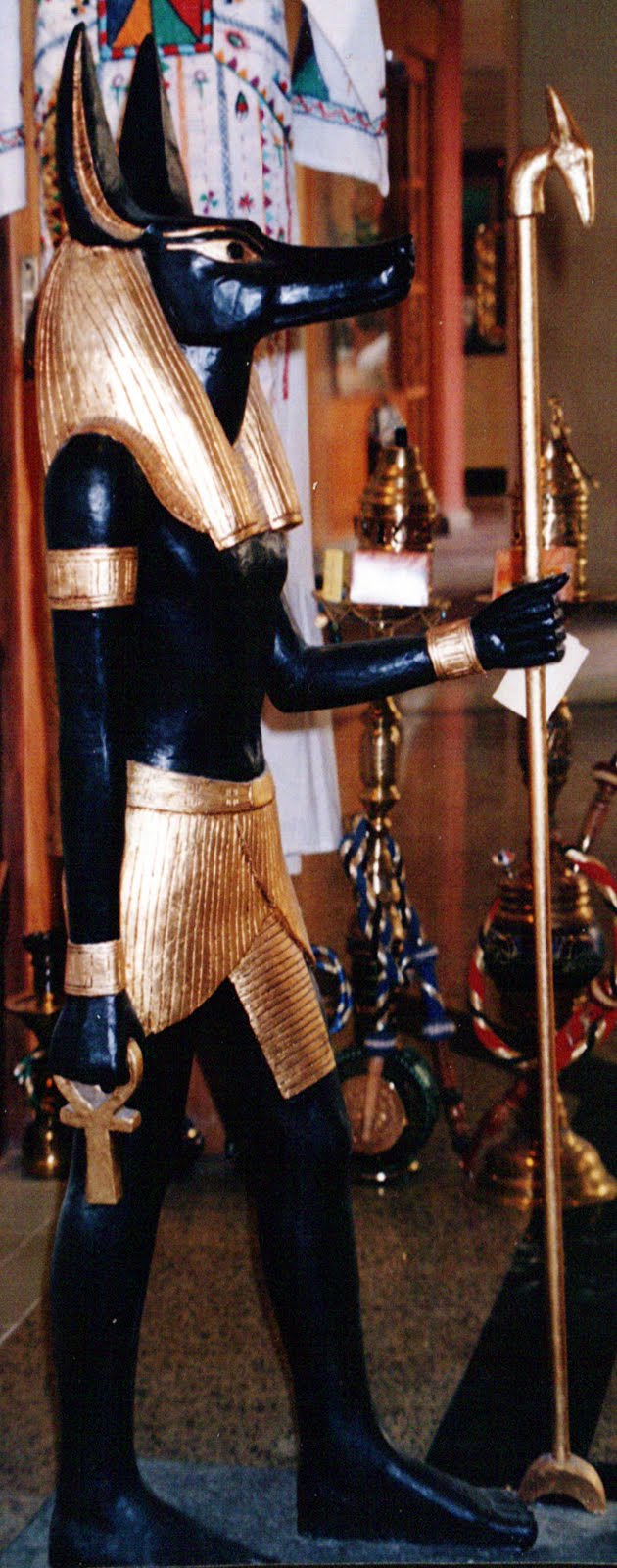
Anubis statue, Cairo (Dr Karl Shuker)
The worship of the cat as a god in ancient Egypt and elsewhere is well known, but less familiar is the diversity of canine deities that have also been venerated in various cultures.
ANUBIS - JACKAL-HEADED GOD OF ANCIENT EGYPT
Probably the most famous canine deity of all is Anubis - the jackal-headed son of Osiris, god of the underworld, and Nebthet, a funeral goddess. Sometimes represented as a coal-black, bushy-tailed jackal or pointed-eared dog in a crouched or lying down position, Anubis was worshipped in Egypt from c.2700 BC to the close of ancient Egyptian history in c.400 AD, and was venerated extensively at the necropolis in Memphis. He originated as a god of putrefaction, but eventually emerged with a more specific (and less unappetising) role - as the mortuary god who presided over embalming. Indeed, Egyptian priests supervising official embalmers wore jackal-headed masks to signify the presence of Anubis during these preparations. Moreover, according to traditional Egyptian lore, Anubis invented funeral rites, presiding over the funeral and mummification of his own father, Osiris.
Once mummification of a dead person is complete, it is Anubis who leads the dead into the presence of his father, Osiris, in the underworld, to be judged by him. Anubis also weighs the dead person's heart, in the Hall of the Two Truths, to determine its ultimate fate.
Another, less familiar canine-headed deity of Egyptian mythology is Upuaut. Originally a warrior god, Upuaut is variously represented as a dog-headed, jackal-headed, or even wolf-headed man who leads the funeral cortege at the festivals of Osiris. He also steers the boat of the sun as it journeys through the dark realm of the night between dusk and dawn.
HERMANUBIS AND THE ORIGIN OF THE WEREWOLF MYTH?
After the Greeks and Romans took over Egypt, the cult of Anubis became assimilated with that of the Greek messenger god, Hermes, and a new, combined deity was created - Hermanubis. Just like Anubis, Hermanubis was represented as a canine-headed man, but his functions changed. Instead of being strongly associated with funeral rituals and embalming, emphasis was placed upon his role as a guide, leading the souls of the dead through the underworld. Moreover, just like Hermes, Hermanubis came to be portrayed with winged sandals, and held a staff or caduceus, with two snakes entwined around it, in his hand.
Nevertheless, as with the priests of Anubis, those of Hermanubis wore canine masks - a tradition leading scholar Hugh Trotti in 1990 to propose a most intriguing theory. By the first century AD, worship of Hermanubis had spread beyond Rome-ruled Egypt, reaching Rome itself - where Germanic troops recruited into the Roman armies would have seen statues of this canine god, as well as his dog-headed priests. Such sights would no doubt have been remembered and spoken of by the Germanic people after the Roman Empire's fall - and Trotti has speculated that distorted accounts of these may ultimately have inspired legends of werewolves, i.e. humans who could transform themselves into wolves.
XOLOTL - A CANINE GOD OF THE AZTECS
Another notable canine deity is Xolotl, one of the principal gods of Aztec mythology in ancient Mexico, who created mankind by leading them up from the spirit world and bestowing upon them the gift of fire. Due to his magical ability to assume any shape, Xolotl has been depicted in many forms, but is most commonly represented as an oddly-formed dog, with rear-running feet, and ears that can point backwards or forwards.
Xolotl is the twin of the sky god Quetzalcoatl, and represents the evening star, Venus, hauling the sun downwards each evening into the gloomy vault of night. A deity with varied associations, he is also the god of twins (as a twin himself) and ball games, as well as a deity of the underworld, corresponding to the Pek or lightning dog of Maya mythology. Today, Xolotl's name is still linked to dogs in zoological nomenclature, though only very indirectly - sharing it with the axolotl, a form of aquatic Mexican salamander, whose larval form is reminiscent of a dog and hence is sometimes referred to as a water-dog.
BHAIRAVA AND HIS CANINE STEED
In Hindu lore, Bhairava, a door guardian, is a fearsome canine deity. One of the forms assumed by the god Siva, he is often portrayed either as a huge black dog, or as a human riding a black dog. Terrifying to behold, Bhairava has many arms, three eyes, long matted hair, and sometimes has a serpent entwined around his body, with a collar of skulls around his neck. Food sellers plying their ware outside Indian temples dedicated to Siva sell tiny dogs carved out of sugar, which can then be presented as an offering to Bhairava.
In northern India, a canine deity was formerly worshipped by certain Dravidians. So too were dogs in Nepalese villages, during a special festival called Khicha Puja, in which a garland of flowers was deferentially placed around the neck of every dog in each village.
ST GUINEFORT - THE AMAZING STORY OF A CANINE CANONISATION
Down through the ages, many saints have been accredited with miraculous powers, or have led unusual lives, but one of the most remarkable histories on record must surely be that of St Guinefort, who may well be the only canonised greyhound!
It was in c.1250 AD when a Dominican priest called Stephen of Bourbon first learnt of the tomb of St Guinefort, located in a sacred grove within the remote Dombes region north of Lyons, France. Upon further enquiry, he was amazed to discover that this saint had actually been a greyhound, which had been wrongly blamed for the death of a local lord's infant. Only after it had been slain by the enraged lord was the discovery made that in reality the dog had been protecting the baby from a snake. Stricken with guilt and remorse for his rash action, the lord erected a tomb, in which the dog's bones were placed.
Soon, stories began to emerge of miracles occurring at the site of this tomb, featuring the inexplicable restoration to good health of sick children brought here by their parents, and the dog duly became known as St Guinefort. Stephen of Bourbon, however, was horrified by what he deemed to be this unholy, sacrilegious activity, and swiftly instigated the destruction of the tomb and its grove. Yet the cult of St Guinefort survived in secret long after Stephen of Bourbon's own demise, with a chapel dedicated to the slightly re-named Saint-Guy le Fort existing in the 17th Century on the site of the original tomb, and with the greyhound saint's name restored to its original form by the 1800s. Even today, St Guinefort's story is well known in the Dombes region, and researchers have revealed possible links between this history and the famous Welsh legend of Gelert - another noble dog that died a martyr. They do say that every dog has its day - but in St Guinefort's case, it has lasted several centuries!


 The ammut



 Posts
Posts