Dr KARL SHUKER

Zoologist, media consultant, and science writer, Dr Karl Shuker is also one of the best known cryptozoologists in the world. He is the author of such seminal works as Mystery Cats of the World (1989), The Lost Ark: New and Rediscovered Animals of the 20th Century (1993; greatly expanded in 2012 as The Encyclopaedia of New and Rediscovered Animals), Dragons: A Natural History (1995), In Search of Prehistoric Survivors (1995), The Unexplained (1996), From Flying Toads To Snakes With Wings (1997), Mysteries of Planet Earth (1999), The Hidden Powers of Animals (2001), The Beasts That Hide From Man (2003), Extraordinary Animals Revisited (2007), Dr Shuker's Casebook (2008), Karl Shuker's Alien Zoo: From the Pages of Fortean Times (2010), Cats of Magic, Mythology, and Mystery (2012), Mirabilis: A Carnival of Cryptozoology and Unnatural History (2013), Dragons in Zoology, Cryptozoology, and Culture (2013), The Menagerie of Marvels (2014), A Manifestation of Monsters (2015), Here's Nessie! (2016), and what is widely considered to be his cryptozoological magnum opus, Still In Search Of Prehistoric Survivors (2016) - plus, very excitingly, his four long-awaited, much-requested ShukerNature blog books (2019-2024).

Dr Karl Shuker's Official Website - http://www.karlshuker.com/index.htm

IMPORTANT: To view a complete, regularly-updated listing of my ShukerNature blog's articles (each one instantly clickable), please click HERE!

IMPORTANT: To view a complete, regularly-updated listing of my published books (each one instantly clickable), please click HERE!

IMPORTANT: To view a complete, regularly-updated listing of my Eclectarium blog's articles (each one instantly clickable), please click HERE!

IMPORTANT: To view a complete, regularly-updated listing of my Starsteeds blog's poetry and other lyrical writings (each one instantly clickable), please click HERE!

IMPORTANT: To view a complete, regularly-updated listing of my Shuker In MovieLand blog's articles (each one instantly clickable), please click HERE!

IMPORTANT: To view a complete, regularly-updated listing of my RebelBikerDude's AI Biker Art blog's thematic text & picture galleries (each one instantly clickable), please click HERE!

Search This Blog


PLEASE COME IN, I'VE BEEN EXPECTING YOU...

PLEASE COME IN, I'VE BEEN EXPECTING YOU...
WELCOME TO SHUKERNATURE - ENJOY YOUR VISIT - BEWARE OF THE RAPTOR!


Showing posts with label pseudo-melanism. Show all posts

Saturday, 12 July 2025

SPOTTING A SPOTTED BUSHBUCK IN LIBERIA

 
A typically-patterned male northern bushbuck in Senegal (© Lucy Keith-Diagne/Wikipedia – CC BY 4.0 licence)

Bushbucks are the smallest members of the spiral-horned African antelope group, which also include the kudus, nyalas, sitatunga, elands, and bongo. Traditionally, just a single bushbuck species has been recognized, Tragelaphus scriptus, albeit with numerous subspecies (some of which long ago were briefly deemed by certain 'splitter' mammalogists to be species in their own right before being 'lumped' into T. scriptus), distributed through much of sub-Saharan Africa. More recently however, it has been split taxonomically into two – the northern bushbuck, native to western and northern/central Africa, which retains the binomial name T. scriptus; and the Cape bushbuck T. sylvaticus, native to southern and eastern Africa.

Moreover, in the Cape bushbuck both sexes are generally brown, often with only limited coat patterning on the torso, even in the more showy male (though more strikingly patterned individuals do sometimes occur). Conversely, the northern bushbuck is the more familiar form, patterned as its torso is (most especially in the adult male) with a diverse, eyecatching arrangement of vertical white stripes on its flanks and often also a horizontal lower flank stripe lying beneath them plus a couple of horizontal shoulder stripes, all of them again white, as well as a series of white spots on its haunches. The overall effect is as if this antelope is wearing a harness, which is why a popular longstanding alternative name for the bushbuck as a whole has always been the harnessed antelope, but which is nowadays applied specifically to the northern species.

 
Adult female northern bushbucvk with calf in Ghana (© Lalambala/Wikipedia – CC BY-SA 4.0 licence)

However, as will now be revealed, there is one northern bushbuck specimen on record whose coat patterning is dramatically different from that of any other bushbuck of any kind – so much so, in fact, that veteran cryptozoologist Dr Bernard Heuvelmans deemed it worthy of being investigated as potentially representing an entirely discrete but currently undescribed species in its own right. In addition, its extraordinary skin is apparently still preserved in a museum. Yet this unique, fascinating individual and its very intriguing history have never been fully documented in any English-language publication – until now, that is, via this worldwide ShukerNature exclusive. So, let's begin at the beginning of this very belated bushbuck revelation.

I first learned of this singular specimen during the mid-1980s, when browsing through Heuvelmans's lengthy but thoroughly engrossing paper 'Annotated Checklist of Apparently Unknown Animals With Which Cryptozoology is Concerned', a paper that I have since returned to countless times during my own researches. It was published in Vol. 5 of Cryptozoology, the official scientific journal of the now-defunct International Society of Cryptozoology, and in it Heuvelmans briefly documented dozens of cryptids, many of which were very obscure and hitherto-unknown to me, arranged geographically and via habitat, with each cryptid's entry supplemented by one or more source references. Here is Heuvelmans's entry for the mystery bushbuck:

A small, entirely spotted bushbuck antelope, known only from an incomplete skin (preserved in the Zoological Museum of Berlin University) from Liberia (Pathé 1940).

The reference cited by him is: Pathé, Moritz (1940). Die Suche nach dem Fabeltier [The Search For The Mythical Creature]. Deutscher Verlag (Berlin).

 
The front of the dustjacket for Pathé's above-cited book, illustrated with one of his own paintings – note the spotted bushbuck skin sticking partly out of one of his cases (public domain)

Moritz Pathé (1893-1956) was a prolific and very talented German artist and book illustrator, specializing in animal pictures, and the author of several works, documenting his travels in Africa seeking rare creatures to portray, but also to hunt and trap.

Yet despite searching for more information concerning Pathé's enigmatic antelope, I was unable to locate any, and eventually it slipped from my mind. A few weeks ago, however, my interest in it was revived when palaeontologist and fellow cryptozoological writer Dr Darren Naish contacted me to enquire whether I had any information on file regarding it. As I still hadn't, Darren's query inspired me to launch another search, and this time, finally, I achieved success, thanks to two longstanding friends who both share my enthusiasm for all matters of a cryptozoological kind.

The first of these was French crypto-scholar Michel Raynal, who kindly supplied me with a copy of the principal chapter from Pathé's book in which he documented the Liberian spotted bushback (the entire book featured it, as it was the mythical animal referred to in the title, but this particular chapter contained the most significant information concerning it). Although the text was in German, I would normally have experienced no problems with translating it, but as various of you may know, for quite some time now I have been afflicted with a close-up vision problem (happily, my distance vision is unaffected) that makes reading and on-screen research difficult at present (an operation to correct this condition should be taking place soon). Consequently, translating many pages of German into English is presently beyond my capabilities.

Moreover, because the font employed in the book is a very ornate one that was commonly used in German publications back in the days when Pathé's book was published, blocking and pasting the text in sections into Google Translate and other translation sites also failed, because its ornate font rendered the text unreadable by the online translators.

But then one of my German crypto-friends, Markus Hemmler, came to my rescue, generously providing me with an immensely useful English translation of the relevant chapter (annotated by him with some very informative explanatory notes), plus other excerpts, as well as a copy of a colour plate from it (as did Michel) that contained Pathé's own very detailed illustrations of the skin, showing it dorsally and laterally, and which I've included here, as you'll see below. Markus subsequently also supplied me with an image of the full-colour illustrated dustjacket of Pathé's book (shown above here), the illustration being one of the author's own paintings, plus some of his line-drawings that appeared inside the book. All of these will be revealed later here.

First of all, however, here is a summary of the pertinent information regarding the spotted bushbuck as provided by Pathé in the principal chapter of his book devoted to it plus some references to it that appeared in subsequent chapters:

In 1937, Pathé was spending time in the West African country of Liberia, with the express purpose of hunting, drawing, and painting various of its more exotic animal species, in particular the pygmy hippopotamus and the crowned eagle. But a fortuitous meeting with a youth offering for sale a truly extraordinary albeit incomplete antelope skin changed the course of his plans completely, so that much of his time there was instead spent seeking a living example of this exceptionally elusive, ostensibly mythical, yet (by virtue of the afore-mentioned physical, tangible skin) unequivocally real creature, even inspiring the title of the book that he would write about his adventures.

To quote from one of Markus's annotations to his English translation of the relevant sections from Pathé's book:

At the beginning of the book Pathé already is in Monrovia [Liberia's capital] and until page 92 he describes some adventures like the journey from Monrovia (via Mesurado River, Stockton Creek to St. Paul River, then over land to Royersville at the Po River and beyond this river into the jungle) to Bangatown at the Lofa River [in northwestern Liberia] and his experiences and exploration of the surrounding area.

And so it was that one day during his stay in Bangatown, Pathé received an unexpected visitor in the form of a native youth named Jimmy, about 20 years old and hailing from a small village far upriver in the neighbouring but still quite distant Gola region. Jimmy had been hoping to sell the skin on behalf of his uncle to some people with whom his father and uncle had done business before, but for various reasons he failed to sell it to them. However, being mindful of Pathé's reputation as a hunter, Jimmy had then brought the skin to him, in case he may wish to buy it, and as Pathé had never seen anything like it before, he swiftly did so.

 
A b/w illustration by Pathé from his book, depicting Jimmy holding the spotted bushbuck skin (public domain)

According to Jimmy, who also had never seen one like it before, the antelope had been shot by a native hunter somewhere in Gola. Jimmy stated that he did not know specifically where, but eventually revealed that the hunter had mentioned a distant spot on the Mahé River, a tributary of the afore-mentioned Lofa River..

Pathé decided to hire Jimmy as his hunting boy, offering him both pay and on-the-job training if he accepted, which the youth instantly did, promising to return in a week's time and begin his exciting new career, which again he did.

The book then digresses, pursuing other topics such as the successful search by Pathé and Jimmy for a crowned eagle that Pathé hoped to paint, but on p. 110 he returns to the anomalous antelope skin, which becomes his principal focus thereafter. Yet what was so special about it? Here is the earlier-mentioned colour plate containing three illustrations of it by Pathé:

 
Three colour paintings of the mystery spotted antelope skin, the first one being a concept image of what it may have looked like with its legs still present; all three prepared by Pathé (public domain)

As seen, the skin lacked its head and limbs, but those were not relevant in relation to what instantly set it apart from all known antelopes, which was its remarkable patterning. Although its species appeared at the very least to be akin to the bushbuck, this skin lacked the latter's characteristic white stripes and posterior white dappling. Instead, and incongruously, its back and much of its flanks were heavily patterned with black spots, which in its dorsal and upper dorso-lateral regions had coalesced and congealed so extensively that a solid mass of black pigmentation had resulted.

Could this extraordinary creature represent a hitherto-undescribed species in its own right, or was it a very distinctive, aberrant specimen of the known northern bushbuck? Pathé personally appeared far from sure, because during the course of his book his opinion oscillated back and forth constantly between these two options.

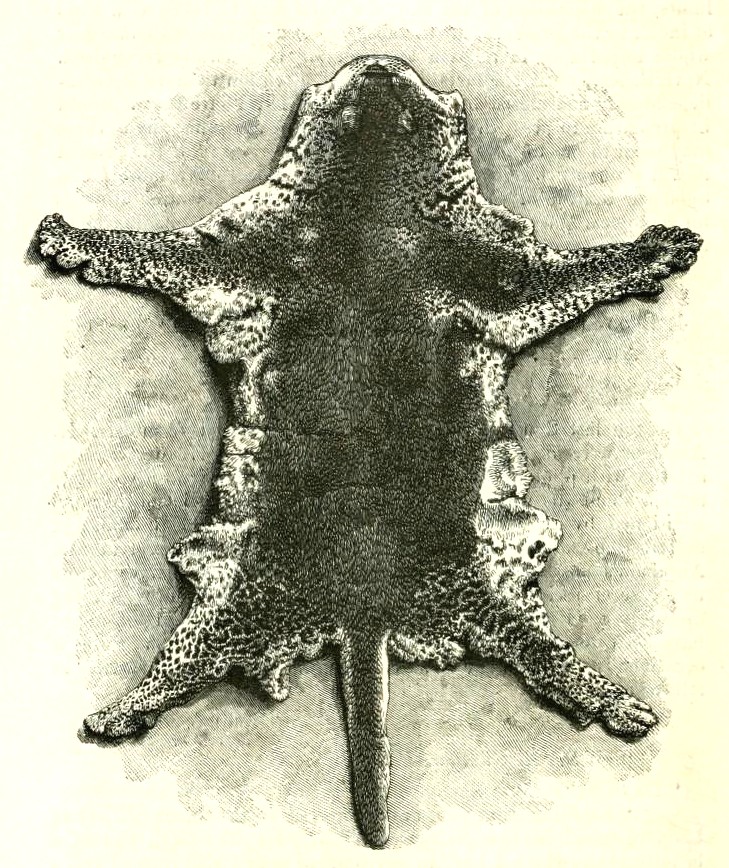
When I first saw his paintings of it, I immediately thought of two remarkable leopards that had been shot in the vicinity of Grahamstown, South Africa, during the 1880s (click here to see my documentation and pictures of them on ShukerNature; they are also chronicled in my three books on mystery cats). Dubbed melanotic at that time (but a term rarely used today), in each of these aberrant individuals the typical black-pigmented leopard rosettes had broken up on the flanks into tiny but very profuse black spots that in the upper dorso-lateral and dorsal regions had amalgamated into solid or near-solid expanses of black pigmentation, just as was exhibited by Pathé's singular bushbuck specimen.

In the case of the Grahamstown leopards (similar cases are also on record featuring other leopards, tigers, and at least one jaguar individual known to me), this abnormal patterning is nowadays referred to as pseudo-melanism, distinguishing it from true melanism.

For in the latter condition (which is responsible for all-black leopard specimens aka black panthers, and all-black individuals in many other animal species too), the pelage's black rosettes of the individual in question are unaffected but its background colour is abnormally dark, so much so in fact that it often obscures the presence of the rosettes. Conversely, as described above, in pseudo-melanism the background colour of the individual's pelage remains its usual shade but is virtually obscured dorsally and dorso-laterally by abnormal amalgamation and coalescing of the black rosettes into large expanses of solid black pigmentation plus intense black speckling elsewhere on the flanks.

 
Illustration from the 1880s depicting the dorsal view of the second melanotic Grahamstown leopard's skin, clearly revealing its remarkable pseudo-melanistic patterning, which is ostensibly reminiscent of the spotted bushbuck's patterning (public domain)

However, the fundamental problem with seeking to identify the spotted bushbuck skin as that of a pseudo-melanistic specimen is that in typical bushbuck specimens their markings are white, not black. So as bushbucks never normally possess any black markings at all, I cannot conceive how pseudo-melanism could create this specimen's unique pattern of black-pigmented spots and coalesced black spotting.

In contrast, it is possible that the skin represents an example of incomplete true melanism, whereby instead of the pelage of the individual in question being black all over, it exhibits melanism only in certain body regions, such as its back and flanks, for instance. In some cases involving very discrete, localized body regions, this is known as mozaicism, with one famous example being that of Ranger, a male lion born during the 1970s at Glasgow Zoo (then called Calder Park Zoo). His parents were of normal colouration, but he exhibited a large black region on his chest plus another one on his right foreleg (click here to see my documentation of Ranger on ShukerNature).

Whatever the precise explanation for this bushbuck skin's aberrant appearance, however, it is hardly surprising that Pathé was so interested it – but he was not the only one.

 
A sketch by Pathé of the spotted bushbuck's incomplete skin in dorsal view that appears on the cloth binding of his book's front cover (normally hidden beneath the dustjacket) (public domain)

Not long after purchasing the skin from Jimmy, Pathé received a visit from a renowned big game hunter/explorer of English-African-Indian heritage named Charles Sandiputt. He made a living from shooting rare specimens for rich Western clients and then charging them steeply for the privilege of acquiring these greatly-desired trophies, but he was currently running low both on funds and on gun cartridges, and hoped to purchase some of the latter from Pathé. While conversing, Pathé naively showed Sandiputt the spotted bushbuck skin, and although the hunter tried to disguise his excitement, it was clear to Pathé how very interested he was in it.

Sure enough, after examining the skin in detail, Sandiputt offered Pathé a sizeable sum of money for it (despite having pleaded poverty earlier), and also offered to go hunting with him in search of additional specimens. This last-mentioned offer in particular was an abrupt about-face to say the least, after just moments earlier having turned down Pathé's own suggestion for them to go hunting together, but that of course was before he'd seen the spotted bushbuck skin!

However, Pathé refused both of the hunter's offers, having realized by now that he'd made a mistake in revealing the skin's existence to Sandiputt, who departed not long afterwards without having secured from Pathé not only the skin but also any specific details regarding who had shot the animal itself and where. Some days later, however, Sandiputt surreptitiously reappeared, and was caught by Pathé questioning his native helpers on this very same subject, but having already been prompted by Pathé not to divulge any details about it to anyone, they remained tight-lipped.

To cut a lengthy story short: After Sandiputt had exited empty-handed a second time, Pathé soon sent Jimmy back to his Gola homeland to find the hunter from there who had shot the freak bushbuck, and secure his services in a search for living specimens, which Jimmy did. Pathé dubbed the hunter Bill, who then led Pathé and his hunting party to the mountainous regions upstream of the Little Mahé River in Gola. Here, with Jimmy serving as translator, Bill claimed to have not merely shot the specimen whose skin was now a closely-guarded possession of Pathé (he even took it with him on their Gola hunt, in order to ensure that it was not stolen in their absence if left unguarded back at Bangatown) but also to have seen several additional living specimens.

However, the hunt for these elusive antelopes proved unsuccessful, due in no small way to Pathé's alarming discovery that Sandiputt was also seeking these creatures in this very same vicinity and at the very same time as them, and that – in an example of devious intrigue worthy of high politics or industrial espionage – Bill was a veritable double agent. For he had already been contacted and cunningly hired in secret by Sandiputt to tire out Pathé's party so that they would quit the search and return to Bangatown, leaving behind Bill who would then lead Sandiputt in his own search, assisted by the local villages' inhabitants to whom Sandiputt had promised a big reward for a skin or information concerning where such antelopes could be found alive. Furthermore, Bill was to steal Pathé's boat too for travelling up the Mahé River, as Sandiputt didn't have access to one himself!

 
Bill with Charles Sandiputt, drawn by Pathé (public domain)

Ultimately, however, Sandiputt's dastardly ploy was all in vain, with none of his unscrupulous plans coming to fruition, because the ever-loyal Jimmy had made sure that Bill did not steal Pathé's boat, and neither party encountered any spotted bushbucks anyway (though Pathé did make a somewhat paradoxical claim that he and Bill briefly spied two such creatures together, only to directly contradict himself a little later in his book by saying that he had failed to find any – very strange). Ultimately, however, everyone returned home in apparent defeat, certainly with their respective quests for actual skins unfulfilled. But even then, the story was not quite over.

For not long after Pathé had arrived back in Bangatown with his party, his hut suffered an unexplained break-in, with no fewer than four of his locked iron cases and trunks having been forced open, yet nothing inside them had been taken. Bearing in mind that Pathé had been keeping the precious bushbuck skin locked in just such a case (he had several of them in his hut), he naturally suspected that whoever had broken in was seeking the skin but had chosen the wrong cases. Presumably, moreover, as Pathé's remaining cases (including the one that did contain the skin) had not been tampered with, the would-be burglar(s) must have come close to being disturbed, causing them to flee before having chance to force open any of the others.

Despite a thorough investigation taking place, no culprit was ever identified or apprehended, but Pathé reflected extensively upon the indisputable fact that when Sandiputt had first visited him, the hunter had witnessed him taking the skin out of one of these cases, so Sandiputt had been aware thereafter that this is where it was being kept. Moreover, Sandiputt had reappeared at Bangatown just a short time before the burglary had taken place (his excuse for doing so being that he wished to return Pathé's loaned cartridges to him), so he was known to have been in this precise location at that precise time. Coincidence?

After describing a feverish dream in which he had shot a spotted bushbuck, only to wake up and find that it had all been nothing more than a hallucination, and that it was now Christmas Day, Pathé made plans to travel back to Liberia's capital Monrovia and thence to Germany, duly arriving home in early 1938. Pathé had always planned to make his zoologically-valuable, unique spotted bushbuck skin freely available to science, so although it took him several months after returning to Germany before he actually did so, Pathé finally fulfilled his vow by donating it to the Zoological Museum at the Humboldt University of Berlin. In response, he received the following written communication from the then head of its mammal department, the eminent German zoologist Prof. Hermann Pohle (and which is translated here by Markus):

Dear Mr Pathé!

Thank you very much for sending me the fur from Monrovia. At first glance, I could see that no wild animal from which it could have come is known. A careful comparison then revealed that no domestic animal of this coloration is known either. Therefore, it is an unknown species or breed. Unfortunately, the fur is very incomplete; it is missing the head and legs. Therefore, it is unsuitable for a new description. It would therefore be of great value if you were able to travel to Liberia again and capture a complete animal, at least the fur and skull of one specimen.

Needless to say, however, Pathé did not do so, as WW2 would soon be changing the face of the world forever. Incidentally, Pohle's contemplation as to whether a domestic animal identity was tenable for the supposed spotted bushbuck pelt is intriguing, especially as there are speckled domestic goats, for example, whose torso pelts do recall that of the spotted bushbuck. Taking this line of thought further, one might even wonder if its head and limbs had been deliberately removed by its originator (Bill?) in order to disguise the fact that this is indeed all that it really was, just a domestic creature, not a wild animal at all. This certainly wouldn't be the first time that such subterfuge has happened with mysterious mammal specimens. However, Pohle seemed adamant that this was not the case here. and he was an extremely knowledgeable, experienced mammalogist, so I see no reason to disbelieve him - but recently ia much more serious issue has arisen regarding Pathé's specimen.

As is so depressingly frequent in sagas of physical, tangible cryptozoological specimens, Markus made a worrying discovery when he recently contacted the museum for information concerning the skin. Can you guess what he discovered? Yes indeed, there was no entry either for the skin itself or for the name Pathé on the museum collection's database! However, as he did learn, the collection isn't fully digitized as yet, so the skin may still turn up there, lurking meanwhile in anonymity somewhere within the museum's capacious basement, perhaps? Also, the database isn't accessible online at present anyway, after having gone offline in 2024 due to a cyber-attack, but hopefully at some stage in the future it will reappear online, enabling external researchers like Markus and myself to peruse it directly ourselves.

 
A sketch by Pathé from his book, depicting how he conceived the spotted bushbuck might have looked in life (public domain)

Also of note is that Markus succeeded in obtaining from the archives of Berlin's Natural History Museum seven pages of written correspondence between Pathé and Pohle, but there was only a single very brief reference in them to the spotted bushbuck. Namely, in a letter to Pathé dated 25 October 1946, Pohle expressed optimism that Pathé would soon resume travel back to Liberia (now that WW2 was over), and stated: "It seems to me that you must now finally find the mythical creature and bring it back, even if it is only a domestic animal", but as already noted here, that never happened, and given the unverified nature of its continuing presence in the Humboldt University Zoological Museum's collection, Pathé's spotted bushbuck skin is an even bigger enigma now than it was before!

And on that unsatisfactory, unresolved note, with its very existence, let alone its taxonomic or genetic identiy, an ongoing mystery, we must bid adieu at least for the time being to the anomalous antelope constituting the subject of this present ShukerNature article – the most comprehensive coverage of it ever published in the English language. Markus plans to prepare a German-language counterpart, which will be posted in due course in his own blog, and when it appears there I shall add a clickable link to it here.

Lastly, one of the most unexpected aspects of this entire saga is that Pathé does not appear to have actually stated anywhere in his book the precise year when his search for the spotted bushbuck took place, but due to some masterfully Sherlockian detective work by Markus, it seems safe to say that it was in 1937. This is because Markus uncovered a short newspaper report published on 28 April 1938 by the Bergische Post, in which it mentions that Pathé "has just returned from Liberia". Recalling that Pathé had specifically referred in his book to spending Christmas there, just before leaving Liberia to return home to Germany, this clearly identifies the year that he spent in Liberia as 1937.

If any additional news regarding the spotted bushbuck skin emerges, I'll include it here as an update. Meanwhile, my sincerest thanks go to Markus Hemmler and Michel Raynal for very kindly making so much relevant information available to me, thereby making my preparation of this article possible.

 
A vintage photograph of Moritz Pathé, from his book Mit Büchse und Palette im westafrikanischen Urwald (Franz Schneider Verlag: Berlin, 1944) (public domain)


Friday, 25 February 2022

A BLACKER SHADE OF DARK - THE GENETIC EXPLANATION FOR PSEUDO-MELANISTIC TIGERS, REVEALED AT LAST!

 
Exquisite painting of a pseudo-melanistic tiger, prepared specifically for my writings by acclaimed animal artist and longstanding friend Bill Rebsamen – thanks Bill! (© William M. Rebsamen)

True melanism is when an animal's background colour is abnormally dark (due to the expression of a mutant gene allele), so much so that any surface patterns or markings are hidden by it, as with the rosettes of a black leopard, for example.

Despite many eyewitness reports and anecdotal accounts on file, however, no melanistic or black tiger has ever been scientifically confirmed, and this exotic cat form thus remains a cryptid – claimed to exist by locals but not verified by science (for more details on ShukerNature regarding melanistic aka black tigers, click here).

Yet in recent years, following largely unconfirmed sightings dating back half a century, media reports have documented several living specimens in eastern India's Similipal Nature Reserve of what they refer to as black tigers. Photographs of these supposed black tigers, however, swiftly confirm that they are not melanistic specimens. Instead, they represent an equally intriguing but reverse phenomenon, known correctly as pseudo-melanism.

This is characterised by the animals' background colour being normal but their surface markings being abnormally abundant and broad, and having fused together to yield an almost unbroken, solid black mass of dark pigmentation, especially dorsally and upon the tigers' flanks, that has largely obscured the background colouration.

 
Skin of a reverse-coated pseudo-melanistic tiger from Similipal, India (© Dr Lala A.K. Singh)

Until very recently, the genetic basis of pseudo-melanism in tigers has remained unknown. In September 2021, however, a newly-published study in the journal PNAS (Proceedings of the National Academy of Sciences) conducted by a team of researchers from the National Centre for Biological Sciences (NCBS) in Bangalore revealed that this condition was the result of a rare mutation in one gene, Transmembrane Aminopeptidase Q (or Taqpep, for short).

Recessively inherited variants of this gene are also responsible for the markings in domestic cats, and in the ornately striped king mutant form of the normally spotted cheetah.

Moreover, whereas it has been estimated that up to 37% of all tigers in the Similipal Nature Reserve are pseudo-melanistic, there do not appear to be any such specimens anywhere else in India. The researchers believe this unusual situation to be due to a combination of a small founder population at Similipal, its isolation from other tiger populations, and inbreeding within the Similipal tiger population. Also, these tigers' darker colouration may be giving them a selective advantage when hunting in the shadowy forests of Similipal.

For further information on ShukerNature concerning pseudo-melanistic tigers, click here; and for feline pseudo-melanism in general, click here. See also this fascinating subject's coverage in my trilogy of cryptozoological cat books – namely, Mystery Cats of the World, Cats of Magic, Mythology, and Mystery, and Mystery Cats of the World Revisited.

 
My trilogy of cryptozoological cat books (© Dr Karl Shuker & Robert Hale Ltd/CFZ Press/Anomalist Books respectively)


Wednesday, 6 December 2017

DELINEATING THE DARKER SIDE OF LEOPARDS - ARE SOME MYSTERY CATS PSEUDO-MELANISTIC?


Chromolithograph from the PZSL, 3 March 1885, depicting the first Grahamstown pseudo-melanistic leopard as it would probably have looked in life, based upon its pelt's appearance (public domain)

To date, my very first book, Mystery Cats of the World, originally published in 1989 and now long out of print (but not out of copyright, incidentally), has yet to be republished. Regrettably, however, considerable chunks of its content can be found in uncredited and sometimes extensively plagiarised form on the Net within a number of websites. Consequently, unless readers of those particular sites are already familiar with my book, they will probably be entirely unaware that it is the original source of such material.

To redress at least a portion of this very unfortunate and frustrating situation, I am therefore presenting herewith the full text from my book concerning one of the most eyecatching but rarest categories of feline enigmas on record. Namely, pseudo-melanistic leopards, and their potential relevance to the identity of certain cryptozoological cats. My book was the first to document this very intriguing, thought-provoking subject in detail, including the discovery of pseudo-melanistic leopard specimens in both Asia and Africa, but once again its coverage has since been copied profusely online by others yet with very varying degrees of associated acknowledgement. I am also expanding its coverage, by incorporating some additional information and illustrations that I have encountered with regard to such cats during the period of almost 30 years that has passed since my book was published.


A MYSTERY FROM MALABAR

In certain parts of Asia, black panthers (i.e. melanistic specimens of the leopard Panthera pardus constituting a visibly distinctive morph resulting from the expression of the recessive non-agouti mutant allele of the agouti gene and described in more detail later here) are more common than the normal, spotted wild-type morph of the leopard. Conversely, pseudo-melanistic individuals from this continent are exceedingly rare, so much so in fact that I have only ever read of one confirmed specimen. It was originally documented in 1915 by H.O. Collins, as referred to fully below, within the Bulletin of the South California Academy of Science. Here is its noteworthy history.

Normal spotted wild-type version of the leopard (© JanErkamp/Wikipedia - CC BY SA 3.0 licence)

One of the magnificent and mysterious feline skins on record was purchased in December 1912 by Holdridge Ozro Collins from G.A. Chambers of Madras [now Chennai], India. Its predominant colour was an elegant glossy black and was described in 1915 by Collins as follows:

The wide black portion, which glistens like the sheen of silk velvet, extends from the top of the head to the extremity of the tail entirely free from any white or tawny hairs.

He goes on to say:

In the tiger, the stripes are black, of an uniform character, upon a tawny background, and they run in parallel lines from the center of the back to the belly. In this skin, the stripes are almost golden yellow, without the uniformity and parallelism of the tiger characteristics, and they extend along the sides in labyrinthine graceful curls and circles, several inches below the wide shimmering black continuous course of the back. The extreme edges around the legs and belly are white and spotted like the skin of a leopard....The skin is larger than that of a Leopard but smaller than that of a full grown Tiger.

The cat had been killed in Malabar, south-western India, earlier in 1912, and so unusual was its exceedingly handsome skin that Chambers had been totally unable to classify it, so that he wondered whether it could actually represent some hitherto unknown form of felid. To obtain an answer, Chambers had sent it to Madras's Government Museum for official identification. He subsequently received a letter from J.R. Henderson of the museum, who stated that, although the species was certainly leopard, it constituted a variety that he had never before seen. Collins also sought scientific advice concerning its status, and learnt from Dr Gerrit S. Miller Jnr, curator of the Smithsonian Institution's Division of Mammals in Washington DC, USA, that it was indeed a black leopard, but not of the normal melanistic type.

A normal melanistic leopard, aka black panther (© Qilinmon/Wikipedia - CC BY-SA 3.0 licence)

In fact, this remarkable skin was that of a pseudo-melanistic leopard, an extremely rare mutant known even today from only from a handful of specimens. In a normal melanistic leopard (i.e. black panther), its coat's background colour is abnormally dark, but its coat's rosettes are unchanged (so they can often still be spied in shadow-like form against its coat's dark background colouration, rather like a pattern on watered silk, when viewed at certain angles and in certain lighting conditions). Conversely, in a pseudo-melanistic leopard its coat's background colour is normal (orange-yellow) but is largely obliterated by abnormal fusion (nigrism) and multiplication (abundism) of the rosettes.

In extreme cases of pseudo-melanism, as demonstrated by Collins's specimen, this fusion and multiplication of the rosettes can be so extensive that virtually the entire upper body is covered in a solid mass of black colouration, with only occasional gaps present through which its coat's normal background colour is visible (appearing as orange streaks or spots). Faced with such a bizarre skin, it is little wonder that its owners had wondered whether it constituted a major zoological discovery.

King cheetah (© Steve Jurvetson/Wikipedia/Flickr - CC BY 2.0 licence)

Incidentally, less extreme occurrences of nigrism and abundism in the cheetah Acinonyx jubatus are responsible for the ornately striped and blotched pelage of a rare but very distinctive morph dubbed the king cheetah Acinonyx jubatus var. rex, which was once mistakenly thought to be a separate species from the normal spotted version. There are also a few visibly-comparable leopard counterparts to this cheetah variety on record, which I have duly referred to in my writings as king leopards. One Indian specimen, recorded as recently as 2012 from the Parambikulam forests in Kerala's Palakkad district, has sometimes been referred to online as a pseudo-melanistic leopard but its extent of abundism and nigrism is much less pronounced than that of the Malabar specimen or any of the Grahamstown specimens discussed below – instead, it is a classic king leopard.


A BEWILDERMENT OF BLACK LEOPARDS IN AFRICA

Surprisingly, and in stark contrast to the extremely abundant black panther of Asia, very few records exist of melanistic leopards in Africa. Considering that this latter continent has numerous localities whose habitats and climate correspond closely with those in Asia that support black panthers, the reason for this anomaly is quite obscure. In fact, the only areas from which true (i.e. non-agouti) melanistic leopards have been recorded with certainty are Ethiopia and Cameroon, plus the forests of Mount Kenya and Kenya's Aberdares mountains.

Yet, if we also take heed of the many unconfirmed reports of predominantly black, leopard-like cats from several other African regions, it would seem that African panthers of one form or another are (or were) more widespread - and varied - than science supposes.


SOUTH AFRICA'S MELANOTIC MYSTERY CATS

A mysterious felid of quite remarkable appearance was killed by a Mr F. Bowker during the early 1880s in a hilly, scrub-covered district 40 miles northeast of Grahamstown, in South Africa's Eastern Cape Province, and its flat skin was sent by him to German-born British zoologist Dr Albert Günther at London's Natural History Museum, where it remains today. Its coat's background colour was tawny, brightening to a rich orange gloss on the shoulders. Rosettes were virtually absent, being replaced mostly by numerous small separate spots, but these had coalesced dorsally to yield an unbroken expanse of black, stretching from its head right along to its tail base. In contrast to this specimen's richly hued upperparts, however, its underparts were principally white with large black spots, as in typical leopards, and it also bore the facial markings characteristic of this species. Its total length was 6 ft 7 in (including a 2.5- ft tail).

Dr Albert Günther (public domain)

Günther had initially entertained the possibility that this singular cat was actually a naturally-occurring leopard-lioness hybrid. However, as he reported on 3 March 1885 in the Proceedings of the Zoological Society of London (his report also containing the spectacular full-colour chromolithograph that opens this present ShukerNature blog article), Günther's detailed examination of its skin had ultimately revealed certain very specific but taxonomically significant features which, in combination with its already-noted leopard features, persuaded him that, despite its exotic colour scheme, its owner had indeed been nothing more than a leopard after all - albeit of a very spectacular pseudo-melanistic variety (and comparable with the Malabar specimen noted earlier in this ShukerNature blog article).

A year later, Günther received a second, even darker, glossier flat skin from a specimen of this same pseudo-melanistic variety, which had been shot at Collingham, approximately 20 miles from Grahamstown, and subsequently presented as a donation to London's Natural History Museum by its then-owner Reverend Nendrick Abraham (President of the Grahamstown Natural History Society). Utilising the detailed account contained in Abraham's accompanying letter, Günther formally documented this skin on 6 April 1886, once again in the Proceedings of the Zoological Society of London.

B/w photograph from the PZSL, 6 April 1886, of the flat skin from Abraham's Collingham-derived pseudo-melanistic leopard (public domain)

At least seven other, less striking pseudo-melanistic examples have been recorded (although, tragically, some of these no longer exist), including two pelts and sightings of two living specimens as reported by Abraham in his letter to Günther, but only from South Africa's Eastern Cape Province and none at all since the 20th Century's opening decade, as documented in 1987 by Dr Jack Skead (a former director of the Kaffrarian Museum in King William's Town) within a major review entitled Historical Mammal Incidence in the Eastern Cape. Skead's work was brought to my attention via some references to it in a CFZ Yearbook 1997 article on these exotic-looking leopards authored by Chris Moiser, who with fellow wildlife writer David Barnaby had viewed and photographed a mounted specimen at the Izoko South African Museum in Cape Town two years earlier.

In his PZSL report for 3 March 1885 concerning Bowker's pelt, Günther had dubbed this spectacular pseudo-melanistic leopard variety Felis leopardus [=Panthera pardus] var. melanotica. As a result, sometimes these extremely unusual felids are alternatively termed melanotic leopards.

As noted above, the Izoko South African Museum in Cape Town famously has on display a mounted specimen of a pseudo-melanistic leopard. In his CFZ Yearbook 1997 article, Chris Moiser revealed that this was purchased from a professional taxidermist based in Grahamstown in November 1898, and had apparently been shot 15.5 miles south of that town. Although somewhat faded with age nowadays, appearing brown rather than black, it is still visually arresting, as seen here:

The mounted pseudo-melanistic leopard on display at the Iziko South African Museum in Cape Town (© Lew Viergacht)

My sincere thanks to Lew Viergacht for so kindly making his two excellent photographs of this remarkable specimen available to me for inclusion in this ShukerNature blog article.


THE DAMASIA – DARK LEOPARD OR NEW SPECIES?

Well worth considering is whether a comparable variety could be the explanation for a still-unidentified African felid known as the damasia, which dwells - not surprisingly? - in Kenya's Aberdares [already documented in my book as the home of a controversial, diminutive form of spotted lion known as the marozi, as well as melanistic leopards, i.e. black panthers].

The damasia was referred to in a letter sent to The Field by G. Hamilton-Snowball and published on 9 October 1948, concerning his sighting of spotted lions on these mountains. In it, he also recalled that during the 1920s he had shot a creature that he had taken to be a leopard, albeit a very large, dark specimen. Yet when his Kikuyu attendants saw it, they announced that it was not a chui (leopard) but a damasia, and that a damasia was as different from a leopard as a simba (lion) was from a marozi. Apparently the damasia is well known to the Aberdares natives but is always mistaken by non-locals for a leopard.

Painting of a pair of marozis or Kenyan spotted lions, based upon a preserved skin and eyewitness descriptions (© William M. Rebsamen)

Tropical Africa's native tribes frequently classify animals by way of criteria very different from those used by scientists. Often an individual animal that is of a colour or size different from that of normal specimens of the same species, or an individual that is notably more aggressive than others of its own species, is given an entirely separate name by the natives and thought of as being of a form totally different from the more typical members of its species. Therefore it is certainly possible that, despite the Kikuyus' firm denial, the damasia really is just a dark-coloured (pseudo-melanistic?) leopard.

Since genuine black (melanistic) leopards are on record from the Aberdares, it would be interesting to learn whether the natives class them as leopard or damasia. Alternatively, considering that the Aberdares' primeval forests already house one mystery cat, in the form of the marozi, it is not inconceivable that they are hiding further zoological surprises too.


THE NDALAWO – BLACK-AND-GREY CRYPTO-CAT OF UGANDA

This Ugandan mystery carnivore was described by game warden Captain William Hichens in a Discovery article of December 1937 as follows: "...a fierce man-killing carnivore, the size and shape of a leopard, but with a black-furred back shading to grey below". A ndalawo skin was actually procured on one occasion but was sent out of the country before it could receive formal scientific attention. Consequently, its identity was never ascertained, and its whereabouts are now unknown.

African wildlife authority Captain Charles Pitman had previously recorded in his book A Game Warden Among His Charges (1931) that the ndalawo seemed to be a "partly melanistic leopard" (note the word 'partly', indicating that it was not a normal black panther), practically devoid of spots but displaying a few typical leopard markings on the extremities and round the lower jaw. This more detailed description is reminiscent of that cited by Günther for P. pardus var. melanotica; certainly, pseudo-melanistic leopards have paler underparts, unlike the uniformly-dark melanistic black panthers.

Second view of the mounted pseudo-melanistic leopard at the Iziko South African Museum (© Lew Viergacht)

Based upon pelage considerations alone, it is not implausible that the ndalawo may indeed prove to be a pseudo-melanistic leopard (albeit a less showy version than those from South Africa). However, there is more than just its pelage to consider: the ndalawo exhibits some rather unexpected traits for a mere leopard. For example, it allegedly hunts in threes or fours, and whilst hunting it gives voice to a most peculiar laugh. These traits are indicative of a hyaena.

Yet as Hichens pointed out, the ndalawo is very greatly feared as an exceedingly ferocious beast, whereas even the oldest woman in a native kraal is more than prepared to shoo away a hyaena that comes too close. If the ndalawo is a form of leopard, it is a very unusual one; in fact, out of all of the black mystery cats of Africa discussed here, the ndalawo is surely the one most likely to represent a hitherto unknown felid species.

Vintage sepia photograph of the Iziko South African Museum's mounted pseudo-melanistic leopard specimen as featured in The Mammals of South Africa, Vol 1 (1900), authored by the museum's then-director, W.L. Sclater, and showing how much darker it was a century ago than it is today, light-induced fading having taken its toll down through the intervening decades (public domain); my sincere thanks to Facebook friend Velizar Simeonovski for kindly bringing this illustration to my attention.


OTHER PSEUDO-MELANISTIC BIG CATS

Pseudo-melanistic specimens have also been confirmed from other big cat species, most notably the tiger P. tigris, with several examples recorded from Similipal and elsewhere in India (although these are often referred to incorrectly as melanistic specimens by the media), as documented by me in various publications (and also here on ShukerNature).

Exquisite painting of a pseudo-melanistic tiger in life as inspired by photographs of various pseudo-melanistic tiger pelts; produced specifically for me by William M. Rebsamen, it first appeared in an article of mine published by the now-defunct British monthly magazine All About Cats in its January-February 1999 issue, then again later that same year in my book Mysteries of Planet Earth (1999) (© William M. Rebsamen)

In addition, I once saw a close-up full-colour photograph of an exceedingly handsome pseudo-melanistic jaguar in captivity, but unfortunately I have no further details concerning this specimen.


AN ARTICLE OF MINE ON PSEUDO-MELANISTIC LEOPARDS

Finally: In addition to the above coverage directly excerpted and expanded from my Mystery Cats of the World book, I have also documented pseudo-melanistic leopards (albeit only briefly this time) in my second, more recent feline-themed book, Cats of Magic, Mythology, and Mystery (2011), as well as in a two-page article published by All About Cats in its May-June 1997 issue. Within that article, I was granted exclusive permission by David Barnaby and Chris Moiser to reproduce a colour photograph snapped by them in August 1995 during their viewing of the mounted specimen at the Iziko South African Museum, which I did. Regrettably, however, as with my writings about such cats, this photo has since turned up on various websites but without any accompanying credit given to David and/or Chris (hence in my opinion it seems unlikely that their permission for such sites to use it has been obtained, or even sought).

For those of you who may not have seen my All About Cats article, here it is – please click on each of its two scanned pages to enlarge it for reading purposes.

My two-page All About Cats article from May-June 1997 on the subject of pseudo-melanism and melanism in leopards and other big cats (© Dr Karl Shuker)