Dr KARL SHUKER

Zoologist, media consultant, and science writer, Dr Karl Shuker is also one of the best known cryptozoologists in the world. He is the author of such seminal works as Mystery Cats of the World (1989), The Lost Ark: New and Rediscovered Animals of the 20th Century (1993; greatly expanded in 2012 as The Encyclopaedia of New and Rediscovered Animals), Dragons: A Natural History (1995), In Search of Prehistoric Survivors (1995), The Unexplained (1996), From Flying Toads To Snakes With Wings (1997), Mysteries of Planet Earth (1999), The Hidden Powers of Animals (2001), The Beasts That Hide From Man (2003), Extraordinary Animals Revisited (2007), Dr Shuker's Casebook (2008), Karl Shuker's Alien Zoo: From the Pages of Fortean Times (2010), Cats of Magic, Mythology, and Mystery (2012), Mirabilis: A Carnival of Cryptozoology and Unnatural History (2013), Dragons in Zoology, Cryptozoology, and Culture (2013), The Menagerie of Marvels (2014), A Manifestation of Monsters (2015), Here's Nessie! (2016), and what is widely considered to be his cryptozoological magnum opus, Still In Search Of Prehistoric Survivors (2016) - plus, very excitingly, his four long-awaited, much-requested ShukerNature blog books (2019-2024).

Dr Karl Shuker's Official Website - http://www.karlshuker.com/index.htm

IMPORTANT: To view a complete, regularly-updated listing of my ShukerNature blog's articles (each one instantly clickable), please click HERE!

IMPORTANT: To view a complete, regularly-updated listing of my published books (each one instantly clickable), please click HERE!

IMPORTANT: To view a complete, regularly-updated listing of my Eclectarium blog's articles (each one instantly clickable), please click HERE!

IMPORTANT: To view a complete, regularly-updated listing of my Starsteeds blog's poetry and other lyrical writings (each one instantly clickable), please click HERE!

IMPORTANT: To view a complete, regularly-updated listing of my Shuker In MovieLand blog's articles (each one instantly clickable), please click HERE!

IMPORTANT: To view a complete, regularly-updated listing of my RebelBikerDude's AI Biker Art blog's thematic text & picture galleries (each one instantly clickable), please click HERE!

Search This Blog


PLEASE COME IN, I'VE BEEN EXPECTING YOU...

PLEASE COME IN, I'VE BEEN EXPECTING YOU...
WELCOME TO SHUKERNATURE - ENJOY YOUR VISIT - BEWARE OF THE RAPTOR!


Showing posts with label Madagascar. Show all posts

Thursday, 15 August 2013

THE BLACK INDRI – REVIVING ANOTHER MELANISTIC MYSTERY BEAST


Engraving of a predominantly black indri from Goodrich's book of 1885

A few days ago, I documented here on ShukerNature the rediscovery of a forgotten melanistic mystery beast – Brevet's black Malayan tapir. Now, a second such case has come to my attention.

Isn't it amazing what you can uncover on clip-art sites? While browsing through various of these a couple of nights ago in search of some public-domain animal images for various future writing projects, I came upon the remarkable engraving that opens this present ShukerNature blog post. It was labelled as an indri, but as can readily be observed here, what is so intriguing and unexpected about it is that it is almost entirely black. Only its face and brow, its hands and feet, and its throat appear somewhat paler in hue; the remainder of its body is totally black.

The indri or babakoto Indri indri is famous not only for being arguably the largest species of lemur known to be alive today on Madagascar (the diademed sifaka Propithecus diadema runs it an extremely close second), but also for its very striking black and white pelage.


A typical black-and-white indri (Erik Patel/Wikipedia)

What is not so well known, however, is that in reality this species' colouration varies dramatically through its zoogeographical range on its island home. To quote Nick Garbutt in Mammals of Madagascar (1999):

"Towards the southern limits, the basic colour is black with creamy-white patches on the crown, nape and throat, base of the back, fore-arms, thighs and lower legs – these areas may also be tinged with silver-grey or pale creamy-yellow. The face and muzzle are black and the ears are round, tufted and prominent. The eyes are yellow-green.

"At the northern extreme of the Indri's range pelage pattern is very different. Again the base colour is black, but pale grey and white regions are far less evident. The inner face is black, surrounded by a white facial disc which extends down the throat. There are white areas on the sides of the abdomen which extend under the armpits and there is a white pygal triangle at the base of the back which continues to the rump and includes the vestigial tail; the heels may also be pale grey or yellowish-white. White areas are completely absent on the forearms and upper hindlimbs.

"In some localities towards the centre of the Indri's range, for instance around Mananara, a mixed pattern occurs which is intermediate between the two extremes outlined above."

A taxiderm black-and-white indri at Tring Natural History Museum (Dr Karl Shuker)

Investigating the near-black indri engraving further, I discovered that it had originated from S.G. Goodrich's book The Animal Kingdom Illustrated (A.J. Johnson & Co: NY, 1885), appearing on p. 119.

Could there be any other antiquarian illustrations of black or near-black indri specimens online, I wondered. Despite spending a fair length of time pursuing this possibility, however, only two came to light, neither of which corresponded with the specimen from Goodrich's tome.


Engraving of a supposed black indri that is clearly not an indri at all

The animal depicted in the first of these images, reproduced above, is certainly all-black but is quite evidently not an indri at all. This is evinced not simply by its very long tail (the indri, conversely, is noted for being the only near-tailless modern-day lemur – hence its binomial synonym Indri brevicaudatus – 'short-tailed indri'), but also by its entire morphology. For this compares closely in size and proportions with one of the much smaller, true lemurs. I have been unable to ascertain the original source for this illustration.

In contrast, the second image, produced by French naturalist Pierre Sonnerat and derived from Johann von Schreber's series of animal tomes Die Säugthiere in Abbildungen nach der Natur mit Beschreibungen (Wolfgang Walter: Erlangen, 1775-92), and which is reproduced below, definitely shows an indri. Moreover, it corresponds well with Garbutt's above-quoted description of northern indri specimens.

A mostly black (northern?) indri illustrated by Sonnerat and appearing in Schreber's late 18th-Century series of animal tomes

So was Goodrich's engraving based upon an extreme example of the northern indri, or perhaps even upon a melanistic specimen of the southern indri - or could it simply have been an inaccurate illustration, possibly based only upon verbal descriptions, rather than upon physical specimens directly viewed by the artist? Was it even an indri at all?

With regard to this last-mentioned query, I did notice on a couple of websites that had reproduced this image the suggestion that perhaps it was a late-surviving relative of one of the officially-extinct giant lemurs. As documented extensively within my latest book, Mirabilis: A Carnival of Cryptozoology and Unnatural History (2013), that same explanation has also been proposed in relation to certain other Madagascan mystery beasts, such as the tratratratra, tokandia, and habéby.

Mirabilis, featuring a giant lemur on its front cover (Dr Karl Shuker/Anthony Wallis)

In this particular instance, however, the morphology of the animal in Goodrich's engraving is sufficiently detailed for there to be no doubt whatsoever that it is indeed intended to represent an indri – only the predominantly black colour of its pelage marks it out as different from more typical indri specimens.

In any case, there is also some wholly independent, and very exciting, proof to hand that readily confirms its identity as an indri. Namely, the current existence of living identical near-black specimens!

Nestled within the rugged mountains of northeastern Madagascar is the Anjanaharibe-Sud Special Reserve, which currently protects 42,488 acres of rainforest on the eastern slopes of the Anjanaharibe Massif, and is home to a number of very rare and unusual animals and plants – including what is referred to there as the black indri.

Photo of an Anjanaharibe-Sud black indri that is almost identical to the specimen portrayed in Goodrich's engraving (© Madagascar Biodiversity Partnership)

As its name reveals, this very distinctive form of indri is predominantly black, with only its face, hands, feet, and throat (plus in some specimens its rump, and/or a strip above its haunches) introducing any paler colouration. If such an extreme variety as this can exist today, as indeed it does, I see no problem in accepting that comparably dark-furred individuals were thriving little more than a  century ago – especially as even now, little is known about the black indri of Anjanaharibe-Sud. Also worth remembering is that far more rainforest was still present back in those times, before great swathes were felled during modern-day legal and (particularly) illegal logging activity, which means that much more habitat was available then to sustain these largest of living lemurs.

In short, I consider it likely that the mysterious near-black indri depicted in Goodrich's engraving was a northern indri specimen displaying extremely restricted paler pelage colouration. Another melanistic mystery mammal from the past duly revived and identified.

Primatologist Dr Russell Mittermeier holding an Anjanaharibe-Sud black indri (© Mireya Mayor)


Thursday, 8 November 2012

THE MADAGASCAN MAN-EATING TREE - MORE THAN JUST A MONSTROUS MYTH?

Artistic representation of the Madagascan man-eating tree created especially for my article 'Arboles Devoradores de Hombres' in the Spanish magazine Enigmas (March 1997)

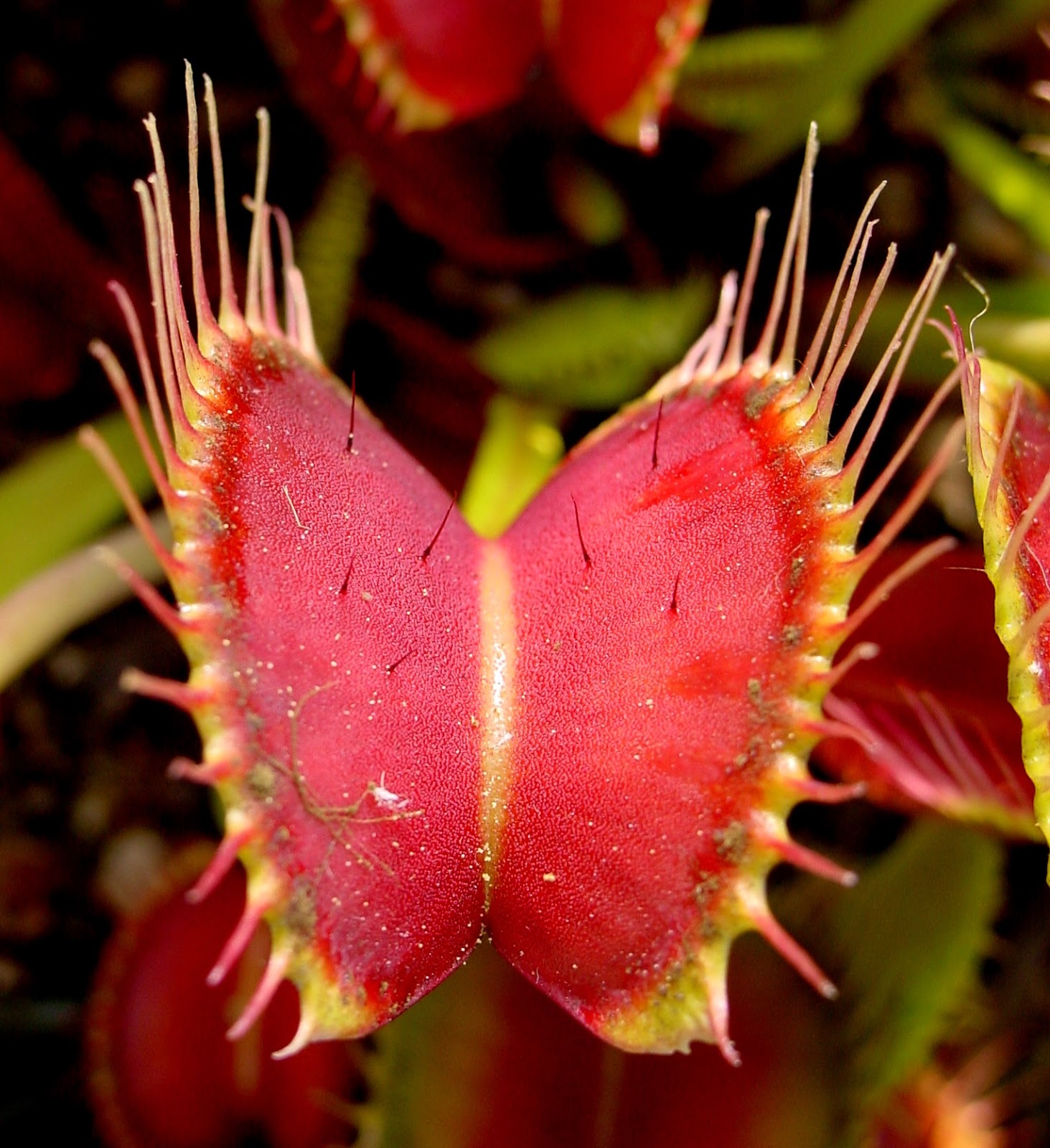
When the Venus flytrap Dionaea muscipula was first made known to botanists in the 1760s, they would not believe that it could actually catch and consume insects - until living specimens were observed in action. Moreover, reports have also emerged from several remote regions of the world concerning horrifying carnivorous plants that can ensnare and devour creatures as large as birds, dogs, and monkeys - and sometimes even humans!

Venus flytrap (Noah Elhardt/Wikipedia)

Once again, however, these accounts have been received with great scepticism by science - relegating them to the realms of fantasy alongside such fictitious flora as Audrey II, the bloodthirsty 'Green Mean Mother' star of the cult movie musical Little Shop of Horrors (1986) and its b/w non-musical predecessor from 1960. But could such botanical nightmares really exist?

A somewhat lurid illustration of an alleged man-eating plant from Strand Magazine, September 1899

Perhaps the most incredible case on file is one that first came to Western attention via an extraordinary letter allegedly received during the early 1870s (differing accounts give different dates) by Polish biologist Dr Omelius Fredlowski (sometimes spelt 'Friedlowsky'). According to the letter's contents, at least one Western explorer claimed to have witnessed an all-too-real, fatal encounter with a rapacious botanical monster (as portrayed vividly in the illustration opening this present ShukerNature article of mine) that would put even the worst excesses of Audrey II to shame!

The letter was from Carl Liche (also variously given as 'Karl' and as 'Leche' in a variety of combinations!), a German explorer who had been visiting a primitive tribe called the Mkodos on the island of Madagascar. While there, he and a fellow Westerner called Hendrick were shown a grotesque tree, which the Mkodos referred to as the tepe,  and to which humans were sacrificed:

"If you can imagine a pineapple eight feet high and thick in proportion resting upon its base and denuded of leaves, you will have a good idea of the trunk of the tree, a dark dingy brown, and apparently as hard as iron. From the apex of this truncated cone eight leaves hung sheer to the ground. These leaves were about 11 or 12 ft long, tapering to a sharp point that looked like a cow's horn, and with a concave face thickly set with strong thorny hooks. The apex of the cone was a round white concave figure like a smaller plate set within a larger one. This was not a flower but a receptacle, and there exuded into it a clear treacly liquid, honey sweet, and possessed of violent intoxicating and soporific properties. From underneath the rim of the undermost plate a series of long hairy green tendrils stretched out in every direction. These were 7 or 8 ft long. Above these, six white almost transparent palpi [tentacles] reared themselves toward the sky, twirling and twisting with a marvellous incessant motion. Thin as reeds, apparently they were yet 5 or 6 ft tall."

Suddenly, after a shrieking session of prayers to this sinister tree, the natives encircled one of the women in their tribe, and forced her with their spears to climb its trunk, until at last she stood at its summit, surrounded by its tentacle-like palpi dancing like snakes on all sides. The natives told the doomed woman to drink, so she bent down and drank the treacle-like fluid filling the tree's uppermost plate, and became wild with hysterical frenzy:

"But she did not jump down, as she seemed to intend to do. Oh no! The atrocious cannibal tree that had been so inert and dead came to sudden savage life. The slender delicate palpi, with the fury of starved serpents, quivered a moment over her head, then fastened upon her in sudden coils round and round her neck and arms; then while her awful screams and yet more awful laughter rose wildly to be instantly strangled down again into a gurgling moan, the tendrils one after another, like green serpents, with brutal energy and infernal rapidity, rose, retracted themselves, and wrapped her about in fold after fold, ever tightening with cruel swiftness and the savage tenacity of anacondas fastening upon their prey. And now the great leaves slowly rose and stiffly erected themselves in the air, approached one another and closed about the dead and hampered victim with the silent force of a hydraulic press and the ruthless purpose of a thumb screw.

"While I could see the bases of these great levers pressing more tightly towards each other, from their interstices there trickled down the stalk of the tree great streams of the viscid honeylike fluid mingled horribly with the blood and oozing viscera of the victim. At the sight of this the savage hordes around me, yelling madly, bounded forward, crowded to the tree, clasped it, and with cups, leaves, hands and tongues each obtained enough of the liquor to send him mad and frantic. Then ensued a grotesque and indescribably hideous orgy. May I never see such a sight again.

"The retracted leaves of the great tree kept their upright position during ten days, then when I came one morning they were prone again, the tendrils stretched, the palpi floating, and nothing but a white skull at the foot of the tree to remind me of the sacrifice that had taken place there."

Liche subsequently dubbed the tepe Crinoida dajeeana (after a fancied resemblance to the starfish-related crinoids or sea-lilies, and in honour of a noted Bombay physician, Dr Bhawoo Dajee), but he was not the only visitor to Madagascar to learn of this nightmarish species. Chase Salmon Osborn, Governor of Michigan from 1911-13, journeyed to Madagascar during the early 1920s in the hope of seeing for himself the terrible tree. Sadly for science (but perhaps fortunately for him!), he did not succeed in locating one, but he discovered that it was well-known to natives all over the island, and even some of the Western missionaries working there believed in its existence. He also claimed he had learnt that from the very earliest times Madagascar had been known as 'the land of the man-eating tree', which he used as the title of a book that he later wrote about his sojourn in Madagascar (though the tepe itself scarcely featured in it).

Artistic representation of the Madagascan man-eating tree or tepe (Tim Morris)

Nevertheless, there is much to doubt in Liche's testimony regarding this herbaceous horror - not least of which is whether Liche himself ever existed! Eminent biochemist and cryptozoologist Dr Roy P. Mackal, now retired from the University of Chicago, devoted an entire chapter to the Madagascan man-eating tree in his book Searching For Hidden Animals (1980), but was unable to discover any background history concerning Liche, and even the original publication source of Liche's letter remains a mystery.

No less controversial is the morphology of the man-eating tree, for Liche's description brings together an extraordinary (and highly unlikely) collection of specialised structural features seemingly drawn from several wholly different, unrelated groups of plants. As Roy justifiably pointed out, such an amazing combination of characteristics could not reasonably be the outcome of effective evolutionary adaptation. Moreover, its ever-animate, writhing palpi are unlike any structure ever reported from any known species of plant.

Man-eating plant from the front cover of an issue of the fiction magazine Amazing Stories

Consequently, Roy dismissed the existence of Madagascar's man-eating tree, at least in the form attributed to it by Liche. However, as he noted when concluding his chapter dealing with this lethal entity, Liche's description may be a highly-embellished, exaggerated account of a real but smaller, less dramatic species of carnivorous plant native to Madagascar:

"It may well be that there existed or still exists an unknown relatively large carnivorous plant that has one or two of the adaptations described for trapping birds or other smaller arboreal creatures. There are still large forest areas, especially in the southeastern and south-central portions of Madagascar, that would be interesting to explore."

Certainly, any region of the world that has offered up for scientific scrutiny as many truly unique, endemic species as this veritable island continent has already done must surely retain the potential for concealing some major biological surprises even today.

Another artistic depiction of the man-eating tree (artist unknown to me)

Indeed, there may even be some photographic evidence for the existence of such a plant. Czech explorer Ivan Mackerle is probably best-known in cryptozoological circles as the most famous modern-day seeker of the Mongolian death worm (click here for my ShukerNature article on this cryptid). However, he also has a longstanding interest in stories of mysterious flesh-eating flora, and in 1998 he led a month-long expedition to Madagascar, in order to investigate reports of the man-eating tree. Moreover, in a letter to me concerning this, Ivan included a truly tantalising snippet of information of which I was not previously aware.

Ivan Mackerle seeking the tepe in Madagascar (Ivan Mackerle)

In 1935, a former British army officer called L. Hearst apparently spent four months in Madagascar, and while there he took photographs of some unknown species of tree under which lay the skeletons of various sizeable animals. According to Ivan, these photos were later published somewhere, but he has been unable to find out where. Some scientists who saw the photos claimed that they were fakes, so Hearst returned to Madagascar to obtain more convincing proof, but died in mysterious circumstances.

This, at least, is the story that Ivan has pieced together, but he has been unable as yet to provide conclusive corroboration for it. So if anyone reading this ShukerNature article has any relevant information, or knows where the tree photos were published, I'd be very interested to receive details. As for Ivan's own Madagascar expedition, he was unable to uncover any evidence in support of Liche's claims. In a letter to me of 21 September 1998, Ivan wrote:

"We had taken a Malagasy guide and interpreter with us, who lives in Prague and knows Czech. And so we could speak with the natives about mysteries. We had travelled all over the country, mainly in the south region. It is interesting, but no-one had known anything about the man-eating tree. Neither people in town (botanists, journalists, etc) nor natives. They had heard only about pitcher plants. Natives know killer trees but no man-eating ones. The story of Karl [sic] Liche is unknown there. We spoke with many botanists. I could not believe it, because I had supposed that it was a widespread legend there. But killer trees are also very interesting. Many of them are little-known or unknown to science. We found the killer tree 'kumanga', which is poisonous when it has flowers. We took gas-masks for protecting ourselves, but the tree did not blossom at that time. We had seen a skeleton of a dead bird and a dead turtle [tortoise] under the tree. The tree grows only in one place in Madagascar and it is rare today. It was difficult to find it."

So it would appear that even though the man-eating tree is seemingly non-existent, Madagascar can still tantalise mainstream botany, courtesy of the kumanga killer tree. As Ivan's team encountered it, this mystifying species clearly exists - but what can it be, and is it truly capable of achieving the lethal effects claimed by the local people? Mindful that a number of harmless plants on Madagascar have been accredited with all manner of sinister talents in Malagasy folklore, it would hardly be surprising or unprecedented if the kumanga's deadly tendencies owe more to imaginative fiction than biological fact. Conversely, I have so far been unable to determine the kumanga's taxonomic identity - could it therefore be unknown to science, echoing Ivan's above-quoted words? There are evidently some notable mysteries of the cryptobotanical kind still awaiting resolution on the exotic island of Madagascar.

It's behind you!! Me standing bravely in front of a truly gargantuan pitcher plant statue in a park in Kuala Lumpur, Malaysia (Dr Karl Shuker)

Of particular interest in relation to the Madagascan man-eating tree is a claim published in 1888 within the second issue of the magazine Current Literature by its founder, Frederick Maxwell Somers. Namely, that the entire tale of the tepe was nothing more than an inventive work of fiction penned several years earlier by journalist Edmund Spencer, who wrote for the New York World, which just so happened to have been the first media publication to report Liche's man-eating tree account in an exclusive article published on 28 April 1874. And certainly, it is true that no evidence for the ertswhile existence of any of the story's protagonists - Liche, Fredlowski, the Mkodos - has ever been unearthed by investigators of the Madagascan man-eating tree. Unfortunately for the credibility of Somers's claim, however, the same is also true regarding Edmund Spencer! So do we have a genuine hoax here, or do we have a hoaxed hoax?

Moreover, in a further and highly unexpected twist to the long-running saga of Madagascar's missing man-eating tree, Canadian researcher W. Ritchie Benedict revealed in 1995 that he had uncovered a published but hitherto-unpublicised Canadian newspaper account (The Watchman, New Brunswick, 29 May) regarding this cryptobotanical wonder dating back to 1875, and which indicates an origin for it not in Madagascar but in New Guinea!

How ironic it would be if the reason why the greatest mystery plant of all time has never been scientifically exposed is that everyone has been looking for it on the wrong island!

1887 illustration of the reputed ya-te-veo from Central America  

For many more mystery plants of prey - including a reputed Central American equivalent of the Madagascan man-eating plant, called the ya-te-veo - check out my book The Beasts That Hide From Man (Paraview, 2003), which contains the most comprehensive coverage of such plants ever published.

Official poster featuring Audrey II for the 1986 film musical Little Shop of Horrors (Warner Bros)


Thursday, 24 February 2011

NEVER TANGLE WITH A TYGOMELIA - OR TANGO WITH A TOKANDIA!

Tygomelia (Tim Morris)


Having taken many years to summon up enough courage to air in public this particular post's alliterative extravaganza of a title, I now have to justify it - so here goes!

For every Nessie, bigfoot, Beast of Exmoor, yeti, or Mongolian death worm, there is a veritable host of other, far less familiar mystery beasts on record - elusive creatures that have been all but forgotten even by the cryptozoological cognoscenti, let alone by mainstream scientists. Consequently, I am using this post to spotlight three of my particular favourites from this forgotten company of cryptids - a unique trio of weird but very wonderful examples that appear somehow to have slipped through the cracks between the paving stones of cryptozoological prominence, and have descended ignominiously into the dark realms of scientific obscurity.


TYGOMELIA – A GIRAFFE IN MOOSE’S ANTLERS?

One of the most incredible of putative crypto-crossbreeds made its media debut in an Ottawa Times newspaper article of 22 November 1870, after which it vanished from the headlines as swiftly as it had entered them:

"Sir John E. Packenham, an officer in the English army, who has been spending the last year in her Majesty's northern provinces, arrived at Fort Buford [in North Dakota] with an animal of rare beauty, and never before caught on this continent, nor has it been known till late years that the species existed in this country. It is of the same family as the giraffe, or camelopard, of Africa, and is known to naturalists as the tygomelia. They are known to inhabit the high table lands of Cashmere and Hindoo Kush, but are more frequently seen on the high peaks of the Himalaya Mountains. The animal was taken when quite young, and is thoroughly domesticated, and follows its keeper like a dog. It is only four months old, and ordinarily stands about five feet high, but is capable of raising its head two feet, which makes the animal seven feet when standing erect. It is of a dark brown mouse color, large projecting eyes, with slight indications of horns growing out. The wonderful animal was caught north of Lake Athabasca, on the water of the McKenzie's River. It has a craw similar to the pelican, by which means it can carry subsistence for several days. It was very fleet, being able to outfoot the fastest horse in the country. The black dapper spots on the rich brown color make it one of the most beautiful animals in existence, more beautiful than the leopard of the Chinese jungle. Sir John did not consider it safe to transport this pet by water down the Mississippi River, fearing the uncertain navigation and the great change of climate from the Manitoba to the sunny south. He has, therefore, wisely concluded to go by way of St. Paul, Minnesota. The commander of Fort Buford furnishes him with an escort for the trip. He will then proceed through Canada to Montreal, where he will ship his cargo to England. "

In reality, no such beast is known from India or North America (or, indeed, from anywhere else!). Moreover, the only plausible suggestion regarding its identity that has been offered to date (always assuming, of course, that the report was not a journalistic spoof) is one suggested by Edmonton-based cryptid investigator Kevin Stewart. Namely, that this ‘tygomelia’ was a young, freakishly-mottled moose Alces alces (such specimens have occasionally been documented in the wild). But with no images or further accounts of it known to exist, there is little likelihood that we shall ever know for sure.


The rose-horned, claw-footed cryptid of Fredericksburg (Tim Morris)


A ROSE-HORNED, CLAW-FOOTED ENIGMA

A comparably curious mystery beast was the snowy-furred, rose-horned, goat-like creature constantly seen in the company of a Comanche woman visiting the town of Fredericksburg, Texas, during the first half of the 19th Century. What made it much more intriguing, zoologically speaking, than any goat, however, was its size – no bigger than a cat – and, remarkably, the fact that its feet were clawed, not hoofed.

According to the Abbé Emanuel Domenech, a Texas missionary who documented this walking wonder in his book Missionary Adventures in Texas and Mexico (1858), an American officer, who had told him about the woman’s strange pet, had offered her 500 francs for it. However, she would not sell it to him or to others who had also offered riches, stating that she knew of a wood where these animals lived in abundance. She promised that if she ever returned she would catch some for them, but apparently she never did return.

As this odd little animal inexplicably combines the horns of an ungulate (hoofed) mammal with the claws of a non-ungulate, its identity is certainly mystifying. True, a few fossil ungulate forms with claws instead of hooves are known from the palaeontological record, including chalicotheres and certain notoungulates, but these all died out long ago – didn’t they?


TOKANDIA – A LOST GIANT FROM MADAGASCAR

Madagascar is unquestionably the kingdom of the lemurs, with approximately 100 species currently known and new ones still being discovered here on a regular basis. A mere millennium ago, however, there were even more – and some of them were quite enormous, far bigger than any species known to exist today. Officially, these mega-lemurs are long extinct, but native Malagasy folklore and superstition include accounts of various monsters that bear more than a passing resemblance to certain of these ‘lost’ giants. A case in point is the tokandia.

According to local legends, this supposedly mythical, largely terrestrial beast was as big as a bear, and moved on the ground via a dancing series of bounding leaps, but would also on occasion jump into the trees and spend time there. Although not man-like in form, it was said to utter very man-like cries. Is it just a coincidence that the only known fossil creature recorded anywhere in the world that closely resembles the tokandia’s description both in form and in predicted behaviour just so happens to be the koala lemur Megaladapis edwardsi - a huge semi-terrestrial Madagascan species weighing around 75 kg, and known to have still existed here as recently as 1500 AD? Perhaps a few reclusive individuals survived even later, inspiring the legends of the tangoing tokandia.


A 19th-Century engraving of Megaladapis - identity of the tokandia?


Wednesday, 29 December 2010

BETWEEN A ROC AND A HARD PLACE

One of my roc feathers (Dr Karl Shuker)

The main shopping centre of Birmingham, the United Kingdom’s second largest city, is replete with unique shops and market stalls selling all manner of interesting and often quite esoteric items. Even so, the last thing that I expected to find there when casually browsing in a certain large fancy goods shop a couple of years ago was a sheaf of roc feathers! But that is precisely what I did find, much to my astonishment and delight. Allow me to explain.


Two rocs attacking Sinbad's ship


According to Eastern legend and lore, the mighty roc or rukh - featuring as one of Sinbad the Sailor’s most formidable protagonists in the ‘Arabian Nights’ - was said to be a monstrous bird of such prodigious size and strength that it could haul elephants aloft, and carry them away to its gargantuan nest where its brood of hungry super-sized offspring would feed upon these hapless pachyderms. For decades, zoologists and cryptozoologists alike attempted to explain the mythical roc as having been based upon sightings of a gigantic ostrich-like ratite known scientifically as Aepyornis maximus, the great elephant bird, standing 10 ft tall and weighing up to half a ton.


The roc carrying off an elephant


Formerly native to Madagascar, this avian goliath inhabited the extensive marshes and swamps once present on this large island mini-continent, and was known locally as the vouronpatra or vorompatra. It is believed to have survived until at least as recently as the late 1700s, before a lethal combination of over-hunting, introduced avian diseases, and deforestation leading to the drying out of its swampland habitat brought about its demise, but fragments from its enormous eggs can still be commonly found on beaches here.


With an Aepyornis egg and a life-size Aepyornis silhouette (Dr Karl Shuker)

Unfortunately, reconciling the roc with the great elephant bird faced one major problem. Aepyornis was flightless, and therefore wholly incapable of abducting unwary elephants and swooping off into the air with them, gripped tightly in merciless talons of steel as those dusty Arabian legends would have us believe. Nevertheless, on account of its huge size, the great elephant bird remained the closest match – indeed, the only remotely plausible match – for the fabled roc...until 1994, that is.

This was when palaeontologist Dr Stephen M. Goodman published a paper documenting the subfossil remains of a hitherto-unknown species of huge eagle, which he formally christened Stephanoaetus mahery, the Madagascan crowned eagle, and which is believed to have survived on the island until around 1500 AD (both it and its prey were probably hunted into extinction by humans). This spectacular raptor is thought to have preyed not only upon various now-extinct species of giant lemur (subfossil remains show that some weighed up to 26.5 lb) but also quite possibly upon the great elephant bird itself. Clearly, sightings of this mega-eagle made by early European explorers visiting Madagascar and subsequent exaggeration of these sightings during retellings when back home provide a much more likely explanation for the origin of the roc legends than does the flightless elephant bird.

Yet not even Madagascar’s colossal crowned eagle can explain the truly immense plumes that crusaders sometimes purchased in the Middle East to delight and bewilder their families and friends back home in Europe. Claimed by their Arabian vendors to be genuine roc feathers, they sometimes measured 3 ft or more in length, and their vanes’ blades were razor-sharp to the touch.

In reality, of course, these spectacular objects were not feathers at all. They were actually the extremely long leaves of the raffia palm tree Raphia regalis (and related species), but they were certainly convincing enough in their superficial resemblance to gigantic feather to fool the unsuspecting crusaders into spending their hard-earned money on them as exotic souvenirs.

Moreover, when I first came upon the tall vase containing sheafs of these wonderful objects in that Birmingham shop, for just a few moments I too shared the shock and wonder that those crusaders must have experienced when first they saw them. A few of these pseudo-plumes stood nearly half as tall as I am (5’10”), and whereas some were brown, others were an exotic jungle green. Once I’d recovered from my shock, I knew at once what they were, but I still marvelled at finding such cryptozoological curios in such a relatively mundane locality as a high street shop in Birmingham, rather than some mysterious, shadowy souk in the depths of an Arabian kasbah.

Picking a few up – and soon discovering how painful it was when their sharp vanes stabbed into my hands! – I could definitely understand how their wily vendors in those far-distant Middle Eastern lands and times had talked the naïve crusaders into believing that these fantastic objects were roc feathers. Indeed, part of me even wanted to believe it myself!

Instead, however, I satisfied myself with the knowledge that here were some wonderful additions to my collection of zoological esoterica, but I received a final shock when I took half a dozen of the green versions (which looked much more feather-like than the plainer brown ones) to the till to pay for them. Incredibly, all six together totalled less than £2, making them without a doubt the best cryptozoological bargains that I had ever purchased!

A month or so ago, I found myself back inside that very same Birmingham shop, but its remaining roc feathers were long gone - which, I suppose, is no more than one should ever expect when dealing with imaginary monsters!

Wednesday, 17 March 2010

MORE MADAGASCAN MYSTERY MAMMALS

Yes, I do enjoy the occasional alliteration!

African pygmy hippopotamus (Dr Karl Shuker)

But seriously: in a recent ShukerNature blog entry, I documented a selection of reports suggesting the possible survival into recent history of various giant lemurs on Madagascar. However, these are not the only cryptozoological mammals on record from this Indian Ocean island mini-continent, as demonstrated by the following pair of enigmas.


WHAT’S IN A (VERY LONG) NAME? THE KILOPILOPITSOFY

Also known as the tsomgomby, lalomena, or railalomena, the kilopilopitsofy is an unidentified beast spoken of by the Belo-sur-mer villagers to scientists Dr David A. Burney and Ramilisonina during their ethnographical researches on Madagascar in the mid-1990s.

As with a mystery lemur called the kidoky (see my earlier blog), they received consistent reports of this mystery animal from several different eyewitnesses, including, once again, Jean Noelson Pascou, who was able to describe the kilopilopitsofy in considerable detail, following his own sightings of it, one of which was made as recently as 1976. According to Pascou, it is cow-sized but hornless, has very dark skin, pink colouration around its eyes and mouth, fairly large floppy ears, big teeth, large flat feet, is nocturnal, and escapes from danger by running into the water.

When shown photos of various animals, another kilopilopitsofy eyewitness selected a hippopotamus as bearing the closest resemblance to the kilopilopitsofy. Moreover, when asked to describe the sounds that the latter mystery beast makes, Pascou, who was well known in the village as a skilled imitator of local animal noises, gave voice to a series of deep, drawn-out grunts, which the startled scientists realised were very similar to the sounds made by the common African mainland hippopotamus. Yet no species of hippopotamus is supposed to exist on Madagascar – or not any longer, that is.

Alongside the hippos statue at Marwell Zoo, July 2013 (Dr Karl Shuker)

In fact, living alongside the giant lemurs on Madagascar were once no less than three different species of endemic Malagasy hippopotamus. These were: the lesser Malagasy hippo Hippopotamus laloumena (a small relative of the common African mainland species, H. amphibius); the Malagasy dwarf hippo H. lemerlei (an even smaller, dwarf species); and the Malagasy pygmy hippo Hexaprotodon madagascariensis (a distinctive pint-sized species more closely related to the African mainland pygmy hippo). Just like the giant lemurs finally became extinct, however, so too did all three Madagascan hippo species, once again having been hunted and eaten by humans, but with subfossil evidence confirming that at least one species, the Malagasy dwarf hippo H. lemerlei, was still alive as recently as 1000 BP. Furthermore, judging from the testimony of Pascou and others with regard to the mystifying kilopilopitsofy, zoologists as well as cryptozoologists now consider it plausible that at least one of Madagascar’s diminutive trio of hippos actually persisted into much more recent times, and perhaps even into the present day.

As for this mystery beast’s floppy ears, they deem it possible that these were actually loose jowls and cheeks, misidentified as ears when seen fleetingly at night. Alternatively, it may be that they really are ears, larger than those of typical hippos, which have evolved to help dissipate heat if, as seems to be the case, the dwarf hippo in particular was (or is?) more terrestrial than typical hippos.

In 1876, the skin of an alleged tsomgomby was actually shown to Westerner Josef-Peter Audebert, who likened it to that of an antelope (no species of which exists on Madagascar), and stated that it had supposedly come from the south of the island. If only this skin had been preserved – DNA analyses would have unmasked its owner’s identity and, perhaps, finally resolved the longstanding mystery of this very perplexing Madagascan cryptid.


FUSSING OVER A FOSSA

Known zoologically as Cryptoprocta ferox, the fossa is Madagascar’s largest native mammalian carnivore, and superficially resembles a small long-tailed puma, but is more closely related to the civets and genets (viverrids). It has a total length of 1.4-1.7 m, but there was once an even bigger species, the giant fossa C. spelia, which measured a formidable 3 m long. Although officially believed to have died out at least several centuries ago, reports of a very large, fierce cat-like beast stalking this island’s most inaccessible forests and known locally as the antamba have led to speculation that perhaps the giant fossa may still exist. As might be expected, the antamba did not escape the attention of the indefatigable Admiral de Flacourt, who documented it as follows:

The Madagascar antamba is an animal as large as a dog, with a round head, and, according to the relations of the Negroes, resembling the leopard. It devours both men and cattle, and is only found in the most desert[ed] parts of the island.

In November 1999, fossa expert Luke Dollar, intrigued by persistent rumours concerning the antamba, trekked in search of it through northeastern Madagascar’s Zahamena National Park, also known as the Impenetrable Forest, and said to harbour this elusive beast. Unfortunately, he did not sight it, but has not given up hope that it does exist, as most of this uninviting region has never been scientifically explored.

Fossas have enormously long tails in proportion to their total body length (Dr Karl Shuker)

Also worth noting is that, although once again still-unconfirmed by science, there have been a number of reports of melanistic (all-black) fossas in certain eastern rainforest areas of Madagascar.

Fossa (public domain) 


Wednesday, 17 February 2010

MADAGASCAR'S ELUSIVE MEGA-LEMURS AND MINI-MEN


Restoration of Palaeopropithecus ingensin life (Markus Bühler)


The fourth largest island in the world, Madagascar is a veritable miniature continent, brimming with extraordinary animals found nowhere else in the world, including such exotic avifauna as vangas and neodrepanidids, remarkable reptiles that include boas more closely-related to counterparts in South America than to any Old Word snakes plus the world’s greatest diversity of chameleons, and, most famous of all, its wonderful assemblage of lemurs and exotic striped civets. Yet as if all of these were not exciting enough, only a few centuries ago in some cases this zoological treasure trove of endemics also boasted some truly astonishing animals – and none more so than its impressive number of giant lemurs far bigger than anything known to exist today. Today, of course, these creatures are long gone – or are they? Read this investigation of Madagascar’s most astonishing mystery beasts – and decide for yourself.

TRATRATRATRA GOODBYE…?
In 1658, after having resided in Madagascar for a number of years as its governor, French explorer Admiral Étienne de Flacourt published a major tome, Histoire de la Grande Isle de Madagascar, which documented his experiences and discoveries here. It contains a wealth of zoological information, some of which is also of cryptozoological interest, including the following passage:

"Trétrétrétré [or tratratratra in English] is an animal as big as a two-year-old calf, with a round head and a man’s face; the forefeet are like an ape’s, and so are the hindfeet. It has frizzy hair, a short tail and ears like a man’s…One has been seen near the Lipomani lagoon in the neighbourhood of which it lives. It is a very solitary animal, the people of the country are very frightened of it and run from it as it does from them."

At the time, this report was dismissed by European naturalists as nothing more than native folklore. Also discounted were the description and accompanying sketch of what appears to have been the same or at least a very similar unidentified species, but in this instance called the thanacth, documented by André Thévet in his Cosmographie Universelle (1575); the creature in question had been brought to him, while based on the Red Sea, as a curiosity to see by natives from an unspecified eastern land that some authorities now believe may have been Madagascar.

A few centuries later, however, palaeontologists in Madagascar began unearthing fossilised remains of enormous lemurs, which, when dated, proved in some cases to be from creatures that had only died out a few hundred years earlier. Moreover, reconstructions of the likely appearance in life of certain of these animals seemed more than a little reminiscent of the mystifying tratratratra.

Consequently, in his seminal cryptozoological book On the Track of Unknown Animals (1958), Dr Bernard Heuvelmans boldly proposed that this latter mystery beast may indeed have been a surviving representative of the sloth lemur Palaeopropithecus ingens, a giant lemur shown from radiocarbon dating of subfossil remains to have existed until at least the 1500s. As big as a chimpanzee, somewhat sloth-like when in trees but probably at least partly terrestrial due to its large size and weight, Palaeopropithecus would have appeared very spectacular and somewhat awe-inspiring to the native people - hence, if indeed synonymous with the tratratratra, their fear of it.

However, it is now known that Palaeopropithecus had a very pronounced snout, which contrasts with the man-like (and thus presumably flattened) face described by de Flacourt for the tratratratra. Conversely, a second identity offered for it by Heuvelmans, the large extinct lemur Hadropithecus, did have a relatively flattened, ape-like or humanoid face (in stark contrast to the decidedly long-muzzled, canine faces of most known modern-day lemurs), and is known to have existed until around 1000 years ago.


Model of Palaeopropithecus by Markus Bühler (image courtesy of Markus Bühler)

It has lately been confirmed that the giant lemurs were hunted – quite probably into extinction - by humans (who first reached Madagascar around 2000 years BP - Before Present). In April 2002, at a meeting of the American Association of Physical Anthropology, a team of scientists from Massachusetts University and Oxford’s Natural History Museum revealed that some remains of Palaeopropithecus ingens and Megaladapis (another extinct giant lemur, see below) from Taolambiby (a subfossil site in southwestern Madagascar), which were originally collected back in 1911 but only lately studied, showed classic signs of butchering. As the scientists pointed out, the characteristics of the tool-induced bone alterations (sharp cuts near joints, spiral fractures, and percussion striae) suggested dismembering, skinning, and filleting.

Moreover, the giant lemurs also suffered from habitat destruction via extensive deforestation. Nevertheless, there are still areas of dense, remote Madagascan forest little-visited by humankind even today, where reports of bizarre beasts continue to emerge from time to time. One of the most pertinent of these reports relative to the tratratratra controversy was published in Jane Wilson’s fascinating book Lemurs of the Lost World (1990). After mentioning de Flacourt’s account of this cryptid, she notes:

"Although this description may be distorted, it is the last accepted sighting of the now extinct giant lemurs. A few may have survived until the 1930s, however, when a French forester came face to face with an animal sitting four feet high and described it as being unlike other lemurs he had seen. It did not have a muzzle but was like a gorilla with ‘the face of one of my ancestors’."

Or the face of the last tratratratra, perhaps? Although unlikely, it is not impossible that a very small, relict population of at least one species of giant lemur does still persist in Madagascar, highly elusive, nocturnal, and actively avoiding humans whenever possible.

ON THE TRACK OF THE TOKANDIA
In earlier works, the tratratratra was often synonymised with another giant Madagascan lemur, the so-called koala lemur Megaladapis edwardsi. Like Palaeopropithecus, this species is now known from dated subfossil remains to have still existed as recently as 1500, and may well have met its demise at the hands – and weapons – of humans. It derives its common name from the outward similarity of its general body form to that of Australia’s familiar koala – but a koala on a gigantic scale, as this tree-dwelling lemur sported a skull the size of a gorilla’s, and weighed a massive 75 kg or so. It had proportionately long forearms, extraordinarily cow-like jaws, a very elongate face, huge grasping hands and feet, and quite possibly a short tapir-like nasal trunk. Although clearly adapted for life in the trees, its huge size indicated that this monstrous lemur may well have spent quite a lot of time on the ground.


Megaladapis edwardsi (Markus Bühler)

The extended shape of its face and heavy bovine jaws clearly argue against Megaladapis being one and the same as the tratratratra, and in later publications this identification has indeed been discounted in favour of Palaeopropithecus or Hadropithecus, as already discussed here. However, there is another Madagascan mystery beast that Megaladapis does compare well with – a huge, largely terrestrial mammal known as the tokandia. Just like modern-day sifakas and certain other lemurs, the tokandia is said to move on the ground via a series of bounds or leaps, but also jumps into trees, where it spends time too. Moreover, unlike the tratratratra, the face of the tokandia is claimed by the locals not to be man-like, but its cries are allegedly very like those of humans. Accordingly, Dr Heuvelmans and other cryptozoologists have identified the tokandia with Megaladapis. Whether it still exists today, conversely, is another matter entirely, as there do not seem to be any modern-day accounts of the tokandia. Also, even in the least-accessible surviving forests of Madagascar, a koala-shaped lemur the size of a bear would surely be somewhat difficult to overlook.

Megaladapis reconstruction from 1902.


NO KIDDING, IT WAS A KIDOKY
Having said that, there is tantalising evidence that some other form of very large, still-undiscovered species of lemur does still exist in this insular mini-continent. During late July and early August 1995, Fordham University biologist Dr David A. Burney and Madagascan archaeologist Ramilisonina conducted ethnographical research at three remote southwestern Madagascan coastal villages, in particular Belo-sur-mer. Here, interviewing the local people, they collected testimony from eyewitnesses describing three different mysterious beasts, two of which may well be species still unknown to science. One of these creatures was referred to as the kidoky, and according to consistent local descriptions (obtained by interviewing the eyewitnesses completely independently of one another) it apparently resembles those relatively large, principally tree-dwelling lemurs known as sifakas. However, in terms of overall size the kidoky was said to be much larger.

One such animal was reputedly sighted as recently as 1952, by an educated villager called Jean Noelson Pascou. When interviewed by the two scientists, Pascou was adamant about what he had seen, and stated that the kidoky had dark fur, but with a white spot below its mouth and another one upon its brow.

When on the ground, sifakas move via a very characteristic series of sideways bipedal bounds and if threatened will flee up into the trees. In contrast, the kidoky allegedly flees by running away in a series of short, forward leaps reminiscent of a baboon’s mode of locomotion, and usually remains on the ground, rather than taking to the trees. Its face is quite round and man-like, but its loud whooping call is more similar to that of the decidedly dog-headed indri (currently the largest known species of living lemur).

As noted by the two scientists, in terms of overall morphology and lifestyle the kidoky brings to mind two officially extinct genera of giant lemur – Archaeolemur and Hadropithecus, both of which exhibited terrestrial adaptations and were the closest equivalents in lemur terms to the baboons. Like other giant lemurs, however, they are assumed to have died out several centuries ago – but if the testimony of Pascou and other Belo-sur-mer villagers are to be believed, this assumption may well be premature.

THE HABÉBY – A LEMUR IN SHEEP’S CLOTHING?
One of the most mystifying of all Madagascan cryptids is the habéby. Also called the fotsiaondré, it is likened both in size and in overall appearance to a large white sheep, with long furry ears, and a long muzzle, whose coat is dappled with brown or black, and whose feet are reputedly cloven. The Betsileo tribe aver that it inhabits the wastelands of the Isalo range, and that it can sometimes be seen on moonlit nights. For – bizarrely for any sheep – the habéby is claimed to be strictly nocturnal, which presumably explains why it is also said to have very large staring eyes, another very unsheep-like characteristic. Equally odd, if it is indeed a sheep, is that there has never been any report or any tradition of horned habébys, i.e. habéby rams.

Faced with these disconcerting inconsistencies with any typical ovine identity, it is little wonder that zoologists have considered it much more feasible that the habéby is (or was) an elusive species of very large terrestrial lemur, which would explain its night-time activity and associated large eyes. Of course, lemurs are not cloven-footed, but perhaps a predominantly terrestrial, giant form may have evolved superficially hoof-like claws to assist its locomotion on the ground.

MAKING AN ASS OF THE MANGARSAHOC
Equally unexpected in Madagascar are reports of a mysterious white ass with huge ears that almost cover its face. This unlikely-sounding beast is referred to as the mangarsahoc, and, like the tratratratra, was briefly documented by Admiral de Flacourt in his great tome:

"Mangarsahoc is a very large beast, which has a round foot like a horse’s and very long ears; when it comes down a mountain it can hardly see before it, because its ears hide its eyes; it makes a loud cry in the manner of an ass. I think it may be a wild ass."

In 1770, this strange creature was also reported by the Comte de Modave, who claimed that it lived some 10 leagues from Fort Dauphin, and that the local tribespeople were terrified of it:

"[Yet] at bottom it is but a wild ass; many are found in this part of the island, but you must look for them in the woods, for they never leave these lonely places and are hard to approach."

Intriguingly, tracks of hooves said to be from the mangarsahoc have actually been found, and several sightings have been reported in the Ankaizinana forests as well as in the Bealanana and Manirenjy districts, according to Heuvelmans. Yet no specimen has ever been obtained, and, as with the habéby, Heuvelmans was more inclined to deem this evanescent creature a giant lemur than a hoofed, ungulate mammal. Tellingly, it has a vile reputation among the native people, who firmly believe that the mere sight of it will bring bad luck. This seems an unusual superstition to become attached to a wild horse, yet is of the very same kind often associated with some of the more striking, nocturnal lemurs – in particular, for instance, the rather eerie-looking (albeit entirely harmless, inoffensive) aye-aye.

So could the mangarsahoc once again be an undiscovered species of very large, terrestrial, pseudo-hoofed lemur? Or might it instead be a non-existent composite beast, engendered by confusion between Madagascar’s extra-large lemurine cryptids and a very different mystery beast, the tongue-twistingly-named kilopilopitsofy?

KALANORO – MADAGASCAR’S LITTLEFOOT
Perhaps it is only fitting that on such a cryptozoologically paradoxical island as Madagascar, where there are alleged sightings of giant lemurs, elephant birds, and dwarf hippos, there should also be reports not of a bigfoot-type man-beast comparable to those reported from many other regions of the world, but rather a littlefoot – an elusive hairy ape-man, yet of only very short height. Known as the kalanoro, many accounts of it exist, including the following detailed example, published in 1886 by G. Herbert Smith within the Antananarivo Annual:

"We next come to the forest, and from there we get endless stories of the Kalanoro, a sort of wild-man-of-the-woods, represented as very short of stature, covered with hair, with flowing beard, in the case of the male, and with an amiable weakness for the warmth of a fire. An eye-witness related that once, when spending a night in the heart of the forest, he lay awake watching the fire, which had died down to red embers, when suddenly he became aware of a figure answering to the above description warming himself at the fire, and apparently enjoying it immensely. According to his story, he put a summary end to the gentleman’s enjoyment by stealing down his hand, grasping a stick, and sending a shower of red-hot embers on to his unclothed visitor, who immediately, and most naturally, fled with a shriek. Another tells how, on a similar occasion, the male appeared first, and after inspecting the premises and finding, as well as a fire, some rice left in the pot, summoned his better half; the pair squatted in front of the fire and – touching picture of conjugal affection – proceeded to feed one another!

"One must confess that the creature described looks suspiciously like one of the larger sorts of lemur; but in a village near Mahanoro, and on the verge of the forest, the inhabitants say that very frequently these wild people come foraging in their houses for remnants of food, and may be heard calling to one another in the street. "

Back in the 1930s, French palaeontologist Prof. Charles Lamberton speculated that perhaps the kalanoro was based upon folk memories of the last Hadropithecus, the large extinct lemur mentioned earlier in this feature that had a remarkably human profile. However, I am not convinced by a lemur identity for this cryptid, and I certainly disagree with Smith in his view that the kalanoro as described by him in his reports resembles a large lemur. On the contrary, it seems much more humanoid than lemurine, and nowhere was there any mention of a tail. Yet with the exception of the largest officially-living lemur, the near-tailless indri, lemurs generally have very lengthy, noticeable tails. So unless there is a completely unknown, dramatically different species of lemur out there whose evolution has yielded a veritable human counterpart, tailless and bipedal, it seems much more likely that if the kalanoro is more than just a Madagascan counterpart of the Western world’s Little People or fairy folk (or even mermaid – some kalanoro accounts claim that it is amphibious and female!), it may well be a primitive form of human.

Certainly, it bears more than a passing resemblance to reports of Sumatra’s elusive orang pendek or ‘short man’, which in turn has been associated lately with the startling discovery on the nearby Indonesian island of Flores of a dwarf fossil species of human, Homo floresiensis. Could the kalanoro be something similar? Tragically, we may never know, for although it was clearly once a well-known entity on Madagascar, the days when it would visit people’s fires and forage in their houses for food seem long gone - just like, apparently, the kalanoro itself.

In his book’s coverage of Madagascan creatures of cryptozoology back in 1958, Dr Bernard Heuvelmans wrote:

"In Madagascar fortunate circumstances have almost enabled us to watch the extinction of the giant fauna of the past, but we have missed our opportunity."

Judging from the reports presented here before you, it is not entirely beyond hope that small numbers of one or more species of giant lemur may still linger in the most inaccessible, least visited regions of this extraordinary island.

