Dr KARL SHUKER

Zoologist, media consultant, and science writer, Dr Karl Shuker is also one of the best known cryptozoologists in the world. He is the author of such seminal works as Mystery Cats of the World (1989), The Lost Ark: New and Rediscovered Animals of the 20th Century (1993; greatly expanded in 2012 as The Encyclopaedia of New and Rediscovered Animals), Dragons: A Natural History (1995), In Search of Prehistoric Survivors (1995), The Unexplained (1996), From Flying Toads To Snakes With Wings (1997), Mysteries of Planet Earth (1999), The Hidden Powers of Animals (2001), The Beasts That Hide From Man (2003), Extraordinary Animals Revisited (2007), Dr Shuker's Casebook (2008), Karl Shuker's Alien Zoo: From the Pages of Fortean Times (2010), Cats of Magic, Mythology, and Mystery (2012), Mirabilis: A Carnival of Cryptozoology and Unnatural History (2013), Dragons in Zoology, Cryptozoology, and Culture (2013), The Menagerie of Marvels (2014), A Manifestation of Monsters (2015), Here's Nessie! (2016), and what is widely considered to be his cryptozoological magnum opus, Still In Search Of Prehistoric Survivors (2016) - plus, very excitingly, his four long-awaited, much-requested ShukerNature blog books (2019-2024).

Dr Karl Shuker's Official Website - http://www.karlshuker.com/index.htm

IMPORTANT: To view a complete, regularly-updated listing of my ShukerNature blog's articles (each one instantly clickable), please click HERE!

IMPORTANT: To view a complete, regularly-updated listing of my published books (each one instantly clickable), please click HERE!

IMPORTANT: To view a complete, regularly-updated listing of my Eclectarium blog's articles (each one instantly clickable), please click HERE!

IMPORTANT: To view a complete, regularly-updated listing of my Starsteeds blog's poetry and other lyrical writings (each one instantly clickable), please click HERE!

IMPORTANT: To view a complete, regularly-updated listing of my Shuker In MovieLand blog's articles (each one instantly clickable), please click HERE!

IMPORTANT: To view a complete, regularly-updated listing of my RebelBikerDude's AI Biker Art blog's thematic text & picture galleries (each one instantly clickable), please click HERE!

Search This Blog


PLEASE COME IN, I'VE BEEN EXPECTING YOU...

PLEASE COME IN, I'VE BEEN EXPECTING YOU...
WELCOME TO SHUKERNATURE - ENJOY YOUR VISIT - BEWARE OF THE RAPTOR!


Showing posts with label emela-ntouka. Show all posts

Friday, 19 February 2021

MEET THE MBIELU-MBIELU-MBIELU - SO GOOD, THEY NAMED IT THRICE!

 
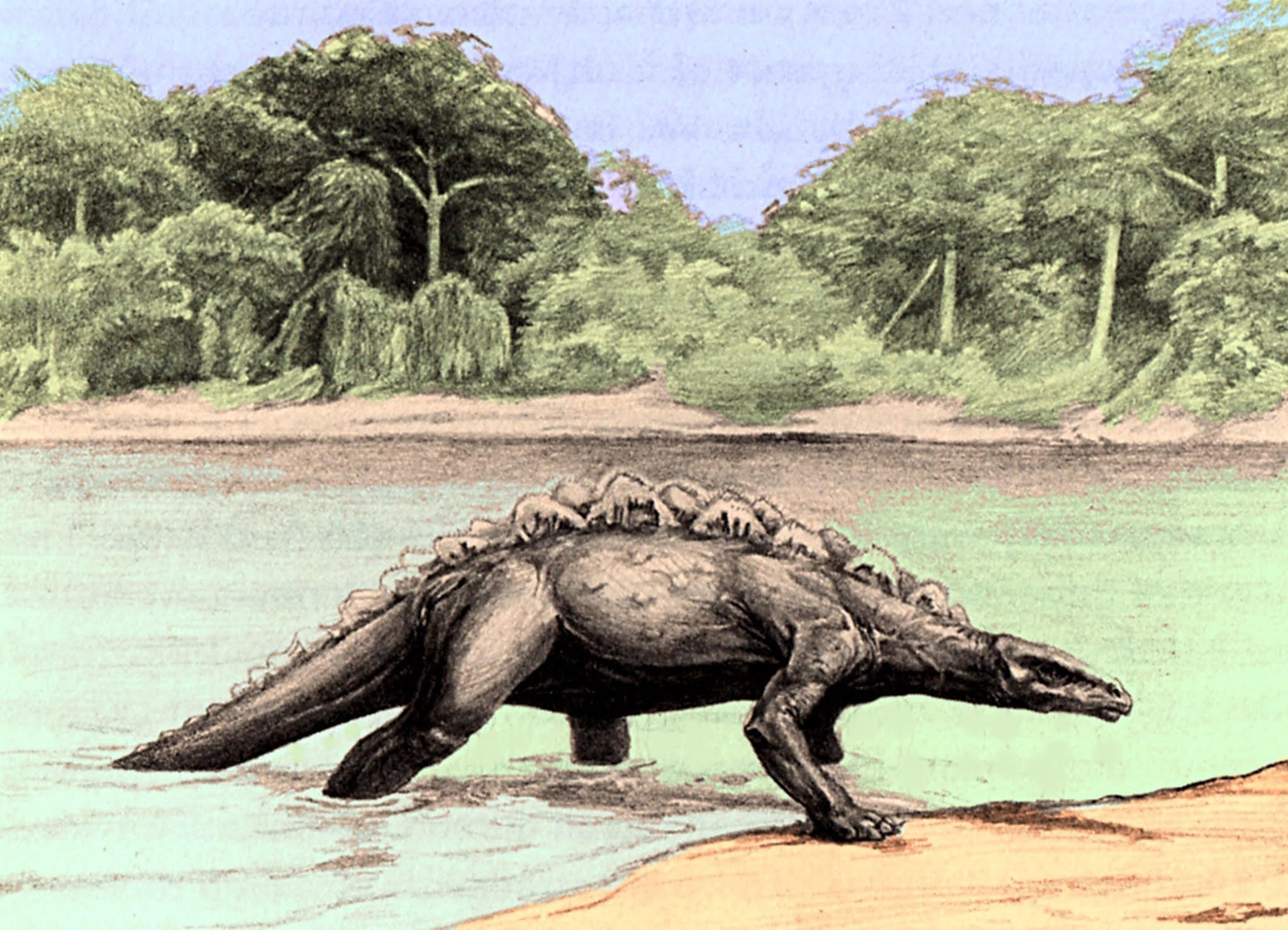
Representation of the mbielu-mbielu-mbielu, based upon eyewitness descriptions (© Drawn by David Miller under the direction of Prof. Roy P. Mackal, colorized here by Dr Karl Shuker)

In addition to the very famous sauropod-lookalike mokele-mbembe and the somewhat less famous nose-horned emela-ntouka (but click here for an extensive ShukerNature article concerning it), a third sizeable cryptid has also been reported from the Republic of the Congo's vast, scarcely penetrable Likouala swamplands. Namely, the mbielu-mbielu-mbielu – so good, they named it thrice! During his two expeditions to this region during the early 1980s, veteran cryptozoologist Prof. Roy P. Mackal collected some interesting anecdotal evidence concerning this hitherto-obscure Congolese mystery beast, and also regarding a fourth, possibly related one, which he duly documented in his classic cryptozoology book A Living Dinosaur? (1987) and which are eminently deserving of being recalled here on ShukerNature.

According to one of the mbielu-mbielu-mbielu's alleged eyewitnesses – a young woman called Odette Gesonget, from the village of Bounila – this triple-termed cryptid is a semi-aquatic beast "with planks growing out of its back". In a bid to identify it, Mackal showed Gesonget several illustrated books depicting animals from the present and also from the distant past – and the picture that she unhesitatingly selected was of the prehistoric plate-bearing non-avian dinosaur Stegosaurus. Comparable descriptions were offered independently by native eyewitnesses s encountered elsewhere during Mackal's Congolese travels too.

 
Life restoration of Kentrosaurus (public domain)

Yet although at least one stegosaur genus, Kentrosaurus, is indeed represented by fossil remains found in tropical Africa, there is no suggestion from fossil evidence that stegosaurs exhibited any amphibious inclination. But who can say whether, during the intervening 65 or more million years from the most recent known fossils to the present day, an evolved surviving stegosaur might have become secondarily aquatic?

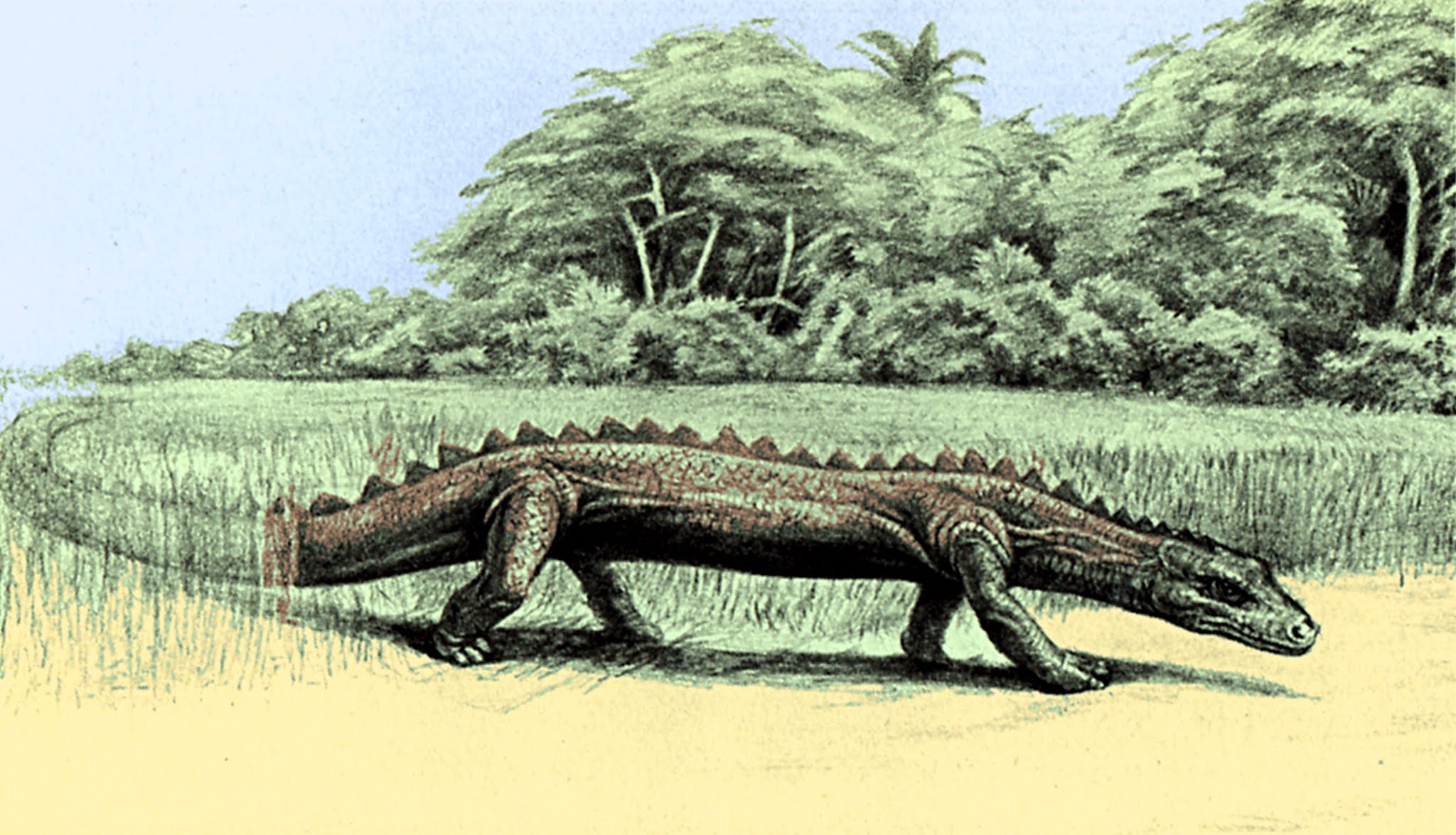
It is possible that this beast, whatever its taxonomic identity may be, is related to (or is even one and the same as) yet another mystery animal from the Likouala swamplands – the nguma-monene, which has been reported from the Mataba tributary of the Ubangi River. According to native descriptions, it resembles a colossal snake (at least 130 ft long!), but bears a serrated dorsal ridge along most of its body's length consisting of numerous triangular protrusions, possesses four short legs, and can walk upon land, with a low-slung body and forked tongue. Suggestions that have been offered for the nguma-monene's taxonomic identity include a snake-like non-avian dinosaur, a very elongate varanid (monitor lizard), and even a primitive reptile descended from the ancestral forms that gave rise to lizards and snakes.

 
Representation of the nguma-monene, based upon eyewitness descriptions (© Drawn by David Miller under the direction of Prof. Roy P. Mackal)

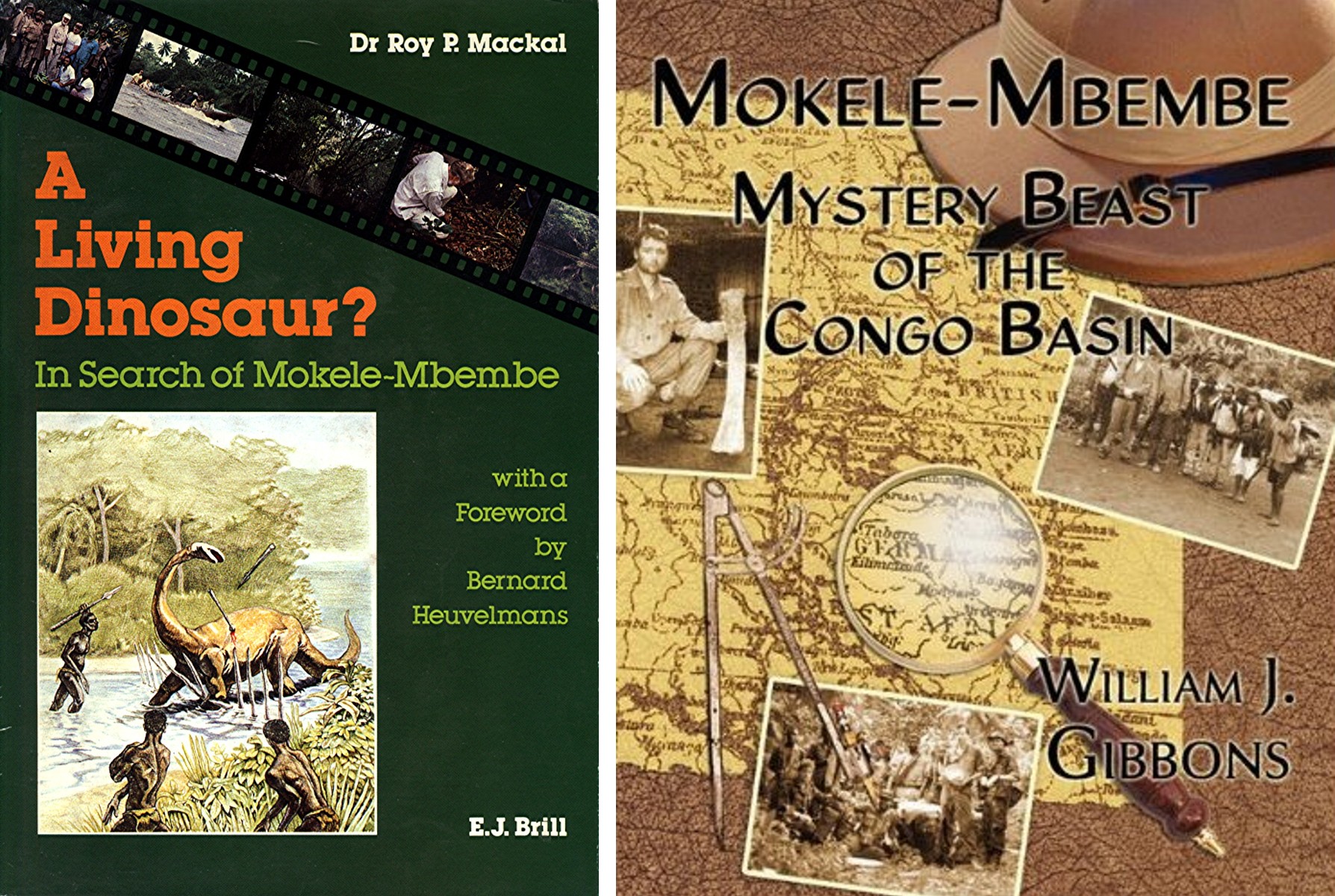
A remarkable modern-day sighting of the nguma-monene by a Westerner was recorded by fellow Congolese cryptid seeker William J. Gibbons in his own book Mokele-Mbembe: Mystery Beast of the Congo (2010), which also documents the various other Congolese and Cameroon cryptids sought by him during his expeditions. The eyewitness in question was Pastor Joseph Ellis, who informed Gibbons personally of his encounter.

It took place one clear sunny day in November 1971, when Ellis was journeying north in his 30-ft-long motorised canoe on the Motaba River. Suddenly he spied a huge, elongated, snake-like creature with a series of ridges like the edge of a saw running the length of its back. It was moving just across the river from the right bank, only around 100 ft away. Turning off his canoe's engine, an astonished Ellis watched as the creature, which he could see was at least as long as his canoe, swam slowly across the river to its left bank, onto which it clambered, crawling through the thick grass and then disappearing into the jungle.

 
Roy Mackal's book and William Gibbons's book (© Roy P. Mackal/E.J. Brill & William Gibbons/Coachwhip Publications)

Ellis never saw its head, but just the section of its body that was visible to him was at least 30 ft long, and was greyish-brown in colour. Although he had personally seen many of this region's large species of animal currently documented by science (including elephants, monitors, pythons, turtles, and crocodiles), he had never spied anything like this creature before, and, having no interest in cryptozoology, had not previously known of its existence here. What could it have been?

Mackal favoured a single, very large, and radically new species of monitor lizard as the most satisfactory explanation for both the nguma-moneme and the mbielu-mbielu-mbielu. Nonetheless, the latter's stegosaurian parallels are evidently difficult to dismiss absolutely – because as he confessed in his book: "For me, mbielu-mbielu-mbielu remains an enigma".

 
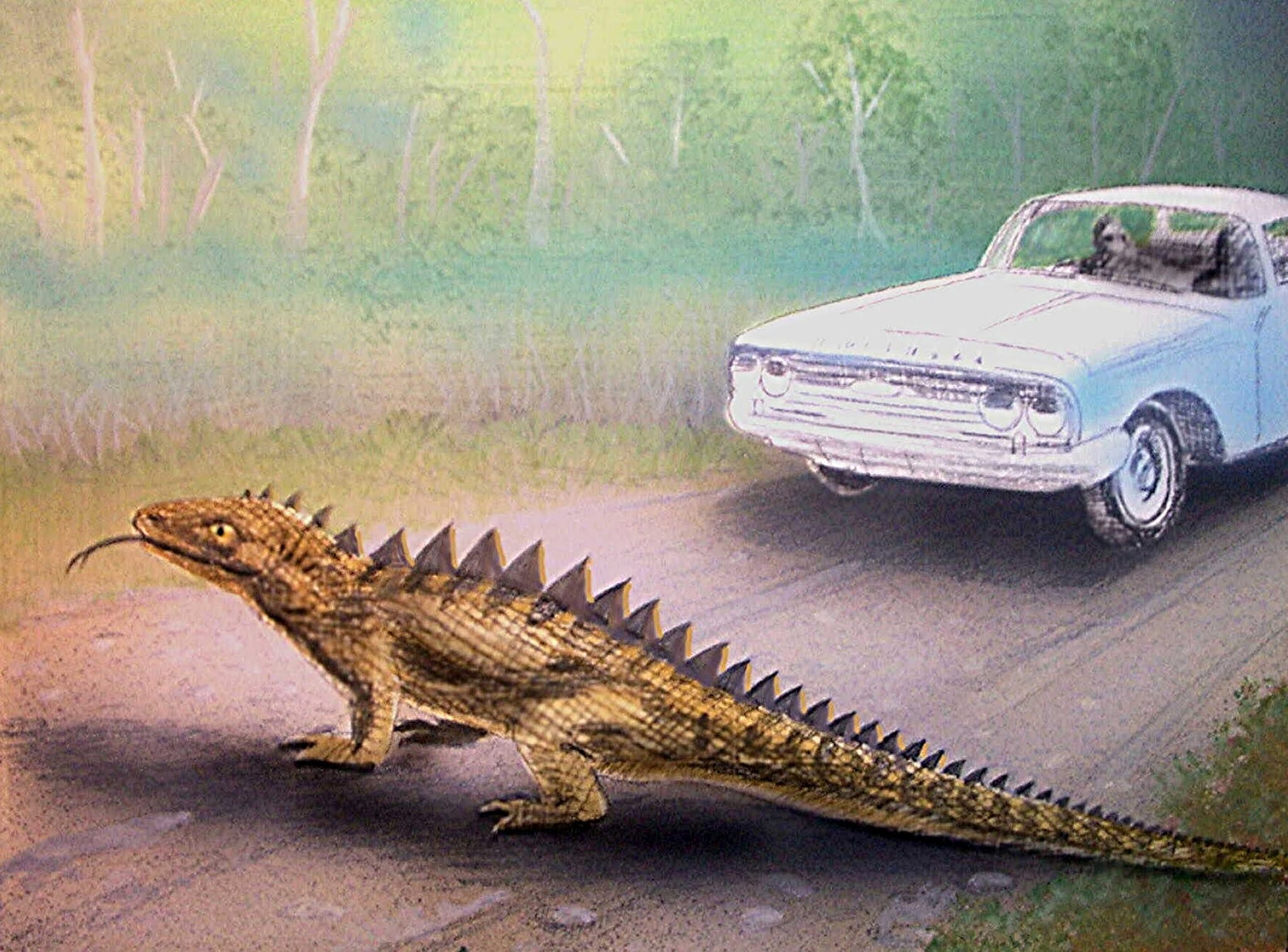
Artistic representation of the Bombays' encounter with a muhuru (© William M. Rebsamen)

Nor are the two Congolese examples documented above the only dorsally-distinctive crypto-reptiles on record from Africa. One day in summer 1961, missionary Cal Bombay and his wife were driving through the Rift Valley on their way to Nairobi, Kenya, when they had to pull up sharply in order to avoid hitting an extremely large reptile apparently sunning itself in the middle of the road. The Bombays estimated that the creature, which was dark grey in colour, measured around 10 ft long, had a snake-like head, four stubby legs, and, most remarkable of all, bore a series of diamond-shaped serrations running down its entire mid-dorsal line, from the back of its head to the tip of its tail.

After about 20 minutes, thus giving its observers plenty of time to peruse it closely, this languorous mystery beast finally stood up, and sauntered lazily into the bush. When some Kenyan natives heard of their encounter, they referred to the creature as a muhuru, but nothing like it is known to Western zoologists.

This ShukerNature article is excerpted and adapted from my book Still In Search Of Prehistoric Survivors.


Saturday, 26 July 2014

THE DEADLY DODU OF CAMEROON – A BELLIGERENT GRUB-EATING BIGFOOT?

Artistic representation of the dodu (© William Rebsamen)

Veteran cryptozoological explorer Bill Gibbons has searched for a number of notable mystery beasts in the field over the years, such as the Congo's mokele-mbembe (click here) and emela-ntouka (click here for some remarkable new finds re this cryptid). He has also brought several hitherto-obscure examples to widespread cryptozoological attention, including Nepal's crocodile-jawed limbless 'dragons' (click here), the New Guinea pterodactyl-like ropen (click here), and the giant Congolese spider or j'ba fofi (comprehensively documented in my book Mirabilis, 2013). What must surely be among the most unusual , however, is of the man-beast variety.

While exploring southern Cameroon, in western Africa, seeking reports of mokele-mbembe-type cryptids during April 2000, Bill was informed by the Baka pygmies and Bantus there of a dangerous primate known to them as the dodu. They claimed that it is dark grey in colour, stands up to 6 ft tall, is mostly bipedal but will sometimes knuckle-walk on all fours, and, of particular note, has only three fingers on each hand and just three clawed toes on each foot. This last-mentioned feature provides an unexpected parallel with the puzzling reports of three-toed bigfoot or sasquatch prints sometimes encountered in North America.

Painting of Bill Gibbons with mokele-mbembe (© William Rebsamen)

Highly aggressive, a dodu will attack gorillas, but has an extremely unusual dietary predilection. After killing an antelope or some other sizeable prey, it does not touch the carcase. Instead, the dodu abandons it for a while, leaving the rotting carcase to fill with maggots, after which the dodu returns, scoops the grubs out, and eats them in quantity. It is also well known for leaving piles of sticks on the forest floor, which, as Bill speculates, may be a form of territorial marking behaviour.

Bill has collected several native reports of encounters with dodus, but by far the most remarkable was one that he heard when returning to Cameroon in 2001. While visiting the lower Boumba region, he was informed that a few months earlier, a group of white men, accompanied by pygmy trackers, had allegedly captured a live dodu, which was seen by residents of a town called Moloundou. Bill suspects that its captors were loggers, but what happened to this unique specimen following its capture (assuming that the report given to Bill was genuine) is unknown.

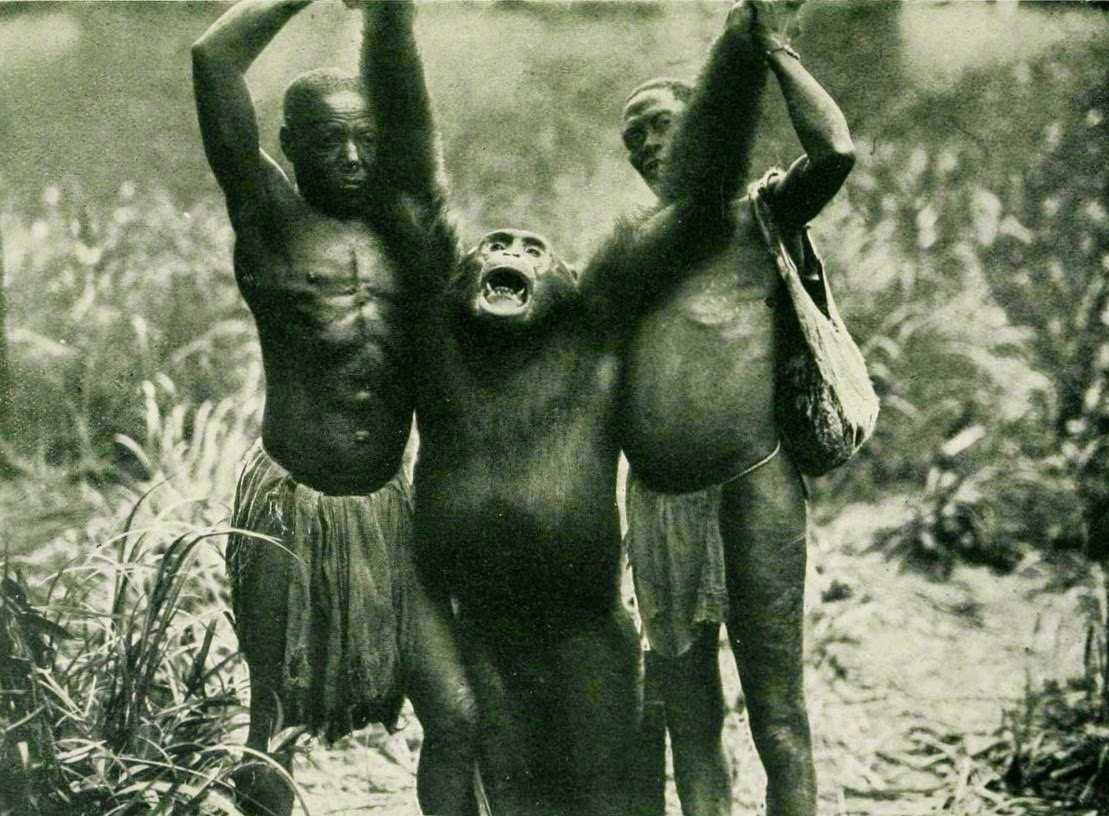
Vintage photograph depicting a dead Bili ape, from a German journal published in 1912

The prospect of such an entity still existing uncatalogued and unclassified by science in modern times might well seem highly implausible, but then again, that is precisely what sceptics thought about the lost giant apes of Bili too - until they were rediscovered in 1996 (click here).


STOP PRESS - 2 August 2014

Today I received the following additional information concerning the dodu from Juan Antonio Gutierrez via Facebook:

"Bill Gibbons and I discovered that the dodu's range is huge.

"From the Lobeke and Sangha rivers in the east to the Dja in the west.

"It's also known as the sapara near Ndongo the last outpost before the end of the world.

"Ndongo villagers told us it frequently stalks them, but never hassles anyone. Plenty of foraging available in the area especially cocoa beans. The dodu likes chocolate!"

Thanks, Juan!


This ShukerNature blog post is excerpted from my book Karl Shuker's Alien Zoo (CFZ Press: Bideford, 2010).


Wednesday, 9 July 2014

GIANT BLACK UNICORNS, A CHINESE QUASI-RHINO FIGURINE, AND THE ENIGMA OF ELASMOTHERIUM

A magnificent restoration of the giant unicorn – a brow-horned Pleistocene rhinoceros known formally as Elasmotherium (© Zdenek Burian)

As I documented in an extremely comprehensive chapter within my book Dr Shuker's Casebook: In Pursuit of Marvels and Mysteries (2008) and subsequently added to in a ShukerNature blog article (click here), a very considerable number of unicorn varieties have been differentiated in legends and folklore from around the world – everything from shape-shifting were-unicorns, carnivorous rabbit unicorns, polar bear unicorns with glowing horns, web-footed unicorns, swivel-horned unicorns, and man-eating unicorns with musical horns, to unicorn birds, unicorn snakes, unicorn snails, unicorn pigs, artificially-induced unicorns, and  even two-horned unicorns (surely a contradiction in terms!).


One of the least-known members of this diverse array, however, is also among of the most fascinating – the giant black unicorn of Siberia. For this spectacular creature is not only of interest to students of animal mythology but may have significant cryptozoological relevance too.

The traditional lore of Siberia’s Evenk people tells of a huge black bull-like creature bearing a single round, thick, tapering horn of immense size upon the middle of its head. This notoriously belligerent beast would charge at any Evenk rider that it spied, tossing the unfortunate man into the air if it could reach him, and spearing him when he fell back down to earth until he died. Moreover, its horn was so large and heavy that if one of these mega-unicorns were killed, the horn alone needed an entire sledge to transport it. Could this awesome but ostensibly fictitious animal have been inspired at least in part by a living species?

The Lungfish, the Dodo, and the Unicorn

Pursuing a suggestion originally put forward by Alexander Brandt and Norman Lockyer in a Nature paper of 8 August 1878, in his book The Lungfish, the Dodo, and the Unicorn (1948) veteran cryptozoological writer Willy Ley presented a fascinating line of speculation as to the possible origin of the Evenk people's traditional lore concerning giant black unicorns of ferocious demeanour:

"The paleontologists of around the year 1900 began to believe that they had successfully discovered the original unicorn. In Russia and in Siberia bones and skulls of an extinct distant relative of the rhinoceros were discovered. This animal, Elasmotherium sibiricum, seemed to resemble the ancient reports [of unicorns] even more than does the living rhinoceros. It was noticeably larger than the largest Indian rhinoceros, its horn was much longer and was actually situated in the middle of the forehead of the animal. But after the first excitement had subsided, most scientists abandoned the idea that Elasmotherium had anything to do with the unicorn legend. However, as Melchior Neumayr wrote in his History of the Earth: it is possible that in Siberia man and Elasmotherium actually lived together and that Elasmotherium was exterminated by man; at least one may explain in this way the ancient songs of the Tunguses [aka the Evenks], which tell that formerly there lived in their country a kind of terrible black ox of gigantic size and with only one horn in the middle of the forehead, so large that an entire sled was needed for the transportation of this horn alone."

Was Elasmotherium (above) the Evenks' giant black unicorn? (© Philip72/Wikipedia)

Up to 15 ft long and standing over 6.5 ft at the shoulder, E. sibiricum was comparable to a woolly mammoth Mammuthus primigenius in size, and (at least for a rhinoceros) had proportionately long legs. The last member of its genus, it is believed to have survived in Siberia until at least 350,000 years ago but quite possibly as late as 50,000 years ago, during the late Pleistocene epoch (and definitely as recently as 26,000 years ago in Kazakhstan, thanks to the discovery there of Elasmotherium skull fragments, made public in March 2016).

Consequently, this makes the hypothesis of survival for a time by this species alongside modern man in Siberia as outlined above by Ley neither impossible nor even overly implausible. An earlier species, E. caucasicum, had flourished in the Black Sea region of Europe during the early Pleistocene and was even bigger, up to 16 ft long and weighing an estimated 4-5 tons.

Reconstruction of a pair of Siberian giant unicorns Elasmotherium sibiricum (© Apokryltaros/Wikipedia)

Certainly, a huge gracile rhinoceros bearing a gargantuan horn not upon its snout's nasal bones like all known living rhino species today but upon its brow's frontal bones instead might well make a very convincing giant unicorn. And indeed, Elasmotherium is commonly referred to informally by this exact name - the giant unicorn.

Nor is the huge black unicorn of Evenk lore the only evidence that has been put forward in support of the postulated if currently-unproven late survival of Elasmotherium and its contemporaneous, pre-extermination existence alongside humanity in Asia. In 1958, two additional Elasmotherium species were formally named – E. inexpectatum and E. peii, both of which had lived in northern China during the early Pleistocene, becoming extinct around 1.6 million years ago. However, they were subsequently reclassified as Chinese representatives of E. caucasicum rather than separate species in their own respective right (meanwhile, fossil remains of a still-valid third species, E. chaprovicum, have been obtained from Europe and Asia, and date from 2.6 million to 2.2 million years ago).

An enraged Elasmotherium versus a couple of pesky prehistoric felids (© Hodari Nundu/Deviantart.com)

Nevertheless, the onetime occurrence of any species of Elasmotherium in China is particularly intriguing, due to the existence of a certain very unusual and greatly perplexing example of Chinese iconography.

While browsing online on 8 August 2012, I came upon a photograph of a small but very distinctive and highly unusual animal figurine, made of bronze. On first sight, it somewhat resembled a rhinoceros, with a short pointed horn upon its snout – but a closer look revealed that this horn curved forwards, whereas those of rhinos normally curve backwards. Moreover, its body did not bear any 'armour pleats' like those exhibited to varying degrees by all five rhino species alive today (unless the vertical lines that continue up onto its body the lines of its limbs are meant to represent the pleats present on the body of the great Indian rhinoceros Rhinoceros unicornis, a species present in ancient China before being hunted into extinctuion there; but if so, they are not portrayed at all accurately and entirely lack the transverse creases running across the limbs' proximal region). Even more striking, however, was something that it did bear – a second, larger horn…but not upon its nasal bones. Instead, projecting slightly forwards, it arose directly from the centre of the creature's brow – just like the horn of a unicorn!

The photograph depicting this intriguing figurine (reproduced below) appeared on the s8int.com website, which offers a biblical perspective on science (including cryptozoology), and is written by Chris Parker. Accompanying the photograph were details of its origin and recent history, followed by Parker's thoughts as to what type of creature it may represent.

The mystifying Chinese quasi-rhino figurine (copyright owner unknown to me/image source online = http://s8int.com/WordPress/)

Those details revealed that the figurine was in excellent condition and dated from China's Tang Dynasty (618-907 AD), an extremely formidable combination as far as its value as a collectible objet d'art was concerned, because in 2007 it was sold at auction by Christies in London for the staggering sum of US$ 216,000 !!

The Lot description for it that was provided by Christies read as follows:

"A RARE AND SMALL BRONZE FIGURE OF A RHINOCEROS
TANG DYNASTY (618-907 AD)

"Shown standing four-square with tail flicked to the left, the head well cast with two horns of different length, ears pricked back, small eyes and downward curved, overlapping muzzle sensitively cast along the upper edges of the mouth with folds in the skin, which can also be seen in the skin of the neck and chest, the thick hide indicated by overlapping wave pattern diminishing in size on the head and legs, with a rectangular aperture in the belly, the dark brownish surface with some patches of dark red patina and green encrustation.

"Lot Notes

"The depiction of the rhinoceros in bronze is very rare, especially during the Tang period. Earlier depictions do exist, however, as evidenced by the late Shang rhinoceros zun [i.e. an ancient Chinese wine vessel made of bronze or ceramic] in the Avery Brundage Collection, illustrated by d’Argencè, The Ancient Chinese Bronzes, San Francisco, 1966, pl. XIX and another large zun (22 7/8in. long), ornately decorated, but quite realistic in its depiction of a rhinoceros, of late Eastern Zhou/Western Han dynasty date, found in Xingping Xian, Shaanxi province, included in the exhibition, The Great Bronze Age of China, Metropolitan Museum of Art, 1980, New York, Catalogue, no. 93"

So, in spite of the fundamental differences in morphology exhibited by this figurine, it was nonetheless deemed to be a rhinoceros by whoever had prepared its Lot description at Christies - even though they had actually included references within that very same Lot description to much more accurate yet even earlier Chinese depictions of rhinoceroses. One can only assume, therefore, that the writer in question was determined to identify it, however tenuously, with some known animal type, and/or was not a zoologist!

Triceratops, the most famous genus of ceratopsian dinosaur (© Nobu Tamura/Wikipedia)

Swiftly dismissing the rhinoceros from serious consideration as the figurine's basis, Parker offered up a very thought-provoking if dramatic alternative – a ceratopsian dinosaur. Known colloquially as the horned dinosaurs, this group included such prehistoric stalwarts as Triceratops, Styracosaurus, and Monoclonius (aka Centrosaurus). Officially, of course, like all dinosaurs, the last ceratopsians became extinct around 65 million years ago, at the end of the Cretaceous Period. But could a ceratopsian lineage have somehow survived beyond the Cretaceous and persisted right up and into the present day, undiscovered by science but represented iconographically by this perplexing work of ancient Chinese art?

Sadly for such an exciting prospect, the figurine lacks the bony neck frill characterizing quadrupedal ceratopsians, and its snout horn curves forward instead of backwards like that of ceratopsians. Also, its tail does not appear to be as long and hefty as that of the latter dinosaurs (this characteristic is deduced from the fact that in the photograph it is hidden on the creature's left side, whereas if it were of ceratopsian dimensions it would have been too big to have been concealed in this manner). Conversely, the figurine does possess what Parker interpreted as a beak, which if so would certainly help to ally it morphologically with the ceratopsians, because these reptiles famously sported large beaks. However, it simply looks to me like a large pointed upper lip, very similar in shape, in fact, to that of Africa's black rhinoceros Diceros bicornis and also, albeit to a lesser degree, that of the great Indian rhino.

Head of Chinese quasi-rhino figurine (top) and head of black rhinoceros (bottom), showing that the former apparently shares the latter's well-defined pointed upper lip

Of particular interest is that Parker then compared the figurine with a certain cryptid that has already been popularly linked to the idea of a putative modern-day ceratopsian – tropical Africa's emela-ntouka ('killer of elephants'). This is an aquatic snout-horned mystery beast that is said by native observers to disembowel with its long pointed horn any elephants recklessly trespassing within its swamp or lake domain (click here for more information regarding it). Unlike the Chinese figurine, however, the emela-ntouka does possess a very long, heavy ceratopsian-like tail, though it too is frill-less, and it also sports a pair of small but elephant-like ears – an incongruous feature indeed for any reptile to exhibit, thus indicating that it is mammalian rather than reptilian in identity.

Artistic impression of the emela-ntouka (© Jean Claude Thibault)

Parker concluded his account by briefly considering the mythological Chinese unicorn, noting that one Chinese researcher has proposed that depictions of this supposedly non-existent beast may in reality have been based upon sightings of a surviving species of Elasmotherium. Could the same identity thus explain the Chinese figurine too, he wondered?

Personally, I don't think so. To begin with, the figurine's snout-horn would be an anomaly for any Elasmotherium species currently known from the fossil record. In addition, even its brow horn, though correctly located, seems far too short and slender to be comparable to that of Elasmotherium. Conversely, its legs are indeed relatively long, like those of Elasmotherium, but its body is proportionately much too short and squat to be compatible with the huge 15-ft-plus length attributed by palaeontologists to the proportionately very long body of Elasmotherium. So I am certainly not persuaded personally by such an identity for it.

As far as I am concerned, unless it constitutes an inordinately stylised (or just simply inaccurate!) representation of the great Indian rhinoceros the identity of this Chinese quasi-rhino figurine remains unresolved.

Chinese quasi-rhino figurine (top) compared with Elasmotherium (bottom)

In any case, there is an issue of especial relevance concerning any attempt to link horned cryptids to Elasmotherium that has not been mentioned here so far, but which definitely needs to be – so here it is. All of the varied lines of speculation discussed above in this present ShukerNature blog article stem directly from one single, fundamental assumption – namely, that Elasmotherium really did possess a horn, and a monstrously large one at that. Consequently, it will undoubtedly come as something of a surprise to discover now that despite many fossil remains of Elasmotherium having been found, and from many different sites too, not a single Elasmotherium horn, of any size, has ever been uncovered. So why do palaeontologists assume not only that it was horned but also that its presumed horn was so enormous?

The answer to this pertinent question is the presence of a very large hemispherical protuberance, 3 ft in circumference and 5 in deep, with a furrowed (and therefore vascularised?) surface, upon the frontal bones, which is traditionally interpreted as the base for a horn. Moreover, coupled with the occurrence of irregular bony deposition normally indicating that an exceptionally firm attachment to something was required there, plus the extraordinarily large hump of muscle present to manage the head, the overriding conclusion is that an extremely large and heavy horn was indeed borne upon the frontal bones of Elasmotherium.

Reconstruction of an Elasmotherium skull bearing its immense horn – always assuming that it did possess one! (© Dr Karl Shuker)

Moreover, there is a Palaeolithic cave painting in Rouffignac, France, of a mighty rhinoceros bearing an enormous horn, which is believed by some to represent Elasmotherium (although the horn of this cave painting rhinoceros looks to me more like a typical rhino snout-horn than a brow-borne horn).

The putative Elasmotherium cave painting in Rouffignac

But who knows - perhaps one day a fossil Elasmotherium skeleton will be unearthed that comes complete with its ostensibly real but currently invisible mega-horn. And if that happens, this huge enigmatic rhinoceros's link to the Siberian giant black unicorn will suddenly take a tantalising step closer to veracity.

A couple of black unicorn figurines exhibiting a more typical, familiar unicorn form (© Dr Karl Shuker)

And finally: a snippet of Elasmotherium trivia. One of my favourite television series, a delightful mix of Primeval-style special effects/sci-fi and factual but entertaining Walking With Dinosaurs-style documentary (in what is nowadays popularly termed the 'docu-fiction' genre), was Prehistoric Park. This six-episode UK series, produced by Impossible Pictures (who also produced Walking With Dinosaurs) and originally broadcast in 2006 (first by ITV, then shortly afterwards by Animal Planet), was fronted on-screen by British wildlife presenter Nigel Marven. Its premise was that Nigel would journey back into a wide range of different geological time periods via a space-time portal, encounter various spectacular but long-extinct species, and bring living specimens of them back with him through the portal into the present day, where they would then be exhibited in Prehistoric Park - a vast wildlife park containing a host of different environments and habitats (presumably a nod towards Jurassic Park). One of the most thrilling episodes (#2) saw Nigel saving himself from a highly belligerent male Elasmotherium in Siberia before successfully bringing it back with him through the portal into Prehistoric Park. Indeed, the CGI Elasmotherium was so stunning that it even made the front cover of the series' UK DVD, charging after its suitably-alarmed co-star Nigel!

 Prehistoric Park, the UK DVD (© Impossible Pictures)


POST-SCRIPT - A TORTOISE-SHELLED, CLAW-FOOTED RHINO-UNICORN WITH FORWARD-CURVED HORNS!

Today, 9 July 2014, German cryptozoological correspondent Markus Bühler reminded me of an extremely bizarre Chinese illustration that had appeared in a wonderful book by Herbert Wendt entitled Out of Noah's Ark, published in 1956, in which he chronicled the history of discovery by mankind of our planet's major animal species. In his documentation of the rhinoceros's discovery, Wendt included two remarkable illustrations, both of them by the Japanese artist Katsushika Hokusai (1760-1849). The first was of a bizarre Asian unicorn, very different from the traditional Chinese deer-like ki-lin, that sported a tortoise-shell upon its back and a single forward-curving horn upon the back of its head. And the second was of a later version of this same mythical creature, but now as portrayed after the Chinese had carried out their large-scale transportations of southern Asian rhinoceroses. It still retained its tortoise-shell but had now gained no less than three horns. According to Wendt, the two additional ones were derived from the rhinoceros. Yet whereas these were small, but were indeed nasal in location (like rhino horns are), the third (originally the only horn present and sited on the back of its head) was much longer and was now brow-borne (unlike any modern-day rhino horn). Moreover, all three were forward-pointing (just like those of the Chinese quasi-rhino figurine documented by me earlier here), not rearward-pointing as is true of rhino horns.

Consequently, if Wendt is correct in his attribution of the tortoise-shelled unicorn's subsequently-gained trio of horns to the influence of Asian rhinoceros transportation by the Chinese, here is a precedent for rhinos being depicted inaccurately in Oriental art with forward-pointing and brow-borne horns directly comparable to the figurine's. Having said that, however, the tortoise-shelled, triple-horned unicorn had also acquired a second, equally bizarre feature that again  is not typical of rhinoceroses if accurately depicted. As can be seen from the two Hokusai illustrations reproduced below in this present ShukerNature blog article, in its original form the tortoise-shelled unicorn had possessed ungulate hoofs, whereas in its later, triple-horned incarnation these have been replaced by three black claws on each foot. True, rhinos are indeed triple-toed, but they possess clearly-formed hooves, not claws. In contrast, even the Chinese quasi-rhino figurine was hoofed, not claw-footed.

So although intriguing, the tortoise-shelled unicorn's pertinence to the Chinese quasi-rhino figurine's identification as a rhinoceros is far from evident, and it is probably safest merely to say that it can be looked upon as yet another example of just how extremely stylised (or just plain inaccurate) artistic depictions of animals can be.

The earlier depiction of the tortoise-shelled Asian unicorn (top); and the later triple-horned, claw-footed version, believed by Wendt to be the result of having been assigned certain morphological attributes from the rhinoceros (bottom) (Katsushika Hokusai)



Sunday, 6 July 2014

BIRD-HEADED FISH-MEN AND PIG-RIDING MAN-BEASTS - MORE PERPLEXING PORTRAYALS FROM THE CENTRAL AFRICAN REPUBLIC

A red river hog (aka bush pig), a species of wild pig habitually ridden through the Central African Republic's forests by dwarf hairy man-beasts…allegedly! (© Dr Karl Shuker)
In my previous ShukerNature blog article (click here), I documented a remarkable drawing by the late artist Jean Claude Thibault, a Frenchman resident for many years in the Central African Republic (CAR). It depicts what appears to be the mysterious emela-ntouka or 'killer of elephants' – a horned aquatic cryptid also reported elsewhere in Africa under such names as the chipekwe and irizima.

Thibault's emela-ntouka drawing (© Jean Claude Thibault)

Moreover, this was just one of four pictures depicting intriguing CAR entities that had been drawn by Thibault (sometime during the early 1990s or late 1980s), and which were shown to me in August 2012 by Anette Stichnoth. She was working at that time for the Dzanga-Sangha Protected Areas (APDS) – a region of especial conservation significance in the CAR (check out its website here). The drawings had lately been displayed in an art exhibition held by the APDS, not long after Thibault had died (about three years ago), and Anette was enquiring about the entities illustrated in them. A year later, she received some illuminating information concerning these entities from a CAR local who was very knowledgeable about his country's traditional lore and legends.

So now, with Anette's kind permission, this present ShukerNature blog article exclusively unveils Thibault's three other drawings online, accompanied by the information that she received concerning them, together with my own thoughts.

The mondjoli-mbembe - a bird-headed fish-man from the folklore of the Central African Republic (© Jean Claude Thibault)

Above is the first of these drawings. It depicts a truly bizarre entity known as the mondjoli-mbembe or, more simply, the fish-man. According to Anette's CAR informant, this bird-headed humanoid is a paranormal being that lives in marshes and swamps, feeding upon fishes, from which he obtains his mystical powers that enable him to vanish from one place and appear instantly somewhere else. Sometimes, moreover, he makes fishermen disappear who want to fish in the watery terrain that he inhabits. When he kills fishes, he leaves them in a heap, and if a fisherman should find that heap the mondjoli-mbembe has no objection to the man taking half of the fishes away. But he must not take all of them – otherwise the angry mondjoli-mbembe will follow him to his village and take his revenge, which is not a pleasant sight to behold!

Red river hogs, with one of them ridden by a pig genie (© Jean-Claude Thibault)

This second drawing by Thibault depicts a hairy bipedal humanoid entity of diminutive stature riding a species of central and western African wild pig known as the red river hog or bush pig Potamochoerus porcus (not to be confused with the closely-related and similarly-named but less visually-colourful bushpig P. larvatus of eastern and southern Africa). According to Anette's CAR informant, such entities as this individual are supernatural dwarf beings known as pig genii or pig ghosts, which act as pig-herds to the red river hogs, walking in front of them in the forest, and even riding on their backs. Moreover, should a hog refuse to allow one of these beings to ride it, the pig genie will punish it, and chase it away from the other hogs towards the traps set by human hunters.

The third Thibault drawing presented here also depicts pig genii, but this time they are about to take part alongside some humans in a ritual known as boyebe. Before human hunters set out on a foray, they supposedly perform boyebe, which consists of dancing around a fire with the pig genii, because the men believe that this will ensure that they achieve success in their hunting.

Human hunters and pig genii about to take part together in the pre-hunting ritual of boyebe (© Jean Claude Thibault)

There seems little doubt that the mondjoli-mbembe is entirely mythical, a grotesque, composite bird-man equipped with magical powers and confined exclusively to the CAR's corpus of traditional folklore. Conversely, the pig genii are very similar indeed in basic form to a number of dwarf hairy bipedal man-beasts of possible hominoid identity reported widely across tropical Africa. These include such cryptozoologically familiar forms as the agogwe of Tanzania and Mozambique, the fating 'ho of Senegal, the Congolese kakundakari, and the séhité of the Ivory Coast.

Les Bêtes Humaines d'Afrique (front cover illustration © Alika Lindbergh/Plon Publishing)

According to veteran cryptozoologist Dr Bernard Heuvelmans, who devoted a major section to them in his book Les Bêtes Humaines d'Afrique (1980), these primate cryptids could variously be surviving gracile australopithecines (early bipedal African hominids known to have existed from 3.9 million to 1.7 million years ago), proto-pygmies, and/or proto-bushmen. Other suggestions include chimpanzees Pan troglodytes that have become more bipedal than is typical for their species, or bonobos P. paniscus – which walk upright quite commonly anyway. Some of these entities are deemed by their superstitious human neighbours to be preternatural, but descriptions of them given by Western eyewitnesses suggest otherwise – that they are corporeal yet highly elusive, currently-unclassified hominoids, exactly as proposed by Heuvelmans.

The CAR pig genii may well fall into this category too, with their pig-riding, pig-herding proclivities and their fire-dancing, pre-hunting rituals alongside humans owing rather more to native imagination than to ethnological interaction. Interestingly, according to traditional lore in Brazil a short hairy man-beast inhabiting its jungles and called the curupira (click here to see a painting depicting it) is said to ride those wild pig-like ungulates known as peccaries and even small deer called brockets or mazamas. So such folklore motifs are clearly not confined to Africa.

If any ShukerNature reader has additional information concerning the CAR entities depicted in Thibault's drawings, I'd welcome any details that you could send me or post here – thanks very much!

Restoration of Australopithecus africanus, a species of gracile australopithecine that existed from around 3.03 million to 2.04 million years ago (© Nachosan/Wikipedia)


Saturday, 5 July 2014

THE EMELA-NTOUKA – NEW CORROBORATIVE EVIDENCE FOR THE CONGO'S CRYPTIC 'KILLER OF ELEPHANTS'?

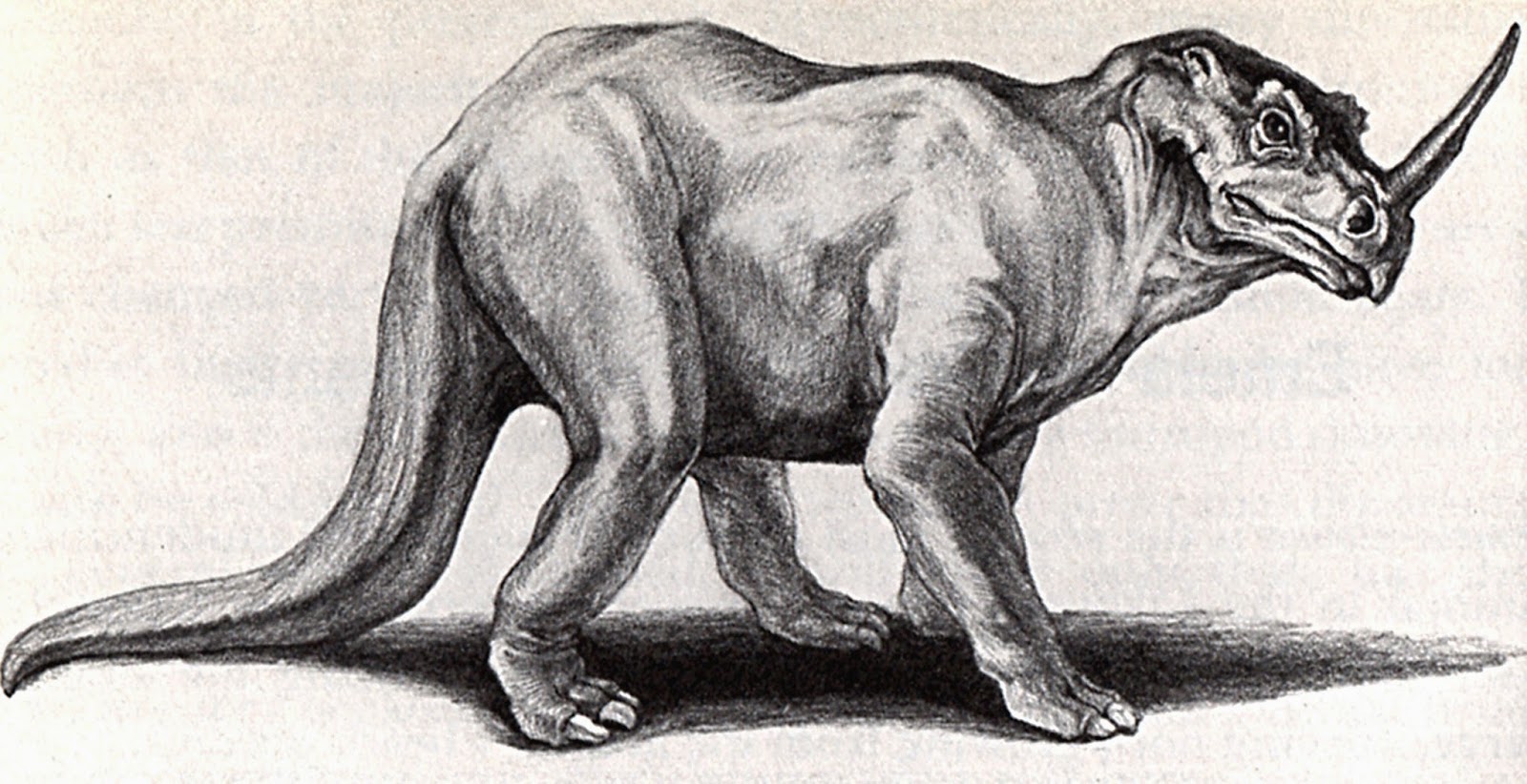
Reconstruction of the emela-ntouka (© David Miller under the instruction of Prof. Roy P. Mackal)

I've been promising ShukerNature readers for almost a year now that I'd write up this fascinating discovery and post it – so now I have done, and here it is!

A little over 30 years ago, the most famous creatures of cryptozoology were Nessie, the yeti, a sundry array of sea serpents, and the North American bigfoot. In 1982, however, following his return to the USA in December 1981 at the end of the second of two expeditions to the People’s Republic of the Congo (formerly the French Congo), veteran American cryptozoologist Prof. Roy P. Mackal revealed to an astonished media and general public that the elusive swamp monster that he had been searching for in the Congo may conceivably be a living dinosaur! A new cryptozoological star had been born – an elusive long-necked mystery beast bearing an extraordinary outward resemblance to a sauropod, and known to the local Congolese pygmies as the mokele-mbembe. But this wasn't the only Congolese cryptid that Mackal's team had learnt about during their forays there. Less familiar but definitely no less interesting was a second major mystery beast claimed by the pygmies to inhabit that country's vast Likouala swamplands – a truly extraordinary (and exceedingly formidable) horned creature known to them as the emela-ntouka, or ‘killer of elephants’.

Another reconstruction of the emela-ntouka (© Hodari Nundu/Deviantart.com)

The size of an elephant itself, but semi-aquatic, the emela-ntouka is said to have a long heavy tail, four sturdy legs, and, most notable of all, a very long, sharp horn borne upon its snout. On first sight, this cryptid sounds like some form of rhinoceros. However, its long heavy tail differs dramatically from the short, lightweight version possessed by all known rhino species. So too does its horn, for whereas those of rhinoceroses are nothing more than masses of compressed hair, according to native testimony the emela-ntouka’s is said to resemble the ivory tusk of an elephant. As ivory is only associated with tusks and teeth, not horns, however, it is probable that if the pygmies' claim about it is correct, the emela-ntouka's horn is composed of bone.

Its behaviour is also very distinctive. Although wholly herbivorous, the emela-ntouka is claimed to be extremely belligerent, so much so that if even something as mighty as an elephant or buffalo enters a lake in which one of these creatures is residing, the latter will not hesitate to attack the intruder - stabbing and disembowelling its hapless victim with its formidable snout-horn.

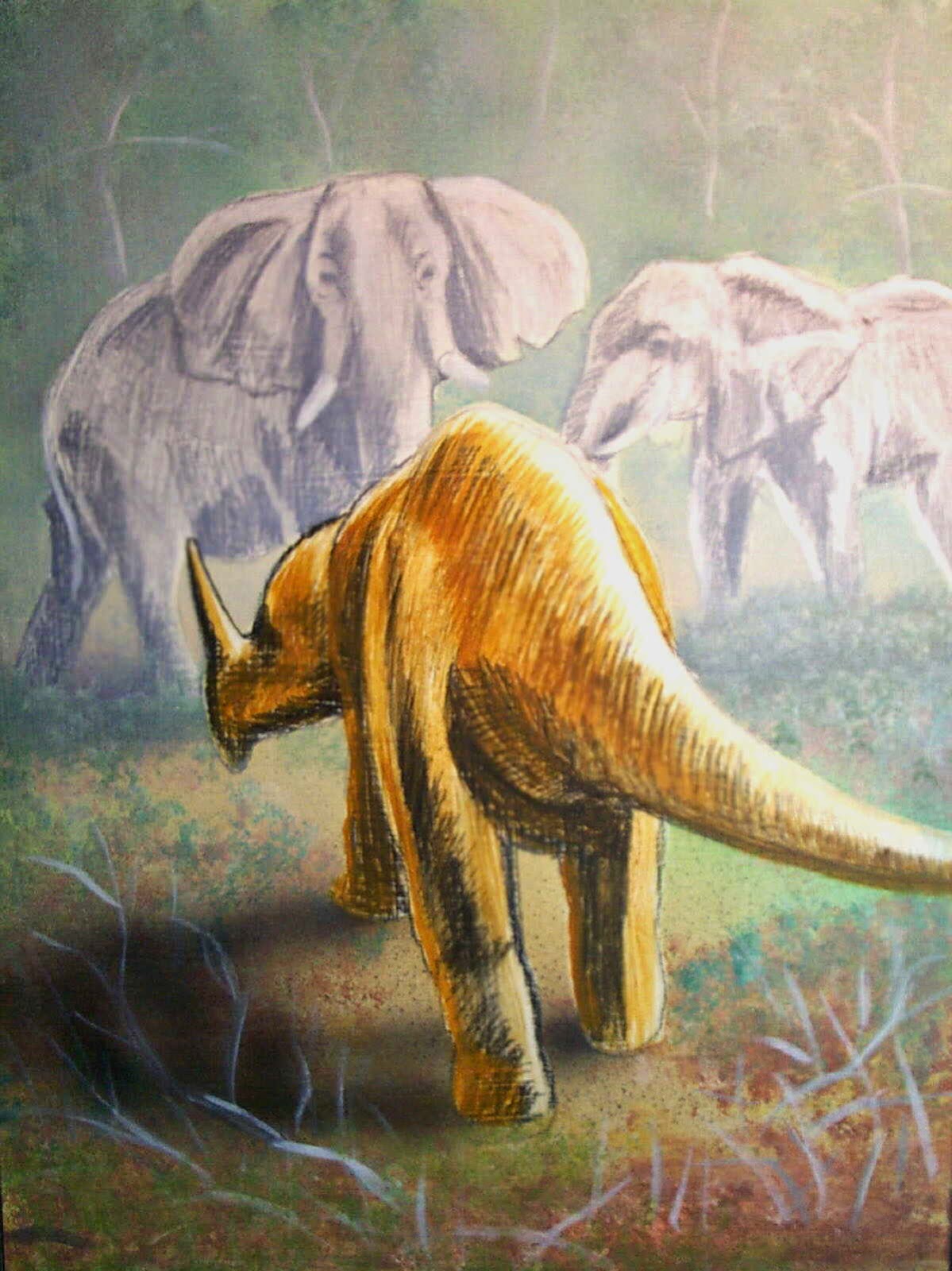
An emela-ntouka facing off a wary herd of elephants (© William Rebsamen)

Following his own investigations of this extraordinary beast, Mackal proposed, albeit cautiously, that it may actually be a surviving ceratopsian or horned dinosaur – i.e. belonging to a group of huge herbivorous dinosaurs that included such prehistoric stalwarts as Triceratops and Styracosaurus. Many ceratopsians possessed more than one horn, but at least one famous example, Centrosaurus (formerly called Monoclonius), bore only a single horn, at the end of its nose – and reconstructions of Centrosaurus certainly recall descriptions of the emela-ntouka. Moreover, because the horns of ceratopsians were true horns (composed of bone), not compressed hair, they may well have resembled ivory, just like the emela-ntouka’s; and all ceratopsians had long heavy tails, providing yet another match with the emela-ntouka.

Modern restoration of Centrosaurus in life (© Nobu Tamura/Wikipedia)

Indeed, the only major discrepancy between the pygmies' description of this cryptid and palaeontological reconstructions of ceratopsians is that the latter dinosaurs bore a huge bony frill around their neck, protecting this otherwise-vulnerable body region from attack by carnivorous dinosaurs, whereas no such frill has been reported for the emela-ntouka. However, if the latter beast is indeed a surviving ceratopsian, it is the product of 64 million years of continued evolution, i.e. from when the most recent fossil ceratopsians died out right up to the present day - a immense period of time during which evolution could readily have engineered the reduction or complete elimination of a frill (especially as such a heavy accoutrement would no longer be needed following the extinction of the mighty carnivorous dinosaurs).

The emela-ntouka envisaged as a reptile (© Sebastian Tawil)

Equally interesting is that, as with the mokele-mbembe, reports of creatures resembling the emela-ntouka are not confined to the Congo’s Likouala swamplands. The Democratic Republic of Congo (formerly Zaire) also has its own counterpart, dubbed the irizima, and there are even reports from as far west as Liberia. Moreover, several notable East African lakes, including Lakes Bangweulu, Mweru, and Tanganyika, as well as the Kafue swamps, are said to be inhabited by a very comparable cryptid known as the chipekwe, which kills hippopotamuses with its horn, but does eat them. Occasionally, one of these aggressive animals has itself been killed by native hunters, but, sadly, no remains have ever been made available for scientific analysis. However, the ivory-like horn is said to be highly prized by them, so perhaps there is a chipekwe horn or two preserved in a local chief’s dwelling somewhere in East or Central Africa and awaiting discovery by a sharp-eyed Western explorer, scientist, or missionary?

The emela-ntouka/chipekwe as portrayed in its jungle swampland domain, complete with hippos! (© Dr Karl Shuker)

Meanwhile, French cryptozoologist Michel Ballot has lately found what may be the next best thing. Since 2004, he has conducted a number of excursions into Cameroon, seeking evidence for the existence of unknown aquatic beasts. In 2005, during his second expedition, travelling through a region of northern Cameroon bordering the Central African Republic, he visited a village where he saw (and purchased) a large, truly remarkable wooden carving. It depicted in great detail a strange beast with four sturdy legs, a long heavy tail, and a head whose nose bore a long horn.

Although this carving doesn’t match any known animal alive today, as can be seen from the photograph of it reproduced below in this present ShukerNature blog article (and also click here for Michel's own account of it, with additional photos) it is a faithful representation of the emela-ntouka.

Photograph of the more detailed, better-known of the two emela-ntouka carvings encountered by Michel Ballot in Cameroon (© Michel Ballot)

Interestingly, this carving portrays the emela-ntouka with a pair of small frilly ears, almost like miniature elephant’s ears, a feature not previously reported for this cryptid but which, if genuinely possessed by it, indicates a mammalian rather than a reptilian identity. Moreover, in his own account Michel revealed that in 2005 he had actually found not one but two such carvings, in separate locations and created by separate artists, but identical in appearance. Judging from the photo below of the second one, however, it is less detailed and less well-executed than the first, more famous carving.

Photograph of the second, less-publicised emela-ntouka carving encountered in Cameroon by Michel Ballot (© Michel Ballot)

Now, in a ShukerNature world-exclusive, I can reveal a third, independently-obtained but undeniably corroborative piece of iconographical evidence for the veracity of this specific morphological identikit relative to the emela-ntouka.

And here is where that remarkable piece of evidence came to light. Situated in the Central African Republic (CAR), to quote from their website (click here) the Dzanga Sangha Protected Areas or APDS:

"…are internationally known for their beautiful rainforests, host to a remarkable diversity of wildlife, comprising western lowland gorillas, forest elephants, bongo antelopes, forest buffalos and a multitude of bird species. Furthermore, a rich local culture, comprising the Sangha Sangha fishermen as well as hunting and gathering BaAka, are present in the area. Apart from conservation and local development efforts, Dzanga Sangha operates as an eco-tourism and research centre. A variety of well developed tourism activities and a beautiful hotel complex, overlooking the Sangha River, are at your disposal.

"Sharing borders with Cameroun and Congo, the Dzanga Sangha Protected Areas are part of the Trinational Sangha (TNS) complex, currently in the process to become a UNESCO World Heritage Site. Roundtrips to the other National Parks (Lobéké in Cameroun and Nouabalé Ndoki in Congo) can be organized with ease."

Dzanga Sangha (public domain)

On 8 August 2012, I receieved a fascinating email and attached set of four photographs from Anette Stichnoth of Hannover, Germany. The photographs, taken by a friend of hers from the above-mentioned APDS and named Cem Kok, were of four drawings on display at the first, now-dismantled Dzanga Sangha Exhibition (Cem was currently working on the second one), held in the APDS - with whom Anette was working in the capacity of utilising its exhibition's artworks as designs on souvenirs, such as t-shirts and mugs, that could be sold to APDS visitors in order to raise money for the area's continuing conservation. In relation to this, she asked me if I had any idea what the entities were that the drawings depicted, because she wanted to produce an information card for each one but no-one whom she had previously contacted had been able to identify them.

The artist responsible for these four drawings was a Frenchman named Jean Claude Thibault, who had produced them during the early 1990s or late 1980s. He had lived in the Central African Republic (a former French colony) for a number of years, but could not be contacted personally concerning his drawings because he had died in Bangui, the CAR's capital, a couple of years ago.

After examining Thibault's drawings, it was clear to me that they were nothing if not interesting from a cryptozoological standpoint. Three of them depicted humanoid or semi-humanoid beings, and are exclusively documented in a separate ShukerNature blog article (click here) - but the fourth one was very different, and is reproduced below.

Thibault's fourth drawing from the first Dzanga Sangha Exhibition (©  Jean Claude Thibault)

As can be seen, it portrays one elephant fleeing in the background, plus a second one that has been stabbed in its underside by a horned beast bearing an uncanny resemblance to Michel Ballot's Cameroon-procured emela-ntouka carvings!

In order to compare those works of art directly, I have horizontally flipped one of Michel's photographs of the more detailed of the two Cameroon emela-ntouka carvings, thereby enabling its orientation to match that of the creature in Thibault's drawing. So here now are the two images placed alongside one another:

Michel Ballot's Cameroon-procured emela-ntouka carving (top); and Thibault's Dzangha Sangha Exhibition drawing, cropped to concentrate upon the horned beast depicted in it (bottom) (© Michel Ballot/(©  Jean Claude Thibault)

And as can be readily discerned, there is no doubt whatsoever that these two artworks are indeed depicting the same species of animal – whatever that may be! Every major morphological feature - from those strange little frilly ears, and sharp vertical snout-horn, to the very long, broad, sweeping tail with its distinctive dorsal ridge or keel, and the relatively short, sturdy, bent legs with well-differentiated digits - is portrayed in an identical manner by the carving and the drawing. Even the seemingly stylised, non-differentiated pointed teeth are the same in both pieces.

Fascinated by this extraordinary correspondence between works of art created in two entirely different countries by artists very unlikely to have ever seen each other's work, I swiftly emailed Anette for additional information. Unfortunately, however, she didn't have anything further of substance to offer me at that time, but promised to contact me again once she had obtained more details – and almost exactly a year later, she did so.

On 18 August 2013, Anette emailed me a series of descriptions for the four drawings that she had lately been given by a CAR local with knowledge of his country's legendary creatures and entities. The one depicting the emela-ntouka was labelled as 'Mokele-Mbembe', and the creature was said to inhabit the deepest stretches of the River Ndoki. Referring to it as a mokele-mbembe may seem strange on first sight. However, as I discussed in my book In Search of Prehistoric Survivors, in central Africa (i.e. not just the CAR but also the two Congos, Cameroon, etc) the long-necked lake-dwelling cryptid (mokele-mbembe) and the horned lake-dwelling cryptid (emela-ntouka) are often conflated in local reports, with features of one sometimes being wrongly attributed to the other, so this is not as surprising as it might otherwise seem.

Cropped version of Thibault's emela-ntouka drawing (© Jean Claude Thibault)

Due to how astonishingly similar Thibault's CAR emela-ntouka drawing was to Michel Ballot's Cameroon emela-ntouka carvings in terms of the creature's morphology, I had initially wondered whether the former had been directly copied from the latter. Perhaps Thibault had seen online images of the Cameroon carvings? However, when I learnt that Thibault had produced the drawing a decade or more before Michel had even encountered the carvings, let alone photographed them and brought them to public attention by uploading the photos onto the internet, it is surely evident that they are of independent origin, neither one influenced by the other. After all, it is highly unlikely that the Cameroon villagers responsible for the carvings had ever seen Thibault's drawing, which had only been exhibited publicly within the CAR, never outside it.

Equally relevant is that although the carved animals and the drawn one possess identical morphologies, the specific poses respectively adopted by them are not the same at all. Both carved animals are standing stationary, in a neutral behavioural pose, with the head held at a normal height, the hind limbs close together, and the tail (curving to the right in the original, non-flipped version of Michel's photograph of the first carving, to the left in the second carving) held laterally for much of its length and very close to the body. The drawn animal, conversely, is in ferocious attack mode, with its head lowered as it belligerently drives its horn into the body of its hapless pachyderm victim, its hind legs splayed well apart in order to brace itself as it performs the powerful thrusting stab with its horn, and its tail (curving to the left) held out further away from its body in a much wider arc and portrayed throughout its length from above. In short, the two carved animals and the drawn animal indisputably portray the same species, but the two carved animals' shared pose is very different from the drawn animal's - thereby further indicating that the drawing was not copied from or influenced by the carvings or vice-versa.

Yet as the carvings and the drawing correspond with one another so closely morphologically speaking, we must conclude that the image of the emela-ntouka provided by them is an accurate one – that it really does possess small frilly ears, a vertical snout-horn, bent legs, and a very broad, lengthy, powerful tail. The ears alone are enough to demonstrate that it is clearly mammalian in nature (as they are clearly bona fide ears and not, for instance, an abbreviated ceratopsian frill), thereby eliminating a surviving ceratopsian dinosaur from serious consideration in the future. Yet it does not compare with any known species of mammal. Indeed, it is not even possible to allocate this mysterious creature with ease to any existing taxonomic order of mammals. Having said that, however, the image of it yielded by the carvings and the drawing does remind me a little of Arsinoitherium zitteli.

Restoration of Arsinoitherium zitteli in life (© Dmitry Bogdanov/Wikipedia)

Dating from the late Eocene, this was a massive elephantine horn-bearing species of fossil African ungulate belonging to the extinct order Embrithopoda. Named after eminent palaeontologist Dr Karl Alfred von Zittel and Queen Arsinoe I, the wife of the Egyptian pharaoh Ptolemy II (its remains were found in present-day Egypt's Faiyum Oasis), it was believed to have been aquatic in lifestyle, spending much of its time wading and swimming in rainforest swamps rather than walking on land, as it was unable to straighten its legs (thus recalling the emphatically bent legs of the emela-ntouka depicted in the drawing and carvings). Moreover, it is particularly famous for its pair of truly enormous, laterally-sited snout horns, composed of bone but hollow and covered in keratinised skin.

Skeleton of Arsinoitherium zitteli (© Dr Karl Shuker)

According to their known fossil record, embrithopods officially died out almost 30 million years ago (Arsinoitherium was their last known genus), but could the emela-ntouka possibly be a single-horned, scientifically-undiscovered, modern-day representative? The hefty, lengthy tail, however, poses a notable problem - why would an embrithopod evolve such a decidedly non-ungulate feature? Going full circle, a more conservative alternative would be a species of semi-aquatic water rhinoceros, as first suggested by certain cryptozoologists many years ago. Yet in spite of its single horn, the heavy-tailed creature portrayed by the carvings and drawing bears scant resemblance to any of the diverse array of rhino forms on record from either the present day or prehistoric times.

Currently, therefore, the emela-ntouka remains an enigma, but at least it is one that now appears to have a well-defined albeit extremely perplexing morphology.

Swedish artist Richard Svensson's delightful take on the emela-ntouka (© Richard Svensson)

If you wish to learn more about or offer assistance to the Dzanga Sangha Protected Areas (APDS), please visit their website here.

For an extensive account of the emela-ntouka, chipekwe, and other African counterparts, check out their coverage in my book In Search of Prehistoric Survivors (1995).


UPDATE: A SECOND THIBAULT DRAWING OF THE EMELA-NTOUKA

Today, 9 July 2014, I received an extremely interesting email from French cryptozoologist Michel Raynal (thanks Michel!), which provided me not only with additional information concerning the emela-ntouka drawing by Jean Claude Thibault documented here, but also with sight and details of a second one prepared by him, as now revealed.

The drawing already documented here was #12 of twelve Thibault drawings of mythological/legendary entities from the CAR that in 1996 were featured in a special calendar produced by the World Wide Fund for Nature (WWF) in the CAR to raise funds for the Doly-Lodge Project in Bayanga, the largest village within the APDS. So this was not a worldwide calendar, but one specifically for the APDS in the CAR. The emela-ntouka drawing subsequently reappeared in 2000 within an article concerning this cryptid published in issue #3 of the Bangui-based anthropological periodical Zo, and written by Alfred J-P. Ndanga, from Bangui University's Department of Anthropology and Palaeontology. Intriguingly, throughout the article Ndanga referred to the creature not as the emela-ntouka but rather as the mokele-mbembe - another instance of conflating these two great water cryptids of central Africa. 

As for the second Thibault drawing of the emela-ntouka: this appeared in a Congolese newspaper (date and title currently unknown to me), and is reproduced below (note that once again this cryptid is mis-labelled as a mokele-mbembe):


The emela-ntouka (© Jean Claude Thibault)