Engraving of an extraordinary
triple-bodied, single-headed lamb that reputedly existed in Hungary in 1620
Many years ago, a correspondent sent me a photocopy
of the remarkable engraving that opens this present ShukerNature article. It
depicts what was allegedly a living lamb with three fully-formed bodies united
by a single head. According to the caption included in the engraving, this
extreme developmental monstrosity (the study of such freaks is known as
teratology, which translates as 'the study of monsters') had been seen in Klausenburg, Hungary, during July 1620. (Incidentally, I have never
been able to trace the original source of this engraving, so if anyone reading
my article has any information concerning it, I'd welcome all details. Also:
Klausenburg was technically part of Transylvania
during the 1600s, which in turn was assimilated into Hungary before eventually becoming part of present-day Romania.)
A developmental monstrosity born with a single head
but two bodies is known technically as a syncephalus or monocephalus, and is
basically a pair of incompletely-separated (conjoined) twins in which, during
embrogeny, the head (cephalic) portion of the originally-single embryo has not
differentiated into two separate heads but has instead remained as a solitary
undivided unit, thus developing into only a single head, whereas the body
portion of the originally-single embryo has split into two halves with each
half developing into a body. (Less common and more deleterious to survival is
the reverse derivation of a syncephalus, in which a pair of separate twins originally
develop but the heads of the two twins subsequently fuse during embryogeny with
one head becoming reabsorbed into the other.) There is, however, a great deal
of variation on record with regard to the degree of body-portion splitting
occurring, so that in some cases the two bodies remain joined together rather
than separating from each other – as seen with the following syncephalic lamb,
illustrated in an early engraving of unknown origin (at least to me).

Engraving of a syncephalic lamb displaying
incomplete separation of its two bodies
Examples of syncephaly have been recorded from many
different animal species, including our own Homo sapiens. However,
because of internal anatomical complications, not to mention the physiological
strain of a single head attempting to maintain full neurological control and
metabolic functioning of two bodies, syncephalic individuals possessing totally
discrete bodies rarely survive for very long following birth. (In contrast,
bicephalic or dicephalous individuals, possessing a single body but two heads,
do sometimes survive to maturity, especially in certain creatures such as
terrapins and snakes – click here for
more information concerning two-headed snakes.)
Consequently, the concept of a surviving syncephalic
lamb that possessed not just two but three completely separated bodies
seemed too surreal, let alone too implausible, to warrant even the most cursory
of considerations. So I simply filed away the engraving in one of my folders of
teratological material and forgot all about it – until last Friday, 6 February
2015. For that was when I paid a visit to a very special attraction and saw
something there that totally challenged my previous assumptions concerning
syncephalic animals and their likelihood of surviving for any notable length of
time following birth – and, in turn, made me think again about that anomalous
triplicate lamb from Hungary.

Robert Ripley, founder of the
Ripley's Believe It Or Not! franchise (public domain/Wikipedia)
The attraction in question was Ripley's Believe It
Or Not! Odditorium London (click here to
visit its official website). Situated on the
corner of London's Piccadilly Circus, this is a spectacular six-storey exhibition
centre that is packed throughout with bizarre curiosities and interactive
displays celebrating the famous books, TV shows, and newspaper strips
documenting all manner of incredibly weird yet wonderful people, animals,
buildings, creations, and much much more that were originally compiled, collected,
and drawn by entrepreneur-cartoonist Robert Ripley (1890-1949) for his
countless publications.
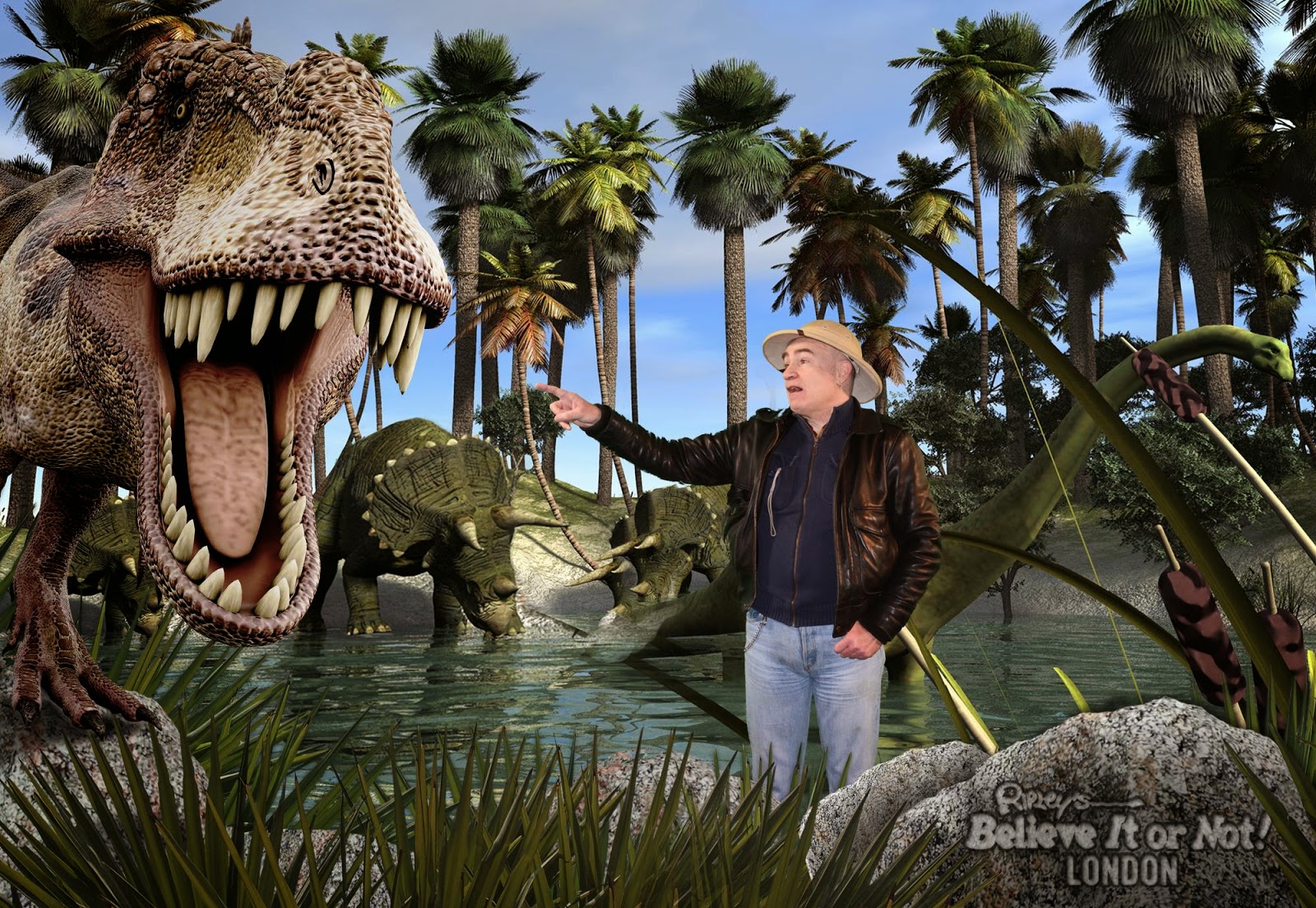
Experiencing some Mesozoic mayhem at
Ripley's Believe It Or Not! Odditorium London (© Dr Karl Shuker)
As a zoologist, it was obviously the various –and
extremely varied – animal attractions that particularly interested me, and I
was certainly not disappointed in the array on display. There are many Ripley's
Believe It Or Not! Odditoriums worldwide, especially in the USA (but with London's
being the largest one of all), and they have become synonymous with
teratological animals. There was certainly a goodly selection here in London (some of which were actual taxiderm specimens,
others models of real specimens), including several two-headed creatures,
animals with extra (supernumerary) limbs (a condition known as polymelia), and other
equally curious caprices.
One such creature was a rooster with three separate
legs that had been found in 1998 in England (exact location not specified), and was on display
alongside a five-legged lamb (its right hind limb was a double leg), again from
England and found during the early 1990s.

A three-legged rooster and a
five-legged lamb – two polymelic animals at Ripley's Believe It Or Not!
Odditorium London (© Dr Karl Shuker)
The two-headed lamb standing close by had been born
in Shandong, China, in 2006, and both of its heads were fully
functioning, with separate personalities.

Ripley's two-headed lamb from Shandong, China (© Dr Karl Shuker)
Just behind it was a pair of conjoined ('Siamese') piglets,
joined back-to-back but with separate necks and heads (thus constituting a
lesser version of the controversial rachipagus condition, in which conjoined
twins are joined dorsally from the back of their heads down the entire length
of their backs). These conjoined piglet twins were apparently similar in form to
a pair possessed by the eminent Russian tsar Peter the Great (1672-1725), who famously
owned a sizeable collection of scientific curiosities (click here for more information concerning this).

The conjoined piglets at Ripley's
Believe It Or Not! Odditorium London (© Dr Karl Shuker)
Just inside the entrance to the odditorium was a taxiderm
specimen of an adult black-and-white Friesian cow, which looked totally normal
– until I realised that a fully-formed fifth leg complete with hoofed foot was
growing outwards and upwards from between its shoulders! This bizarre
teratological condition is called notomelia, and indicates that during this
cow's embryogeny a supernumerary, aberrantly-located limb bud had developed. Alternatively,
but more dramatically, as an example of what could be termed pseudonotomelia it
is possible that the cow had originated as a pair of twins but that one of
these two twins had subsequently degenerated and had been almost totally
reabsorbed into the other one during their embryonic development, with only the
single limb providing external evidence of the absorbed twin's former existence
as a separate entity. (A very similar instance of notomelia, featuring a male
Friesian calf, was published in the July 2014 issue of the Canadian Veterinary
Journal.)

Ripley's notomelic Friesian cow
possessing a dorsally-sited supernumerary leg, plus the heads and forequarters
of a small white two-headed calf (© Dr Karl Shuker)
Here's another two-headed calf that was on display:

Two-headed calf at Ripley's Believe
It Or Not! Odditorium London (© Dr Karl Shuker)
And here's an albino alligator, complete with
ruby-red eyes:

Albino alligator at Ripley's Believe
It Or Not! Odditorium London (© Dr Karl Shuker)
There were also a number of life-sized models of
famous human curiosities. At one extreme was a model of Alypius, a dwarf from Alexandria during ancient Egyptian times, who was only 43 cm (17 in) tall, and whose fitting punishment for committing
treason was imprisonment inside a parrot cage!

Model of Alypius at Ripley's Believe
It Or Not! Odditorium London (© Dr Karl Shuker)
And at the other extreme, standing in front of a
full-sized American mastodon skeleton that only served to emphasise his truly
exceptional stature, was a full-sized model of Robert Wadlow (1918-1940),
immortalised in the record books as the world's tallest man. Suffering from
pituitary-induced gigantism, when he died aged just 22 years old he was already
a little over 8 ft 11 in tall, and was still growing. Indeed, had he grown
just under one inch more, he would have been the only confirmed 9-ft-tall human
ever recorded. Standing alongside this real-life giant's model, even at a
respectable 5 ft 10 in tall I still felt totally overshadowed by him, and
overawed too.

Standing alongside the life-sized
model of Robert Wadlow at Ripley's Believe It Or Not! Odditorium London (© Dr Karl
Shuker)
Equally eyecatching was a full-sized bust of a man
exhibiting hypertrichosis, also known as werewolf syndrome as persons
displaying this condition of extreme hairiness were once believed by the
superstitious to be lycanthropes.

Bust of a man exhibiting hypertrichosis
at Ripley's Believe It Or Not! Odditorium London (© Dr Karl Shuker)
Also well worthy of attention was the conical, elongated
skull of an ancient Peruvian, its extreme shape having resulted from the
practice prevalent then and there of using tightly-wrapped cloth, boards, and
rope to distort the shape of a child's growing skull via rigorous binding.

Manually-distorted conical skull of
an ancient Peruvian at Ripley's Believe It Or Not! Odditorium London (© Dr Karl
Shuker)
Yet despite all of these wonders and marvels, the
specimen that startled me most at Ripley's Believe It Or Not Odditorium London
was not actually on physical display there. Instead, it appeared – and even
then only very fleetingly – on a video
being played in loop format on a screen close to most of the teratological
animal specimens. The video showed a selection of teratological animals that
were on display at various odditoriums around the world, and also included some
footage of certain of these animals when they were still alive. Watching this
video, I was astonished when a couple of seconds of film was shown of a living,
seemingly adult, and clearly perfectly healthy syncephalic donkey, which
consisted of a single head to which were connected two completely separated,
fully-formed bodies!
By the time that my mind had registered this
astonishing image, the video had moved on to showing other specimens, so I
waited until it looped back to the beginning and then looked out for the donkey
footage. After studying it intently when it reappeared, there was no doubt in
my mind about what I had seen. It was indeed as I'd thought it to be on first
viewing, both in form and in condition, though even now I struggle to
comprehend how such a creature could survive to maturity – two independent four-legged
bodies linked to a single controlling head.
After then waiting for the footage to come round a
third time, when it did so I snapped a photo of this amazing
donkey-in-duplicate, which although of poor quality would serve as a visual record
of it for my files, and I vowed to investigate the matter further when I
returned home. After all, if such a creature could truly exist and survive to
adulthood, even the ostensibly impossible triplicate-bodied syncephalic lamb of
Hungary suddenly seemed less implausible.

My photographic record of the
syncephalic donkey as featured in the video shown at Ripley's Believe It or
Not! Odditorium London (© Dr Karl Shuker/Ripley's Believe It or Not! Odditorium
London)
And sure enough, my online researches have indeed
confirmed the donkey's reality. Named Rascal, he was a miniature donkey owned
by farmer Paul Springer whose farm is situated near Mineral Point, Wisconsin, USA. Paul's longstanding interest in teratological
livestock has led him over the years to purchase a number of specimens that
exhibit some anatomical peculiarity but are otherwise healthy and not suffering
in any way, and allow them to live out a full, happy life on his farm instead
of being slaughtered by their original owners either for their meat or simply
because they were different.
Paul's first purchase was a six-legged calf called
Boldegard during the 1970s, who went on to enjoy a long 14-year life on Paul's
farm, followed by a range of other animals with extra legs, additional horns, two
heads, or, in Rascal's case, one head and two bodies. Following their eventual
deaths, half a dozen of the most striking individuals have been sold by Paul to
the Ripley's Believe It Or Not! franchise for exhibition in various of their
odditoriums. So it is possible that Rascal is on display in one of them,
somewhere in the world. Consequently, if any of my readers have seen him, and
can send me details, I'd very much like to receive them here – many thanks
indeed in advance!
How uplifting it is to read of Paul Springer's
compassion for all of the out-of-the-ordinary creatures that he has rescued from
certain premature death. When asked in a media interview (WSAW.com 15 November
2009) what compelled him to rescue and care for animals with abnormalities, his
answer was as inspirational as it was direct:
"There's
something about them that maybe I feel sorry for. I give them a life. Most
people will put them down and sell them. I am proud of them. People who see them, it gives them a
chance to realize that everything isn't [normal], whether it be human beings or
pigs or people or cats or dogs, we're not all born normal. Just because
somebody has a handicap, they shouldn't be shunned. They should be given every
chance, and love and attention that's possible."
Amen to that!

Rascal when alive (© Paul Springer)


 Posts
Posts