Benjamin
Waterhouse Hawkins's Crystal Palace studio in 1853, containing some of his
completed statues of prehistoric 'monsters' (public domain)
On 22 April 2010, I finally fulfilled a
lifelong ambition, by visiting a veritable Lost World of dinosaurs and other
monstrous members of our planet's prehistoric fauna. Yet this particular Lost
World was located not atop some lofty South American mesa, or concealed amid
some remote African rainforest. Instead, it was cosily ensconced within a
leafy, tranquil setting not very far from the frantic hustle and bustle of
central London. I refer of course to Crystal Palace Park, and its spectacular
array of life-sized (albeit far from life-like) palaeontological reconstructions,
which date back to Victorian times and include the earliest representations of
dinosaurs ever created.
Today, they are considered by many to be nothing
more than antiquated curiosities, at least as far as their direct relevance to
modern-day fossil studies is concerned. Yet in historical terms, their
significance is immense, as is their aesthetic value as stunning works of art. So
here via this comprehensive 3-part ShukerNature blog article, I invite you all
to pay a virtual, verbal visit with me to these extraordinary creations, and
uncover their fascinating histories and mysteries.
Standing
in front of the iconic Megalosaurus statue
in the Dinosaur Court at Crystal Palace Park, London, on 22 April 2010 (© Dr
Karl Shuker)
I first learnt of the Crystal Palace
dinosaurs from one particular animal book that (along with many others) my
mother had bought me when I was a child, back in the 1960s. A compilation of
chapters written by several different authors, and which I still own today as a
fond reminder of my early years, it was entitled Children's Encyclopedia of Knowledge: Book of Nature, and had been
published by Collins in 1967. I'd also been bought a number of books devoted
specifically to dinosaurs and other prehistoric beasts. Yet whereas the respective
reconstructions in these latter books of the various famous dinosaurs' likely
appearance in life all compared well with one another, those in my Book of Nature were radically different.
This notable discrepancy puzzled me for some time until I finally uncovered the
answer.
The dinosaur illustrations in the
above-named book were photographs of enormous statues on display in southeast London's
Crystal Palace Park, but they more closely resembled giant, misshapen lizards than
the very distinctive, familiar forms depicted in all of my dinosaur books. Back
in those far-distant pre-internet times, it took a while for me to learn more
about them, but during the mid-1970s I bought Adrian J. Desmond's bestselling
book The Hot-Blooded Dinosaurs (1975),
which included a fascinating history of how and when the first dinosaur remains
had been discovered, and it was here that the secret of Crystal Palace Park's mystifying
monsters was at last revealed to me.
Vintage
engraving of the Crystal Palace in Hyde Park, London, for the Great Exhibition,
1851 (public domain)
The year 1851 saw Central London's Hyde
Park host the world-famous Great Exhibition (1 May-15 October), which was a
huge exposition showcasing the finest achievements of British industry as well
as including displays from other countries around the world too. It was housed
within a spectacular, palatial exhibition centre designed by Sir Joseph Paxton
and composed extensively of glass, which duly became known as the Crystal
Palace. Although initially intended to be merely a temporary creation, so
popular did this very imposing, impressive edifice prove to be that when the
Great Exhibition ended, instead of being demolished the Crystal Palace was purchased
for £50,000 by the new, specially-created Crystal Palace Company, which then paid
for it to be dismantled and moved in its entirety from Hyde Park to Penge, situated
on the lower slopes of Sydenham Hill, southeast London.
Here it was painstakingly reassembled and
became the focus of a new, specially-designed park, with beautiful landscaped
gardens, lakes, statues, and many other eyecatching features. These included
what became its most famous attractions – the incredible statues of huge dinosaurs
and other exotic-looking prehistoric animals created by English sculptor and
artist Benjamin Waterhouse Hawkins (1807-1894).
Benjamin
Waterhouse Hawkins sitting (Maull & Polyblank Wellcome/Wikipedia – CC BY 4.0 licence)
Despite having become extinct many
millions of years ago, dinosaurs are among the most popular of all animals in
today's world, their diverse imagery appearing everywhere, from books and films
to toys and postage stamps, as well as being represented by countless displays
in museums worldwide. All of which makes it all the more surprising, therefore,
that although dinosaur fossils had been dug up by geologists and excavators for
centuries, it was not until 1824 when the first dinosaur was scientifically named.
This was the 25-30-ft-long carnivorous theropod
Megalosaurus ('big lizard'), a saurischian
or lizard-hipped dinosaur, by Oxford University's Professor of Mineralogy and
Geology, the Reverend William Buckland, based upon fossil remains unearthed in
Oxfordshire, and originally thought to indicate a creature measuring around 40
ft long. A year later saw the naming of a second dinosaur form, the herbivorous
30-40-ft ornithopod Iguanodon, based
upon remains found in the Tilgate Forest area of West Sussex by English palaeontologist
Gideon Mantell and initially deemed by him to have measured around 60 ft long.
This was followed in 1833 by a third, Hylaeosaurus,
a herbivorous spiny ankylosaur, originally thought to have been approximately
25 ft long but nowadays downsized to around 10-13 ft. Its remains had been
exposed after an explosion had demolished a quarry face not far from where
Mantell's Iguanodon remains had been
obtained. Both of these latter forms are ornithischian or bird-hipped dinosaurs,
and both were named by Mantell.

Professor
Sir Richard Owen (public domain)
When ideas were being sought for subjects
to be represented in the new Crystal Palace Park, the suggestion of
constructing life-sized representations of extinct animals was put forward,
although there is still some controversy as to its originator. However, Queen
Victoria's enterprising consort Prince Albert (already responsible for the
Great Exhibition itself), Britain's foremost zoologist and palaeontologist of
the day, Prof. Sir Richard Owen (1804-1892), and the Crystal Palace's designer,
Sir Joseph Paxton, were all probably involved. Once this notion had been formally
accepted, in September 1852, Hawkins was duly commissioned by the Crystal
Palace Company to construct these statues, using concrete, brick, lead, and
steel.
Initially, the plan was to concentrate
upon prehistoric mammals, with thoughts of reconstructing mastodonts, mammoths,
and other furry wonders from the distant past. But once Hawkins had read some
of Owen's publications, it wasn't long before the prospect of also
reconstructing dinosaurs reared its reptilian head. At that time, only the
above-named trio of dinosaurs had been formally recognized, so Hawkins decided
to recreate all three of them with life-sized sculptures to show what they may
have looked like in life. Moreover, as his work progressed, the scheme was
expanded still further to include reconstructions of quite a number of other
archaic beasts too.
'The
'Crystal Palace' from The Great Exhibition', an engraving by George Baxter,
after 1854 (Wellcome Images-Wikipedia – CC BY4.0 licence)
Indeed, by the end of the project, no
fewer than 33 statues representing 20 different animal species had been produced
(together with some reconstructions of fossil plants too, such as cycads),
yielding a major attraction dubbed Dinosaur Court (aka Dinosaur Park), which encompassed
three specially-created islands within a large artificial lake, situated near
the southern end of Crystal Palace Park itself. Although the idea was to focus
upon such creatures that had once existed in Britain, some non-native examples
were also represented, Hawkins having utilised fossil remains from Holland when
reconstructing the mosasaur, for instance, from South Africa for Dicynodon, and from South America for Megatherium.
This unique project was nearing
completion by the end of 1853, so to mark with suitable panache its impending
official opening, a lavish banquet given by Hawkins was held on 31 December,
New Year's Eve, of that same year, at which 21 notable dignitaries invited by
him attended, including Owen and world-renowned bird painter John Gould. And
the setting for this celebration? None other than inside Hawkins's colossal
hollow mould for the construction of his standing Iguanodon statue! Never before, and probably never again, would
such an event take place quite literally inside the bowels of a Mesozoic
mega-beast!
Banquet
inside the mould of Hawkins's Crystal Palace Iguanodon statue, New Year's Eve 1853 (public domain)
Just over 5 months later, on 10 June 1854,
Crystal Palace Park was formally opened by Queen Victoria and Prince Albert.
Furthermore, no fewer than 40,000 visitors were in attendance, anxious to see
what the media were enthusiastically referring to as an incredible assemblage
of antediluvian monsters, i.e. labeling them as giant creatures that were
believed by Creationists and other religious figures from that time to have
existed on Earth during its earliest age before being wiped out by the Great
Flood.
Although initially proving very popular,
the Crystal Palace Park's Dinosaur Court eventually fell out of favour,
especially once continuing palaeontological discoveries revealed that most of its
reconstructions were actually very inaccurate. Neglected, especially after the Crystal
Palace's destruction by fire in 1936, the statues eventually became partially
hidden amid an overgrowth of undergrowth, and suffered considerably from damage
caused not only by external, environmental influences but also by vandalism.
Happily, following a first major restoration project in 1952, the historical significance
of Hawkins's creations as a pioneering palaeontological venture was belatedly
recognized, and in 1973 they were officially classed as National Heritage Grade
II Listed Monuments, upgraded to Grade I in 2007. Meanwhile, an extensive
second restoration project had taken place in 2002, recreating their dignified
former appearance, making many repairs to their crumbling forms, and overseen by
the London Borough of Bromley, the landowner of Crystal Palace Park.

Indigo
Iguanodons in 1995, before the 2002 restoration, showing their previous
countershaded paint scheme with white undersides (public domain)
Intriguingly, I'd long heard rumours that
during the 1970s and possibly beyond, some of these statues were painted in bright
garish colours. Only recently, however, have I uncovered some notable details
concerning this hitherto scarcely-documented chapter in their long-running saga.
For example: during their 'painted
period', the standing Iguanodon
statue was initially rendered a deep olive green with contrasting white
underparts and golden jaw edges, but by the late 1970s both Iguanodon statues were dark indigo blue
dorsally, pure white ventrally (although their throat region began as a flushed
pink shade, subsequently fading to white). They still sported this colour
scheme during the 1990s (as confirmed by some early 1990s videos and mid-1990s
photos of them), whereas in still later photos they are a pale mint green. In
addition, Mandy Holloway, Curator of Fossil Reptiles, Amphibians, and Birds at
London's Natural History Museum at that time, has shown me a photograph snapped
by her of the left-hand side of the Megalosaurus
(nowadays uniformly grey all over) that reveals the presence of a thick red
horizontal stripe running along its lower flank, and striations of the same
shade upon its limbs.

Crystal
Palace's Iguanodons when mint-green in colour (© CGPGrey/Wikipedia – CC BY 2.0 licence)
Moreover, the charity organization
Friends of Crystal Palace Dinosaurs (FOCPD – click here to access
their fascinating and very worthy website) kindly alerted me to a music video
from 1977 currently accessible online (click here
to view it) that features the late singer Lena Zavaroni boating past these
dinosaur statues while singing the song 'I Had A Brontosaurus', in which the Megalosaurus is almost entirely bright red.
I'd initially assumed that this vivid colouration was simply a special-effect
created for the video, but Mandy confirmed that it was genuine – the Megalosaurus having been painted red on
the instructions of the now long-defunct Greater London Council (GLC), which
was also responsible for painting the other statues in Dinosaur Court that were
brightly coloured during that period. Apparently, the reason for doing so was
to make the statues appealing to young visitors, as a children's zoo had also
been set up there, on Tertiary Island.
Correspondent Sam Crehan has shown me a
full-colour photo of the Megalosaurus
statue during its red phase that appears in the little children's book I-Spy Dinosaurs and Prehistoric Animals,
and which reveals that its underparts (not very visible in the Lena Zavaroni
music video) were white. (I suspect that the statue's red colour in the video,
so bright that it virtually glows, has been enhanced, to make it more visible
against its dark, shadowy background.)
From I-Spy Dinosaurs and
Prehistoric Animals as scanned by Sam Crehan, a full-colour photo of the Megalosaurus statue during its red phase
(© Faber & Faber/I-Spy Ltd/Michelin – reproduced here on a strictly
non-commercial Fair Use basis for educational/review purposes only)
In January 2021, Crystal Palace Dinosaurs
devotee Anthony Hawkins posted on FOCPD's Facebook page a photo of the Megalosaurus when red with white
underparts that dated from December 1980. And a similar photo from 1979 was an entry in the 2016 Arles
Festival of Photography, Rencontre d'Arles, a premier event for photographic
art.
Finally, Canadian cryptozoological friend
Sebastian Wang has drawn my attention to the official website of Palaeoplushies,
a manufacturer of plush toys, which includes in its list of products not one
but two versions of the Crystal Palace Megalosaurus
– identical in shape and size, but very different in colour. For whereas one is
grey, the other is red. In its official description of these two Megalosaurus versions, Palaeoplushies
refers to the grey one as ""Classic Grey" – The current
weathered grey concrete look", and to the red one as ""70s
red" – The look this statue had during the 70s" (click here
to view and/or purchase these Megalosaurus
plushies on the Palaeoplushies website). In short, Megalosaurus really was red in colour during the 1970s and at least
as recently as the early 1980s too. This in turn means that Mandy's photo of it
sporting just a horizontal red flank stripe and some red leg markings was
snapped at a time when most of its red paint had been removed or painted over,
or had simply faded away (red and yellow pigments are very prone to fading when
exposed to sunlight).

My
resin model of the Crystal Palace Megalosaurus
statue – my model's original golden-scaled form (top) and digitally recoloured
to show what the statue would have looked like during its red-painted period
(bottom) (© Dr Karl Shuker)
Dinosaur Court's prehistoric creatures
were originally located upon, and also within the waters surrounding, three
artificial islands (named Tertiary, Secondary, and Primary), and most of these
statues are still there today. The general public can walk around the islands
(but not as yet directly upon them, except during special annual Open Days) via
a railed public footpath on the Court's mainland portion, which affords excellent
views of all of the statues. The islands are arranged in geological order, with
their respective creatures dating from the Cenozoic Era back as far as the
Permian Period of the late Palaeozoic Era. However, the Mesozoic Era is the
Court's principal focus, because that is when most of the archaic beasts
represented here existed, during the Age of Reptiles, as this era is commonly
termed.
After arriving inside Crystal Palace
Park's Dinosaur Court, if we begin our journey through geological time with the
most recent creatures represented here, as I did, the first of Hawkins's statues
encountered are four different mammals from the Cenozoic Era. These were
formerly present on Tertiary Island, but except for the ground sloth they have
now been relocated on the nearby mainland.
Anoplotherium herd in Crystal Palace Park's Dinosaur Court (© Simon/Wikipedia
– CC BY 2.0 licence)
One of these mammals is Anoplotherium, represented by a small
herd of three statues when I visited and photographed them in 2010 (yet some
sources claim that only two exist). It was a primitive artiodactyl ungulate
(even-toed hoofed mammal) from the late Eocene and early Oligocene Epochs (c.37-33
million years ago).
Anoplotherium is nowadays thought to be
related to camels and llamas, and which Hawkins did provide with a camel-like
head and neck. Its fossil remains have been found widely across Europe,
including Hampshire and the Isle of Wight in the UK.
Anoplotherium herd seen from the opposite side, Crystal Palace (© Dr Karl
Shuker)
Also represented here is Palaeotherium, another primitive hoofed
mammal, in existence at much the same time as Anoplotherium and whose remains have again been found in Hampshire
and the Isle of Wight. Unlike Anoplotherium,
however, Palaeotherium was a perissodactyl
(odd-toed) ungulate. Originally there were three statues of it, but the largest
one mysteriously vanished sometime after the late 1950s and has never been seen
again.
Hawkins followed the opinion of eminent
French zoologist Baron Georges Cuvier concerning the likely appearance of Palaeotherium in life, reconstructing it
to resemble those modern-day perissodactyls the tapirs. Today, conversely,
palaeontologists generally depict it as a perissodactylian parallel to the artiodactylian
giraffe's shorter-necked forest relative, the okapi.
One
of Hawkins's Crystal Palace Palaeotherium
statues (© Dr Karl Shuker)
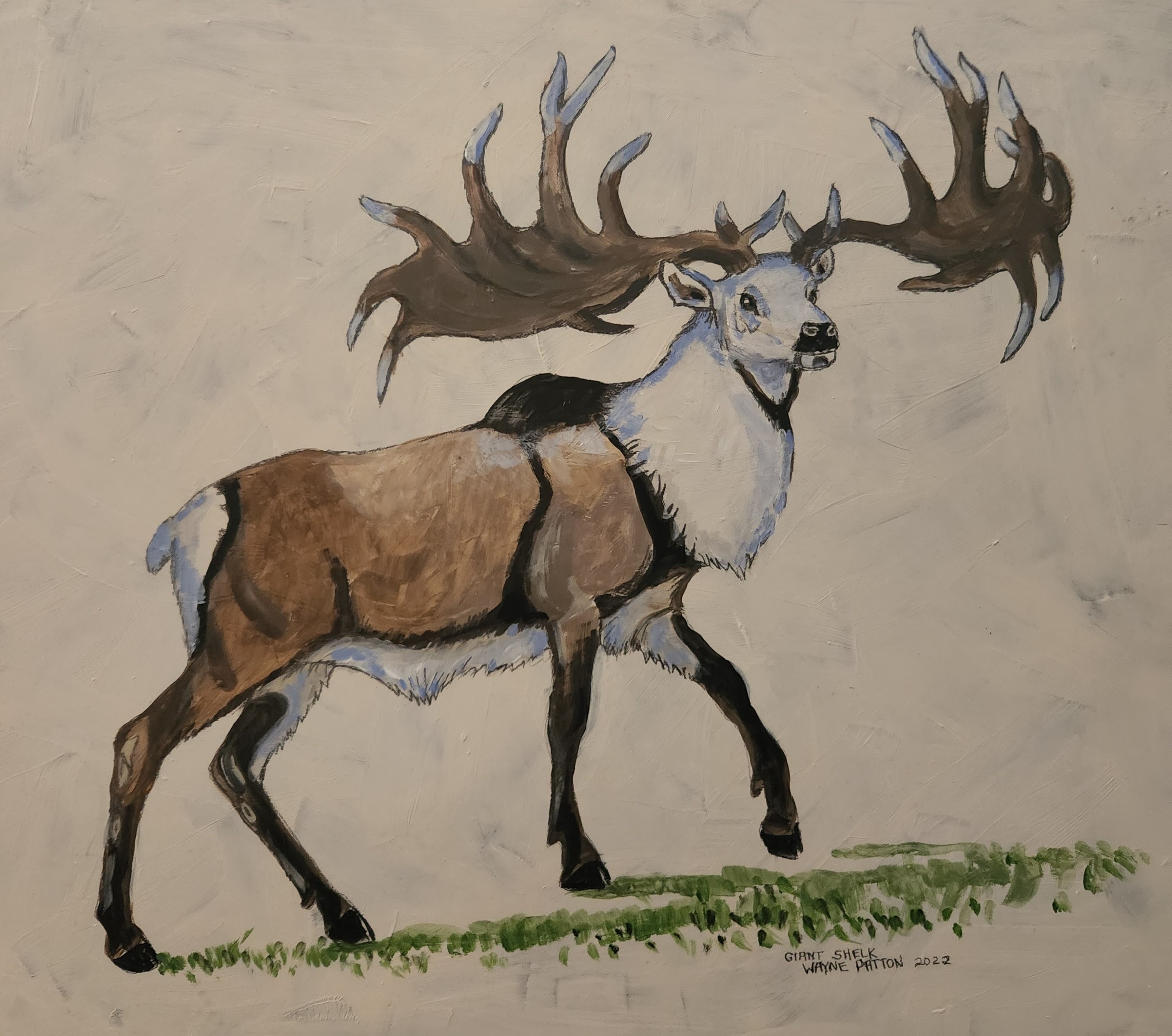
My favourite Hawkins mammals are his very
imposing giant deer or Irish elks Megaloceros
giganteus, consisting of two antlered adult stags standing regally and an
antler-lacking adult doe reposing with her fawn close by. Even today, these statues
still correspond well with palaeontological thoughts regarding their likely
appearance. This is because Hawkins based them upon living modern-day deer.
In addition, for his stag statues' antlers
he utilized actual complete fossils of the famously magnificent antlers borne
by this species' stags, but in subsequent years these real fossil antlers were
replaced by replicas. Their remains have been found not only in Ireland but also
on the Eurasian mainland, including as far east as Siberian Russia. Some have
been dated to as recently as the early Holocene, 8000 years ago.
Giant
deer aka Irish elks Megaloceros giganteus
at Crystal Palace Park (© Neil Cummings/Wikipedia – CC BY-SA 2.0 licence)
Finally, a suitably huge
Pliocene/Pleistocene Megatherium or
giant ground sloth from Argentina squats upright on its haunches, grasping a
tall tree. However, it sports a short trunk-like proboscis that is no longer
thought to have been a valid feature of this creature.
Over the course of many years following
the sloth's installation at Dinosaur Court in 1854, the girth of the tree that
it is grasping grew so wide that it broke the sloth's left forearm, which
needed to be restored. And at the time of my visit in 2010, its right paw was
missing.
Front
and side views of the Megatherium
statue in 2010, clearly revealing that its right front paw was missing at that
time (© Dr Karl Shuker)
Also worth noting is that at one stage
during its long and distinguished existence, this very spectacular statue
shared its location with the afore-mentioned children's zoo. That must surely be
the only example of such a zoo to contain a giant ground sloth in its midst!
Moreover, although this Crystal Palace
example is the first Megatherium
statue to have been attempted by Hawkins, in subsequent years its gigantic species
would again be an inspiration to him when designing a second major exhibit, as
will be revealed later here.
19th-Century
engraving of the Crystal Palace Megatherium,
depicting it when its right front paw was still intact (public domain)
Memorable though these bygone mammals are,
it will come as no surprise to learn, however, that the most popular portion of
Dinosaur Court is the next island to which the mainland public footpath now
leads, Secondary Island. For this contains Hawkins's most famous creations – his
Mesozoic dinosaurs and pterosaurs.
Moreover, on its shore and also in the adjacent waters of Dinosaur
Court's lake are Mesozoic plesiosaurs, ichthyosaurs, sea crocodilians, and a
mosasaur.
So that is where our virtual tour of
Crystal Palace's Lost World will be taking us tomorrow, in Part 2 of this
ShukerNature blog article (click here to access it) – back in time to the astonishing Age of Reptiles.
And after that comes Part 3 (click here to access it), where I reveal the tragic tale of Hawkins's ill-fated Palaeozoic Museum, planned to be a major attraction in New York City. Don't miss them!
My
mother Mary Shuker and the Megatherium
statue at Crystal Palace Park on 22 April 2010 (© Dr Karl Shuker)




 Posts
Posts