Dr KARL SHUKER

Zoologist, media consultant, and science writer, Dr Karl Shuker is also one of the best known cryptozoologists in the world. He is the author of such seminal works as Mystery Cats of the World (1989), The Lost Ark: New and Rediscovered Animals of the 20th Century (1993; greatly expanded in 2012 as The Encyclopaedia of New and Rediscovered Animals), Dragons: A Natural History (1995), In Search of Prehistoric Survivors (1995), The Unexplained (1996), From Flying Toads To Snakes With Wings (1997), Mysteries of Planet Earth (1999), The Hidden Powers of Animals (2001), The Beasts That Hide From Man (2003), Extraordinary Animals Revisited (2007), Dr Shuker's Casebook (2008), Karl Shuker's Alien Zoo: From the Pages of Fortean Times (2010), Cats of Magic, Mythology, and Mystery (2012), Mirabilis: A Carnival of Cryptozoology and Unnatural History (2013), Dragons in Zoology, Cryptozoology, and Culture (2013), The Menagerie of Marvels (2014), A Manifestation of Monsters (2015), Here's Nessie! (2016), and what is widely considered to be his cryptozoological magnum opus, Still In Search Of Prehistoric Survivors (2016) - plus, very excitingly, his four long-awaited, much-requested ShukerNature blog books (2019-2024).

Dr Karl Shuker's Official Website - http://www.karlshuker.com/index.htm

IMPORTANT: To view a complete, regularly-updated listing of my ShukerNature blog's articles (each one instantly clickable), please click HERE!

IMPORTANT: To view a complete, regularly-updated listing of my published books (each one instantly clickable), please click HERE!

IMPORTANT: To view a complete, regularly-updated listing of my Eclectarium blog's articles (each one instantly clickable), please click HERE!

IMPORTANT: To view a complete, regularly-updated listing of my Starsteeds blog's poetry and other lyrical writings (each one instantly clickable), please click HERE!

IMPORTANT: To view a complete, regularly-updated listing of my Shuker In MovieLand blog's articles (each one instantly clickable), please click HERE!

IMPORTANT: To view a complete, regularly-updated listing of my RebelBikerDude's AI Biker Art blog's thematic text & picture galleries (each one instantly clickable), please click HERE!

Search This Blog


PLEASE COME IN, I'VE BEEN EXPECTING YOU...

PLEASE COME IN, I'VE BEEN EXPECTING YOU...
WELCOME TO SHUKERNATURE - ENJOY YOUR VISIT - BEWARE OF THE RAPTOR!


Showing posts with label trilobite beetle. Show all posts

Friday, 12 August 2016

DREDGING UP SOME LIVING TRILOBITES?


Large-scale model of the 'Dudley bug' trilobite Calymene blumenbachii (© Dr Karl Shuker)

One of the best-known groups of fossil animal are the trilobites ('three-lobed'), this name deriving from the distinctive three-lobed structure of their body, which consists of the cephalon (head shield), the thorax, and the pygidium (tail shield). Ranging in size from a dinner plate down to a pea, they are famed for their segmented body form, numerous pairs of limbs, and extremely well-developed compound eyes.

Global but exclusively marine in distribution, this taxonomic class of arthropods was one of the earliest, with the first-known representatives in the fossil record dating back approximately 540-520 million years to the early Cambrian Period (though it is suspected that there may well have been earlier forms as yet unrepresented by documented fossils dating as far back as 700 million years, to the pre-Cambrian).

Beautiful illustration of trilobites from Système Silurien du Centre de la Bohême, by Joachim Barrande, 1852 (public domain)

Bearing in mind how zoologically familiar they are today and how their taxonomic identity as arthropods is indisputable, it may come as something of a surprise to learn that the first trilobite fossils to attract notable scientific attention, during the 1700s, incited considerable controversy as to what type of creature they represented, resulting in some exceedingly bizarre notions being aired in all seriousness.

They were initially deemed to be ancient, three-lobed clam-like seashells (and were duly dubbed Concha triloba), because these particular trilobite fossils showed only the animals' dorsal side (thereby concealing the fact that trilobites actually possessed legs – lots of legs, in fact!).

Sentimentally priceless - a diverse selection of trilobite casts on a matrix slab bought for me by my late mother Mary Shuker during our first, very happy visit to Lyme Regis, Dorset (© Dr Karl Shuker)

Not everyone agreed with this identification, however, and offered various alternative but equally erroneous suggestions. The normally authoritative British zoologist Dr George Shaw (1751-1813), for instance, proposed that trilobites were fossil caterpillars, while some contemporaries opined that they were archaic centipedes, or (less preposterous) crustaceans.

The matter remained contentious until American palaeontologist Charles D. Walcott resolved it in a very convincing manner – by skilfully and painstakingly using a hacksaw to open up no fewer than 3,500 fossils of curled-up trilobites, thereby revealing the presence of their jointed legs, and, in turn, these hitherto-baffling beasts' true nature as arthropods.
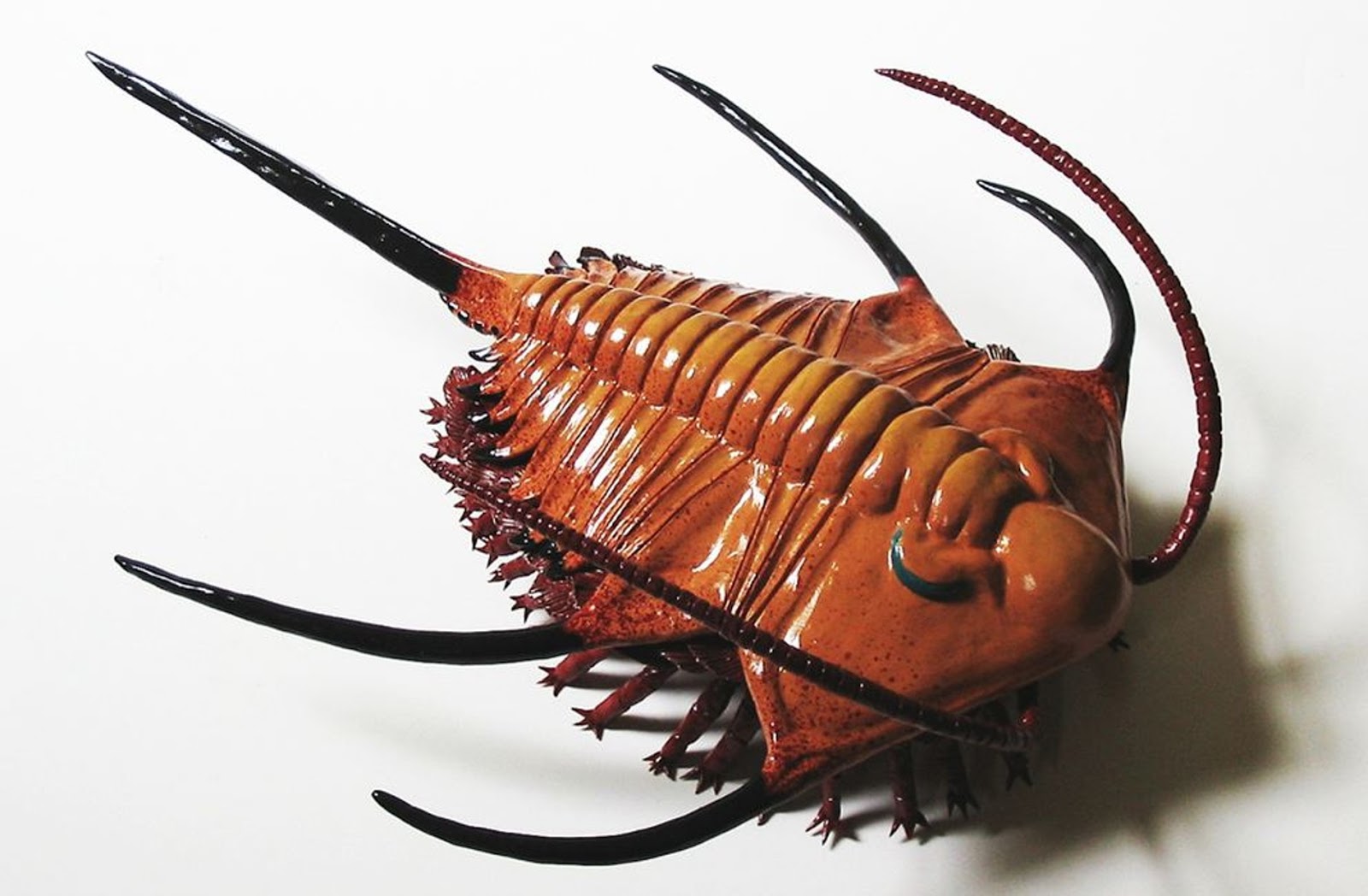
Spectacular, life-like model of Bristolia bristolensis, a notably long-spined species of early Cambrian trilobite from the southwestern USA (© Andrew 'Trilobite' Scott – click here for a ShukerNature exclusive showcasing many other examples of Andrew's stunning artwork)

During the lengthy course of their evolution, the trilobites became exceedingly successful, yielding a vast diversity of species (some 17,000 are currently recognised) as well as body forms and lifestyles before decreasing markedly in the Devonian, and finally dying out completely around 252 million years ago (in the mass extinction that occurred at the end of the Permian) – or did they? There is no well-established reason why they should have done.

As a zoologist living in the West Midlands, England, I am very aware that one particular trilobite species, Calymene blumenbachii from the Silurian Period, is so abundant in the fossiliferous limestone quarries of Wren's Nest in the West Midlands town of Dudley that it is popularly known as the Dudley bug or Dudley locust, and even appears on the Dudley County Borough Council's official coat-of-arms. Naturally, therefore, I've been a fan of trilobites ever since childhood, and my fossil collection contains several specimens, but my interest in cryptozoology would subsequently yield an additional reason for my being fascinated by them.

Dudley bug trilobite, from James Geikie's Outlines of Geology, 2nd rev. edit, 1883 (public domain)

In the mid-1980s, I purchased veteran American cryptozoologist Prof. Roy P. Mackal's classic book Searching For Hidden Animals (which had originally been published in 1980 in the U.S.A., but not until 1983 in the U.K.), and was delighted to find that it documented a wide range of lesser-known cryptids.

However, one chapter that obviously attracted my particular interest was tantalisingly entitled 'Living Trilobites?'. It included a discussion as to whether any representatives of these archaic arthropods might have survived the Permian mega-death and persisted in benthic anonymity on the ocean floor into the present day.

Prof. Roy P. Mackal and the UK hb 1st edition of his book Searching For Hidden Animals (© Prof. Roy P. Mackal/Cadogan Books)

As Mackal noted, many trilobites were shallow coastal dwellers (especially the later ones), yet no living trilobites from such localities have ever been discovered. Consequently, the only hope for modern-day survival is if "some forms adapted to a deeper, more obscure environment and there found refuge" - or if some that were already so adapted simply persisted. Should this scenario have indeed taken place, it could explain why no Cenozoic trilobite fossils have ever been found - because these would not be readily discovered or accessed on the ocean floor. But what about obtaining living specimens there?

Until reading Mackal's book, I hadn't been aware that the very first global marine research expedition, the voyage of HMS Challenger from 21 December 1872 to 26 May 1876, seriously believed that living trilobites might be dredged up from the ocean bottom. But although countless specimens that included representatives of over 4,000 hitherto-unknown animal species were indeed procured there, none of them were trilobites. Or, as worded in the authoritative Encyclopaedia Britannica's eleventh edition, published in 1911, the "faint hope" of finding such creatures was not realised.

HMS Challenger portrayed in an engraving from 1858 (pubic domain)

In reality, however, a few years before this expedition had even set out on its epic voyage of zoological discovery, a claim had been made that a living trilobite had already been obtained, and from a depth of 1,200 fathoms (7,200 ft). Moreover, this claim was actually believed for a time before the creature's true, non-trilobite identity was revealed. Another veteran cryptozoological chronicler, Willy Ley, who briefly reported the case in one of his many articles, didn't provide further details, but as noted by Mackal the timing and morphological similarities strongly suggests that the discovery in question was actually that of a certain Antarctic species of isopod crustacean (the taxonomic group which includes woodlice and sea slaters) that is astonishingly trilobite-like in outward appearance.

Brought to scientific attention in 1830, its first officially recorded specimen had actually been found inside the gut of a marine fish examined by American naturalist Dr James Eights while visiting the South Shetland Islands between Patagonia and Antarctica during the so-called 'Expedition of 1830'. Emphasising its remarkable morphological convergence, in 1833 Eights formally christened this memorable new species Brongniartia [now Ceratoserolis] trilobitoides. And it was indeed initially mistaken for one of these prehistoric arthropods by some observers, but it sports two pairs of antennae (a crustacean characteristic), whereas trilobites only had one.

Ceratoserolis trilobitoides from James Eights's 1833 description paper (public domain)

Other modern-day creatures that have often been mistaken for living trilobites are chitons and water pennies. Chitons (or polyplacophorans, to give them their formal zoological name) constitute a taxonomic class of molluscs characterised by their very distinctive shells, which are composed of eight separate but slightly overlapping plates, and afford these animals a superficially segmented appearance dorsally.

If a chiton is turned over, however, its ventral body surface is seen to be non-segmented and only possessing a single, typically-molluscan foot, in contrast to the many limb pairs possessed by trilobites. As for water pennies, these trilobite imposters are the larval stage of certain aquatic freshwater psephenid beetles, belonging to the genus Mataeopsephus.

19th-Century engraving of chitons (public domain)

Also superficially trilobite-like in outward dorsal appearance are both the larvae and the larval form-retaining adult females of lycid (net-winged) beetles belonging to the genus Platerodrilus, and which are therefore known colloquially as trilobite beetles (click here for a ShukerNature article featuring these distinctive insects). Native principally to tropical rainforests in India and southeastern Asia, some of them are brightly coloured.

Finally, the juvenile stage of those famous 'living fossils' known as xiphosurans or horseshoe crabs is termed a trilobite larva, once again because of its superficial similarity to genuine trilobites. Horseshoe crabs, incidentally, are the closest living relatives of another taxonomic group of iconic fossil arthropods – the eurypterids or sea scorpions.

Exquisite illustration by Ernst Haeckel from 1904 featuring trilobites, horseshoe crabs, and sea scorpions (© public domain)

Back in the 1980s, a bizarre story emanating from Australia briefly hit the news headlines, claiming that some trilobites had been found inhabiting Perth's storm drains. Not surprisingly, however, this was soon exposed as a hoax, featuring an old tyre that had been cut into the shape of a trilobite.

A fossil trilobite species of familiar, non-extreme morphology (public domain)

Numerous deepsea collecting expeditions have been launched since Challenger, but none has ever procured any living trilobites, and yet some tantalising indirect (or, to be precise, ichnological) evidence for such creatures may have been recorded, which Mackal described as follows:

...in 1967, I was invited by Ralph Buchsbaum, professor of zoology at the University of Pittsburgh, to give a seminar on our researches at Loch Ness. During the social hour after the presentation one of his colleagues told me about experimental photography of the sea bottom that was in progress. He stated that photographs of fresh tracks identical to the Cruciana [sic – Cruziana], the fossilized trilobite tracks, had been obtained. He expressed the hope that traps could be lowered to catch whatever was making these highly suggestive tracks. As far as I know the nature of these tracks was never determined and nothing was ever trapped, because of a subsequent loss of funding for the project. The business of identifying sea-bottom trails and tracks is a tricky one and to infer living trilobites from a track is even more tricky. A marvelous collection of sea-bottom tracks and trails is presented in a book entitled The Face of the Deep by B. C. Heezen and C. D. Hollister. Only a tiny fraction of aquatic animal tracks have been identified, so that fertile ground for new discoveries is indeed abundant...Underwater photography of the ocean floor...appears to be a promising tool for future cryptozoological expeditions.

Cruziana from Portugal (public domain)

Cruziana is a famous trace fossil taking the form of elongate, bilobed burrows that are roughly bilaterally symmetrical. As noted in a 2010 Lethaia paper by Dr Stephen Donovan, many examples are believed to be the tracks or trails yielded by trilobites while deposit-feeding, but certain others are deemed not to be, because they were present in freshwater environments (where no trilobite fossils have so far been found) and/or were of Triassic date, by which time all trilobites were supposed to have died out. But were these ostensibly anachronistic tracks actually made by surviving post-Permian trilobites for which direct fossil evidence has simply not been found as yet?

Incidentally, two other types of trace fossil believed to have been created by trilobites are Rusophycus and Diplichnites. The former fossils are excavations featuring little or no forward movements, and have therefore been interpreted as traces left by trilobites while resting or in defence/protection mode. In contrast, the latter fossils are believed to be traces left by trilobites while walking upon the sediment surface.

Rusophycus trace fossil from Ordovician Period (public domain)

Mackal ended his living trilobites chapter on a somewhat pessimistic note, concluding: "While not impossible, it is most improbable that living trilobites still exist". After that, this fascinating prospect appeared to have vanished from the modern world just as surely, it would seem, as the trilobites themselves – which is why I was so startled, but delighted, by a certain comment allegedly made by a well-respected current scientist more recently.

On 24 June 2004, Yahoo! News released online a report concerning the receipt of a $600,000 start-up grant from the private Alfred Sloan foundation for a proposed 10-year international survey of the oceans' depths, at an estimated total cost of US $1 billion, to be funded by governments, companies and private donors, and officially dubbed the Census of Marine Life (CoML). As part of this grand-scale project, scientists led by researchers from the University of Alaska planned to use robot submarines and sonar to track down life forms in the Arctic Ocean's chilling deepwater domain, and expectations were that by the end of its decade-long course, the survey could easily have doubled the number of species known from this particular ocean.

Three-dimensional reconstruction of Drotops armatus, a very spiny species of Devonian trilobite from Morocco (public domain)

All very worthy indeed, but what caught my eye amid all of these statements was one attributed in the news report to none other than Dr Ron O'Dor, chief scientist of the multi-nation CoML. According to the report, whose exact wording is quoted here as follows, Dr O'Dor "speculated that Arctic waters might hide creatures known only from fossils, such as trilobites that flourished 300 million years ago". It would seem, therefore, that the notion of finding living trilobites has not been entirely discounted by scientists after all.

Happily, the CoML did indeed take place, this very ambitious project ultimately featuring scientists from more than 80 different nations, and releasing the world's first-ever census in 2010 – but no living trilobites were listed. Nevertheless, there is a notable precedent well worth mentioning here.

Pilina, a fossil monoplacophoran outwardly resembling modern-day Neopilina (public domain)

The monoplacophorans are a primitive taxonomic class of molluscs, whose youngest fossil species date from around 380 million years ago. On 6 May 1952, however, trawling off Mexico's western coast at a depth of almost 12,000 ft in dark, muddy clay, the Danish research ship Galathea hauled up 10 complete specimens and three empty shells of a small, seemingly unremarkable mollusc superficially resembling a limpet but which proved upon scientific examination to be a living monoplacophoran. This hitherto-unknown species was formally named Neopilina galatheae, since when further specimens of it, and of several additional modern-day species too, have been obtained (see my Encyclopaedia of New and Rediscovered Animals, 2012, for full details).

Structurally, these living monoplacophorans are very different internally from their archaic fossil ancestors, so if living trilobites do exist, these too are likely to be highly evolved species. Nevertheless, the discovery of Neopilina and kin readily demonstrates that it is by no means impossible for invertebrates deemed by their fossil record to have died out in very far-distant prehistoric ages to be represented, in fact, by living species that have simply evaded scientific detection.

A classic late-1800s illustration of living trilobites by Heinrich Harder (public domain)

This ShukerNature blog article is adapted from my forthcoming book Still In Search Of Prehistoric Survivors.


Wednesday, 1 January 2014

TRILOBITE BEETLES, CETI EELS, AND THE BEAST OF BRUNEI

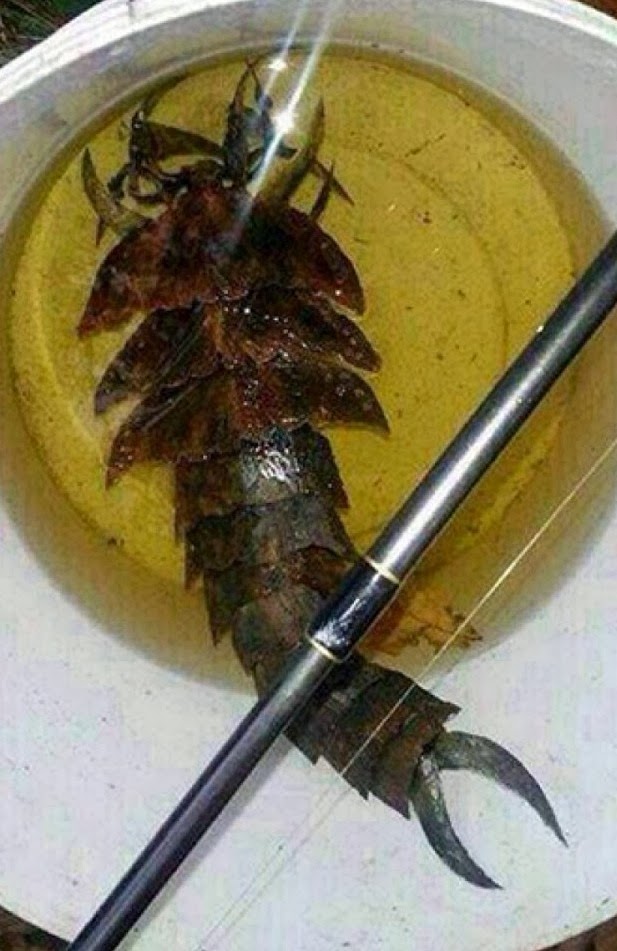
The mystifying Beast of BruneiStefan Rydehed - see Update section at the end of my article)

Where else but on the internet are you ever likely to encounter a creature as bizarre in appearance as the specimen depicted in the above photograph – unless, that is, it turned up in a river located within the Sultanate of Brunei? This small independent sovereign state situated in northwestern Borneo tends to be more famous for its extensive petroleum and gas fields and its mega-wealthy ruler, one of the world's richest men, than for any freshwater cryptids. All of that may change, however, if this ShukerNature post's mystery beast is ever confirmed to be genuine – but is it?

I first learned of the entity that I have herewith dubbed the Beast of Brunei on 14 December 2013, when fellow British cryptozoological researcher Richard Muirhead placed on the wall of the Facebook Cryptozoology Group a clickable link to a page (at http://www.projectnoah.org/spottings/124556003) that he had spotted earlier on the website of Project Noah. This website encourages persons to upload photos of any animal whose taxonomic identity they wish to discover. On the page spotted by Richard was the photograph that heads this current ShukerNature article, together with only the briefest, single-line account by the person who had posted the photo there, and who is based in Brunei. The person's user name is Hazwan (but no real name or biographical details are present), who claimed: "Someone caught this during fishing", and then asked what it was. Hazwan also claimed that the photo had been obtained on 11 December, and had been posted by him/her that same day on this Project Noah page. In addition, Hazwan stated that the coordinates of the location where the creature had been photographed were Lat: 4.97 Long: 114.90. This is near the coast within Brunei's capital, Bandar Seri Begawan.

The armoured anomaly present inside what looked like a white bucket or similar vessel containing some yellowish water was certainly very unfamiliar in appearance, and the lack of anything in the photograph that could provide a scale to gauge its size only served to heighten the mystery surrounding it. On first sight, it looked like some bizarre form of crustacean, but it seems to lack the sizeable number of limbs and dual pair of antennae typically associated with these arthropods. Also, the pincer-like cerci seemingly present at the posterior end of its body were much more reminiscent of the abdominal forceps of earwigs and certain other insects than of anything exhibited by a crustacean. Yet I am not familiar with any form of aquatic insect – adult or larval stage - that is even vaguely similar in appearance to the Beast of Brunei.

Beast of Brunei on left (© Stefan Rydehed - see Update section at the end of my article), and a female Duliticola hoiseni trilobite beetle from Malaysia on right (© Yixiong Cai = Tiomanese/Flickr)

Could it therefore have been some form of terrestrial insect that had inadvertently fallen into the river and had then been spied and caught by whoever had photographed it? As it so happens, there is a group of terrestrial beetles that do offer at least a superficial resemblance to this mystery animal. Coleopterans belonging to the taxonomic family Lycidae, they are known, for good reason, as trilobite beetles. For whereas the adult males are typical-looking beetles (and also fairly small, only around 1 cm long), the much larger adult females (up to 6 cm long) and also the juveniles sport an ornate protective armour of segmented, spine-bearing plates known as scutes that do recall the appearance of those long-vanished prehistoric arthropods the trilobites – and also the Beast of Brunei, as seen in the comparison photograph above.

Yet despite spending a considerable time perusing images online of various species of trilobite beetle (insects, incidentally, that do include Borneo within their distribution range), I have failed to find any that provide a convincing correspondence to the Beast of Brunei. Possibly the closest are those of the genus Duliticola (which is actually named after Borneo's Mount Dulit), but the Beast's body is proportionately too long and slender, and its cerci are unprecedented among trilobite beetles.

A still from a YouTube video showing an exceptionally attractive, lilac-hued female trilobite beetle from Puhipii Mountain in Oudomxay Province, northwestern Laos, uploaded onto YouTube on 13 January 2009 (© Quaoar Power/YouTube)

By today, 1 January 2014, the Project Noah page containing Hazwan's Beast photograph had attracted 20 comments from various readers, asking questions concerning the creature and offering some suggestions as to its possible identity, with a possible Duliticola larva being favoured, albeit very hesitatingly, by more than one person. In response, however, Hazwan had merely added that it was a friend (unnamed) who had photographed the animal, that it had been caught in a Brunei river, but that he/she had no further information or photos relating to it. One reader boldly suggested that the creature could be some form of anomalocarid – but as pointed out by Richard S. White (director of the International Wildlife Museum in Tucson, Arizona), those armoured stem arthropods became extinct at least 400 million years ago, at least as far as the fossil record is concerned. Moreover, all known forms were exclusively marine.

As for the true trilobites: the last of these iconic if similarly archaic marine arthropods had died out during the mass extinction at the end of the Permian Period, approximately 250 million years ago.

Classic early illustration of trilobites by Heinrich Harder

It was strange, but from the first moment that I saw Hazwan's photograph, I felt sure that I'd seen something like the Beast of Brunei somewhere before - but where? On 14 December, I'd reposted its photo and Project Noah link from Richard's Facebook wall onto my own, and asked for opinions. Some FB colleagues shared my view that it was vaguely reminiscent of a trilobite beetle, and there was also some discussion as to whether it might actually be a man-made fishing lure, whose jointed body would presumably wriggle in an animate manner in the river's current and thus attract fishes to it.

However, the comments that intrigued me the most were those of Kristian Lander, Blake Smith, and Jonathon Richter, all three of whom independently called to attention its similarity to a small but hideous, much-dreaded creature from science fiction – the ear-penetrating, mind-controlling Ceti eel, which appeared in the second Star Trek movie, The Wrath of Khan, released by Paramount Pictures in 1982. Having seen this film, and at around that time, I now realised that it was a dimly-recollected memory of the Ceti eel that I'd been thinking of when I'd felt certain I'd seen something like the Beast of Brunei before.

The Ceti eel's principal attributes are summarised as follows in its Wikipedia entry:

The Ceti eel appears in the 1982 film Star Trek II: The Wrath of Khan. It is the only indigenous lifeform of Ceti Alpha V known to have survived after Ceti Alpha VI exploded and sent Ceti Alpha V into a different orbit. Ceti eels incubate their larvae between protective plates that line their backs. The slime-covered larva will seek out a larger animal, enter its skull through the ear and wrap itself around the cerebral cortex. This causes the subject intense pain and makes them very susceptible to suggestion. As the larva grows, the host suffers from insanity and eventual death. Ceti eels bear a remarkable resemblance to antlion larvae.

Although I would argue against it bearing "a remarkable resemblance" to antlion larvae, this fictitious creature does provide a certain degree of accord with the Beast of Brunei, as revealed by the following photo of an official Ceti worm prop used for the Star Trek film in question:

An official Ceti eel prop from Star Trek II: The Wrath of Khan startrekpropauthority.com/Paramount Pictures)

Even so, it still didn't match the elusive image that I had in my mind – but then, when perusing further illustrations of the Ceti eel online, I finally found it!

I discovered that the version of the Ceti eel seen on screen was not the only one that had been conceived. No less than 15 different concept or prototype Ceti eels had been sketched by one of the film's designers, visual-effects artist Ken Ralston from Industrial Light & Magic, yielding a great diversity of forms, and it was the film's producer, Robert S. Sallin, who had made the final choice as to which of these should become the on-screen Ceti eel. Of the 14 versions that didn't make it, one of them (Ceti eel Concept #11) even possessed a pair of sizeable, grasshopper-like hind legs; and another one, the very first to be sketched by Ralston in fact (Ceti eel Concept #1), sported a pair of posterior earwig-like cerci!

Yes indeed, there it was – the image that I knew I'd seen somewhere before and had remembered vaguely ever since. It was none other than Ceti eel Concept #1, deftly combining an armoured body that resembled a somewhat extreme example of an adult female trilobite beetle with those instantly-recognisable terminal cerci that had hitherto foiled every attempt by me to identify the Beast of Brunei.

Sketch of Ceti eel Concept #1 (© Ken Ralston/Robert S. Sallin/Paramount Pictures)

Although the thoracic scute spines on Ceti eel Concept #1 are much lengthier and more attenuated than those of the Beast, it can readily be seen from the above illustration that the former fictitious creature is much more similar to the latter mystery one than any other candidate that has been considered so far.

So where does this leave the Beast of Brunei? Of the various identities that have been proposed and noted here, the surviving anomalocarid contender seems least likely. For although it cannot be entirely ruled out that a lineage of these archaic invertebrates has persisted to the present day undiscovered by science, the fact that there is no trace whatsoever in the known fossil record of such an immensely extensive period of anomalocarid survival as 400 million years renders this possibility highly unlikely. (Having said that, however, we must be scrupulously fair and point out that the most recent anomalocarid species, Schinderhannes bartelsi, currently known from just a single specimen, is 100 million years younger than the next most recent species, so there is a confirmed 100-million-year gap in the anomalocarids' fossil presence; could there also, therefore, be a later, 400-million-year gap?)

A model of an anomalocarid, genus Anomalocaris, at Australia's National Dinosaur Museum in Canberra (Photnart/Wikipedia)

If the Beast of Brunei is an adult female or a juvenile trilobite beetle, then it is apparently a very distinctive, undescribed species, because its armour differs markedly from any species whose morphology I am aware of, and its cerci are unique. Of course, there is the faint possibility that these latter structures are not cerci at all, and even that they are not actually attached to the animal – perhaps they are merely something upon which the animal is resting, because they do appear somewhat misaligned. Alternatively, one FB friend suggested that they resembled the tail of a fish that had been attached somewhat inexpertly to the animal's posterior end. As for the animal's legs and possible antennae visible at its anterior end, these are not sufficiently clear in the photo to enable any detailed comments concerning them to be made.

Despite allegedly having been found in a river, the Beast of Brunei does not correspond physically to any known taxon of crustacean. Perhaps the nearest are the so-called Balmain bugs or butterfly fan lobsters Ibacus spp. of Australia, but these are marine crustaceans, not freshwater, and their morphological similarities to the Beast are only very minor anyway. In reality, this anomalous creature does not correspond to any known taxon of any invertebrate.

An illustration from 1815 of a  Balmain bug

What it does correspond most closely to, conversely, is an imaginary entity created for a science fiction film. So is the Beast an unofficial (albeit skilfully-manufactured) Ceti eel replica? If so, unless it had originally been created as a distinctive, mobile fishing lure, why was it found in a Brunei river? Or was it? Is this enigmatic creature's entire story (if anything with such scant details can even be referred to as a story anyway) no less fictitious than the Ceti eel? That is, could it be that the Beast wasn't found in a river at all, but was an artificial creation photographed (or even photoshopped) by persons unknown, and then utilised as the basis of yet another zoologically-themed internet hoax?

If it IS genuine, then its extraordinary, unparalleled combination of morphological attributes suggests that the Beast of Brunei is a truly remarkable zoological discovery of potentially profound scientific significance – and especially so if by extreme good fortune the animal itself has been preserved. But as almost a month has now passed since its internet debut yet without anything further emerging online regarding it, in my opinion the omens for its authenticity do not look good.

A very eyecatching female specimen of a Duliticola trilobite beetle species from Sabah, one of two Malaysian states present in northern Borneo (© Dave Dunford/Wikipedia)

Perhaps the situation concerning the Beast of Brunei and what it may (or may not) represent is best summed up on another website. On the Project Noah page containing Hazwan's photo of the Beast and the few details available concerning it, one reader suggested that Hazwan should send the photo and its details to a website called Whatsthatbug, which specialises in identifying unusual insects and other arthropods and generally achieves considerable success in this. Hazwan did so, and on 12 December they duly appeared on the following page - http://www.whatsthatbug.com/2013/12/12/unknown-thing-caught-fishing-brunei - under the heading 'Unknown "Thing" caught while fishing in Brunei'. And here is the response from this website's owners:

"We don't even know where to begin to classify this thing. We hope you are able to provide additional information. How large was this thing? Was it caught with a net or a fishing pole? Are there any additional photos showing the underside? Perhaps one of our readers can assist with this identification."

I accessed this page most recently during the early hours of today, 1 January 2014, when preparing the present ShukerNature article; at that time, no additional information had been supplied by Hazwan, and no assistance in identifying the creature had been offered by any reader.

I would love to be proved wrong, but somehow I don't think that we're going to be hearing any more about the Beast of Brunei – or, even if we do, I am not expecting it to shake the foundations of zoology any time soon.

Having said that: if anyone reading this ShukerNature post has any pertinent information concerning the Beast of Brunei and/or its possible identity, please do post details below – I'd be extremely interested to read them. Thanks very much!

Model of prehistory's famous 'Dudley bug' trilobite Calymene blumenbachii (© Dr Karl P.N. Shuker)

I am most grateful to Richard Muirhead for bringing this intriguing creature to my attention by posting on the Facebook Cryptozoology Group's wall the link to Hazwan's original Project Noah communication; and also to the following persons for their much-valued insights and opinions concerning its possible nature: Kevan Farmer, Kristian Lander, Cameron A. McCormick, Tim Morris, Jonathon Richter, Robert Schneck, Blake Smith, Spencer Thrower, Richard S. White, and Absentia Xuicoatl.

Close-up of the Beast of Brunei (© Stefan Rydehed - see Update section below)

UPDATE, 23 April 2024: I'm happy to say that the mystery re the Beast of Brunei's true nature has finally been solved. Today, while reading the latest issue (Vol. 10. #28, April 2024) of Richard Muirhead's anomalous animals magazine Flying Snake, I encountered a fascimating investigative article by Josh Hughes, whose researches have laid bare this entity's identity. I highly recommend that you read his full article in Flying Snake, but suffice it to say here on ShukerNature that the Beast proved to have been nothing more than a model, created in only an hour by Swedish short-film director and writer Stefan Rydehed, who also enjoys constructing models as a hobby. In an interview with reporter Kenny Hero from a local newspaper, Rydehed revealed that he had prepared the Beast from old plastic biscuit tins and some electrical cords out of sheer boredom, and had then uploaded several photographs of it onto his own Facebook page in early 2013 to see whether anyone would assume that it was real, but he hadn't any idea of how much interest it had engendered until much later, when contacted by Josh. Also, it wasn't until one of these photos was sent some months later to Hazwan by a friend, with Hazwan in turn submitting it to Project Noah, that the Beast of Brunei story went viral. As for the model itself, it still resides in Rydehed's barn, and was never at any time anywhere even remotely near Brunei. Another curious crypto-case duly solved - my congratulations to Josh Hughes for his highly successful monster-busting!