Dr KARL SHUKER

Zoologist, media consultant, and science writer, Dr Karl Shuker is also one of the best known cryptozoologists in the world. He is the author of such seminal works as Mystery Cats of the World (1989), The Lost Ark: New and Rediscovered Animals of the 20th Century (1993; greatly expanded in 2012 as The Encyclopaedia of New and Rediscovered Animals), Dragons: A Natural History (1995), In Search of Prehistoric Survivors (1995), The Unexplained (1996), From Flying Toads To Snakes With Wings (1997), Mysteries of Planet Earth (1999), The Hidden Powers of Animals (2001), The Beasts That Hide From Man (2003), Extraordinary Animals Revisited (2007), Dr Shuker's Casebook (2008), Karl Shuker's Alien Zoo: From the Pages of Fortean Times (2010), Cats of Magic, Mythology, and Mystery (2012), Mirabilis: A Carnival of Cryptozoology and Unnatural History (2013), Dragons in Zoology, Cryptozoology, and Culture (2013), The Menagerie of Marvels (2014), A Manifestation of Monsters (2015), Here's Nessie! (2016), and what is widely considered to be his cryptozoological magnum opus, Still In Search Of Prehistoric Survivors (2016) - plus, very excitingly, his four long-awaited, much-requested ShukerNature blog books (2019-2024).

Dr Karl Shuker's Official Website - http://www.karlshuker.com/index.htm

IMPORTANT: To view a complete, regularly-updated listing of my ShukerNature blog's articles (each one instantly clickable), please click HERE!

IMPORTANT: To view a complete, regularly-updated listing of my published books (each one instantly clickable), please click HERE!

IMPORTANT: To view a complete, regularly-updated listing of my Eclectarium blog's articles (each one instantly clickable), please click HERE!

IMPORTANT: To view a complete, regularly-updated listing of my Starsteeds blog's poetry and other lyrical writings (each one instantly clickable), please click HERE!

IMPORTANT: To view a complete, regularly-updated listing of my Shuker In MovieLand blog's articles (each one instantly clickable), please click HERE!

IMPORTANT: To view a complete, regularly-updated listing of my RebelBikerDude's AI Biker Art blog's thematic text & picture galleries (each one instantly clickable), please click HERE!

Search This Blog


PLEASE COME IN, I'VE BEEN EXPECTING YOU...

PLEASE COME IN, I'VE BEEN EXPECTING YOU...
WELCOME TO SHUKERNATURE - ENJOY YOUR VISIT - BEWARE OF THE RAPTOR!


Showing posts with label yeren. Show all posts

Friday, 29 December 2017

'MYSTERY CREATURES OF CHINA: THE COMPLETE CRYPTOZOOLOGICAL GUIDE', BY DAVID C. XU - A LANDMARK IN THE LITERATURE OF UNKNOWN ANIMALS


The exquisite artwork on the front cover of David C. Xu's wonderful book (© David C. Xu/Coachwhip Publications)

December 2017 may seem rather early for anyone to put forward a major contender to receive in a year's time the accolade of Best Cryptozoology Book of 2018, but in my opinion the truly exceptional work by David C. Xu to which this present ShukerNature blog post is devoted, and which is officially published at the beginning of next month by Coachwhip Publications, more than justifies being nominated for such an honour.

When David very kindly asked me a while ago if I would pen a foreword to his book on Chinese cryptozoology, I was delighted to do so, because Sinian mystery beasts have always fascinated and frustrated me in equal amounts – fascinated by those select examples recorded in Western-language publications, and frustrated by the certain knowledge that there were many additional examples hidden from my investigative capabilities as I do not read or speak any of China's native tongues.  And my latter suspicion was more than confirmed by the incredible diversity of such latter beasts that David's book revealed to me as I read through it in advance of preparing my foreword.

So now, as an exclusive pre-publication taster of what to expect in this incredible, thoroughly engrossing volume, and with David's kind permission, here is my foreword to his book, reproduced in full:

I consider myself very fortunate to possess at least a working knowledge of several different European languages, which has enabled me to research and bring to international cryptozoological attention via my writings a considerable number of fascinating but hitherto-obscure cryptids that had never previously been documented in any English-language publication.

However, there is one massive geographically-based archive of cryptozoological information that until now has remained largely unattainable for me, due simply to the frustrating fact that I have no comparable knowledge or experience of any of the languages indigenous to that vast country in question – the latter country being, of course, China. True, down through the ages, a number of English-language books have chronicled some of the most famous and spectacular of its mythological fauna – such as the Chinese dragons (long, etc), Chinese phoenix (fenghuang), Chinese unicorn (qilin), celestial stag, and winged hua fish. A smaller number of cryptids have also been highlighted internationally, in particular the yeren or Chinese wildman, the blue tigers of Fujian, the aquatic monsters of Lake Tianchi, and the bizarre 'hippoturtleox' of Tibet. Nevertheless, to adapt one of Sir Isaac Newton's most quoted of quotations, to me these are little more than just a few pebbles or seashells lying on the beach, perhaps a little smoother or prettier than some others, but with the great ocean of Sinian cryptozoology lying all undiscovered before me – but not any more!

Thanks to the superb book before you now, the vast and previously-concealed, unseen menagerie of Chinese mystery beasts is enshadowed and encrypted no longer, its fascinating panoply of scientifically unknown animals laid bare at last to an international readership that has waited so long for a knowledgeable guide adept in English to lead it into these secret creatures' enthralling domain.

Having been wholly immersed in cryptozoology from both an investigative and a chronicling standpoint for over 30 years, whenever I read any new such book nowadays I expect to be (and generally am) already familiar with the majority of mystery beasts presented within it – but not this time! To my surprise but total delight, page after page in this extremely comprehensive volume unfurled extraordinary cryptids that I had never previously encountered – confirming my long-held suspicion as outlined earlier here that China's crypto-chronicles held all manner of treasures formerly hidden from me by virtue of my inability to read any Sinian language. And I have no doubt whatsoever that countless other readers similarly limited linguistically will experience the same thrill of discovery as I did when first reading this book, and am still doing when re-reading it.

After all, where else could a non-Chinese cryptozoological reader readily encounter (and especially all within the same single volume) such captivating creatures as cyan lake goats and aquatic oxen, coffin beasts and mountain crashers, elusive water monkeys (one of my favourite 'new' cryptids) and blood-sucking blanket beasts, the tamarisk children and the water man-bear, false-eyed ungulates, and wolf-pack interlopers, a bewilderment of mystery big cats and an extraordinary diversity of man-beasts all meticulously disentangled and delineated, relict chilotheres and living chalicotheres (or at least some mystifying cryptids very like them in appearance), vanishing three-humped camels (another particular favourite of mine) and colour-changing deer, living dragons and latter-day unicorns (not so mythological after all, it would seem), giant birds and birds with four wings, a veritable plethora of putative prehistoric survivors, and even a supposed flying centipede, plus many, many more. Some are undoubtedly more folkloric than factual, but in every instance their case makes compelling reading.

The history of each cryptid is chronicled comprehensively, followed by an equally detailed assessment of the various possible identities on offer for it, and concluding with a very valuable bibliography of sources. There is also a very considerable number of illustrations, including some very eyecatching reconstructions of what many of the cryptids under consideration here may look like, based at least upon eyewitness descriptions.

Today, thanks to the ease with which specialised books on mystery animals that would once have struggled to find a mainstream publisher can now appear in print due to POD technology, e-readers, and other advances, cryptozoology is experiencing a veritable Golden Age within the publishing world, with more titles appearing – and staying – in print than at any other time in this subject's history. In short, crypto-readers nowadays can all too easily find themselves in the previously unexpected but thoroughly delightful position of being spoilt for choice when deciding which book(s) to buy. So here, as a gift from me to you, is a personal recommendation – buy this book, and I absolutely guarantee that you will not be disappointed.

True, I have to confess that when I first read its subtitle I had to suppress an instinctive inward shudder, because I have seen the phrase "Complete…Guide' or similar appear so often in book titles across a vast range of subjects, only for a reading of the books to reveal all too readily how inappropriate and grandiose was the application of such a title to them – but not in this instance. David Xu must be very heartily congratulated, because he has prepared a truly exemplary work of cryptozoological scholarship and erudition, one that in my opinion can stand alongside any of the greatest works on mystery beasts ever published, and, in terms of its specific subject, one that has absolutely no peers or competitors of any kind. It is, quite simply, unique, one of a kind, a cryptozoological sui generis – there really is nothing else like it in existence, and its comprehensiveness is such that I consider it highly unlikely that there ever will be.

So, if you're looking for a fascinating, entirely original cryptozoological book to read (and I am obviously assuming that you have already purchased and read all of mine!), then this is the book for you – it really is as simple as that.

David's book can be ordered here on Amazon's USA site and here on Amazon's UK site – if you do so, I guarantee that it will be one of the most spellbinding cryptozoological books that you will ever read, because it is a monumental landmark in the literature of unknown animals.

The back cover of David's book, containing more information concerning its contents (© David C. Xu/Coachwhip Publications)


Friday, 8 April 2011

THE NUNG-GUAMA AND THE NYAMATSANE – A COUPLE OF OBSCURE CRYPTO-PRIMATES FROM ONCE LONG AGO?

The nung-guama (Vojtěch Kubašta)

Right from early childhood, I have always greatly enjoyed reading myths, folktales, and legends from around the globe – attracted at least in part, no doubt, to the fact that they often included a wide assortment of fantastical fauna – and even as a youngster I rapidly acquired a sizeable collection of books retelling the most famous and also many not-so-famous stories from world folklore.

One of my favourites, bought for me during the mid-1960s but which I still own today, was a wonderful volume entitled Once Long Ago: Folk and Fairy Tales of the World. First published in 1962 by Golden Pleasure Books Ltd (London), it contained no less than 70 folktales, drawn from cultures throughout the world, which were skilfully retold by eminent fantasy writer Roger Lancelyn Green (1918-1987), and beautifully illustrated by Czech artist Vojtěch Kubašta.

Many marvellous beasts of legend and lore appeared in them, including a diverse array of dragons, magical birds, mermaids, a formidable griffin, and Australia’s mighty bunyip. In addition to those familiar mythical creatures, however, were two that I had never previously heard of - and, over 40 years after first reading that book, I have still never encountered any notable additional details regarding either of them in any other publication.


Flicking through my much-treasured (if rather careworn) copy of Once Long Ago again recently, I was reminded of these twin enigmas, so I’ve decided to present what little I know of them here, in case anyone else can add to my scant knowledge.

THE NUNG-GUAMA – A MONSTROUS CHINESE MYSTERY

Featuring in a Chinese folktale entitled ‘The Nung-Guama’, which told of how a series of kind passers-by helped a poor widow woman to defeat all attempts by this eponymous monster to devour her, it was succinctly described by its intended victim in the story as follows:

“His body was like a bull, and its head was as big as a wine-jar. His feet were big and soft and floppy: I could hear them going ‘Flap-flosh’ as he walked. And he had dirty hair and horrid hands with big, sharp claws.”

It was also said to enjoy the taste of human flesh above all other food but was an infamously messy eater, it had a howling “squelchy” speaking voice, it was apparently nocturnal (as it told the widow that it would come back that night to devour her), and it first emerged from out of a clump of bamboo directly in front of the terrified woman. The story was illustrated with several pictures by Kubašta, including two of the nung-guama, one of which opens this present blog post of mine. These images suggest some form of man-beast, perhaps even the Chinese yeren, or at least an ape-like primate.

Several other retellings of this tale are known to me, including an entire 32-page children’s reading book, The Nung-Guama, written again by Green, and republished in 1991 by BBC Books with delightful illustrations by Aileen Raistrick. These latter pictures portray it as a savage green biped with tusks and horns – which, at least in my fevered imagination, calls to mind an extraordinary hybrid of Shrek and the Gruffalo!

All of the versions of this folktale that I have seen tell much the same story, but apart from sometimes mentioning that it crunches bones, they offer precious little descriptive details regarding the mystifying nung-guama (or nung-gwama, as spelt in one retelling).

The defeated nung-guama (Vojtěch Kubašta)

So what is this seemingly-obscure creature? A wholly imaginary Chinese equivalent of Western ogres, hobgoblins, demons, or suchlike? Alternatively, could it be a mythicised form of some known animal species – or even a bona fide cryptid? With so little information to hand, it is extremely risky to attempt any kind of formal identification for the nung-guama – unless there are readers out there who have additional information or can shed further light upon this subject...?

THE NYAMATSANE – A BASUTO MEGA-BABOON OR MINI MAN-BEAST?

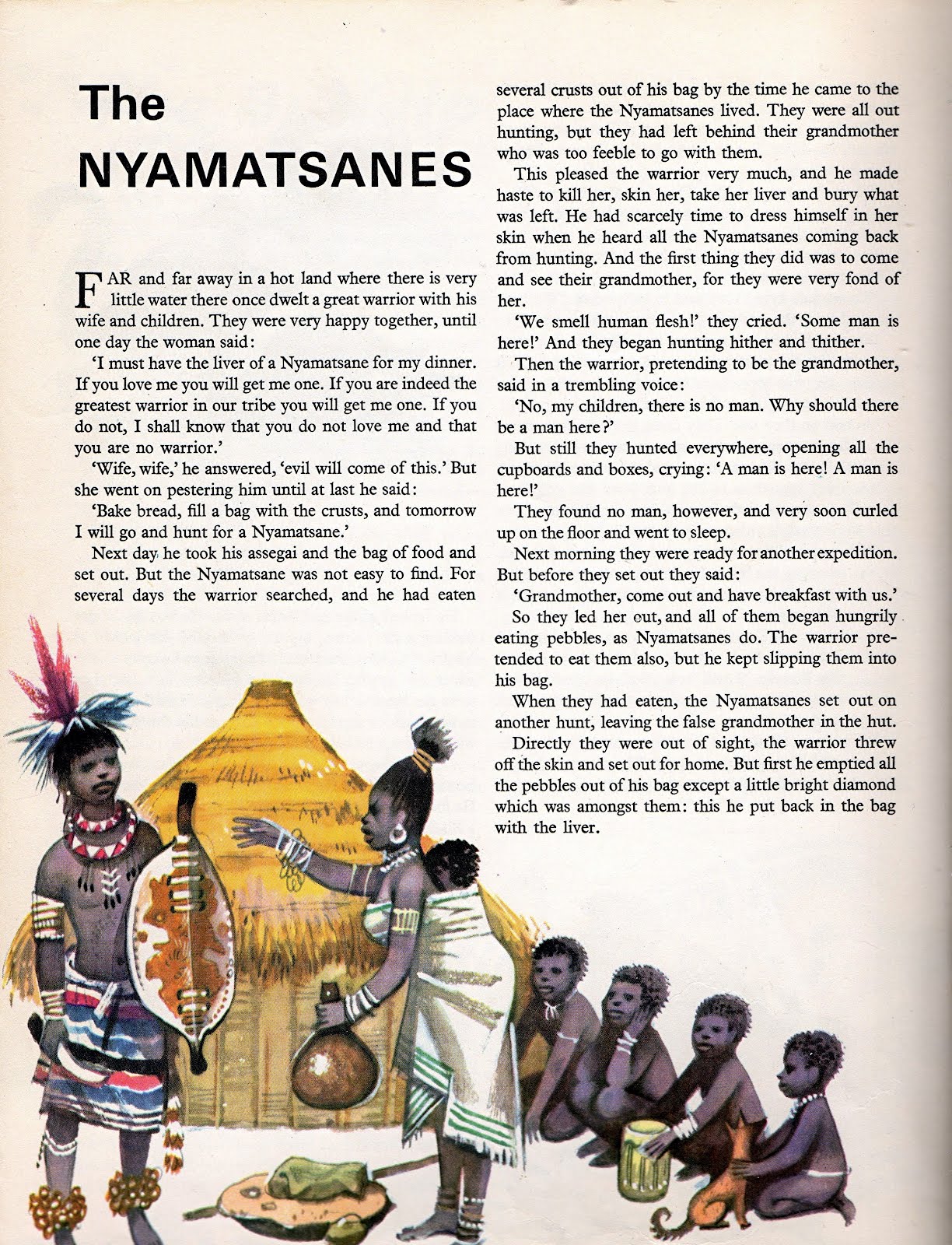
The second mysterious entity from Once Long Ago was another eponymous being, featuring in a Basuto folktale entitled ‘The Nyamatsanes’. In this story, the wife of a brave warrior living in an unnamed arid land (but presumably within Lesotho, formerly known as Basutoland) suddenly developed an insatiable craving for the liver of a nyamatsane. Eventually, the warrior agreed to go out and kill one, and bring back its liver for her to eat. When he reached the place where these creatures lived, however, they had all gone off hunting, except for their very old, feeble grandmother, whom the warrior promptly killed and skinned, after which he cut out her liver. Before he could depart, however, the nyamatsanes returned, so he disguised himself as their grandmother, and succeeded in fooling them, even though they were convinced that they could smell human flesh. When they fell asleep that night, he fled, but as soon as they discovered their dead grandmother’s body the next morning they chased after him in fury, but he eventually eluded them.

Strangely, however, although the nyamatsanes featured extensively throughout this story, Green’s version of it contained no morphological details whatsoever concerning them. Even Kubašta’s illustraton, included here, depicted them only in the most basic, minimalist manner – namely, as dark-coloured, tailless, superficially monkey-like entities with featureless faces, predominantly quadrupedal in gait yet also capable of standing and even cavorting bipedally, but shorter in stature than the human warrior. The only details of note that can be gleaned from Green’s retelling are that these beings are carnivorous (they were out hunting when the warrior arrived in their domain, plus they are very attuned to the scent of human flesh), and, very oddly, that they are extremely partial to eating pebbles (to aid digestion, perhaps?).

The nyamatsanes’ folktale appears in similar form within various compendia of African legends, sometimes as the opening section of a much longer story featuring the hare as a trickster, but – as with the nung-guama – extra details concerning them are conspicuous only by their absence.

Indeed, the only attempt to categorise the nyamatsane in any way at all that I have so far encountered appears in Jan Knappert’s book Myths and Legends of Botswana, Lesotho, and Swaziland (1985). Included as folktale #43 within a section entitled ‘The Oldest Tales’, during this story’s retelling Knappert briefly states:

“Although the Nyamatsane are supposed to speak fluent if funny Sesotho [the national, Bantu language of Lesotho] they are rather pictured as a sort of baboon or man-ape.”

This verbal description accords well with Kubašta’s depiction of them in Once Long Ago – the only illustration of nyamatsanes that I have ever seen. So what could they be?

The nyamatsanes (Vojtěch Kubašta)

As suggested for the nung-guama in relation to Chinese myths, they are quite probably nothing more than non-existent entities of African legend, akin to the goblins and other quasi-humanoids of our own traditional folklore. Then again, southern Africa is replete with reports and alleged sightings of diminutive man-beasts likened by Dr Bernard Heuvelmans and various other cryptozoologists to surviving australopithecines, as well as claims of fierce, extra-large monkeys that have been compared with certain species of supposedly extinct giant baboon. Should we therefore be adding the nyamatsanes to the Dark Continent’s already-lengthy list of crypto-primates?

Personally, I consider it imperative that before even the most desultory consideration of these beings’ possible taxonomic identity is attempted, we obtain substantially more descriptive information concerning them, especially with regard to their morphology and behaviour.

Consequently, as with the nung-guama yet again, if there is anyone out there with such data to hand, I’d very much like to hear from you and see it posted here – so that the nung-guama and the nyamatsane may ultimately become more than just memories from once long ago.

UPDATE: 26 August 2012

In view of the considerable interest and conjectures stimulated by the content of this ShukerNature post, I am presenting below scans of the original pages from my copy of Once Long Ago in which Roger Lancelyn Green told the Chinese folktale of the nung-guama and the Basuto folktale of the nyamatsanes, with illustrations by Vojtěch Kubašta, so that you can read the full stories. Please note that these are © Golden Pleasure Books Ltd (London), Roger Lancelyn Green, and Vojtěch Kubašta.


Wednesday, 19 August 2009

SHAN HAI JIN - AN ANCIENT CHINESE WONDER BOOK


There are a number of highly significant tomes out there that have never attracted the degree of cryptozoological and zoomythological attention that they deserve. One such example is the Shan Hai Jin (or Jing) - a classic Chinese text at least 2,200 years old, roughly 31,000 words long, divided into 18 sections, and containing a wealth of information on all manner of extraordinary beasts. Although most are assuredly mythical, there could well be some genuine cryptids amongst them - the trick is deciding which is which.

To give you an idea of the scope of this remarkable book, the following mentions of entities referrred to in it are quoted from an extensive, highly informative communication that I received quite a while ago concerning the Shan Hai Jin (and also various other notable Chinese sources of info re mystery/legendary beasts) from one of my correspondents, Chinese-born S. Lu, now living in Washington, USA:

"Throughout the years I found so many, many, many parallels between the East and West myths and legends...For instance, the cockatrice's Chinese "cousin" described in Shan Hai Jin [SHJ] is the Suan Yu bird. It's like a snake with four wings, six eyes and three legs. If we picture it as having a bird's/rooster's head and talons, it'll look almost exactly like a cockatrice. The book also says that the Suan Yu bird's appearance foreshadows the coming of bad things.

"Shan Hai Jin is such a treasure with extensive knowledge of lots of things, it's a shame that many people keep a close mind toward the strange creatures and phenomena documented inside.

"There are accounts of mermaids (it's called Ling fish in SHJ), the kind that has human legs and arms with a fish/dolphin tail. I've seen depictions of this creature in the Arabian Nights when Sinbad was taken to an underwater palace by such a man or a merman.

"Europeans' view of the Indian people as dog-headed [cynocephali] is not completely out of the question. In SHJ yellow humanoid creatures with dogs' heads are described. Their name is Huan dog. There are also three-leg people, three-head people, egg-laying people, bird-body people (Siren?), one-foot people, snake-body people (Lamia?) [one such entity is the nuwa, as pictured here in this blog utilising an SHJ illustration], etc.

"Chinese centaurs have often been referred to as deities of some sort, they are horses or bulls with "human heads and hands". Chinese satyrs or pans are a people from the country of Dinling. Their upper bodies are like humans and lower parts are of the hairy horse legs with hooves, and they like to run. Water horses, the kind you talked about in Flying Toads and many other Western folklores, can also be found in SHJ...

"There are much more in other ancient texts in China that document similar things. One even says that the yerens [Chinese wildmen] are able to make themselves invisible and transform to dodge humans....

"There is a china.com [not any longer, sadly] that contains reports from Shen Nong Jia about yeren, albino animals, giant toad monsters, donkey-head wolves, rooster-crest snakes (my grandma told me her mother's story of how such a snake was found in a local "Tu Di" (earth god) temple in the rural Nanjing, Jiangsui Province, the snake didn't siss, but sounded like chicken, the locals thought it has a crest because it was old), unicorns (the website has personal stories of hunters [who] shot dead a couple of unicorns, they say the creature is not exactly a horse, nor a goat, nor a deer; in one account the single horn tilts/curls backward and another forward; they are very agile, and their meat was good; again the local people are sure that they are there), scarlet bats and hogs, etc.

"Have you heard about the famous 'Legend of the White Snake' about a white snake, accompanied by her friend or maid a green snake, transformed into a beautiful woman to marry a mortal, who saved her life a thousand years ago (reincarnation)? In Shen Nong Jia, scientists found that the rare white snakes are often seen to be with green snakes."

And this is just a taster of the treasures to be found inside this amazing work. Of all the subjects mentioned above, however, the one that possibly intrigues me the most received the least mention - scarlet bats. They're certainly new to me, so if there's anyone out there who has any info on Chinese scarlet bats, I'd be delighted to receive it.