Dr KARL SHUKER

Zoologist, media consultant, and science writer, Dr Karl Shuker is also one of the best known cryptozoologists in the world. He is the author of such seminal works as Mystery Cats of the World (1989), The Lost Ark: New and Rediscovered Animals of the 20th Century (1993; greatly expanded in 2012 as The Encyclopaedia of New and Rediscovered Animals), Dragons: A Natural History (1995), In Search of Prehistoric Survivors (1995), The Unexplained (1996), From Flying Toads To Snakes With Wings (1997), Mysteries of Planet Earth (1999), The Hidden Powers of Animals (2001), The Beasts That Hide From Man (2003), Extraordinary Animals Revisited (2007), Dr Shuker's Casebook (2008), Karl Shuker's Alien Zoo: From the Pages of Fortean Times (2010), Cats of Magic, Mythology, and Mystery (2012), Mirabilis: A Carnival of Cryptozoology and Unnatural History (2013), Dragons in Zoology, Cryptozoology, and Culture (2013), The Menagerie of Marvels (2014), A Manifestation of Monsters (2015), Here's Nessie! (2016), and what is widely considered to be his cryptozoological magnum opus, Still In Search Of Prehistoric Survivors (2016) - plus, very excitingly, his four long-awaited, much-requested ShukerNature blog books (2019-2024).

Dr Karl Shuker's Official Website - http://www.karlshuker.com/index.htm

IMPORTANT: To view a complete, regularly-updated listing of my ShukerNature blog's articles (each one instantly clickable), please click HERE!

IMPORTANT: To view a complete, regularly-updated listing of my published books (each one instantly clickable), please click HERE!

IMPORTANT: To view a complete, regularly-updated listing of my Eclectarium blog's articles (each one instantly clickable), please click HERE!

IMPORTANT: To view a complete, regularly-updated listing of my Starsteeds blog's poetry and other lyrical writings (each one instantly clickable), please click HERE!

IMPORTANT: To view a complete, regularly-updated listing of my Shuker In MovieLand blog's articles (each one instantly clickable), please click HERE!

IMPORTANT: To view a complete, regularly-updated listing of my RebelBikerDude's AI Biker Art blog's thematic text & picture galleries (each one instantly clickable), please click HERE!

Search This Blog


PLEASE COME IN, I'VE BEEN EXPECTING YOU...

PLEASE COME IN, I'VE BEEN EXPECTING YOU...
WELCOME TO SHUKERNATURE - ENJOY YOUR VISIT - BEWARE OF THE RAPTOR!


Showing posts with label The New Zoo. Show all posts

Friday, 10 August 2012

THE BONOBO OR PYGMY CHIMPANZEE - A NEW APE, INCOGNITO

A bonobo at Twycross Zoo (Dr Karl Shuker)

One of the highlights of my visit yesterday to Twycross Zoo in Leicestershire, England - famous worldwide for its very comprehensive collection of primates and its excellent record of success in breeding and conserving endangered species - was viewing its breeding group of bonobos or pygmy chimpanzees Pan paniscus, led as is normal for this species by an alpha female (in the common chimp, conversely, it is an alpa male who acts as group leader).

Our own species' closest living relative (putative living Neanderthals excepted!) together with the much more familiar common chimpanzee P. troglodytes, the bonobo is visibly different from the latter species in several ways - which makes it all the more remarkable that its separate taxonomic status was not even suspected, let alone recognised, until the 1920s, i.e. less than 100 years ago. The history of the bonobo's official scientific discovery and classification as a valid species of great ape in its own right is a major success story for cryptozoology, and makes fascinating reading, which I have documented in all three of my books on new and rediscovered animals - The Lost Ark( 1993), The New Zoo (2002), and The Encyclopaedia of New and Rediscovered Animals(2012), and is now reproduced here on ShukerNature:
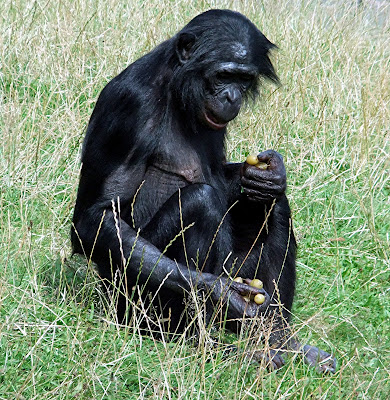
The bonobo is visibly different from - and much more human-like than - the common chimpanzee (Dr Karl Shuker)

Until the mid-1920s, science only accepted the existence of one species of chimpanzee, the familiar common species Pan troglodytes, generally divided into three subspecies. In 1928, however, zoologist Dr Ernst Schwarz was examining some specimens at the Congo Museum in Tervueren, Belgium, when he came upon a series of skeletons and skins of a chimpanzee type that appeared very different from any that he had seen before.

Two bonobos at Twycross Zoo (Dr Karl Shuker)

Obtained by a M. Ghesquiere, they revealed that this strange form of chimpanzee was smaller in size than the common species, and was much more slender in build. Its head was smaller too, but its face was longer and narrower, its dense fur was also long and was uniformly black except for a small white patch on the rump, and it lacked the common chimpanzee's familiar white beard. Schwarz discovered that these odd-looking chimps had been collected in an area of tropical rainforest on the south bank of the Congo River - all previously recorded chimpanzees had been obtained from localities north of this river.
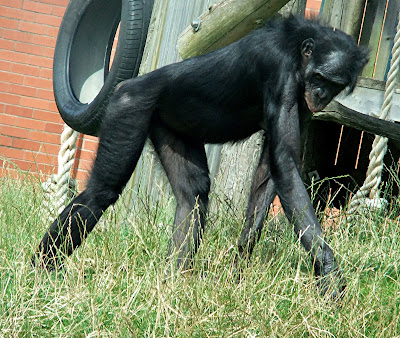
Until viewing Twycross's specimens yesterday, I had not realised just how gracile, or relatively long-limbed, the bonobo is in comparison with the common chimpanzee (Dr Karl Shuker)

Evidently, the southern chimps comprised an important find, and their distinctive morphology persuaded Schwarz that they represented a currently undescribed subspecies. Hence in 1929 he formally documented it within the museum's journal, naming this new ape P. t. paniscus - the pygmy chimpanzee. Five years later, it was elevated to the level of a full species - P. paniscus.
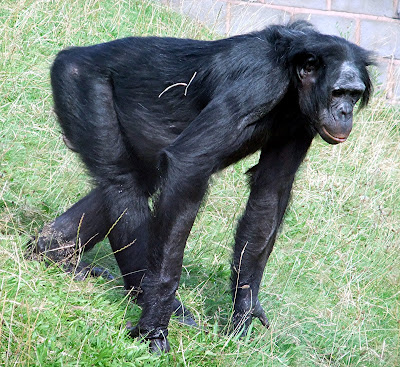
Bonobo - the leggiest member of the great apes (Dr Karl Shuker)

Once science became aware of this freshly-found primate, investigations uncovered that the Tervueren examples were not the only specimens of pygmy chimp to have been collected without recognition of their separate taxonomic status. The British Museum's collections had contained one in 1895, for instance, and a living example of what was almost certainly a pygmy chimp had been on show for a time in 1923 at New York's Bronx Zoo. Similarly, John Edwards, a zoological historian and Fellow of London's Zoological Society, has kindly brought to my attention a picture postcard in his private collection depicting a chimp housed in Amsterdam Zoo, again during the early 1920s, which was quite obviously a pygmy chimpanzee.
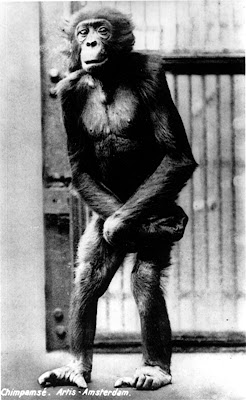
John Edwards's historically significant postcard, depicting a bonobo maintained at Amsterdam Zoo before the separate taxonomic status of its species had been recognised (John Edwards)

Since the species' 'official' discovery, specimens (correctly identified) have been exhibited at several zoological gardens, particularly in European collections such as Antwerp Zoo and Vincennes Zoo. In 1962, Frankfurt Zoo succeeded in breeding pygmy chimps for the first time in captivity, and has repeated this feat on a number of occasions since then. Studies of captive individuals such as these have revealed that the pygmy chimpanzee is much more docile and even-tempered than its less placid, better-known relative.
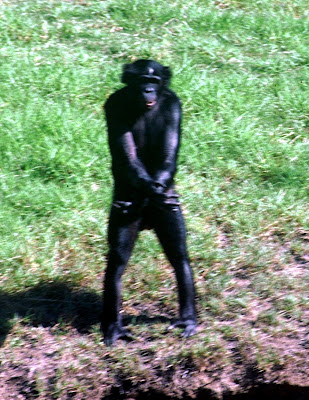
Bonobos are able to stand upright on their hind legs and are adept at walking bipedally too (Alan Pringle)

There has been a fair amount of controversy concerning the pygmy chimpanzee's precise taxonomic identity. Whereas some experts are so convinced of its distinct specific status that they have even placed it within its own genus, as Bonobo paniscus (bonobo is its native name), certain others still prefer to treat it merely as a subspecies of the common chimpanzee. Recent biochemical and genetic comparisons between common and pygmy chimps, however, indicate that the latter ape is certainly sufficiently distinct to justify classification as a separate species (though whether separate generic status for it is warranted is still a matter for conjecture).
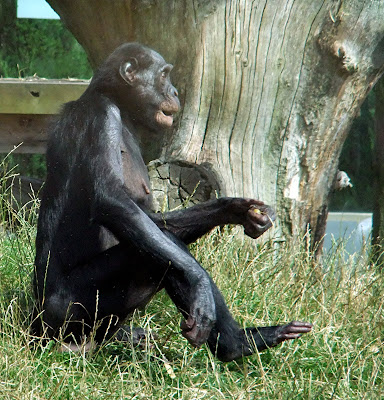
When viewing a photograph like this one, it is not difficult to comprehend that the bonobo is our own species' equal closest living relative (Dr Karl Shuker)

It seems surprising that a wholly new species of ape could remain undetected by science until as recently as the late 1920s, especially when specimens were actually preserved in scientific museums and exhibited alive in zoos. In fact, there is an even more ironic twist to this tale. Following extensive researches on the subject, Vernon Reynolds revealed in the 1960s that the individual designated by Linnaeus way back in 1758 as his type specimen for the common chimpanzee was actually a pygmy chimpanzee!

The bonobo - now recognised as a wholly discrete, second species of chimpanzee after centuries of taxonomic obscurity (Dr Karl Shuker)

For many more remarkable histories of animal discovery and rediscovery, please check out my latest book, The Encyclopaedia of New and Rediscovered Animals: From Okapis to Onzas - and Beyond (Coachwhip Publications: Landisville, 2012).


Thursday, 8 December 2011

THE ENCYCLOPAEDIA OF NEW AND REDISCOVERED ANIMALS - A FIRST GLIMPSE OF MY LATEST BOOK


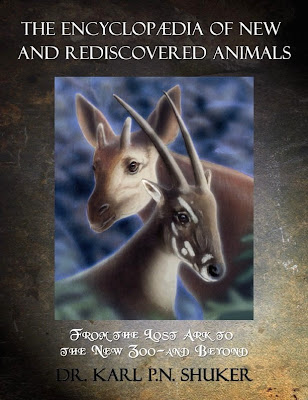
I've just received, one day early, the perfect birthday present! Here's the fully-approved, finalised version of the cover for my soon-to-be-published book The Encyclopaedia of New and Rediscovered Animals: From the Lost Ark to the New Zoo - and Beyond (which is off to the printers in the next few hours!). My very sincere thanks to Bill Rebsamen for his wonderful front and back cover illustrations!

Here's some information concerning my book:

At the beginning of the 20th century, scientists and laymen alike appear to have been peculiarly confident that the world had been thoroughly explored and most of its creatures named and documented. Few, if any, large animals still awaited discovery. The scientific unveiling of the giraffe-like okapi in 1901 was one of the earliest of this century's discoveries to shake this belief. But many consider it to be the last great find, and view the rediscovery of extinct animals to be as likely as the alchemic conversion of iron into gold.

Since 1901, however, a whole host of new and rediscovered creatures has turned up to contradict these views - including a giant 7-ft-long forest hog from Africa, a colossal Indonesian monitor lizard called the Komodo dragon, the lobe-finned coelacanth fish resurrected from 64 million years of supposed extinction, the incredible megamouth shark, deep-sea tube-dwelling worms over 8 ft tall with huge red tentacles resembling strange alien flowers, plus the extraordinary Vu Quang ox and giant barking deer both discovered in Vietnam during the 1990s. And discoveries continue to be made today, in the 21st century - ranging diversely and dramatically from giant peccaries and zombie worms to an entire new suborder of insects known as the gladiators, a veritable jungle of new monkeys, and an extraordinary chameleonesque snake. And nor can we possibly forget the sensational rediscovery in North America of the near-legendary, supposedly long-extinct ivory-billed woodpecker.

The Encyclopaedia of New and Rediscovered Animals is the third, wholly-updated edition of the very first - and still the definitive - book to be devoted to the spectacular zoological discoveries and equally amazing rediscoveries of the 20th century, which attracted international acclaim and exemplary reviews following its original publication in 1993 (when it was entitled The Lost Ark), and its subsequent republication in 2002 as an updated, greatly-expanded second edition (entitled The New Zoo). This latest edition also contains an in-depth survey of the 21st century’s most celebrated discoveries and rediscoveries made during its first decade, a superb foreword by pre-eminent American cryptozoologist Loren Coleman, plus an exhaustive, significantly-increased bibliography, as well as the only comprehensive collection of colour and b/w illustrations of these spectacular animal species ever published (including new, previously-unpublished photographs, and several exclusive, specially-commissioned full-colour paintings).

Unquestionably, The Encyclopaedia of New and Rediscovered Animals provides good reason indeed for believing that our world continues to holds many more animal surprises in store for future revelation.

It is published by Coachwhip Publications in the USA, and is due out very shortly (printers permitting!) - so keep checking Amazon!

Tuesday, 18 October 2011

A CENTURY OF OWSTON'S BANDED CIVET

Owston's banded civet (Chris Brack)


To promote my soon-to-be-published Encyclopaedia of New and Rediscovered Animals - the fully-revised, thoroughly-updated, and greatly-expanded third incarnation of what began as The Lost Ark in 1993, and then became The New Zoo in 2002 - during the next few weeks I shall be excerpting from this latest book of mine as a series of ShukerNature exclusives some of the remarkable animals whose discoveries or rediscoveries are celebrating notable anniversaries in 2011. Here's one of them.


OWSTON'S BANDED CIVET

Owston's banded civet Chrotogale owstoni is an obscure Asian species, measuring up to 3.5 ft in total length. Named after Alan Owston, whose native collector procured its type specimen on 16 September 1911 at Yen-bay, on Tonkin's Song-koi River in southern China, it was officially described in 1912 by Oldfield Thomas, who designated it as the sole member of a new genus. The visually arresting pattern created by contrasting light and dark, transverse bands on its body and the basal portion of its tail closely resembles that of the banded palm civet Hemigalus derbianus, but the latter species lacks the dark spots visible on the neck, shoulders, flanks, and thighs of Chrotogale.

Owston's banded civet depicted upon a Vietnamese postage stamp from 1966

Furthermore, anatomical comparisons uncovered distinct differences in cranial structure and dentition between the two species, differences sufficiently marked to warrant these civets' respective residence in separate genera. Most remarkable of these contrasts were the very slender muzzle of Chrotogale, and its incongruous incisors - these latter teeth are surprisingly broad and close-set, and arranged almost in a semi-circle, a condition more comparable to that of certain insectivorous marsupials than to any species of viverrid.

Owston's banded civet depicted upon a set of Vietnamese postage stamps from 2005

Whether Chrotogale too is predominantly insectivorous, however, remains uncertain, as even today it is still a very mysterious animal, known from less than two dozen preserved specimens originating variously from northern Vietnam, Laos, and from Tonkin and Yunnan in China. A live individual was captured in Vietnam in 1991, followed by others more recently. These latter include (in 1999) three males and seven females at Hanoi Zoo, six males and four females at Ho Chi Minh City (formerly Saigon) Zoo, four of each sex at Pittsboro Zoo in North Carolina, and one female at Frankfurt Zoo. More recently, an international conservation and breeding programme for them was established in co-operation with Vietnam’s Cuc Phuong National Park working with various zoos including Newquay Zoo.

My scraperboard illustration of Owston's banded civet (Dr Karl Shuker)

Tuesday, 16 August 2011

SURF HIPPOS, HERE THEY COME!

Surfing hippopotamus (picture source unknown)

Hippopotamuses surfing in the sea may seem as improbable as polar bears gambolling across the desert, but as the remarkable photograph above readily demonstrates, in the world of nature few things are even impossible, let alone merely improbable. For although the common hippopotamus Hippopotamus amphibius is traditionally associated with freshwater habitats, such as rivers and lakes, it does also frequent saltwater in certain localities. These include the southern Orango group of islands, part of the Bijagos Archipelago in the Atlantic Ocean off the western coast of Guinea Bissau (formerly Portugese Guinea) in western Africa, which are now a national park. Saltwater hippos occur off the Kenyan island of Manada Toto too, and - the location of the stunning photo here - in the Petit-Loango Reserve in southwestern Gabon. Here, the hippos spend much of the day taking their ease in swamps and lagoons close by, but emerge at dusk to graze upon grass along the beach and indulge in boisterous surfing safaris out to sea.

Photos of surfing hippos in South Africa (sources unknown) 

What makes such scenes even more extraordinary than their mere setting is the fact that despite being intimately associated with water, hippos are far from being the animal world's most competent swimmers.

Only when seen in its entirety on land, can the hippo's immense size be fully comprehended (Dr Karl Shuker) 

Indeed, even though their massive bulk (they are beaten in the heavyweight stakes among terrestrial mammals only by the elephants and some rhinoceroses) is effectively buoyed by their aqueous surroundings, these gargantuan cousins of pigs and peccaries (but actually most closely allied to whales, dolphins, and other cetaceans) often do not venture into expanses of lake or river deeper than their own bodies.

Common hippopotamus (Dr Karl Shuker)

Even hippos seen with just their heads above water are, in reality, usually standing on the riverbed or lake bottom, stretching their necks to keep their heads above water, ably assisted by the evolutionary relocation of their eyes, ears, and nostrils close to the top of their heads. If, moreover, a hippo does decide to dive or swim underwater, a reflex action closes its ears and nostrils entirely, and it will commonly stay wholly submerged for 3-5 minutes - but may, if required, continue to do so for up to 30 minutes! And as the surfing hippos ably prove, if necessary it can indeed swim unaided by terra firma beneath its feet.

Note the hippo's upward-opening nostrils (Dr Karl Shuker) 
 
Equally interesting is that despite their far-from-streamlined form, hippos are able to attain some nifty turns of running speed - even underwater. One hippo was timed charging along the bed of a river at a highly respectable 5 miles per hour, in spite of the appreciable drag effect of its watery surroundings acting upon it. And on land, hippos can readily outpace human runners, having been timed at up to 30 miles per hour - so beware!

Hippopotamus figurine carved out of blue sodalite

Certainly, hippos, in spite of being predominantly peaceful creatures, have acquired a formidable reputation as arguably the most dangerous animal to humans in Africa - adult females are notoriously ferocious if challenged or disturbed when they have calves. Their weapons are of course their colossal mouths, armed with huge curving tusks. Including their gum-embedded roots, the lower canine teeth of a hippo can sometimes grow up to 3 ft long - the length of an average human arm! And when a male hippo opens its stupendous jaws to yawn - not an indication of boredom, incidentally, but a sign of aggression toward another male seeking to invade its territory, or of courtship intent toward a female - the resulting gape can be up to 150°. Only whales among mammals can outgape a yawning hippo!

Hippo gape (Aqwis/Wikipedia)

Indeed, it has been claimed that a hippo can open its jaws wide enough to accommodate a 4-ft-tall child inside! And this beast's mighty maws are so powerful that an adult specimen can bite a 12-ft-long crocodile in half! But even when not chomping a croc, male hippos fighting for territory can inflict terrible wounds upon each other, and even kill one another, with their huge curved tusks.

Skull of common hippopotamus
 
So tough, in fact, are these awesome teeth that little more than a century ago hippo ivory was popular among dentists for use in manufacturing human artificial teeth - once they had succeeded in dissolving with acid the yellow enamel covering the ivory, because this enamel is as hard as glass and accounts for a third of each tusk's total weight! Much further back in time, the ancient Egyptians carved amulets for babies out of hippo ivory, believing that this substance had the power to ward away demons. Furthermore, the Egyptian goddess of childbirth, Taueret, was popularly portrayed as a bipedal hippopotamus. 

Statuette of Taueret carved out of faience (Jon Bodsworth) 
 

Undoubtedly, the hippo attracted great interest from early humans, and not just on account of its huge size and formidable jaws, but also due to the longstanding belief that it could sweat blood. The explanation for this curious but totally inaccurate notion is that in order to ensure that its thick, almost-hairless skin remains supple and moist when out of the water, and also to avoid it becoming sunburnt, the hippo secretes a sticky, oily, pink-hued substance from glands beneath the surface of its skin, which on first glance can appear a little like seeping blood but is in reality an efficient, ready-made sun-block! It may also act as an antibiotic, helping to promote germ-free healing of wounds inflicted upon each other by bellicose male hippos. 
 
Having said that, a rare bona fide pink hippopotamus was photographed in Kenya's Masai Mara Game park during late September 2010 by British tourist brothers Will and Matt Burrard-Lucas (and others have previously been reported in Uganda). Apparently a leucistic individual, exhibiting reduced body pigmentation, photos and a full news report of this extraordinary creature can be found here: http://www.dailymail.co.uk/news/article-1315917/Rare-pink-hippo-images-captured-Masai-Mara-Kenya.html 

Another of the hippo's secrets, conversely, has only been revealed quite recently. Not surprisingly, for a creature that spends so much of its time partly or fully submerged, the hippo is able to vocalise not merely on land but underwater too - thanks to a stentorian voice and powers of vocal projection that would put even the most skilled of human opera singers to shame. Hippos can communicate with one another directly through the medium of water via ear-splitting bellows of such potent force that they can be both heard and physically felt by anything positioned up to 50 ft away! But that is not all - scientists have lately discovered a hitherto unsuspected infrasonic component to this bellow, an amazing rumble beneath the threshold of human hearing but which can be detected underwater by other hippos as far away as 18.7 miles!

Hippo swimming (Dr Karl Shuker)
 

No less amazing than its voice, however, are the eyes of the hippo - due to the bizarre shape of their pupils, each resembling an inverted, smooth-cornered capital 'T'! Yet again, this is an evolutionary adaptation to assist the hippo in its amphibious lifestyle, for it uniquely (among mammals) enables the hippo to see above and below the water surface with the same intensity of light, thus yielding a complete view, unimpeded by the water. 
 
Pygmy hippopotamuses 


Less familiar, smaller, and much daintier than the well known, common hippopotamus is the much more terrestrial, forest-dwelling pygmy hippo Choeropsis (=Hexaprotodon) liberiensis, which looks more like an over-sized shiny-black pig than a hippo. For many years, the very existence of this reclusive animal was discounted by science, in spite of longstanding native testimony and reports brought back to Europe by western travellers. Some even attempted to dismiss it as nothing more than a freak, stunted version of the common, larger species. As noted in my book The New Zoo: New and Rediscovered Animals of the Twentieth Century (2002; new, greatly-expanded edition due out later this year!!!), not until five living specimens were brought back alive by German explorer Hans Schomburgk in 1913 was the pygmy hippo scientifically accepted as a second, valid species of hippopotamus in its own right. 
 
Pygmy hippos


Most remarkable of all, however, is that there could even be a third, supposedly long-extinct species of hippo still awaiting scientific detection - on the island of Madagascar. Several millennia ago, at least three different species of undersized, dwarf hippo existed here, but these are officially deemed to have died out long ago. However, even today locals in southwestern Madagascar occasionally claim to encounter a shy, unidentified mystery beast that they refer to as the kilopilopitsofy or tsomgomby, which, when described by them, sounds irresistibly similar in both appearance and habits to a small form of hippo. Even the alleged vocalisations of the kilopilopitsofy seem remarkably reminiscent of the bellows of a hippo. 

Is the kilopilopitsofy a surviving species of Madagascan dwarf hippo? (Dr Karl Shuker)
 

Clearly, the fascinating realm of the river horse - the literal translation of 'hippopotamus' - may still have some hefty surprises in store! 

My late grandmother Gertrude Timmins's blue hippopotamus ornament - a fond memory from my childhood (Dr Karl Shuker) 

 
NB - Unless stated otherwise, all images included in this post are, to the best of my knowledge, in the public domain.


Wednesday, 6 April 2011

SEEKING THE LOST BIRDS OF PARADISE

The King of Holland's bird of paradise - a confirmed hybrid (John Gould)

Few branches of natural history have been so exhaustively documented as ornithology, which is why any study devoted to a hitherto-uninvestigated ornithological subject is rare indeed. However, celebrated bird artist and researcher Errol Fuller has devoted more than 30 years to a thoroughly fascinating, ongoing study of a series of once long-forgotten but potentially highly-significant birds of paradise – which he has documented not only in various articles but also in a truly magnificent book, The Lost Birds of Paradise (Swan Hill Press, 1995).

CONTROVERSIAL CROSSBREEDS

Ethereal, gloriously-plumed cousins of the crow family, the aptly-named birds of paradise are native to New Guinea, various of its outlying islands, the Moluccas, and eastern Australia. In addition to the 40 species currently recognised by science, there are a further 24 forms that were once classified as genuine species but which have since been discounted as hybrids. Most of these, moreover, are known from only a handful of examples, and some from just a single specimen, often collected many years ago and never seen again - hence Errol's 'lost' appellation for them is doubly appropriate.

The Lost Birds of Paradise by Errol Fuller

The majority of these erstwhile species were stripped of their taxonomic significance and reduced in rank to the lowly level of hybrids in a scientific paper published in the journal Novitates Zoologicae by avian expert Prof. Erwin Stresemann in 1930 (since then, six others have been discovered and duly demoted too). Surprisingly, for over 60 years these dramatic assessments were never seriously investigated or challenged, but have been rigorously re-examined in Errol's investigations.

Some 'lost birds of paradise' are certainly nothing more than exotic crossbreeds. In each of these cases, the composite nature of its plumage is very apparent and readily exposes the identities of the bird's parental species. The King of Holland's bird of paradise Diphyllodes gulielmi-tertii, known from several specimens obtained in various regions of lowland New Guinea, is a good example. Described in 1875, it is evidently a hybrid of the magnificent bird of paradise D. magnificus and the little king bird of paradise Cicinnurus regius - gorgeously combining the former species' erectile cape and lyrate central tail feathers with the emerald-tipped, breast-flanking feather fans characterising the little king.

Captain Blood's bird of paradise Paradisea bloodi is known from a unique specimen taken during jungle patrol in the northern end of Papua's Wahgi Valley on 20 September 1944 by the wonderfully-named Captain Neptune Blood. However, its identity as the pulchritudinous product of an illicit liaison between Prince Rudolph's indescribably beautiful blue bird of paradise P. rudolphi and Count Raggi's fiery-plumed P. raggiana is again betrayed by the visible intermingling of these two species' respective characteristics in its exquisite plumage.

Certain other 'lost birds of paradise', conversely, cannot be reconciled very convincingly with the hybrid identities proposed by Stresemann. A case in point is Bensbach's bird of paradise, an extremely distinctive, purple-plumed form that was dubbed Janthothorax bensbachi in 1894. It is still known only from the single specimen obtained in the Arfak Mountains of northwest New Guinea and presented to the Leiden Museum by J. Bensbach.

Bensbach's bird of paradise

As argued by Errol, its current status as a hybrid is highly unsatisfactory - based entirely upon a very cryptic, terse statement by Stresemann that offered no explanation why he deemed this specimen to be a crossbreed between the lesser bird of paradise P. minor and the magnificent riflebird Ptiloris magnificus. It seems most unlikely that these markedly dissimilar species would interbreed, and they share few similarities with J. bensbachi. Hence Errol considers it possible that Bensbach's bird of paradise is a valid species after all, but one that may now be extinct, bearing in mind that it has never been recorded since 1894.

Equally mystifying is Rothschild's lobe-billed bird of paradise, christened Loborhamphus nobilis in 1901 and known only from two specimens reputedly originating from somewhere in Dutch New Guinea. Its lengthened breast and neck feathers were sufficient for Stresemann to nominate the superb bird of paradise Lophorina superba as one of its progenitors, and the bare flaps of skin on its face presumably inspired him to propose a wattle-faced species called the long-tailed paradigalla Paradigalla carunculata as the other one.

Rothschild's lobe-billed bird of paradise

In reality, however, the complement of features exhibited by Loborhamphus nobilis is so complex, recalling so many different species, that its identification seemingly defies solution. Having said that, the correct solution in any mystery is usually the simplest one that covers all of the known facts - which, in this particular case, is the proposal that Rothschild's lobe-billed bird of paradise was indeed a genuine species, but is probably lost for ever.

Equally worthy of attention is Elliot’s sicklebill Epimachus ellioti – a long-tailed, silky-plumed bird of paradise of which the type specimen arrived in London during 1872 from an unrecorded New Guinea locality. In an attempt to explain this individual as a hybrid, Stresemann postulated that its parent species were the black sicklebill E. fastuosus and the Arfak astrapia Astrapia nigra. In short, Stresemann proposed that Elliot’s sicklebill was of intergeneric origin.

Elliot's sicklebill

Yet although by no means unknown amongst birds, intergeneric hybrids are much rarer than interspecific ones. And as Errol has pointed out, Elliot’s sicklebill possesses certain noticeable characteristics not exhibited by either of its supposed parent species. These include: a distinct lobing of the mouth, a green breast with a wash colouration rather than a metallic one, and its diminutive body size – Elliot’s sicklebill is notably smaller than any accepted species of sicklebill or astrapia. Yet in stark contrast, bona fide hybrids are often larger than both or at least one of their parent species. Yet again, therefore, it is not inconceivable that this enigmatic bird is yet another distinct, valid species.

Ultimately, only DNA analyses are likely to solve the taxonomic tribulations engendered by such mystifying birds as these. Yet in view of the fact that they are represented only by (at most) a very few precious museum specimens which in some cases are over 200 years old - and therefore exceedingly fragile and/or not well-preserved – it may never be possible to conduct this necessary research anyway. In short, at least some of the lost birds of paradise are destined to remain exactly that, their secrets locked forever within a handful of desiccated, dead-eyed skins – sombre mementoes of what may once have been vibrant, valid species but which have now disappeared and are all-but-forgotten by science today.

Containing 40 full-colour plates, and a thorough review of every controversial species on record, The Lost Birds of Paradise remains the definitive work on this engrossing subject, and is an engrossing work of ornithological detection guaranteed to excite and entertain everyone with a passion for investigating mysteries and anomalies within the ever-surprising realms of natural history.

Moreover, in 2004 Errol announced that he had uncovered further evidence to support his thesis, in the form of certain 18th-Century bird paintings by French artist Jacques Barraband. Known for the accuracy of his avian illustrations, most of Barraband's subjects (which include several birds of paradise) can be readily identified with known species - but there are a few enigmatic, mystery birds of paradise painted by him that do not resemble any recorded species. One of these paintings, published by New Scientist in its 15 May 2004 issue, shows a black-breasted 12-wired bird of paradise, whereas the typical version has a yellow breast. Could Barraband's paintings thus include depictions of unknown species, or at least a further selection of controversial crossbreeds?

Barraband's mystery black-breasted 12-wired bird of paradise

UNDISCOVERED AND REDISCOVERED BIRDS OF PARADISE

Returning to the subject of paradigallas – a possible undiscovered species of these superficially crow-like birds of paradise was sighted in 1992 by David Gibbs while exploring the uninhabited Fakfak Mountains in southwestern Irian Jaya, New Guinea. Indeed, the late Dr E. Thomas Gilliard, a leading bird of paradise expert and author of the authoritative work Birds of Paradise and Bower Birds (1969), was optimistic that unrecognised new species did still exist in remote New Guinea localities. And it should be remembered that one of this avian family’s most striking representatives, the ribbon-tailed bird of paradise Astrapia mayeri (whose male possesses a pair of white tail feathers measuring up to 3 ft long, i.e. three-and-a-half times as long as its combined head and body length!) was unnamed and undescribed by science until 1939.

The long-tailed paradigalla

Furthermore, what may be yet another undiscovered bird of paradise has been reported several times on Goodenough Island, one of the three large D’Entrecasteaux Islands situated just off southeastern New Guinea. Here is what I wrote about it in my book Mysteries of Planet Earth (1999):

“In 1953, Goodenough was visited by the Fourth Archbold Expedition (named after Richard Archbold, a millionaire explorer from the U.S.A.), and while there one of its members spied a curious bird, documented as follows three years later in the expedition's official report:

'In the forest one morning I saw a black bird the size of a small crow which seemed to be a bird of paradise but not Manucodia comrii [curl-crested manucode] or Manucodia keraudrenii [trumpet manucode], the only members of the family reported from the island. Our native hunter...described...a small black bird with a long tail, which dances in the treetops in the mountain forests of Goodenough, a description that suggests an Astrapia [long-tailed bird of paradise].'

“The next report appertaining to this unidentified species that I have on file appeared in the March 1976 issue of the New Guinea Bird Society's newsletter, and describes a sighting made by James Menzies, a renowned expert on New Guinea wildlife:

'On Mt. Oiamadawa'a, Goodenough Island 28 December 1975. Altitude about 1600 m, moss forest of Castanopsis, pandanus and tall bamboo. At dawn - a group of medium-sized black birds with long tails moving about in the forest canopy. Observed against the rising sun, without binoculars. Call a short explosive rattle.'

“Shortly afterwards, these two reports came to the attention of Australian ornithologist Bruce M. Beehler, who resolved to search for this elusive species when visiting Goodenough in 1976, and again in 1980. Unfortunately, he was unable either to observe or to obtain a specimen, so the Goodenough Island mystery bird currently remains just that - a mystery.

“Beehler documented his search in his book A Naturalist In New Guinea (1991), and, as he noted, there are quite a number of possible identities on offer. For instance, it may not even be a bird of paradise. Instead, it might be a species, known or unknown, of drongo (predominantly black, long-tailed crow-like bird), long-tailed starling, or honeyeater (meliphagid). Yet the Archbold report's author seemed quite convinced that it was a bird of paradise.

“For many people, the mere mention of these famous New Guinea denizens readily conjures up images of highly exotic, multi-hued, flamboyantly-plumed birds - which is why the extremely showy, ornately-arrayed astrapias, despite their long tails, do not yield a very plausible identity for the Goodenough bird. However, not all birds of paradise fit this popular image. Some of the smaller ones, such as the manucodes, are far less colourful, sporting dark metallic plumages instead of dramatic flourishes of vivid, ostentatious plumes. Certain manucodes have fairly long tails too, increasing their resemblance to this cryptic species.

“There is also one further candidate - for which we need to look towards the least known, and least spectacular, bird of paradise species. Indeed, so demure is its plumage that its English name has relegated it to a position midway between its more spectacular relatives and the decidedly dowdy species from which the birds of paradise are believed to have evolved.

“I am referring to the paradise crow Lycocorax pyrrhopterus, inhabiting the islands of the Moluccan archipelago, lying to the west of New Guinea. Measuring 14-17 in long and crimson-eyed, this bird of paradise is indeed outwardly corvine in appearance, its silky blackish-brown plumage relieved only by a faint greenish gloss on its body and a blue-black sheen on its long tail when viewed at close range, plus a buffish-white tinge on its inner flight feathers. Frequenting the hill forests of its Moluccan homeland, despite being quite a common species the paradise crow is very shy, and hence is rarely observed.

The paradise crow (Richard Bowdler Sharpe)

“Quite apart from its cry, which resembles a terse bark from a somewhat hoarse dog rather than the explosive rattle described by Menzies, its marked zoogeographical separation from Goodenough Island indicates that the paradise crow is not likely to be one and the same as the latter's black-plumed mystery bird. However, an allied, still-undescribed species of paradise crow with similar habitat preference and reclusive nature indigenous to Goodenough would yield a very satisfactory identity for this island's avian anomaly.”

Certainly, it is not impossible that long-vanished birds of paradise may one day be refound. Indeed, this is precisely what happened as recently as 2005. Just as evanescent as any of Errol’s examples was - until now - a beautiful species of six-wired bird of paradise known variously as the bronze parotia or Berlepsch's parotia Parotia berlepschi (but sometimes classed as a subspecies of Queen Carola's parotia Parotia carolae). Formally described in 1897 and named after German ornithologist Hans von Berlepsch who had chanced upon some taxiderm museum specimens, all male, it was a classic 'homeless' New Guinea enigma - its stuffed specimens had definitely originated somewhere in this huge island, but where?

A male Berlepsch's parotia (Bruce Beehler)

Eminent American ornithologist Dr Jared Diamond had helped to fill in a gap, when in 1979 he had encountered what he considered to be some female specimens of this rarity, alive and well and living in the remote Foja Mountains of Irian Jaya (Indonesian New Guinea). In December 2005, however, a scientific team visiting these scarcely-explored mountains (and led by the afore-mentioned Australian ornithologist Bruce Beehler) achieved a notable first. When a male and female flew into their camp, their startled observers duly became the first scientists to observe a living male Berlepsch's parotia - its throat adorned in gleaming metallic plumage, its head sporting a striking crest of six disc-tipped, wire-like plumes, and giving voice to an unsettlingly raptorial growl, far removed indeed from the dulcet tones that one might expect to emerge from the throat of a paradise bird!


Review of The Lost Birds of Paradise in The Guardian (1 February 1996)

Saturday, 12 February 2011

BEEBE'S BATHYSPHERE FISH - AN 'UNTOUCHABLE' DEEPSEA RIDDLE

Beebe's bathysphere fishes (William M. Rebsamen)


One of the 20th Century's most mysterious ichthyological discoveries was a remarkable deepsea fish that was officially described and named in 1932, yet which has never been examined in the flesh and has no known representative in any of the world's museums.

On 22 November 1932, Bermuda-based zoologist Dr William Beebe was 2100 ft beneath the surface of the sea in a bathysphere, sited 5 miles southeast of Bermuda's Nonsuch Island. While he was observing the denizens of the deep passing by the bathysphere's windows, two very unusual fishes became illuminated in the craft's electric beam of light as they twice swam past it, no more than 8 ft away. Their long slender bodies, each of which was at least 6 ft long with strongly undershot jaws housing numerous teeth, reminded Beebe of barracudas, but running along either side of each fish was a single, laterally-sited, horizontal row of luminous organs (photophores), little short of twenty in total, and every one emitting a powerful pale blue light.

Equally striking were the two twitching, tentacle-like structures that hung down beneath each fish - one arising from its lower jaw, the other from the beginning of its short anal fin. Once again, each of these structures emitted light, by virtue of a pair of organs at its tip; the organ attached directly to the tentacle shone red, the other one (attached to the red organ) shone blue. Also noteworthy was their vertical dorsal fin, positioned well back towards the tail-end of the body. Beebe was unable to discern any pectoral fins or pelvic fins.

From these fishes' general morphology, Beebe concluded that their species was most probably allied to the melanostomiatids, popularly known as the scaleless black dragon fishes. However, its single line of lateral photophores, not to mention its pair of ventral tentacles with light-emitting terminal organs, unequivocally distinguished it from any known species within that family. As a result, Beebe christened his mystifying discovery Bathysphaera intacta ('untouchable bathysphere fish'), sole member of a new genus.

Postage stamp from Bermuda depicting the bathysphere fish and also the five-lined constellation fish (Dr Karl Shuker)


Bathysphaera was not the only hitherto unknown species of deepsea fish that Beebe discovered and named, but was unable to capture, during his Bermudan bathysphere observations in the early 1930s. He spied a mysterious, 2-ft-long, torpedo-shaped fish at depths of 1500 ft and 2500 ft, and named this grey-coloured species the pallid sailfin Bathyembrix istiophasma. He also described the three-starred angler fish Bathyceratias trilychnus, a 6-in-long species sighted at 2470 ft, bearing three 'fishing rod' structures (illicia) on its head, and clearly allied to the deepsea angler fishes (ceratioids); as well as the five-lined constellation fish Bathysidus pentagrammus, spotted at a depth of 1900 ft and resembling a Chaetodon butterfly fish or an Acanthurus surgeon fish, but exquisitely decorated with five glowing lines of yellow and purple photophores on each side of its roundish body.

Just as beautiful was a long-beaked multicoloured fish with scarlet head, blue body, and yellow tail that Beebe informally named the abyssal rainbow gar - four of which he observed swimming together in a stiff, almost upright posture at a depth of 2500 ft.

No specimens of any of these 'untouchable' species have so far been obtained. Consequently, as with Bathysphaera, and assuming that Beebe's testimony was truthful, they are secrets of the sea that were revealed to humanity only briefly before disappearing back into its depths' dark and alien anonymity.

The bathysphere fish, depicted in William Beebe's book, Half Mile Down (1934)


This is an excerpt from my book The Encyclopaedia of New and Rediscovered Animals (Coachwhip: Landisville, 2012), which is the fully-updated, thoroughly-revised, and greatly-expanded third edition of The Lost Ark.

Sunday, 22 November 2009

A LAKE IS A LAKE IS A LAKE...ISN'T IT?

Taimen


Some months ago, Richard Freeman in his blog was perplexed about the location of a certain Tibetan lake said to house monsters, which I was able to resolve by revealing that for reasons still unknown to me it has been referred to by a variety of different names, of which Lake Wembo is just one.

As it happens, moreover, there is another Chinese 'monster' lake that is mystifying me for a similar reason - over the years, its name has inexplicably changed, causing some confusion at first as to whether the two names did indeed refer to the same body of water. I refer to what was originally called Lake Hanas, but which in more recent years is now repeatedly called Lake Kanasi. Has the name officially changed, or it is merely a question of a different transliteration from Chinese to English being adopted (as with Peking to Beijing, for instance)? If anyone has any info, I'd love to receive it.

Meanwhile, for anyone who may not know about the fascinating monsters of Lake Hanas/Kanasi, here is what I wrote about them in 2002 within my book The New Zoo: New and Rediscovered Animals of the Twentieth Century (which will be republished in 2011 in a new, expanded, updated edition):


"THE MONSTER FISHES OF CHINA'S LAKE HANAS

"Officially, the largest specimen of freshwater fish on record is a 15 ft European catfish Silurus glanis, caught in Russia's Dniepper River sometime prior to the mid-1800s (though this species as a whole is generally shorter than the pa beuk, officially deemed to be the world's largest freshwater fish). As a consequence, the lake-dwelling fishes reported in July 1985 by no less an authority than China's eminent biologist Prof. Xiang Lihao, from Xinjiang University, attracted appreciable scientific interest.

"In July, the professor and a party of students arrived at a large but remote body of water called Lake Hanas, situated in northwestern China's Xinjiang Autonomous Region, in order to examine its potential as the site of a future nature reserve. On 24 July, one of the students observing the lake from a watchtower built two years earlier noticed several huge reddish-coloured objects moving at the water's surface. When the professor and students scrutinised them closely through binoculars, they discovered to their astonishment that they were enormous salmon-like fishes, whose heads, tails, and spiny dorsal rays could all be clearly discerned. Just how enormous they were, however, was not revealed until the next day.

"That morning, while again being observed through binoculars by Xiang Lihao, one of the fishes very obligingly aligned itself in parallel with a stretch of the bank extending between two trees. Armed not only with binoculars this time but also with a camera, the professor took some photos, then measured the distance between the trees. Using this measurement, he was able to calculate from the photos that the fish was at least 33 ft long!

"A large salmon known as the taimen Hucho taimen is indeed known from several rivers in northern China, but this species' maximum recorded length is a mere 6.5 ft - far short of the Lake Hanas monsters. Worth noting is that giant red fishes in this lake have been reported for decades by local villagers, but as the lake had not previously attracted scientific attention such reports had not been widely circulated. Now, with an eyewitness of Prof. Xiang Lihao's scientific standing, there should be no question concerning their existence or authenticity as giant fishes. So unless they are abnormally huge taimen, the Lake Hanas fishes must surely comprise a spectacular new species, requiring formal description and study."


An updated account of these creatures will appear in my new, updated New Zoo.


Tuesday, 9 June 2009

SETTING THE SEAL ON THE COELACANTH GOBLET - YOUR ASSISTANCE IS REQUESTED!


Coelacanth (William M. Rebsamen)


I've made this request for info before, but to no avail. However, I don't give up easily, so here we go again!

In 1996, French crypto-correspondent Michel Raynal sent me details of a remarkable Spanish goblet described to him (and also sketched) by one of his own contacts. The goblet in question is supposed to date from the 17th Century and depicts a strange fish that greatly resembles the modern-day coelacanth Latimeria chalumnae, which remained undiscovered by science until December 1938, and has never been caught off European waters - only off South Africa, Mozambique, Madagascar, and (mostly) the Comoro Islands. (A second, closely-related species was captured off Sulawesi, Indonesia, during the late 1990s.)

Does the goblet provide evidence, therefore, for an unknown Latimeria population existing in the seas around Spain, or even Mexico - if the goblet was of Mexican origin but was brought back to Spain at a later date?

Michel's correspondent stated that the mystifying goblet was on display in the Carnegie Museum of Natural History at Pittsburgh, and that, emphasising the similarity of its portrayed fish to Latimeria, a specimen of Latimeria preserved in formaldehyde was exhibited alongside the goblet, with a caption asking whether there could indeed be coelacanths in the Atlantic still undiscovered by science. Greatly intrigued by this, on 30 April I wrote to the museum to request further details concerning the goblet - its origin, previous ownership, opinions from the museum's zoologists, whether any photos of it could be made available to me - and on 9 May I received a kind but very unexpected reply from Elizabeth A. Hill, Collection Manager of the museum's Section of Vertebrate Paleontology.

According to Ms Hill, the goblet was not on display there, and she could find no information that the museum had ever possessed such an item! Moreover, its Recent (i.e. modern-day) fish collection was disposed of many years ago to another museum, which meant that it does not exhibit any fish in formaldehyde. As a further check, Hill contacted the museum's Anthropology Division, which holds a collection of glassware, just in case the goblet was here instead, but it was not - nor did its records have any listing of anything fitting its description that had arrived there on long-term loan from another museum.

Indeed, the only remotely similar item on display in the Carnegie Museum of Natural History proved to be a small blue and white Wedgwood plate with Latimeria itself in the centre - according to its label, this plate was presented to the museum by the Buten Museum of Wedgwood in Merion, Pennsylvania.

I can only assume that if the story of the goblet is genuine, Michel's correspondent was mistaken as to which museum was displaying it - which is where you, gentle readers, come in! If anyone out there has seen this goblet while visiting a museum in the U.S.A. (or anywhere else, for that matter), I would greatly welcome details. Who knows - we may even have another 'quest for the thunderbird photo' in the makings here!