Dr KARL SHUKER

Zoologist, media consultant, and science writer, Dr Karl Shuker is also one of the best known cryptozoologists in the world. He is the author of such seminal works as Mystery Cats of the World (1989), The Lost Ark: New and Rediscovered Animals of the 20th Century (1993; greatly expanded in 2012 as The Encyclopaedia of New and Rediscovered Animals), Dragons: A Natural History (1995), In Search of Prehistoric Survivors (1995), The Unexplained (1996), From Flying Toads To Snakes With Wings (1997), Mysteries of Planet Earth (1999), The Hidden Powers of Animals (2001), The Beasts That Hide From Man (2003), Extraordinary Animals Revisited (2007), Dr Shuker's Casebook (2008), Karl Shuker's Alien Zoo: From the Pages of Fortean Times (2010), Cats of Magic, Mythology, and Mystery (2012), Mirabilis: A Carnival of Cryptozoology and Unnatural History (2013), Dragons in Zoology, Cryptozoology, and Culture (2013), The Menagerie of Marvels (2014), A Manifestation of Monsters (2015), Here's Nessie! (2016), and what is widely considered to be his cryptozoological magnum opus, Still In Search Of Prehistoric Survivors (2016) - plus, very excitingly, his four long-awaited, much-requested ShukerNature blog books (2019-2024).

Dr Karl Shuker's Official Website - http://www.karlshuker.com/index.htm

IMPORTANT: To view a complete, regularly-updated listing of my ShukerNature blog's articles (each one instantly clickable), please click HERE!

IMPORTANT: To view a complete, regularly-updated listing of my published books (each one instantly clickable), please click HERE!

IMPORTANT: To view a complete, regularly-updated listing of my Eclectarium blog's articles (each one instantly clickable), please click HERE!

IMPORTANT: To view a complete, regularly-updated listing of my Starsteeds blog's poetry and other lyrical writings (each one instantly clickable), please click HERE!

IMPORTANT: To view a complete, regularly-updated listing of my Shuker In MovieLand blog's articles (each one instantly clickable), please click HERE!

IMPORTANT: To view a complete, regularly-updated listing of my RebelBikerDude's AI Biker Art blog's thematic text & picture galleries (each one instantly clickable), please click HERE!

Search This Blog


PLEASE COME IN, I'VE BEEN EXPECTING YOU...

PLEASE COME IN, I'VE BEEN EXPECTING YOU...
WELCOME TO SHUKERNATURE - ENJOY YOUR VISIT - BEWARE OF THE RAPTOR!


Showing posts with label Mirabilis. Show all posts

Saturday, 1 January 2022

SMALL-SCREEN SHUKER SIGHTINGS - A CLICKABLE COLLECTION OF MY TV APPEARANCES

 
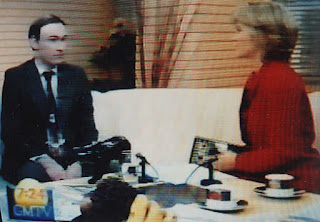
Screenshot from one of my appearances on GMTV during the early 1990s (© Dr Karl Shuker/GMTV – reproduced here on a strictly non-commercial Fair Use basis for educational/review purposes only)

I tend to be elusive, and reclusive, at the best of times (almost as much, in fact, as the cryptids that I investigate!). So it should come as no surprise to learn that anyone who knows me well will tell you that appearing on television is something that I loathe doing – as in loathe with an absolute, abiding passion. And here's why.

Firstly, as is also true with a surprising number of actors (surprising in the sense that because they do it as a profession, one might therefore expect them to be long since accustomed to this), I simply don't like seeing, or hearing, myself on the small screen – never have done, never will.

Secondly, I abhor the devious, dubious practices that TV interviewees are sometimes subjected to – such as (very) selective editing of recorded interviews prior to their actual screening, including slyly presenting the interviewee's words out of context; and unexpectedly assailing the interviewee in live programmes with deliberately provocative questions that are unrelated to the subject officially under discussion and are specifically designed to confuse and/or ridicule the interviewee.

Thirdly, there is the not insignificant matter of some TV companies doing their utmost to avoid offering the interviewee a fee for their appearance, for travel expenses, or for their time spent providing TV show researchers with masses of free information – information, moreover, that is then frequently used in those TV shows but without giving their unpaid source any onscreen credit or recognition either. And so on…

 
Screenshot from one of my favourite TV appearances, being interviewed by Richard & Judy on This Morning in 1995 (© Dr Karl Shuker/This Morning – reproduced here on a strictly non-commercial Fair Use basis for educational/review purposes only)

Consequently, once I had achieved a measure of ongoing success with my writing career, i.e. by the late 1990s, I made a conscious decision to bow out of TV appearances whenever possible and allow my books and articles do my talking for me instead – a decision that I've adhered to ever since (although I do not totally rule out future TV appearances if the subject to be discussed is sufficiently enticing and the TV company involved is one that I feel happy to work with).

Prior to my retirement from the small-screen showbiz world, however, I had taken part in quite a variety of high-profile TV shows, and had obtained recordings of a fair few of them, especially those that I'd actually enjoyed participating in, and which had not subjected me to any of the unpleasant practices outlined above. Moreover, because those latter interviews also contained information that I considered may be of interest to other cryptozoological enthusiasts, during the past few years I've uploaded them onto YouTube in order to make them readily available to viewers, and also, hopefully, to preserve them long after I'm no longer here to do so personally.

There may be other such recordings lurking in my archives that I've overlooked (and there are also currently on YT some TV programmes or videos uploaded by other YT users that feature me). In addition, I know that I have a number of my many radio interviews preserved on audio cassette tapes that I have yet to convert into MP3 files and upload onto YT. Meanwhile, however, in order to enable easy access to what is already there, it has occurred to me that a directly clickable list of those recordings would be highly beneficial to potential viewers.

[NB – The following clickable list of interviews is not arranged in strict chronological order because I don't have precise recording dates for some of them, so  I cannot be absolutely certain 30-odd years down the line which was produced first in certain cases, but they were all recorded during the 1990s unless stated otherwise. One clue to their correct chronological order, however, may be derived from taking note of how much, or how little, hair I still possess in each of them!] 

And so, as they used to say in the classic UK children's TV show Blue Peter, here's one I made earlier (click the red description below for each video in order to go directly to that video on YT):

 
Being interviewed by Anthea Turner on GMTV during the early 1990s (© Dr Karl Shuker/GMTV – reproduced here on a strictly non-commercial Fair Use basis for educational/review purposes only)


Interview in early 1990s with Anthea Turner on UK breakfast TV show GMTV re mystery cats.

Interview in early 1990s with Michael Wilson on UK breakfast TV show GMTV re mystery cats.

Interview in early 1990s with Lorraine Kelly on UK breakfast TV show GMTV re mystery cats.

Interview in early 1990s with Mike Morris on Live Wire, screened by former UK Cable TV channel Wire TV, re mystery cats.

 
Screenshot from my interview with Mike Morris on Live Wire during the early 1990s (© Dr Karl Shuker)

Interview in 1993 with Andy Crane on former Saturday morning ITV show What's Up Doc re new and rediscovered animals as featured in my book The Lost Ark (1993).

Part 1 of an extensive three-part interview in 1993 with John Hammond on former UK Cable TV channel Wire TV re new and rediscovered animals, plus cryptozoology in general.

Part 2 of an extensive three-part interview in 1993 with John Hammond on former UK Cable TV channel Wire TV re new and rediscovered animals, plus cryptozoology in general.

Part 3 of an extensive three-part interview in 1993 with John Hammond on former UK Cable TV channel Wire TV re new and rediscovered animals, plus cryptozoology in general.

 
Screenshot of Richard Uridge wearing my self-customised biker's jacket in a Midlands Today news report, autumn 1993 (© Dr Karl Shuker/Midlands Today – reproduced here on a strictly non-commercial Fair Use basis for educational/review purposes only)

Something different: Two local TV news reports from autumn 1993 re a then-current Black Leather Jacket museum exhibition featuring one of my own self-customised biker jackets (seen being worn by motorbike-riding Midlands Today presenter Richard Uridge in the second news report).

Interview re British mystery cats in an episode of the 1994 TV documentary series Arthur C. Clarke's Mysterious Universe, narrated by Carol Vorderman.

[and here, uploaded by someone else, is the entire episode]

Part 1 of the three-part cryptozoology-themed mid-1990s interview with myself and veteran Nessie seeker Steve Feltham by husband-and-wife TV presenters Richard Madeley & Judy Finnegan on UK breakfast TV show This Morning.

Part 2 of the three-part cryptozoology-themed mid-1990s interview with myself and veteran Nessie seeker Steve Feltham by husband-and-wife breakfast TV presenters Richard Madeley & Judy Finnegan on UK breakfast TV show This Morning.

Part 3 of the three-part cryptozoology-themed mid-1990s interview with myself and veteran Nessie seeker Steve Feltham by husband-and-wife breakfast TV presenters Richard Madeley & Judy Finnegan on UK breakfast TV show This Morning.

 
Screenshot of my live appearance on Sky News, mid-1990s (© Dr Karl Shuker/Sky News – reproduced here on a strictly non-commercial Fair Use basis for educational/review purposes only)

Live interview in mid-1990s on Sky News re the Bodmin Beast.

Interview re Morgawr the Cornish sea monster in Season 3, Episode 2 of the UK ITV documentary series Strange But True? presented by Michael Aspel; this episode was first screened on 6 September 1996.

Part 1 of my three-part mid-/late 1990s interview for UK monthly mysteries magazine Fortean Times on the subject of cryptozoology.

Part 2 of my three-part mid-/late 1990s interview for UK monthly mysteries magazine Fortean Times on the subject of cryptozoology.

Part 3 of my three-part mid-/late 1990s interview for UK monthly mysteries magazine Fortean Times on the subject of cryptozoology.

 
Screenshot from my three-part Fortean Times interview (© Dr Karl Shuker/Fortean Times – reproduced here on a strictly non-commercial Fair Use basis for educational/review purposes only

Interview in late 1990s re British mystery cats, on former UK TV news programme 3D, presented by Julia Somerville.

 
Speaking at the CFZ's 2007 Weird Weekend conference (© Mark North)

Speaking at the official launch of my first CFZ Press-published book, Extraordinary Animals Revisited (2007), during the CFZ's 2007 Weird Weekend conference.

Speaking at the official launch of my second CFZ Press-published book, Dr Shuker's Casebook (2008), during the CFZ's 2008 Weird Weekend conference.

 
Snapped with CFZ friend Nichola Sullings at the CFZ's 2008 Weird Weekend conference (© Dr Karl Shuker)

Something different: my poem 'Airport' being read aloud by Silas Hawkins, from my first published poetry collection, Star Steeds and Other Dreams (2009).

Something different: my poem 'The Loch Ness Monster' being read aloud by Silas Hawkins, from my first published poetry collection, Star Steeds and Other Dreams (2009).

Speaking re giant spider reports documented in my book Mirabilis (2013), in an excerpt from a lengthy radio interview on Coast To Coast AM, first broadcast in 2013.

 
Lecturing at the very first Fortean Times UnConvention, in 1994; as far as I am aware, however, no video recording of my presentation exists – but I'd be happy to be informed otherwise, and even happier to be able to view any such recording! (© Lars Thomas)


Sadly, my TV debut (and still among my favourite small-screen appearances) is not included in the above list, because so far it does not appear to have been uploaded onto YT by anyone – fyi, it was in a 1987 TSW (Television South West) documentary entitled The Beast of Exmoor. However, I do own an official VHS video recording of the entire programme, kindly gifted to me by TSW, so it is not lost (which is very fortunate, because TSW closed down at the end of 1992).

Moreover, as I mentioned earlier here, I may have in my archives some additional TV recordings featuring me, plus cassette recordings of various radio interviews with me that I definitely have, all of which I'll upload onto YT at some stage. Once I do, I'll insert clickable links to them in this present listing. So be sure to check back here from time to time if you'd like to access them for future viewings (and listenings – hey, did I just invent a new word??).

Finally, I can't go without mentioning one of the most popular ploys that TV companies have tried when attempting to solicit my services for free namely, emphasizing all the publicity that I'll derive from appearing on or assisting their show. Every time I've received that spiel, I've had to exert severe self-control in order to prevent myself from answering back with the withering reply that British fashion designer Vivienne Westwood allegedly gave when responding to a similar statement in a similar situation: "Darling, I don't NEED the publicity!" Wonderful!

 
Just in case you thought that I'd forgotten – here am I with Mom and Chris Tarrant after my appearance on a certain TV quiz show a long, long time ago… (© Dr Karl Shuker)


UPDATE: 30 April 2022 - I've also recorded a fair few radio interviews down through the decades, but here is the very latest one, recorded yesterday and uploaded today by Dark Waters onto YouTube. Namely, my appearance on the famous Dark Waters Radio show, in which he and I chat about all manner of mystery beasts, from bigfoot and dogman to water monsters, secret snakes, and much much more!

Dr Karl Shuker on the Dark Waters Radio show (© Dark Waters - reproduced here on a strictly non-commercial Fair Use basis for educational/review purposes only)


Saturday, 3 April 2021

UPDATING THE LOUISIANA GIANT SPIDERS SAGA

 
Giant spider sculpture in Ottawa, Canada (© Markus Bühler)

Last year, I posted a 2-part ShukerNature blog article of mine (click here and here to access it) concerning the alleged encounters during 2005 and 2007 by various Louisiana-based U.S. army personnel with some incredibly huge spiders. Unsurprisingly, it attracted a great deal of attention, especially as by all the fundamental laws of biophysics such creatures shouldn't – couldn't – exist. The information concerning these immense arachnids was provided to me by one of their reputed eyewitnesses, and he gave me full permission to publish all of it, on the sole condition that I did not make public his identity, which I have not done. Instead, I refer to him merely as Sgt S.

My 2-part article engendered a fair few comments from readers, some of which queried certain technical and military aspects of Sgt S's testimony. As a result, I have recently received some additional information from him, not only addressing those queries but also providing further insights into the creatures that he and others allegedly encountered. Moreover, he has provided me with a series of truly startling, thought-provoking scale drawings that readily reveal the supposed sizes of those spiders alongside an average human. As noted above, the zoologist in me cries out that such creatures simply cannot be. Equally, however, Sgt S's extensive, impassioned communications are ones that ostensibly originate from someone who was truly terrified and still patently haunted by what he claims to have seen.

As before, Sgt S has kindly granted me full permission to publish these updates under the same condition as before, that he remains anonymous, and to which I fully accede. Personally, however, I can see no feasible way via which the diametrically opposite, mutually exclusive disparity between the biological incongruity of the spiders and the apparent honesty of his belief in what he claims to have seen can be resolved. So I choose instead to present Sgt S's additional information and scale drawings herewith without comment from me, but in the form of a new article that will serve as a publicly-available record of the latter data's existence, which I feel needs to be done.

I received the first of Sgt S's new emails to me just over a fortnight ago, on 14 March 2021, in which he stated: "I finally saw your blog postings of my accounts with the giant spiders at Fort Polk. Thank you so much for bringing this story to light and keeping my name out of it. After reading it all over again I remembered a few more details from the 2005 sighting, regarding the animals' behavior that are significant enough to include".

On 18 March, Sgt S. added:

I was so traumatized by these events that I became disassociated, as if this were too unbearable to think about or as if it happened to someone else. To be clear on the retelling of these parts of the story, I did not fully recall the entire play-by-play of events, as it was so hard to deal with, that I blocked it out trying not to think about it. I have not talked about it at all with anyone until writing about it with you, 15 years later. Now it haunts me to even see a large dog lose in the park as that is the general size of the creature’s torso, without the 6-inch venomous fangs and long creepy legs. I was finally able to talk about it with a friend from work who is very open-minded to this sort of thing and that helped me to decide to write these additional details. You have my permission to publish as agreed upon before.

I must discourage anyone from trying to get near one of these things, or even walking in their area as they are extremely dangerous, venomous, man-eating, ambush predators that can move with tremendous force and speed.

He then presented an extensive account, which he revised slightly during some subsequent emails. This is his finalised version. Be sure to check back to my previous 2-part article in order to set the scene and read in context what is now presented below:


2005 Sightings

Animal Type 1A

On the night of the first encounter in 2005, when I first saw this thing that I will label Type 1A, I could not believe what I was seeing. In the heat of the moment, I charged forward and used my M4 carbine weapon’s buttstock to smash Type 1A in the head repeatedly, swinging wildly with my weapon at its legs while kicking and screaming at it at the top of my lungs. The flashlight shining directly in its eyes illuminated the eye tube itself making it appear light blue. I can compare it to being in a dark room and shining a light into to the bottom of a clear glass bottle filled with clear viscous fluid or clear jelly. The eyes of course were outwardly convex and had no eyelids. Before I charged, Type 1A tilted its head to the side and around so I could see the light all the way inside its head and there were increasingly smaller rings inside the eye tube. I think the adrenaline from my fight or flight instinct kicked in when I saw it moving. Type 1A backed up and sprayed a mist of foul-smelling liquid at us from about 5 or 6 feet away. The pheromone-laced liquid came out from the animal’s mouth, (or likely from glands near its mouth) and initially fanned out like water from an automotive windshield wiper nozzle, before dispersing into a mist. It happened very suddenly while I was firing blank 5.56mm rounds in its face, so it may have been a defensive response. The scent was a mix of ammonia and strong animal musk, like the scent of a cat marking its territory but much more pungent. The smell was not as bad as Skunk spray but more of a wet, swampy undercurrent of stench. With the sound and flash from 30 blank rounds, Type 1A turned its back and fled very clumsily, tumbling into its own legs, and smashing into the trees and sticks on the wooded area and was feeling its way around trying to find a path to escape before it scampered out of sight. I believe these things cannot see very well like most spiders and instead follow their noses (or whatever olfactory organs a spider has).

After I cut SGT Becky loose from the thick threaded silk, I became entangled and stuck to the ground. While SGT Becky was screaming and running back to our tent, I was nauseated from the pungent spray and basically frozen in fear, unable to move my legs. I then changed magazines in my weapon and made a Morse code S.O.S signal by firing a three-round burst, followed with three separate single-round shots, finishing with another three-round burst. I did this pattern three times. I could still hear movement in the trees from the direction where Type 1A fled, so I frantically cut away blindly at the dirt trying to free myself until I could get up and run like the devil back to our tent. I was very disoriented, dizzy, and itchy on my exposed skin as was SGT Becky. In retrospect, I believe this was due to a neurotoxic effect on the inch-long bristles or hairs we found all over our uniforms that I believe were ejected from Type A1 in a defensive reflex. Common tarantulas are known to shoot bristles or urticating hairs from their abdomens, to ward off predators. The bristles were black, white, and tan. Some of these were collected in a zip lock bag but the senior leadership took these away with any other evidence.

Later when they asked me to describe what I saw, I recalled thinking Type 1A looked like an old, frail man. Its head was not covered in hair, but the face and fangs were covered in long, light-colored bristles. This gave it the appearance of a bald, bearded elderly man, with its long, thin legs giving it the appearance of frail, bony arms, and legs.

When the senior leadership arrived one of the soldiers recognized the scent on us and ordered his men to go get bottles of ammonia and Simple Green (a degreaser popular with the Army). He ordered us to wash our hands and faces with ammonia and warned us to burn our uniforms or wash them three or four times with the Simple Green to get the smell out, or ... “she’ll come after you”. He did not elaborate further.

 
Scale drawing showing a Type 1A spider alongside an average human (© Sgt S)


----


Animal Type 2A

When everyone calmed down from all the excitement I headed back to my cot. SGT Becky returned from the Aid station under assistance as they had given her tranquilizers. She was removed from training the next day under a command referral due to her traumatized state. My tent mates began complaining about the musty smell on me, so I threw the scent-marked uniform in a laundry bag outside, next to the tent about 20 feet from the door. After I changed and made a coffee I started heading out to the showers and laundry, and stood just inside of the door frame, getting my eyes adjusted to the dark. I had a black shaving kit/ toiletry bag in my right hand outside the open door when I felt something hit the bag. There was a whitish, silver-dollar-sized material connected to a thick string against my black bag. As I turned it slightly to look, it was pulled away from me suddenly and with great force, smashing my wrist into the metal frame of the door and snatching it out of my hand. Just then another soldier leaving the portable toilets, about 40 feet perpendicular to the door, started gasping in silent screams, pointing at a dark mass, about the size of a man and low to the ground along the outer wall of the tent, where my laundry bag was (this [creature] I will label as Type 2A). He threw a plastic spit bottle at the shape on the ground, splashing tobacco spit all over Type 2A, and it turned in his direction making a hissing sound. Immediately I threw my hot coffee and canteen cup that I had in my other hand. Type 2A turned again now with its back to me and raised with its head topping off at about five feet from the ground. Its 2- to 3-inch-thick front and side legs then spread out, shaking menacingly in the air, spanning 6 or 7 feet in circumference! Type 2A's back legs were dangling straight down like it was on its tiptoes and its abdomen was about 1 foot thick by 3 feet long. All this happened instantaneously, and in a split second, it leaped 50 or 60 feet horizontally away! (I suppose it could have run on its back legs but it covered 50 to 60 feet of distance in a split second!) It reached the edge of the "200 man" tent and without stopping it rounded the corner, crashing into another tent alongside ours. It clumsily clambered over the next tent ripping holes in the fabric then disappeared into the woods. Animal Type 2A was much darker in color, with a thicker coat of bristles, much thicker in body mass. Its abdomen was more elongated than bulbous, and its overall size was greater than a large man. I did not see its fangs as it was dark and quickly turned its back to me, but overall, it gave the appearance of an enormous tarantula. Someone found my bag the next day by the wood line and it was punctured, with the shaving cream can exploded and the other contents mangled. Again, the senior officers collected it and ordered us not to talk about the incident. The soldier who threw the spit bottle already had a phobia of spiders and this event so traumatized him that he could no longer speak intelligibly. He became so uncontrollably stressed that he was also removed from the training under command referral.

 
Scale drawing showing a Type 2A spider alongside an average human (© Sgt S)

In my first email to you on the 2005 event, I mentioned another soldier woke up to what he said looked like a bearded old man wearing large black goggles, looking at us at the base of our open tent door. To elaborate further on that event, that night of the first sighting I placed Army issue cots upright, lengthwise around my sleeping cot in a feeble attempt to protect myself with a wall around me. In the night I awoke to a loud metal banging sound at the rear tent door near where I was sleeping. But when several of us got up there was nothing to see. In the morning one of my upright cots was gone. I found it crumpled up in the field behind our tent with more sticky silk around it. I assume one of the spiders returned and spit silk at where their scent was coming from, catching an upended cot instead of me. The cots are made of sturdy aluminum intended for years of military use and not easily crumpled up by human hands.

After these incidents, the senior leadership came back and ordered me to surrender my boots and any clothing I wore when I was sprayed by Type 1A. I washed my equipment including my helmet, flashlight, and weapon with the Army-issued M295 Decontamination Kit (this is a charcoal powdered mitten that has a disgusting rotten fish oil smell). I also used the M295 kit on my head, face, neck, hands, and arms. I repeated this process a few times to get the smell off me and we sprayed the area down with Army issued STB, or super tropical bleach, (the M295 and STB are for chemical weapons defense). After the decontamination, a few showers, new uniforms, spraying down the tent area with STB, and pouring STB into the hole where Type 1A appeared, the creatures did not return. I was quietly praised for being a survivor and openly mocked for seeing something that was not there or feeling stressed about an event that never happened.


2007 Sighting

Animals Type 1B & Type 2B

I would like to label the 2007 daytime sighting of the large, light-colored trapdoor spider, Type 1B, and the night-time sighting of the gargantuan spider on the roof as Type 2B. [see Part 2 of my previous article here for details of Sgt S's 2007 sighting.]


OBSERVATIONS

1. Nocturnal, occasionally diurnal.

2. Burrowing and tunneling.

3. Creates Trap Doors with silk feeder lines to capture and ambush prey. Alerted by vibrations.

4. Large venomous fangs, and potentially venomous tailhook/ stinger.

5. Spitting silk to capture prey from at least a 20’ distance.

6. Makes a hissing sound when agitated.

7. Urticating hairs with a neurotoxic effect.

8. Raises up and rattles its forelegs legs before jumping horizontally at high velocity to 50 or 60 feet.

9. Pheromone marking and hunting.

10. Inferior sight.

11. Superior olfactory senses.

12. Prey baiting.

13. Easily startled.

14. Returns to scent marked hunting of prey even when startled.

15. Follows scent marked prey over many miles and many days.

16. Moves silently under cover of darkness.

17. "Bags" prey in silk to carry off to burrows.


Scale drawing showing a Type 1B spider alongside an average human (© Sgt S)


ASSUMPTIONS:

1. I assume the creatures were hunting after the scent marked on my clothes and body by Type 1A and Type 1B. I propose They may work communally or competitively going after each other’s scent marked prey.

2. Type 2A spit a sticky web hitting my bag and pulled it away from me, perhaps as a way of capturing prey from a distance, like the spitting spider, Scytodes thoracica.

3. I think it reacted to the liquids thrown at it like many common spiders do, by raising up and jumping away, albeit with extraordinarily terrifying force and speed. If I were in its path it would have undoubtedly taken me with it.

4. Animal Types 1A, 1B, 2A, and 2B may all be the same species but different sex and at different life phases. I believe the lighter colored, smaller Types 1A and 1B are the males, as both male spiders are usually smaller, and each performed the scent-marking behavior. I believe Type 2A and Type 2B are the females. Both being larger, darker colored and followed the scent of Types 1A and 1B. One theory is that these are four different animals at two different life stages. Another could be that these are two animals that have enlarged from 2005 to 2007. These could be mated pairs.

5. I speculate that these things may have a long lifespan where they hibernate or have years of inactivity where they remain in their tunnels.

Sgt S concluded his testimony with the following telling comment contained in an email to me of 26 March 2021:

Putting together the scale drawings made me sick with anxiety. I feel nauseous just looking at them again. If I did not see it with my own eyes I wouldn't believe that venomous spiders as large as grizzly bears could actually be roaming around freely in the Louisiana woodlands. I don't care if anyone else believes it to be honest because gravity doesn't care if you believe in it either. Go ahead and jump off a tall building and try not to believe in gravity if you want. 

 
Scale drawing showing a Type 2B spider alongside an average human (© Sgt S)

So there we have it, make of it all what we will, but undeniably fascinating.


I have already stated my personal opinion as a zoologist regarding the biological feasibility of such spiders, based upon what is currently known concerning arachnid anatomy and physiology. As for whether the U.S. Army would – or could – keep such extraordinary events a secret or alternatively endeavour to seek out and either capture or destroy anything as inimical as these arachnid entities, I am not a military man, so I have neither the theoretical knowledge nor the practical experience to answer such questions. Nor do I have any means of either confirming or discounting Sgt S's testimony. Like so much evidence put forward in cryptozoology, it is entirely anecdotal, unsupported by any physical, tangible evidence. Nevertheless, in view of its detail and depth, I have decided to document it herewith, because I feel not to do so would be both judgmental and remiss, and might even mean that if there is other, independent evidence out there that could substantiate its claim, it might not be brought forward. But now it might, so now we must wait and see.

My sincere thanks to Sgt S for sharing his testimony with me and, as before, for most kindly permitting me to make it publicly available.

For further details concerning giant spider reports, be sure to click here to read a detailed survey on ShukerNature, and also check out the comprehensive chapter devoted to such creatures in my book Mirabilis: A Carnival of Cryptozoology and Unnatural History.


Monday, 8 March 2021

A MYSTERY GHARIAL FROM AUSTRALIA?

 
Exquisite 19th-Century engraving of the gharial (public domain)

The most distinctive, readily identifiable species of crocodilian alive today is the gharial or gavial Gavialis gangeticus, due to its exceedingly long, slender jaws and its very sizeable total length (a few specimens exceeding 20 ft have been confirmed; only the estuarine crocodile is longer). However, the gharial is confined entirely to the Indian subcontinent. Nothing like it has ever been recorded from modern-day Australia – officially...

The huge estuarine or saltwater crocodile (up to 20 ft long, sometimes slightly more), and the smaller freshwater or Johnston's crocodile Crocodylus johnstoni are the only two species of crocodile known to exist in Australia today. However, Australian herpetologist Richard Wells has informed me that when he lived in the Northern Territory during the early 2000s, he received a number of consistent reports from a variety of independent informants, including aboriginals, old ex-crocodile hunters, and fish poachers, suggesting that the tidal parts of its Mary River system was home to a third, very large but dramatically different crocodilian that is apparently unidentified by science.

 
Estuarine (saltwater) crocodile (public domain)

According to Wells's data, kindly shared by him with me:

[it] would appear to be totally aquatic with an elongated jaw with numerous exposed teeth more in keeping with that of some kind of gharial (Gavialis) – but it appears to reach a larger size, has paddle-like limbs, and is of nocturnal behaviour. Most reports of the creature have been dismissed as representing sawfish or crocodiles, but all the people who reported it were very familiar with sawfish and crocs, but were adamant that it is some sort of crocodile-like reptile and it scared the hell [out] of them.

 
Largetooth sawfish Pristis pristis in Daly River, Northern Territory, Australia (© Peter Kyne/Wikipedia – CC BY 3.0 licence)

So what could this gharial lookalike be? Interestingly, crocodiles in zoos that have been fed a low-protein diet sometimes develop exposed teeth that jut out laterally from the jaws. So could the Mary River mystery crocodile simply constitute size-exaggerated freak specimens of one or other of Australia's two known species?

Worth noting is that Johnston's crocodile does possess a rather long, superficially gharial-like snout. But this does not explain the paddle-like limbs cited for the Mary River beast (thus rendering the already-improbable possibility of an undiscovered population of bona fide gharials existing here even more improbable).

 
Johnston's crocodile (© Mark Marathon/Wikipedia – CC BY-SA 4.0 licence)

Intrigued by this cryptid, I contacted Australian reptile palaeontologist Dr Ralph Molnar for his views, and he aired a thought that had occurred to me too. Namely, that a paddle-limbed crocodilian instantly recalls the thalattosuchians or sea crocodiles.

Thalattosuchians constituted a prehistoric group of highly-specialised, elongate-bodied, and wholly-aquatic marine reptiles related to true crocodilians and superficially similar to them too. As they lacked the osteoderms of true crocodilians, however, they were smooth-skinned. In addition, they possessed flippers as limbs instead of claw-footed legs, and probably bore a distinctive tail fin. Yet despite being well-adapted for their maritime lifestyle, they were a relatively short-lived group, and vanished from the known fossil record over 120 million years ago.

 
Reconstructions of the possible appearance in life of various thalattosuchians (© Mark T Young et al/Wikipedia – CC BY 2.5 licence)

But could it be that a lineage of thalattosuchians has somehow survived into the present day, undetected by science and only subtly changed from those ancient times? It seems highly unlikely, and yet it would not be the first time that the existence of a 'living fossil' (or Lazarus taxon) has been confirmed.

A much more conservative, alternative option, but still involving prehistoric survival, hinges upon whether the eyewitnesses' claims that the Mary River crocodile's feet are paddled are strictly accurate. Could they simply be more rounded than those of Australia's pair of known crocodile species? For if they are not truly paddled, a very remarkable identity for the Mary River crocodile, as noted by Dr Molnar, becomes available for consideration.

 
A pair of captive gharials (public domain)

Less than two million years ago, a very gharial-like Pleistocene species known as the Murua crocodile, and variously dubbed Gavialis or Ikanogavialis papuensis, inhabited Murua (aka Muyua and Woodlark Island) and the Solomon Sea surrounding it, just above southeastern New Guinea, and therefore in close proximity to the waters off Australia's Northern Territory. In the past, some authorities were more in favour of classifying this 7-10-ft-long species as a thoracosaur (prehistoric reptiles that may or may not have even been crocodilian in identity). Yet whereas initially sceptical, Molnar subsequently informed me that it might well have been a species of gharial (although he believed that it was distinct from the genus Gavialis). Certainly, its elongated snout was very like the latter's, as was its piscivorous diet, and nowadays it is indeed housed within the gharial's taxonomic family (but delineated by some workers within the genus Ikanogavialis rather than Gavialis). Moreover, it appeared to have been a fully marine gharial, thereby making it the most geologically-recent marine crocodilian currently known to science. In 1982, Molnar documented this intriguing species within a Memoirs of the Queensland Museum paper.

Based upon what is known of its morphology from fossil evidence, the Murua crocodile would correspond very closely indeed with the Mary River's mystery reptile, though it was smaller than the latter cryptid is said to be (but as noted earlier here, this greater size may simply be a product of exaggeration or poor estimation on the part of eyewitnesses). Some reptilian authorities have suggested that the Murua crocodile may have survived beyond the Pleistocene, perhaps until as recently as the late Holocene, but in view of Wells's reports it may actually still exist today. If there really is a marine gharial species awaiting scientific discovery in the tidal portion of Australia's Mary River system, let us hope that a day will come when the remains of one of the latter's mystery crocodiles will be found and its taxonomic identity finally revealed.


This ShukerNature blog article is extracted and updated from my books Mirabilis: A Carnival of Cryptozoology and Unnatural History and Still In Search Of Prehistoric Survivors: The Creatures That Time Forgot?.

 
Thalattosuchian models, Geosaurus (left, small) and Dakosaurus (right, big), at the Museum am Löwentor, in Stuttgart, Germany (© Ghedoghedo/Wikipedia – CC BY-SA 4.0 licence)