Dr KARL SHUKER

Zoologist, media consultant, and science writer, Dr Karl Shuker is also one of the best known cryptozoologists in the world. He is the author of such seminal works as Mystery Cats of the World (1989), The Lost Ark: New and Rediscovered Animals of the 20th Century (1993; greatly expanded in 2012 as The Encyclopaedia of New and Rediscovered Animals), Dragons: A Natural History (1995), In Search of Prehistoric Survivors (1995), The Unexplained (1996), From Flying Toads To Snakes With Wings (1997), Mysteries of Planet Earth (1999), The Hidden Powers of Animals (2001), The Beasts That Hide From Man (2003), Extraordinary Animals Revisited (2007), Dr Shuker's Casebook (2008), Karl Shuker's Alien Zoo: From the Pages of Fortean Times (2010), Cats of Magic, Mythology, and Mystery (2012), Mirabilis: A Carnival of Cryptozoology and Unnatural History (2013), Dragons in Zoology, Cryptozoology, and Culture (2013), The Menagerie of Marvels (2014), A Manifestation of Monsters (2015), Here's Nessie! (2016), and what is widely considered to be his cryptozoological magnum opus, Still In Search Of Prehistoric Survivors (2016) - plus, very excitingly, his four long-awaited, much-requested ShukerNature blog books (2019-2024).

Dr Karl Shuker's Official Website - http://www.karlshuker.com/index.htm

IMPORTANT: To view a complete, regularly-updated listing of my ShukerNature blog's articles (each one instantly clickable), please click HERE!

IMPORTANT: To view a complete, regularly-updated listing of my published books (each one instantly clickable), please click HERE!

IMPORTANT: To view a complete, regularly-updated listing of my Eclectarium blog's articles (each one instantly clickable), please click HERE!

IMPORTANT: To view a complete, regularly-updated listing of my Starsteeds blog's poetry and other lyrical writings (each one instantly clickable), please click HERE!

IMPORTANT: To view a complete, regularly-updated listing of my Shuker In MovieLand blog's articles (each one instantly clickable), please click HERE!

IMPORTANT: To view a complete, regularly-updated listing of my RebelBikerDude's AI Biker Art blog's thematic text & picture galleries (each one instantly clickable), please click HERE!

Search This Blog


PLEASE COME IN, I'VE BEEN EXPECTING YOU...

PLEASE COME IN, I'VE BEEN EXPECTING YOU...
WELCOME TO SHUKERNATURE - ENJOY YOUR VISIT - BEWARE OF THE RAPTOR!


Showing posts with label Ken Gerhard. Show all posts

Friday, 31 December 2021

TIJUANA'S 'ZEBRAS' - OR, PUTTING THE ZONKEY INTO ITS DONKEYS!

 
A vintage hand-coloured(?) picture postcard depicting a Tijuana 'zebra', from my collection (Photo of this picture postcard © Dr Karl Shuker)

In 2004, when I visited the city of Tijuana in Baja California, Mexico, just across the border from San Diego in California, USA, I saw one of the famous 'Tijuana zebras' (aka zonkeys, but not to be confused with true zonkeys, which are zebra x donkey hybrids – click here for a ShukerNature survey of zonkeys, zorses, and zeedonks). Needless to say, these eyecatching equids are not real zebras, but instead are donkeys humanely painted with stripes using women's hair dye to make them look like zebras for photo-opportunities popular with tourists – except with me, that is.

Bizarrely, I failed not only to take a single photograph of the one 'zebra' that I saw, but also to seize the opportunity of buying an official posed photo of me with it (my only excuse for such remiss behaviour being that back then, I didn't realise just how iconic and unique an aspect of Tijuana these animals are), and even today, over 16 years later, I still regret not doing so. Fortunately, I have at least been able to purchase online some excellent vintage picture postcards depicting various Tijuana 'zebras' from bygone decades, so these will have to suffice. One example from my collection opens this present ShukerNature blog article, and here's another one:

 
Also from my collection, a second vintage hand-coloured(?) picture postcard depicting a Tijuana 'zebra' (Photo of this picture postcard (Photo of this picture postcard © Dr Karl Shuker)

But when (and, above all, why!) did this decidedly strange tradition of painting stripes on donkeys in Tijuana begin? (Indeed, it is a tradition so intimately associated with this city that even its professional basketball team is named after these curious creatures – the Tijuana Zonkeys.)

Recollections may vary (as a certain majestic lady apparently once said about an entirely different matter…), but the majority of sources that I've read on the subject agree that it arose during or immediately prior to the World War 2 period of the 1940s. Ever since gambling in Mexico had been declared illegal, in 1935, the resulting closure of Tijuana's casino, hitherto a great tourist draw, had created a great void that somehow needed to be filled if tourists were to continue visiting the city, but how?

 
An unusual Tijuana 'zebra', inasmuch as its coat has not been whitened with powder, its stripes having been painted directly over its untreated coat's normal background colouration instead (© Broken Sphere/Wikipedia – CC BY-SA 3.0 licence)

Remembering that a pair of donkeys with carts that used to stand outside the casino had always been a favourite, frequently-photographed attraction, some of the city centre's enterprising youths hit upon the money-spinning idea of bringing in donkeys with richly ornamented carts that tourists could be photographed with, but this time for a fee.

Sure enough, they proved very popular and also very lucrative, becoming a common sight along Avenida Revolucíon (Revolution Avenue), extensively frequented by partying tourists, but there was one major problem. Back in the 1940s, standard everyday photography was almost exclusively of the black-and-white variety, which meant that Tijuana's predominantly unicoloured, monochromatic donkeys hardly showed up in the resulting photographs. If only there was a way to give these animals more visual contrast.
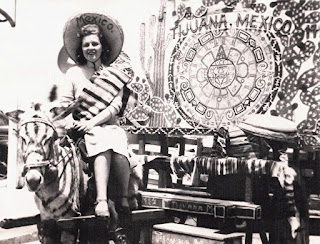
 
 
Two early b/w photos (the second one sepia-tinted) of Tijuana 'zebras' from 1944 (public domain)

There is much controversy concerning who originated the novel idea of painting black stripes on Tijuana's tourist-magnet donkeys to achieve the required level of contrast for photographic purposes, but, regardless of his identity, by the end of the 1940s Avenida Revolucíon was home to a number of these home-made zebras, and a new Tijuana tradition was duly born. Moreover, to optimize the level of contrast exhibited by them, the donkeys usually (though not always) have a white powder applied to their coats before the black stripes are painted on, as was the case with the individual that I saw (click here to view a short video on YouTube of a typical Tijuana 'zebra').

By the late 1970s, no fewer than 25 'zebras' with their owners could be encountered in Avenida Revolucíon, each with their own specific allocated spot for attracting tourist trade. Yet by the time of my visit in 2004, this number had decreased significantly, due in no small way to the precipitous fall in the number of tourists visiting from across the border in the USA since the dreadful events of 9/11. A decade later, moreover, according to a 2013 report issued by Washington D.C.'s National Public Radio, only three Avenida Revolucíon 'zebras' remained.

 
Interestingly, this particular Tijuana 'zebra' was photographed in May 2004, i.e. just weeks before I visited Tijuana – so in view of how few specimens were still present by then, it could well be the very same animal that I saw there (public domain)

In an attempt to elicit increased interest and city pride in its faux zebras, a year later, in 2014, they were formally declared part of Tijuana's cultural heritage by the Cultural Heritage Council of the State of Baja California in northern Mexico. Nevertheless, its decision was revoked in 2017, following protests from animal-rights activists, with the unnamed federal judge responsible for this legal reversal ruling that because living entities are not real estate, they cannot be considered part of Tijuana's cultural heritage. That decision does not prevent those few 'zebras' still existing from continuing to ply their trade, via their owners, on Avenida Revolucíon, although the activists have stated that they would prefer life-sized fibre-glass replicas to be used, rather than the living animals themselves.

At present, the survival of Tijuana's longstanding tradition of its tourist-touting pseudo-zebras remains uncertain. I've never read or heard about any claims of their owners mistreating them, so as long as they are indeed well cared for and not stressed by exposure to tourists, it seems a shame if these celebrated equine ambassadors for Tijuana were to disappear from Avenida Revolucíon where they have brought such colour and unique appeal for so long.
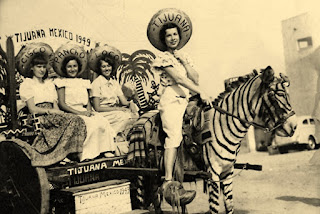
 
 
(Top) A sepia-tinted b/w photo of a Tijuana 'zebra' snapped in 1949 (public domain); (Bottom) Something different, a Tijuana 'panda'! – a Tijuana donkey painted to look like a giant panda instead of a zebra, snapped in 1960 (© owner unknown to me despite extensive online searches – reproduced here on a strictly non-commercial Fair Use basis for educational/review purposes only)

Finally: although the Tijuana 'zebras' are not cryptids, I can exclusively reveal here on ShukerNature a direct link between them and cryptozoology, courtesy of the delightful photograph presented below, which was snapped in 1974. Depicted with his family during a holiday in Tijuana, wearing the sombrero labeled Pancho, and aptly garbed in a striped sweater, the little boy sitting upon a Tijuana 'zebra' grew up to become one of today's most famous cryptozoologists. Any guesses as to his identity?

In fact, it's none other than my longstanding friend from Texas, Ken Gerhard, who very kindly emailed me this family photo for my article when I mentioned to him quite a while ago now that I was planning to blog about the Tijuana 'zebras' on ShukerNature. Thanks Ken! And now, at last, I've done so.
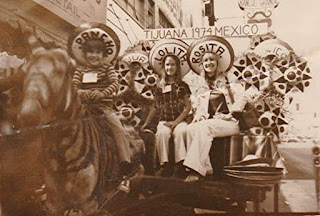
 
Ken Gerhard, sitting upon a Tijuana 'zebra' as a youngster with his family in 1974 during a holiday in Tijuana (© Ken Gerhard)


Thursday, 17 March 2016

PROF. HENRY BAUER REVIEWS A MANIFESTATION OF MONSTERS IN THE JOURNAL OF SCIENTIFIC EXPLORATION


Below is a very positive review of my recent book A Manifestation of Monsters, which has just appeared in the Journal of Scientific Exploration (vol. 30, no. 1, pp. 133-134, 2016), and was penned by Prof. Henry H. Bauer, whose Loch Ness monster book, The Enigma of Loch Ness, remains one of the standard works on this cryptozoological subject.

As can be seen from my book's front cover (the spectacular artwork is by Michael J. Smith), it contains a vast diversity of subjects, including such cryptozoological stalwarts as Nessie, mokele-mbembe, Jersey devil, thylacine, bigfoot, Mongolian death worm, chupacabra, and coelacanths, as well as many much less familiar, much more obscure mystery beasts too that will not be found in any other crypto-book. So be sure to check it out (published by Anomalist Books, it is available in both paperback and Kindle editions on Amazon and elsewhere, and contains a foreword by Ken Gerhard). Here is Prof. Bauer's review:

Click the above image to enlarge it for reading purposes (© Journal of Scientific Exploration/Prof. Henry H. Bauer)


Sunday, 30 August 2015

MY LATEST BOOK, A MANIFESTATION OF MONSTERS, IS NOW AVAILABLE TO PRE-ORDER ON AMAZON!


Front cover of my latest book, A Manifestation of Monsters (© Dr Karl Shuker/Michael J. Smith/Anomalist Books)

I'm delighted to announce that my latest book, A Manifestation of Monsters: Examining the (Un)Usual Subjects, published by Anomalist Books and containing a foreword by my good friend and fellow cryptozoologist Ken Gerhard, is now available to pre-order on Amazon.

Please click its title above to access its own dedicated web-page on my website, which includes direct clickable links to its ordering pages on Amazon's American and British sites.

Fellow cryptozoologist and good friend Ken Gerhard, who very kindly wrote the foreword to my new book - thanks, Ken!! (© Ken Gerhard)

And here's a summary of what inspired this 22nd book of mine and what it contains:

During the 30 years in which I have been investigating and documenting mystery creatures, my writings have been guided by countless different inspirations, but what inspired this present book was a spectacular work of art. Namely, the wonderful illustration that now graces its front cover, which was prepared by Michael J. Smith, an immensely talented artist from the USA, and which I first saw in 2012. It depicts no less than 17 cryptids and other controversial creatures, including the Loch Ness monster, bigfoot, coelacanth, mokele-mbembe, Jersey devil, chupacabra, Mongolian death worm, Tasmanian wolf, dogman, giant squid, skunk ape, and dodo.

Ever since seeing it, my notion of preparing a book inspired directly by this painting and the eclectic company of entities that it portrays has always stayed with me, but the fundamental problem that I faced if I were to do so was how to categorise them collectively.

What single term could be used that would effectively embrace, encompass, and enumerate this exceptionally diverse array of forms, as well as the range of additional creatures that would also be included in the book? 'Cryptid' was not sufficiently comprehensive, nor was 'mystery creature' or 'unknown animal', because some of the depicted beasts seem to exist far beyond the perimeters - and parameters - of what is traditionally deemed to be the confines of cryptozoology. Consequently, I eventually concluded that there was only one such term that could satisfy all of those requirements – indeed, it was tailor-made for such a purpose. The term? What else could it be? 'Monster'!

UPDATE: 2 September 2015 – Look what manifested through the post today! (© Dr Karl Shuker)
 
Derived from the Latin noun 'monstrum' and the Old French 'monstre', 'monster' has many different modern-day definitions - a very strange, frightening, possibly evil (and/or ugly) mythical creature; something huge and/or threatening; a malformed, mutant, or abnormal animal specimen; and even something extraordinary, astonishing, incredible, unnatural, inexplicable. These definitions collectively cover all of this book's subjects – and so too, therefore, does the single word 'monster' from which the definitions derive.

Thus it was that this became a book of monsters, but not just a book – a veritable manifestation of monsters. That is, a unique exhibition, a singular gathering, an exceptional congregation of some of the strangest, most mystifying, and sometimes truly terrifying creatures ever reported - still-unidentified, still-uncaptured, still-contentious. Even 'mainstream' species like the dodo and coelacanth, whose reality and zoological identity are fully confirmed, still succeed in eliciting controversies, and are veritable monsters - the dodo having been referred to by various researchers as a monstrous dove, and the coelacanth as a resurrected prehistoric monster.

So, if you're looking for monsters, you've certainly come to the right place, and will certainly be purchasing the right book. Just pray that once you open it and encounter the incredible creatures lurking inside, you don't live to regret your bravery – or foolishness - in having done so. In fact, just pray that you do live...

Hoping that you enjoy encountering my manifestation of monsters!!

Michael J. Smith's spectacular original artwork, 'Cryptids', which inspired my book and which now appears on its front cover – thanks, Michael!! (© Michael J. Smith)


Friday, 27 September 2013

MOTHMEN AND OWLMEN AND MANBATS, OH MY! – WELCOMING KEN GERHARD'S LATEST BOOK, 'ENCOUNTERS WITH FLYING HUMANOIDS'


Ken Gerhard's latest book, Encounters With Flying Humanoids: Mothman, Manbirds, Gargoyles and Other Winged Beasts

Today, I received through the post a copy of Encounters With Flying Humanoids: Mothman, Manbirds, Gargoyles and Other Winged Beasts. This is the latest book by renowned American cryptozoologist Ken Gerhard, who had added a very kind handwritten inscription to my copy before posting it to me – thanks Ken!

Several months ago, Ken had asked me if I'd write a foreword to his book, and after reading its manuscript I was only too happy to do so, as I was very pleased that these extraordinary and extremely diverse entities' reports had finally been compiled and assessed within a single volume, in so expert and enthralling a manner too.

As I wrote in my foreword, I've always been interested in this subject, ever since encountering by chance many years ago a fascinating book that included a number of different examples. But why waste time attempting to summarise what I wrote in my foreword? Far better simply to reproduce it in full here, as my personal, unequivocal recommendation to everyone interested in such beings, such 'things with wings', to purchase Ken's excellent new book without delay!

One afternoon during the early 1980s, I was browsing through the upstairs, second-hand department of Andromeda Books – the once-celebrated but now long-demised science-fiction and fantasy bookshop in Birmingham, England – when I came upon a paperback entitled Earth's Secret Inhabitants, which had been published in 1979. Its front cover illustration was extremely eyecatching – a full-colour depiction of two feathery-winged humanoids flying through the sky in a scene captured within the hulking silhouette of a bigfoot-type man-beast.

Initially, I'd assumed that this book was a sci-fi novel, but then I noticed that its authors were none other than D. Scott Rogo and Jerome Clark – two leading American non-fiction writers specialising in the field of mysterious phenomena. And when I turned to the back cover, the blurb revealed that its contents featured a wide range of surreal entities that apparently share our planet with us but have never been scientifically explained - including a veritable phalanx of winged 'bat-men'. Until then, I'd been largely unaware of these aerial apparitions, but after reading about them in Rogo and Clark's book – because, needless to say, I purchased it immediately! – I was totally captivated by their bizarre histories and extraordinary appearance, and from then on I made a point of collecting as much information concerning them as I could find.

My much-read copy of Earth's Secret Inhabitants (Dr Karl Shuker/Tempo Books)

The most immediate problem that I have always faced whenever doing so, however, is that such material is extremely disparate, scattered loosely among countless publications, yet rarely compiled or assimilated into any kind of lucid or lengthy coverage. This is why I was delighted to learn recently that Ken Gerhard was writing a book-length treatment of these winged wonders, and even more delighted when he very kindly invited me to write a foreword for it.

Reading through his book, Encounters With Flying Humanoids, it is evident that Ken shares my own fascination with the bat-men and man-birds that have haunted our skies for many centuries, continue to be encountered even today, in all parts of the world, and assume a diverse assortment of forms. Moreover, unlike previous writers, he has not been content to limit his coverage to such perennially-chronicled enigmas as mothman, owlman, and the man-bats of Texas, but has cast his gaze like a vast skyborne net far and wide through time and space, encompassing many much more obscure examples that even I, despite having spent years of collecting material myself, had never previously heard of.

Consequently, Encounters With Flying Humanoids very commandingly fills a sizeable, (all-too-)long-present gap in the Fortean and cryptozoological literature, and it also makes enthralling, if not a little disturbing, reading. What are these mysterious flying figures with plumes of bird or pinions of bat, and where have they originated? Do they truly belong somewhere within our planet's grand scheme of things, or are they visitors from the great beyond – from alien worlds, planes, or dimensions, rarefied realms stranger than we can even begin to suspect? And if so, why are they here? What might their purpose be?

A worthy successor to his previous highly-acclaimed volumes on winged mystery beasts and cryptids of Texas, Ken's latest, superb book is a timely reminder of just how outlandish our land can sometimes be, how otherworldly our world may sometimes seem, and that there truly are more things – especially with wings – in heaven and earth, gentle reader, than are dreamt of in anyone's philosophy!

Click here to purchase Ken's book from Amazon.

With my very own flying humanoid! (Dr Karl Shuker)