Dr KARL SHUKER

Zoologist, media consultant, and science writer, Dr Karl Shuker is also one of the best known cryptozoologists in the world. He is the author of such seminal works as Mystery Cats of the World (1989), The Lost Ark: New and Rediscovered Animals of the 20th Century (1993; greatly expanded in 2012 as The Encyclopaedia of New and Rediscovered Animals), Dragons: A Natural History (1995), In Search of Prehistoric Survivors (1995), The Unexplained (1996), From Flying Toads To Snakes With Wings (1997), Mysteries of Planet Earth (1999), The Hidden Powers of Animals (2001), The Beasts That Hide From Man (2003), Extraordinary Animals Revisited (2007), Dr Shuker's Casebook (2008), Karl Shuker's Alien Zoo: From the Pages of Fortean Times (2010), Cats of Magic, Mythology, and Mystery (2012), Mirabilis: A Carnival of Cryptozoology and Unnatural History (2013), Dragons in Zoology, Cryptozoology, and Culture (2013), The Menagerie of Marvels (2014), A Manifestation of Monsters (2015), Here's Nessie! (2016), and what is widely considered to be his cryptozoological magnum opus, Still In Search Of Prehistoric Survivors (2016) - plus, very excitingly, his four long-awaited, much-requested ShukerNature blog books (2019-2024).

Dr Karl Shuker's Official Website - http://www.karlshuker.com/index.htm

IMPORTANT: To view a complete, regularly-updated listing of my ShukerNature blog's articles (each one instantly clickable), please click HERE!

IMPORTANT: To view a complete, regularly-updated listing of my published books (each one instantly clickable), please click HERE!

IMPORTANT: To view a complete, regularly-updated listing of my Eclectarium blog's articles (each one instantly clickable), please click HERE!

IMPORTANT: To view a complete, regularly-updated listing of my Starsteeds blog's poetry and other lyrical writings (each one instantly clickable), please click HERE!

IMPORTANT: To view a complete, regularly-updated listing of my Shuker In MovieLand blog's articles (each one instantly clickable), please click HERE!

IMPORTANT: To view a complete, regularly-updated listing of my RebelBikerDude's AI Biker Art blog's thematic text & picture galleries (each one instantly clickable), please click HERE!

Search This Blog


PLEASE COME IN, I'VE BEEN EXPECTING YOU...

PLEASE COME IN, I'VE BEEN EXPECTING YOU...
WELCOME TO SHUKERNATURE - ENJOY YOUR VISIT - BEWARE OF THE RAPTOR!


Showing posts with label giant snake. Show all posts

Thursday, 30 September 2021

LAOCOÖN, HIS SONS, AND POSEIDON'S CRESTED SERPENTS FROM THE SEA

 
The famous ancient Greek marble statue, 'Laocoön and His Sons', unearthed within an Italian vineyard in 1506, depicting the Trojan priest Laocoön and his twin sons being slain by a pair of huge serpents (public domain/Wikipedia)

In February 1506, a magnificent, mostly-intact marble statue in the Hellenistic baroque style was unearthed within the grounds of a vineyard owned by a Felice de Fredis, near Santa Maria Maggiore, Italy. As his great interest in classical works was well known, Pope Julius II was duly informed of the statue's discovery, and he in turn swiftly sent a team of experts to the vineyard in order to evaluate it personally and report back to him; the team included a young Michelangelo.

The statue consisted of three human figures, of which the central, adult male figure was approximately life-sized, whereas the two male youths flanking him were slightly less so, thereby enhancing the central figure's dramatic appearance. The faces and bodies of all three figures were contorted and twisted with tortured agony and fear – and for good reason. Two huge snakes were coiled around this unfortunate human trio, savagely attacking them with lethal intent. The statue was taken to the Vatican, where it has remained on public display ever since in one of its museums.

There has been much controversy as to whether this very dynamic work of art is one and the same as a certain statue written about in ancient works, and which dated back to the 2nd Century BC; or whether it is a somewhat later copy of that early statue (which some believe may actually have been created from bronze, not marble); or whether it is a much later, original work, possibly inspired by but not a direct copy of the 2nd-Century BC statue. One or other of the last two options is now deemed the most likely identity.

 
A vintage engraving of the statue 'Laocoön and His Sons', in which the illustrator has restored the missing portions to portray how the statue may have originally appeared when complete and unbroken (public domain)

The time period of this vineyard-unearthed statue's creation has also attracted dissension, with proffered dates ranging from c.200 BC to the 70s AD, with an approximate time-span of 27-BC-68 AD being the most favoured nowadays. Moreover, it is believed to have spent some time adorning the palace of the Roman Emperor Titus (reigned 79-81 AD). Its creators may have been a trio of Greek sculptors from Rhodes – namely, Agesander, Athenodoros, and Polydorus.

One aspect concerning the vineyard statue for which there is absolutely no controversy, however, is who and what it depicts, because the fraught scene in question is one of the most famous in all of classical Graeco-Trojan mythology. The central figure is the Trojan priest Laocoön, and the two youths are his twin sons Antiphantes (aka Antiphas) and Thymbraeus. Accordingly, the title by which this statue is officially known in the art world is 'Laocoön and His Sons'.

But what is of particular interest and relevance to this present ShukerNature article is the zoological nature of the giant serpents lethally encircling the doomed trio's bodies, which are named Porces and Chariboea (aka Curissia or Periboea). Based upon the statue alone, they simply look like muscular, constricting snakes, quite possibly inspired by the African rock python Python sebae, often kept as a pet in ancient Greece and Rome too. Consequently, they have been readily accepted as such by some authors. Conversely, ancient written accounts of their morphology and origin suggest something rather more exotic.

 
An African rock python (public domain)

As with the specific identity and age of the statue, there is contention regarding the precise background of Laocoön and why the snakes – or whatever they are – were attacking him and his sons, with different ancient sources making differing claims. As this is not the relevant place to examine and discuss in detail each of these sources and claims, suffice it to say therefore that the three major claims are that Laocoön was:

A Trojan priest who warned the Trojans not to trust the huge wooden horse offered to them as a gift by the opposing Greeks; his warning went unheeded and the Trojans fatally wheeled the horse into their city, thereby precipitating their destruction at the hands of the Greek soldiers concealed inside it, but to punish him for trying to prevent the horse from being accepted, the goddess Athena (the Greeks' divine supporter) sent two giant snakes to kill him and his sons.

Or: A Trojan priest of Apollo who broke his oath of celibacy by fathering his sons, so as a punishment Apollo sent two giant snakes to kill him and his sons.

Or: A Trojan priest of Poseidon who desecrated his temple by indulging in sexual intercourse within its perimeter, so as a punishment Poseidon sent forth two great serpents of the sea across the waves to kill him and his sons.

 
Engraving of Laocoön and his sons being attacked by giant snakes from the sea, in Speculum Romanae Magnificentiae, c.1516-20 (public domain)

Of these, the third version is the one most commonly cited and favoured, and is featured dramatically within ancient Roman poet Virgil's classic epic The Aeneid (written 29-19 BC):

Two snakes from Tenedos (I shudder to think of it) come on over the peaceful sea unwinding their huge coils and swim abreast towards the shore. Their breasts rise among the billows, their bloody crests tower over the waves; their flanks skim the abyss, and their vast tails curve in sinuous coils, the waves carrying the spume. Already they have reached the beach: their burning eyes shine, red with blood and flame; their tongues, like a dart, flicker in their mouths, which they lick, hissing...

Tenedos is an island in Turkey where according to legend the Greeks hid their army, to fool the Trojans into believing that the war between their two nations was finally over – a treacherous ruse augmented by their deceitful gifting to the Trojans of the Trojan Horse.

 
Vintage illustration of the oarfish (aka giant oarfish or ribbonfish) (public domain)

Way back in the 1970s, I studied sections of The Aeneid (including the above one) as part of my Latin O-Level course, and I can still well remember thinking how very reminiscent Poseidon's fire-crested sea serpents were of a certain huge and highly distinctive species of marine fish. Moreover, when I subsequently acquired and read veteran cryptozoologist Dr Bernard Heuvelmans's classic tome In the Wake of the Sea-Serpents (1968), I discovered that I wasn't the only one to have recognised this similarity. Here is what Heuvelmans wrote:

The colour of these snakes' crests makes one suspect that Virgil's terrific picture may be inspired, in parts at least, by one of the most mysterious of the world's larger fishes, the oarfish Regalecus glesne...It is long and serpentine, and right along its spine is a crest of bright coral red which it can raise into a sort of plume on its head.

Just how long this surreal but wholly inoffensive ribbon-like fish can be is very much a matter for conjecture, as I examined in an entire chapter devoted to it within my book A Manifestation of Monsters (2015), and also here on ShukerNature. It is certainly known to measure over 30 ft long, but some plausible if unconfirmed lengths of up to 50 ft have also been documented.

 
A Greek wall plate of mine depicting the vineyard-unearthed 'Laocoön and His Sons' statue (© Dr Karl Shuker)

Consequently, whereas the vineyard statue's visual portrayal of Laocoön and his sons' dreadful fate at the coils of their constricting nemeses was probably more naturalistic, merely inspired by pythons, verbal versions of the Laocoön legend like that of Virgil in which the giant serpents were huge crested snakes of the sea sent across the waves by Poseidon were more melodramatic, and conceivably inspired by rare sightings and strandings ashore of the spectacular oarfish. (They certainly do not recall any of the known, elapid species of sea snake currently documented.) Or, as Heuvelmans put it:

It is therefore more likely that the two serpents from Tenedos whose "bloody crests tower over the waves" were modelled on oarfish. There is even less doubt that these huge fragile fish could not have done the least harm, even to a newborn baby left upon the beach. But poetic licence will explain much...

Indeed it will.

 
My replica in resin from Greece of the 'Laocoön and His Sons' statue (© Dr Karl Shuker)


Friday, 29 September 2017

CUTTING A PHONEY MEGA-PYTHON DOWN TO SIZE - OR, EXPOSING ANOTHER FAKE SNAKE


Photo-manipulated fake photograph of an ostensibly mega-sized reticulated python (creator of this fake photograph currently unknown to me)

When investigating the numerous online fake anaconda photographs exposed by me in my previous ShukerNature blog article (click here to access it), I frequently encountered various permutations of another fake snake image – the most abundant example of which opens this present ShukerNature article.

Here two some more of these python-portraying permutations, which again appear on countless sites online:

Two additional fake photographs utilising the same python image (their creator(s) is/are presently unknown to me)

Moreover, I soon discovered that they also frequently featured as video-thumbnail photographs for various YouTube videos concerning giant snakes, but invariably they were conspicuous only by their absence within the videos themselves. In short, they were simply being used as clickbait (just like the fake anaconda ones), enticing potential viewers to access the videos.

The snake portrayed in these fake photos is readily recognisable as a reticulated python Python reticulatus. Now, I am well aware that this species is the world's longest species of modern-day snake, with specimens regularly exceeding 20.5 ft, but even the current confirmed record-holder – a truly astonishing individual 32 ft 9.5 in long that was shot in 1912 on the Indonesian island of Sulawesi (=Celebes) – would not measure up in any sense of those words to the monstrous mega-python in the photographs under consideration here. Moreover, even forced perspective would be sorely challenged to yield a size-based visual illusion anywhere near as spectacular as the serpent depicted in them.

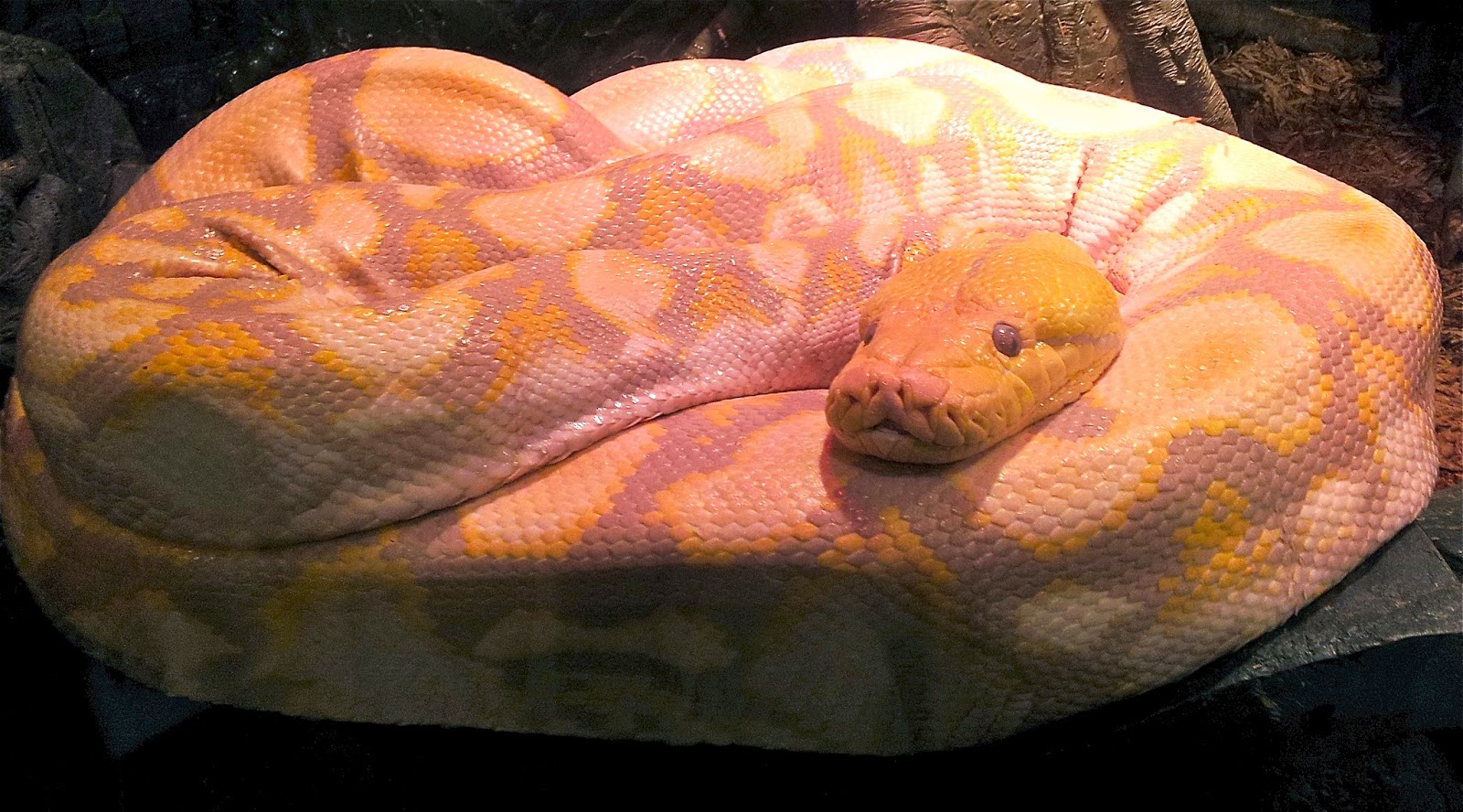
(Above) A genuine photograph of a wild-type reticulated python (public domain); (Below) A genuine photograph of Lemondrop, a lavender albino reticulated python housed at the California Academy of Sciences in Golden Gate Park, San Francisco, California, USA (© Maya Visvanathan/Wikipedia – CC BY-SA3.0 licence)

Clearly, therefore, these photos were fakes, produced by adding small images of humans into some original, genuine photograph of a reticulated python in order to make the latter snake appear immense, but the only way to verify this was to trace that original, genuine photo. Happily, however, unlike the search for the original anaconda image, finding this python precursor was much easier to accomplish. I soon discovered a version that was identical with the others relative to the python itself but lacked any people in it, only depicting the snake, so this was obviously the original, genuine photo whose image had been appropriated by the hoaxer(s). It was present on many sites dealing with snakes, and not surprisingly it was especially popular on southeast Asian sites, because the reticulated python is native to southeast Asia. But none of these sites provided any source for it, so where had this photograph originated?

Fortunately, within a very short time I succeeded in tracing it back to the website RFUK, or Reptile Forums UK in full, and specifically to a post by a RFUK member with the user name Mikee. On 15 September 2009, Mikee had posted on this site a number of photographs of some of his pet snakes, past and present, and one of these pictures was the sought-after original, genuine python photo lacking people in it (click here to access this particular RFUK page and scroll down it until you come to Mikee's post and photos). Here is that photograph (#3 as posted by Mikee):

The original, genuine photograph of a pet reticulated python that has since been utilised by hoaxer(s) unknown to create fake mega-python images (© Mike Andrews – reproduced here on a strictly educational, non-commercial Fair Use basis for review purposes only)

By clicking Mikee's name alongside his post, I was able to access his public profile on RFUK, and I discovered that his real identity was Michael Andrews, from Essex, England. His RFUK profile also included links to his Facebook page, and when I accessed this I found the same python photograph in one of his FB photo albums too (it is publicly accessible, so click here to view this python photo in it). The album in question is entitled 'My Passion', and is devoted to photographs of various of Michael's pet reticulated pythons. The specific python photograph under investigation by me here had been uploaded into this FB album by Michael on 17 May 2010.

Consequently, the mystery of the mega-python image is a mystery no longer – Michael's original, genuine photograph of one of his pet reticulated pythons has simply been photo-manipulated by creator(s) unknown, and without Michael's knowledge, to produce a range of fake pictures of purportedly gargantuan pythons that have flooded the internet and are proving particular popular as clickbait images for uploaded videos there. Interestingly, however, using TinEye's Reverse Image Search the earliest fake version that I was able to track down online had been uploaded on 16 May 2016, so unlike the fake anaconda photos these python equivalents seem to have been created only fairly recently.

Close-up of a spectacular life-sized statue of a reticulated python on display inside the Reptile House at Taronga Zoo in Sydney, Australia, when I visited it in 2006 (© Dr Karl Shuker)


Friday, 28 July 2017

HOW A GIANT SNAKE BECAME A SPIKY SEASHELL – WELCOME TO THE MAUSOLEUM OF MONSTERS


One of several artworks by Swiss painter Henry Fuseli (1741-1825) with a cryptozoological connection – Reiter Von Riesenschlange Überfallen ('Horseman Attacked By A Giant Snake'); watercolour, painted in c.1800 (public domain)

In contrast to insidious and infamous zoological frauds such as Piltdown Man and the stuffed mermaids of Oriental origin, many cases of confused taxonomic classification have occurred not through deliberate, predetermined intentions to create non-existent creatures or to lure scientists along false trails, but instead via simple misidentifications. Nonetheless, the results have often been both unexpected and spectacular, but few more so than in the case of the giant venomous serpent of South America's Gran Chaco region. After all, how can such an ostensibly monstrous reptile transform into a spiky seashell of far more modest proportions and far less dangerous attributes?

As I now reveal here in ShukerNature, the story of this astonishing metamorphosis, though largely forgotten today, must surely rate as one of the most extraordinary (and embarrassing) incidents in the entire history of 20th-Century zoology.

Gran Chaco location on map (public domain)

Deep within the most secluded realms of the mystery beast investigator's mind lies a dark and mournful cemetery, whose gates are for the most part firmly chained and heavily barred. Whenever his speculations and theories aspire to the grandiose and gothic, however, he is forced to tread the shadowy pathway leading to this most dreaded and dreadful of destinations - the mausoleum of monsters.

In this forsaken spot – within this cryptic catacomb of mythological mammalia, apocalyptic archosauria, and other fabulous fauna of every type - no ordinary assemblage of skeletons is ensconced. No, indeed. Here, amongst shattered dreams and mocking illusions, lie the hastily-jettisoned remains of those great zoological discoveries that were subsequently exposed as sorry misidentifications. A faux-pas phantasmagoria, whose forbidding presence within the annals of zoology serves as a stern warning to all cryptozoologists of the perils of premature pronouncement or imprudent identification. Let us tarry a while here, and examine one of its most dramatic examples.

A veritable mausoleum of monsters – an exquisite 19th-Century engraving depicting some of the Victorian-age prehistoric animal sculptures of Crystal Palace created by English sculptor Benjamin Waterhouse Hawkins (1807-1894) (public domain)

In 1926, the Proceedings of the Royal Society of Edinburgh published a paper by Prof. Sir John Graham Kerr, at that time Regius Professor of Zoology at the University of Glasgow, in which he described a huge, curved poison fang belonging to a hitherto unknown genus and species of giant snake - which he formally named Bothrodon pridii (with Bothrodon translating as 'furrow-tooth').

Approximately 2.5 in long as measured along the outside of the curve, this fang was truly enormous.

Bothrodon pridii 'fang', pictured in 1926; scale in mm (public domain)

Indeed, as noted by now-retired mollusc expert David Heppell from the Royal Museum of Scotland who documented this specimen in The Conchologist's Newsletter (March 1966), it was roughly nine times longer than that of a 6-ft-long boomslang Dispholidus typus - one of the world's deadliest snakes.

Moreover, it even dwarfed the fangs of the Gaboon viper Bitis gabonica. Native to much of sub-Saharan Africa, this formidable serpent not only is the largest member of the genus Bitis and the world's heaviest species of any type of viperid, but also holds the record for the longest fangs of any known species of snake alive today – up to 2 in long.

Gaboon viper showing its huge fangs (© Brimac the 2nd/Wikipedia CC BY 2.0 licence)

Accordingly, judging from the relative size of the fang, Prof. Kerr estimated that the total length of its venomous owner, Bothrodon pridii, could have approached 60 ft or so.

Truly a monster, in every sense of the word!

Prof. Sir John Graham Kerr (© T & R Annan & Sons Ltd/Wikipedia CC BY 4.0 licence)

The poison fang had been obtained by one of Kerr's friends, missionary Andrew Pride (after whom Kerr had named this outsized ophidian) from the Gran Chaco's silt-like deposits, which dated back no further than the Pleistocene epoch (2.5 million to 11,700 years ago). Despite a prolonged, thorough search of this locality by Pride for this mega-snake's skeletal remains, however, none were found.

In his paper Kerr concisely described the fang's appearance, including the prominent poison groove running all along its apparent external face, as well as the two narrow parallel stripes, dark-brown in colour, that lay along the distal (terminal) portion of its length. He also discussed the possible phylogenetic relationships of Bothrodon pridii itself, by comparing its fang's morphology with that of contemporary snake species.

The boomslang, an opisthoglyphan snake, depicted in 1838 (public domain)

From these studies, Kerr concluded that the fang most closely resembled those of the opisthoglyphans. This is a group of rear-fanged colubrid snakes that include the boomslang, and which point the way towards the more highly-evolved present-day venomous snakes. In addition, Kerr deduced from the fang's peculiar hook-like shape that, rather than functioning as a striking fang, it most probably served to hold the prey stationary whilst its poison entered the wounds produced by the snake's other teeth in the prey's flesh.

Sherlock Holmes would certainly have approved - because Kerr's paper demonstrated most effectively the considerable amount of information concerning an entire organism (be it serpent or sapient!) that could be obtained by meticulous analysis of only a single component of that organism. Or so it seemed...

Reconstruction of the giant ground sloth Megatherium (public domain) alongside a fossil skeleton of it at London's Natural History Museum (© Dr Karl Shuker)

Kerr duly presented this unique fang to the Hunterian Museum of the University of Glasgow, and in 1933 a cast of it was displayed alongside a label stating that Bothrodon may have fed upon cumbersome plains-dwelling creatures such as the giant ground sloth Megatherium.

Conversely, noted herpetologist Dr Raymond Ditmars suggested small mammals as likely prey in his classic book Snakes of the World (1931).

Dr Raymond Ditmars (public domain)

Nevertheless, Ditmars was palpably impressed by Kerr's discovery and documentation of Bothrodon, exclaiming in his snake book:

It was during the preparation of this manuscript that the author received the greatest surprise in the many years he has studied the serpent clan – and it related to a rear-fanged snake.

Its possible stature also greatly excited Ditmars:

As the poison-conducting teeth of the rear-fanged snakes are short in proportion to the body length, the size of this monster is open to thrilling conjecture...Indeed the thought it inspires rather dulls the conjectural image of that dinosaurian star, Tyrannosaurus, whose races passed away ages before this mammoth Bothrodon prowled the soil.

I'm not quite sure how a limbless creature can be said to prowl; but in any event, as a serpent of substance Bothrodon remained unchallenged – until 1939, that is, when it was unceremoniously dethroned, disgraced, and, worst of all, exposed as nothing more than a snail in snake's similitude!

Chiragra spider conch's shell, underside (© Udo Schmidt/Wikipedia CC BY-SA 2.0 licence)

For Dr W. Quenstedt, after closely examining a coloured cast of the fang sent to the University of Berlin's Paleontological Museum by Prof. Kerr, recognised the specimen's true identity. It was one of those six curved projections, long and groove-bearing, that fringe the large shell aperture of Lambis [now Harpago] chiragra, the Chiragra spider conch - a large and ornate, modern-day species of Indo-Pacific gastropod mollusc! Every feature of the 'fang' confirmed this identity – its size, shape, long groove, brown stripes. There could be no mistake – Bothrodon pridii was no more.

To be fair, however, Kerr's misidentification is not as surprising as it may seem on first sight. After all, he could hardly have been expected to anticipate the discovery within the deposits of Paraguay's Gran Chaco of a shell fragment from a gastropod normally inhabiting the Indo-Pacific oceans.

Bothrodon 'fang' and shell projection from Chiragra spider conch's shell (public domain)

Indeed, this one aspect of Bothrodon's bizarre history remains totally unexplained and seemingly inexplicable even today. How could a section of shell from a modern-day Indo-Pacific mollusc have been obtained in Gran Chaco? David Heppell noted that there is no question that Gran Chaco was the locality involved. Thus, as he remarked, the discovery can be explained only by way of some human introduction.

Notwithstanding this, the survival of Bothrodon pridii within the zoological literature on taxonomic synonyms serves as a stark reminder of just how easily and how far one can travel along the wrong track after having once set foot upon it. Certainly, although many weird metamorphoses have been documented from the animal kingdom, few can surely compare with the transformation of a giant snake into a spiky seashell!

Chiragra spider conch's shell, upper side (© James St John/Wikipedia CC BY 2.0 licence)

As a curious footnote (assuming of course that anything concerning snakes can possess a foot!): even though the re-identification of the Bothrodon 'fang' as a prong from the shell of a Chiragra spider conch was swiftly and fully accepted by the herpetological community following Quenstedt's dramatic denouement in 1939, it is possible that Kerr himself was not so quick to accept this embarrassing revelation.

The reason why I suggest this is that while browsing very recently through Kerr's book A Naturalist in Gran Chaco, first published in 1950 and chronicling the zoological expedition that he mounted during the late 1890s to this vast semi-arid region of southern South America (overlapping northwestern Bolivia, western Paraguay, northern Argentina, and a small portion of southwestern Brazil), I was very surprised to find that although he included just over a page devoted to the Bothrodon specimen's discovery and his studies of it, he made no mention whatsoever of its molluscan re-identification. Equally, however, I can find no mention anywhere of his ever having publicly discounted or disputed this latter taxonomic reassignment of it.

Hardback first edition of Sir John Graham Kerr's book A Naturalist in Gran Chaco (© Sir John Graham Kerr estate/Cambridge University Press – reproduced here on a strictly non-commercial Fair Use basis only, for educational/review purposes)

So how can we explain this very curious, and conspicuous, absence in Kerr's book, which was first published more than a decade after Quenstedt's fateful, published declaration? As Kerr died just seven years later, in 1957, it is likely that we shall never be able to answer this highly intriguing question with any degree of certainty.

Taxonomically speaking, therefore, Bothrodon pridii may indeed be long dead and buried within the mausoleum of monsters, but perhaps its mystery is not entirely extinguished after all.

My own close encounter with a giant snake… - a magnificent life-sized sculpture by Tim Johnman of a reticulated python at Taronga Zoo in Sydney, Australia, which I visited in 2006 (© Dr Karl Shuker)


Tuesday, 25 August 2015

MY 500TH SHUKERNATURE POST! – PRESENTING THE TOP TEN SHUKERNATURE POSTS OF ALL TIME: FROM BLACK LIONS AND MERMAIDS TO POODLE MOTHS AND PENIS SNAKES!


Subjects documented in six of my all-time Top Ten ShukerNature blog posts (mermaid photo © Dr Karl Shuker; Venezuelan poodle moth photo © Arthur Anker; giant sea serpent gaff photo © Takeshi Yamada; © of the other photos unknown to me)

Welcome to my 500th ShukerNature blog post! To mark this momentous occasion, I have pleasure in presenting for your entertainment and interest the following equally momentous list – the Top Ten ShukerNature posts of all time, based upon hit counts. And here they are, each one with its own clickable direct link to the post itself.

Posted: 12 June 2012
Hits count: 1,155,307

Posted: 1 August 2012
Hits count: 209,972

#3: MYSTERY OF THE VENEZUELAN POODLE MOTH – HAVE YOU SEEN THIS INSECT??
Posted: 22 August 2012
Hits count: 114,688

Posted: 16 August 2012
Hits count: 92,565

Posted: 3 August 2012.
Hits count: 76,659

Posted: 1 October 2012
Hits count: 58,418

Posted: 26 January 2014.
Hits count: 44,933

#10: GIANT ANACONDAS AND OTHER SUPER-SIZED CRYPTOZOOLOGICAL SNAKES
Posted: 20 September 2013
Hits count: 42,213

Analysing this list, several intriguing if not readily explainable facts swiftly emerge.

First and foremost, melanistic cats – most especially black lions – clearly hold an abiding fascination for ShukerNature readers. The popularity of my all-time #1 blog post, exposing various online black lion photographs as photo-manipulated hoaxes, is truly, outrageously, and – above all else – inexplicably phenomenal! What on earth is it about black lions that should have generated well over 1 million hits for this particular post since I uploaded it just over 3 years ago, far more than any other ShukerNature post, and continuing to add to that count by the thousands each week?

Collectively, ShukerNature's 500 posts have garnered a total hits count of just over 5.1 million, which means that this one single post has contributed more than 20% of that total all by itself! Nor does it end there. A follow-up post of mine exposing a further black lion photo as yet another hoax also makes the all-time Top Ten ShukerNature posts list (coming in at #8), and my examination of the highly contentious issue of whether black pumas exist is at #5.

Equally perplexing is why four of the ten posts in this all-time Top Ten list originated from the very same month, August 2012, bearing in mind that I have been posting on ShukerNature from 20 January 2009 right up to the present day, and on a regular basis throughout that sizeable time span too. What was/is so special about that specific month, therefore, particularly as the four posts in question from it deal with four entirely different subjects? True, the poodle moth was attracting tremendous online interest at the time of my post, so that would definitely have helped focus attention upon it here on my blog too. And the term 'penis snake', as invented by the media for it, no doubt explains why a large but hitherto highly-obscure species of aquatic amphibian lacking limbs and lungs has received such a high hits count on here.

Certainly, there is no doubt that photos of weird animals that have gone viral online prove popular subjects for ShukerNature posts, especially those posts that investigate what the creatures portrayed in such photos are and whether such photos are genuine or fake. The success of my two black lion posts exemplify this trend, as do those dealing respectively with the poodle moth, the potoo, the alleged half-human half-rabbit hybrid, and the many bizarre beasts created by Takeshi Yamada.

As for the two remaining posts in this list, dealing with merfolk and giant snakes respectively, these are perennially popular cryptozoological subjects. Consequently, their presence should come as no surprise.

Looking back one last time at this all-time Top Ten list, there is no doubt that I could never have predicted which of my 500 ShukerNature posts would have made the cut. And when uploading the first of my black lion posts back in June 2012, a post that took no more than half an hour to prepare, I never dreamed even for an instant that it would become the runaway ShukerNature success story that it has done and still is, seemingly destined never to be overtaken by any other post on this blog of mine, regardless of its subject, and continuing to increase its count by significant amounts on a daily basis.

But what about the other nine posts in this list? Will they still be in the Top Ten when or if a 1000th ShukerNature post is uploaded one day? Who can say? If I've derived nothing else from this list, I have definitely learnt from it to expect the unexpected – which only serves to increase my passion for preparing further ShukerNature posts in the future, as well as my fervent hope that you will continue to enjoy reading and re-reading them. So here's to the next 500, and thank you all as ever for your continuing encouragement and interest in my researches and writings!

Subjects documented in the remaining four of my all-time Top Ten ShukerNature blog posts (photo-manipulated black puma photo © Dr Karl Shuker; giant python photo © Colonel Remy van Lierde; penis snake photo © Matt Roper; © of photo-manipulated black lion photo unknown to me)


Thursday, 6 August 2015

EXPOSING THE CON IN ANACONDA - OR, HOW I MONSTERED A MONSTROUS SNAKE HOAX


The online photo of a supposed gargantuan anaconda shot in Africa's Amazon River !! (photo-manipulated photograph's creator(s) unknown to me)

Less than a month after debunking a trio of quasi-coloured mock pythons on ShukerNature (click here), I was able to do the same to an even more outrageous hoax of the constrictor kind, this time involving a much-manipulated photograph of a green anaconda Eunectes murinus.

According to the record books, this anaconda species, the biggest known to science, rarely exceeds 20 ft long. However, many reports have been filed concerning a truly colossal form of anaconda supposedly existing amid the vast jungle swamplands and lagoons of Brazil and elsewhere in South America – the so-called sucuriju gigante – that allegedly far exceeds that size. In 1907, the subsequently-lost explorer Lieut.-Col. Percy Fawcett reputedly shot an estimated 62-ft specimen as it began to emerge from Brazil's Rio Abuna but couldn't salvage its monstrous form, and there have even been a few photographs made public that allegedly portray killed but never-preserved specimens of it (click here for my ShukerNature coverage of some examples). Could the subject of this present ShukerNature blog article be another such picture? I don't think so!

Photograph of a supposed 130-148-ft-long sucuriju gigante killed in or around 1932 at Manaos, Brazil, after having been captured alive (public domain)

During the late evening of 1 August 2015, I saw the startling photograph opening this ShukerNature article posted on Facebook friend Simon Hicks's 'Zen Yeti' FB group page. If it were genuine, the slain anaconda featured in it would be truly gargantuan – but was it genuine? The oddly-contorted, compressed coils of the snake didn't look natural, but any specimen that so dwarfed the humans standing around it (yet standing around it in a remarkably unconcerned, disinterested manner, I might add, for persons supposedly in such close proximity to so immense a snake, dead or otherwise) is always going to attract suspicion anyway.

It was linked to the timeline of one Rakesh Mintu Bjp, and when I clicked that link it took me to an annotated version of the photo on this person's timeline. I also checked online outside Facebook, and the photo and annotation had already appeared on many other websites during the past month or so. Consequently, neither had originated with Bjp – he had merely posted one such copy on his FB timeline, as had several other persons, I discovered, which means that the originator of the photo and annotation is currently unknown. Anyway, this is the annotation:

"World's biggest snake Anaconda found in Africa's Amazon river. It has killed 257 human beings and 2325 animals. It is 134 feet long and 2067 kgs. Africa's Royal British commandos took 37 days to get it killed."

Even if the photograph hadn't seemed dubious before (which it had!), after reading the garbled nonsense above I could now have no doubt whatsoever that it was a blatant, and exceedingly silly, hoax. And how did I know this? Where to begin?!!

Well, first and foremost: unless someone has sneaked it into Africa without telling me, the Amazon River is famous for being the largest in South America.

Secondly: unless someone had thoughtfully embedded a veritable 'kill-o-meter' inside the anaconda, how could anyone state so precisely how many humans and animals it had killed?

Thirdly: its length is more than 4 times the maximum confirmed length for any modern-day snake, and more than 3 times the maximum estimated length for the longest snake ever known from planet Earth – Titanoboa cerrejonensis, from the Palaeocene epoch in what is now Colombia, which is believed to have attained a maximum length of around 42 ft and a weight of around 2500 lb (1135 kg – only about half that of the photo's mega-anaconda).

Titanoboa life-sized model exhibit of the Smithsonian Institution, in the Natural History Museum © Ryan Quick/Wikipedia – Creative Commons Attribution 2.0 Generic License)

Fourthly: there is no such regiment as Africa's Royal British commandos.

Fifthly: how on earth could it take 37 days to kill this snake, huge though it would have been if real? A concerted artillery or machine-gun salvo to its head would surely have dispatched it in a far shorter time period.

And sixthly (if such a word exists!):  regardless of how long it took to kill this alleged ophidian behemoth, where are the wounds, the signs of how it met its end? It looks extraordinarily, inexplicably, unbloodied - indeed, entirely unmarked, unwounded in any way - to my eyes.

Just after midnight on 2 August, I posted on my 'Journal of Cryptozoology' FB group's page a link (click here - but only accessible to members of my FB group) to the photo as it appeared on Rakesh Mintu Bjp's timeline.

All that was now needed was the original, non-manipulated anaconda photograph to bring this sorry snake saga to a well-deserved end, and, after spending all of 2 minutes online using Google Image after having posted the fake photo's link on my 'Journal of Cryptozoology' page, I duly uncovered it, here, on a page dealing with anacondas, from a Brazilian biology website entitled 'Bio Curiosidades'. If you scroll down the page, it is the fifth photo from the top of the page.

The original, non-manipulated anaconda photograph (© www.ninha.bio.br)

The fake photograph had been produced by person(s) unknown simply by horizontally-flipping the above, original photograph to create a mirror-image version of it, then compressing it horizontally to yield those oddly-shaped coils, then either superimposing from a second photo the people and background around it, or, more probably, superimposing it upon a second photo containing the people and background.

After finding this photograph on the 'Bio Curiosidades' website, I duly posted on my 'Journal of Cryptozoology' FB group page a link to it, beneath my previous one linking to the fake photo. Case closed.

Thus endeth the tale of the giant anaconda that was merely a giant con.

The original, non-manipulated anaconda photograph alongside the fake, photo-manipulated version; NB - I have horizontally-flipped the original photo here in order to provide a direct comparison of it alongside the fake photo (© www.ninha.bio.br for original photo/creator(s) of fake photo unknown to me)