Dr KARL SHUKER

Zoologist, media consultant, and science writer, Dr Karl Shuker is also one of the best known cryptozoologists in the world. He is the author of such seminal works as Mystery Cats of the World (1989), The Lost Ark: New and Rediscovered Animals of the 20th Century (1993; greatly expanded in 2012 as The Encyclopaedia of New and Rediscovered Animals), Dragons: A Natural History (1995), In Search of Prehistoric Survivors (1995), The Unexplained (1996), From Flying Toads To Snakes With Wings (1997), Mysteries of Planet Earth (1999), The Hidden Powers of Animals (2001), The Beasts That Hide From Man (2003), Extraordinary Animals Revisited (2007), Dr Shuker's Casebook (2008), Karl Shuker's Alien Zoo: From the Pages of Fortean Times (2010), Cats of Magic, Mythology, and Mystery (2012), Mirabilis: A Carnival of Cryptozoology and Unnatural History (2013), Dragons in Zoology, Cryptozoology, and Culture (2013), The Menagerie of Marvels (2014), A Manifestation of Monsters (2015), Here's Nessie! (2016), and what is widely considered to be his cryptozoological magnum opus, Still In Search Of Prehistoric Survivors (2016) - plus, very excitingly, his four long-awaited, much-requested ShukerNature blog books (2019-2024).

Dr Karl Shuker's Official Website - http://www.karlshuker.com/index.htm

IMPORTANT: To view a complete, regularly-updated listing of my ShukerNature blog's articles (each one instantly clickable), please click HERE!

IMPORTANT: To view a complete, regularly-updated listing of my published books (each one instantly clickable), please click HERE!

IMPORTANT: To view a complete, regularly-updated listing of my Eclectarium blog's articles (each one instantly clickable), please click HERE!

IMPORTANT: To view a complete, regularly-updated listing of my Starsteeds blog's poetry and other lyrical writings (each one instantly clickable), please click HERE!

IMPORTANT: To view a complete, regularly-updated listing of my Shuker In MovieLand blog's articles (each one instantly clickable), please click HERE!

IMPORTANT: To view a complete, regularly-updated listing of my RebelBikerDude's AI Biker Art blog's thematic text & picture galleries (each one instantly clickable), please click HERE!

Search This Blog


PLEASE COME IN, I'VE BEEN EXPECTING YOU...

PLEASE COME IN, I'VE BEEN EXPECTING YOU...
WELCOME TO SHUKERNATURE - ENJOY YOUR VISIT - BEWARE OF THE RAPTOR!


Showing posts with label bili ape. Show all posts

Saturday, 26 July 2014

THE DEADLY DODU OF CAMEROON – A BELLIGERENT GRUB-EATING BIGFOOT?

Artistic representation of the dodu (© William Rebsamen)

Veteran cryptozoological explorer Bill Gibbons has searched for a number of notable mystery beasts in the field over the years, such as the Congo's mokele-mbembe (click here) and emela-ntouka (click here for some remarkable new finds re this cryptid). He has also brought several hitherto-obscure examples to widespread cryptozoological attention, including Nepal's crocodile-jawed limbless 'dragons' (click here), the New Guinea pterodactyl-like ropen (click here), and the giant Congolese spider or j'ba fofi (comprehensively documented in my book Mirabilis, 2013). What must surely be among the most unusual , however, is of the man-beast variety.

While exploring southern Cameroon, in western Africa, seeking reports of mokele-mbembe-type cryptids during April 2000, Bill was informed by the Baka pygmies and Bantus there of a dangerous primate known to them as the dodu. They claimed that it is dark grey in colour, stands up to 6 ft tall, is mostly bipedal but will sometimes knuckle-walk on all fours, and, of particular note, has only three fingers on each hand and just three clawed toes on each foot. This last-mentioned feature provides an unexpected parallel with the puzzling reports of three-toed bigfoot or sasquatch prints sometimes encountered in North America.

Painting of Bill Gibbons with mokele-mbembe (© William Rebsamen)

Highly aggressive, a dodu will attack gorillas, but has an extremely unusual dietary predilection. After killing an antelope or some other sizeable prey, it does not touch the carcase. Instead, the dodu abandons it for a while, leaving the rotting carcase to fill with maggots, after which the dodu returns, scoops the grubs out, and eats them in quantity. It is also well known for leaving piles of sticks on the forest floor, which, as Bill speculates, may be a form of territorial marking behaviour.

Bill has collected several native reports of encounters with dodus, but by far the most remarkable was one that he heard when returning to Cameroon in 2001. While visiting the lower Boumba region, he was informed that a few months earlier, a group of white men, accompanied by pygmy trackers, had allegedly captured a live dodu, which was seen by residents of a town called Moloundou. Bill suspects that its captors were loggers, but what happened to this unique specimen following its capture (assuming that the report given to Bill was genuine) is unknown.
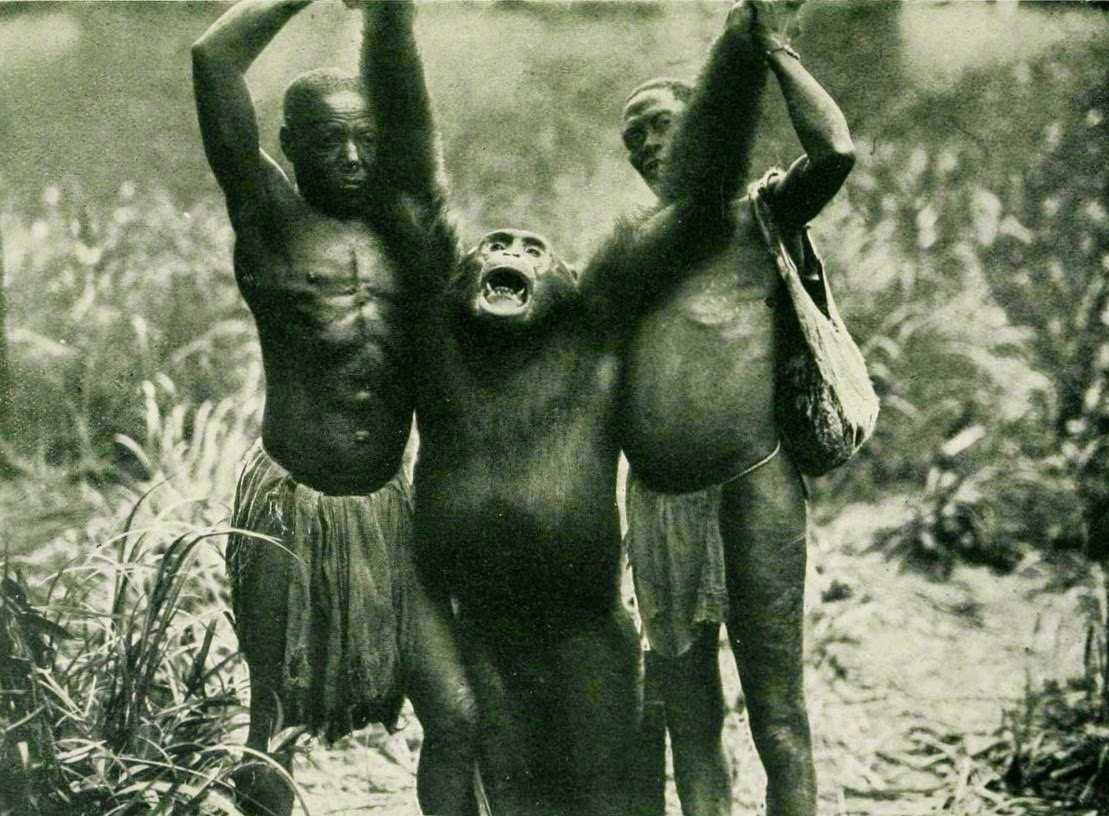
Vintage photograph depicting a dead Bili ape, from a German journal published in 1912

The prospect of such an entity still existing uncatalogued and unclassified by science in modern times might well seem highly implausible, but then again, that is precisely what sceptics thought about the lost giant apes of Bili too - until they were rediscovered in 1996 (click here).


STOP PRESS - 2 August 2014

Today I received the following additional information concerning the dodu from Juan Antonio Gutierrez via Facebook:

"Bill Gibbons and I discovered that the dodu's range is huge.

"From the Lobeke and Sangha rivers in the east to the Dja in the west.

"It's also known as the sapara near Ndongo the last outpost before the end of the world.

"Ndongo villagers told us it frequently stalks them, but never hassles anyone. Plenty of foraging available in the area especially cocoa beans. The dodu likes chocolate!"

Thanks, Juan!


This ShukerNature blog post is excerpted from my book Karl Shuker's Alien Zoo (CFZ Press: Bideford, 2010).


Monday, 18 March 2013

THE SPINY-BACKED CHIMPANZEE – A CONGOLESE CHUPACABRA CHIMP!


Reconstruction of the spiny-backed chimpanzee (Tim Morris)

In an ongoing occasional series, previous ShukerNature posts have documented a number of once- and still-controversial forms of chimpanzee – the pygmy chimpanzee or bonobo (click here), the koolookamba (here), Ufiti (here), ape-man Oliver (here), and the Bili ape (here). None, however, is as bizarre as this series' latest example – the little-known yet truly extraordinary spiny-backed chimpanzee reported from the Democratic Republic of Congo.

The only information concerning this anomalous anthropoid currently known to me is a short account that appeared in Philippe Coudray's self-illustrated book Guide des Animaux Cachés (2009).

According to Coudray, a member of a unit from the United States Navy who wishes to remain anonymous has claimed that during a mission to the Democratic Congo sometime between 1997 and 2002, the unit's team encountered 13 bipedal chimpanzees that were attempting to kill another animal. Standing 4.5-5 ft high, they were uniformly grey in colour, but by far their most distinctive feature was the series of spines running down each chimp's back, which stood up like porcupine quills whenever the chimps became agitated.

Coudray also stated that the team actually shot a three-minute video film of these extraordinary apes, but that it remains a military secret. The precise location of this sighting is unknown, but as the team was from the US Navy and the Democratic Congo is virtually landlocked, it may have been somewhere close to Lake Tanganyika.

The possession of genuine spines by these apes seems highly improbable, but perhaps they sported distinctive manes or even erectile tufts of hair that superficially resembled spines. Moreover, manes have also been reported from certain other bipedal crypto-primates, including the batutut of Borneo (closely resembling the Sumatran orang pendek), the brown-furred Congolese kakundakari, and the Central American dwendi. Indeed, were it not for the chimps' grey fur, they might even have been one and the same as the kakundakari, although kakundakari eyewitnesses generally claim that this latter entity is humanoid rather than anthropoid in form, and smaller than the spiny-backed chimps.

The potto (ltshears/Wikipedia)

Among known primates, the only species that can in any way be described as spiny is a small loris-related African prosimian known as the potto Perodicticus potto. Its neck bears a series of small tubercles covering its elongated cervical vertebrae, which have sharp points and almost pierce its skin, and are utilised as defensive weapons. Needless to say, however, these do not even begin to compare with the quills described for the spiny-backed chimps discussed here.

The bipedal nature of these chimps is very noteworthy too, as chimpanzees do not normally exhibit such behaviour as a habitual activity.

With so little information and no hard evidence to examine, and not even any eyewitness names to pursue, however, there seems little else that can be said in relation to the Congolese spiny-backed chimpanzee. Could it simply be a hoax, or a figment of poorly-viewed or imperfectly-reported observations? Or might there really be a singularly astonishing strain of spiny chimp out there, still awaiting formal scientific disclosure - a veritable chupacabra chimpanzee, in fact?!!

Philippe Coudray's own illustration of the spiny-backed chimpanzee


Friday, 8 February 2013

THE BILI (BONDO) APES – UNMASKING THE CONGO'S GIANT CHIMPANZEES


This photograph of a shot Bili ape appeared in Vol. 1 of Adolf Friedrich Herzog von Mecklenburg’s tome Vom Kongo zum Niger und Nil: Berichte der Deutschen Zentralafrika-Expedition 1910/1911, which was published in 1912 – more than a century before this highly distinctive ape form’s reality was formally recognised by science


Here's the latest in my occasional series of ShukerNature cryptozoology articles re anomalous and controversial chimpanzee forms (click here for my account of the pygmy chimpanzee or bonobo, here for the koolookamba, here for Ufiti, and here for 'apeman' Oliver).

Until quite recently, even amid the many remote regions of darkest Africa, the possibility of an unknown form of anthropoid existing there yet still eluding scientific recognition seemed ludicrous - but then came the Bili (aka Bondo) ape.

The saga of this remarkable, highly controversial primate began more than a century ago, when in 1898 a Belgian army officer returned home from what is now the Democratic Republic of Congo with some gorilla skulls obtained by him in a forested region near the village of Bili, on the Uele River in northern Congo's Bondo area - even though no other gorillas had been found within hundreds of miles of Bili before (or since). He donated them to Belgium's Congo Museum in Tervueren, where in due course they were examined by its curator, Henri Schouteden. He was sufficiently struck by their anatomical differences from other gorilla skulls as well as by their unique provenance (roughly halfway between the extreme edges of the western and eastern distribution of any gorilla populations) to classify them as a new subspecies of gorilla, which he dubbed Gorilla gorilla uellensis.

Less convinced of their separate taxonomic status, conversely, was mammalogist Prof. Colin Groves, whose examination of these skulls in 1970 led him to announce that they were indistinguishable from western lowland gorillas. Thereafter, the Bili ape sank back into obscurity - until 1996, when Kenyan-based conservationist and wildlife photographer Karl Ammann, intrigued by its strange history and apparent disappearance, set out on the first of several Congolese quests to rediscover this mysterious primate.

And rediscover it he did, bringing back such compelling evidence for its presence that several other notable investigators launched their own searches, and returned with equally fascinating clues concerning the Bili ape's nature. Such researchers included primatologist Dr Shelly Williams from Maryland's Jane Goodall Institute, Dr Richard Wrangham from the Leakey Foundation, Dr Christophe Boesch from Leipzig's Max Planck Institute for Evolutionary Anthropology, Dr Esteban Sarmiento from New York's American Museum of Natural History, and Dr George Schaller from New York's Wildlife Conservation Society.

What made their various finds so especially interesting was the ambivalent identity that they collectively yielded for the Bili ape - because, uniquely, it deftly yet bemusingly combines characteristics of gorillas with those of chimpanzees, creating a shadowy anthropoid that is at once both yet neither. For instance: if the Bili ape is a chimpanzee, it is a veritable giant, because videos of living specimens and photographs of dead ones suggest a height of 5-6 ft - a mighty stature supported by the discovery of enormous footprints, some measuring almost 14 in long, and therefore nearly 2 in longer even than those of the mountain gorilla!

A dead Bili ape, revealing its noticeably large size (http://www.factzoo.com/mammals)

Also, very large ground nests constructed by Bili apes have been found that compare with those created by gorillas; normal chimps build smaller, tree-borne nests. Further evidence of the Bili ape's great size comes from local Bondo hunters, who distinguish two distinct apes - 'tree-beaters' (normal chimps) and 'lion-killers' (the Bili apes). The latter earn their name from their combined size and ferocity, a mix potent enough to ensure their terrestrial safety even in a jungle profusely populated by lions and leopards.

Indeed, so unafraid of these great cats are the Bili apes that according to media claims they hoot loudly when the moon rises and sets - an activity unknown among normal, smaller chimps, who avoid doing so in case they attract predators. However, these latter claims have been denied by Amsterdam University field researcher Cleve Hicks, who spent a year with colleagues tracking Bili apes during from mid-2005 to June 2006, followed by a second study spanning July 2006-February 2007.

Particularly noticeable is the presence of a pronounced sagittal crest running along the top of one of the original skulls collected by the Belgian army officer, and also on a Bili ape skull found by Ammann in 1996 - because this crest, normally an indication of powerful jaws as the jaw muscles are attached to it, is characteristic of gorillas, not of chimps. Conversely, the facial anatomy of the Bili skulls is decidedly chimp-like, not gorilla-like. In addition, hair samples taken from Bili ape ground nests have been shown to contain mitochondrial DNA similar to that of chimps, and the fruit-rich content of examined faecal droppings is again consistent with a chimp identity - although, perplexingly, the droppings themselves outwardly resemble those of gorillas.

So what is the Bili ape - a gorilla-sized chimp (freak population?/new subspecies?/new species?), an aberrant form of gorilla (freak population?/new subspecies?/new species?) that has evolved certain chimp-like anatomical and behavioural characteristics, or even possibly a genuine chimpanzee-gorilla hybrid? No confirmed crossbreeding between chimp and gorilla has ever been recorded, but the two species are sufficiently similar genetically to engender viable offspring. Mitochondrial DNA is passed down exclusively from the maternal parent, so if such interspecific matings are indeed occurring they must involve female chimps and male gorillas, to explain why the mitochondrial DNA from the Bili ape samples is chimp-like.

Happily, however, the Bili ape's identity was eventually unmasked. Comprehensive DNA analyses, including nuclear DNA (thus shedding light on both the maternal and the paternal lineages of the Bili ape), had been underway since autumn 2003 at Omaha's Henry Doorly Zoo, under the auspices of conservation geneticist Dr Ed Louis, and involving DNA comparisons with gorillas, chimps, and also bonobos (pygmy chimps).

So too had analyses of mitochondrial DNA taken from faecal samples conducted by Dr Cleve Hicks and other Amsterdam University colleagues, who had also examined these primates' behaviour in the field. And in 2006, this latter team announced that their findings all confirmed that the Bili ape belongs to a known subspecies of chimp – the eastern chimpanzee Pan troglodytes schweinfurthii. Presumably, therefore, the Bili ape's very distinctive morphological features have evolved through its population's isolation from others of this subspecies but involve relatively little change at the genetic level. After years of mystery and intrigue, the riddle of the Bili ape had at last been solved.


This ShukerNature post is excerpted from my book The Encyclopaedia of New and Rediscovered Animals (Coachwhip: Landisville, 2012).