Dr KARL SHUKER

Zoologist, media consultant, and science writer, Dr Karl Shuker is also one of the best known cryptozoologists in the world. He is the author of such seminal works as Mystery Cats of the World (1989), The Lost Ark: New and Rediscovered Animals of the 20th Century (1993; greatly expanded in 2012 as The Encyclopaedia of New and Rediscovered Animals), Dragons: A Natural History (1995), In Search of Prehistoric Survivors (1995), The Unexplained (1996), From Flying Toads To Snakes With Wings (1997), Mysteries of Planet Earth (1999), The Hidden Powers of Animals (2001), The Beasts That Hide From Man (2003), Extraordinary Animals Revisited (2007), Dr Shuker's Casebook (2008), Karl Shuker's Alien Zoo: From the Pages of Fortean Times (2010), Cats of Magic, Mythology, and Mystery (2012), Mirabilis: A Carnival of Cryptozoology and Unnatural History (2013), Dragons in Zoology, Cryptozoology, and Culture (2013), The Menagerie of Marvels (2014), A Manifestation of Monsters (2015), Here's Nessie! (2016), and what is widely considered to be his cryptozoological magnum opus, Still In Search Of Prehistoric Survivors (2016) - plus, very excitingly, his four long-awaited, much-requested ShukerNature blog books (2019-2024).

Dr Karl Shuker's Official Website - http://www.karlshuker.com/index.htm

IMPORTANT: To view a complete, regularly-updated listing of my ShukerNature blog's articles (each one instantly clickable), please click HERE!

IMPORTANT: To view a complete, regularly-updated listing of my published books (each one instantly clickable), please click HERE!

IMPORTANT: To view a complete, regularly-updated listing of my Eclectarium blog's articles (each one instantly clickable), please click HERE!

IMPORTANT: To view a complete, regularly-updated listing of my Starsteeds blog's poetry and other lyrical writings (each one instantly clickable), please click HERE!

IMPORTANT: To view a complete, regularly-updated listing of my Shuker In MovieLand blog's articles (each one instantly clickable), please click HERE!

IMPORTANT: To view a complete, regularly-updated listing of my RebelBikerDude's AI Biker Art blog's thematic text & picture galleries (each one instantly clickable), please click HERE!

Search This Blog


PLEASE COME IN, I'VE BEEN EXPECTING YOU...

PLEASE COME IN, I'VE BEEN EXPECTING YOU...
WELCOME TO SHUKERNATURE - ENJOY YOUR VISIT - BEWARE OF THE RAPTOR!


Showing posts with label mystery dogs. Show all posts

Sunday, 27 October 2024

A FORMER FOXY FRIEND?

 
Reconstruction of the likely appearance in life of the officially-extinct Argentinian avus fox Dusicyon avus (© Juandertail/Wikipedia – CC BY-SA 4.0 licence)

South America's so-called foxes are mis-named, as these native wild dogs are more closely related to wolves and domestic dogs than to the true, Old World foxes, genus Vulpes. They constitute several different species and genera, some very much alive, others long extinct. And then there is one, Dusicyon avus, or Argentina's avus fox for convenience, that although extinct today, died out only recently, in around 400 BP (1454-1626 AD), and for mystifying reasons that have yet to be conclusively established.

Moreover, another, newly-revealed mystery surrounds this enigmatic canid – was it the first (and only) mainland South American fox species to have been domesticated by humans?

The reason for this unexpected line of speculation derives from a new and truly remarkable archaeological discovery – the remains of an avus fox purposefully buried inside a human grave dating back 1500 years in a burial site at Cañada Seca, in Patagonia, Argentina.

Another avus fox had been found inside an even older human grave almost a decade previously elsewhere in Argentina, at Loma de los Muertos in General Conesa, but what makes the later, Patagonian find so interesting is that whereas the diet of the earlier specimen had not been examined, DNA analysis has shown that the Patagonian specimen had dined with prehistoric hunter gatherers and was part of their camp's inner circle. Click here to access the original scientific paper formally documenting this research.

Commenting upon this find's extreme rarity, Dr Ophélie Lebrasseur from the University of Oxford opined here: "I think it was more than just symbolic; I really do think it was companionship".

 
Taxiderm specimen of the Falklands Island wolf or warrah Dusicyon australis held at New Zealand's Tūhura Otago Museum (© Kane Fleury/MothmanNZ/Otago Museum/Wikipedia – CC BY 4.0 licence)

Also relevant is that the avus fox's closest relative is also nowadays extinct, but became so even more recently, in 1876, after being not only hunted for its fur but also deliberately poisoned by farmers concerned that it may pose a threat to their sheep.

Indigenous to the Falkland Islands and traditionally deemed their only native species of land mammal, the so-called Falklands wolf or warrah D. australis has lately been considered by some researchers to have been introduced here in domesticated form by human voyagers from South America (worth noting is that the warrah was remarkably tame, wholly unafraid of humans).

Additionally, DNA analyses have revealed that it diverged evolutionarily from the avus fox a mere 16,000 years ago. In short, a creature intimately allied to the avus fox was still alive as recently as the mid-1870s.

This leads me to wonder whether, as the avus fox's own historical, mainland extinction remains unresolved, perhaps that is because such an event never actually happened. That is, perhaps a remnant avus fox population still lurks scientifically undetected amid the wildernesses of Argentina, within Patagonia's vast pampas expanses, having retreated there once domestic dogs arrived in South Anerica and supplanted the avus fox in the affections of humans?

All of this is currently speculative, of course, but fascinating nonetheless.

 
Vintage illustration of the Falklands Islands wolf, by H. Smith, 1850 (public domain)

Tuesday, 28 March 2023

MOUNT POPA’S ERSTWHILE MYSTERY DOG, AND AUSTRALIA’S STILL-UNEXPLAINED YOKYN – A COUPLE OF CURIOUS CANINE CRYPTIDS

 
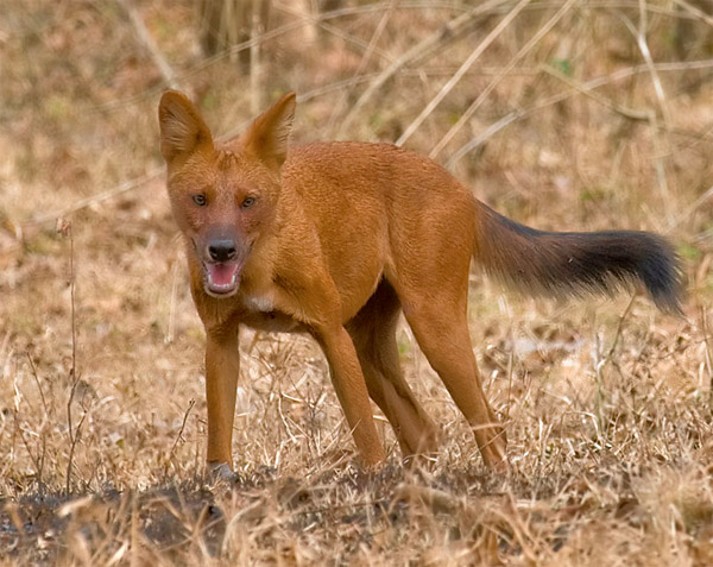
A Burmese dhole – this dhole subspecies was not scientifically described until 1941, when its existence was finally accepted (© Yathin S. Krishnappa/Wikipedia – CC BY-SA 3.0 licence)

Down through the decades, I have documented a wide range of canine cryptids, but two of the least-known examples are those presented here, making their ShukerNature debut. One is now a former mystery canid, the other remains an enigma.

A wild dog of once-controversial scientific status was a mysterious specimen discovered on Mount Popa, a dormant volcano in the region of Mandalay in central Burma (now Myanmar). Renowned British zoologist Reginald I. Pocock stated in 1936 that no specimens of Asia's very distinctive wild red dog or dhole Cuon alpinus had ever been obtained from Burma, but shortly afterwards he learnt that acclaimed mammalogist and animal collector Guy C. Shortridge had secured a specimen on Mount Popa.

Naturally, Pocock was anxious to examine this unique example, an adult female, especially as Shortridge alleged that it only had five pairs of teats (female dholes have 6-8 pairs), and weighed only 19 lb (unusually light for a dhole). However, after studying its skull, uncovered at the British Museum, Pocock recognized that it had been nothing more than an old, small domestic dog Canis familiaris, with a high crown and short muzzle. But, ironically, genuine Burmese dholes were obtained later, and in 1941 Pocock christened their subspecies C. a. adustus – a taxonomic classification still recognised today.

 
A dingo – the identity of Australia's elusive yokyn? (Katy Platt/Wikipedia – copyright-free)

As for the yokyn – this still-unexplained canine cryptid is a strange dog-like beast reputedly well-known to Australian aboriginals and farmers. Said to be approximately half the size of a full-grown dingo, with disproportionately long claws, a stocky, muscular  build, and a very variable pelage (sometimes brindled, sometimes even multi-coloured), a specimen has yet to be formally examined, so its identity remains uncertain (Fate, May 1977; also click here for additional details online).

An unknown species, an odd type of feral domestic dog, a dingo Canis dingo (aka C. lupus dingo aka C. familiaris dingo), a dog-dingo crossbreed, and even a surviving mainland race of the marsupial Tasmanian wolf Thylacinus cynocephalus are among those identities on offer. If anyone reading this ShukerNature article has further information concerning the yokyn, I'd love to receive details.

This ShukerNature article is excerpted and updated from my book Extraordinary Animals Revisited.


Thursday, 25 October 2018

SEEKING THE SHAMANU - IS JAPAN'S LITTLE HOWLING GOD TRULY EXTINCT?


Carl Hubert de Villeneuve's sketch of German botanist Philipp Franz von Siebold's captive shamanu, which he had purchased in 1826; sketch produced sometime during 1826-1830 (public domain)

According to traditional mainstream zoology, the shamanu or Japanese dwarf wolf Canis lupus hodophilax was, as its names suggest, a noticeably small subspecies of grey wolf indigenous to Japan (specifically the islands of Honshu, Kyushu, and Shikoku, but not Hokkaido – where a second, much larger grey wolf subspecies, C. l. hattai, once existed instead) but not otherwise significant from an evolutionary standpoint, and was hunted into extinction in 1905.

During September 2018, however, some startling news emerged that very emphatically overturned the first of these two longstanding assumptions.

Taxiderm shamanus at Ueno Zoo, Tokyo (© Katuuya/Wikipedia – CC BY-SA 3.0 licence)

For that was when, during the International Symposium on Biomolecular Archaeology, held at Jena in Germany, graduate student Jonas Niemann from Denmark's University of Copenhagen revealed that after he and a team of fellow researchers had analysed the genome of a shamanu skeleton from London's Natural History Museum, they had made the startling, highly unexpected discovery that its DNA more closely resembled that of a long-extinct wolf that had lived in Siberia over 35,000 years ago than that of living Eurasian and American wolves, and that the shamanu therefore appeared to be a modern-day relic of an ancient, ostensibly long-vanished group of wolves that had once ranged across the Northern Hemisphere but had hitherto been deemed to have become extinct around 20,000 years ago.

As commented upon by paleogeneticist Mikkel Sinding from the Greenland Institute of Natural Resources in Nuuk, who had extracted the DNA from the shamanu skeleton, this remarkable disclosure could offer a new window on the evolution of wolves, as well as dogs.

Shamanu skeleton, in the National Museum of Nature and Science, Tokyo, Japan (© Momotarou2012/Wikipedia – CC BY-SA 3.0 licence)

Suddenly, a long-held belief regarding the shamanu was no more. But this is not all. Might the second traditional shamanu tenet – that this veritable bonsai wolf became extinct in 1905 – also be disproved one day?

This is by no means impossible, because long after that fateful year, eyewitness reports of small, mysterious wolf-like creatures in various regions of Japan have continued to emerge, encouraging some investigators to become cautiously optimistic that the shamanu may indeed still persist.

Shamanu engraving, from Cambridge Natural History, Mammalia, 1902 (public domain)

I first became aware of and interested in this exciting possibility back in the 1990s, and after researching it I penned an article on the subject, which was duly published in the July-August 1997 issue of the now long-defunct British bimonthly magazine All About Dogs (and contained a delightful colour drawing of a shamanu by Philippa Coxall (now Foster), who illustrated many magazine articles of mine during that decade). As this article may not have ever been seen by readers outside Europe, however, I am reprinting it herewith as a ShukerNature exclusive. Please click on each of its pages to expand it for reading purposes.

 (NB – Since I wrote that article back in 1997, it has been shown that the Arab wolf C. l. arabs is slightly smaller on average than the shamanu, so the latter is no longer deemed to be the world's smallest subspecies of grey wolf; and the shamanu is no longer believed to have existed on Hokkaido; also, my article contains a misprint - the shamanu's height should be 55 cm, not 35 cm.)

My All About Dogs article, of July-August 1997, concerning the possible survival of the shamanu (© Dr Karl Shuker)

My article attracted sufficient interest from readers to inspire me to continue researching this fascinating subject, and in my book The Beasts That Hide From Man (2003) I added some further, more recent information, which reads as follows:

In January 1997, a significant new piece of evidence for the shamanu's putative survival was publicised - a series of recent photographs depicting a dog-like beast that bears a startling similarity to a living shamanu. The photos were snapped on 14 October 1996 by 47-year-old Hiroshi Yagi in the mountain district of Chichibu. He had been driving a van along a forestry road that evening when a short-legged dog-like beast with a black-tipped tail suddenly appeared further down the road. A longstanding shamanu seeker, Yagi reached for his camera, but the animal vanished. After driving back and forth along the road in search of it, however, Yagi saw it again, and this time was able to take no fewer than 19 photos from just a few feet away. He even threw a rice cake towards it, hoping to tempt it closer still, but the creature turned away and disappeared into a forest. When the pictures were examined by eminent Japanese zoologist Prof. Imaizumi Yoshinori, he felt sure that the animal was indeed a shamanu.

In November 2000, Akira Nishida took a photo of a canine mystery beast on a mountain in Kyushu that was widely acclaimed afterwards as evidence of shamanu survival - until March 2001, that is. For that was when a sign appeared on a hut on Ogata Mountain claiming that the creature in the photo was nothing more than a Shikoku-region domestic dog that the hut's owner had been forced to abandon for private reasons. However, Yoshinori Izumi, a former head of the National Science Museum's animal research section, dismisses this claim as a hoax, and remains adamant that the photographed canid is a bona fide shamanu, even stating that the pattern of the creature's fur is completely different from that of Shikoku dogs. This is evidently a saga with many more chapters still to be written!

Japan's very poignant, official memorial statue to the shamanu, which stands by the banks of the Takami River in Higashiyoshino, Nara, and is a replica of the last confirmed individual killed by hunters nearby in 1905. Inscribed is the haiku: I walk/ With that wolf/ That is no more. (© Katuuya/Wikipedia – CC BY-SA 3.0 licence)

I have recently discovered online an extensive scientific paper analysing the photographs snapped by Hiroshi Yagi of the so-called Chichibu wild dog, as this mystery canid individual has since become known. Authored by him and Japanese scientist Masazumi Morita, and published by the Japanese journal Animate in 2015, its findings indicate that the creature may indeed have been a shamanu, as revealed by the paper's summary:

Nineteen photographs of an animal "Chichibu wild dog" were taken on 14th October 1996 at the Chichibu mountains. Four of photos that captured artificial structures on the same picture, were analyzed for determination of body, head and face sizes. The estimated sizes were similar to those of a specimen of the Japanese wolf, Canis hodophilax that went extinction in 1905. Based on the results, we applied the super-impose method between the photos of head or whole body and skeletal photos of C. hodophilax specimen. The results showed that the photographed animal approximated to C. hodophilax specimen with appearance, size and shape. It indicated that a canine animal similar to C. hodophilax was present in 1996.

Taxiderm shamanu, in the National Museum of Nature and Science, Tokyo, Japan (© Momotarou2012/Wikipedia – CC BY-SA 3.0 licence)

I haven't read any reports of putative shamanu survival lately, but in view of this enigmatic little canid's elevated evolutionary significance and recent outing as a prehistoric survivor of sorts, perhaps it's time that I took up its case once more to search for and publicise any new sightings and accounts that may be on record.

So, watch this space!

Shamanu illustration by Kawahara Keiga, produced sometime during 1823-1829 (public domain)

Finally: it is nothing if not ironic that perhaps the best known shamanu illustration may not actually portray a shamanu at all. In 1826, German botanist Philipp Franz von Siebold purchased two living canids. One was a genuine shamanu (and was unequivocally depicted by Carl Hubert de Villeneuve; his depiction of it opens this present ShukerNature article), the other was an adult female specimen of a strain of domestic dog familiar in Japan and referred to variously as the yamainu or mountain dog. He made detailed notes and sketches of the two animals, taking pains to delineate their morphological differences.

Notwithstanding this, however, when Dutch zoologist Coenraad Jacob Temminck subsequently consulted Siebold's notes while preparing his own documentation of the shamanu for his great work Fauna Japonica (1833), he somehow confused the two different canids, ultimately synonymising them as one and the same form. Consequently, there has been much controversy and conjecture ever since as to whether the shamanu illustration in his work does indeed depict a shamanu or whether it is instead based upon the mountain dog. Nevertheless, this image has been reproduced and presented as a bona fide shamanu representation in many later publications, making it the most (in)famous shamanu picture ever.


Illustration of a possible shamanu but more probably just a yamainu or mountain dog, in Dutch zoologist Coenraad Jacob Temminck's Fauna Japonica, 1833 (public domain)


Thursday, 5 July 2018

WOLVES, JACKALS, COYOTES, AND SOME VERY UNUSUAL 'HILL FOXES' - EXPLORING BRITAIN'S UNOFFICIAL CANINE FAUNA


Contemporary picture postcard depicting the infamous Hexham (Allendale) wolf, from my personal collection (© Dr Karl Shuker)

Whereas Britain's unofficial feline fauna has attracted immense attention from the media and the general public (albeit rather less so from the scientific community) for several decades now, its equally unrecognised canine contingent has received far less notice, yet is no less intriguing and controversial. To redress the balance somewhat, therefore, here is a selection of UK crypto-canid cases that I have investigated and documented down through the years.

Quite a variety of British mystery dogs have been reported, including some extremely large beasts with decidedly Baskervillian overtones (comparable to the controversial Beast of Gévaudan that terrorised France during the mid-18th Century – click here for my extensive analysis of this highly contentious case). They have often blamed for savage killings of sheep or other livestock.

Reference print for Hound of the Baskervilles (Collection of the National Media Museum, no restrictions)

These are surely nothing more unusual than run-wild hounds, or crossbreeds with various of the larger well-established breeds (e.g. mastiff, great dane) in their ancestry. Typical examples reported include an enormous black creature with a howl like a foghorn, hailing from Edale, Derbyshire (Daily Express, 14 October 1925); a beast the size of a small pony sighted on Dartmoor by Police Constable John Duckworth in 1969 and again in 1972 (Sunday Mirror, 22 October 1972); and a sheep-slaughtering marauder stalking the Welsh hamlet of Clyro, Powys (Sunday Express, 10 September 1989). Notably, Clyro is actually the locality of the real Baskerville Hall – its name was borrowed by Sir Arthur Conan Doyle for his fictional, Dartmoor-relocated equivalent.

Even today, some remarkably lupine mystery beasts are sighted spasmodically in Staffordshire’s wooded Cannock Chase (e.g. Stafford Post, 30 May 2007). Some have opined that these mystery dogs are wolves. However, according to many authorities, the last verified wolf of mainland Britain died in Scotland during either the late 17th or the early 18th Century (opinions differ as to the precise year, but 1680 and 1743 are two popular suggestions).

The murderous Hound of the Baskervilles as depicted upon the cover of a book by Sir Arthur Conan Doyle (public domain)

Incidentally, long after the last Irish wolf was killed, in County Carlow around 1786, there were rumours that small wolves existed on the Isle of Achill, just off Ireland’s western coast. Traditionally, these have been assumed to be wholly mythical, but in a letter to me of 21 February 1998, British zoologist Clinton Keeling provided a fascinating snippet of information on this subject - revealing that as comparatively recently as c.1904, the alleged Achill Island wolves were stated to be “common” by no less a person that okapi discoverer Sir Harry Johnston.

Also of note here is that according to Michael Goss (Fate, September 1986), when foxes became scarce in a given area, hunters would sometimes release foxes imported from abroad - until as recently as the early 1900s, in fact - and that in some cases it seems that these imported ‘foxes’ were really jackals or young wolves.

Second contemporary picture postcard depicting the Hexham (aka Allendale) wolf (public domain)

A supposed grey wolf Canis lupus blamed for numerous livestock killings near Monmouthshire’s Llanover Park in 1868 was never obtained (The Field, 23 May 1868). Conversely, after a long hunt during winter 1904 for an unidentified sheep-killer in Hexham and Allendale, Northumberland, a wolf was finally found - discovered dead, on 29 December 1904, upon a railway line near Carlisle. As John Michell and Robert Rickard discussed in Living Wonders (1982), it was initially thought to have been an escapee belonging to a Captain Bain (sometimes named as Bains) of Shotley Bridge, near Newcastle, which had absconded in October, but his wolf had only been a cub, whereas the dead specimen was fully grown. A visiting American later claimed that the Hexham wolf’s head, preserved by a taxidermist, was actually that of a husky-like dog called a malamute, but several experts strenuously denied this.

When the supposed wolf responsible for several sheep attacks between Sevenoaks and Tonbridge in 1905 was shot by a gamekeeper on 1 March (Times, 2 March 1905), it proved to be a jackal C. aureus. Interestingly, as noted by Alan Richardson of Wiltshire (The Countryman, summer 1975), an entry in the Churchwardens’ Accounts for the village of Lythe, near Whitby, North Yorkshire, recorded that in 1846 the sum of 8 shillings was paid for “One jackall [sic] head”. As this was a high price back in those days, it suggests that whatever the creature was, it was unusual. By comparison, fox heads only commanded the sum of four shillings each at that time.

The common or golden jackal C. aureus (© Thimindu/Wikipedia CC BY-SA 2.0 licence)

In May 1883, R. Payze met some men travelling to London, who had caught three very young, supposed fox cubs while passing through Epping Forest. Payze bought one, naming it Charlie, but as he grew older it became clear that Charlie was not a fox. When shown by Payze to A.D. Bartlett, London Zoo’s superintendent, Charlie was readily identified by Bartlett as C. latrans, North America’s familiar coyote or prairie wolf.

After receiving Charlie for the zoo, Bartlett investigated his origin, and learnt that a few years earlier four coyote cubs had been brought to England in a ship owned by J.R. Fletcher of the Union Docks. They were kept for a few days at the home of a Colonel Howard of Goldings, Loughton, then taken to Mr Arkwright, formerly Master of the Essex Hunt, and released in Ongar Wood, which joins Epping Forest. Bartlett found that the local people acquainted with this forest well recalled the release of the coyotes, which they termed the ‘strange animals from foreign parts’ (The Naturalist’s World, 1884).

To the untrained eye, some coyotes can look superficially vulpine (© Justin Johnsen/Wikipedia – CC BY 2.0 licence)

Charlie was clearly a first-generation offspring of two of these original four; and those, or their descendants, no doubt explained the periodic reports thereafter from this region regarding grey fox-like beasts, occasionally spied yet never caught by the hunt - but how did this strange saga end? Did Epping’s coyotes simply die out, or did they establish a thriving lineage? And, if so, could there still be coyotes here today?

Intriguingly, in the Countryman (summer 1958), Doris W. Metcalf recalled having seen some very large, grey-furred wolf-like beasts near Jevington prior to World War II; she had assumed that they must be “the last of an ancient line of hill foxes”, or perhaps some surviving fox-wolf hybrids (but fox-wolf crossbreeding does not occur, and even it if did, it is highly unlikely that any resulting offspring would be viable). In May 1974, a similar animal, said to be 2 ft tall with a distinctly fox-like tail, was spied by Thomas Merrington and others as it slunk around the shores of Hatchmere Lake and the paths in Delamere Forest, Kingsley (Runcorn Weekly News, 30 May 1974).

A grey-coated coyote, the identity of Jevington's 'hill foxes'? (© Dawn Beattie/Wikipedia – CC BY 2.0 licence)

When the Isle of Wight’s mystifying lion-headed ‘Island Monster’, allegedly maned but otherwise virtually hairless, was finally shot in 1940, it proved to be an old fox in an advanced state of mange; almost all of its fur had been lost, except for some still covering its neck, creating the illusion of a mane (Isle of Wight County Press, 24 February 1940). During the 1980s, Exmoor naturalist Trevor Beer was shown the carcass of a strange grey fox killed at Muddiford; its pelage consisted almost entirely of grey under-fur (hence the fox’s odd colour) - due to disease-induced hair loss, or perhaps a mutant gene? (There is on record a rare mutant morph of the red fox Vulpes vulpes known as the woolly fox in which the harsher outer coat is indeed largely or entirely absent, with only the softer, woollier under-fur present.)

In January 1990, a peculiar fox-like beast with blue-grey fur was spotted seeking food in a snow-covered field at Cynwyd, Corwen, in North Wales, by farmer Trefor Williams; after capturing it with a lasso, he brought it home. His unexpected find, duly christened Samantha, was a blue-phase Arctic fox Alopex lagopus, another species not native to Britain (Daily Post, 2 February 1990). Back in March 1983, an Arctic fox had been killed at Saltaire, West Yorkshire, by David Bottomley’s collie (Sunday Express, 6 March). Their origins are unknown.

Blue fox – i.e. an Arctic fox exhibiting its blue-phase summer coat (public domain)

In February 1994, an Arctic fox was discovered in the courtyard of Dudley Castle, in whose grounds stands Dudley Zoo, but it had not escaped from there. Yet again, its origin remains undetermined (Wolverhampton Express and Star, 15 February 1994).

So too does that of the female Arctic fox shot in the early hours of 13 May 1998 by a farmer from Alnwick, Northumberland, after he discovered it eating one of his lambs; its body was later preserved and mounted by local taxidermist Ralph Robson (Fortean Times, September 1998). Curiously, just three months earlier, a male Arctic fox had been shot less than 30 miles away. Could these have been an absconded pair?

Arctic fox exhibiting its more familiar white-phase winter coat (public domain)

Finally: On the evening of 13 March 2010, cryptozoological correspondent Shaun Histed-Todd was driving a bus along a Dartmoor road when he saw a most unusual creature run down the edge of the moor and stand at the road side, where the bus’s headlights afforded him an excellent view of it for roughly half a minute before it ran back up onto the moors (Shaun has asked me not to make public the precise location, to protect the animal). Shaun contacted me a few days later, as he was unable to identify it, and provided me with a detailed description, whose most notable features were as follows. It resembled a young fox and had a bushy white-tipped tail, but its coat was dark silvery-grey, it had noticeably large ears, white paws, and a black raccoon-like facial mask. Reading this, I was startled to realise that Shaun’s description was an exact verbal portrait of a most unusual yet highly distinctive animal – a young platinum fox. After checking photos of platinum foxes online, Shaun confirmed that this is indeed what he had seen.

Arising in 1933 as a mutant form of the silver fox (itself a mutant form of the red fox), its extraordinarily beautiful and luxuriant fur meant that platinum foxes were soon being bred in quantity on fur farms as their pelts became highly prized. But what was a platinum fox doing on Dartmoor, where, as far as I know, there are no fur farms? The platinum condition results from a dominant mutant allele (gene form), and as it has arisen spontaneously in many unrelated, geographically-scattered fox litters since 1933, perhaps it has done so again, quite recently, in a litter of Dartmoor foxes. Shaun has since learned of other sightings of this animal, with one made only 2 miles away from the site of his own observation.

Platinum fox pelt (public domain)

Clearly, Britain's unofficial canine fauna may have more surprises still in store for us.

This ShukerNature blog article is an expanded version of various extracts from my books Extraordinary Animals Revisited and Karl Shuker's Alien Zoo.

A third contemporary picture postcard depicting the Hexham (Allendale) wolf (public domain)


Saturday, 2 June 2018

REMEMBERING THE ANDEAN WOLF - A WOLF IN SHEEPDOG'S CLOTHING?


Artist reconstruction of the Andean wolf's possible appearance in life (artist identity and © unknown to me, image present here on The Full Wiki; reproduced here on ShukerNature upon a strictly non-commercial Fair Use basis for educational purposes only)

Welcome to another contribution to this intermittent series of early cryptozoological and other anomalous animal articles of mine exclusively reproduced here on ShukerNature from their now-defunct original British and continental European magazines. It documents a longstanding canine mystery beast known variously as the Andean wolf or Hagenbeck's wolf, discovered by professional animal collector Lorenz Hagenbeck and first brought to scientific attention by German zoologist and pioneering cryptozoologist Dr Ingo Krumbiegel.

Krumbiegel's illustrative comparisons between the imagined appearance in life of the Andean wolf (left) and its postulated relative the maned wolf (right) (public domain)

This article of mine was first published in the July-August 1996 issue of a long-discontinued bimonthly British magazine entitled All About Dogs, and was the very first publication to include a colour photograph of this cryptid's distinctive (albeit by now somewhat faded) pelt (a few months later it also appeared in my book The Unexplained, published in November 1996).

My July-August 1996 article re the Andean wolf from All About Dogs – please click its image to enlarge it for reading purposes [NB - for Cabreera, read Cabrera] (© Dr Karl Shuker)

The skull attributed by Krumbiegel to the Andean wolf was lost during World War II, but it had already been discounted by some zoologists as having originated from a domestic dog. As for the pelt: sixteen years after my above article was published, I included the following brief update regarding this controversial canid as part of its coverage within my book The Encyclopaedia of New and Rediscovered Animals (2012):

In 2000, an attempt was made to analyse DNA samples from the pelt. Unfortunately, the outcome was unsatisfactory, because the samples were found to be contaminated somehow with dog, wolf, human, and even pig DNA, and to make matters worse still, the pelt had been chemically treated.

However, DNA analysis techniques have vastly improved since 2000, so for quite some time I still had high hopes that further studies of this nature upon the Andean wolf's unique pelt would take place and in turn provide a more satisfactory, precise outcome. Yet as far as I am aware, no additional investigations of it have occurred to date. Nevertheless, based upon earlier findings noted here, it does seem more likely that its pelt is indeed from a domestic dog (albeit of undetermined breed or crossbred heritage) rather than, as originally postulated by Krumbiegel, from a distinct species (and genus) in its own right.

A maned wolf (© Markus Bühler)