Dr KARL SHUKER

Zoologist, media consultant, and science writer, Dr Karl Shuker is also one of the best known cryptozoologists in the world. He is the author of such seminal works as Mystery Cats of the World (1989), The Lost Ark: New and Rediscovered Animals of the 20th Century (1993; greatly expanded in 2012 as The Encyclopaedia of New and Rediscovered Animals), Dragons: A Natural History (1995), In Search of Prehistoric Survivors (1995), The Unexplained (1996), From Flying Toads To Snakes With Wings (1997), Mysteries of Planet Earth (1999), The Hidden Powers of Animals (2001), The Beasts That Hide From Man (2003), Extraordinary Animals Revisited (2007), Dr Shuker's Casebook (2008), Karl Shuker's Alien Zoo: From the Pages of Fortean Times (2010), Cats of Magic, Mythology, and Mystery (2012), Mirabilis: A Carnival of Cryptozoology and Unnatural History (2013), Dragons in Zoology, Cryptozoology, and Culture (2013), The Menagerie of Marvels (2014), A Manifestation of Monsters (2015), Here's Nessie! (2016), and what is widely considered to be his cryptozoological magnum opus, Still In Search Of Prehistoric Survivors (2016) - plus, very excitingly, his four long-awaited, much-requested ShukerNature blog books (2019-2024).

Dr Karl Shuker's Official Website - http://www.karlshuker.com/index.htm

IMPORTANT: To view a complete, regularly-updated listing of my ShukerNature blog's articles (each one instantly clickable), please click HERE!

IMPORTANT: To view a complete, regularly-updated listing of my published books (each one instantly clickable), please click HERE!

IMPORTANT: To view a complete, regularly-updated listing of my Eclectarium blog's articles (each one instantly clickable), please click HERE!

IMPORTANT: To view a complete, regularly-updated listing of my Starsteeds blog's poetry and other lyrical writings (each one instantly clickable), please click HERE!

IMPORTANT: To view a complete, regularly-updated listing of my Shuker In MovieLand blog's articles (each one instantly clickable), please click HERE!

IMPORTANT: To view a complete, regularly-updated listing of my RebelBikerDude's AI Biker Art blog's thematic text & picture galleries (each one instantly clickable), please click HERE!

Search This Blog


PLEASE COME IN, I'VE BEEN EXPECTING YOU...

PLEASE COME IN, I'VE BEEN EXPECTING YOU...
WELCOME TO SHUKERNATURE - ENJOY YOUR VISIT - BEWARE OF THE RAPTOR!


Showing posts with label mythical animals. Show all posts

Saturday, 22 February 2025

PRESENTING THE PYRALLIS - BORN (AND BORNE) WITHIN THE FIERY FURNACES OF ANCIENT CYPRUS

 
Is this what the fire-sustained pyrallis is said to have looked like in ancient Cyprus? This is #1 of ten original pyrallis representations included by me in this article.

The classical mythology of ancient Greece is plentifully populated by all manner of famous legendary beasts – from centaurs, satyrs, gorgons, and Stymphalian birds to harpies, sirens, the minotaur, and much more. There are also some far less familiar but no less fascinating examples, including the diminutive but thought-provoking fusion of herpetology and entomology presented here now – namely, the pyrallis of ancient Cyprus.

Also known variously as the pyrausta, pyragones, or pyrotocon, the pyrallis derives all of its names from the Greek word 'pyr', which translates as 'fire', because it is intimately associated with this traditional fundamental element. According to traditional classical Greek legend, the pyrallis was a tiny incandescent beast resembling a winged, four-limbed, golden insect but in more recent times it is often represented with a scaly reptilian body and the head of a fire-breathing dragon too.

 
A 16th-Century woodcut engraving of a basic copper-smelting furnace like those in ancient Cyprus (public domain)

Moreover, not only was it born in but also spent its entire life flitting amongst the coruscating flames of copper-smelting furnaces in Cyprus, living amid these blazing domains in great swarms resembling gleaming showers of glowing sparks, borne upon the furnaces' billowing heat and smoke. Should any of these minute insectoids fly beyond the confines of their infernal abode for even a split-second, however, they would instantly turn to ash and die.

In that respect, the pyrallis, although entirely different in form and size, is reminiscent of another creature from Greek fable, the fire-inhabiting salamander, after which real-life salamanders are named (even though they certainly do not inhabit fire!).

 
Image of the fire-inhabiting mythical salamander, created by me using Magic Studio

Needless to say, it was long assumed that such a fanciful animal as the pyrallis was indeed entirely fabulous, with no basis in reality. However, as will now be revealed here, although attracting scant scientific attention even at the time of its original presentation in a published article, and nowadays, 75 years later, having been all but forgotten, there is one compelling line of speculation that seeks to identify this mythical mini-beast with a certain bona fide species, one whose own intimate association with fire may have genuinely inspired the pyrallis legend.

The earliest record relating unequivocally to the pyrallis as described by me above is a brief passage that can be found in Chapter 36 (not 42 as sometimes incorrectly claimed) of Book #11 from Naturalis Historia (The Natural History). This is the  encyclopaedic magnum opus produced by the eminent 1st-Century Roman scholar/naturalist Pliny the Elder (23/24 AD to 79 AD), which consists of 37 books contained within ten volumes.

 
Portrait engraving of Pliny The Elder (public domain)

In the 1855 English translation of Naturalis Historia prepared by Dr John Bostock, the relevant passage reads as follows:

That element [fire], also, which is so destructive to matter, produces certain animals; for in the copper-smelting furnaces of Cyprus, in the very midst of the fire, there is to be seen flying about a four-footed animal with wings, the size of a large fly: this creature is called the "pyrallis," and by some the "pyrausta." So long as it remains in the fire it will live, but if it comes out and flies a little distance from it, it will instantly die.

 
Pyrallis #2

True, it was not the first pyrallis mention. In his comprehensive work History of Animals, celebrated Greek scholar Aristotle (384-322 BC) stated that the turtle dove was at war with the pyrallis. However, he seemingly considered the latter creature to be merely some form of unspectacular bird, as this mention was contained within a paragraph devoted entirely to warfare between different types of familiar bird, such as the owl, crow, raven, kite, green woodpecker, gull, tern, and buzzard. Consequently, it would appear to have no relevance to the fire-sustaining insect-dragon under investigation by me here. (Indeed, various Aristotlean researchers have identified this avian pyrallis as a type of pigeon, the pygmy dove.)

Conversely, and also confusingly, elsewhere in his same work Aristotle described in some detail a creature that he did not name but which is evidently one and the same as the pyrallis that would be named and documented by Pliny three centuries later.

 
Aristotle bust, a marble, Roman copy after a Greek bronze original by Lysippos from 330 BC (public domain)

Here is Aristotle's account of his unnamed version:

Living animals are found in substances that are usually supposed to be incapable of putrefaction…In Cyprus, in places where copper-ore is smelted, with heaps of the ore piled on day after day, an animal is engendered in the fire, somewhat larger than a blue bottle fly, furnished with wings, which can hop or crawl through the fire. And…perish when you keep the one away from the fire…Now the salamander is a clear case in point, to show us that animals do actually exist that fire cannot destroy; for this creature, so the story goes, not only walks through the fire but puts it out in doing so…Such is the mode of generation of the insects above enumerated.

 
Pyrallis #3

It is clear that this passage by Aristotle describing an unnamed blue bottle-sized fire-inhabiting creature was the primary source utilized by Pliny for his own version, in which said creature was referred to by him by name, as the pyrallis (or pyrocausta), and also that Aristotle deemed it to be some type of insect. Less clear, meanwhile, is why Aristotle applied that very same name, pyrallis, to an entirely different, wholly unrelated creature, a kind of bird. All very strange, and bewildering!

Anyway, one subsequent early work also documented the pyrallis, albeit not by that name. This work was Book 2 of De Natura Animalium, a 17-book collection of brief accounts and anecdotes concerning natural history, written by Roman author Aelian, aka Claudius Aelianus (c175-c235 AD), with a particular emphasis upon extraordinary or fabulous cases.

 
A vintage claimed likeness of Aelian (public domain)

Here is the short passage that he wrote about creatures that he termed fire-flies but which obviously referred to the pyrallis:

That living creatures should be born upon the mountains, in the air, and in the sea, is no great marvel [I'd beg to differ regarding creatures being born in the air!], since matter, food, and nature are the cause. But that there should spring from fire winged creatures which men call 'Fire-flies,' and that these should live and flourish in it, flying to and fro about it, is a startling fact. And what is more extraordinary, when these creatures stray outside the range of the heat to which they are accustomed and take in cold air, they at once perish. And why they should be born in the fire and die in the air others must explain.

 
Pyrallis #4

Notwithstanding Aelian's naming of them as fire-flies, these mythical entities' fire-generated, fire-inhabiting lifestyle sets them wholly apart from the real-life insects known to us today as fire-flies, which are bioluminescent lampyrid beetles, and also include the familiar glow-worms. For their only connection to fire is the fiery light that they emit. Perhaps, therefore, Alien had somehow conflated the legendary pyrallis with the genuine fire-flies and glow-worms.

Whatever the explanation for his nomenclatural confusion, however, Aelian certainly seemed to believe in the authenticity of the pyrallis, so might there be a real-life insect known to him that gave rise to this legendary mini-monster? Such a fascinating notion was put forward as a very plausible possibility in 1950 by Emile Janssens, via a fascinating yet little-known paper published in French by the scientific journal Latomus, in turn published by the Société d'Études Latines de Bruxelles, in Belgium.

 
A smoke fly, Microsania sp., greatly enlarged (public domain)

As Janssens noted in his paper, pyrophilic or pyrophilous (fire-loving) insects are far from unknown. Take, for example, the aptly-dubbed smoke flies of the genus Microsania, belonging to the taxonomic family Platypezidae, the flat-footed flies. Just a few millimeters long at most, typically hump-backed in appearance, and of global distribution, these diminutive dipterans seem to appear from nowhere wherever there is a fire and smoke, and swarm amidst the fire like motes of black ash, then vanish as swiftly as they appeared once the fire dies and the smoke dissipates.

Their attraction to fire was first scientifically recorded by Belgian entomologist G. Severin via a 1921 paper, in which he revealed how, after having sought in vain for any Microsania specimens for 20 years within a particular area of Belgium, he unexpectedly observed numerous individuals dancing in swarms amidst the smoke generated by a heath fire in that very same locality, but that was not all. Not one specimen could be found more than a few feet (1 m) beyond the perimeter of the fire and its smoke; and once the fire had ceased and its embers had cooled, every last fly disappeared, not a single one remaining in the area.

 
The common blue bottle fly Calliphora vomitoria (© Shiv's fotografia/Wikipedia – CC BY-SA 4.0 licence)

This scenario bears much more than a passing resemblance to that of the pyrallis legend, as Janssens commented in his paper. Nevertheless, he dismissed these flies as the likely identity for the latter entity on account of how tiny they are, in stark contrast to the classical writers quoted by me earlier here all stating that the pyrallis was the size of a large blue bottle fly, i.e. Calliphora vomitoria, a very familiar species of blow fly, which measures 1-1.5 cm long and is therefore considerably bigger than a Microsania fly.

Although far from unknown as noted earlier, out of the more than 1 million insect species currently described by science (and with countless more still awaiting description) only around 50-60 of them are pyrophilic. Of these, moreover, the vast majority are beetles, plus ten dipterans (true flies), eight hemipteran bugs, one wasp, and one moth. Two of the best-known pyrophilic beetles are a pair of European carabid (ground beetle) species – Sericoda quadripunctata (attracted to severe burning outbreaks) and Pterostichus quadrifoleolatus (to weak burnings).

 
Sericoda quadripunctata, a European species of pyrophilic carabid (ground beetle) (©Yves Bousquet/Wikipedia – CC BY 3.0 licence)

By far the most famous and best-studied pyrophilic beetle species, however, and which was favoured above all other real-life creatures by Janssens as the identity of (or at least the inspiration for) the pyrallis, is a certain European species of buprestid wood-boring beetle. Despite its sombre black colouration, Melanophila acuminata is colloquially known as the fire beetle or fire bug, due to its decidedly fiery lifestyle, in every sense.

For just like the smoke flies, this insect species is irresistibly drawn to fire (hence yet another name for it, the fire-chaser beetle) – so much so that whenever there is a forest fire and all other creatures are fleeing away from it, these beetles are seen fleeing towards it! Indeed, rural fire fighters are often greatly hindered by large swarms of them while trying to extinguish such blazes, to the extent that they often have to wear special beekeeper attire in order to prevent these beetles from penetrating their clothes and biting them!

 
An adult fire beetle Melanophila acuminata (© AG Prof. Schmitz/Wikipedia – CC BY-SA 2.5 licence)

Several studies of this bizarre beetle, which is approximately 1 cm long, the size of a blue bottle fly, have uncovered the reason for its obsession with fire and the various anatomical accessories that it has evolved to assist it in locating conflagrations. As is so often true in so many disparate walks of life, it all has its basis in sex!

The fire beetle has evolved to copulate specifically upon the still-burning wood of newly-scorched trees, especially conifers, and to lay its eggs beneath the charred bark of such trees, which then serves as food for this beetle's white maggot-like larvae once hatched. Even its feet have evolved an asbestos-like resistance to high temperatures that enables it to scuttle around unharmed on smoldering wood and sizzling embers too hot for a human hand to dare touch.

 
Melanophila acuminata larva on Pinus sylvestris, the Scots pine (© Gilles San Martin/Wikipedia – CC BY-SA 2.0 licence)

But how do fire beetles sense the presence of a fire? Examinations of their micro-anatomy have revealed that just like certain heat-sensing snakes such as pit vipers and rattlesnakes, these beetles possess a pair of thermal infra-red receptors, resembling tiny pits. These sensory organs are present on their thorax's undersurface, each containing a small water droplet that expands when heat is detected, triggering a nervous system response to follow the heat source.

They are extraordinarily sensitive to heat, enabling the beetles to home in on a fire from very considerable distances. In fact, one study whose results were published in 2012 estimated via the use of modeling that this particular species could detect a fire from as far away as 80 miles (roughly 130 km)!

 
Pyrallis #5

In addition, there are olfactory organs on the antennae of this species that some researchers believe may detect smoke and thereby further assist it in its fire-sensing needs. No doubt such organs explain instances in which these insects have been known to swarm en masse at American football stadiums during a game, lured there by the thick haze of tobacco smoke resulting from the game's numerous smoking spectators.

Bearing in mind, however, as I've revealed earlier here, that the fire beetle is not the only known European species of pyrophilic beetle, why did Janssens favour it above all of the others as a possible explanation for the pyrallis legend?

 
Pyrallis #6

After referring briefly to one of those others, here is what he stated in his paper:

But there is better. We know, thanks to the English entomologist W[illiam]. E. Sharp, the extraordinary habits of a Buprestid beetle which flies with the vivacity of a fly and which has the size required by the indications of ancient authors. It is Melanophila acuminata.

 
Pyrallis #7

He then quoted a very pertinent excerpt concerning Sharp that had appeared in a 1934 scientific account written by fellow entomologist A. Collart and published in the Société Entomologiquede Belgique's Bulletin. Knowing that this species could be found on charred pine tree trunks, Sharp had set about seeking specimens of it in a Berkshire pine forest where a fire had recently broken out. As documented by Collart:

It was only after a long search that a single specimen of Melanophila was caught on a charred stump of Pine; this was a meagre harvest, when, guided by a distant smoke, Mr. Sharp and the friend who accompanied him arrived at a place where the fire was still active. Immediately several specimens of Melanophila were captured; some were running on ground too hot for the hand to be able to rest on it. Others were installed, often in copula on burning pine stumps or, under a bright August sun, flew through puffs of acrid smoke released by the burning peat; and, grilled by the peaty materials on fire, blinded by a suffocating smoke, the two researchers made a painful but very fruitful hunt for the Melanophila!

 
Pyrallis #8

As Janssens judiciously pointed out, the above description certainly parallels that of Aelian (as well as Pliny's and Aristotle's) for the pyrallis. Moreover, it is reasonable to assume that the fuel used in the copper ore furnaces of Cyprus long ago consisted mainly of resinous pine wood.

And whereas fire beetles do not actually die when they eventually depart from the fire and smoke that initially attracted them, they do disappear back into their rural surroundings with extraordinary rapidity, plus their dark colouration makes them difficult to observe when no longer illuminated by the bright glow of a fire. So again it is not unreasonable to assume that ancient Cypriot observers assumed that they had simply turned to ash and died.

 
Pyrallis #9

Consequently, I certainly feel that Janssens's proposal that the pyrallis myth was inspired by sightings of fire beetles swarming and flying amidst the burning, smoking pine wood fuel in copper ore furnaces to be a tenable one, and it is a great shame that it did not receive the scientific attention and further investigation that it so richly deserved.

NB – All pyrallis illustrations included here were created by me using Magic Studio, and represent this legendary beast in a variety of different forms, including insect-headed, dragon-headed, four-limbed, and six-limbed, all of which are descriptions that have been attributed to it by various authors down through the ages.

 
Pyrallis #10


Friday, 17 September 2021

DOL HAREUBANG AND HAETAE - A COUPLE OF KOREAN CURIOSITIES

 
What is the identity of this small but heavy, dimple-surfaced statuette that I purchased many years ago in an English charity shop? Only recently did I find out – and was most surprised by what it proved to be, so be sure to check out my ShukerNature article here to discover its most interesting, unexpected identity! (© Dr Karl Shuker)

Throughout my far-flung travels overseas down through the decades, whenever I've brought some mementoes back home afterwards I've always attempted to choose items of direct cultural relevance to the country or countries that I've visited, as opposed to more generic souvenirs. Equally, when perusing items at collector's fairs, markets, car boot sales, etc, I've always been drawn to unusual, distinctive ethnic items, especially if their country of origin is, at least at the time of my purchasing them, unknown not only to the purveyor but also to me – thereby encouraging me to conduct some detective work in order to uncover their nature and provenance.

So it was with the enigmatic little statuette whose photograph opens this present ShukerNature article of mine, and which I purchased at least 15 years ago at a charity shop in the English city of Wolverhampton. Standing just a few inches tall, it is made of black stone and is surprisingly heavy for its small size, with a very distinctive multi-dimpled surface, long ears (somewhat like Easter Island's giant moai), and very large bulging eyes.

Yet in spite of its singular appearance, and despite my making a number of attempts to discover something about it, all of my investigations met with failure. Consequently, I had no idea at all where this curious carving had originated or which entity it is meant to represent – until 2021, that is. For in April of this year, after reposting a photograph of it on my Facebook timeline (I'd first posted the same photo there six years earlier, back in April 2015, but it had not elicited any positive response from anyone), I received the long-awaited answer to this longstanding mystery. One of my quizzing friends and fellow West Midlander, Neil Russell, was able to identify my puzzling little figurine for me.

It is a dol hareubang, a stone statuette of the guardian deities of Jeju Island, off southern South Korea, carved from porous basaltic (volcanic) rock, and placed outside gates to offer both protection from interdimensional demons and fertility. Awesome!! Mine is only very small, clearly created as a souvenir of South Korea, but the originals on Jeju are up to 10 ft tall. Thanks Neil!

 
A full-sized dol hareubang on display outside the National Folk Museum of Korea at Seoul, South Korea (© Ethan Doyle White/Wikipedia – CC BY-SA 4.0 licence)

Following the belated success in discovering via Neil the identity and provenance of my previously perplexing statuette, I was duly reminded of a previous Korean curiosity that had formerly mystified me for some years. It too was a statue, albeit a much bigger one this time and one that was not owned by me.

Amid my archives of mystery beast data collected online is a public domain photograph depicting a very large stone statue of an extremely eyecatching legendary beast, but one whose identity had long been unknown to me. This was because (most unusually for me!) I had somehow failed to record any details concerning it – no name, no provenance, nothing at all, in fact, except for its photo's public domain status. The beast itself looked vaguely similar to China's famous Dogs of Fo, but was sufficiently distinct for me to feel sure that it would prove to be a legendary entity in its own right – and sure enough, it was.

In the past, I'd carried out a number of reverse picture searches, in the hope of discovering a website containing the mysterious photograph, but all had met with failure – until I conducted yet another such search in 2010 while preparing my book Karl Shuker's Alien Zoo: From the Pages of Fortean Times. And this time – success! It turned up on a Wikipedia page devoted to a Chinese mythical creature known as a xiezhi, but the entity in the photograph that I was interested in was not a xiezhi per se, but rather a Korean equivalent of sorts, known as a haetae, with the photograph depicting a haetae statue in the grounds of a Korean palace.

And here is that photograph:

 
The onetime tantalising photograph depicting a haetae statue in the grounds of a Korean palace  see second photo below for more details re location (public domain)

Never having visited the Korean peninsula, I've not seen haetae statues in the flesh – or stone, to be precise! However, it would appear that as the haetae is deemed there to be a guardian beast and in particular a valued protector against natural disasters such as earthquakes and fires, it is represented by statues in a number of significant sites in South Korea. Moreover, it has been the official symbol of Seoul itself since 2009.

Both canine and leonine in shape, the haetae sports a pair of very sizeable upper fangs more in keeping with a sabre-tooth than either a dog or a lion – and unlike any form of known canid or felid, this muscular mammal eats fire and is covered in sharp scales. In some representations, it also bears a small central horn upon its brow like that of a very short-horned unicorn, and a bell hangs upon a ribbon around its neck. Furthermore, it is supposedly able to travel back and forth through time, to distinguish between right and wrong so that it punishes wrongdoers without mercy, to bite the moon if so desiring (thus explaining the latter's waning period), and even to cause an eclipse.

According to ancient Korean tradition, this immensely powerful creature is native to the frontiers of Manchuria and appeared as a city-protecting entity in architectural sculpture during the early Joseon dynasty (the last dynastic kingdom of Korea, lasting for five centuries, from July 1392 to October 1897).

So if ever I'm fortunate enough to visit the Korean peninsula one day, I'll be sure to say a very respectful hello to its exceedingly formidable fire-eating lion dog (or dog lion) aka the moon-munching, time-travelling haetae!

 
Early photograph of the haetae statue = one of a pair, in front of the reconstructed South Gate of Kyongbok Palace, in Seoul, South Korea, guarding it against fire; photo snapped in c.1900 (photo source: Cornell University Library – no publishing restrictions)


Tuesday, 31 January 2017

MAKING A MOCKERY OF THE MOCK TURTLE NO LONGER – ELUCIDATING LEWIS CARROLL'S LUGUBRIOUS CALF-HEADED CHELONIAN


A colourised version of one of Sir John Tenniel's famous original illustrations of the Mock Turtle with the Gryphon and Alice, from Alice's Adventures In Wonderland, 1865 (public domain)

Written by Lewis Carroll (the pen name of a socially shy Oxford University mathematician called Charles Lutwidge Dodgson), and originally published in 1865, one of my favourite childhood novels was Alice's Adventures In Wonderland (or Alice In Wonderland, to call it by its nowadays more commonly used shortened title). As is universally known, it was based upon an impromptu story told by Carroll to family friend Dean Henry Liddell's three young daughters one summer afternoon in July 1862 while he and the Reverend Robinson Duckworth were taking them on a rowing-boat ride along the Isis river (part of the Thames) not far from their home.

Photographed by Lewis Carroll in 1860, Alice Liddell as a 7-year-old child, the child who would later inspire Alice's Adventures In Wonderland (public domain)

One of the children was Alice Liddell, aged 10 at that time, whom Carroll made the heroine of the story after she'd asked him to tell them one that featured her in it. At the end of their boat ride, Alice begged Carroll to write the story down for her so that she would always have it, and so that same evening he duly began drafting out what would become three years later one of the best-loved children's novels of all time. Moreover, it would be followed in 1871 by an equally popular Alice-starring sequel, Through the Looking-Glass and What Alice Found There (which I actually liked even more than the first novel).

Lewis Carroll, photographed in 1863, just two years before the publication of his now-immortal children's novel (public domain)

Very fond of literary nonsense, witticisms, riddles, puns, and other word play, Carroll included many such examples in both of his Alice books. And as someone who read them countless times as a child and has always derived comparable pleasure from verbal drolleries, I greatly enjoyed spotting and making sense of them.

The first picture of the Mock Turtle that I ever saw, from my much-loved Marjorie Torrey-illustrated Alice In Wonderland book that my mother Mary Shuker bought for me when I was a very small child (© Marjorie Torrey/Random House – included here on a strictly non-commercial Fair Use basis only)

However, there was one example that not only delighted me due to the fact that it concerned a seemingly fictitious creature that I'd never heard of before (even as a child, mysterious monsters and mythical beasts always fascinated me – clearly a cryptozoologist in the making!), but also had long mystified me. This was because I felt quite sure that its unusual name and even more unusual form embodied more significance than I had perceived as a child, yet I couldn't decide just what that significance might be. Appearing towards the end of the first Alice novel (or AAIW, for short, as used hereafter in this article), in tandem with an example of that very famous legendary beast the griffin (or gryphon, a more classical spelling, used by Carroll in that book), the perplexing creature in question was referred to by Carroll as a mock turtle.

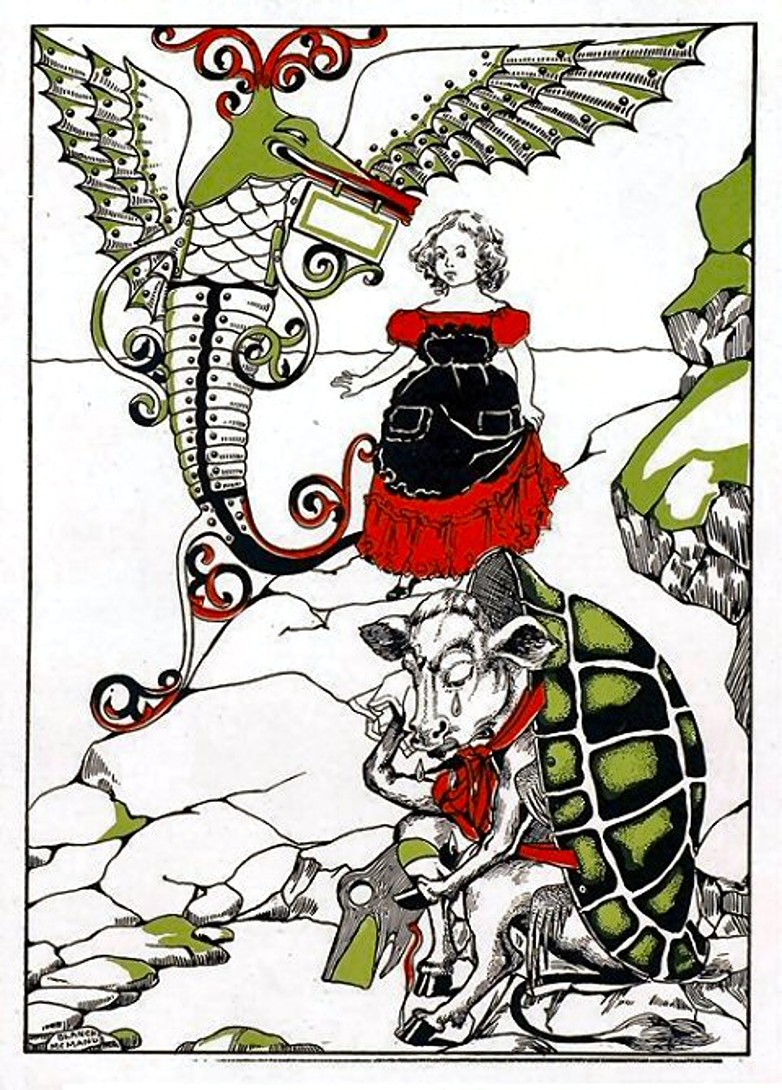
An exquisite Art Nouveau-inspired portrayal of the Mock Turtle and Gryphon, by Blanche McManus, 1899 (public domain)

In Carroll's account of the Gryphon and the Mock Turtle that the Queen of Hearts had taken Alice to meet, nothing of note concerning the morphology of either of them was included by him (devoting much of his coverage instead to their reciting and performing the Lobster Quadrille, a most unusual dance). Instead, all such details were imparted to the reader entirely by way of some excellent line drawings prepared by the renowned illustrator Sir John Tenniel working in strict accordance with Carroll's very exacting instructions. Carroll had initially planned to illustrate the book himself, and did so in a preliminary, then-unpublished, handwritten version entitled Alice's Adventures Under Ground (AAUG), which he presented to Alice Liddell on 26 November 1864. However, he recognised that his artistry was not of a sufficiently high standard for publication purposes, so he engaged Tenniel to prepare the required artwork for the final, longer version that became AAIW. (This was evidently a wise decision, judging at least from Carroll's bizarre illustration of the Mock Turtle that appeared in AAUG, in which its head resembled that of a seal, and its long, slender body looked as if it were composed entirely of overlapping roof tiles!)

Lewis Carroll's decidedly odd-looking drawing of the Mock Turtle, from Alice's Adventures Under Ground (public domain)

In Tenniel's drawings, the Gryphon was depicted in typical griffin form, as a composite of eagle and lion, deftly amalgamating the beaked head, taloned forelimbs, and plumed wings of the former with the furry body, clawed hind limbs, and long tuft-tipped tail of the latter. Conversely, whereas the Mock Turtle also appeared to be a composite creature, it did not resemble anything known to me from either fable or fact. Nor had I even heard of a mock turtle before. Evidently, therefore, I reasoned, unless it were an exceedingly obscure mythical beast it must have been one of Carroll's own inventions, but what had inspired him to fashion it in the extraordinary form that he had done, and where had its very distinctive, memorable name originated? These were the two questions that puzzled me for so long (back in those now far-distant days before the information super-highway of the internet had come into being!).

Sir John Tenniel's most famous depiction of the Mock Turtle and Gryphon, 1865 (public domain)

For in Tenniel's illustrations, this remarkable creature was portrayed with the familiar body shell and scaly front flippers of a real turtle, but sported the big-eared head, hoofed hind legs, and long tufted tail of a calf. In my youthful naivety, I simply assumed that the 'mock' aspect of its name related to the fact that because of these bovine attributes it wasn't a genuine turtle, with the latter attributes merely being humorous but hardly meaningful creations by Carroll. I now know of course that had I been alive during Victorian times when AAIW was written and published, I would have been readily aware of the true derivation of this term and the attendant significance of those attributes – especially as, albeit unrealised by me back in my childhood, Carroll had actually provided the answer to one of my afore-mentioned questions in his text:

Then the Queen left off, quite out of breath, and said to Alice, "Have you seen the Mock Turtle yet?"

"No," said Alice. "I don't even know what a Mock Turtle is."

"It's the thing Mock Turtle Soup is made from," said the Queen.

"I never saw one, or heard of one," said Alice.

Neither had I, but nor had I ever heard of mock turtle soup either, so I had assumed that this too was just another Carrollian invention. Many years later, however, I finally stripped bare the mystery surrounding the 'mock' moniker, and uncovered at last the truth behind this very tantalising turtle.

A colourised version of Tenniel's second original illustration of the Mock Turtle and Gryphon with Alice, 1865 (public domain)

It turned out that mock turtle soup was actually a bona fide dish, an English soup originally created during the mid-1700s but very commonly served in Victorian times. It earned its name from the fact that it was actually a cheap substitute for genuine turtle soup, which was a very expensive delicacy that few could afford. Instead of containing turtle flesh as its primary ingredient, mock turtle soup contained calf meat (veal), taken especially from those parts of a calf that were otherwise usually discarded, i.e. the head, hooves, and tail, and which therefore cost a lot less to produce than real turtle soup.

Classic illustration by Arthur Rackham of the Mock Turtle, Gryphon, and Alice, 1907 (public domain)

Suddenly, all became clear. His fondness for humorous word games, puns, and other literary trickery had clearly inspired Carroll to dream up a character that was then playfully put forward by him when recounting his story as the (non-existent) creature from which was derived a certain very common veal-containing dish from his time whose memorable name would be familiar to his young listeners and thus make them laugh – namely, mock turtle soup. That was why the Mock Turtle had a turtle's shell and front flippers but a calf's head, hind limbs, and tail – with typically witty Carrollian absurdity, it was the visual embodiment of what mock turtle soup pretended to contain (turtle) and what it actually did contain (the calf elements listed above).

In this illustration from 1916, the Gryphon and a particularly tearful Mock Turtle perform the Lobster Quadrille for a somewhat bemused Alice (public domain)

One further feature that was a major component of the Mock Turtle was its extremely lugubrious, sobbing demeanour. When Alice asked the Gryphon why his chelonian companion was so sorrowful, the Gryphon replied very dismissively that it was "all his fancy", that he didn't actually have any sorrow. Yet because the Mock Turtle briefly mentioned that he had once been a real turtle (but without providing any clues as to why he no longer was), there has been much speculation among Carrollian scholars as to whether this was the reason for his tearful melancholia, coupled perhaps with what may have been a poverty-stricken upbringing (when recounting his history to Alice, the Mock Turtle intimated that he was poor when young, revealing that he couldn't afford to study any extra subjects at school, only the regular ones).

The Mock Turtle is no less mournful in this illustration either, by Gwynedd Hudson, 1922, but Alice looks distinctly perturbed by their terpsichorean exuberance! (public domain)

As a wildlife enthusiast from the earliest of ages, however, it occurred to me a long time ago that a more likely origin for this particular characteristic of the Mock Turtle was that real turtles, which are all exclusively marine in the strict definition of the term 'turtle' traditionally employed in British English, rid their bodies of excess salt (derived from drinking seawater) by excreting it in the form of salty tear-like exudation trickling from glands near to their eyes, so that they look very much as if they are weeping profusely. Quite apart from being a mathematician and storyteller, Carroll was also a keen amateur naturalist (and is known to have made a particular study of those animals featuring in his Alice novels to ensure that his accounts of them were accurate). Consequently, he was assuredly aware of this specific behavioural occurrence in turtles, and had cleverly incorporated it with altered meaning into the Mock Turtle's persona, transforming it from a practical osmoregulatory activity into an entirely anthropomorphic emotional outpouring instead.

The Mock Turtle managed to be doleful even when dancing, as seen here in this lantern slide image from the early 1900s (public domain)

More than 150 years have passed since the Mock Turtle was introduced to the world in AAIW, and it has been depicted by over 70 artists within the numerous illustrated editions that have been published since the original one from 1865, containing Tenniel's drawings. It has also appeared in a considerable number of films and TV adaptations, in which it has been played by the likes of Cary Grant, Sir John Gielgud, Sir Michael Hordern, Donald O'Connor, Gene Wilder, and Ringo Starr, as well as being voiced by Alan Bennett in the 1985 film Dreamchild.

The Mock Turtle in a photo-still from Alice In Wonderland (1915), a very early silent film version written and directed by W.W. Young, starring Viola Savoy as Alice, and viewable online here (public domain)

What is particularly interesting, however, is that whereas earlier portrayals generally retained its appearance as originated by Tenniel following Carroll's instructions to him, there have been various later depictions that have strayed significantly from this. Moreover, the way in which they have strayed seems to indicate that those responsible may not have realised why this character's appearance was what it was in the original book, thereby, albeit inadvertently, making a veritable mockery of the Mock Turtle.

An illustration from 1907 by W.H. Walker featuring an accurately-depicted Mock Turtle but a very predatory-looking Gryphon in worryingly close proximity to Alice! (public domain)

The reason for my suspecting this to be the case is that the Mock Turtle has sometimes been depicted not as a half-turtle half-calf composite, but merely as a normal, ordinary turtle, i.e. with not just a turtle's body shell and front flippers but also a turtle's head, hind flippers, and tail – thereby entirely missing the etymological significance and origin of this Carrollian character. After all, if the Mock Turtle is presented as being exactly the same in appearance as a genuine turtle, how can the term 'mock' be justifiably applied to it? Equally, the crucial fact that it was specifically created by Carroll as the creature from which mock turtle soup is supposedly derived is wholly concealed visually if it is depicted simply as a totally normal-looking turtle. Consequently, I can only assume that those who have produced these latter images do not know about mock turtle soup. In a different but no less bizarre vein, I have also seen the Mock Turtle portrayed with the head, trotters, and curly tail of a pig, which if anything makes even less sense than depictions of it as a genuine turtle!

An unusual but thoroughly charming illustration from 1926 by A.L. Bowley, in which not only Alice but also apparently both the Mock Turtle and the Gryphon are depicted as youngsters (public domain)

Today, the Mock Turtle's fame stretches far beyond the confines of Carroll's beloved novel, appearing in a number of works by other authors inspired by Wonderland and its many strange but memorable inhabitants. As noted earlier, it features in many movie and TV dramatisations of AAIW too, as well as in various songs, and it has even lent its name to a popular Indie rock band, The Mock Turtles, hailing from Greater Manchester, England.

Still more dancing, but no sign of Alice in this illustration from 1928 – perhaps she'd become bored of it all by now and went home! (© Copyright holder and original source of this illustration presently unknown to me – reproduced here on a strictly non-commercial Fair Use basis only)

Nevertheless, at least for me there is one major disappointment associated with this memorable character – that it didn’t appear in Walt Disney's very colourful, classic animated film, Alice in Wonderland, first released in 1951. Very recently, however, I was most interested to discover that in fact, along with the Gryphon, the Mock Turtle had indeed been due to feature in it. In fact, cartoon versions of their characters had been produced, and were scheduled to appear in one scene, with the Mock Turtle even singing two specially-penned songs ('Beautiful Soup', sung to the tune of 'The Blue Danube', and 'Will You Join The Dance?', based upon the 'Lobster Quadrille' poem recited by this character in the novel'). Just before the film's completion, however, their scene and songs were axed. Happily, though, all was not entirely lost, because later on in the 1950s Disney produced an animated Wonderland-based commercial for Jell-O gelatin desserts in which the Mock Turtle and Gryphon did feature, together with Alice.

A very beautiful, colourful rendition of the Mock Turtle, Alice, and a fiery-plumed Gryphon by Harry Rountree, 1928 (© Harry Rountree, reproduced here on a strictly non-commercial Fair Use basis only)

Even so, failing to make the final cut in one of Disney's most delightful animated films would be enough, surely, to make anyone cry, let alone someone as famously weepy as the mournful Mock Turtle!

The Nursery "Alice" – a special edition of AAIW for very young children, simplified by Lewis Carroll and illustrated by Sir John Tenniel; it was published in 1890 and included both the Mock Turtle and the Gryphon on its front cover, prepared by one of Carroll's friends, E. Gertrude  Thomson (public domain)

To read a previous ShukerNature blog article concerning another of my favourite AAIW animal characters, the iconic and decidedly idiosyncratic Cheshire Cat, please click here.

One of my all-time favourite AAIW-inspired artworks, an absolutely spectacular and very original futuristic/fantasy take on the Mock Turtle, Gryphon, and Alice, by the world-renowned fantasy artist Rodney Matthews (© Rodney Matthews, included here on a strictly non-commercial Fair Use basis only)