Dr KARL SHUKER

Zoologist, media consultant, and science writer, Dr Karl Shuker is also one of the best known cryptozoologists in the world. He is the author of such seminal works as Mystery Cats of the World (1989), The Lost Ark: New and Rediscovered Animals of the 20th Century (1993; greatly expanded in 2012 as The Encyclopaedia of New and Rediscovered Animals), Dragons: A Natural History (1995), In Search of Prehistoric Survivors (1995), The Unexplained (1996), From Flying Toads To Snakes With Wings (1997), Mysteries of Planet Earth (1999), The Hidden Powers of Animals (2001), The Beasts That Hide From Man (2003), Extraordinary Animals Revisited (2007), Dr Shuker's Casebook (2008), Karl Shuker's Alien Zoo: From the Pages of Fortean Times (2010), Cats of Magic, Mythology, and Mystery (2012), Mirabilis: A Carnival of Cryptozoology and Unnatural History (2013), Dragons in Zoology, Cryptozoology, and Culture (2013), The Menagerie of Marvels (2014), A Manifestation of Monsters (2015), Here's Nessie! (2016), and what is widely considered to be his cryptozoological magnum opus, Still In Search Of Prehistoric Survivors (2016) - plus, very excitingly, his four long-awaited, much-requested ShukerNature blog books (2019-2024).

Dr Karl Shuker's Official Website - http://www.karlshuker.com/index.htm

IMPORTANT: To view a complete, regularly-updated listing of my ShukerNature blog's articles (each one instantly clickable), please click HERE!

IMPORTANT: To view a complete, regularly-updated listing of my published books (each one instantly clickable), please click HERE!

IMPORTANT: To view a complete, regularly-updated listing of my Eclectarium blog's articles (each one instantly clickable), please click HERE!

IMPORTANT: To view a complete, regularly-updated listing of my Starsteeds blog's poetry and other lyrical writings (each one instantly clickable), please click HERE!

IMPORTANT: To view a complete, regularly-updated listing of my Shuker In MovieLand blog's articles (each one instantly clickable), please click HERE!

IMPORTANT: To view a complete, regularly-updated listing of my RebelBikerDude's AI Biker Art blog's thematic text & picture galleries (each one instantly clickable), please click HERE!

Search This Blog


PLEASE COME IN, I'VE BEEN EXPECTING YOU...

PLEASE COME IN, I'VE BEEN EXPECTING YOU...
WELCOME TO SHUKERNATURE - ENJOY YOUR VISIT - BEWARE OF THE RAPTOR!


Showing posts with label Secret Snakes and Serpent Surprises. Show all posts

Wednesday, 24 January 2024

THE HORN SNAKE AND THE HOOP SNAKE - FEARSOME CRITTERS OF THE SERPENTINE KIND

 
Hoop snake in hot pursuit! (© Richard Svensson)

Following on from my previous ShukerNature blog article chronicling what may well be North America's most familiar folkloric Fearsome Critter of any kind, the truly monstrous hodag (click here to access my article), I am now documenting the most (in)famous Fearsome Critters of the serpentine kind – namely, the horn snake and the hoop snake.

I must not forget, in these random sketches, my old friend and neighbour, Uncle Davy Lane...Nothing could move him out of a slow, horse-mill gait but snakes, of which "creeturs he was monstrous 'fraid." The reader shall soon have abundant evidence of the truth of this admission in his numerous and rapid flights from "sarpunts."...He became quite a proverb in the line of big story-telling. True, he had many obstinate competitors, but he distanced them all farther than he did the numerous snakes that "run arter him."...

"But at last I ventured to go into the face uv the Round Peak one day a-huntin.' I were skinnin' my eyes fur old bucks, with my head up, not thinkin' about sarpunts, when, by Zucks! I cum right plum upon one uv the cuiousest snakes I uver seen in all my borned days.

"Fur a spell I were spellbound in three foot uv it. There it lay on the side uv a steep presserpis, head big as a sasser, right toards me, eyes red as forked lightnin,' lickin' out his forked tongue, and I could no more move than the Ball Rock on Fisher's Peak. But when I seen the stinger in his tail, six inches long and sharp as a needle, stickin' out like a cock's spur, I thought I'd a drapped in my tracks. I'd ruther a hard uvry coachwhip [snake] on Round Hill arter me en full chase than to a bin in that drefful siteation.

"Thar I stood, petterfied with relarm — couldn't budge a peg - couldn't even take old Bucksmasher off uv my shoulder to shoot the infarnul thing. Nyther uv us moved nor bolted 'ur eyes fur fifteen minits.

"At last, as good luck would have it, a rabbit run close by, and the snake turned its eyes to look what it were, and that broke the charm, and I jumped forty foot down the mounting, and dashed behind a big white oak five foot in diamatur. The snake he cotched the eend uv his tail in his mouth, he did, and come rollin' down the mounting arter me just like a hoop, and jist as I landed behind the tree he struck t'other side with his stinger, and stuv it up, clean to his tail, smack in the tree. He were fast.

"Of all the hissin' and blowin' that uver you hearn sense you seen day­light, it tuck the lead. Ef there'd a bin forty-nine forges all a-blowin' at once, it couldn't a beat it. He rared and charged, lapped round the tree, spread his mouf and grinned at me orful, puked and spit quarts an' quarts of green pisen at me, an' made the ar stink with his nasty breath.

"I seen thar were no time to lose; I cotched up old Bucksmasher from whar I'd dashed him down, and tried to shoot the tarnil thing; but he kep' sich a movin' about and sich a splutteration that I couldn't git a bead at his head, for I know'd it warn't wuth while to shoot him any whar else. So I kep' my distunce tell he wore hisself out, then I put a ball right be­tween his eyes, and he gin up the ghost.

"Soon as he were dead I happened to look up inter the tree, and what do you think? Why, sir, it were dead as a herrin'; all the leaves was wilted like a fire had gone through its branches.

"I left the old feller with his stinger in the tree, thinkin' it were the best place fur him, and moseyed home, 'tarmined not to go out again soon..."

   H.E. TaliaFerro ('Skitt') – 'Uncle Davy Lane'

Over the years, the annals of zoology have received and dutifully logged various reports of some truly remarkable pseudo-serpents, i.e. false snakes once deemed to be genuine species but subsequently exposed as imaginative folktales, deceiving hoaxes, or monstrous misidentifications. One of the most intriguing examples is the North American horn snake – not least because it is actually two pseudo-serpents in one! Moreover, as noted above, both of them are derived from the rich Fearsome Critters folklore of this New World continent's early lumberjacks and other rural pioneers.

The earliest notable account of the horn snake appeared in American explorer John Lawson's important work A New Voyage to Carolina (1709; retitled The History of Carolina in later editions), whose description succinctly includes all of the principal characteristics of this singular, highly controversial reptile:

Of the Horn Snake, I never saw but two that I remember. They are like the Rattlesnake in Colour, but rather lighter. They hiss exactly like a Goose when anything approaches them. They strike at their Enemy with their Tail, and kill whatsoever they wound with it, which is armed at the End with a Horny Substance like a Cock's Spur. This is their Weapon. I have heard it credibly reported by those who said they were Eye-Witnesses, that a small Locust Tree, about the Thickness of a Man's Arm, being struck by one of these Snakes at Ten o'clock in the Morning, then verdant and flourishing, at Four in the Afternoon was dead, and the Leaves dead and withered. Doubtless, be it how it will, they are very venomous. I think the Indians do not pretend to cure their wound.

 
Front cover of John Lawson's 1709 book A New Voyage to Carolina (public domain)

In the 1722 self-revised edition of his 1705 tome History and Present State of Virginia, Virginia historian and government official Colonel Robert Beverley emphasised the nature of the horn snake's stinging tail as a formidable weapon:

There is likewise a Horn Snake, so called from a Sharp Horn it carries in its Tail, with which it assaults anything that offends it, with that Force that, as it is said, it will strike its Tail into the Butt End of a Musket, from whence it is not able to disengage itself.

The first naturalist to document the horn snake in detail was Mark Catesby, in the first volume of his major work The Natural History of Carolina, Florida and the Bahama Islands (1731), summarising the descriptions provided previously by Lawson and Beverley, but discounting its tail's deadly nature as outrageous fiction and identifying its species as a 'water viper', to which he gave the formal name Vipera aquatica. According to Catesby, the horn snake's tail-sting or spine was merely a blunt, horny, and completely innocuous structure about half an inch long.

 
Water moccasin, threat display (public domain)

Curiously, however, the species that he dubbed Vipera aquatica and labelled as the horn snake is traditionally believed to have been the water moccasin Agkistrodon piscivorus - the world's only species of semi-aquatic viper. Yet although it does possess a short, thick, blunt-ended tail, the latter does not bear a spine at its tip. Consequently, some modern-day herpetologists dispute that Catesby's so-called 'water viper' (and thence his horn snake) was indeed the water moccasin.

Notwithstanding Catesby's scepticism regarding the venomous nature of the horn snake's tail spine, this feature was steadfastly reiterated in subsequent accounts elsewhere (so too was the claim that this species was reddish or at least partly reddish in colour). And to complicate matters still further, a second, even more fantastic, zoologically-implausible characteristic was soon attributed to this already much-muddled mystery snake – the supposed ability to turn itself into a vertical hoop by grasping its tail in its jaws just like the mythical ouroboros, thereby enabling it to roll along the ground at great speed like a living tyre. When carrying out this bizarre mode of locomotion, the horn snake thus became known as the hoop snake.

 
Ouroboros drawing from a late medieval Byzantine Greek alchemical manuscript (public domain)

An early hoop snake account was penned by American traveller J.F.D. Smyth in 1784, following a stay in western North Carolina, and was published in Volume 1 of his multi-tome travelogue Tour in the United States of America. After describing the by now familiar morphological characteristics of the horn snake, Smyth added the following very remarkable behavioural information:

As other serpents crawl upon their bellies, so can this; but he has another method of moving peculiar to his own species, which he always adopts when he is in eager pursuit of his prey; he throws himself into a circle, running rapidly around, advancing like a hoop, with his tail arising and pointed forward in the circle, by which he is always in the ready position of striking.

It is observed that they only make use of this method in attacking; for when they fly from their enemy they go upon their bellies, like other serpents.

From the above circumstance, peculiar to themselves, they have also derived the appellation of hoop snakes.

The next couple of centuries saw many published reports of hoop-rolling horn snakes – hailing from a wide geographical spread, including the Minnesota-Wisconsin border, North Carolina, and British Columbia in Canada - despite their self-evident improbability. A typical example, which concisely contains all of the intrinsic horn/hoop snake motifs, is the following account, published on 8 November 1884 by an Australian newspaper entitled the Maitland Mercury and Hunter River General Advertiser but documenting an alleged incident that took place in Virginia, USA:

One day last week a little girl, whose name slipped the correspondent's usually retentive memory, was chased by a monster hoop snake nearly a mile. Just as it seemed that it was about to strike her, she dodged behind a large apple tree. The rapidly whirling snake turned to follow and struck the tree with such force as to drive the horn-spike into the hard wood over two inches. The child was so frightened that she sank down, her heart thumping as though it would burst out of her body.

One of her brothers, who had seen her flying down the hill, went to see what was the matter. When he reached the tree it was quaking like an aspen and its leaves and fruit falling to the ground in a perfect shower, the prostrate girl being almost buried beneath them. As soon as he got her restored to consciousness he took a fence rail and killed the venomous reptile, which was eleven feet two and a half inches in length and eight inches in circumference. The horn point on the tail was six and a half inches long, and so deeply imbedded in the hard wood that it could not extricate itself. This all happened near South Mountain, Va [Virginia].

With the girl's name conveniently forgotten, the correspondent responsible for the account not named, and the eminently unlikely nature of the entire incident, the most reasonable assumption is that this incident, like so many others of its kind involving extraordinary, unbelievable beasts, was a journalistic invention. Yet even today, supposedly serious reports of hoop-rolling horn snakes are still being documented, thus sitting uncomfortably alongside unequivocally tongue-in-cheek, light-hearted versions, cartoons, and other jokey representations of this classic pseudo-serpent.

 
Raymond Ditmars (public domain)

Moreover, it is nothing if not telling that although celebrated American snake expert Raymond Ditmars (1876-1942) placed 10,000 dollars in trust at a New York bank to be awarded to the first person who provided him with conclusive evidence for the reality of the hoop snake, this very substantial prize was never claimed.

But are reports of horn and hoop snakes absolutely fictional, or could there be at least a kernel of truth at the heart of such ostensibly unfeasible tales? Quite apart from the fact that there are many fully-attested sightings of snakes grasping their tails in their mouths (albeit while lying on the ground, and therefore yielding horizontal circles rather than the hoop snake's vertical ones), there are certain fully-recognised species of North American snake that do bear a spiny structure at the tip of their tail. So it may be that some of these latter species have helped inspire and shape the legend of the horn snake.

 
Mud snake (© John Sullivan/Wikipedia – CC BY-SA 3.0 licence)

One of the leading candidates for this role is the mud snake Farancia abacura, a semi-aquatic, non-venomous species of colubrid native to the southeastern USA. Up to 6 ft long, black dorsally, black and orange ventrally (with the orange sections extending upwards laterally, thereby corresponding with certain horn snake accounts referring to reddish-orange sides), this distinctive snake has only a short tail, but it bears a noticeable spine at its tip, which in reality is a greatly-enlarged terminal scale of hard, horny constituency and quite sharp at its tip. Of course, the spine is not venomous, but this species shares a sufficient number of other characteristics with the legendary horn snake – both the tail spine and the shortness of the tail itself, a tendency to prod prey with its tail spine, plus orange flanks, and a water-frequenting preference – for there to be little doubt that it has actively influenced traditional, non-scientific belief in sting-tailed horn snakes.

Certainly, eminent American herpetologist Dr Karl P. Schmidt (1890-1957) favoured this identity for the latter pseudo-serpent when documenting the horn/hoop snake saga in an article published in the January/February 1925 issue of the American periodical Natural History. This theory has also been championed much more recently, by another American herpetologist, Dr J.D. Wilson, in a mud snake article published by the Savannah River Ecology Laboratory in 2006, and not only for the horn snake specifically but also for its locomotory hoop snake alter ego. A closely-related species, the rainbow snake F. erytrogramma, which again is semi-aquatic, non-venomous, native to the southeastern USA, and very similar to the mud snake by virtue of its body colouration, short tail, and readily-visible tail spine, is actually referred to colloquially as the hoop snake across much of its geographical range.

 
Coachwhip snake (public domain)

Yet another North American non-venomous colubrid that has been implicated with the hoop snake legend is the coachwhip snake Masticophis flagellum, endemic to the southern USA and also northern Mexico. Up to 6.5 ft long, this species is sometimes reddish-pink in colour, recalling once again descriptions of the horn snake.

Moreover, although it does not possess a tail spine, it is a fast-moving, very agile species, and Schmidt, among others, has suggested that the hoop snake component of the horn snake myth may have originated from sightings of species like this one (as well as fellow non-venomous North American colubrid the common black snake Coluber constrictor – and in particular its most distinctive subspecies, the blue racer C. c . foxii) gliding along at great speed and in an undulating manner over the tops of bushes without descending to the ground, thus recalling the hoop snake's supposed rolling mode of progression.

 
Common black snake (public domain)

Interestingly, horn and hoop snake traditions are not exclusive to North America. Comparable tales have been recorded from Australia too. This island continent is home to the highly venomous death adders – a genus (Acanthophis) of viper-impersonating elapids whose several species are all famed for their very conspicuous tail spine.

Central and West Africa are also sources of sting-tailed horn/hoop snake reports, which in this case appear to have been inspired by harmless blind burrowing snakes of the genus Typhlops, which possess very prominent tail spines. Moreover, Schmidt suggested that slaves brought to North America from these regions of Africa may have contributed to the New World horn snake folklore by recalling stories of African burrowing snakes that subsequently became transferred to America's own equivalent species (though not of the genus Typhlops, as this is confined to Central and South America in the New World).

 
An Australian death adder (public domain)

Yet regardless of the varied scientific explanations documented and discussed that discount the horn and hoop snake as being wholly fictitious, belief in the reality and lethal nature of these pseudo-serpents is still deeply ingrained among great swathes of the general public across North America and elsewhere. So much so, in fact, that it seems likely that their origins will forever remain controversial, and with any investigations of scientifically-untrained eyewitness reports destined merely to go round and round in circles – just like the hoop snake itself!

Having said that, however, no article on hoop snakes could possibly close without mentioning a truly remarkable somersaulting snake from the Philippines. Courtesy of a fascinating video produced by a longstanding cryptozoological friend, Tony Gerard, there is conclusive proof of at least one species of snake's extraordinary ability to make dramatic somersaulting leaps through the air when fleeing a perceived threat.

 
Northern triangle-spotted snake (© R. Brown et al., 2013/Wikipedia CC BY 3.0 licence)

The species in question is the northern triangle-spotted snake Cyclocorus lineatus, a small, non-venomous member of the very diverse, elapid-related taxonomic family Lamprophiidae and endemic to the Philippines. The video (posted here on YouTube by American herpetologist/cryptozoologist Chad Arment as StrangeArk on 19 May 2019) shows Tony with one of these snakes held briefly under a bowl. When Tony lifts up the bowl and gently prods the snake, it rapidly flees via a series of very dramatic somersaulting leaps through the air and across the ground, so that it bears more than a passing resemblance to the fabled hoop snake.

Indeed, the only reason why I am including it here, rather than in an article dealing with jumping snakes, is that whereas the hoop snake was said to turn itself into a hoop by gripping its tail in its mouth and then rolling along like a vertical hoop or wheel, this Philippines snake engenders its superficially hoop-like appearance by way of repeated somersaulting leaps, without ever grasping its tail in its mouth.

 
Vintage sketch of a hoop snake by Margaret R. Tryon (public domain)

Nevertheless, the overall visual effect is similar enough to make me wonder if other snakes can also accomplish such somersaults and, in turn, whether the hoop snake tales originated from sightings of snakes performing this acrobatic ability, with the tail-in-mouth detail being subsequently added in elaborated retellings. From such are myths, legends, and folktales born.

This ShukerNature article is excerpted and adapted from my book Secret Snakes and Serpent Surprises, published by Coachwhip Publications.


Wednesday, 30 November 2022

WOOLLY BEARS AND HAIRY HUBERTS

 
Vintage illustration of a woolly bear, aka Hairy Hubert in County Durham (public domain)

As you all know, I love delving through old books and periodicals in search of odd little titbits of obscure zoological trivia, and not so long ago I found the following interesting snippet of information in William Brockie's book Legends and Superstitions of the County of Durham (1886), which was entirely new to me and certainly warrants a mention on ShukerNature.

So here it is:

HAIRY HUBERT

If you throw a hairy worm, in the North called Hairy Hubert, over your head, and take care not to look to see where it alights, you are sure to get something new before long.

 
The 1974 EP Publishing edition of William Brockie's book Legends and Superstitions of the County of Durham, originally published in 1886 (public domain/EP Publishing – reproduced here on a strictly non-commercial Fair Use basis for educational/review purposes only)

County Durham is in the northeast of England, and although I had never heard of Hairy Hubert before, I suspected that it was probably a local name used there for some form of hairy caterpillar.

And sure enough, when I investigated it I discovered that the creature in question was none other than the woolly bear, the famously furry caterpillar of the garden tiger moth Arctia caja, a common species in Great Britain. Another nomenclatural novelty duly deciphered!

 
Adult garden tiger moth Arctia caja, one of Britain's most attractive native moth species (public domain)

This ShukerNature blog article is excerpted from my latest book, Secret Snakes and Serpent Surprises, published earlier this year by Coachwhip Publications and available from Amazon UK, Amazon USA, and all other good online and physical bookstores.


Thursday, 28 July 2022

PARKER'S PAPUAN MYSTERY SNAKE, AND A LEGLESS LIZARD OF OZ?

 
Reconstructing (using a vintage drawing of a black-headed python) the possible appearance of two very distinctive Australian mystery snakes(?) with magenta-coloured heads and yellow bodies that were allegedly encountered in c.1999 (© Dr Karl Shuker)

In his book A Guide to the Snakes of Papua New Guinea (1996), renowned British snake expert Mark O'Shea devoted an entire page to an enigmatic, still-unidentified, but seemingly highly venomous PNG snake of aquatic lifestyle that he has dubbed Parker's snake, in honour of Australian herpetologist Fred Parker, who had first brought this mysterious serpent to scientific attention in his own book The Snakes of Western Province (1982). Both researchers have sought it in the field, but without success, despite specifically visiting the Western Province village of Wipim where it reputedly killed three children (see below). Between them, however, they have collected some valuable information from the local people, who, unsurprisingly, greatly fear this reptile.

In his book, Parker had reported the rapid deaths of three young girls allegedly bitten by this snake while bathing in the Ouwe Creek near Wipim during 1972-73. Other reports of it from further afield have also occurred, but without any attributed deaths. Based upon eyewitness descriptions and other native testimony, Parker's snake is an extremely venomous but also very rare aquatic snake measuring no more than 6.5 ft long, yellowish-brown to brown dorsally and pale yellow to white ventrally, with smooth scales, enlarged ventrals, and a short cylindrical tail. It is said to favour small freshwater swamps and inland streams rather than larger rivers or open swampy grassland. Although it has been seen basking on dry land, it apparently prefers hiding on the muddy bottom. Death resulting from a bite by this snake is very rapid, within just a few minutes, which is much faster than from a taipan or even a sea-snake bite.

 
Mark O'Shea, 2014 (© Papblak/Wikipedia – CC BY-SA 4.0 licence)

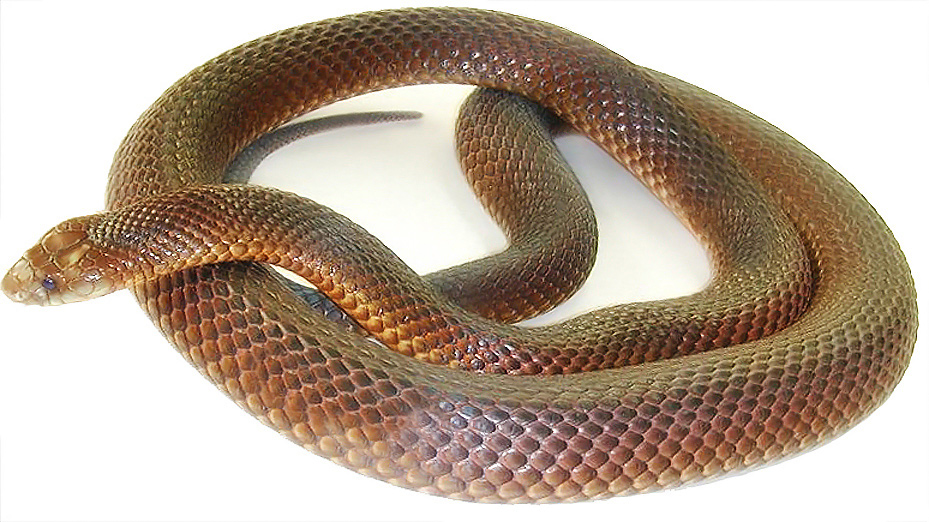
As Mark O'Shea noted in his book, he and Parker have considered a number of possible identities for this mystery serpent. These include New Guinea's mildly venomous dog-faced water snake Cerberus rynchops (with its toxicity presumably exaggerated by locals), the extremely venomous mulga or king brown snake Pseudechis australis (although this Australian elapid has yet to be formally recorded from New Guinea), the small-eyed snake Micropechis ikaheka (another highly venomous elapid but this time known from New Guinea), and even some form of sea-snake or taipan. Yet as Mark freely conceded, none of these wholly corresponds with the local accounts given for it.

Consequently, Parker's snake currently remains an elusive but tantalizing enigma within the ophidian literature; nothing more concerning it has emerged since the publication of Mark's book in 1996, as he confirmed to me during a Facebook communication between us on 22 January 2022.

 
King brown snake aka mulga snake (© AllenMcC/Wikipedia – CC BY-SA 3.0 licence)

Not all mysterious snakes are huge, as exemplified by the following tantalisingly vague report of a diminutive form of unidentified serpent from Australia:

I once came across 2 little snakes in a waterhole, somewhere in the outback (can't remember where, it was about nine years ago [i.e. c.1999] and I was travelling all around Oz) but they were about 20 cm [8 in] long with a magenta head and a yellow body. I have never been able to find a picture or find out anything about them, too bad I didn't have a camera!!

 
Red-naped snake (© Alexandre Roux/Wikipedia – CC BY 3.0 au licence)

This report was posted onto the Aussie Pythons & Snakes online forum by someone with the username Charlie on 24 January 2008, but it received no response. So as far as I'm aware, no conclusive taxonomic identification of his small yet strikingly-coloured waterhole snakes was ever forthcoming. Nor have I had greater success than Charlie in identifying them.

On 13 November 2021, I posted Charlie's intriguing report on various Facebook groups devoted to cryptozoology to see what response (if any) it elicited. Several identities for the snakes were duly suggested, including the Australian tree snake Dendrelaphis punctulatus, red-naped snake Furina diadema, woma python Aspidites ramsayi, young specimens of the black-headed python A. melanocephalus, and young western brown snakes Pseudonaja nuchalis, but none of these corresponds closely with Charlie's description of the small, very distinctively-hued snakes that he spied.

 
Black-headed pythons (© Dawson/Wikipedia – CC BY-SA 2.5 licence)

In view of their miniature size, moreover, it is conceivable that they were not snakes at all, but instead a species of legless lizard, of which there are quite a few endemic to Australia. Some of these, moreover, are deceptively serpentine in outward appearance, especially to those who may not be too familiar with snakes – but yet again I have been unable to obtain pictures of any such reptile that matches those two mystery specimens encountered by Charlie.

An anomalous Aussie mystery snake, or a legendary lizard of Oz? Could it even be that these creatures weren't reptiles at all, but perhaps some form of invertebrate – a species of annelid worm, for instance, or planarian flatworm, the latter of which includes some brightly-coloured Australian species? Any thoughts or suggestions would be greatly welcomed!

This ShukerNature article is excerpted exclusively from my recent book Secret Snakes and Serpent Surprises.


Thursday, 12 May 2022

THE PICHU-CUATE – IS A TINY BUT TERRIFYING CRYPTO-SNAKE RESEMBLING KIPLING'S KARAIT ALIVE AND WELL AND LIVING IN AMERICA?

 
Two photographs of Charles Fletcher Lummis – a pichu-cuate eyewitness who lived to tell the tale, literally, documenting this sinister serpent in his book The King of the Broncos (public domain)

Some time ago, I investigated a mysterious, highly-venomous mini-snake named Karait – a memorable albeit short-lived, mongoose-slain character briefly included by Rudyard Kipling in his story 'Rikki-Tikki-Tavi', which was contained in the first of his two Jungle Book novels. Kipling never specified Karait's taxonomic identity. However, as I revealed in my extensive ShukerNature coverage (click here to read it), this dust-dwelling yet deadly snakeling may have been based upon the Indian saw-scaled viper Echis carinatus.

But that is not all. For it is nothing if not intriguing that a cryptozoological snake bearing a remarkable resemblance both morphologically and behaviourally to Kipling's Karait has been reported from New Mexico and Arizona in the southwestern USA, as brought to my attention recently by American herpetologist/cryptozoologist Chad Arment.

 
Indian saw-scaled viper Echis carinatus (public domain)

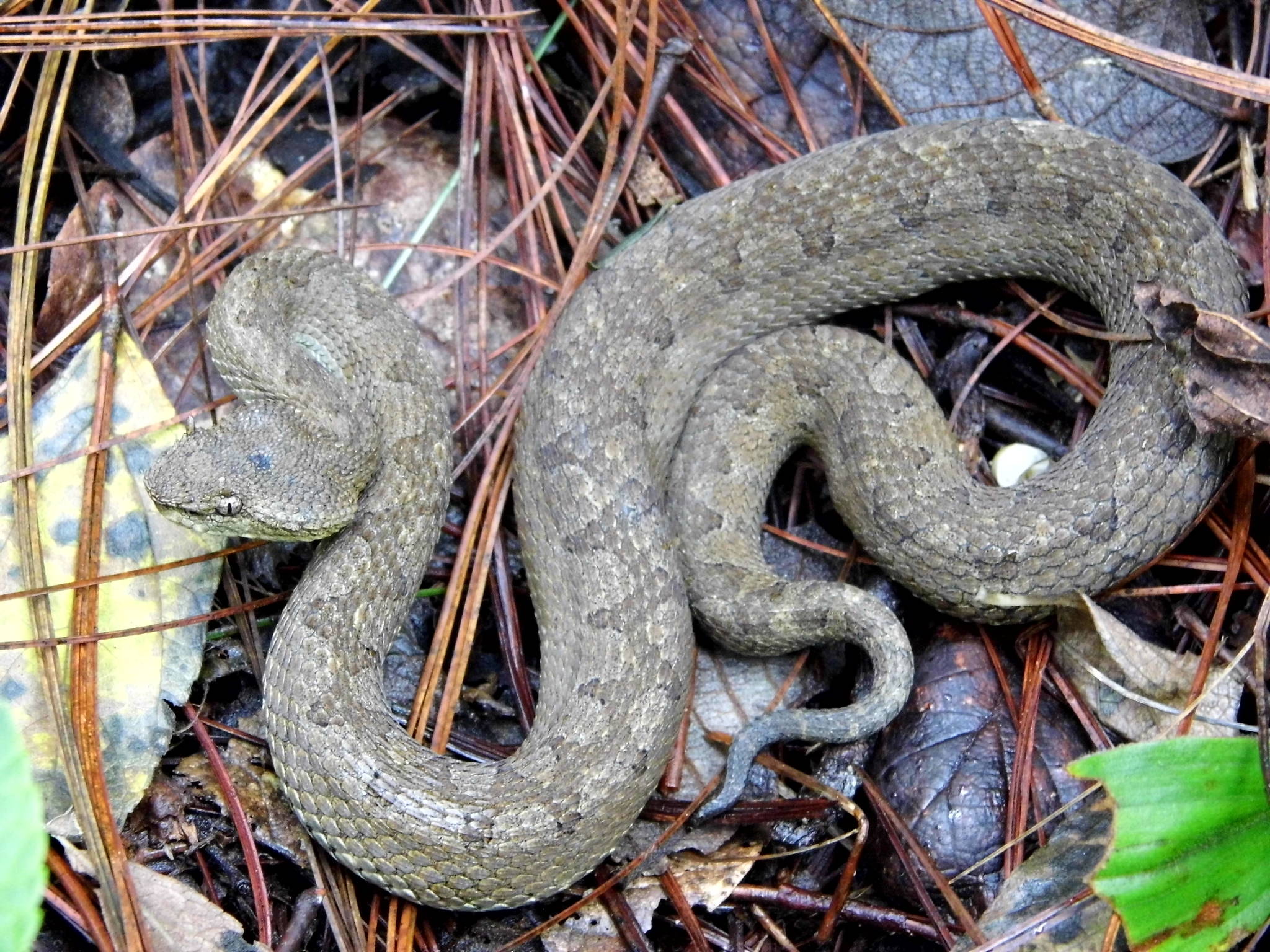
Known as the pichu-cuate – allegedly an Aztec name, in turn suggesting that knowledge of this snake dates back many centuries – it is described as being a tiny species of viper, no bigger or thicker than a normal lead pencil, bearing a pair of small horns above its eyes (supra-ocular), and is a nondescript grey dorsally, rose-pink ventrally, but more venomous than any other North American snake. Extremely rare but also inordinately aggressive, the pichu-cuate supposedly spends its time concealed in sand and dust, sometimes with just its triangular head visible, but will not hesitate to bite anything or anyone that touches it, whether deliberately or inadvertently, which almost invariably leads to its victim's exceedingly rapid, agonizing death. There are claims that people who have been bitten on the hand or a finger by a pichu-cuate have swiftly cut (or shot) off the wounded appendage in the desperate hope of saving their life by preventing this snake's highly virulent venom from travelling further into their body.

The only venomous snakes on record from New Mexico and Arizona are rattlesnakes and coral snakes, which certainly do not resemble the pichu-cuate. Moreover, the morphological and behavioural description presented above for the latter cryptozoological serpent does not match that of any snake species known to exist in these two U.S. states.

 
First edition (1897) of Lummis's book The King of the Broncos (public domain)

This diminutive but highly dangerous Karait-like snakeling was first brought to widespread attention by newspaper writer Charles Fletcher Lummis in his compilation book of traditional New Mexican lore The King of the Broncos (1897), in which he related how a young Mexican shepherd named Claudio was apparently bitten on the thumb by a pichu-cuate and was able to save his own life only by shooting off his thumb to prevent the snake's virulent, swift-acting venom from spreading into his body. Moreover, Lummis subsequently claimed to have personally encountered a pichu-cuate on three separate occasions, and on the first of these to have even killed it, whose body he then examined in detail. Regrettably, however, he didn't retain it afterwards for scientific scrutiny. Lummis described its colouration as leaden grey dorsally, matching the sand in which it had been hiding, but rosy-red ventrally, like a conch shell's aperture. Its tiny fangs were no more than one eighth of an inch long, but moveable, slotting into grooves in the roof of its mouth when not about to strike.

In his own book Cryptozoology: Science & Speculation (2004), Chad Arment devoted a chapter to the pichu-cuate, in which he documented Lummis's coverage of it. However, he pointed out that the name 'pichu-cuate' and variations of it are also used in the southwestern USA and Mexico non-specifically, for any snakes deemed by locals to be venomous (regardless of whether they actually are). Hence it is not applied exclusively to this one particular, cryptic serpent.

 
Cryptozoology: Science & Speculation by Chad Arment (© Chad Arment/Coachwhip Publications – reproduced here on a strictly non-commercial Fair Use basis for educational/review purposes only)

Equally, however, Lummis's mention of the latter's fangs slotting into grooves in the roof of its mouth when not striking is significant, because in North America the only front-fanged venomous snakes with fangs that can move are viperids, thereby eliminating elapids from consideration, as well as rear-fanged colubrids. Also informative is his mention of the pichu-cuate's supra-ocular horns, because as noted by Chad, only four known Latin American snakes possess them. Moreover, two of these, the sidewinder Crotalus cerastes and the eyelash viper Bothriechis schlegelii, can be instantly eliminated, because the former was well known to Lummis, and the latter is arboreal and too colourful. This leaves only the Mexican horned pit viper Ophyracus undulatus and the montane pit viper Porthidium melanurum. Of these two, the former provides the closer match morphologically, but geographically it is not known to exist anywhere near New Mexico or Arizona.

Consequently, Chad concluded his coverage of the pichu-cuate by pondering whether either O. undulatus previously exhibited a broader distribution range than it does today, extending into those two U.S. states, or a small, undescribed viper species formerly inhabited them, and may perhaps still do so today? The following details suggest that this might be true.

 
Mexican horned pit viper (© Eugenio Padilla/Wikipedia – CC BY-SA 4.0 licence)

On 6 May 1984, in his regular 'New Mexican Scrapbook' column published by the El Paso Times, Marc Simmons recalled Lummis's documentation of the pichu-cuate almost a century earlier, and then added some very intriguing, modern-day information of his own. During his travels around New Mexico, Simmons had mentioned the pichu-cuate to various old-timers, but the name meant nothing to them. However, they did tell him about an enigmatic snake known to them as the nino de la tierra ('child of the earth') that sounded suspiciously similar to the pichu-cuate. For it is said to be a small but very deadly, vicious snake that buries itself in the sand, and fatally strikes anyone who sits or lies in that place. But that is not all.

A couple of years earlier, Simmons saw a friend who had been hiking in the rocky foothills of central New Mexico's Ortiz Mountains. The friend mentioned that in a dry arroyo (steep-sided gulley) he had encountered a small grey snake with a triangular head, which in spite of its diminutive size had given him such a chill that he'd instinctively backed away straight away. So perhaps the pichu-cuate (aka nino de la tierra?) is more than just a myth after all.

 
Marc Simmons's El Paso Times column of 6 May 1984 documenting the nino de la tierra, which may be one and the same as the pichu-cuate – please click this picture to enlarge it for reading purposes (© Marc Simmons/El Paso Times – reproduced here on a strictly non-commercial Fair Use basis for educational/review purposes only)

Lastly, there may be some further information concerning the perplexing pichu-cuate hidden away in the collection of photographs and artwork by Lummis that is preserved at the Southwest Museum in Los Angeles, California. Time, therefore, for some enterprising Californian cryptozoologist to seek an opportunity to examine them there?

This ShukerNature blog article is excerpted exclusively from my new book Secret Snakes and Serpent Surprises, published by Chad Arment's own company, Coachwhip Publications. It can be obtained here at Amazon UK and here at Amazon USA. More information concerning it is available via its own dedicated page here on my official website.

 
Secret Snakes and Serpent Surprises (2022) (© Dr Karl Shuker/Coachwhip Publications)