The statue of Glycon
unearthed at Tomis, Romania, in
1962; right-hand view (public domain)
A snake with a blond head of hair and the ears of
a man would certainly be a marvel – but how much more so would one be that
could also speak, and even foretell the futures of those who sought an audience
with this wondrous ophidian oracle? All of this and much more – or, quite
probably, a great deal less – was Glycon, the Roman Empire's incredible
serpentine soothsayer.
In c.105 AD, a very controversial, enigmatic
figure was born who would in time come to be known far and wide as Alexander of
Abonoteichus, after the small fishing village on the Black Sea's southern coast that
was his birthplace. Back in Alexander's time, Abonoteichus was located within
the Roman province of Bithynia-Pontus (specifically within
Paphlagonia, which was sandwiched between Bithynia and Pontus), but today it is
contained within the Asian Turkish province of Kastamonu, and is now named
Inebolu.

19th-Century
illustration of an African rock python (public domain)
Apparently very handsome and tall with an
extremely charismatic personality, Alexander was originally apprenticed to a
physician/magician, but after his mentor died Alexander met up with a Byzantine
chorus-writer nicknamed Cocconas, and the two spent some time thereafter
travelling around together, earning their living as fake magicians, quack
doctors, and via other chicanery. Eventually, they reached Pella in Macedonia, and it was here that
Glycon was born, so to speak, because this is where they purchased for just a
paltry sum of money an extremely large and impressive-looking yet very tame
snake (such serpents being commonly for sale in this locality at that time).
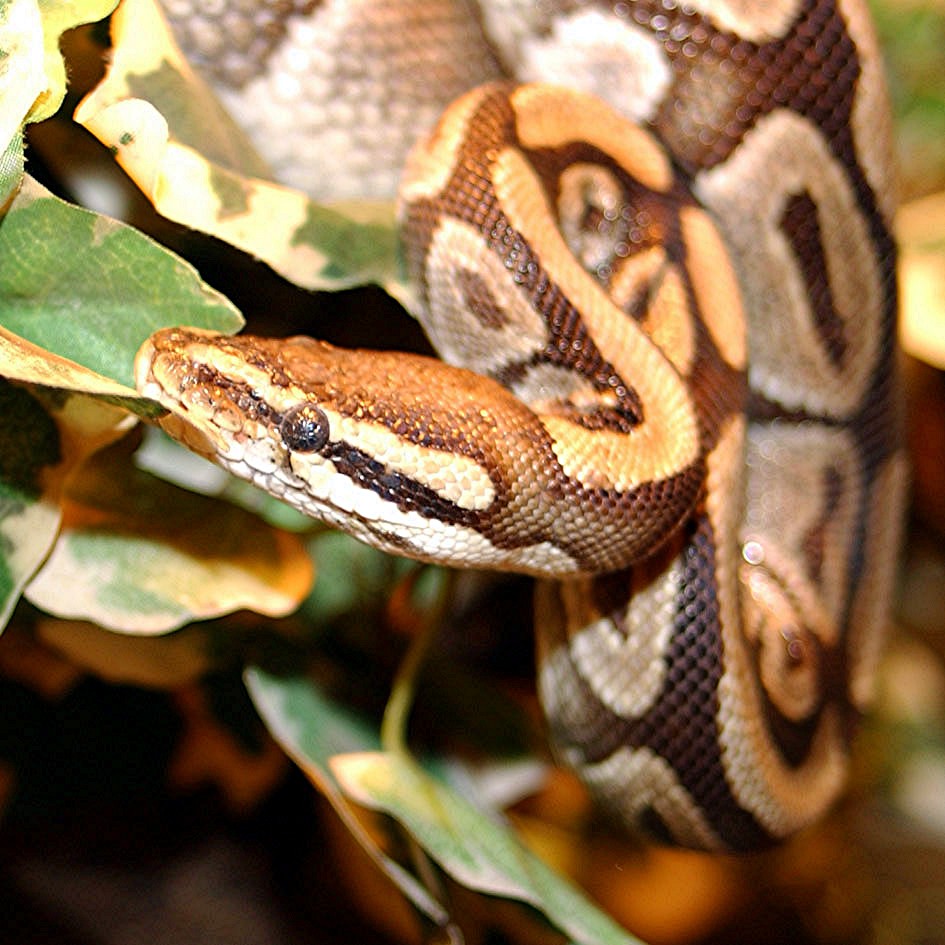
It was probably an African rock python Python
sebae, as specimens of this very sizeable species (averaging 15.75 ft long
but sometimes exceeding 20 ft) were apparently brought back to Rome, because it is
depicted in Roman mosaics. Also, fertility-related snake cults had long existed
in Macedonia, stretching back at
least as far as the 4th Century BC.

Apollo after slaying the
serpent dragon Python, engraving by William Grainger, late 1700s (public domain)
Alexander and Cocconas then journeyed to Chalcedon, a maritime town in
Bithyna, where they lost no time in concealing inside its temple to the god
Apollo a series of bronze tablets proclaiming that both Apollo and his
serpent-associated son Asclepius, the Greek god of medicine and healing, would
soon be appearing in Alexander's home village of Abonoteichus. They then contrived
for these 'hidden' tablets to be found, and news of the tablets' sensational
proclamations swiftly travelled widely, eventually reaching Abonoteichus
itself, whose inhabitants promptly began building a temple dedicated to Apollo
and Asclepius. It was then, in or around 150 AD, that the partnership of
Alexander and Cocconas broke up, with Cocconas electing to stay in Chalcedon
and continue producing phoney oracles, whereas Alexander was keen to put the
next stage of their original plan into action, and so he duly set off back to
Abonoteichus.
Using more fake oracles to proclaim himself as a
prophet and healer, Alexander also claimed that his father was none other than
Podaleirius, son of Asclepius himself and a legendary healer in his own right.
Moreover, as signal proof of this, he arranged for a goose egg that he had
'discovered' inside Abonoteichus's newly-built temple to be publicly opened by
him at noon on the following day in the village's marketplace before a crowd of
curious but credulous onlookers, promising that a wonder would be revealed that
would confirm all that he had alleged. And sure enough, when he opened the egg,
a tiny snake emerged (one that supposedly he had subtly inserted inside before
overtly 'discovering' the egg in the temple). As snakes were sacred to
Asclepius (one common European species, the Aesculapian snake Zamenis
longissimus, is actually named after Asclepius's Roman counterpart,
Aesculapius), Alexander's grandiose claims were readily accepted by
Abonoteichus's simple, unworldly villagers.

Statue of Asclepius and snake, 2nd Century AD, found on the island of Rhodes, Greece (public
domain)
As an interesting aside here: Chickens are often
infected with parasitic gut-inhabiting worms, including the ascarid roundworm Ascaris
lineata, a nematode species that can grow to a few inches in length (a
related giant species in humans can grow to over 1 ft in length!). They are
often passed out of the bird's gut when it defaecates. Unlike in mammals,
however, the bird's gut and its reproductive system share a common external
passageway and opening – the cloaca. Sometimes, therefore, an ascarid worm
ejected from the gut finds its way into the bird's reproductive system rather
than being excreted into the outside world, and moves into the oviduct. Once
here, however, it becomes incorporated into the albumen of an egg, inside which
it remains alive yet trapped when the egg is laid. But as soon as the egg is
broken open to eat by some unsuspecting diner, the worm wriggles its way out of
it and inevitably scares the diner, who frequently but mistakenly assumes that
this unexpected creature is actually a tiny snake.
I wonder if such a scenario explained the above
'snake-inside-egg' incident involving Alexander? Or could the egg have actually
been a genuine snake egg, but passed off to the ingenuous crowd by Alexander as
an unshelled, undersized goose egg, perhaps?

Ascaris, a
large parasitic nematode (public domain)
But that was not all. Alexander also stated that
the baby snake was itself a deity, and that he would therefore be caring for
it. After a few days had elapsed with the villagers not setting eyes upon this
infant reptilian god, Alexander reappeared, once again thronged by awed
spectators, but now only briefly and ensconced within a small dimly-lit shrine
inside the temple where viewing conditions were far from ideal. Moreover, this
time his huge, fully-grown pet snake from Pella was wrapped around
his body, and he glibly announced that the baby serpent deity had miraculously
matured directly into adulthood.
Yet even that incredible high-speed
transformation was not the most surprising facet of Alexander's outrageous
revelation. Instead of possessing a typical snake's head, the head of this
remarkable creature apparently resembled that of a man, and sported an
abundance of long blond hair sprouting liberally from it, as well as a pair of
human ears! Moreover, it could even speak, and in the future would directly
voice certain oracles or autophones to temples worshippers seeking guidance.
Alexander announced that this astonishing entity was called Glycon, and
constituted a new, living, physical manifestation or incarnation of Asclepius.

Two Romanian postage
stamps, issued in 1974 and 1994 respectively, depicting the famous statue of
Glycon unearthed in 1962 (public domain)
Henceforth, Alexander's reputation, wealth,
prestige, influence, and power, derived from his status as a celebrated
prophecy-spouting soothsayer and in turn a highly-esteemed personage attracting
acclaim and attention from all strata of Roman society, knew no bounds. In
particular, the temple that he had established at Abonoteichus (by now a
prosperous town) became a focus for fertility-themed worship and offerings by
barren women wishing to become pregnant; and also for the very lucrative
provision of oracles (always requiring prior receipt of payment). Moreover,
Alexander was frequently consulted by public figures of high political standing
anxious to solicit his ostensibly Heaven-sent advice regarding significant
matters of state. The fact that sometimes his advice was by no means reliable
seemed to be conveniently overlooked.
Thus it was, for example, that in 161 AD,
Alexander provided a very favourable oracle to Marcus Sedatius Severianus, the Gaul-originating
Roman governor of Cappadocia, on the basis of
which Severianus put into action his plan to invade Armenia – only for his
invasion force, including himself, to be slaughtered by the Parthians.
Allegedly, Alexander soon afterwards replaced the official temple record of his
oracle with a revised one that was much less favourable.

A sheet of Romania's
Glycon-depicting postage stamp issued in 1974, from my own philatelic
collection (public domain)
In 166 AD, Alexander provided an oracle verse
that was utilised as an amulet and inscribed above the doors of numerous houses
throughout the Roman Empire in the hope of warding off the devastating Antonine
Plague that had been introduced into the Empire by troops returning home from
campaigns in the Near East, and which killed thousands of people every day. Not
surprisingly, the amulets had no effect (indeed, it was actually claimed by
critics of this futile course of action that households bearing an amulet
suffered more plague-induced deaths than those not bearing it!), but Alexander
was too powerful by then for his standing to be affected by any such
dissension.
Not long after that debacle, the Roman emperor
himself, Marcus Aurelius, requested Alexander to send an oracle to his troops
on the Danube River during ongoing
warfare (168-174 AD) with a Germanic tribe called the Marcomanni. The oracle
that Alexander duly sent declared that victory would be achieved if two lions
were thrown alive into the Danube. Once again, however, the stark fact
that after obeying this unusual command the emperor's army was annihilated
there (20,000 Roman soldiers killed, and even the hapless lions clubbed to
death) failed to elicit any censure for the unperturbed Alexander, who coolly
pointed out that the oracle had not specified which side in the war
would achieve success!

Bust of Marcus Aurelius
(public domain)
Of course, Alexander was far from being entirely
unsuccessful as a prophet, but reputedly his triumphs often involved the use of
spies, thugs, and blackmailers to obtain the necessary information upon which
to base his oracles. In addition, there were claims that sealed scrolls
containing requests for oracles that acolytes presented to him were secretly
opened by him using hot needles in order to discover what information they
contained and thus devise an oracle in accordance with it. He also benefited
from making friends in (extremely) high places, one of the most significant
of whom was Publius Mummius Sisenna Rutilianus, a former Roman consul and provincial
Roman governor in Asia and Upper Moesia, who declared himself
protector of the Glycon oracle. He also provided Alexander with some very
high-ranking contacts in Roman society, and he even married Alexander's own
daughter.
Not content with merely being an exceptionally
famous mystic, meanwhile, Alexander utilised Rutilianus's own eminence to help
launch a very spectacular annual three-day festival replete with processions,
ceremonies, and re-enactments of various mystical rituals, all held at the
temple in Abonoteichus. These were devoted to the celebration of Apollo's birth
and that of his son Asclepius, the appearance of Glycon, Alexander's own
mother's supposed marriage to Asclepius's son Podaleirius, and even an alleged
romance between Alexander himself and the Greek moon goddess Selene that purportedly
led to the birth of Alexander's daughter, now the wife of Rutilianus.

Selene the Greek moon goddess,
with Phosphoros the Morning Star and Hesperos the Evening Star, depicted on
Roman marble altar, 2nd Century AD (public domain)
Alexander even persuaded the Roman emperor
Antoninus Pius to change Abonoteichus's name to the much grander-sounding
Ionopolis ('Greek city'). In addition, this same emperor and also his
successors Lucius Verus and Marcus Aurelius all issued coinage depicting
Glycon. Yet despite achieving such successes as these, with savage irony a
prediction that he made about himself proved to be singularly inaccurate – just
like many that he had predicted for others had been. He prophesied that he
would live to the age of 150, but died at only 70 in or around 170 AD, caused
by a gangrenous limb. Yet although the cult's leader was no more, the cult
itself, and its veneration of Glycon, persisted for at least a further century
– having occupied a vast area at its peak of popularity, stretching from the Danube in the west to the Euphrates in the east - before
eventually petering out. Having said that, it is nothing if not interesting to
note that as recently as the 1970s, belief in a "magical snake" still
existed among Turkish locals living in the vicinity of Inebolu (formerly
Ionopolis/Abonoteichus).
But how do we know about Alexander and Glycon,
almost two millennia after their demise? In fact, only a single primary source
for the extraordinary history of the reputedly phoney prophet and his talkative
hairy-headed human-eared snake god is known, and it just so happens to be an
exceedingly acerbic, hostile account written by an infamously vituperative
satirist with a very specific reason for hating Alexander and all that he
represented. Needless to say, therefore, one might well be forgiven for
wondering whether the entire saga was totally fictitious.

Happily, however, independent corroboration for
the reality of the Glycon cult also exists. This includes not only the survival
of some of the afore-mentioned Roman coinage bearing the image (and even the
name) of this very singular deified serpent, but also a magnificent marble
statue of Glycon, dating from the Severan dynasty (193-235 AD), standing almost
3 ft tall, and in excellent condition. It had been excavated in April 1962
along with various other statuary under the site of a former railway station in
Constanta, Romania, formerly the ancient
city of Tomis.
So spectacular and unexpected was this ornate
Glycon sculpture, now housed at Constanta's Museum of National History and
Archaeology, that it featured on a Romanian postage stamp in 1974 (which is
what first brought Glycon to my attention, as an enthusiastic stamp collector
during my childhood), as well as on a second one issued in 1994, and also on a
Romanian 10,000 lei bank note in 1994.

The Romanian 10,000 lei
bank note depicting the Glycon statue, issued in 1994 – sample only (Wikipedia
/public domain – reproduced here on a strictly non-commercial Fair Use basis
only)
Moreover, smaller Glycon statuettes in bronze
have been found in Athens too, confirming the
cult's spread into and across southwestern Europe. And according to the
2nd-Century-AD Christian philosopher Athenagoras of Athens, writing
in his Apology (c.176/177 AD), a statue of Alexander once stood in the
forum of Parium, which was a Greek city in Mysia on the Hellespont (now called
the Dardanelles).
Consequently, as there can be no doubt that
Glycon, regardless of its true nature, really did exist, should we look more
favourably upon its sole primary literary source, even though said source
originated from the pen of an inimical satirist? This is where it all becomes much
more complex, as will now be seen.

Lucian of Samosata, engraving
by William Faithorne, 1600s (public domain)
The source in question is a concise but
coruscating essay tersely entitled Alexander the False Prophet, written
in Ancient Greek by Lucian of Samosata (Samosata being an ancient Syrian city
on the west bank of the Euphrates river). A popular Greek satirist and
rhetorician, Lucian was a contemporary of Alexander, and was particularly noted
for the scoffing, sarcastic nature of many of his writings. His essay contained
the history of Alexander and Glycon that I have summarised here in this present
article of mine, but also included many additional claims and suppositions of
fraud, lewd behaviour, and other undesirable activities relative to its human
and serpentine subjects.
For instance, Lucian confidently asserted that
the talking head of Glycon was not this snake's real head (which, he claimed,
was kept well hidden under Alexander's armpit), but was instead an artificial
construction made from linen and skilfully manipulated by Alexander using a
lengthy internal tube composed of conjoined bird windpipes that led out from
the false head into a hidden chamber where an assistant spoke words into the
tube, thus making it seem as if Glycon were speaking. Lucian further alleged
that a series of very fine, attached horse-hairs acted as internal pulleys to
make the false head open and close its mouth, and extend and retract its
tongue.

Sculpture of Lucian of
Samosata, atop an ornamental pillar in the grounds of Nordkirchen Castle, near Münster, Germany (©
Mbdortmund/Wikipedia – GFDL 1.2 licence)
Lucian also 'explained' how various of
Alexander's correct predictions had been achieved via fraudulent activity. He
even alleged that shortly after a somewhat acrimonious meeting with Alexander
(in c.162 AD) during which he had tried to trick Alexander and had even
attempted (albeit unsuccessfully) to dissuade Rutilianus from marrying the
latter's daughter, he had narrowly avoided death during a boat trip when
Alexander had supposedly paid the vessel's crew to murder him, only being saved
when the captain prevented them from carrying out the heinous deed.
Traditionally, this vicious character
assassination of Alexander by Lucian in literary form has tended to be viewed
uncritically by those modern-day scholars actually aware of it (with Glycon in
particular being among the Roman Empire's least-known figures
of interest nowadays). However, all of that changed dramatically in June 2011.

Steve was a highly-respected veteran researcher of ancient Asian and European mysteries, as well as one of the original Gang of Fort associated with the founding of Fortean Times itself (originally entitled The News), and his article directly challenged many of Lucian's long-accepted claims.

Steve Moore with fellow FT
colleagues in 2002 - from left to right, back row to front row: Mark
Pilkington, Paul Sieveking, Bob Rickard, Ian Simmons, Steve Moore, and
Owen Whiteoak (© Paul Sieveking)
This very notable volte-face was due to the publication of a fascinating, eye-opening article presenting a very
erudite reappraisal of Alexander, Glycon, and their portrayal by their
longstanding nemesis Lucian. Appearing in the British monthly periodical Fortean
Times (which is devoted to the serious investigation and chronicling of
unexplained and controversial phenomena of every conceivable - and
inconceivable! – kind), the article was authored by Steve Moore.Steve was a highly-respected veteran researcher of ancient Asian and European mysteries, as well as one of the original Gang of Fort associated with the founding of Fortean Times itself (originally entitled The News), and his article directly challenged many of Lucian's long-accepted claims.

Opening page of text from
Steve Moore's excellent Fortean Times article (© Steve Moore/Fortean
Times)
For example, Steve questioned how Lucian could
have known any specific details about Alexander's early years, especially those
shared with Cocconas, bearing in mind that he, Lucian, had not spent any time
alongside the pair to witness anything at first hand, and that Cocconas and
Alexander were hardly likely to have informed him (or anyone else, for that
matter) what they had been doing if they had truly been engaged in fraudulent
activity during that time period, as vehemently asserted by Lucian in his
account. Indeed, Steve went even further, by questioning whether Cocconas even
existed – after all, there is no mention of him outside Lucian's poisonous
diatribe. Might he therefore have been a wholly fictitious character, invented
specifically by Lucian in order to cast Alexander's early years in as bad a
light as possible?
No less circumspect are Lucian's
wholly-unsubstantiated claims of spying, thuggery, blackmail, furtively opening
sealed scrolls, and a varied assortment of other equally unpleasant activities attributed
by him to Alexander. As for Lucian's once again unconfirmed allegation of
almost being murdered by henchmen of Alexander while taking a boat ride, this
just so happens to have been a very popular storyline in romantic works of
fiction from that time period (and of which Lucian would certainly have been
well aware). So it should clearly be viewed with great caution as a supposed
statement of fact.

Was Glycon's voice achieved
by ventriloquism and its head a glove or sock puppet, i.e. comparable, for
instance, with how the famous American entertainer Shari Lewis 'brought to
life' Lamb Chop and Charlie Horse? (public domain)
Equally, Steve pointed out that Lucian's bold
statements regarding the nature of Glycon's head and speech were mere
supposition too. True, the notions that Lucian had put forward regarding the
mechanisms by which a fake head could have been secretly operated by Alexander
were nothing if not ingenious, but that is all that they were – notions, not
facts. No physical evidence or direct eyewitness observations confirming them
were presented by Lucian in support of his accusations, it was all speculation
(and spiteful speculation at that) on his part, nothing more. Other, much less
controversial options also existed but which Lucian never mentioned, such as
ventriloquism to make Glycon speak, and a simple glove or sock puppet-like
creation to make its fake head move and open its mouth (always assuming of
course that a fake head really was present).
Moreover, we only have Lucian's very questionable
testimony that Glycon actually talked at all! In fact, it is even possible that
Lucian never actually saw Glycon or spoke to anyone who had done so, because,
amazingly, his essay makes no mention whatsoever of Glycon's two most
remarkable physical features – its human ears and blond hair. Conversely,
whereas Lucian claimed that it possessed a human-like head, most of the
physical depictions of Glycon currently known (i.e. the various coins and
statues noted earlier by me in this article) actually portray it with a
long-snouted head that is certainly more pythonesque than humanoid in
appearance. If for no other reason than this, therefore, the authentic nature
of the content of Lucian's essay clearly should not - can not - be taken in any
way for granted.

Glycon portrayed upon a 2nd-Century
AD Ionopolis coin (copyright holder unknown, despite considerable searches by
me; reproduced here on a strictly non-commercial Fair Use educational basis
only)
Returning to the matter of the mobility and
loquacity of Glycon's head, it would be very prudent here to quote Steve's take
on Lucian's assertions regarding this:
In boasting that he knows how the trick was done, Lucian is plainly
covering up the fact that this can only be a matter of conjecture. These
conjectures may be very close to the truth; but they remain conjectures,
not proof.
Steve also applied this same line of sound reasoning
very successfully and convincingly to many other of Lucian's scathing claims
masquerading as facts against Alexander. In addition, certain of Alexander's
activities that Lucian deemed to be evidence of his fakery – most notably his
retreating overnight into an inner, subterranean sanctuary called the adyton,
in order to receive his oracles in peaceful solitude via dreams, and then
reveal them publicly the following morning - were shown by Steve to be no
different from those performed by various soothsayers and oracle-givers who had
not been accused of or linked to fraud, such as the very famous,
much-revered Oracle of Apollo at Claros, on the coast of Ionia in present-day
Anatolia, Turkey.

'Chariot of Apollo', by
Gustave Moreau, late 1800s (public domain)
Indeed, there is even a very relevant,
present-day parallel, as Steve tellingly revealed in his own article:
The adyton is an underground chamber, and it's now known that
withdrawal to a cave or subterranean chamber to obtain visions and mystic
revelations was a common practice among Greek seers, being used similarly to a
modern sensory deprivation tank.
As for charges made by Lucian against Alexander
of lewd behaviour and even male prostitution: such activities were by no means
uncommon back in their day, and some of the ceremonies and rituals performed
during the kinds of celebration that Alexander had modelled his own annual
three-day festival upon were notoriously liberal to say the least! Once again,
therefore, why was Lucian singling out Alexander, this time for indulging in
behaviour that was no different – or worse – than that of many others in his
role?

Illustration from 1885
depicting a small bronze bust of Epicurus, derived from Herculaneum (public
domain)
The answer would seem to be quite simple, but
hitherto ignored by those who have supported Lucian's writings unquestioningly.
Lucian was an Epicurean, whereas Alexander was no fan of Epicureans, or
Christians either, for that matter, banning both groups from his annual
festivities. His reason for doing so is that Epicureans (followers of the
teachings of the ancient Greek philosopher Epicurus) were known for their
fervent scepticism of superstition and claimed cases of divine intervention
(and Christians would certainly not have tolerated any cult of snake veneration, i.e. ophiolatreia,
derived from the Greek deity Asclepius – or indeed any other such cult).
Consequently, the activities of Alexander would
have made him a prime focus for disdain by Lucian. And when this was coupled
with Alexander's own dislike of Epicureans, as well as his immense success and
fame, overshadowing Lucian's own accomplishments at that time, it was
inevitable that literary sparks would fly when Lucian chose to write about him.

Astronomically, Asclepius
is immortalised as the constellation Ophiuchus, the snake-bearer, as depicted
here in Urania's Mirror – a set of constellation cards
published in London in c.1825 (public domain)
Certainly, there was never any hope for an
unbiased, objective account, and Lucian definitely did not disappoint on that
score - the result being a destructive, cynical, hyper-sceptical, and
uber-vitriolic outpouring of verbal venom specifically designed to diminish,
denigrate, and entirely discredit the reputation of the subject of his enmity.
And for many centuries, this is exactly what Lucian's vindictive essay
achieved, abetted by Christian scholars and scientists alike (for whom stories
of snake deities and diviners of the future were anathema), until Steve Moore's
much-needed objective perspicacity opened readers' eyes to what may well have
been the greatest of all trickeries associated with Alexander and Glycon – one
which, ironically, was nothing of their own doing either, but was instead the
ostensibly accurate yet substantially inaccurate account of their lives penned
by Lucian.

A psychedelic interpretation of Glycon (© Dr Karl Shuker)
In short, the true nature of this toxic treatise had been hidden in
plain sight for a very long time indeed, shielded from any penetrating analysis
by Lucian's name and by generations of readers with their own compatible
agenda, until the coming of Steve's diligent, iconoclastic detective work.
Obviously, there is no doubt that hoaxing did
play some part in certain of Alexander's activities, most notably in relation
to the physical serpent Glycon, but equally, as Steve so forensically revealed,
it is likely that Alexander was nowhere near as villainous as Lucian would have
everyone believe – more sinned against than sinning, in fact. It is often said
that the pen is mightier than the sword, but never more so than when that pen
has been liberally dipped in the lethal venom of hatred and jealousy.

I wish to dedicate this ShukerNature blog article
of mine to the memory of Steve Moore (1949-2014), one of my first and enduring
friends in the Fortean community, who always encouraged and supported my own
writings and researches within the fascinating field of inexplicabilia,
including cryptozoology. Thank you Steve, and may you now know the answers to
all of the many ancient historical riddles that you investigated so extensively,
and with such expertise and wisdom, during a life so richly inspired by mystery
and wonder.

Steve Moore (© Paul Sieveking)

Steve Moore (© Etienne Gilfillan)




 Posts
Posts