Dr KARL SHUKER

Zoologist, media consultant, and science writer, Dr Karl Shuker is also one of the best known cryptozoologists in the world. He is the author of such seminal works as Mystery Cats of the World (1989), The Lost Ark: New and Rediscovered Animals of the 20th Century (1993; greatly expanded in 2012 as The Encyclopaedia of New and Rediscovered Animals), Dragons: A Natural History (1995), In Search of Prehistoric Survivors (1995), The Unexplained (1996), From Flying Toads To Snakes With Wings (1997), Mysteries of Planet Earth (1999), The Hidden Powers of Animals (2001), The Beasts That Hide From Man (2003), Extraordinary Animals Revisited (2007), Dr Shuker's Casebook (2008), Karl Shuker's Alien Zoo: From the Pages of Fortean Times (2010), Cats of Magic, Mythology, and Mystery (2012), Mirabilis: A Carnival of Cryptozoology and Unnatural History (2013), Dragons in Zoology, Cryptozoology, and Culture (2013), The Menagerie of Marvels (2014), A Manifestation of Monsters (2015), Here's Nessie! (2016), and what is widely considered to be his cryptozoological magnum opus, Still In Search Of Prehistoric Survivors (2016) - plus, very excitingly, his four long-awaited, much-requested ShukerNature blog books (2019-2024).

Dr Karl Shuker's Official Website - http://www.karlshuker.com/index.htm

IMPORTANT: To view a complete, regularly-updated listing of my ShukerNature blog's articles (each one instantly clickable), please click HERE!

IMPORTANT: To view a complete, regularly-updated listing of my published books (each one instantly clickable), please click HERE!

IMPORTANT: To view a complete, regularly-updated listing of my Eclectarium blog's articles (each one instantly clickable), please click HERE!

IMPORTANT: To view a complete, regularly-updated listing of my Starsteeds blog's poetry and other lyrical writings (each one instantly clickable), please click HERE!

IMPORTANT: To view a complete, regularly-updated listing of my Shuker In MovieLand blog's articles (each one instantly clickable), please click HERE!

IMPORTANT: To view a complete, regularly-updated listing of my RebelBikerDude's AI Biker Art blog's thematic text & picture galleries (each one instantly clickable), please click HERE!

Search This Blog


PLEASE COME IN, I'VE BEEN EXPECTING YOU...

PLEASE COME IN, I'VE BEEN EXPECTING YOU...
WELCOME TO SHUKERNATURE - ENJOY YOUR VISIT - BEWARE OF THE RAPTOR!


Showing posts with label giant octopus. Show all posts

Sunday, 30 November 2025

HIDING IN PLAIN SIGHT - TWO RECENTLY-REVEALED CRYPTOZOOLOGICAL EXAMPLES

 
What happens when you ask AI to generate an image of a tall bipedal tailless monkey confronting a gigantic octopus emerging from the sea onto the shore (Created by Dr Karl Shuker using Grok)

Cryptozoology is full of examples of cryptids that once their existence was finally confirmed officially by science were shown to have been long since known to the world anyway, but had somehow been overlooked, veritably rendered invisible – in other words, they had remained hidden in plain sight. So here are two recently-revealed additional examples.


MAPPING A CRYPTO-SPECIMEN

Cryptozoological specimens are notorious for being almost as elusive as the cryptids themselves, with a worrying tendency to vanish out of sight, never to be recorded again. So it is always a pleasant albeit rare surprise if such a specimen reappears somewhere, as was the case recently with one that has apparently been hidden in plain sight for quite some time.

On 26 August 2025, I was startled but delighted to learn from Florida resident and longstanding Facebook friend Adam Naworal that he had recently encountered a sample of tissue from the famous St Augustine globster. The sample was preserved and on public yet wholly unpublicised display in the map room at the St Augustine Historical Society – Oldest House Museum Complex – in Florida.

 
Aimee's photograph of the sample of St Augustine globster tissue (© Aimee & Adam Naworal, but free to use by any researcher)

As revealed in the above photograph snapped of this remarkable specimen by Adam's wife Aimee and included here with her and Adam's kind permission, it consists of several chunks of whitened flesh preserved in fluid (formalin?) inside a large vertical glass jar, labelled and firmly stoppered. The St Augustine globster is – or was – the huge rotting carcase that washed ashore on a beach near St Augustine during November 1896. Eminent cephalopod (octopus/squid/cuttlefish) expert Prof. A.E. Verrill from Yale University deemed it to be the remains of a hitherto-unknown species of truly gigantic octopus, but since then there has been a long-running dispute among scientists as to whether this is indeed what it was or whether, alternatively, it was simply the partial, highly-decomposed carcase of a whale, composed largely of blubber, and assuming an amorphous mass nowadays referred to as a globster.

Samples were taken from it at the time, and analysed, yielding contentious, contradictory results, but most of these samples were thought to have been lost or discarded. So this confirmed example at the St Augustine Historical Society is of special interest and scientific value, and now, thanks to keen-eyed Adam and Aimee, is duly documented here for cryptozoological posterity. Also, they have asked me to note here that they are making their photograph of this specimen freely available for all researchers to use at no charge, only a credit to Aimee is required – thanks guys! Incidentally, Adam has since informed me that the sample has now been taken off display, so it was extremely fortuitous that he and Aimee were visiting during the time when it was accessible for viewing by the public and were therefore able to place its existence on record.


AN INFERNAL FIND!

And staying with crypto-discoveries hidden in plain sight: Just two days before I learnt from Adam and Aimee about the St Augustine globster sample, another longstanding Facebook friend, Robert Schneck, had drawn my attention to an illustration that he'd lately discovered and had now uploaded to his Facebook page 'Historian of the Strange'. Prepared by German artist Hermann Wöhler (1897-1961) in c.1930, it was an exceedingly detailed line drawing entitled 'Inferno', depicting all manner of hideous monsters and other terrifying entities envisaged by him to be inhabiting Hell. But what had attracted Robert's particular attention was the creature depicted almost at the very centre of the illustration, because as he pointed out, it looked more than a little reminiscent of a certain alleged cryptid depicted in a notorious photograph during the early 1920s.

The cryptid in question was the so-called Loys's ape, reputedly encountered in the jungles on the border of Colombia and Venezuela by Swiss geologist Dr François de Loys while leading a party of explorers through this difficult, inhospitable terrain. The official narrative as provided by Loys was that they'd encountered two such creatures walking together on their hind legs and lacking tails. Threatened by them, the explorers shot one, the female, causing the male to flee. Taking the creature's lifeless carcase back to camp, they sat it on a crate, propped it upright with a long stick placed vertically beneath its chin, and photographed it. The carcase did not survive but the photo did, and for decades led to supposition that it portrayed one of the mysterious bipedal ape-like entities long reported from many different regions of South America, and inducing French/Swiss anthropologist Prof. George Montandon to formally dub their scientifically-undescribed species Ameranthropoides loysi.

 
'Inferno' by Hermann Wöhler, with the Loy's ape lookalike creature appearing almost dead-centre (left) and the hoax photo of Loys's ape (right) - please click dual image to enlarge it for viewing purposes (both images are now in the public domain)

Ultimately, however, long after Loys himself had died, one of his team's still-living members confessed that it had all been a hoax – the creature in the photo was nothing more than their pet spider monkey, which, after eventually dying, had been propped up and photographed (with its long tail either hidden or cut off) to yield the famous, but now infamous, Loys's ape picture. (The entire sordid saga of this hoax has already been documented by me in full here, here, and here on ShukerNature, so check it out.)

Bearing in mind that Wöhler's illustration had been created no more than ten years after Loys's photograph had first been published and had duly hit the headlines, it does indeed seem likely that this eyecatching image had directly inspired Wöhler to include a representation of it within his line drawing. For there is no doubt that the facial expression of Loys's ape as captured in the photo, with mouth agape and eyes staring widely, is certainly more than a little hellish, positively infernal, in fact! So, many thanks indeed to Robert for alerting me to a fascinating yet previously unrevealed and undocumented cryptozoological connection concealed within the art archives.

 
Another of my AI images, this time generated by Magic Studio, which took my verbal prompt to depict a giant ape confronting a giant octopus a little too far, inasmuch as it yielded a fascinating if wholly fictitious monkey-octopus hybrid! (Created by Dr Karl Shuker using Magic Studio)

This ShukerNature article originally appeared in the form of one of my regular Alien Zoo columns for the famous long-running British monthly magazine Fortean Times.


Thursday, 30 December 2021

ST GEORGE AND THE PTERODACTYL – A SHUKERNATURE 'PICTURE OF THE DAY'

 
'St George and the Pterodactyl', a painting by Benjamin Waterhouse Hawkins, 4 December 1873 (public domain)

It's been a while since I posted a 'Picture of the Day' on ShukerNature, so here is a particularly intriguing picture that has attracted a lot of interest among friends and readers ever since I first brought it to their attention in a Facebook post on 20 June 2017.

A small ink-and-wash drawing, presently housed in the Academy of Natural Sciences in Philadelphia, it was apparently completed on 4 December 1873 by English painter/sculptor Benjamin Waterhouse Hawkins (1807-1894). He is of course most famous for his gigantic, scientifically groundbreaking sculptures of dinosaurs and other prehistoric creatures that he created during the early 1850s to accompany the erection of the spectacular Crystal Palace in what became Crystal Palace Park, following this huge glass edifice's removal from its previous, original site in London's Hyde Park, where it had stood during the Great Exhibition of 1851.

For full details of these stupendous exhibits, which, unlike the palace itself, still survive today, please click here, here, and here, to read my comprehensive three-part ShukerNature article documenting their history and also that of their subsequent, ill-fated American counterparts, again created by Hawkins.

(Incidentally, the earlier date of 4 December 1868 also given by Hawkins for the drawing under consideration here, as written by him beneath its bottom edge alongside 4 December 1873, suggests that it may have begun as a design for a sculpture to be created as part of that never-completed American collection, but following the latter's tragic end was transformed by him into this drawing and seemingly completed in December 1873, as noted earlier.)

In addition to those monumental mega-sculptures, Hawkins also produced a sizeable body of natural history paintings and drawings, some of which again depicted prehistoric species, whereas others portrayed modern-day animals. Most of these were serious studies, but now and again he'd produce a rather more tongue-in-cheek illustration, of which 'St George and the Pterodactyl' is a particular case in point.

 
Crystal Palace Park's iconic dinosaur sculptures by Hawkins, depicted in Matthew Digby Wyatt's book Views of the Crystal Palace and Park, Sydenham, 1854 (public domain)

For instead of the titular saint battling the traditional reptilian dragon of mythology, in this very distinctive drawing Hawkins provided him with an erstwhile reptilian foe from antiquity. Moreover, it is one with which Hawkins was particularly familiar, given that he had created two pairs in life-sized sculptured form for the Crystal Palace Park, under the supervision of no less a palaeontological authority than Prof. Sir Richard Owen.

Namely, a pterodactyl – but no ordinary one, given its great size; as can be seen, it is virtually as big as St George's horse! As for its precise taxonomic identity: its toothy jaws have inspired attempts to categorise this depicted pterosaur as a species belonging to the genus Ornithocheirus, but I have not seen any unequivocal acceptance of this classification.

Speaking of St George's horse, this poor beast has problems of its own – keeping its hooves free from the flailing, grasping tentacles of a not-inconsiderable octopus lurking at the water's edge. As for the drawing's setting – this is believed to be Fingal's Cave, a large sea cavern on the uninhabited island of Staffa, in Scotland's Inner Hebrides group, as evidenced by the readily-visible columns of basalt of which Fingal's Cave is wholly composed.

For more details concerning this unusual painting by Hawkins, I recommend clicking here to access a fascinating article by historian Lydia Pyne, which examines its possible inspirations and symbolic interpretations.

Finally, as further evidence of Hawkins's occasional flights of artistic fantasy, here is another example. Signed by him with his initials, and dated December 1864, it consists of a very (melo)dramatic drawing (pen and black ink and wash) that depicts a group of equestrian prehistoric men doing battle with a veritable phalanx of pterosaurs! Truly a flight of fancy in every sense! (Incidentally, if anyone has additional details concerning this extraordinary drawing, or a better reproduction of it, I'd very much like to receive them – many thanks in advance.)

 
Hawkins's extraordinary drawing of some horse-riding early men battling a flock of pterosaurs, dated December 1864 (public domain)


Wednesday, 4 March 2020

THE CURIOUS CASE OF JACQUES COUSTEAU'S MISSING SEA MONSTER

Is the sheytan based upon sightings of manta rays? (public domain)

On 29 November 2018, fellow UK cryptozoologist Richard Freeman brought to my attention a most intriguing article (click here to access it), written by Zineb Boujrada and posted earlier that year on Culture Trip's website, concerning a hitherto-obscure East African aquatic cryptid. Djibouti's so-called Island of the Devil (Goubbet Al-Kharab) earns its name from a terrifying sea monster called the sheytan (translated as 'devil') that locals vehemently believe exists in the bay (the Goubbet) surrounding the island.

Making this account especially interesting was its inclusion of what seemed to be a truly extraordinary and very noteworthy claim if true. Namely, that no less eminent a maritime expert than France's internationally famous undersea explorer and diver Jacques Cousteau had not only obtained proof of the sheytan's reality but also "insisted it never be revealed to humanity".

Quoting from Boujrada's Culture Trip article:

According to local newspapers at the time, Cousteau and his team conducted an experiment to explore the depths of the Goubbet by submerging a camel carcass in a cage. To their surprise, as they took it out of the water, they discovered that the cage had been entirely smashed and deformed, resulting in the disappearance of the carcass.

All of this was entirely new to me, so I lost no time in posting links to Boujrada's article on my various Facebook cryptozoology-related groups in the hope of eliciting further information or clarification. Happily, assistance soon came, courtesy of veteran French cryptozoologist Michel Raynal, who duly informed me on 30 November that the local Djibouti newspapers' claims were unfounded rumour, and that in 1971 Cousteau had publicly denied it in one of his own books, Life and Death in a Coral Sea (with Michel kindly sending me a copy of the relevant section from it).

Jacques Cousteau (copyright-free)

As this incident appears never to have attracted specific cryptozoological attention prior to my subsequent documentation of it in my Alien Zoo column for Fortean Times, however, I am presenting herewith Cousteau's own statement as contained in his book:

...we decided to visit the Goubet, a famous gulf of the Red Sea. Before leaving Djibouti that morning, one of our crew had by chance asked a local Arab diver about the Goubet. "Ah, sir," the man had replied, "it is a most extraordinary place. It is bottomless, and it is inhabited by monsters so large that they can drag down lines attached to 200-liter cans. Moreover, in 1963, Commandant Cousteau went there with Fredéric Dumas and his best divers, and they were so terrified by what they saw that they ran away."

Naturally, we were eager to see the place in which, according to local gossip, we had earned so ignominious a reputation. I must report, however, that the Goubet was a disappointment. It is an inland sea or gulf that connects with the Red Sea by a narrow pass in which there is a very strong current, running up to seven knots. The surrounding area is very beautiful, and very wild, being dominated by volcanic mountains bare of foliage and marked in shades of red, yellow, and black.

Once in the Goubet itself, we lowered the diving saucer to a depth of over six hundred feet without catching sight of even a small monster. The divers then suited up and went down also, but they saw nothing more remarkable than some very large sea urchins. There seemed to be very few fish of any kind. It is my guess that the "Goubet monster" of Arab legend was originally a manta ray, seen by some shepherd from a hill top. Manta rays are plentiful in this area, and it must happen occasionally that they wander into the Goubet and – because the inlet is so narrow and because mantas are not the most intelligent of beasts – have trouble finding their way out again.

Consequently, it would seem that either the sheytan is real but remained remarkably well hidden when Cousteau conducted his actual, genuine search for it, or it is indeed just a monstrous local legend. Worth noting, incidentally, is that a commonly-used colloquial name for the giant manta ray Manta birostris is the devil-fish (click here for more details). Alternatively, as this term has also been used in relation to giant squids and octopuses, perhaps if it truly exists the sheytan might be a gargantuan cephalopod, especially as mantas are pelagic creatures, not deepsea ones, whereas giant squids do inhabit deep waters. My thanks to Richard and Michel for alerting and assisting me in my investigation of this curious case.

In view of how the sheytan allegedly inhabits great depths and drags down lines to these depths, if it truly exists might it be some form of giant deepsea octopus? (public domain)


Sunday, 5 July 2015

GLOBSTERS ABOUNDING! - PART 2: SEEKING GIANT OCTOPUSES… BUT FINDING ROTTING SPERM WHALES


Vintage illustration of a deepsea octopus, by Ernst Haeckel (public domain)

In Part 1 of this ShukerNature blog article (click here), I surveyed a wide range of globsters, including the celebrated Trunko, and I also chronicled a selection of reports featuring alleged giant octopuses – traditionally, the most popular identity for globsters. As now revealed, however, modern-day studies of these latter anomalous entities have unveiled a very different explanation for them.

UNMASKING THE GLOBSTERS, AND UNVEILING THE QUASI-OCTOPUS
Thanks to the advances in DNA technology during the past two decades, science now has a reliable tool with which to investigate and expose the hitherto-cryptic identity of globsters, and in the past few years this is precisely what has happened, with eye-opening results.

The first notable globster to be unmasked by DNA analyses was the Fortune Bay specimen from Newfoundland. In February 2002, a team of researchers led by Newfoundland molecular systematics expert Dr Steven M. Carr published their findings in the Biological Bulletin scientific journal, summarising them as follows:

"DNA was extracted from the carcass and enzymatically amplified by the polymerase chain reaction (PCR): the mitochondrial NADH2 DNA sequence was identified as that of a sperm whale (Physeter catodon). Amplification and sequencing of cryptozoological DNA with "universal" PCR primers with broad specificity to vertebrate taxa and comparison with species in the GenBank taxonomic database is an effective means of discriminating otherwise unidentifiable large marine creatures."

Effective it has certainly been. One South Florida scientist with a longstanding interest in globsters is Dr Sidney K. Pierce, and in recent years he has led several studies of preserved globster remains, culminating in a detailed Biological Bulletin paper of June 2004 co-authored by Carr and several other researchers, which concentrated upon the Chilean globster but also examined samples from various additional specimens.

Chilean globster (© Dr Elsa Cabrera – Fair Use/Educational Purposes Only)

The team announced:

"Electron microscopy revealed that the remains [of the Chilean globster] are largely composed of an acellular, fibrous network reminiscent of the collagen fiber network in whale blubber. Amino acid analyses of an acid hydrolysate indicated that the fibers are composed of 31% glycine residues and also contain hydroxyproline and hydroxylysine, all diagnostic of collagen. Using primers designed to the mitochondrial gene nad2, an 800-bp product of the polymerase chain reaction (PCR) was amplified from DNA that had been purified from the carcass. The DNA sequence of the PCR product was 100% identical to nad2 of sperm whale (Physeter catodon). These results unequivocally demonstrate that the Chilean Blob is the almost completely decomposed remains of the blubber layer of a sperm whale. This identification is the same as those we have obtained before from other relics such as the so-called giant octopus of St. Augustine (Florida), the Tasmanian West Coast Monster, two Bermuda Blobs, and the Nantucket Blob. It is clear now that all of these blobs of popular and cryptozoological interest are, in fact, the decomposed remains of large cetaceans."

Yet how can a decomposed sperm whale transform in shape and texture so dramatically that it becomes a globster, sometimes even equipped with apparent tentacles? As I revealed in my book, Extraordinary Animals Revisited (2007), the answer is fascinating, and also has a notable precedent:

"There is a notable precedent for such dramatic misidentification when dealing with beached remains, which is known as the pseudo-plesiosaur effect. When a basking shark Cetorhinus maximus dies and its body decomposes, it undergoes a remarkable transformation. The gill apparatus falls away, taking with it the shark's jaws, leaving only its small cranium and exposed backbone, thus resembling a small head and long neck. The end of the shark's backbone only runs into the upper fluke of its tail, so during decomposition the lower fluke falls off, leaving what looks like a long slender tail. And to complete the plesiosaur deception, the shark's pectoral fins, and sometimes its pelvic fins too, remain attached, resembling two pairs of flippers. Little wonder, therefore, why a number of amazingly plesiosaurian carcases have been reported over the years, only for anatomical and biochemical analyses to expose them as sharks.

"Now, moreover, we have confirmation that an analogous transformation is responsible for at least some of the hitherto perplexing globsters that have come to light - a transformation that I propose should hereafter be referred to as the quasi-octopus effect. As detailed by Drs Pierce, Carr, and Letelier, after a whale dies its body can float for months, decomposing, until eventually its heavy backbone and skull dissociate from their encompassing skin-sac of rotting blubber, and sink to the sea bottom, leaving behind a thick gelatinous matrix of collagen - the tough protein found in skin and connective tissue. It is this mass of collagen, still encased in its skin-sac, that washes ashore, as a globster. Furthermore, if a few of the whale's ribs remain within the collagen matrix, and any 'fingers' of fibrous flesh are attached to them, these resemble tentacles [or even a trunk, in the case of Trunko]. And if the whale is a sperm whale, the spermaceti organ gives the resulting globster a bulky shape reminiscent of an octopus."

So does that mean that globsters are a dead-end as far as providing evidence for the reality of giant octopuses is concerned? Not quite, perhaps...

VERRILLY A GIANT OCTOPUS?
The grand-daddy of all globsters was washed ashore near St Augustine, Florida, on 30 November 1896. Its prodigious remains, pinkish-grey and pear-shaped, were over 6 m long, 1.6 m wide, and 1.3 m high, and were estimated to weigh 5 tons. What appeared to be the stumps of five massive tentacles were clearly visible in photographs taken of this monstrous carcase by local physician DeWitt Webb, as was what seemed to be a severed tentacle, measuring 8.7 m long and 20 cm thick. Webb sent a sample of its tough flesh to Yale University cephalopod (squid and octopus) expert Prof. Addison E. Verrill, who announced that the carcase had been a giant octopus, which he formally christened Octopus giganteus. Later, however, Verrill recanted, claiming that it was merely the spermaceti organ of a sperm whale.

St Augustine globster (public domain)

A second sample, sent to the Smithsonian Institution, has been tested on numerous occasions via several different techniques, and has yielded differing results. Whereas Pierce’s studies indicated that it was indeed of sperm whale origin, analyses by eminent Chicago University biochemist and longstanding cryptozoological investigator Prof. Roy P. Mackal strongly supported an octopus identity. However, the sample has been preserved for so long that it has probably been contaminated and rendered useless for detailed study - which would explain the greatly diverging results - unless future advances in technology can overcome this obstacle. If they can, then interested researchers should apply to the Institute of Creation Research (ICR) in El Cajon, California, for it is here that the only surviving sample of tissue from the St Augustine globster can be found, donated by Prof. Mackal in 2003 to the ICR’s Professor of Biology, Dr Kenneth Cummings.

Drawing of St Augustine globster by Prof. Addison E. Verrill (public domain)

How ironic it would be if the existence or otherwise of what would be (if real) one of the largest marine creatures alive today – the elusive giant octopus – is ultimately determined by this tiniest sliver of substance, the last remnant from one of cryptozoology’s most enduring enigmas. For a further picture and details concerning this globster, click here to access my ShukerNature-reprinted interview conducted back in the 1990s with Prof. Mackal.

THE MULTI-LIMBED MONSTER OF ANTIBES
In addition: A truly bizarre sea monster was allegedly sighted between Antibes and Nice in 1562. Oval in shape, with a pig’s head at one end and a trunked elephant-like head at the other, it boasted no less than eleven claw-bearing limbs.

Antibes multi-limbed sea monster (public domain)
Is it possible that this weird entity, depicted in the Paralipomena (supplement) to the second edition of Conrad Gesner’s Historiae Animalium Liber IV: Piscium et Aquatilium Animantium Natura (1604), was a distorted description of a giant octopus?

GIANT OCTOPUS, OR MYSTERY JELLYFISH?
Finally: In 1953, while testing a new type of deep-sea diving suit in the South Pacific, an Australian diver named Christopher Loeb encountered a Lovecraftian horror from the ocean’s unpenetrated depths, which I documented as follows within my book From Flying Toads To Snakes With Wings (1997):

"The diver had been following a shark, and was resting on the edge of a chasm leading down to much deeper depths, still watching the shark, when an immense, dull-brown, shapeless mass rose up out of the chasm, pulsating sluggishly, and flat in general outline with ragged edges.

"Despite appearing devoid of eyes or other instantly-recognizable sensory organs, this malign presence evidently discerned the shark's presence somehow, because it floated upwards until its upper surface made direct contact. The shark instantly gave a convulsive shudder, and was then drawn without resistance into the hideous monster's body. After that, the creature sank back down into the chasm, leaving behind a very frightened diver to ponder what might have happened if that nightmarish, nameless entity had not been attracted towards the shark!"

Cirrothauma murrayi, a species of deepsea cirrate octopus (public domain)

In the past, a deepsea octopus has been offered as a possible identity for this disturbing creature, but as I discussed in detail within my book, a far more satisfactory candidate is a deepsea jellyfish.

Whereas all octopuses have tentacles, some deepsea jellyfishes do not. What they do have, however, are potent stinging cells called nematocysts on their bodies (and tentacles if they possess any), armed with venom that swiftly paralyses their prey. This would readily explain the immediate paralysis of the shark. Moreover, jellyfishes do not possess true eyes but they are equipped with sensory structures responsive to water movements. Consequently, the creature would have learnt of the shark’s presence by detecting its movements in the water. How lucky, then, that the diver had remained stationary!

Artistic representation of the deadly Chilean hide (© Icarito)

Interestingly, Chilean legends tell of a very similar beast called el cuero or the hide, as it is likened in shape and size to a cowhide stretched out flat, with countless eyes around its perimeter, and four larger ones in the centre. As it happens, jellyfishes possess peripheral sensory organs called rhopalia that incorporate simple light-sensitive eyespots or ocelli.

Moreover, some jellyfishes also have four larger, deceptively eye-like organs visible at the centre of their bell, though in reality these organs are not eyes at all. Instead, they are actually portions of the jellyfishes' gut, known as gastric pouches, with the jellyfishes' horseshoe-shaped gonads sited directly underneath these pouches and also very visible (as in the familiar moon jellyfish Aurelia aurita).

Exquisite illustration of various jellyfish species revealing their four centrally-sited gastric pouches, depicted by Ernst Haeckel (public domain)

So perhaps the deadly hide is more than a myth after all, lurking like so many other maritime horrors reported down through the ages in the deep oceans' impenetrable black abyss, but only very rarely encountered by humankind – which in view of the dreadful fate that befell the hapless South Pacific shark in 1953 may be just as well!

A sinister-looking deepsea octopus in a 19th-Century illustration (public domain)

For further details concerning globsters and Trunko, check out my books Extraordinary Animals Revisited and Mirabilis.


Saturday, 4 July 2015

GLOBSTERS ABOUNDING! - PART 1: BLOBS, TRUNKO, LUSCA, AND MORE...


Me with giant octopus model (© Dr Karl Shuker)

Mystery beasts come in all sizes and shapes, but in the case of globsters they are most famous not just for their great size but also for their conspicuous lack of any well-defined shape. Aptly named by American cryptozoologist Ivan T. Sanderson in the early 1960s, globsters (also dubbed blobsters or blobs) are generally huge, amorphous masses of decomposing tissue, usually rubbery and covered in fibrous ‘hair’, lacking any recognisable body parts or skeleton, which are regularly washed ashore on beaches around the world.

GLOBSTERS IN THE NEWS
The first globster to attract international attention, and for which Sanderson coined the term ‘globster’, was discovered on the beach north of Tasmania’s Interview River by three eyewitnesses in August 1960. Measuring about 6 m long, 5.5 m wide, and 1.2 m thick, with an estimated weight of 5-10 tonnes, it was composed of tendon-like threads attached to a fatty substance that did not readily compose. Despite its unusual appearance, it was left uninspected on the beach for over 18 months until some on-site tests were finally conducted on 7 March 1962 by Australia’s CSIRO (Commonwealth Scientific and Industrial Research Organisation), which proved inconclusive. A second CSIRO analysis 10 days later revealed protein and in particular the connective tissue protein collagen to be primary constituents.

Newspaper cutting re the Tasmanian globster of 1960 (© Hobart Mercury)

In 1965, another hairy globster, 9 m long, was found on a New Zealand beach, and a smaller one, only 2.5 m long, turned up in November 1970 on a Tasmanian beach. More recently, Tasmania hosted yet another globster stranding when in January 1998 a 6-m, 4-ton specimen drifted ashore on Four Mile Beach. What made this example particularly interesting was that it sported several sturdy, elongate projections resembling tentacles.

Four Mile Beach globster as documented in the globster coverage from my book Mysteries of Planet Earth (© Dr Karl Shuker/Carlton Books/globster photo's copyright owner unknown to me – please post details if known)

Another tentacled enigma was the stranded globster spied by tourist Louise Whipps (not Whitts, as frequently but incorrectly given in media reports) on Benbecula, a small remote Scottish island in the Outer Hebrides. Until now, Benbecula’s claim to cryptozoological fame had been the burying here more than 170 years earlier of a supposed mermaid, but whatever the putrefying entity encountered by Whipps had once been, it had definitely never been a mermaid. A photo of her sitting beside the globster provided a useful scale that confirmed her estimation of its length - a relatively modest 3.5 m.

Louise Whipps with the Benbecula globster (© Louise Whipps – Fair Use/Educational Purposes Only)

What made the Benbecula specimen unexpectedly eyecatching (for a globster!), however, was the series of tentacular flaps that fringed its otherwise flat, elongate form. Staff at Newcastle’s Hancock Museum, shown Whipps’s photo, were unable to offer any positive identification of this globster, and despite the photo later appearing in countless media reports worldwide, it remained unidentified.

Equally well-publicised was the so-called Bermuda blob - a grey 2.5-m rubbery specimen discovered washed up on a beach in Mangrove Bay, Bermuda, by Teddy Tucker during May 1988. Waves subsequently washed it back out to sea, but not before Tucker had removed a chunk of its flesh and preserved it in formalin.

Teddy Tucker with the 1988 Bermuda blob (© Teddy Tucker – Fair Use/Educational Purposes Only)

Tissues samples were also obtained from the globster cast up from the depths in August 2001 at St Bernard’s, Fortune Bay, in Newfoundland, as well as from the most famous globster of modern times – the enormous gelatinous specimen discovered washed ashore on 23 June 2003 by a crowd of perplexed coastal villagers from Los Muermos, southern Chile. Measuring a stupendous 12.5 m long, 5.6 m wide, 1 m high at its tallest point, and estimated to weigh over a tonne, like most globsters it was wholly shapeless in form, leathery in texture, and grey and pink in colour, inspiring some news reports to liken it to a squashed elephant! With such a vast quantity of tissue available, it is heartening to learn that samples were indeed taken for scientific testing.

GLOBSTERISING TRUNKO
Perhaps the most sensational globster revelation of modern times, however, came in 2010, when, following our joint discovery of some remarkable photographs published more than 80 years earlier but which had hitherto remained entirely unknown to the cryptozoological world, I and German cryptozoologist Markus Hemmler exclusively revealed that one of the world's most anomalous and contentious mystery beasts had in fact been a globster. The cryptid in question was none other than Trunko – the huge sea monster sporting a long proboscis-like structure and covered in what eyewitnesses described as snow-white fur that was washed ashore on a South African beach during the early 1920s, remaining there for several days before the tide carried it back out to sea, never to be seen again, or identified – until 2010, that is.

Trunko (© A.C. Jones)

Following a close examination of the excellent, newly-unearthed close-up photos, however, which had been snapped by one of Trunko's eyewitnesses and published shortly afterwards in a magazine article that had, astonishingly, been overlooked completely by cryptozoologists for more than eight decades afterwards, I could see beyond any shadow of doubt that what they depicted was an absolutely typical (indeed, classic) globster. In other words, the Trunko carcase was not that of some extraordinary maritime elephant whose species still eluded science, as had been seriously speculated in the past, but was actually something much more prosaic, the same as all other globsters – whose precise nature will be revealed a little later in this present ShukerNature blog article.

For full details of Trunko's long-awaited identification and resolution, click here, here, and here, and also see my definitive chapter-length account in my book Mirabilis (2013).

Clearly, there is no shortage of globsters on record – but what exactly are they? Resembling no known species, they have been the subject of heated zoological and cryptozoological debate for decades – with identities ranging from some wholly unknown marine species or decomposed whales to rotting shark carcases and, most intriguing of all, the putrefied remains of gargantuan octopuses, far bigger than any currently recognised by science.

TENTACLES OF TERROR
The world’s largest known species of octopus is Enteroctopus dofleini, with a maximum recorded tentacle (or, technically, arm) span of 7.1 m. Having said that, a freakishly large specimen of Haliphron atlanticus was dredged up by a fishing trawler off New Zealand’s Chatham Islands in March 2002 that sported an estimated tentacle span of 10 m (it was an incomplete, badly-damaged individual). However, some truly gigantic octopuses that would put even the latter to shame have been reported from a number of disparate locations over the years, suggesting that science has far from confirmed the upper size limit of these mighty eight-limbed monsters of the deep.

Do giant mystery octopuses exist? (© William Rebsamen)

Hawaii has a longstanding history of giant octopuses. In 1928, for instance, no less than six colossal specimens, each with an estimated tentacle span approaching 12.5 m, were allegedly sighted together off Oahu’s coast by Robert Todd Aiken, who was stationed at Pearl Harbor with the US Navy at that time. A comparable giant, greyish-brown and said to be the size of a car, with suckers as big as dinner plates along each of its 9.3-m tentacles, was seen by diver Madison Rigdon about 200 m off Oahu’s Lahilahi Peninsula one Sunday morning in 1950. The octopus was being attacked by several sharks, but succeeded in warding them off, after which it released a huge quantity of black ink and swiftly sank out of sight.

Amazingly, an even bigger octopus was reported that very same year, this time spotted by fisherman Val Ako as it rested 10 m or so underwater on a reef off Hawaii’s Kona Coast. Ako claimed that its tentacles were around 25 m long, armed with suckers as big as car tyres, and stated that it was still there half an hour after he had first sighted it.

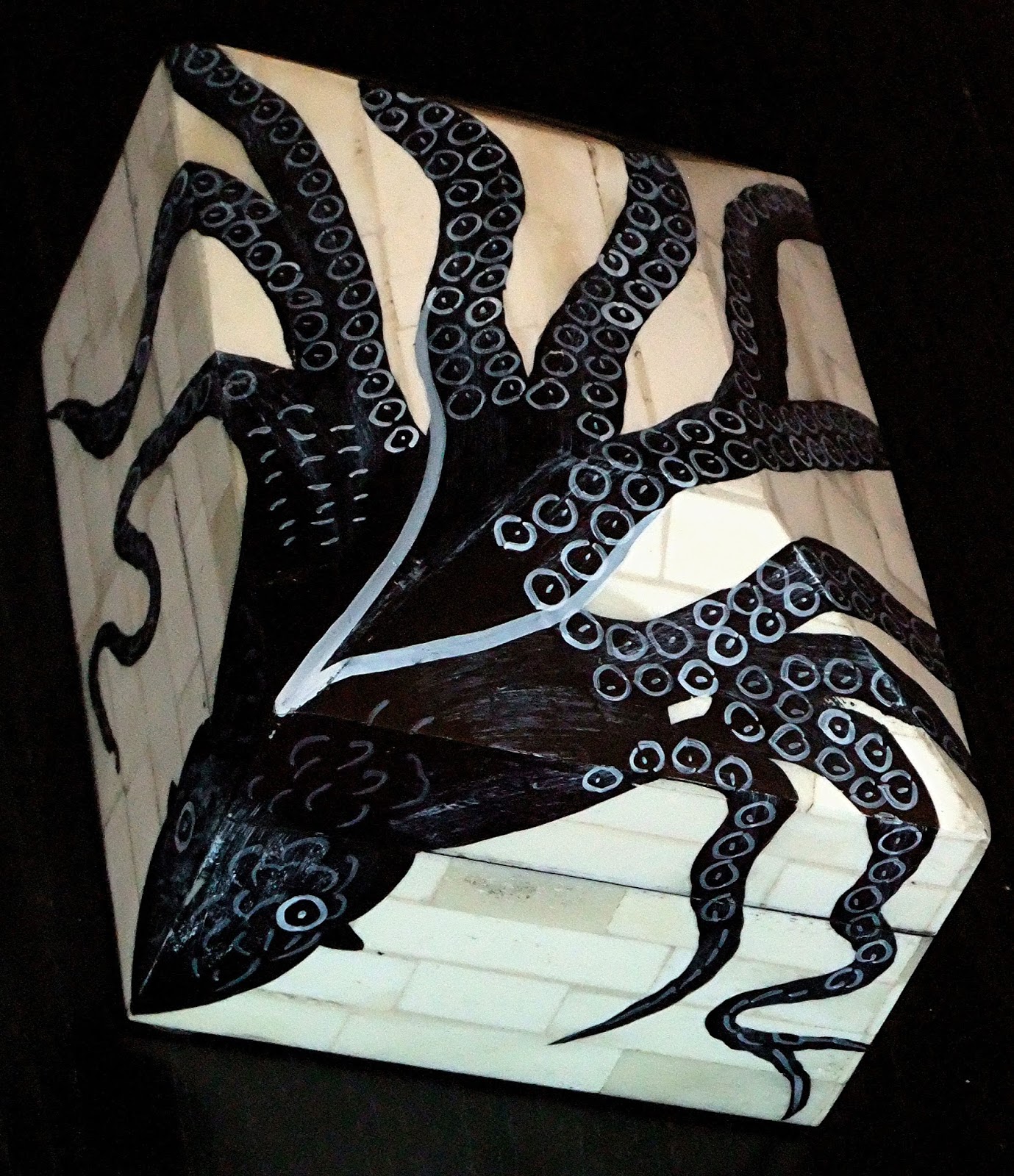
My giant octopus trinket box, inlaid with mother-of-pearl; interestingly, whether by chance or design, some of the octopus's tentacles are bifurcate (© Dr Karl Shuker)

Gargantuan octopuses have sometimes been blamed for disturbing or raiding shellfish traps placed on the seabed. One such case featured Bermudan fisherman Sean Ingham, who lost two very sizeable prawn traps to an elusive underwater plunderer between 29 August and 3 September 1984, the second of which had been snapped from its cable at a depth of 560 m. When laying some more traps 16 days later, however, he had a terrifyingly close encounter with his foe, when without warning something grabbed hold of his boat from below, and effortlessly dragged it along for more than half a kilometre before finally releasing it again. Moreover, the vessel’s sonar equipment revealed that the mysterious underwater boatnapper had been 15.5 m high and pyramidal in shape, i.e. the typical shape of an octopus, but one of gigantic proportions.

On Christmas Eve 1989, a massive octopus - “as huge as an imported cow”, according to one eyewitness, Agapito Caballero - allegedly rose to the surface and attacked a motorised canoe transporting a number of people in waters off the southern Philippines. Twelve survivors were rescued, clinging onto their overturned canoe, by some fishermen on Christmas Day. The survivors claimed that once the octopus had capsized the canoe by grabbing its outriggers, it had simply sunk back beneath the waters, without attempting to harm any of their company.

19th-Century engraving of a giant octopus attacking a ship (public domain)

Famous Roman naturalist Pliny the Elder (23-79 AD) claimed that a monstrous octopus with a barrel-sized head and tentacles 9 m long would come ashore and raid fish ponds in Rocadillo, Spain (octopuses are indeed known to leave water and cross land if necessary to capture prey). And as far back as classical times, giant octopuses have been reported from the Mediterranean. Indeed, the mythical many-armed, hole-dwelling sea monster Scylla has been claimed by some researchers to have been inspired by sightings of huge octopuses in Italian waters.

During his own investigations of reputed giant octopuses, veteran American marine biologist and amateur cryptozoologist Dr Forrest Wood collected several reports from the Bahamian island of Andros, whose blue holes (vertical underwater caves) are claimed by locals to be frequented by a monster known as the lusca, equipped with “hairy hands” that drag down any unwary human divers or bathers. Certain octopuses, known as cirrate octopuses, are characterised by tentacles bearing hair-like projections (cirri). Consequently, some cryptozoologists have suggested that the lusca may be an unknown species of giant cirrate octopus.

Supporting a link between lusca and giant octopus is a report given to Wood on Andros by an island inspector, who claimed that during a fishing trip off the island with his father, in waters approximately 180 m deep, their line seemed to snag on the sea bottom. When they looked down through the transparent water, however, they were aghast to see that in reality, the line had hooked an enormous octopus, which abruptly released the line and gripped the bottom of their boat instead! Fortunately, however, it soon let go, and sank down far below until it vanished from view.

Giant octopus as conceived by Swedish crypto-artist Richard Svensson (© Richard Svensson)

Clearly, then, there is ample circumstantial evidence on file to suggest the existence of mega-octopuses in various expanses of water around the world – but what about globsters? Do they genuinely constitute physical evidence for these creatures’ existence?

For this and other startling globster revelations, click here to check out Part 2 of this ShukerNature blog article.

Captain Nemo viewing a giant octopus – an illustration from the classic Jules Verne novel Twenty Thousand Leagues Under the Sea (public domain)