Dr KARL SHUKER

Zoologist, media consultant, and science writer, Dr Karl Shuker is also one of the best known cryptozoologists in the world. He is the author of such seminal works as Mystery Cats of the World (1989), The Lost Ark: New and Rediscovered Animals of the 20th Century (1993; greatly expanded in 2012 as The Encyclopaedia of New and Rediscovered Animals), Dragons: A Natural History (1995), In Search of Prehistoric Survivors (1995), The Unexplained (1996), From Flying Toads To Snakes With Wings (1997), Mysteries of Planet Earth (1999), The Hidden Powers of Animals (2001), The Beasts That Hide From Man (2003), Extraordinary Animals Revisited (2007), Dr Shuker's Casebook (2008), Karl Shuker's Alien Zoo: From the Pages of Fortean Times (2010), Cats of Magic, Mythology, and Mystery (2012), Mirabilis: A Carnival of Cryptozoology and Unnatural History (2013), Dragons in Zoology, Cryptozoology, and Culture (2013), The Menagerie of Marvels (2014), A Manifestation of Monsters (2015), Here's Nessie! (2016), and what is widely considered to be his cryptozoological magnum opus, Still In Search Of Prehistoric Survivors (2016) - plus, very excitingly, his four long-awaited, much-requested ShukerNature blog books (2019-2024).

Dr Karl Shuker's Official Website - http://www.karlshuker.com/index.htm

IMPORTANT: To view a complete, regularly-updated listing of my ShukerNature blog's articles (each one instantly clickable), please click HERE!

IMPORTANT: To view a complete, regularly-updated listing of my published books (each one instantly clickable), please click HERE!

IMPORTANT: To view a complete, regularly-updated listing of my Eclectarium blog's articles (each one instantly clickable), please click HERE!

IMPORTANT: To view a complete, regularly-updated listing of my Starsteeds blog's poetry and other lyrical writings (each one instantly clickable), please click HERE!

IMPORTANT: To view a complete, regularly-updated listing of my Shuker In MovieLand blog's articles (each one instantly clickable), please click HERE!

IMPORTANT: To view a complete, regularly-updated listing of my RebelBikerDude's AI Biker Art blog's thematic text & picture galleries (each one instantly clickable), please click HERE!

Search This Blog


PLEASE COME IN, I'VE BEEN EXPECTING YOU...

PLEASE COME IN, I'VE BEEN EXPECTING YOU...
WELCOME TO SHUKERNATURE - ENJOY YOUR VISIT - BEWARE OF THE RAPTOR!


Showing posts with label hobbit. Show all posts

Saturday, 14 November 2020

OVER TO THE ORANG KARDIL – SUMATRA'S 'OTHER' ORANG PENDEK?

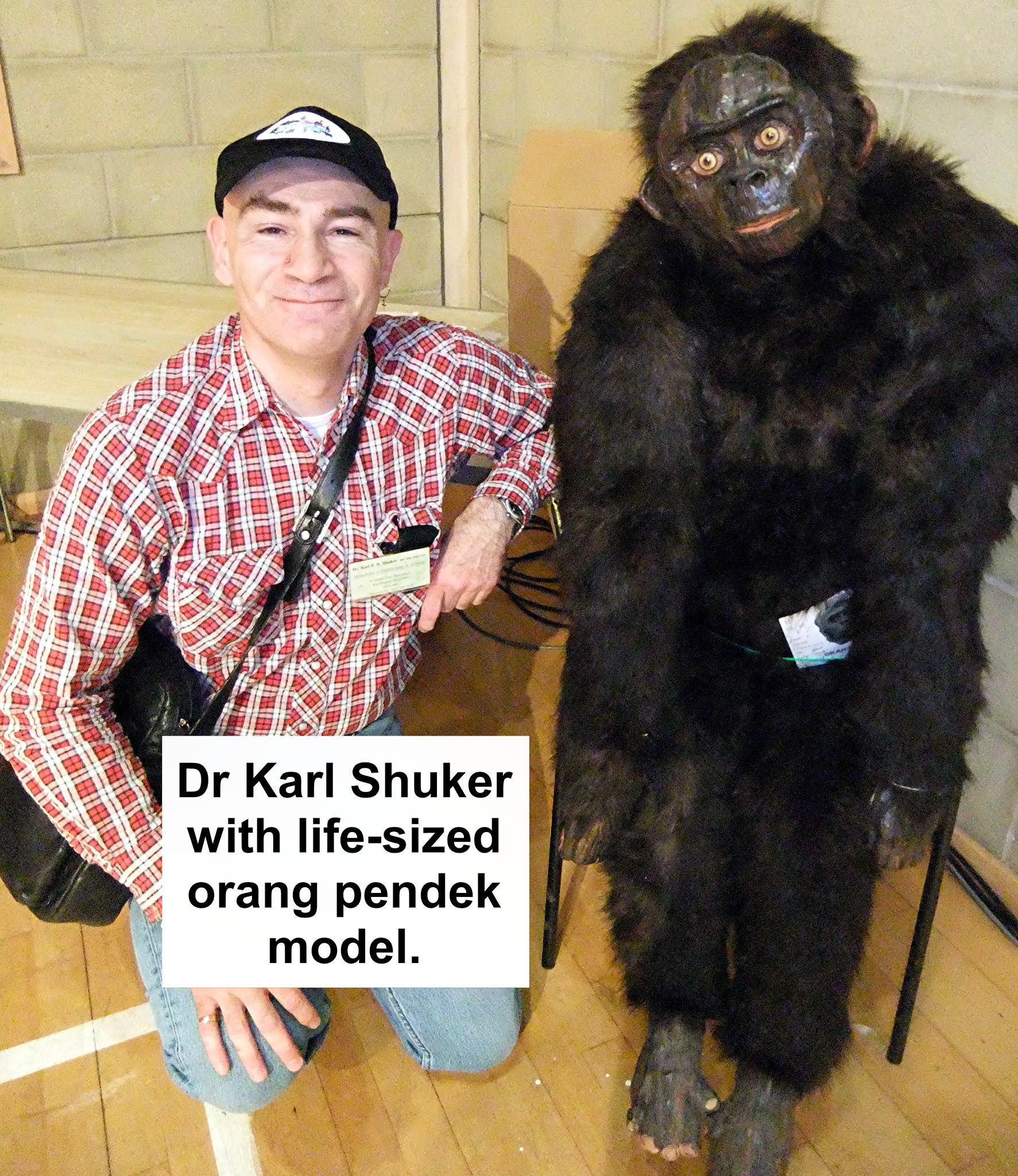
Alongside a life-sized representation of the orang pendek created for the CFZ (© Dr Karl Shuker / CFZ)

Once upon a long ago in the wonderful world of cryptozoology, only a single type of diminutive Indonesian mystery man-beast was widely reported – the orang pendek ('short man') or sedapa of Sumatra, in this southeast Asian country's Greater Sundas island group, reported by locals and Westerners alike for well over a century. Physically represented by unidentifiable hair samples and wholly distinct footprint casts, this reddish-furred, bipedal, tailless entity is usually said to stand a mere 3-4.5 ft tall.

Plaster cast of an alleged orang pendek footprint, revealing its very distinctive form (© Dr Karl Shuker)

Suggested identities on offer for the orang pendek have ranged from a terrestrial form of orang utan or gibbon to a bona fide human species, possibly even a relict representative of our own species' predecessor, Homo erectus. So far, so simple (relatively speaking).

An orang utan standing upright in the wild (© Tom Low/Wikipedia – public domain)

Then in 2003, the first skeletal remains of what, after much contention, is nowadays accepted by most researchers to have been a bona fide diminutive human species (rather than merely stunted, freak Homo sapiens) were found on the small island of Flores in Indonesia's Lesser Sundas group. Formally dubbed Homo floresiensis but known colloquially as Flores Man or the hobbit, it is believed to have only stood around 3.5 ft tall, and to have become extinct at least 50,000 years ago – or did it?

Replica skull of Flores Man aka the hobbit (© Dr Karl Shuker)

Researchers began hearing native folklore and stories concerning the ebu gogo, described not only as very short human entities but also as still very much alive in the wilder, more remote regions of Flores. If such beings really do exist, might they be living, modern-day representatives of Homo floresiensis? Some cryptozoological investigators have taken this line of speculation even further, by linking Flores Man with the Sumatran orang pendek, even though the latter seems taller and more ape-like, not to mention zoogeographically separate. But then came news of an additional component to the Indonesian man-beast/mini-human mystery that makes matters even more complex and potentially confusing.

A reconstruction of the orang pendek as a hairy ape-like biped (© Randy Merrill)

As publicised recently in a number of online articles and reports (click here to access one of them), Sumatra may also be home to a second, fundamentally different man-beast from the orang pendek, one which, moreover, is very reminiscent of the ebu gogo and, in turn, Flores Man. Known as the orang kardil (aka orang kardill), according to native testimony this entity is definitely some form of human, not ape, hunting aggressively with spears and even deemed to have killed villagers on occasion, but is even shorter in stature than the orang pendek.

Reconstruction of the possible appearance and stature of the ebu gogo compared with an average human (© Connor Lachmanec)

Consequently, is it possible that a truly miniature Indonesian species of human has existed at one time or another not just on Flores, due to its savage nature has infiltrated traditional Indonesian folklore under various local names such as ebu gogo and orang kardil, and may even still survive today in remote regions of Flores, Sumatra, and perhaps elsewhere in this multi-island country too? All of this is total conjecture, of course, but less than 20 years ago even Flores Man's own existence was entirely unknown to science.

Orang pendek, orang kardil, ebu gogo – are such entities more than just a briefly-glimpsed face in the forest? (© William M. Rebsamen)


UPDATE - 14 November 2020

Just a few hours after I uploaded my above article onto ShukerNature and posted links to it in my various Facebook groups, CFZ cryptozoologist Richard Freeman, who has led CFZ expeditions seeking the orang pendek in Sumatra, posted the following fascinating account regarding the orang kardil in my 'Beasts of Legend, Myth & Fantasy' FB group:

"Our late guide Sahar Dimus said that his father and a friend had encountered the Orang-kardill in 1981. The pair had been in a remote part of what is now Kerinci Sablat National Park trading rice for goods in isolated villages. One evening whilst camping in the jungle and cooking rice a tiny man like creature with long hair on the head but a naked body emerged from the rainforest and tried to steal the rice. Sahar's father's friend killed it with a parang (similar to a machete). Then more of the creatures ran out of the forest armed with bamboo spears and killed the man. They did not attack Sahar's father. Sahar said there had been no recent sightings of orang-kardill though there were many of orang-pendek. On my last Sumatran trip a large group of witnesses were gathered in Sahar's village close to Gunung Tuju. All had seen orang-pendek and / or its tracks but none had seen orang-kardill or had heard of any recent sightings. They were quite clear that the two were different."

Thank you so much for making this greatly-welcomed information available, Rich!


 2ND UPDATE - 15 November 2020

Earlier today, Indonesian Facebook friend Ben Haryo informed me of a third spelling for this entity's native name - 'orang kerdil'. He also informed me that the term:

"...means "dwarf" in our Indonesian language. We believe they exist as a race of very reclusive tribe of diminutive human-like creatures, but more human than spirits. Their counterparts are Tuyul who are not humans but evil genies."

Thanks very much, Ben, for these very valuable additional details!


Wednesday, 6 September 2017

DREAMCHILD AND VAMPIRES AND HOBBITS, OH MY! [an Eclectarium of Doctor Shuker crosspost]


'Kong: Skull Island' publicity poster and film still (© Jordan Vogt-Roberts/Legendary Pictures/Tencent Pictures/Warner Bros. Pictures)

I've viewed quite a number of fantasy-themed movies lately, some new, some vintage, some exceedingly obscure, but most of them offering various degrees of cryptozoological/zoomythological content and relevance. So be sure to click the link below to read my mini-reviews of these films, first published on my Facebook wall but now preserved together in my Eclectarium:

The Eclectarium of Doctor Shuker: DREAMCHILD AND VAMPIRES AND HOBBITS, OH MY!

An adult female graphorn with her calf - from 'Fantastic Beasts and Where to Find Them' (© David Yates/Heyday Films/Warner Bros. Pictures)


Friday, 3 January 2014

FLORES HOBBITS AND THE GIANT STORK OF DOOM


Homo floresiensis vs Leptoptilos robustus (© Hodari Nundu/deviantart)

I am extremely fortunate to count among my friends and colleagues a number of extremely talented artists, and the pseudonymous 'Hodari Nundu' (aka 'Justin Case') is one of these very gifted persons, as immediately demonstrated by the particularly vibrant example of his artwork presented above (click it to enlarge it), which showcases two most remarkable island-confined species.

Where on Earth would you find all within the very selfsame location a unique, Alice-in-Wonderland-reminiscent assemblage of mega-rats and mini-humans, gargantuan lizards, dwarf elephants, and gigantic storks? Only on Flores – a small island in Indonesia's Lesser Sundas group that provides some classic examples of both island gigantism and insular dwarfism.

Between 20,000 and 10,000 years ago, it was home to: two extra-large species of giant rat, Papagomys armandvillei and P. theodorverhoeveni, the former of which still survives today (and indeed, according to some researchers the latter may do too); a dwarf subspecies of elephant-related stegodont proboscidean Stegodon florensis insularis, which died out around 12,000 years ago and is the youngest stegodont form on record from southeast Asia; the Komodo dragon Varanus komodoensis, the world's largest living species of lizard, which still survives on Flores today (as well as on the neighbouring islands of Komodo, Rintja, and Padar) and undoubtedly preyed upon Flores's dwarf stegodonts; plus the two highly significant species featured in this ShukerNature article's opening illustration.

If it can't see me, it can't eat me, right? Wrong! Never under-estimate its very highly-developed sense of smell! Posing with a life-sized Komodo dragon model at Chester Zoo, England (© Dr Karl Shuker)

One of these is the now world-famous 'hobbit' – the informal nickname given to Flores Man Homo floresiensis. With its most complete recorded specimen estimated at approximately 18,000 years old, this controversial, diminutive species of hominid apparently stood little more than 3 ft tall, may be descended from Homo erectus, and is believed to represent another case of insular dwarfism. Its first scientifically-documented remains were discovered in September 2004 at Liang Bua Cave in western Flores.

Life-size replicas of Homo erectus and Homo floresiensis skulls for comparison purposes (© Dr Karl Shuker)

And the other species, whose remains were also uncovered in that very same cave, may have been one of the Flores hobbits' deadliest antagonists. It is a marabou stork, but far bigger than any of today's trio of marabou species. Yet it remained undescribed by science until as recently as 2010. Formally dubbed Leptoptilos robustus, the giant stork of Flores stood approximately 6 ft tall and weighed up to 35 lb, due to its extremely heavy leg bones – on account of which it is likely to have been predominantly if not exclusively flightless.

Even so, Smithsonian Institution palaeontologist Dr Hanneke J.M. Meijer and Dr Rokus A. Due from Jakarta's National Center for Archaeology, who jointly described its fossilised remains (dated at between 20,000 and 50,000 years old) in a Zoological Journal of the Linnean Society paper, believe that it was still theoretically capable of hunting and devouring juvenile hobbits. Having said that, there is presently no direct evidence confirming such activity; in the words of Dr Meijer as spoken during a 2010 interview with the UK's BBC television news service: "Whether or not this animal may have eaten hobbits is speculative: there is no evidence for that." Then again, as Dr Meijer also conceded in that same interview: "But can not be excluded either."

In European tradition, the stork brings newborn human babies to their parents - but in a major reversal of that benevolent role, Indonesia's giant stork of doom may conceivably have hunted down such babies (possibly even older infants too) and devoured them. Only on the topsy-turvy island of Flores!

Were the hobbits of Flores stalked by a stork? (© Inge van Noortwijk)


Wednesday, 6 November 2013

BILBO BAGGINS VERSUS THE MONGOLIAN DEATH WORM?


An unofficial, personal interpretation of the hobbit Bilbo Baggins (Richard Svensson) and a representation of the Mongolian death worm based upon eyewitness accounts (Ivan Mackerle)

The works of J.R.R. Tolkien contain a number of creatures with some pertinence to cryptozoology, such as giant spiders, dragons, and the dreaded watcher in the water (a monstrous freshwater cephalopod?). Yet perhaps the most unexpected as well as the most fascinating Tolkien reference to a cryptid, which occurs in The Hobbit (1937), is so brief and inconspicuous that it can be easily passed by or even entirely overlooked, with its cryptozoological significance not even registering upon the reader. This is a great tragedy, because, remarkable as it may seem, the mystery beast in question is none other than the extraordinary Mongolian death worm!

J.R.R. Tolkien, aged 24, photographed in 1916 when a soldier in the British Army during World War I (Public domain/Wikipedia)

In 'An Unexpected Party', which is the opening chapter of The Hobbit, the hobbit in question, Bilbo Baggins, has received an unexpected visit at his home, Bag End, from the wizard Gandalf and a company of dwarves, whom Gandalf has informed would do well to include Bilbo, as a burglar, in their planned quest to retrieve their stolen gold from the great dragon Smaug. The dwarves, however, are far from convinced that Bilbo would be serve well in this capacity, and they air their doubts very vocally in Bilbo's parlour while he is in the drawing-room (but, unbeknownst to them, still within ear-shot of their protestations). Angered by their dismissive attitude, Bilbo strides back into the parlour, and boldly proclaims that he is more than capable of fulfilling the role that they wish him to undertake:

Tell me what you want done, and I will try it, if I have to walk from here to the East of East and fight the wild Were-worms in the Last Desert

Brave words indeed, but also very puzzling ones, because they are never explained nor even referred to ever again either within this or any other Tolkien novel. They are presumably said by Bilbo in a figurative sense, to convey that he is willing to tackle anything. But even so, what exactly are the wild Were-worms that they refer to, and where was the Last Desert?

An earthworm

The term 'worm' has a number of different zoological and zoomythological meanings. Its most familiar zoological meaning is as a contraction of 'earthworm' – the common name for most terrestrial oligochaetes. However, many other, unrelated zoological invertebrate taxa that include long, elongate species also have 'worm' in their names – tapeworms, peanut worms, acorn worms, beardworms, thorny-headed worms, ragworms, roundworms, flatworms, etc etc. There are even a few worm-dubbed vertebrates, such as the slow worm Anguis fragilis (a species of limbless lizard).

In zoomythology, 'worm' is one of several related terms – others include 'orm', 'ormer', and 'wyrm' – applied to certain serpent dragons (i.e. limbless, wingless dragons that basically resemble huge serpents except for their dragon-like head), such as Britain's Lambton worm, Linton worm, and Kellington worm. This category of dragon was also often characterised by noxious breath (rather than breathing fire), and the ability to rejoin into a single entity again if cut up into segments.

In Tolkien's works, conversely, he applies the term 'worm' to a very elongate-bodied form of classical dragon, i.e. equipped with four legs, a pair of wings, and the ability to breathe fire. Smaug in The Hobbit was a prime example of Tolkien's dracontological definition of 'worm'.

My trusty 40-year-old copy of The Hobbit, featuring an early sketch by Tolkien himself of the worm Smaug on its cover (illustration © Unwin Books)

Consequently, the were-worm may be a bona fide type of invertebrate worm, albeit one of formidable size and/or temperament if it warranted being fought against (as opposed merely to being trodden upon!); or it could be a Smaug-like dragon. But what about the 'were' component of its name?

This prefix, from the Old English 'wer', generally denotes 'human' - hence a werewolf, for instance, is a human that can transform itself into a wolf, a weretiger is a human that can transform itself into a tiger, and so on. Does this mean, therefore, that a were-worm is a human that can transform itself either into a gigantic invertebrate-type worm or, perhaps more plausibly, into a dragon? Alternatively, is it a true invertebrate-type worm, or a true dragon, but one that exhibits highly advanced, human-like intelligence? Or could it even refer to a being that was half-human, half-dragon, akin in form perhaps to the ancient Indian snake deities or nagas, which possessed human heads (and sometimes thorax and arms too) but serpent bodies? Any of these solutions, however, would involve an entity of truly monstrous nature.

Figurine of a female naga, or nagini (Dr Karl Shuker)

As for the Last Desert, where these were-worms reputedly dwell: all that appears to be known about this arid realm is that according to hobbit folklore, it is located at the very easternmost end of Middle-earth, and therefore lies far to the east of the Shire where the hobbits live.

But where does the Mongolian death worm fit into all of this? As any self-respecting cryptozoologist will know, this much-dreaded cryptid allegedly inhabits the Gobi Desert, and according to the nomads living in fear of it there, it can not only squirt a lethal acidic venom at anyone confronting it, but also kill directly via touch (or even indirectly if a person touches it with an implement made of metal) in a mysterious manner that is extraordinarily reminiscent of electrocution.

Another representation of the Mongolian death worm (Thomas Finley)

Yet even the versatile death worm cannot transform into a human or vice-versa. So what connection can there be between this cryptid and Tolkien's were-worm, other than that they both inhabit deserts?

A comprehensive two-volume study of The Hobbit, entitled The History of The Hobbit, Mr Baggins, was published in 2007 by HarperCollins in the UK (and by Houghton Mifflin in the USA), containing Tolkien's unpublished drafts of The Hobbit, together with commentary written by Tolkien scholar John D. Rateliff. These drafts revealed how this novel had undergone many changes, some minor, some major, between the very first version and the final, published edition. One such change is of paramount important to the subject of this ShukerNature post, because it concerns Bilbo's statement regarding the were-worms.

It turns out that in the very first, original draft of The Hobbit, that statement made no mention at all of were-worms, or of the Last Desert. Instead, what it did state, very thought-provokingly, is as follows:

[that Bilbo would walk to] the Great Desert of Gobi and fight the Wild Wire worms of the Chinese.

How remarkable that the Last Desert as named in the final, published edition of The Hobbit was clearly inspired, therefore, by none other than the real-life Gobi Desert. And no less significant is that the ostensibly shape-shifting were-worm was apparently no such thing in the original draft of The Hobbit, being a wire-worm instead. But what did this term signify?

An Oriental dragon

In view of the reference to the Chinese, could it have referred to one of those famously serpentine-bodied Oriental dragons? However, they tend to waft languorously through the skies, or rise up from the seas or from deep freshwater pools, rather than reside in deserts, and are often viewed in ancient Eastern traditions as deities. So this identity for Tolkien's wild wire worms seems somewhat unlikely. And why, in any case, would he have applied the adjective 'wire' to such dragons?

Certainly, the term 'wire worm' is intriguing, inasmuch as in zoological parlance a wire worm is the elongate limbless worm-like larva of a click beetle, belonging to the family Elateridae. But I hardly think that Tolkien was referring to some hobbit-inimical, hyper-aggressive click beetle grub when writing of 'Wild Wire worms'.

Two species of click beetle and their respective wire worm larval form

All of which brings us, therefore, to the Mongolian death worm. This cryptozoological creature has definitely – indeed, exclusively – been reported from the Gobi Desert, and is undeniably zoologically worm-like in overall appearance (its local names, allergorhai-horhai and allghoi-khorkhoi, both translate as 'intestine worm', as it is likened by the nomads to a worm that resembles an animate intestine). But is it conceivable that Tolkien had heard of such an entity, especially way back in the 1930s? After all, Western cryptozoology itself did not become aware of it until the 1990s, when Czech explorer Ivan Mackerle began searching for and writing about the Gobi's reputed inhabitant after having researched its history in Russian and Mongolian documents.

Wood carving of a death worm-like creature in Gobi museum near Dalanzadgad, Mongolia (Ivan Mackerle)

Nevertheless, Tolkien, as a highly erudite, eclectic reader, may indeed have known of such a beast, thanks to the publication in 1926 of On the Trail of Ancient Man, written by eminent American palaeontologist Prof. Roy Chapman Andrews. This bestselling book concerns the American Museum of Natural History's famous Central Asiatic Expedition of 1922 to the Gobi, led by Prof. Andrews, in search of dinosaur fossils, but it also includes a mention of the Mongolian death worm – which as far as I am aware is the earliest such mention of it in any Western publication.

In order to obtain the necessary permits for the expedition to venture forth into the Gobi, Andrews needed to meet the Mongolian Cabinet at the Foreign Office. When he arrived, he discovered that numerous officials were attending their meeting, including the Mongolian Premier. After Andrews had signed the required agreement in order to obtain the expedition's permits, the Premier made one final but very unusual and totally unexpected request:

Then the Premier asked that, if it were possible, I should capture for the Mongolian government a specimen of the allergorhai-horhai. I doubt whether any of my scientific readers can identify this animal. I could, because I had heard of it often. None of those present ever had seen the creature, but they all firmly believed in its existence and described it minutely. It is shaped like a sausage about two feet long, has no head nor legs and is so poisonous that merely to touch it means instant death. It lives in the most desolate parts of the Gobi Desert, whither we were going. To the Mongols it seems to be what the dragon is to the Chinese. The Premier said that, although he had never seen it himself, he knew a man who had and had lived to tell the tale. Then a Cabinet Minister stated that "the cousin of his late wife's sister" had also seen it. I promised to produce the allergorhai-horhai if we chanced to cross its path, and explained how it could be seized by means of long steel collecting forceps; moreover, I could wear dark glasses, so that the disastrous effects of even looking at so poisonous a creature would be neutralized. The meeting adjourned with the best of feeling.

Call me a cynic, but I have the distinct impression that Prof. Andrews did not take the death worm too seriously. In any event, he certainly didn't succeed in finding one, which is probably no bad thing - bearing in mind that he had planned to pick up with steel forceps a creature that had allegedly killed a fellow geologist who had prodded it with a metal rod!

Prof. Roy Chapman Andrews (George Grantham Bain Collection/USA Library of Congress/Wikipedia)

During the 1920s, the American Museum of Natural History sent forth several additional Central Asiatic Expeditions to Mongolia and China, and in 1932 a major work, The New Conquest of Central Asia, was published, documenting all of them, with Prof. Andrews as its principal author. The first volume in the series Natural History of Central Asia (edited by Dr Chester A. Reeds), it contained a brief section entitled 'The Allergorhai Horhai':

At the Cabinet meeting the Premier asked that I should capture for the Mongolian Government a specimen of the Allergorhai horhai. This is probably an entirely mythical animal, but it may have some little basis in fact, for every northern Mongol firmly believes in it and will give essentially the same description. It is said to be about two feet long, the body shaped like a sausage, and to have no head or legs; it is so poisonous that even to touch it means instant death. It is reported to live in the most arid, sandy regions of the western Gobi. What reptile can have furnished the basis for the description is a mystery!

I have never yet found a Mongol who was willing to admit that he had actually seen it himself, although dozens say they know men who have. Moreover, whenever we went to a region which was said to be a favorite habitat of the beast, the Mongols at that particular spot said that it could be found in abundance a few miles away. Were not the belief in its existence so firm and general, I would dismiss it as a myth. I report it here with the hope that future explorers of the Gobi may have better success than we had in running to earth the Allergorhai horhai.

If Tolkien had read either or both of these books, and as someone passionately interested in archaeology it is by no means an unlikely possibility, then he would indeed have learnt of the dreaded death worm, whose sensational nature might very well have impressed him sufficiently to incorporate a version of this creature in his first draft of The Hobbit. Moreover, Andrews's comparison of the death worm's significance to the Mongolian people with that of the dragon to the Chinese may even have inspired Tolkien's otherwise-opaque linking of the wild wire worms to the Chinese.

Dr Jarda Prokopec and Ivan Mackerle seeking the Mongolian death worm in the Gobi Desert (Ivan Mackerle)

As for why the wild wire worms were replaced in later drafts by wild were-worms, and the Gobi Desert replaced by the Last Desert, who can say? Perhaps Tolkien felt that the latter versions were more compatible with the entirely fictitious Middle-earth than were a real desert and a semi(?)-mythical creature from Mongolian tradition referenced to in a real scientific publication.

Of course, this is all very speculative, as there is no firm evidence that Tolkien ever did read or even know of Andrews's above books, but that memorable sentence in Tolkien's original draft of The Hobbit remains a compelling enigma. And if nothing else, it conjures up the truly surreal scenario of a hobbit doing battle with the Mongolian death worm – which is surely worthy of a novel in its own right!


This ShukerNature post is excerpted from one of my current books-in-progress – The Mongolian Death Worm: Do Nomads Dream of Electric Worms? Philip K. Dick and 'Blade Runner' aficionados will need no explanation of my book's subtitle!

For the most comprehensive documentation of the Mongolian death worm ever published, see my book The Beasts That Hide From Man (Paraview: New York, 2003).




Saturday, 16 July 2011

THE HOBBIT ACTOR AND A REAL-LIFE SHELOB – OR SOMETHING PRETTY DARN CLOSE?


With my very own Shelob! (credit: Dr Karl Shuker)

British actor Dominic Monaghan has starred in many films and TV series, but is probably best-known for his role as the hobbit Merry in Peter Jackson’s spectacular ‘The Lord of the Rings’ (LOTR) trilogy of movies, based upon J.R.R. Tolkien’s monumental fantasy epic.

However, following a tip-off from a member of my regular pub quiz team (thanks Mark!; who said that pub quizzes aren’t educational?!), earlier this year I came upon a very intriguing online report previously unknown to me that suggested Dominic might have been taking his LOTR role even more seriously than expected. In LOTR, two of Merry’s fellow hobbits, Frodo and Sam, experience a life-threatening encounter with Shelob – a colossal spider. Yet whereas Shelob was fictional, the media report, which was reproduced on several websites, claimed that Dominic was planning to launch a 12-man expedition in search of a real-life mega-spider that, if proven to exist, would be the world’s largest.

Dominic Monaghan in his LOTR role as the hobbit Merry (credit: New Line Cinema Productions)

According to this report (click here to view it), which was written by Alexandru Stan and published on InOut Star’s website on 12 March 2008, the spider in question was called the hercules baboon spider, measured 14-15 inches across, and, of particular interest, was known only from a single specimen obtained in Nigeria during the early 1900s, which is now preserved in alcohol at London’s Natural History Museum.

As the Life Sciences Consultant for Guinness World Records (formerly known as The Guinness Book of Records), I am naturally well aware that the current record-holder as the world’s largest species of spider by mass is the goliath bird-eating spider Theraphosa blondi. This nocturnal burrowing species, native to wet swamps and marshy areas in the mountain rainforests of northeastern South America, boasts a leg span of up to 11 in (the diameter of a dinner plate!), and can weigh over 6 oz.

Indeed, the biggest specimen of this species on record was a 12-year-old captive female called Rosi, which sported a body length alone of 119.4 mm (4.7 in), i.e. not including its leg length, and weighed an astonishing 175 g (6.17 oz) – which is almost as heavy as six house sparrows! Consequently, any spider that allegedly exceeds these dramatic dimensions, and, as a bonus, is also virtually unknown to science, is definitely going to attract my undivided attention!

An adult female specimen of the goliath bird-eating spider Theraphosa blondi

Eager to learn more, in case Guinness’s existing record for the largest spider species by mass needed to be amended, I lost no time in researching this subject personally and also contacting a number of likely sources of further information, including the Natural History Museum itself, as well as a number of other institutions, organisations, and individuals. Over the next few weeks, a welter of information came my way, the most informative of which can be summarised as follows.

Firstly, I discovered to my surprise that in spite of the report’s claim that only a single specimen of hercules baboon spider existed, there seemed to be a veritable embarrassment of specimens out there in the pet trade, and there was even a plentiful supply of videos posted on YouTube of what were claimed to be hercules baboon spiders. Something, clearly, was amiss here – but what?

After learning of my desire to discover as much as I could regarding this enigmatic species, palaeontologist Dr Darren Naish, who shares my own interest in cryptozoological matters, sent me the following illuminating email on 16 March 2011:

"It is implicated by spider people that the things now being called 'hercules baboon spiders' are actually nothing of the sort (they're actually king baboon spiders), and that the animal that really should go with this name is indeed only known from the type specimen."

Pursuing this promising lead, I discovered that the ‘real’ hercules baboon spider is Hysterocrates hercules, which is genuinely known only from its type specimen or holotype – a female collected by a Lieutenant Abadie at Jebba in what was then Upper Niger, now Nigeria. Characterised by a black cuticle covered with a thick coating of dark olive-brown hairs, and shining with a greyish silky sheen under reflected light, as well as by having the fourth leg unthickened, this unique specimen is held at the Natural History Museum, and its species was formally described in the 14 November 1899 issue of the Proceedings of the Zoological Society of London by none other than renowned British zoologist Reginald I. Pocock.

As for the so-called hercules baboon spider specimens in the pet trade and on YouTube, these pretenders to the throne of H. hercules are indeed specimens of the related but smaller king baboon spider Pelinobius muticus (aka Citharischius crawshayi, a junior synonym), which is an East African species with a leg span of up to 8 in. So there was the first riddle concerning the hercules baboon spider duly solved.

The hercules imposter – a king baboon spider Pelinobius muticus

On 21 April, I received another very insightful email, this time from Richard Gallon, the administrator of the British Tarantula Society Study Group:

"I can confidently state that Pocock’s holotype specimen of Hysterocrates hercules (which I have measured and examined for forthcoming taxonomic papers) does not even come close to members of the genus Theraphosa in terms of leg-span or body mass.

"Pelinobius muticus females are large and bulky, but not as large as H. hercules or any Theraphosa. Indeed there are several South American genera (e.g. Pamphobeteus, Sericopelma, Lasiodora etc.) which are bigger than these African taxa."


Judging from this, Dominic’s notion that H. hercules may well be the world’s biggest spider appeared to be in error – an assumption comprehensively confirmed when I received on 21 May an email from Dr George Beccaloni of the Natural History Museum containing the following crucial details:

"With regard to the West African baboon spider Hysterocrates hercules, it is certainly very large, but the heaviest spider known is undoubtedly the 175 gram [6.17 oz] female Theraphosa blondi listed by Guinness, and the largest in terms of legspan is the giant huntsman Heteropoda maxima, from caves in Laos, which has an accurately measured maximum legspan of 300 mm [12 in]...Any claims of larger spider specimens remain to be proven - and I don't think that any baboon spider is likely to displace the current champions!"

On 3 June, Jan Beccaloni, the museum’s arachnid curator, also emailed me, kindly enclosing some information received from fellow arachnologist and theraphosid specialist Ray Gabriel from the British Tarantula Society, who stated that H. hercules is only about two-thirds the size of T. blondi.

So there it was – everyone was agreed that H. hercules was neither the heaviest species of spider nor even the species with the greatest leg span. And that seemed to be the end of the matter, until, in a subsequent email, Dr Beccaloni suggested a highly entertaining means of publicising this former controversy – by staging at the Natural History Museum a filmed comparison by volume of the type specimen of H. hercules with a suitably sizeable specimen of T. blondi, supervised by a member of the Guinness World Records (GWR) team. Needless to say, I considered this to be an excellent idea, and passed it on at once to the editor of GWR, Craig Glenday, who thought so too, and was happy to act personally in the capacity of official adjudicator.

And so it was that my original investigation of H. hercules ultimately led to a filmed ‘Battle of the Spiders’ weigh-in at the Natural History Museum later last month (June 2011), conducted by Dr George Beccaloni and witnessed by Craig Glenday for GWR. Utilising Archimedes’ Principle of liquid displacement as a means of accurately determining the volume of the challenger (the H. hercules holotype) and the defender (a hefty adult female T. blondi called Tracy, a long-deceased pet of Jan Beccaloni) as both were preserved in alcohol, the two species’ rival claims to the title of the world’s heaviest spider were finally put to the test.

The Natural History Museum’s online press release, containing a video of this historic arachnological bout, can be viewed here.

And the result? Tracy’s volume was found to be more than double that of the H. hercules holotype. In short, a straight knock-out, with T. blondi the undisputed heavyweight spider champion, retaining its title with ease.

Even so, as a nonetheless respectably (albeit not superlatively) large species yet still known only from a single specimen, H. hercules retains an air of mystique. Moreover, Dominic Monaghan never did succeed in launching an expedition to look for it. Consequently, an excellent way to bring this investigation to a satisfactory close would be for an intrepid spider seeker to pursue the hercules baboon spider in the field, as the rediscovery of this long-lost semi-Shelob is certainly long overdue! Any takers?

A model of the LOTR’s mega-spider, Shelob (credit: Dr Karl Shuker)

I wish to thank everyone who assisted me during my researches into this fascinating case, in particular Dr George and Jan Beccaloni of the Natural History Museum, Ray Gabriel and Richard Gallon from the British Tarantula Society, Craig Glenday at Guinness World Records, and Dr Darren Naish for their most welcome expertise and interest.