The Rodriguez onza (©
International Society of Cryptozoology – permission to reproduce in my writings
granted to me in perpetuity by J. Richard Greenwell, ISC Secretary)
For zoologists, the year 1986 opened in a
decidedly dramatic manner - with the apparent procurement on 1 January of a
legendary creature whose existence had been denied by science for centuries.
That evening, Mexican ranger Andres Rodriguez Murillo surprised a very large cat
close to his home in the valley behind Parrot Mountain, in Mexico's Sinaloa
State. Fearing that it was a jaguar about to attack him, he shot it, but when
he examined its body he found that it was neither a jaguar Panthera onca
nor a puma Puma concolor - the only other large felid 'officially'
existing in Mexico.
It did resemble a puma superficially, but
its limbs were longer and its body was more slender, giving it a cheetah-like
outline; in addition, its ears were unusually big, and the inner surfaces of
its forelimbs bore dark markings not possessed by pumas. As Rodriguez had
little knowledge of wildlife, he contacted an expert hunter by the name of
Manuel Vega to come over and identify it for him. When Vega arrived, he felt
sure that he recognised the cat - identifying it as an onza, the fabled third
large cat of Mexico.

The puma (top) and the jaguar
(bottom) – Mexico's two official large cats (public domain)
The onza's existence within the rugged
mountainlands of the Sierra Madre Occidental is supported by more than 300
years' worth of local eyewitness accounts (even including the testimony of
visiting missionaries and Jesuit priests) from Sinaloa and also Sonora. Yet
these had always been dismissed by zoologists as reports of poorly-seen or misidentified
pumas.
Conversely, back in the 18th Century
accounts of this controversial creature appeared in the works of several of
Mexico's learned Jesuit scholar-priests. They recorded that the onza is greatly
feared by ranchers and peasants, and is said to be an unusually aggressive
animal, far more dangerous than either the burly jaguar or the diffident puma,
but far more elusive too.

However, it may be that the onza's history can
be traced back even further than this. According to Spanish conquistador Bernal
Diaz del Castillo, in 1519 the famous zoo owned by the Aztec king Montezuma
contained two types of 'lion' (puma). One was the normal puma, but the other
was a much more mystifying cat that supposedly resembled a wolf. As wolves have
noticeably longer legs than pumas, was this unidentified animal the onza? Further
details concerning the onza's early history are given in my book Mystery Cats of the World.
Some 20th-century accounts of
alleged onzas had actually been supported for a short time by complete
specimens, though in every case these were somehow lost or destroyed. In spring
1926, for example, hunter-cowboy C.B. Ruggles trapped and killed a supposed
onza southeast of Yaqui River in Mexico's Sonora State. After taking some
photos of its carcase, and noting that it had very skinny hindquarters, with
dark spots on the inner side of its limbs, Ruggles discarded it. A few years
later, American naturalist J. Frank Dobie reported shooting an onza caught in
traps set on Mexico's Barrancas de la Viboras; regrettably, its skin was
subsequently devoured by bugs.

Clell and Dale Lee posing
with their hunting dogs alongside the carcase of the Shirk onza
(© International Society of Cryptozoology –
permission to reproduce in my writings granted to me in perpetuity by J. Richard
Greenwell, ISC Secretary)
In 1938, while in the company of renowned
hunters Dale and Clell Lee from Arizona, Indiana banker Joseph Shirk shot an
onza on Sinaloa's La Silla Mountain; photos show that, as with all of the
others, it resembled an extremely gracile, long-limbed puma with big ears and
unusual limb markings. Although much of its carcase was discarded, its skull
was retained - only to vanish without trace when sent to a museum whose name,
frustratingly, does not appear to have been placed on record. The dead body of
a large unidentified felid that may well have been an onza was taken to Texas
University in the late 1950s, but this cannot be traced either.
J. Richard Greenwell, at that time the
secretary of the International Society of Cryptozoology (ISC), who had a
particular interest in the onza, succeeded in locating two onza skulls - one
from a specimen shot in 1938 on La Silla Mountain by R.R.M. Carpenter while
accompanied by Dale and Clell Lee (thus providing a remarkable parallel to the
history of the Shirk specimen), the other from an onza shot by Jesus Vega
(father of Manuel Vega) in much the same area sometime during the mid-1970s
(this skull is now owned by rancher Ricardo Urquijo).
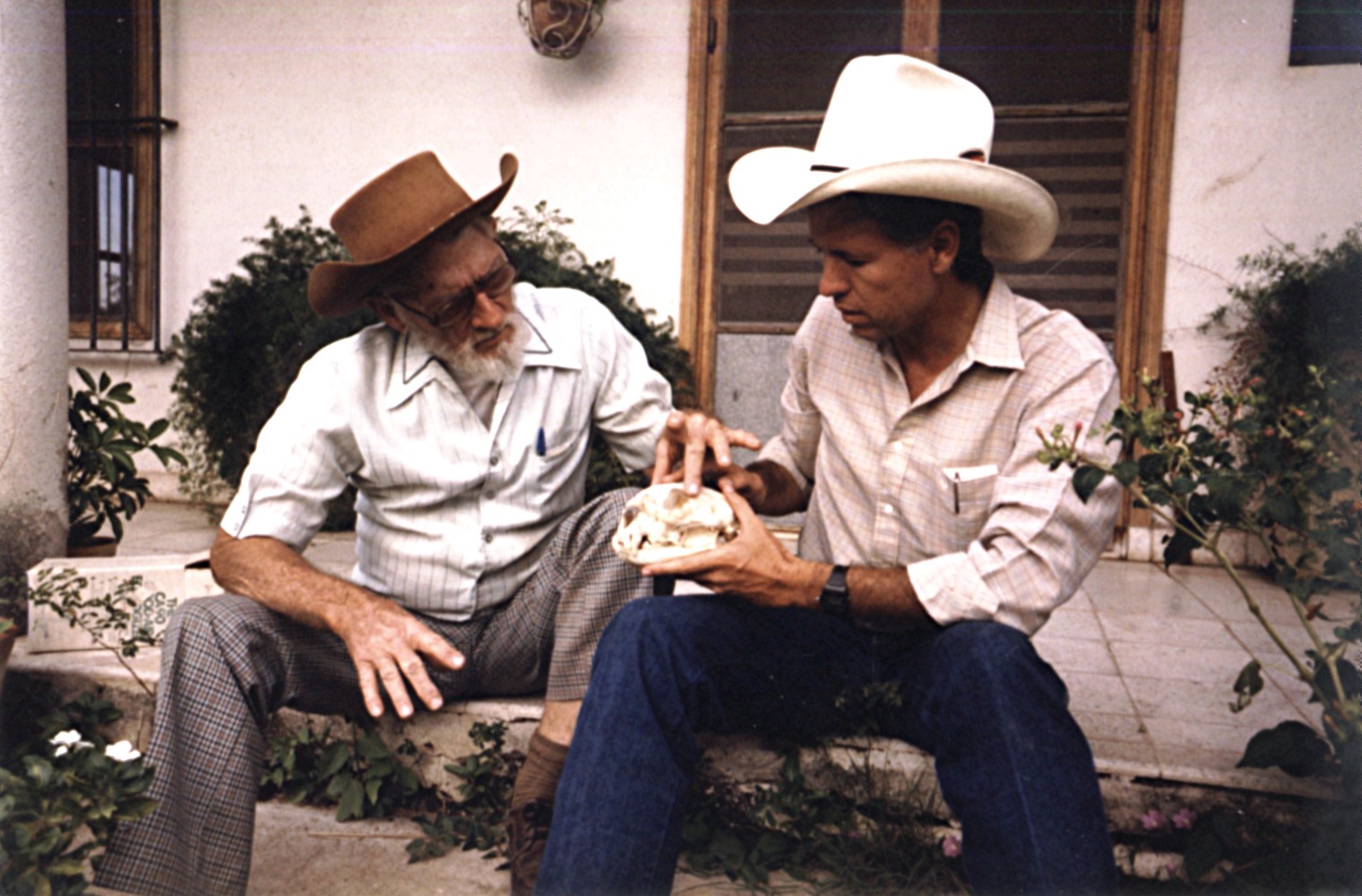
Robert E. Marshall and
Ricardo Urquijo with the Vega onza skull (© International Society of
Cryptozoology – permission to reproduce in my writings granted to me in
perpetuity by J. Richard Greenwell, ISC Secretary)
Additionally, another onza investigator,
Arizona hunter Robert E. Marshall, was successful in obtaining the incomplete
skull (its lower jaw was missing) of an onza shot during the 1950s at Los
Frailes, Sinaloa. Marshall was also the author of The Onza – published
in 1961, it was the first book devoted to this cryptid; a second, Onza! The
Hunt For a Legendary Cat, written by Neil B. Carmony, was published in
1995. Both make fascinating reading, and I highly recommend them to anyone
interested in cryptozoology.
Around the time of the shooting of the
Rodriguez specimen in January 1986, an onza was allegedly captured alive,
and held for several days in captivity at a ranch in northern Sonora, where it
was supposedly photographed too. Tragically, however, when no-one showed any
interest in it, its owner shot it and threw its body away. As for the
photographs, these have yet to make a published appearance. And in early 1987,
yet another onza was reportedly shot in Sinaloa, this time by a wealthy
Mazatlan businessman; but, true to form, its remains were not preserved.

Robert E. Marshall's book The
Onza (© Robert E. Marshall/Exposition Press – reproduced here on a strictly
educational, non-commercial Fair Use basis only)
In short, with the exception of three
skulls, physical remains of onzas have displayed a disconcerting tendency to
disappear beyond the reach of scientists. The Rodriguez specimen, however,
changed all of that - for instead of destroying its remains, the ranchers
contacted Richard Greenwell. Following a complex series of interchanges, the
precious specimen was transported to the Regional Diagnostic Laboratory of
Animal Pathology, belonging to Mexico's Ministry of Agriculture and sited in
Mazatlan, Sinaloa.
There it was painstakingly studied and
dissected by a biological team headed by American puma researcher Dr Troy Best,
who had been working alongside Greenwell during his earlier onza
investigations. After the dissection, extensive samples of skeletal material,
tissues, and blood were taken for examination and analysis in various U.S.
research institutions, in a bid to uncover the onza's taxonomic status. Several
different taxonomic identities have been offered over the years, but the
principal four are as follows.

Neil B. Carmony's book Onza!
(© Neil B. Carmony/High-Lonesome Books – reproduced here on a strictly
educational, non-commercial Fair Use basis only)
The most exciting possibility is that it
could be a currently undescribed species - one that quite conceivably descended
from the typical puma, but later diverged from it to fill the ecological niche left
vacant by the extinction approximately 11,000 years ago of Miracinonyx
trumani - an extraordinary felid now known to have been a true American
cheetah (it was first classed as a cheetah-like puma). Indeed, German felid
specialist Dr Helmut Hemmer initially mooted that the onza may actually be a
surviving representative of Truman's cheetah, but after studying casts of two
onza skulls and comparing them with fossil material from M. trumani, he
changed his mind. However, regardless of whether it is even related to (let
alone synonymous with) Truman's cheetah, if the onza is indeed a valid species
in its own right it should be distinguishable from the puma via the biochemical
and genetic analyses conducted by those researchers studying the Rodriguez
specimen (see below).
Another intriguing, frequently-raised
possibility is that the onza is a naturally-occurring hybrid of puma and
jaguar (i.e. either a pumajag or a jaguma). No evidence for this identity was obtained, however, from examination
of the Rodriguez specimen. In any case, hybrids of this type that have been
bred in captivity bear no resemblance to onzas, appearing visibly intermediate between
puma and jaguar instead.

Artistic representation of a
Truman's cheetah attacking a pronghorn (© Hodari Nundu)
Two rather more conservative but still-interesting identities
remain. The onza may simply be a mutant, non-taxonomically distinct form of the puma, the result of a
genetic aberration that has yielded an uncommonly slim, leggy variety. If so, could it even be that an atavistic phenotype-influencing gene surviving from the period of shared ancestry by pumas and cheetahs but suppressed in normal pumas is somehow expressing itself in onza specimens, i.e. is responsible for 'onzaism' in pumas? If we take the Rodriguez specimen as a bona fide onza, the onza's
gracility is, indisputably, a natural facet of its appearance (rather
than starvation-induced emaciation), because this specimen was found
to possess adequate amounts of body fat. Genetically-induced onzaism may be confined to Mexico due to genetic drift; then again, as I noted in my 1989 mystery cats book, onza-like cats have also been reported from South America, so if the onza is indeed a freak non-taxonomic variety of puma, perhaps the mutant onza-inducing gene (should it exist) is more widely distributed among the global puma population after all. If not a genetic freak, the onza could
be a separate subspecies of puma, kept apart from the Mexican puma Puma concolor
azteca by behavioural differences and dissimilar habitat preferences. If
the last-mentioned identity were the correct one, however, then once again (as
with the possibility that it is a separate species) we would expect the onza to
be distinguishable biochemically and genetically from other pumas. But is it?
Early biochemical tests had failed to
uncover any characteristics differentiating the Rodriguez specimen from pumas,
which would seem to suggest that onza and puma are very closely related. Yet
this conclusion stems from a fundamental assumption that, although widely
accepted in the zoological (and especially the cryptozoological) community, has
never actually been confirmed. Namely, that the onza specimen whose tissues
provided these biochemical results, i.e. the Rodriguez specimen, really was
an onza!

Illustration of a pair of
pumas (© William M. Rebsamen)
However, is it conceivable that Manuel Vega
had been mistaken, and that this animal had merely been a malformed or infirm
puma that only outwardly resembled a genuine onza? After reflecting upon this
disturbing possibility for some time, in January 1998 I heretically aired it
within an onza article of mine published in the British monthly magazine All
About Cats – and it seems that my suspicions may indeed have been justified.
Only a few months after my article had
appeared in print, the much-delayed volume of the ISC's scientific journal Cryptozoology
covering the years 1993-1996 was finally published, and contained a report by a
research team featuring Prof. Stephen O'Brien, an expert in feline molecular
genetics. The team's report revealed that after conducting comparative protein
and mitochondrial DNA analyses using tissue samples taken from the Rodriguez
onza and from specimens of known North American cat species, the results
obtained for the Rodriguez onza were found to be indistinguishable from those
of North American pumas. Of course, this does not necessarily mean that all onzas
are pumas, but how savagely ironic it would be for the most celebrated supposed onza
specimen not to have been an onza after all.

Cutting from the Arizona Daily Star (Tucson) newspaper dated 1 October 1938, featuring the then newly-snapped
photograph of Clell and Dale Lee with the Shirk onza - the first onza photo ever published in the USA (© International Society
of Cryptozoology – permission to reproduce in my writings granted to me in
perpetuity by J. Richard Greenwell, ISC Secretary)
On 15 April 1995, an alleged male onza was
shot behind Parrot Mountain, this time by rancher Raul Jiminez Dominguez. Later
that same day, after having been frozen, the onza's corpse was examined by two
biologists from the Universidad Nacional Autonoma de Mexico, who took tissue
samples away with them for electrophoretic analysis. The remainder of its
carcase was preserved and dissected at Mazatlan for future study. Frustratingly,
no further information has been made public concerning this specimen, but let
us continue to hope that it will eventually provide a precise, unequivocal
answer to the longstanding question of the onza's taxonomic identity.
Meanwhile, Mexico's feline enigma seems
destined to remain a cryptozoological controversy - a far cry indeed from its
popular yet sadly premature image as an erstwhile mystery cat whose reality is
no longer in doubt.

Drawing of the onza (© Hodari
Nundu)
Finally: please be aware that certain early
20th-Century animal encyclopaedias contain photographs of
jaguarundis Puma yagouaroundi labelled as onzas (confusingly, this
species is indeed sometimes termed an onza in certain Mexican states, including
Jalisco). Nevertheless, anything less like the very large, long-limbed onza of
cryptozoology than the much smaller, short-limbed jaguarundi of mainstream
zoology would be difficult to imagine.
Having said that: in 2016, Mexican Facebook
friend and artist Hodari Nundu revealed that he once saw in Jalisco a dead
specimen of what he refers to as a 'giant' jaguarundi. And he subsequently
learnt of a possible second location for such specimens, but he has refrained
from publicly identifying this location in order to keep these cats safe if any
do indeed exist there, noting only that it is a very long distance from
Jalisco. This indicates that if other extra-large jaguarundis do occur in
Mexico, they may be relatively widespread. Moreover, if they are of this
species' dark-grey/black colour phase, such cats may even explain reports here
of mystery 'black panthers'.

Jaguarundi, grey colour phase
(© Bodlina/Wikipedia – CC BY 3.0 licence)
This ShukerNature blog article is adapted from my book The Encyclopaedia of New and Rediscovered Animals – the most comprehensive book ever published on the subject of such creatures.


 Posts
Posts