Dr KARL SHUKER

Zoologist, media consultant, and science writer, Dr Karl Shuker is also one of the best known cryptozoologists in the world. He is the author of such seminal works as Mystery Cats of the World (1989), The Lost Ark: New and Rediscovered Animals of the 20th Century (1993; greatly expanded in 2012 as The Encyclopaedia of New and Rediscovered Animals), Dragons: A Natural History (1995), In Search of Prehistoric Survivors (1995), The Unexplained (1996), From Flying Toads To Snakes With Wings (1997), Mysteries of Planet Earth (1999), The Hidden Powers of Animals (2001), The Beasts That Hide From Man (2003), Extraordinary Animals Revisited (2007), Dr Shuker's Casebook (2008), Karl Shuker's Alien Zoo: From the Pages of Fortean Times (2010), Cats of Magic, Mythology, and Mystery (2012), Mirabilis: A Carnival of Cryptozoology and Unnatural History (2013), Dragons in Zoology, Cryptozoology, and Culture (2013), The Menagerie of Marvels (2014), A Manifestation of Monsters (2015), Here's Nessie! (2016), and what is widely considered to be his cryptozoological magnum opus, Still In Search Of Prehistoric Survivors (2016) - plus, very excitingly, his four long-awaited, much-requested ShukerNature blog books (2019-2024).

Dr Karl Shuker's Official Website - http://www.karlshuker.com/index.htm

IMPORTANT: To view a complete, regularly-updated listing of my ShukerNature blog's articles (each one instantly clickable), please click HERE!

IMPORTANT: To view a complete, regularly-updated listing of my published books (each one instantly clickable), please click HERE!

IMPORTANT: To view a complete, regularly-updated listing of my Eclectarium blog's articles (each one instantly clickable), please click HERE!

IMPORTANT: To view a complete, regularly-updated listing of my Starsteeds blog's poetry and other lyrical writings (each one instantly clickable), please click HERE!

IMPORTANT: To view a complete, regularly-updated listing of my Shuker In MovieLand blog's articles (each one instantly clickable), please click HERE!

IMPORTANT: To view a complete, regularly-updated listing of my RebelBikerDude's AI Biker Art blog's thematic text & picture galleries (each one instantly clickable), please click HERE!

Search This Blog


PLEASE COME IN, I'VE BEEN EXPECTING YOU...

PLEASE COME IN, I'VE BEEN EXPECTING YOU...
WELCOME TO SHUKERNATURE - ENJOY YOUR VISIT - BEWARE OF THE RAPTOR!


Showing posts with label mapinguary. Show all posts

Thursday, 22 December 2022

A SOUTH AMERICAN LEMUR AND A MODERN-DAY GROUND SLOTH? A PAIR OF PUZZLING ANIMAL PORTRAITS IN AN 18TH-CENTURY ARTISTIC MASTERPIECE

Madagascan black-and-white ruffed lemur (© Dr Karl Shuker)

Down through the years, I've investigated a number of mystifying animal artworks, depicting species before they were officially discovered by science, or in locations far removed from where they are officially known to exist. Examples from the former category include various anachronistic representations of kangaroos (one of which I documented in my book The Unexplained, 1996); and the following case is a prime example (but one hitherto undocumented by me) from the latter category. So I am greatly indebted to correspondent Cristian Nahuel Rojas Mendoza for very kindly bringing it to my attention, on 17 December 2022, and which I lost no time in subsequently investigating – thanks, Cristian!

The work of art containing the portrayed out-of-place animal in question is a magnificent yet surprisingly little-known pictorial encyclopaedia in the form of a spectacular mural, entitled Quadro de Historia Natural, Civil y Geografica del Reyno del Peru ('Painting of the Natural, Civil and Geographical History of the Kingdom of Peru'), or QHNCGRP for convenience hereafter in this present ShukerNature blog article of mine. Consisting of numerous miniature oil paintings and accompanying text on a wood panel, it measures a very impressive 128 x 45.25 inches (325 x 115 cm).

QHNCGRP was authored by Basque-born but (for three decades) Peru-based scholar José Ignacio Lequanda, who commissioned French artist Louis Thiébaut to produce the paintings illustrating it, and it was completed in Madrid in 1799 (click here for an extensive article by Daniela Bleichmar documenting its history and contents).

Today, this unique creation is held and displayed at the Museo Nacional de Ciencias Naturales in Madrid, Spain (constituting Spain's national museum of natural history), which has produced an exquisite,  lavishly-illustrated website devoted specifically to it (click here to visit the website). I strongly recommend that you access this site while reading my article here, in order to appreciate fully the nature, context, content, and visual beauty of this truly extraordinary, combined work of art and scholarship, and in particular the two items from it under consideration here.
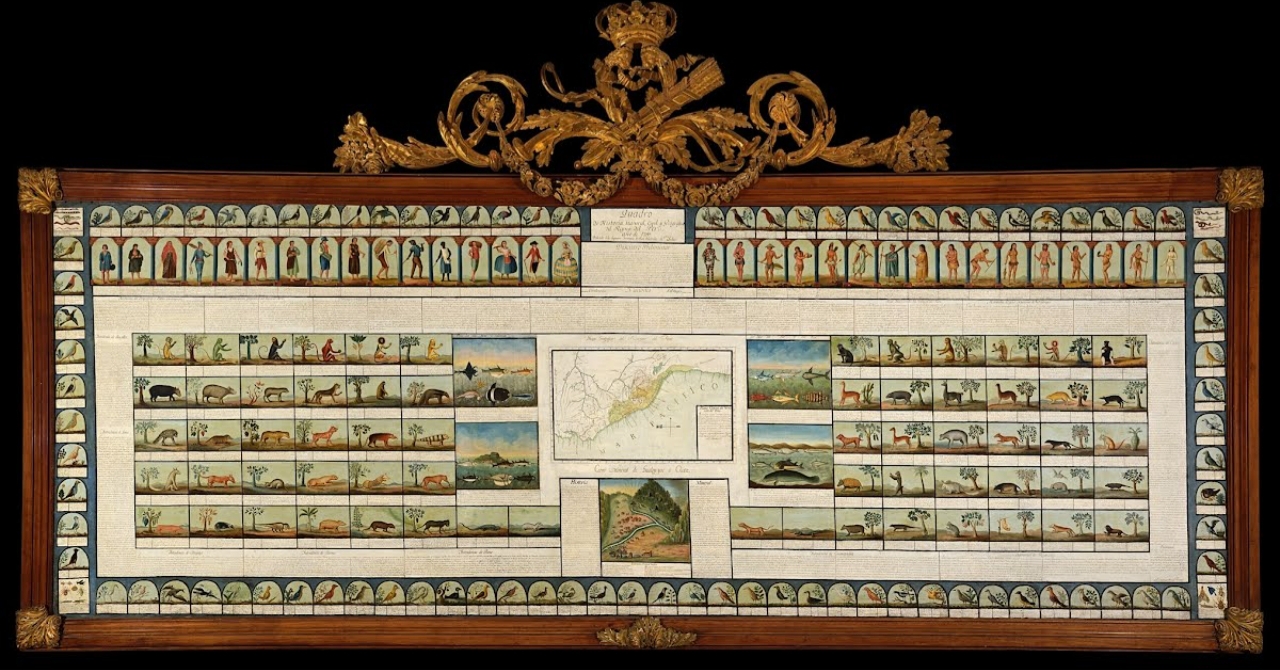
 
View of QHNCGRP in its entirety click to enlarge for viewing purposes (© Museo Nacional de Ciencias Naturales – reproduced here on a strictly non-commercial Fair Use basis for educational/review purposes only)

Containing a grand total of 194 individual images, QHNCGRP presents a picture-driven history of the peoples, animals, and plants of Peru (or, in a few cases, Peru's South American environs). At its centre there is an annotated map of the country, depicting, describing, and delineating its various administrative divisions in different colours, as well as a picture of the mine of Hualgayoc or Chota, emphasizing the significance of mining to Peru at that time.

Constituting the outermost border or frame of QHNCGRP is a series of 88 miniature paintings, each depicting a different Peruvian bird and plant, plus four corner miniatures portraying Peruvian insects and reptiles. And running horizontally directly below the uppermost edge of this ornithologically-themed border is a row of 32 miniatures portraying various human forms, including indigenous peoples and Western couples in various costumes.

Below these, and forming a second, internal frame, is a series of numerous compartments containing Lequanda's tiny but voluminous handwritten text (he also added a descriptive label beneath each animal miniature, and considerable text around the mine picture). Within this second frame are not only four large and four smaller pictures depicting Peruvian aquatic animals but also (split into a left-hand block and a right-hand block of 30 each) a series of 60 miniature paintings, again depicting Peruvian animals. Well, 59 of them are…

As for the 60th: This is the creature portrayed in the miniature present at the right-hand end of the top row in the right-hand block of 30 animal pictures. It seems to have been painted with especial precision by Thiébaut in comparison with certain other of the animals portrayed by him in QHNCGRP, and was labeled here by Lequanda as a mountain-abounding 'Dominican monkey'.


The so-called 'Dominican monkey' miniature painting in close-up; and also shown (arrowed, top row) in situ within QHNCGRP click to enlarge for viewing purposes (public domain)

In reality, however, as anyone even remotely versed in mammalian identification will readily confirm, this particular creature, its distinctive monochrome form being both instantly recognizable and wholly unmistakable, is actually a black-and-white ruffed lemur Varecia variegata, the species depicted in the photograph opening this ShukerNature article, and which is of course endemic to Madagascar! No lemurs of any kind occur anywhere in the New World.

So why is there a portrait of a Madagascan lemur in QHNCGRP, which is exclusively devoted to Neotropical natural history and culture?

The most reasonable explanation, indicated by Lequanda's accompanying text (and also noted by Bleichmar in her afore-mentioned article), stems from his great familiarity with the contents of Madrid's prestigious – and exceedingly prodigious – Royal Natural History Cabinet, which was founded in 1771 and opened to the public in 1776. For within its collection of zoological specimens was none other than a preserved example of the black-and-white ruffed lemur. As this collection would have been consulted by both Lequanda and Thiébaut during their joint preparation of QHNCGRP, one or both of them presumably assumed mistakenly that the lemur specimen was of South American origin, and thus its striking appearance was incorporated accordingly within QHNCGRP. But that is not all.

There is a second animal miniature in QHNCGRP that also attracted my interest and attention when perusing the latter's artworks. If you want to seek out this picture in QHNCGRP, it's the second miniature along in the fourth row within the right-hand block of 30 animal miniatures. Or, to make things simpler, here it is:


The so-called 'Nonga' miniature painting in close-up; and also shown (arrowed, fourth row) in situ within QHNCGRP click to enlarge for viewing purposes (public domain)

According to Lequanda's accompanying text, the Nonga lives on the banks of the River Huallaga (whose source is in central Peru), and is a nocturnal creature greatly feared by the Indians, but which according to Lequansda seems to be a forest spirit rather than a real entity.

When I first looked at this creature, I thought straight away that it resembled a tree sloth in basic outward morphology. But tree sloths do not stand upright, nor are they greatly feared by natives, and far from being forest spirits they are very familiar members of the corporeal animal community throughout the Neotropical zone.

However, their extinct relatives the ground sloths did stand upright, might well be greatly feared by natives due to their very large size and huge claws, especially if they happened to be ill-tempered creatures, readily becoming aggressive if threatened, and, like many other belligerent beasts, may indeed be deemed by their human neighbours to be supernatural spirits as much as flesh-and-blood animals.

So could this miniature by Thiébaut be a depiction of a modern-day, scientifically-undiscovered ground sloth? Certain South American cryptids, such as the ellengassen and (especially) the mapinguary, are already looked upon by some cryptozoologists and zoologists as potentially constituting surviving ground sloths.

 
Image of a ground sloth (public domain)

Unfortunately for such romantic speculation, however, the depicted creature's tiny tail is much more comparable with that of a three-toed tree sloth (two-toed tree sloths are tailless) than with the fairly long and very sturdy caudal appendage exhibited by bona fide ground sloths, which they used for support and balance when squatting upright.

Consequently, my personal opinion is that this mystifying miniature painting was based upon a preserved three-toed tree sloth, but whose normal behaviour of hanging upside-down from tree branches was not known to Liébaut, so he portrayed it incorrectly as a bipedal beast instead, thereby inadvertently recalling its officially extinct terrestrial relatives.

Nor are a misplaced Madagascan lemur and a suspect sloth of the terrestrial variety the only zoological oddities to be found in QHNCGRP click here for a continuation of this investigation, in which I reveal all manner of additional animals of the decidedly anomalous kind lurking incognito within its miniature masterpieces!

My sincere thanks once again to Cristian Nahuel Rojas Mendoza for alerting me to QHNCGRP and, in so doing, adding another very intriguing zoogeographical anomaly from the art world to my archive of such examples. For an extremely extensive account of putative living ground sloths, be sure to check out my book Still In Search Of Prehistoric Survivors.


Tuesday, 8 March 2016

THE YUKON BEAVER EATER, AND GROUND SLOTHS IN NEW ZEALAND?


Restoration of Megatherium (Wikipedia/Public domain)

When we think of sloths, we generally picture those famously sluggish, dog-sized, tree-dwelling beasts that spend much of their time hanging upside-down from branches in modern-day Central and South America. Millions of years ago, however, there were several additional, very different morphological types – of which the most famous and dramatic were the ground sloths.

Most of these were primarily terrestrial, some were rather bovine in appearance but with shaggy fur, and many were considerably larger than their arboreal relatives. Although principally quadrupedal, ground sloths were capable of squatting erect on their hind legs to browse upon high-level foliage, and their distribution range included not only tropical mainland Latin America, but also North America as well as various of the Caribbean islands.

There were four separate taxonomic families containing ground sloths. The largest species were the megatheriids, typified by Megatherium ('big beast') from the Pleistocene of Patagonia, which attained the size of an elephant (recently split from the megatheriids into their own taxonomic family are the nothrotheriids). At the other extreme were the megalonychids, some being the smallest of all ground sloths, but also including the ox-sized Megalonyx ('big claw'), which earned its name from the huge claw on the third toe of each of its hind feet. This latter family also contains today's two-toed tree sloths.

Skeleton of Megatherium (© Dr Karl Shuker)

Intermediate in size between the above groups of ground sloth were the mylodontids - which are of particular cryptozoological interest. For although the last representatives of all types of ground sloth officially died out several millennia ago, reports of mysterious creatures resembling these supposedly bygone beasts have emerged from several different Neotropical locations in modern times - including in particular some compelling evidence to suggest that Brazil may harbour a species of living mylodontid, eluding scientific discovery yet well known to the native people sharing its secluded jungle domain, referring to this cryptid as the mapinguary.

Moreover, certain putative ground sloths living in modern times have been reported from localities outside the Neotropics, including the following pair of hitherto little-known examples.


THE SAYTOECHIN OR YUKON BEAVER EATER

In September 1989, the then recently-formed British Columbia Scientific Cryptozoology Club (BCSCC) was contacted by a Canadian First Nation member named Dawn Charlie concerning a mysterious beast featuring in their oral traditions relating to Yukon's wildlife. The beast in question was referred to as the saytoechin (which translates as 'beaver eater'), and was described as being bigger than even the biggest grizzly bear, and feeding principally upon beavers, which it apparently captured by flipping up their lodges and then seizing the exposed beavers inside. When Native Americans living in the area were shown a book of extinct mammals, they selected an illustration of a ground sloth as the saytoechin, and the most recent reported sighting of one dates from the mid-1980s. As documented in 1990 by BCSCC co-founder Prof. Paul LeBlond in #4 of the Club's newsletter after interviewing Dawn Charlie, the details given by her concerning this sighting are as follows:

The latest report was from Violet Johny, my husband’s sister, who was fishing with her husband and her mother at the head of Tatchun Lake 4 or 5 years ago.  An animal came out of the woods, 8 or 9 feet high, bigger than a grizzly bear.  It was a “saytoechin” and it was coming towards them.  They panicked, fired a few shots over its head and finally managed to get the motor going and took off.  There are other reports.  There is also a report that a white man shot one in a small lake in that area.  Beaver eaters are supposed to live in the mountainous area east of Frenchman Lake.

Although ground sloths are generally thought of as tropical Latin (particularly South) American creatures, before their official extinction at the end of the Pleistocene some species had migrated northwards and had indeed established themselves in parts of North America. At least five genera are currently represented by fossils discovered in various locations here, including a single species, Megaloynx jeffersonii, in Yukon.

Life-sized restoration of Megalonyx jeffersonii in life, at the Iowa Museum of Natural History (© Bill Whittaker/Wikipedia)

So in terms of zoogeography alone, a Yukon ground sloth is already known, but obviously a living one is another matter entirely – as is the saytoechin's apparent dietary proclivity for beavers. This is because according to traditional palaeontological belief, all forms of terrestrial non-aquatic ground sloth were exclusively herbivorous. Having said that: in 1996, Drs Richard Fariña and Ernesto Blanco from the Universidad de la República in Montevideo, Uruguay, published a thought-provoking if controversial paper in the Proceedings of the Royal Society, in which they proposed that Megatherium could have used its fearsome claws to overturn, stab, and kill glyptodonts as prey.

From analysing a Megatherium skeleton, Fariña and Blanco discovered that its olecranon (the elbow portion to which the triceps muscle attaches) was very short. This adaptation is found in carnivores, and optimises speed rather than strength. These researchers opined that this would have enabled Megatherium to use its claws like daggers, and they suggested that it may have commandeered kills made by the sabre-tooth Smilodon in order to add nutrients to its diet (such behaviour is known as kleptoparasitic). Moreover, based upon the estimated strength and mechanical advantage of its biceps, they proposed that Megatherium could have overturned adult glyptodonts as a means of scavenging or hunting them.

However, this proposal has not gained widespread acceptance. In particular, palaeontologist Dr Paul S. Martin considers it "fanciful", noting that in terms of their dentition, ground sloths lack the carnassials that characterise predators, and that to suggest even that they were scavengers (let alone predators) is a reach. In addition, ground sloth dung deposits studied by him in Arizona's Grand Canyon and also in caves in Nevada, New Mexico, and western Texas contained no traces of bone. So far, therefore, at least as far as the palaeontological world is concerned, the case for carnivorous ground sloths in the past (not to mention in the present) has yet to be convincingly made.

Exquisite vintage illustration of Megatherium, from Extinct Monsters - A Popular Account of Some of the Larger Forms of Ancient Animal Life, 4th ed., 1896, Reverend H.N. Hutchinson (public domain)

As for the saytoechin: as discussed by Canadian cryptozoologist Sebastian Wang in a BCSCC Newsletter article (fall 2006) documenting this little-known cryptid, although the Native Americans selected a ground sloth from a book of extinct mammals as resembling it there is little else that actually links the two creatures directly. Other, less dramatic identities for it include an unusually large grizzly bear or black bear, plus some cryptozoological ones, such as a bigfoot, or even a surviving short-faced bear Arctodus or giant beaver Castoroides, although the idea of a giant beaver habitually preying upon normal beavers does not seem very likely. As far as I am aware, no specific search has ever been made for the mystifying Yukon beaver eater, so it is surely time for someone to rectify this oversight.


GROUNDS SLOTHS ALIVE AND WELL AND LIVING IN NEW ZEALAND?!

It was cryptozoological archivist Richard Muirhead who kindly brought to my attention what must surely be the most unexpected claim ever made regarding alleged living ground sloths, which can be found in British retired submarine officer Gavin Menzies's book 1421: The Year China Discovered the World (2002). In it, he claims that from 1421 to 1423, during China's Ming dynasty under the Yongle Emperor, the fleets of Admiral Zheng He, commanded by the captains Zhou Wen, Zhou Man, Yang Qing, and Hong Bao, discovered the Northeast Passage, the Americas, Australia, New Zealand, and Antarctica; circumnavigated Greenland; attempted to reach the North and South Poles; and circumnavigated the world a century before before Ferdinand Magellan carried out the first officially-recognised circumnavigation. Not too surprisingly, mainstream historians do not agree with his claims, but such matters lie outside the scope of this present book of mine.

Megatherium statue in Bautzen, Germany (© Frank Vincentz/Wikipedia CC BY-SA 3.0 licence)

What does lie within its scope, however, is Menzies's suggestion in his own book that on one of their ships the Chinese took aboard some mylodontids captured in Patagonia but that upon reaching New Zealand in c.1421 a pair escaped when the ship was wrecked in Dusky Sound in Fjordland at the southwestern tip of South Island. Moreover, in 1831 a ship from Sydney, Australia, visited Dusky Sound, where two sailors from the ship saw an animal that according to Menzies fitted the description of a ground sloth.

If so, this would indicate that the escaped mylodontids from the 1400s had not only survived in New Zealand but must also have established a population that was still in existence there four centuries later – always assuming of course that the beast seen was indeed a ground sloth, which is a massive assumption to say the least, and even more so when an independent source of information concerning this latter cryptid is examined (see below). Also, the wrecked ship was not Chinese, but an English vessel called the Endeavour, and was wrecked in 1795, not 1421.

A mylodontid depicted on a postage stamp issued by Cambodia in 1994 (public domain)

Further information concerning this very strange state of affairs was presented in Robyn Jenkin's fascinating book New Zealand Mysteries (1970), which contained the following detailed account of the sailors' mystery beast sighting:

Even more bizarre was a story, also reported to the Collector of Customs in Sydney when the Sydney Packet returned home in 1831. One of the ship's gangs which had been stationed at Dusky Sound told of the discovery of an enormous animal of the kangaroo species.

The men had been boating in a cove in some quiet part of the inlet where the rocks shelved from the water's edge up to the bushline. Looking up they saw a strange animal perching at the edge of the bush nibbling the foliage. It stood on its hind legs, the lower part of its body curving into a thick pointed tail, and when they took note of the height it reached against the trees, allowing five feet for the tail, they estimated it stood nearly thirty feet in height!

The men were to windward of the animal and were able to watch it feeding for some time before it spotted them. They watched it pull down a heavy branch with comparative ease, turn it over and tilt it up to reach the leaves it wanted. When it finally saw them, the animal stood watching the men for a short time, then made one almighty leap from the edge of the bush towards the water's edge. There it landed on all fours but immediately stood erect before making another great leap into the water. The men were able to measure the first jump and found it covered twenty yards. They watched the animal plough its way down the Sound at tremendous speed, its wake extending from one side of the Sound to the other.

Here again one is tempted to think the rum was talking, and for an Australian going away from home for months on end, what other animal would stir the imagination but a kangaroo? But how much more romantic to think that perhaps they really had seen some prehistoric animal living out its days in the remote fastnesses of the West Coast Sounds.

Romantic it may be, but the mundane reality is that no ground sloth is suspected to have behaved in the highly dramatic manner ascribed to the creature described above, or to have attained its colossal dimensions, which even dwarf those of the mighty Megatherium. In any case, as no comparable accounts appear to have been filed in this dual-island country since that one, it is surely safe to say that if a living ground sloth is indeed discovered one day, it will not be anywhere in New Zealand!

My late mother, Mary Shuker, alongside a life-sized Megatherium statue by Victorian sculptor Benjamin Waterhouse Hawkins in London's Crystal Palace Park, photographed in 2010 (© Dr Karl Shuker)

My sincere thanks to Sebastian Wang for making available to me his detailed BCSCC Newsletter article on the Yukon beaver eater, and to Richard Muirhead for bringing to my attention the remarkable history of New Zealand's alleged ground sloths.

This ShukerNature article is excerpted from my forthcoming book, Still In Search Of Prehistoric Survivors.

19th-Century engraving depicting the creation of the Crystal Palace Megatherium (public domain)


Tuesday, 5 May 2009

SOUTH AMERICAN MYSTERY BEASTS – Part 1

A mapinguary confrontation (William Rebsamen)

A few blogs ago, I noted that the ITV sci-fi series ‘Primeval’ is one of my all-time favourite television shows. And many of you know that I am currently working upon an expanded, updated version of my 1995 cryptozoology book In Search of Prehistoric Survivors. Consequently, I could not be anything but greatly intrigued to stumble upon an internet article recently that was entitled ‘Primeval Survivors?’ – and, reading it, I was certainly not disappointed.

As you’ll see if you access it in issue #38 (April 2009) of the online teenage magazine Flipside Extra – at http://www.flipside.org.uk/38/primeval.cfm and published by the Institution of Engineering and Technology - the article in question deftly utilises the excellent ‘Primeval’ TV series as a means of introducing cryptozoology, including the possibility that there are undiscovered prehistoric creatures lurking in the modern world (and without needing access here via any Anomaly), my own cryptozoological views, and those of science journal Nature’s editor, Dr Henry Gee, who looks upon cryptozoology in a positive light. All in all, then, a pleasant surprise indeed! BTW, I’m still considering ideas for the title to my book’s update. How about In Search of Primeval Survivors?! Now there’s a thought!

Back to the present, however, and herewith my latest blog post – the first of a two-part account regarding some of South America’s cryptids. These will include some mystery birds, so if you’re interested in them, check out the current issue of Paranormal Magazine, which has an entire article on crypto-birds by me.


SOUTH AMERICAN MYSTERY BEASTS
Part 1.


A 62-ft-long anaconda may sound like the stuff of nightmares, but according to the renowned South American explorer Lt.-Col. Percy Fawcett, this is precisely what he and his exploration team encountered in western Brazil during 1907 while voyaging by canoe along the Rio Abuna, near to its confluence with the Rio Negro. Uncomfortably close to Fawcett's canoe, several feet of broad, powerful, undulating, serpentine coils and a huge triangular head rose up above the surface of the river, and as he and his team watched in horror, a truly colossal anaconda began emerging onto the riverbank. Greatly alarmed by the threat posed to his team by this limbless leviathan, Fawcett shot the snake dead, and then proceeded to measure its gargantuan form. To his amazement, he discovered that the portion of its body that had emerged from the water prior to being shot was 45 ft long, and the portion remaining in the water was 17 ft, thereby adding up to a grand total of 62 ft!

Needless to say, however, Fawcett and his team had no means of transporting an immensely heavy, rapidly-decomposing (and extremely odiferous!), 62-ft carcase back to civilisation. Consequently, his claims concerning its size remain unconfirmed - and Fawcett himself famously vanished in the Brazilian jungle during 1925, never to be seen again.

As there has never been a fully-confirmed specimen of anaconda measuring over 30 ft, some snake experts today are highly sceptical of Fawcett's account. Others, conversely, are not so dismissive. One thing, however, is for sure - giant anacondas are just one of a remarkable number of controversial, still-unrecognised creatures reported over the years from the vast uncharted depths of South America's verdant jungles of mystery.

Giant anaconda (William Rebsamen)


SUCURIJU GIGANTE - OR, BEWARE OF THE SERPENT!

Immense anacondas may seem fanciful to western science, but they are apparently very real to the Indian tribes inhabiting riverside localities within the 'green hell' of Amazonia, who even give these oversized serpents their own specific name - sucuriju gigante.

Some reports seem too incredible to be taken seriously, yet have been vehemently championed by eyewitnesses to the events in question. Thus, in 1948 a stupendous anaconda emerged from the River Oiapoc in Brazil's Guapore territory, and hid itself within the fortifications of Fort Tabatinga - until it was finally dispatched by a hail of at least 500 machine-gun bullets fired by a team of soldiers sent to kill it. According to an illustrated report of this incident later published in a Rio de Janeiro newspaper, when its colossal carcase was measured this monstrous snake was found to be 115 ft long! How accurate this claim is, however, will never be known, because after they had killed it the soldiers pushed the anaconda's body back into the river.

Less incredible but still very impressive was the anaconda once spotted by Amazon voyager F.W. Up de Graffe lying in shallow water underneath his canoe. Writing in 1923:

"It measured 50 ft for certainty, and probably nearer 60. This I know from the position in which it lay. Our canoe was a 24 footer; the snake's head was 10 or 12 ft beyond the bow; its tail was a good 4 ft beyond the stern; the center of its body was looped up into a huge S, whose length was the length of our dugout and whose breadth was a good 5 ft."

There are certain fundamental problems facing anyone attempting to assess reports of giant snakes. Eyewitnesses tend to be notoriously inaccurate when estimating the length of a long snake - especially one that is coiled up. Evidence supplied in the form of extra-lengthy snake skins is of little value either, as skins can be stretched quite considerably. As for photographs purporting to show giant snakes, these rarely contain any scale by which the reptile's size can be determined. And, for obvious reasons, the prospect of capturing and bringing back for scientific examination a living specimen of a serpentine giant is a daunting one to say the very least!

Nevertheless, the likelihood of anacondas existing that do exceed 30 ft, and possibly quite considerably, cannot be ruled out of hand. If the anaconda were a terrestrial species, giant specimens would be highly unlikely, simply because they would be too heavy to move efficiently. As the anaconda is primarily aquatic, however, its body weight - even if fairly immense - would be effectively buoyed by its surrounding watery medium, thus permitting it to grow to sizes far in excess of anything that a land-living serpent could emulate.


THE ANOMALOUS ANDEAN WOLF

The pelt depicted below is currently unique - the only preserved example of a pelt from the elusive, still-controversial Andean wolf. It came from a market in Buenos Aires, where it and three others just like it were spotted by German animal dealer Lorenz Hagenbeck in 1927. After learning that it was from a strange form of dog allegedly inhabiting the Andes, Hagenbeck purchased this pelt - the fate of the others is unknown - and brought it back to Europe, where it is now housed at the Zoological State Museum in Munich, Germany.

Perplexed scientists examined its luxuriant, dense pelage, unlike anything previously documented, and proposed that it originated from an as-yet-undescribed, mountain-dwelling version of the maned wolf Chrysocyon jubatus. German zoologist Dr Ingo Krumbiegel paired it with an equally mysterious canine skull of Andean origin, and in 1949 published a paper in which he formally described this reclusive, montane-adapted maned wolf, and subsequently named it Dasycyon hagenbecki ('Hagenbeck's thick-furred dog'). No sightings or further specimens of this supposed new species, however, have ever been recorded. Hair analyses later suggested that the pelt may be (or may at least be descended) from a domestic sheepdog, but this identity of a wolf in sheepdog's clothing has not been confirmed. During the late 1990s, Guillaume Chapron, a member of the IUCN/SSC-Veterinary Specialist Group, expressed an interest in researching the Andean wolf during some planned field work in Argentina, but again there have been no further developments to date.

Andean wolf pelt (Dennis Vrettos)

MAKE WAY FOR THE MINHOCÃO

Every so often, an unexpected, unheralded upheaval of land occurs in Uruguay and in Parana, southern Brazil, substantial enough in some cases to have caused the collapse of roads and hillsides, and even the diversion of river courses. Even so, this could be dismissed as nothing more than an earth tremor or suchlike - were it not for the amazing fact that a bizarre subterranean creature sometimes reveals itself during this subsidence.

Described by eyewitnesses as resembling a huge worm, but with a pair of small stubby horns on its head, and covered in black scaly skin, it is generally referred to as the minhocão (see an earlier blog of mine for a detailed account of this cryptid). Over the years, many attempts have been made to offer a zoological identity for this cryptic beast - ranging from a giant lungfish to a surviving species of gargantuan armadillo-related prehistoric mammal known as a glyptodont. As I have proposed in previous publications and also in a previous ShukerNature blog post, however, the minhocão's description and behaviour corresponds closest to what one would expect for a giant species of caecilian - a limbless, worm-like, burrowing amphibian, which sometimes does have a pair of small tentacles on its head, and skin embedded with small scales.

IN SEARCH OF THE MAPINGUARY

For a number of years, Brazilian zoologist Dr David Oren, from the Goeldi Museum, has led expeditions into the dense jungle heartland of the Mato Grosso in search of an extraordinary mystery beast known to the local Indians as the mapinguary. According to their description, it is covered in reddish fur, stands as tall as an average adult human when squatting on its hind legs, leaves peculiar footprints that look as if they are back-to-front and other, equally strange bottletop-shaped impressions, emits a loud shouting cry, defecates horse-like droppings, and is claimed to be invulnerable to bullets. Rather more bizarrely, they also claim that it gives off a foul, lethal stench to ward away would-be attackers, and has a second mouth in its stomach! Despite its grotesque-sounding appearance, Oren is confident that although he has yet to observe a specimen, he has at least determined the mapinguary's identity - stating that he believes it to be a surviving species of mylodontid ground sloth.

Officially deemed to have become extinct several thousand years ago, various mummified specimens have been discovered in sealed-away caves. These reveal that they did indeed have red fur, feet that could leave footprints which may appear reversed to anyone unfamiliar with ground sloth foot structure, and a powerful tail whose tip, if used for support while squatting upright, could yield the strange bottletop prints. Moreover, preserved mylodontid faecal pellets that do resemble those of horses have also been found, as have preserved mylodontid pelts, which contain bony nodules that may actually deflect bullets and other missiles. As for the mapinguary's stench emission and stomach-sited 'second mouth': Oren proposes that a specialised scent gland may be present on the mapinguary's belly, releasing a vile skunk-like gaseous odour as a defence mechanism. If the mapinguary is indeed revealed one day to be a living ground sloth, it may well comprise the largest species of mammal native to South America - and hence a major cryptozoological success story.

LAKE TITICACA'S MYSTERY BEAST

One of South America's least-known creatures of cryptozoology is the enigmatic water beast reported from Peru's mighty Lake Titicaca in 1910 by Adolph F. Bandelier, within his book The Islands of Titicaca and Koati. According to Bandelier, a 12-ft-long animal variously said to resemble a manatee or a seal has been sighted near the islands of Tiquina and Titicaca, and also close to the peninsulas of Tiquina and Copacavana, in Lake Titicaca. As yet, however, no formal verification of its existence, let alone its identity, has been forthcoming.

THE CHACO'S DEADLY SLUG-SNAKE

Equally obscure is the formidable mystery beast reported from the Paraguayan Chaco region in 1954 within the autobiography of Charles W.T. Craig, entitled Black Jack's Spurs. The locals claim that this weird-sounding creature resembles a slug-like serpent, but sports the head of a dog, a poisonous barbed spike in its stumpy tail, and is as broad as a horse. Veteran cryptozologist Dr Bernard Heuvelmans opined in 1986 that it could be a form of giant catfish known to the locals as the manguruyu. Moreover, they claim that this fish can grow up to 18 ft long and weigh up to half a ton, but such gargantuan sizes have never been scientifically verified.

GUMS! - IDENTIFYING FAWCETT'S GIANT TOOTHLESS RIVER SHARK

According to Lt.-Col. Fawcett, the Paraguay River contains "...a freshwater shark, huge but toothless, said to attack men and swallow them whole if it gets a chance". However, very few shark species inhabit freshwater, and those that do are well supplied with teeth. Consequently, not all cryptozoologists who accept Fawcett's statement believe this creature to be a shark. British investigator Mike Grayson, for instance, has suggested that it may in reality be a sturgeon, some species of which do bear a very superficial resemblance to sharks and can attain a huge size. Having said that, as Grayson readily concedes, sturgeons normally do not attack and eat people (but perhaps this component of the report is based upon local superstition?). However, there is also a zoogeographical problem with this identity, inasmuch as there is not a single known species of sturgeon native to South America.

My own view is that if such a creature exists and is not a real shark, it may conceivably be a giant catfish. There are more catfish species in South America than anywhere else, and some of these are also among the world's largest. Moreover, some other very big species, such as the European catfish (wels) have been accused of swallowing people (albeit, again, a claim more probably folkloric than factual), and elderly specimens of certain giant catfishes, such as the Mekong River's pa beuk, are indeed toothless. So perhaps 'Gums' (an apt name coined by Grayson for Fawcett's edentate enigma) is actually an old toothless catfish, possibly belonging to a still-undescribed extra-large species.

Click here to read Part 2 of this article.