Dr KARL SHUKER

Zoologist, media consultant, and science writer, Dr Karl Shuker is also one of the best known cryptozoologists in the world. He is the author of such seminal works as Mystery Cats of the World (1989), The Lost Ark: New and Rediscovered Animals of the 20th Century (1993; greatly expanded in 2012 as The Encyclopaedia of New and Rediscovered Animals), Dragons: A Natural History (1995), In Search of Prehistoric Survivors (1995), The Unexplained (1996), From Flying Toads To Snakes With Wings (1997), Mysteries of Planet Earth (1999), The Hidden Powers of Animals (2001), The Beasts That Hide From Man (2003), Extraordinary Animals Revisited (2007), Dr Shuker's Casebook (2008), Karl Shuker's Alien Zoo: From the Pages of Fortean Times (2010), Cats of Magic, Mythology, and Mystery (2012), Mirabilis: A Carnival of Cryptozoology and Unnatural History (2013), Dragons in Zoology, Cryptozoology, and Culture (2013), The Menagerie of Marvels (2014), A Manifestation of Monsters (2015), Here's Nessie! (2016), and what is widely considered to be his cryptozoological magnum opus, Still In Search Of Prehistoric Survivors (2016) - plus, very excitingly, his four long-awaited, much-requested ShukerNature blog books (2019-2024).

Dr Karl Shuker's Official Website - http://www.karlshuker.com/index.htm

IMPORTANT: To view a complete, regularly-updated listing of my ShukerNature blog's articles (each one instantly clickable), please click HERE!

IMPORTANT: To view a complete, regularly-updated listing of my published books (each one instantly clickable), please click HERE!

IMPORTANT: To view a complete, regularly-updated listing of my Eclectarium blog's articles (each one instantly clickable), please click HERE!

IMPORTANT: To view a complete, regularly-updated listing of my Starsteeds blog's poetry and other lyrical writings (each one instantly clickable), please click HERE!

IMPORTANT: To view a complete, regularly-updated listing of my Shuker In MovieLand blog's articles (each one instantly clickable), please click HERE!

IMPORTANT: To view a complete, regularly-updated listing of my RebelBikerDude's AI Biker Art blog's thematic text & picture galleries (each one instantly clickable), please click HERE!

Search This Blog


PLEASE COME IN, I'VE BEEN EXPECTING YOU...

PLEASE COME IN, I'VE BEEN EXPECTING YOU...
WELCOME TO SHUKERNATURE - ENJOY YOUR VISIT - BEWARE OF THE RAPTOR!


Showing posts with label animal hoax. Show all posts

Saturday, 20 January 2024

THE HIDEOUS HODAG - HISTORY OF A HOAX

 
Fibre-glass hodag statue in front of the Rhinelander Area Chamber of Commerce (© Gourami Watcher/Wikipedia – CC BY-SA 3.0 licence)

Back in the pioneering days of North America, when European settlers were attempting to tame the vast wildernesses full of unfamiliar creatures in what to them was the new and very strange, even somewhat frightening continent of North America, rural workers such as lumberjacks and loggers would often spend appreciable periods of time away from their families and homesteads.

Consequently, for company and to keep safe, they would bond together by gathering around fires in their campsites at night, deep within the dark, forbidding forests, and while away the hours by telling tall tales to amuse and play-scare each other, seeing who could spin the most outlandish, spine-chilling yarns, full of daring feats and terrifying monsters – the latter often being inspired by sightings and sounds of what to them were still very mysterious, potentially dangerous native creatures inhabiting this immense New World.

 
A 1932 hodag-depicting commemorative medallion from Rhinelander (public domain)

These largely made-up monstrosities became known collectively as 'Fearsome Critters' or 'Fierce Critters', and took many different forms. Some were fantastical mammals, birds, reptiles, or amphibians, others were colossal fishes, creepy-crawlies, or totally bizarre unclassifiables. Today (which just so happens to be ShukerNature's 15th anniversary!), I am documenting possibly the most famous one of all, Wisconsin's truly horrific, horrible and unequivocally hideous hodag – an allegedly ferocious terror beast that has long fascinated folklorists and even a few cryptozoologists.

With many Fearsome Critters, their origins have been lost in the mists of time, which makes the hodag's history particularly memorable, in every sense, because this is one whose origin in its modern-day form is known very specifically, thanks to a certain Eugene Simeon Shepard.

 
Eugene Shepard as a young man (public domain)

Born on 22 March 1854 in Old Fort Howard (later renamed Green Bay), Wisconsin, Shepard moved with his family shortly afterwards to this US state's New London area, where he worked on his father's farm for a time after leaving school before moving further afield when his father died to work on other, larger farms in wilder, more remote regions. At 16, he became an apprentice timber cruiser, in Wisconsin's Northwoods, where he learnt how to assess tracts of forested land for their lumber value.

And it was here, working for years alongside the lumberjacks and loggers who did the physical toiling required to convert the tracts assessed by him into timber, and listening at night to their humorous, highly imaginative stories of Fearsome Critters, that embryonic visions of what would become the fearsome hodag in the form by which it is so well known today began to stir inside Shepard's singularly inventive mind – a mind that proved more than capable of outdoing even the lumberjacks and loggers for weaving yarns. In short, Shepard had a serious talent for tall tales, and practical jokes too, so he decided to put this talent to good, financially-sound use.

 
Ever the showman, Eugene Shepard in a cart pulled by a moose (public domain)

For although timber cruising had made him rich over the years, Shepard could see that the timber and logging industry, for such a long time a highly profitable one, was now beginning, slowly yet surely, to die, due in no small way to the wholesale denuding by unceasing logging of great swathes of land once profusely covered in trees. So if he wanted to stay wealthy, he needed to look elsewhere to make money.

Since 1882, Shepard had lived in the Northwoods town (now small city) of Rhinelander, within northern Wisconsin's Oneida County, where in addition to timber cruising he had made good money buying and selling property, including areas of tree-cleared land for use in farming. Consequently, this is what he saw as his – and Rhinelander's – future, turning the town into a renowned, famous centre for land speculation, property development, and farming. But in order for this to succeed, Rhinelander needed to be placed fairly and squarely on the map – the media map, that is. In other words, it needed an attraction, one that would serve to draw in from far and wide as many prospective land buyers and farmers interested in settling here as possible.

 
Vintage hodag illustration by Margaret R. Tryon (public domain)

And this was when the enterprising Shepard remembered those folksy fireside lumberjack tales of monsters, in particular the then only vaguely-defined hodag, and decided to put them to good, practical use – by bringing the hodag to life, literally!

Shepard recalled that the lumberjacks had claimed the hodag to be the demonic, vengeful spawn engendered by all the tortured souls of dead cremated oxen that when alive had been cruelly abused as beasts of burden by these selfsame loggers. Yet apart from stating that like its bovine progenitors it possessed a fearsome pair of long curved horns, they gave little consistent indications of what this malevolent monster actually looked like.

 
Phineas T. Barnum (public domain)

Consequently, if he wanted to employ the hodag as his media magnet, Shepard needed to provide it with a well-defined form, which is something that his inordinately creative imagination had little problem in conjuring forth. He then needed to transform this newly-rendered manifestation from a bogey beast of tall tales and yarns into a bona fide physical, tangible reality – and once again, his entrepreneurial skills soon showed him the way to achieve this. Not for nothing has Shepard been popularly compared to that most famous of all 19th-Century American showmen and shysters, the great Phineas T. Barnum himself!

So it was that via a sensational article written by himself and published in an October 1893 issue of a Rhinelander newspaper entitled the Near North, Shepard claimed in his well-honed flair for melodramatic monologues that he and some fellow workers had lately encountered – and killed – an actual hodag in Rhinelander's very own forests. He described it as "a terrible brute [that] assumes the strength of an ox, the ferocity of a bear, the cunning of a fox and the sagacity of a hindoo [Hindu] snake, and is truly the most feared animal the lumbermen come in contact with".

 
Artistic representation of the hodag (© Richard Svensson)

As for its physical appearance: Shepard claimed that the hodag sported the scaly body of a dragon (and breathed fire like one too), plus the head of a huge bull-horned frog, a terrifying elephantine face that snarled with a fanged grin-like grimace, a row of thick curved spines running along its back, four short but sturdy legs with razor-sharp claws on their feet, and a lengthy tail that bore spear-like spines at its tip.

In short, this hodag sounded more than a little reminiscent of certain non-avian dinosaurs (and was subsequently likened to such by some chroniclers), in particular certain spine-bearing stegosaurs armed with thrashing thagomizers, like Kentrosaurus and Huayangosaurus, for instance – overlooking of course its carnivore-consistent fangs, which were conspicuously lacked by these strictly herbivorous prehistoric reptiles!

 
Top: Kentrosaurus, life restoration (© Connor Ashbridge/Wikipedia – CC BY-SA 4.0 licence); Bottom: Huayangosaurus, life restoration (© Nobu Tamura/Wikipedia – CC BY 3.0 licence)

Speaking of the hodag's meat-eating proclivities: perhaps the most surprising, offbeat characteristic attributed to it by Shepard was its supposed fondness for devouring an extremely singular, highly specific item of prey – pure-white bulldogs, but only on Sundays! During the remainder of the week, it satiated its hunger pangs by consuming cattle, mud turtles, water snakes, and large freshwater fishes.

Shepard also added somewhat histrionically that this revolting hodag stank of "buzzard meat and skunk perfume" (a distinctive characteristic that he would return to in a subsequent hodag-themed escapade – see later), and that despite shooting it with "heavy rifles and large-bore squirt guns loaded with poisonous water", the creature withstood all of their efforts to dispatch it. In addition, it had already torn apart the hunting dogs that he and his companions had used to corner it after having encountered this monster in the forests.

 
Reconstruction of the hodag based directly upon the specimen in Shepard's 1893 hodag photograph – see below for details re this latter photo (public domain)

Continuing his febrile fable, Shepard asserted that finally, after hours of fruitless, futile struggle against it, in desperation he and the other men resorted to a very extreme measure – blowing up the hodag using dynamite! Not surprisingly, this certainly worked, reducing it to a mass of charred, unidentifiable remains.

Fortunately (or conveniently, depending upon your point of view!), however, prior to annihilating their aggressor they had been able to photograph it alive – the resulting picture revealing the hodag in all its savage (albeit unexpectedly diminutive) splendour (and despite its pose being decidedly wooden, in every sense!). This photo was reproduced alongside Shepard's account within his published article, and here it is now in mine:

 
Shepard's 1893 hodag photograph (public domain)

Although this hair-raising tale certainly achieved Shepard's aim of attracting some much-needed publicity for, and interest in, Rhinelander, he was not content to put aside his prankster predilection just yet. Three years later, the hodag reappeared in Rhinelander, courtesy once again of Shepard, who went one stage better this second time round than he'd previously done. For instead of a mere photograph and some charred cinders, he now chose to present the genuine item – a living, breathing hodag!

The year 1896 saw the very first Oneida County Fair, organized to promote Rhinelander as a prospective location for future business and farming developments, and just a few days before it opened another hodag-themed article by Shepard appeared in the Near North newspaper. Once again it related in stirring fashion how he and some companions had supposedly encountered a hodag in Rhinelander's neighbouring forests – but this time they didn't kill it. Instead, after trapping it inside its den with stones so that it couldn't escape, they successfully chloroformed the creature, enabling them to capture it alive – and now, at the forthcoming Oneida County Fair, it would be on display, still very much living and breathing, for the fair's visitors to see for themselves!

 
Eugene Shepard's Rhinelander home, with its hodag-holding shed on the right (public domain)

And sure enough, held captive within a shanty yet sturdily-built shed attached to Shepard's own house in Rhinelander, was a real-life hodag – or, to be precise, something that its nervous observers believed to be a real-life hodag. Partially concealed by shadows and a curtain, and held some distance back from its fee-paying public (who were only permitted to glance upon it through a small knot-hole), something seemingly resembling Shepard's famous 1893 description did indeed lurk, measuring 7.5 ft long, 2.5 ft tall, pitch black in colour and bristly, armed with 12 lengthy spines along its back, moving jerkily on its short but formidably clawed limbs, and growling. Also, of particular note, it gave off a putrid stink, just like Shepard had described for it in his original 1893 article.

Confronted by such a menacing entity, its visitors did not stay long enough or approach close enough to obtain a good view of it, which was just as well, at least as far as Shepard was concerned. For, needless to say, the hodag was a hoax – a large model sculpted from wooden logs with fine wires attached to make it move. It had been skilfully constructed by Luke Kearney, one of Shepard's friends (who, years later, went on to write the very informative book The Hodag and Other Tales of the Logging Camps), and was deftly manipulated by Shepard's sons Claude and Layton, acting like puppeteers (with a hidden dog giving voice to the supposed hodag's belligerent moans, groans, and growls when prodded by a small boy). As for its stench, this derived from rank, discarded animal hides obtained from the local tannery that were used to cover the hodag model's wooden framework.

 
Artistic reconstruction of Shepard's captive hodag of 1896, in Wide World Magazine, May 1915 (public domain)

Whether Shepard would have ever owned up of his own volition to committing this fraud, or whether he would have continued with it, will never be known, because in the event he had no option but to confess. For he learned that some scientists from the Smithsonian Institution were so intrigued by media reports of this astonishing animal that they were planning to visit Rhinelander and observe it directly. The game was definitely over, and so was the hodag marionette, which performed no more.

Nevertheless, Shepard's promotion-serving pranks had achieved all that he had hoped for, and more. Rhinelander was indeed on the map now, and the hodag duly entered local folklore on a permanent basis. Yet ironically, Shepard's success actually worked against him on a personal level, because his hodag hoaxes turned him into an infamous, despised figure locally, who became shunned both within and even beyond his Rhinelander homeland. Tragically, on 26 March 1923 aged 69, Shepard died alone, of kidney failure, still estranged from his family and former friends. In modern times, conversely, his reputation has been largely regained and his contributions to Rhinelander's thriving success repatriated, due in no small way to the hodag's fame and lasting legacy in Rhinelander, and Wisconsin in general, for that matter.

 
Eugene Shepard in c.1915 (public domain)

Indeed, like all the best local legends, down through the decades since Shepard's time the hodag's mythology has continued to evolve and expand. Nowadays, for example, several different types of hodag are recognized.

These include the self-explanatory shovel-nosed hodag, which also has longer limbs than the standard variety, and the highly-specialised cave-dwelling hodag, distinguished by its complement of three eyes, enabling it to see clearly within its realm's stygian darkness.

 
Shovel-nosed hodag (top) and cave hodag (bottom) (© Richard Svensson)

Also, some of the more free-thinking members of today's cryptozoological community actually harbor suspicions that the hodag may be more than a fanciful fabrication.

Such speculation posits that there could in fact be a real, still-undiscovered animal species evading scientific detection amid the more remote regions of Wisconsin that inspired Shepard's morphology musings when creating his hoax specimens.

 
Traditional Native American pictograph of Mishibeshu at Lake Superior Provincial Park (© D Gordon E Robertson/Wikipedia – CC BY-SA 3.0 licence)

It has even been tentatively linked to a superficially similar-looking mythical entity known as Mishipeshu ('great lynx'), also dubbed the water panther, and traditionally claimed by a number of different indigenous peoples of the Northeastern Woodlands and Great Lakes region to inhabit Lake Superior.

Oral descriptions as well as petroglyphs of Mishipeshu that date back as far as 400 years ago portray a lengthy reptilian water monster covered with scales but sporting a pair of large cow-like horns on its head, plus a snarling feline face with prominent fangs, four stout clawed limbs, and a series of long spines running down its back and lengthy tail. Might Shepard have conceivably been inspired by folk-stories of this legendary aquatic beast when fleshing out his hodag specimens?

 
Image of water panther, from the National Museum of the American Indian, George Gustav Heye Center library (public domain)

Notwithstanding any such hypothetical real-life or legendary water-dwelling hodag precursors, what is unquestionably a fact is that today Wisconsin's most exceptional, unexpected representative is commemorated in all manner of different cultural ways here. Several Rhinelander organizations and businesses incorporate the hodag in their formal names, for instance, plus this city's annual music festival is known officially as the Hodag County Festival, its high school embraces the hodag as its official mascot, and many shops here sell a wide range of hodag souvenirs, including friendly hodag cuddly toys.

In autumn 1959, the then-Senator John F. Kennedy was even presented with a miniature hodag figurine when he visited Rhinelander during a political campaign, this unusual gift impressing and delighting him so much that he placed it on display at his home afterwards for guests to talk about. He also specifically referred to it himself in a subsequent press interview (Rhinelander Daily News, 16 July 1960).

 
Fibre-glass hodag statue in front of the Rhinelander Area Chamber of Commerce (© redlegsfan21/Wikipedia – CC BY-SA 2.0 licence)

Most impressive of all, however, are a number of spectacular hodag statues dotted around this city. Perhaps the most famous one is the larger than life-size, bright green, fibre-glass example created by local artist Tracy Goberville that stands proudly in the grounds of the Rhinelander Area Chamber of Commerce, with another two on display at Rhinelander's Ice Arena (one of which even blows out smoke from its nostrils as its red eyes light up!).

These and other eyecatching replica hodags attract countless tourists visiting Rhinelander every year. Were he here to see them himself, I feel certain that Eugene Shepard would have approved!

 
'All Eyes on the Hodag' statue by artist Linda Gilbert-Ferzatta in Rhinelander (© Corey Coyle/Wikipedia – CC BY 3.0 licence)

Last, but by no means least: from where is the name 'hodag' derived? It certainly didn't originate with Shepard, because this term existed long before his hoax specimens did. In fact, there is no common consensus as to its etymological origin.

However, the most popular explanation on offer, and favoured by leading hodag historian Kurt Kortenhof (author of the definitive 2006 book Long Live the Hodag: The Life and Legacy of Eugene Simeon Shepard) is that 'hodag' derives from lumberjack slang for one of the implements that they used in their work. The two likeliest possibilities are a type of heavy-duty hoe known technically as a grub hoe, or a type of flat-faced pickaxe known technically as a maddox. So now we know…sort of!

 
Top: Photograph of a re-creation of Shepard's 1893 hodag capture scene for a 1950 Rhinelander pageant (public domain); Bottom: Vintage picture postcard presenting Shepard's 1893 hodag photograph in close-up (public domain)


Saturday, 30 December 2023

SNEAKING UP ON THE SNAKE CAT

 
The snake cat photograph (© unknown to me, despite in-depth searches made by me online; AI-generated, via person(s) unknown to me – reproduced here on a strictly non-commercial Fair Use basis for educational/review purposes only)

During early March 2023, I noticed a certain, very eyecatching photograph doing the rounds on social media and inciting all manner of speculation as to the creature that it portrayed. As seen above, it is a close-up head-and-shoulders image of a very spectacular cat, ornately adorned with vivid black and yellow markings.

According to claims accompanying this photo, the animal is a South American snake cat, up to 50 cm (20 in) long, weighing as much as 4 kg (9 lb), and allegedly the world's rarest species of wild cat, despite the claims also stating that it exists in a number of different countries, including Colombia, Venezuela, Ecuador, Peru, Bolivia, Guyana, French Guiana, and Suriname.

Within its ostensibly expansive distribution range, this exotic beast reputedly exists only in the most remote, inaccessible Amazon jungle locations, is poorly studied, and was not even photographed in the wild state until 2020. Yet the snake cat is supposedly well known to the indigenous locals, who sometimes even rear and tame cubs to use in keeping their homes free of its venomous serpentine namesakes and other undesirable creatures.

Looking at this single extraordinary photo – my subsequent investigations swiftly revealed that there were no other purported snake cat photos online – I had little doubt that it was a fake, as I had never encountered any information whatsoever of this mysterious mammal, yet I felt certain that such a visually-arresting beast would be extensively (and scientifically) documented online and elsewhere if it were indeed real.

Finally, courtesy of a Mexican article, I discovered the truth. As revealed in a Chihuahua Noticias news report from 14 March 2023 (click here to access it), the snake cat is wholly fictitious, with its unique photo actually being an AI (Artificial Intelligence) creation. Quelle surprise!

Looking again at its distinctive markings, I think it likely that photos of a large and very familiar, wide-ranging species of North American amphibian known as the tiger salamander Ambystoma tigrinum, whose bright yellow and black markings readily recall the snake cat's, may have played a part in this non-existent entity's photographic generation.

 
A tiger salamander (public domain)


Friday, 29 September 2023

THE TULLY MONSTER, THE LOCH NESS MONSTER, AND TURKANA'S DANCING WORMS

 
Tullimonstrum gregarium – my Tully Monster model, seen from below (© Dr Karl Shuker)

Down through the decades since it first attracted notable public and media attention during the early 1930s, Scotland's (in)famous Loch Ness Monster has inspired all manner of suggestions as to its possible zoological identity – always assuming, of course, that it actually exists in the first place!

But none, surely, can be any stranger than the little-known example revealed here, a veritable monster in its own right – and which also featured at much the same time, moreover, in one of the most extraordinary zoological hoaxes ever recorded, concerning a large and highly dangerous yet hitherto inexplicably-overlooked species of dancing worm!


MEETING TULLY'S MINI-MONSTER

In July 1966, based upon some fossils found in Illinois and dating back 280-300 million years, Dr Eugene S. Richardson Jr (1916-1983), Curator of Fossil Invertebrates from Chicago's Field Museum of Natural History, fully described within that month's issue of the Field Museum's scientific Bulletin a new species of small, ostensibly inauspicious worm-like creature, but which has subsequently proved to be one of the most zoologically baffling beasts ever recorded by science. Not only that, it can also boast a couple of startling, unexpected links to cryptozoology, as will now be seen.

The official taxonomic name of this enigmatic little animal is Tullimonstrum gregarium, which Richardson had bestowed upon it a short time previously in the prestigious American weekly journal Science. However, it is commonly known colloquially simply as the Tully Monster, and in subsequent years it became so famous that in 1989 it was officially designated the State fossil of Illinois.

 
Tullimonstrum representations in life (© Nabu Tamura/Wikipedia – CC BY-SA 4.0 licence)

This very strange species derives both its binomial and its vernacular name from its fossils' discoverer, Francis J. Tully, an amateur fossil collector who in 1958 had found some specimens of it in the Mazon Creek formation, a series of fossil beds in Grundy County, northeastern Illinois, which had been a coastal estuary during the Late Carboniferous Period when Tullimonstrum had thrived. Unable to identify them, Tully took these mystifying specimens to the Field Museum, whose palaeontologists were equally puzzled, never having seen anything like them before.

However, further fossils of this archaic mystery mini-beast were subsequently discovered – so many, in fact, that their abundance inspired Richardson's eventual naming of it, because Tullimonstrum gregarium translates as 'common Tully monster'. Having said that, however, only one Tully Monster species is known, and only one very specific locality for it is known (the Essex biota section of the Mazon Creek fossil beds) – but what is not known at all, or at least not for certain, is what on earth, or in earth, Tullimonstrum actually is!

 
Tullimonstrum fossils (© Ghedoghedo/Wikipedia – CC BY-SA 3.0 licence)

The reason why this ancient anomaly is so baffling is its morphology, which is so thoroughly bizarre that it has defied all attempts by researchers to categorise with any degree of satisfaction or confidence its singular species within any pre-existing taxon, not even one as elevated in the taxonomic hierarchy as a phylum.

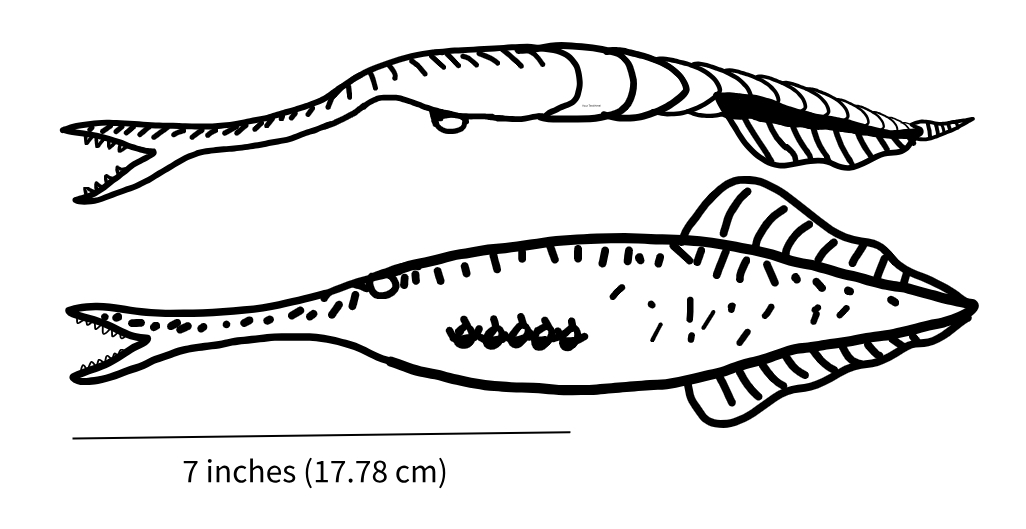
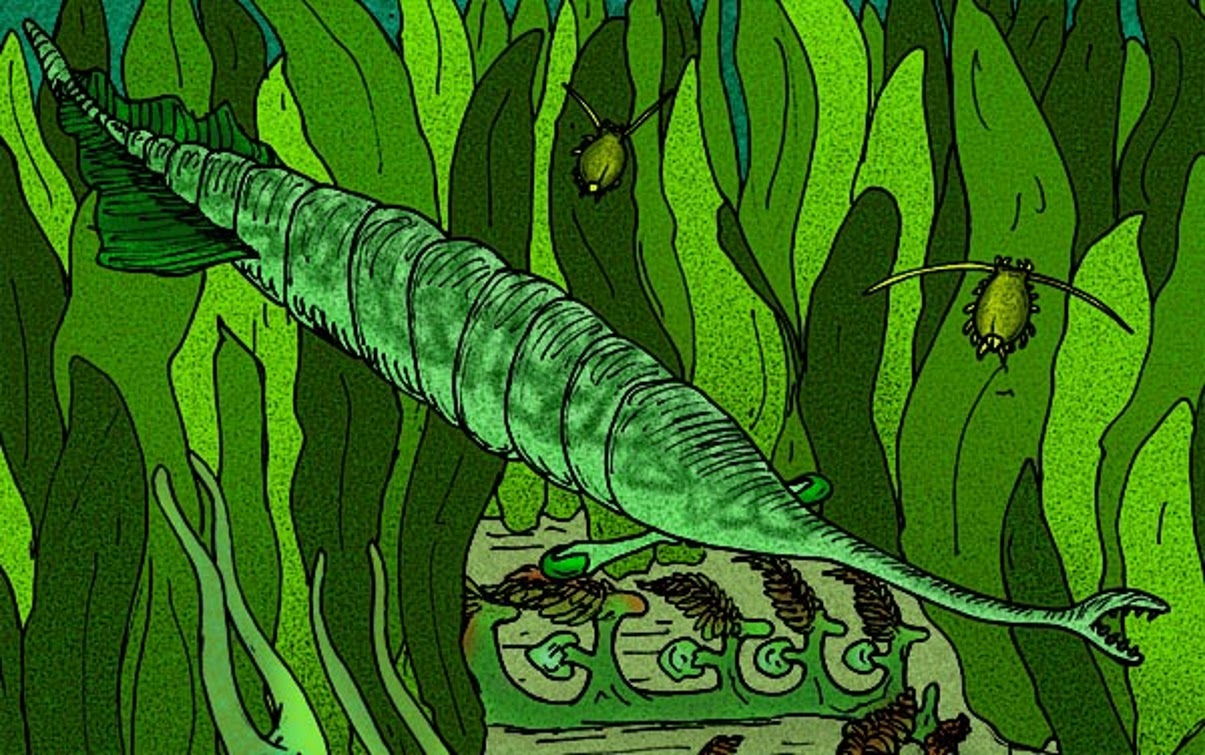
Vermiform in basic body shape and measuring approximately 3-14 inches long, Tullimonstrum is characterized by some truly novel attributes. At its anterior end is a long slender proboscis terminating in a grasping, claw-like pair of jaws, each containing up to eight small, sharp tooth-like structures. Just behind the base of the proboscis is a thin transverse bar, at either end of which is a small round organ believed to be a camera-like eye, each containing melanosomes whose form and structure is consistent with such an identity for it. Further back still are paired structures that have been identified as gills, and its most posterior, tail-end body portion bears a pair of vertical fins resembling a spade in shape. In addition, and the principal reason for its having incited so much speculation as to its taxonomic identity, is the presence of what may be a rudimentary notochord or spinal cord.

 
Tullimonstrum reconstructed as a lamprey-like beast (© Entelognathus/Wikipedia – CC BY-SA 4.0 licence)

Every few years ever since its mid-1960s description, a new study of its fossils results in a new idea being proposed in the scientific literature as to what Tullimonstrum may be, only for this to be hotly disputed by opposing viewpoints.

The most recent published study and proffered opinion dates from as recently as April 2023, when a Japanese research team announced that their advanced 3-D imaging techniques had revealed that Tullimonstrum has segmentation in its head region which extends from its body – something that no known vertebrate lineage possesses. So in spite of possessing a putative notochord or spinal cord, Tullimonstrum was not, they believed, of vertebrate affinity.

 
Tullimonstrum reconstructed as an invertebrate (above), and as a vertebrate (below) (© Fossiladder 13/Wikipedia – CC BY-SA 4.0 licence)

Previous suggestions by earlier researchers, meanwhile, have ranged from this latter beastie being a basal vertebrate distantly related to lampreys, or an anomalocaridid-allied arthropod, to a specialized form of mollusc, a worm, a conodont, or a chordate but of non-vertebrate identity (like present-day tunicates).

As this present ShukerNature blog article is not concerned primarily with either the taxonomic or the palaeontological complexities and controversies relating to Tullimonstrum, however, I shall abstain from presenting any further considerations of these subjects here, and progress instead to what it is concerned with. Namely, two very surprising links between Tully's weird little worm from the far-distant past and cryptozoology in modern times.


IS THE TULLY MONSTER THE LOCH NESS MONSTER?

Ever since the early 1930s, the Loch Ness Monster has always been a major source of cryptozoological contention, but this was especially true during the 1960s and 1970s, following Tim Dinsdale's shooting in 1960 of his short but iconic cine-film purportedly showing a very large, unidentified creature moving across and below the loch's surface. Numerous Nessie-themed books and articles appeared during this period, but one of the most unusual was undoubtedly The Great Orm of Loch Ness: A Practical Inquiry Into the Nature and Habits of Water-Monsters, authored by F.W. 'Ted' Holiday (1921-1979) and published in 1968.

Holiday had long been intrigued by Nessie and other aquatic mystery beasts, but whereas in a second book, The Dragon and the Disc (1973), he pursued a paranormal explanation for such entities (even linking them to UFOs), in The Great Orm of Loch Ness he adopted a more conventional approach, proposing a corporeal, zoological identity for Nessie. However, the specific creature that he nominated was decidedly unconventional.

 
Holding my copy of Holiday's book The Great Orm of Loch Ness (© Dr Karl Shuker/Faber & Faber – reproduced here on a strictly non-commercial Fair Use basis for educational/review purposes only)

Rather than any of the then-in vogue herpetological contenders (such as a giant newt or frog-like amphibian, a crocodilian reptile, or, most popular of all back in those times, a living modern-day species of plesiosaur), after receiving a copy of Richardson's 1966 paper from a fellow LNM investigator Holiday boldly proposed that the Loch Ness Monster was nothing less than a gargantuan present-day descendant of the Tully Monster!

Holiday postulated that Nessie's frequently-reported long slender neck was in reality the elongate proboscis of his proposed giant Tullimonstrum, that Nessie's front flippers were actually his latter hypothesised creature's transverse appendages, and that Nessie's posterior body region, sometimes likened by eyewitnesses to a finned tail, was in fact the latter's paired vertical tail fins. He also saw indications of two dorsal humps in various photographs and other illustrations of Tullimonstrum fossils that might explain Nessie's famous humps if present in a giant Tully Monster.

 
Tullimonstrum as a lamprey-like beast (© PaleoEquii/Wikipedia – CC BY-SA 4.0 licence)

Speaking of which, he pondered whether the small specimens of this extraordinary fossil creature so far discovered were only immature examples, and that perhaps there were full-sized (i.e. Nessie-sized) specimens still awaiting scientific discovery:

Moreover, it is by no means impossible that sections or parts of much larger Tully monsters may even now be reposing in museum basements awaiting identification.

Fifty-five years have passed since Holiday wrote those optimistic words, but as yet, however, no such specimens have come to light. Nor is that the only major issue with Holiday's attempts to identify the Loch Ness Monster with the Tully Monster. The sad but simple truth is that he had misunderstood the true nature of certain key aspects of the latter's morphology, which inevitably had led his proposals badly astray.

 
Loch Ness (public domain)

For instance, in his book he referred to the most anterior jawed portion of Tullimonstrum as its head, whereas in reality it is nothing more than the terminal jaws of this creature's long proboscis – and which Holiday misrepresented as its neck. Similarly, he did his best to identify the transverse bar behind the base of the proboscis as a pair of locomotory paddles, when in reality the pair of fleshy lobes at the two ends of this bar are believed to be visual organs, because they appear to contain some form of retinal structure. And what he envisaged as humps along its back appear to be nothing more than artifacts caused by the flattening of the fragile Tullimonstrum specimens during their fossilization.

Of course, one might suggest in Holiday's defence that by not being a zoologist or palaeontologist he could be forgiven for drawing such erroneous conclusions. Unfortunately, however, this defence falls by the wayside when we discover that his book also includes as an appendix the full text of Richardson's July 1966 Bulletin paper describing Tullimonstrum, in which its body regions' anatomy and functions are accurately documented by Richardson. In addition, Holiday had even corresponded directly with Richardson regarding his proposal that Nessie was a giant Tully Monster (but regarding which Richardson had in turn expressed grave misgivings to him). Consequently, Holiday had no excuse for his own highly inaccurate assumptions regarding these same matters.

 
Tullimonstrum, the Tully Monster – but evidently not the Loch Ness Monster (© Tim Morris)

Holiday had long believed that Nessie was some form of giant worm – hence the title of his book, the word 'orm' being an archaic version of 'worm'. This latter term is in turn sometimes applied not merely in zoology to limbless elongate invertebrates of the earthworm and outwardly similar kind, but also in western mythology to dragons that fit that same description, i.e. elongate and limbless, such as the famous Lambton worm and Laidly worm. This therefore explains why his second book, linking Nessie to UFOs, was entitled The Dragon and the Disc.

Holiday also considered the Tully Monster to be a worm, but one of a uniquely plesiosaurian shape:

Tully's monster did one great thing. It firmly demonstrated that wormlike animals with the appearance of a plesiosaurus did once exist.

 
Typical plesiosaurian representation of Loch Ness Monster (© Richard Svensson)

If so, this could explain not only Nessie's shape when seen by eyewitnesses but also why it wasn't seen more often, i.e. on a regular basis. For if Nessie were indeed a worm, it could therefore absorb oxygen from the loch's water directly through its body's outer layer (epidermal respiration, like frogs and salamanders can often do), not needing to surface on a frequent basis in order to inhale air into its lungs like a mammal or reptile would need to do. Accordingly, Holiday concluded his personal identification of Nessie as a giant undiscovered modern-day Tully Monster with the following bold statement:

No-one knows whether the Orm of Loch Ness is a form of Tullimonstrum; but, talking most unscientifically, I would bet my shirt that it is.

Sadly, however, I think that my above account of how and why his understanding of Tullimonstrum is seriously flawed, and, as an inevitable consequence, his conclusion that a giant version of this species does indeed explain Nessie is wholly wayward, proffers more than sufficient evidence to suggest that Holiday would have certainly lost his shirt!


THE DANCING WORMS OF TURKANA

At much the same time that Holiday was seeking with fervor but ultimate futility to link the Tully Monster to the Loch Ness Monster, Tullimonstrum was also hitting the cryptozoological headlines for a very different yet no less memorable reason.

On 1 September 1966, after reading a report in the East African Standard (a very well known newspaper in what was then British East Africa) concerning the discovery and Richardson's recent scientific description of Tullimonstrum, a retired army Lieutenant-Colonel named R.G.L. Cloudesley, from Nairobi in Kenya, wrote an extraordinary letter to Richardson, in which he made the following potentially exciting claim. The relevant portion reads as follows:

In 1926 having been seconded to the Kings (now Kenya) African Rifles from the Indian Army, I was in northwestern Kenya dealing with some border incidents. Passing through the administrative centre of Lodwar on my return journey, I took the opportunity of calling upon Mr. A. M. Champion, then D. C. Turkana Dis­trict. In addition to being a keen shikar, Champ­ion was a naturalist of the first rank, and during the two evenings I passed in his company he regaled me with many a fascinating yarn about the fauna of the area. Among these was one about a remarkable worm reputed to live in the swamp country to the southeast. The local tribes­men told fantastic stories about its dancing and giving milk, if I remember correctly. Such nonsense aside, Champion did give me a descrip­tion of the creature which he had obtained from various natives (he never succeeded in getting a specimen) and this curiously enough has remained in my memory when much else has been forgotten. His account agreed remarkably well with the illustration of your "Tully Monster," even to the "paddles" and the long snout. Your mention of sharp teeth, incidentally, does agree with a Turkana tale that the creature bites. On this account they are deathly afraid of it, believing that it is poisonous. But then nearly all natives believe everything of the creeping or crawling kind to be venomous.

I hardly dare to suggest that a relation of your extinct "Monster" still survives in one of the remotest parts of East Africa, but it might just be worthwhile to pursue the matter.

 
Tullimonstrum fossil (© James St John/Wikipedia – CC BY 2.0 licence)

Turkana is a northwestern county in Kenya, famous for the discovery there of various significant fossil hominid remains.

Unsurprisingly, Richardson was very interested in Cloudesley's letter, but even before he had chance to reply to it he received a second letter of note, dated 13 September 1966, this time from Purshottan S. Patel of Nakuru, a town situated about 100 miles northwest of Nairobi. Patel informed Richardson that something like Tullimonstrum may actually be existing in Turkana's lakes, as he'd been told by relatives of a strange form of dancing worm that lived in these watery expanses.

 
The long-extinct Tullimonstrum gregarium – but was there a living Tully Monster species of terpsichorean tendency awaiting scientific discovery in the lakes of Turkana? (© Stanton F. Fink/Wikipedia – CC BY-SA 2.5 licence)

Not long afterwards, Richardson received a third letter, dated 8 September 1966, from Joseph N. Ngomo, an intermediate school teacher from Nakuru, who informed him that after his class had read the Standard newspaper's report concerning Tullimonstrum, several of his pupils had claimed that they'd been told of a similar-sounding creature from their fathers. Ngomo included in his letter a note written by one such pupil, a boy named Akai, which stated that these worms are known locally as the ekurut loedonkakini, swim and "wave hands" during the full moon, give milk, and possess a bite fatal to humans.

By now, Richardson was sufficiently intrigued by these ostensibly independent yet closely corroborating communications to suggest to his colleagues at the Field Museum that an expedition in search of Turkana's tantalising dancing worms might be justified, because if they did turn out to be a living Tullimonstrum species this would obviously be a very momentous zoological discovery. First of all, however, a note requesting any additional information regarding these creatures was prepared by the Museum and duly published in the Newsletter of the East African Natural History Association – but none was forthcoming.

 
3D model of Tullimonstrum gregarium as a vertebrate (© Петр Меньшиков-Wikipedia – CC BY-SA 4.0 licence)

In early 1967, while the proposed expedition was still at the planning stage, Richardson was visited by a former colleague, palaeontologist Dr Bryan Patterson (1909-1979), now a professor at Harvard University but previously Curator of Vertebrate Palaeontology at the Chicago Field Museum. Patterson had recently conducted some field work in Kenya and stated that he actually knew the uncle of Richardson's second correspondent, Patel. However, Patterson also stated that he'd never heard of dancing worms at Turkana, and seemed highly amused by the whole subject – as well he might be.

For it subsequently transpired that Cloudesley, Patel, Ngomo, and Akai did not exist – they had all been created, and their communications written, by none other than Patterson himself, as a prank with which to fool his friend Richardson, and which had clearly succeeded very successfully!

 
Fake photograph of Dr Bryan Patterson and a shot Tullimonstrum (public domain)

Happily, Richardson took it all in good spirit after receiving the truth from Patterson in a Christmas 1968 letter that also included a humorous hoax photograph in which Patterson was posing in full field regalia holding a rifle and a supposed shot specimen of a sizeable Tullimonstrum. Indeed, after cancelling his planned expedition to search for it, Richardson even prepared a short book entitled The Dancing Worm of Turkana, publishing it in 1969 under the pseudonym E. Scumas Rory. In it, he reproduced all four of the principal fake communications sent to him by Patterson, and also briefly referred to a second missive that he'd received from 'Patel', plus several additional ones sent to him by various other correspondents.

Additionally, Richardson revealed in this book that F.W. Holiday had written to 'Cloudesley' for information, but had never received a reply (for obvious reasons now!). Moreover, Richardson even contributed an introduction to the book under his own name, together with some fine illustrations under his Rory pseudonym, and nowadays this literary curiosity is a highly-collectable publication in its original hard-copy format (several websites contain downloadable public-domain pdf versions of it).

 
The Dancing Worm of Turkana, front cover (public domain)

In short, even though the dancing worms of Turkana never existed, they are immortalized in print, meaning that their impact, albeit transitory, upon the zoological world will also live on!

Finally: the name 'E. Scumas Rory' seems so unlikely, even contrived, that I cannot help but wonder whether in reality it is a clever anagram, but I've been unable to discover one from it. So if any anagram aficionados are reading this article, perhaps they would like to see whether they can extract one – and, if anyone does, I'd greatly welcome details!

 
An ekurut loedonkakini or Turkana dancing worm, biting a man – sketch by 'E, Scumas Rory' (public domain)