Dr KARL SHUKER

Zoologist, media consultant, and science writer, Dr Karl Shuker is also one of the best known cryptozoologists in the world. He is the author of such seminal works as Mystery Cats of the World (1989), The Lost Ark: New and Rediscovered Animals of the 20th Century (1993; greatly expanded in 2012 as The Encyclopaedia of New and Rediscovered Animals), Dragons: A Natural History (1995), In Search of Prehistoric Survivors (1995), The Unexplained (1996), From Flying Toads To Snakes With Wings (1997), Mysteries of Planet Earth (1999), The Hidden Powers of Animals (2001), The Beasts That Hide From Man (2003), Extraordinary Animals Revisited (2007), Dr Shuker's Casebook (2008), Karl Shuker's Alien Zoo: From the Pages of Fortean Times (2010), Cats of Magic, Mythology, and Mystery (2012), Mirabilis: A Carnival of Cryptozoology and Unnatural History (2013), Dragons in Zoology, Cryptozoology, and Culture (2013), The Menagerie of Marvels (2014), A Manifestation of Monsters (2015), Here's Nessie! (2016), and what is widely considered to be his cryptozoological magnum opus, Still In Search Of Prehistoric Survivors (2016) - plus, very excitingly, his four long-awaited, much-requested ShukerNature blog books (2019-2024).

Dr Karl Shuker's Official Website - http://www.karlshuker.com/index.htm

IMPORTANT: To view a complete, regularly-updated listing of my ShukerNature blog's articles (each one instantly clickable), please click HERE!

IMPORTANT: To view a complete, regularly-updated listing of my published books (each one instantly clickable), please click HERE!

IMPORTANT: To view a complete, regularly-updated listing of my Eclectarium blog's articles (each one instantly clickable), please click HERE!

IMPORTANT: To view a complete, regularly-updated listing of my Starsteeds blog's poetry and other lyrical writings (each one instantly clickable), please click HERE!

IMPORTANT: To view a complete, regularly-updated listing of my Shuker In MovieLand blog's articles (each one instantly clickable), please click HERE!

IMPORTANT: To view a complete, regularly-updated listing of my RebelBikerDude's AI Biker Art blog's thematic text & picture galleries (each one instantly clickable), please click HERE!

Search This Blog


PLEASE COME IN, I'VE BEEN EXPECTING YOU...

PLEASE COME IN, I'VE BEEN EXPECTING YOU...
WELCOME TO SHUKERNATURE - ENJOY YOUR VISIT - BEWARE OF THE RAPTOR!


Showing posts with label pooka. Show all posts

Thursday, 23 April 2015

KEEPING CLEAR OF KELPIES AND OTHER WATER-HORSES


Be wary of water-horses! (Public domain/photo-manipulation effects © Dr Karl Shuker)

Long before modern-day cryptozoologists speculated that Ness and various other Scottish lochs may harbour elusive plesiosaurs, long-necked seals, giant eels, and/or sundry other exotic fauna of the corporeal kind, traditional Highland folklore claimed that these brooding bodies of freshwater were home to fearsome supernatural entities known as water-horses.

Various types of water-horse have been delineated and named, based primarily upon their geographical location and the type of freshwater abode that they reputedly frequent. Of these types, the most formidable and feared is undoubtedly the each uisge (pronounced 'eck ooshkya'), which haunts the Highlands' lochs and the sea. (Incidentally, this sometime maritime water-horse is often depicted with a fish-tail instead of hind limbs and a normal horse's tail, so that it is analogous morphologically to the hippocampus of classical Greek mythology.)

A hippocampus-like water-horse (© Randi MacDonald)

In contrast, the Scottish kelpie is linked to rivers, streams, fords, waterfalls, and other sources of running water. The Isle of Man has its very own, unique type of water-horse, called the cabyll-ushtey. Nor are these malevolent beings limited to Scotland and the Isle of Man within the British Isles. Ireland also has an equivalent entity, known as the pooka.

As their name indicates, the most common guise assumed by water-horses (especially freshwater ones) and also the pooka is that of a horse or pony, usually black in colour (but pale grey in the case of the Manx cabyll-ushtey), with rough, shaggy, unkempt hair and mane usually wet or damp to the touch, plus a faintly stagnant odour, and glowing, demonic eyes. In addition, if observed closely its hooves will be seen to be reversed.

Such a steed will attempt to entice unwary humans, especially children, to mount it and be taken for a ride. But if they are reckless enough to do so, they find themselves unable to dismount, having instantly become stuck fast to its back (which magically lengthens to accommodate any number of persons riding it). They can then do nothing other than watch in abject, impotent horror as the predatory water-horse immediately races directly into its watery domain and plunges down into the depths, promptly drowning and then greedily devouring its hapless, helpless riders.
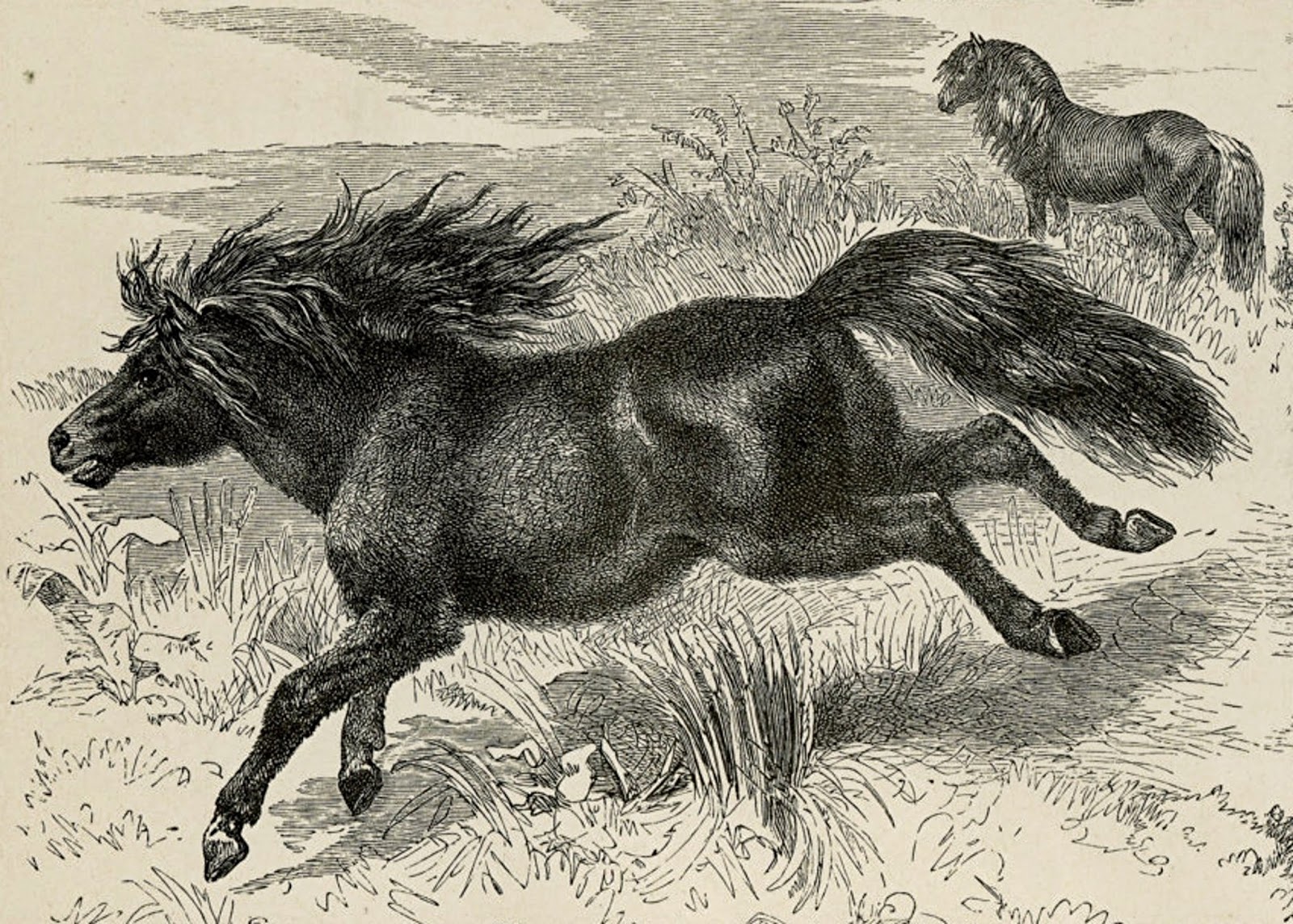

Sometimes, a water-horse will be ensnared by a farmer using a halter stamped with the Sign of the Cross, and is then harnessed to a plough alongside a team of mortal horses. However, its supernatural strength is such that it will readily haul plough and horses alike along with it as it races into its welcoming loch or river, where it soon shakes off the plough and tears apart the doomed horses.

Having said that, there are folk stories of water-horses mating with normal horses. Their resulting hybrid progeny can never drown, and can be physically distinguished from pure-bred normal horses by their extremely short ears.

Very occasionally, a water-horse is actually killed, by being shot with a silver bullet or stabbed with fire-heated spears forged out of iron, but no corpse or carcase is ever left behind. Nothing remains at all, in fact, other than a pool of water, or a jelly-like substance very reminiscent of so-called star rot or pwdre ser.

If chased by a kelpie, one certain means of eluding it is to jump over a stretch of river or stream. Even if it is only very narrow, this will still be sufficient to hold back the kelpie, because it is unable to cross any stretch of running water.


Although it occurs more commonly in its equine guise, the shape-shifting water-horse will sometimes assume human form. It usually appears as a tall, thin youth or young man, whose clothes seem damp, as does his long black hair – which if observed very closely can be seen to contain strands of water weed and grains of sand. He usually wears boots, to conceal the fact that even when he is adopting a human guise, his feet remain hoofed. By contrast, the human form of the pooka is usually a wizened, toothless old man, with evil leer and flashing eyes.

As a child, I was lucky enough to receive as gifts from my family a series of large-format hardback books of world myths, legends, and folktales vividly retold by eminent folklorist Roger Lancelyn Green, beautifully illustrated by Janet and Anne Grahame Johnstone, and published by Purnell. One of these volumes, Myths From Many Lands (1965), included Green’s retelling of a traditional Breton folktale, which he entitled ‘The Goblin Pony’. Years later, I discovered that in both appearance and behaviour this folktale’s eponymous supernatural entity was identical to the Irish pooka, and so fascinated me that a few years ago I penned my own, greatly-expanded version of it, which I reset in Ireland (click here to read it on ShukerNature). In my forthcoming book Here's Nessie! – A Monstrous Compendium From Loch Ness, however, I have relocated it to Scotland, and have replaced the pooka with one of its equally dangerous Caledonian counterparts, the kelpie

As noted above, the kelpie's most innocuous yet deadliest guise is a dark shaggy-coated colt or pony of deceptively playful, harmless demeanour. On first sight, it is easy to mistake a kelpie for a genuine animal - until you see its eyes, which betray its true identity by blazing with a scorching, unholy fire. Consequently, it is always best to avoid anything that might be a kelpie – otherwise you may not live to regret your mistake!

This ShukerNature blog article is excerpted exclusively from my forthcoming book Here's Nessie! – A Monstrous Compendium From Loch Ness.
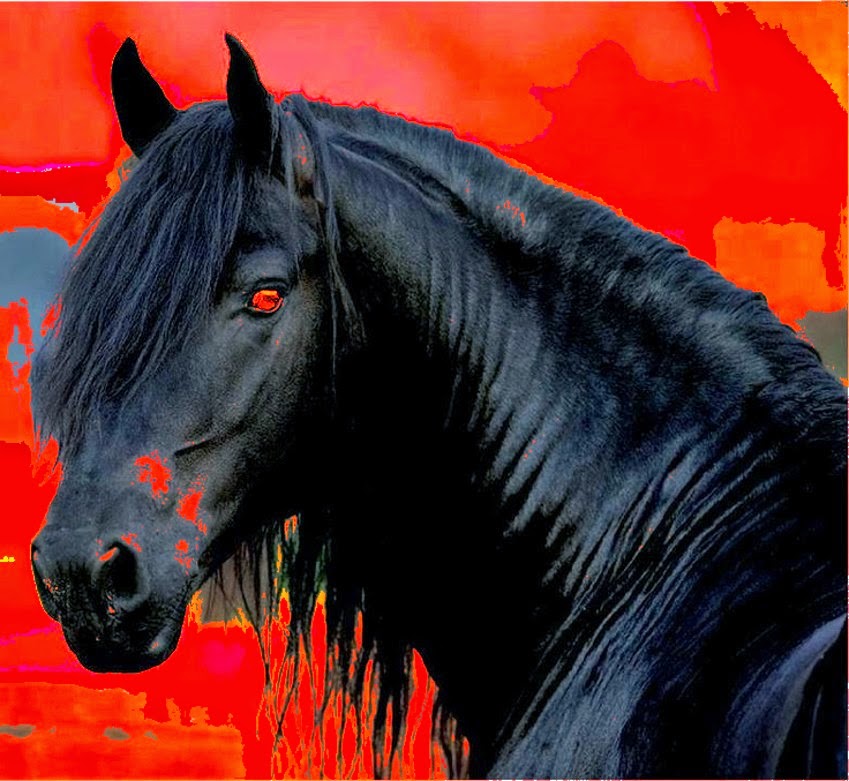
The eyes have it - how to recognise a fiendish water-horse (photograph's copyright owner unknown to me/photo-manipulation effects © Dr Karl Shuker)


Thursday, 23 August 2012

THE TOP TEN PARANORMAL BEASTS IN BRITAIN - HORSE-MEN, HORNED CATS, AND OTHER HORRORS!


The Green Drive Beast (© Sam Shearon)


In modern times, Britain – reputedly the world’s most haunted country – has seen more than even its fair share of monstrous creatures reported, beasts assuredly more supernatural than natural. So here, in no particular order, is my own personal Top Ten paranormal terrors of the zooform kind (i.e. seemingly preternatural entities superficially resembling corporeal creatures). Encounter them at your peril!


HORSE-MEN OF THE APOCALYPSE?
One late evening in 1994, the husband of correspondent Nicky Knott was driving home through King’s Lynn, Norfolk, down a lonely rural back road when he saw a large creature in a field to his right. As it moved closer, it seemed to be a horse, with equine body and four legs, but its observer was horrified to see that it had the face of a man! Terrified, Knott slammed his foot on the accelerator and sped away, and even though he was sure that the ‘thing’ was pursuing him he never once looked back till he reached home. Amazingly, this is not a unique case. Back in spring 1966, a creature fitting this same bizarre, man-faced, horse-bodied, centaur-reminiscent description was encountered in the road ahead as Margaret Johnson and her boyfriend John Farrell were driving past the estate of Lord Dillon in County Louth, Ireland, blocking their way for a couple of minutes and emanating palpable malevolence before abruptly vanishing. Could it have been a pooka – Ireland’s evil supernatural goblin horse?

Horse-man (Richard Svensson)


BEWARE OF BIG-EYES!
During the mid-1950s, writer Joan Forman had spent time teaching at the school in the Kentish village of Goodhurst. One early morning during the summer holidays, when few others were there, she had awoken from sleep in her room, alone within the school building’s oldest section, and was shocked to see a grotesque creature crouching on the floor to the left of her bed, glowing slightly in the darkness and gazing at her with what she considered to be an unblinking stare of outright evil and obscenity. It was about the size of a large cat or corgi dog, but its most striking feature were its huge eyes, which she likened to those of a nocturnal lemur. She lay there, rendered immobile by its seemingly mocking, revolting stare for some time, before, with the onset of dawn, it slowly faded away, and the intense coldness that until then had filled the room vanished with it. Years later, she learned that her successor at the school also witnessed this entity, but in a different bedroom.


A WEIRDLING CALLED WOLFIE
One of the weirdest creatures ever encountered in Britain was nicknamed Wolfie by the Lawson children who first saw it, but it was like no wolf – or anything else, for that matter – ever reported. The Lawson family lived in Abbey House, Cambridge, from 1904 to 1910, during which time Wolfie was spied on many occasions by the children, and even once at close range by their father as it sped down a corridor. According to their descriptions, Wolfie superficially resembled a very large, brown-furred, short-eared hare but with some notable additional attributes – always running on its hindlegs, sporting a pair of flipper-like front paws, and equipped with a long bird-like beak. Wolfie was mostly seen on the ground floor and at twilight, or in the drawing room when lit by lamplight, but even when not observed its presence was readily evinced by the distinctive pattering sound of its footsteps. Wolfie was also encountered by Charmian, the daughter of the Sharp family, who moved into Abbey House in 1920, and in 1947 a mysterious “tiny doggie” was reported in the kitchen by the young son of Celia Schofield, a friend of the then tenant. Although Wolfie did not seem to be malign in any way, its zoologically impossible form, if described accurately, indicates that this inexplicable entity must surely have been paranormal rather than corporeal in nature.

Wolfie (Richard Svensson)


THE VAMPIRE CATERPILLAR OF EDINBURGH
Some zooform phenomena, like Wolfie, seem so bizarre that they defy belief, let alone categorisation, yet their eyewitnesses vehemently affirm that they were real. Another notable example is the entity that Godfrey H. Anderson claimed to have spied on 23 November 1904 while walking along a street in Edinburgh, Scotland. Suddenly, he saw a grotesque 'something' rise out of the gutter and spring up at the throat of a horse. According to Anderson's description, cited in Creatures of the Outer Edge (1978) by Jerome Clark and Loren Coleman, the horse's weird attacker was:

"[a] vague black shape about four feet long and two and a half feet high...[it was shaped] like an hourglass and moved like a huge caterpillar."

The horse reared up in terror, and as it did so its assailant vanished.


LONDON’S HORNED DEMON CAT
One evening in October 1943 during a World War II bombing session inflicted upon London by German aircraft, air-raid volunteer Howard Leland took shelter inside a derelict house, but as he sat at the foot of its staircase he sensed a presence nearby. Shining his torch up the stairs, he was petrified to spy a huge tabby-striped cat sitting crouched at the very top, gazing down at him with demonic eyes – a cat whose skull sprouted a pair of sharp pointed horns! Rooted to the spot with fear, Leland could only watch as this monstrous entity leaped down into the room below, but it vanished before it landed, so that only its spine-chilling yowl echoed in the shadows. Leland consulted renowned clairvoyant John Pendragon, who placed his finger on the house’s precise location on a map, only for his mind to be filled with swirling images of hate-filled cats and an image of a man about to hang himself. Leland made enquiries about this house, learning that others had seen the horned cat, and, significantly, that it had once been inhabited by a practitioner of black magic, who had sacrificed several cats during one foul ritual, but had become deranged, hanging himself from the top of the staircase. Pendragon concluded that the giant horned cat was an elemental, conjured into being by the restless, fury-fuelled ghosts of the slain cats, and which may persist there indefinitely. For a full ShukerNature account of this scary (as opposed to scaredy!) cat, click here.

Horned demon cat (Tim Morris)


A BONELESS TERROR
There are many British folktales telling of encounters with an eerie amorphous entity, animate and sinister, variously nicknamed ‘Boneless’ or simply ‘It’. One moonlit September night during the 1950s, however, railwayman John Davies was riding his motorbike back home to his cottage in Derbyshire’s Longdendale Valley when he saw what appears to have been a bona fide Boneless crossing the road not far ahead. Moments earlier, he had felt an uncanny, seemingly reasonless compulsion to brake, and as he did so he spied what looked like a huge black slug sliding across the road and up the moor, making a scraping noise as its massive but near-shapeless form moved along. Up closer, it looked a little like a massive whale, and even possessed an eye-like structure, and Davies later learnt that it had been seen by others. One such observer was a friend of Davies, who had seen it sliding across the valley below Ogden Clough, where it was also observed on a separate occasion by another of his friends. Both of them were convinced that whatever it was, it was definitely evil, and both had fled in panic after spying it.


THE LEVITATING WHITE DOG OF RICHMOND PARK
Phantasmal Black Dogs are widely reported in Britain; less familiar, conversely, but by no means unknown, are comparable reports of preternatural White Dogs, of which the following is certainly among the most remarkable on file. One evening during the early 1950s, a soldier was returning to his army camp, based inside London’s Richmond Park, when he was startled to see several deer running past him in a panic-stricken state. He was even more startled, however, when he saw that they were being pursued by an enormous pure-white dog with huge teeth – but which, instead of bounding across the ground like any typical earthbound dog, was racing through the air, about half a metre above the ground! For additional ShukerNature posts regarding White Dogs (aka Fairy Hounds in Celtic mythology), click here and here.

Richmond Park's levitating white dog (C. Martin)


A HARPY OF THE HIGHLANDS?
According to Highland legend, on the eve of the historic battle of Culloden in 1746, a hideous winged apparition called the skree appeared in the sky, emitting spine-chilling shrieks and hovering above a detachment of soldiers. It was said to resemble a monstrous bird but with a human head, black leathery wings, and burning red eyes – in other words, a Caledonian counterpart of the harpies from Greek mythology! Moreover, one of its claimed eyewitnesses was none other than Lord General Murray. Although this story is largely dismissed by historians, at least two additional skree appearances have been documented. One was on 22 May 1915, when this veritable bird of ill-omen appeared over Larbert railway station just as a major party of Royal Scots men and officers were about to board their train. So shocked were they by this grotesque entity that the men had to be forced to board at gunpoint by their officers; later that day, the train crashed, killing or injuring many of its passengers. Most recently, during summer 1993, a skree-like creature was reportedly spied on a mist-shrouded outcrop of rock by two lost hill walkers in Glencoe.


ON THE LOOSE IN LYTHAM ST ANNE’S
Highly-acclaimed graphics-fantasy artist Sam Shearon (click here to visit his spectacular artwork's Mister-Sam Facebook page) has long been interested in cryptozoology, but little expected that in 2005 he would have the chance to investigate a truly bizarre beast in his very own hometown of Lytham St Anne’s, Lancashire. As I learnt from Sam when he kindly shared his files on this entity with me, it all began during late April 2005, in the town’s wooded beauty spot of Green Drive, when a mysterious snarling creature initially likened to a large collie with very big pricked ears, a sizeable mouth, light-coloured fur, and a strange lolloping gait was spied there. Other reports soon emerged, but descriptions of the beast became ever stranger, with one eyewitness comparing it with a surreal giant hare, and another describing it as “like a monster out of Doctor Who”! When word of this extraordinary creature reached Sam, he lost no time in interviewing a number of eyewitnesses, and then prepared a highly-detailed illustration of it, based upon their accounts, which appeared in media reports worldwide and is also reproduced here in this ShukerNature post with Sam's kind permission. He also established a dedicated website for documenting sightings. Suggestions as to what the Green Drive Beast might be as put forward by the general public ranged from a lost greyhound or an escapee wallaby to a mystery big cat, or even a far-from-home chupacabra! A number of wildlife experts were also consulted as to the creature’s likely identity, but were baffled, eventually suggesting that it may be a muntjac.

Reeves's muntjac (Margoz/Wikipedia)

Alternatively known as barking deer, muntjac are not native to Britain. However, escapee specimens from captivity of Reeves's muntjac Muntiacus reevesi (native to China) have established thriving populations in several regions of the country, and are notable for their large, fang-like canine teeth – an incongruous feature for deer. In general appearance, however, these small, elusive bambi-like animals display scant similarity to Green Drive’s mystery beast. Eventually, sightings and interest in the Green Drive enigma faded, but in September 2007 a very old, mange-ridden fox bearing a superficial resemblance to certain descriptions of the beast was captured there, reviving interest, and later being dubbed by the media as the correct explanation. Yet how a very sick, elderly fox found two years after the classic sightings of a much more vibrant, larger creature can be deemed to be one and the same as the latter is as mystifying as the beast itself. In any event, Sam’s stunning picture of the 2005 Green Drive Beast remains as vibrant testimony of its erstwhile existence, regardless of its identity.

The Green Drive Beast, clearly no muntjac! (© Sam Shearon)


A LAKE DISTRICT DEVA?
While visiting the Lake District, Cumbria, in June 1922, theosophist Geoffrey Hodson claimed to have witnessed an astonishing being that he believed to have been a deva or nature spirit. According to his description of what he had seen, it was an enormous bat-like entity, brilliant crimson in colour with a human face and burning piercing eyes that fixed themselves upon him as its wings stretched out over the mountainside, before sinking into the hillside and disappearing. It later reappeared before him, but now in much smaller form, this time standing a ‘mere’ 3-4 m high.


It’s not every day that you encounter a malevolent horse-man, a demonic horned cat, or a murderous vampire caterpillar in modern-day Britain, but as can be seen from the above accounts, it’s not beyond the realms of possibility either! So next time you’re out and about, keep your eyes open – sometimes, the unknown and the inexplicable can be a lot nearer than you think!

Sam Shearon, primary investigator of the Green Drive Beast (© Sam Shearon)

Monday, 19 December 2011

THE FAIRY HOUND AND THE POOKA - A CRYPTO-FOLKTALE FOR CHRISTMAS

My very own Celtic fairy hound! (Dr Karl Shuker)

During my time on Facebook, I've made many friends all over the world who share my interests in cryptozoology and animal mythology. One of these friends is Randi Allena Odom, from Texas, USA, to whom I recently recounted a very brief version of a traditional Irish folktale about a Celtic fairy hound. She liked it so much that she said she would love to read a full-length version of it if ever I decided to write one. Well, now I have done, so here, as an early Christmas present to you, Randi, is my story. I hope you enjoy it - Happy Christmas!

According to Irish mythology, one of the most formidable enchanted beasts occasionally met with in lonely rural locations is the fairy hound, or hound of the hollow hills, where the Faerie folk of Erin dwell. Gracile in form, and white in colour, but extremely large, often shaggy-coated, and always instantly distinguished from mortal, non-magical dogs by virtue of its bright red eyes and the red inner linings of its ears, even the mere sight of one of these ethereal creatures is said to bring bad luck. And to speak to or touch one means certain death – usually. Very rarely, however, a fairy hound will bring its human observer good fortune, if it is treated with sufficient courtesy and compassion – as was the case in the following traditional folktale, featuring both a fairy hound and a pooka, which has variants on record not only from Ireland but also from Cheshire and certain other regions of England. But what, may you ask, is a pooka? Let's just hope that you're never unlucky enough to meet one and find out...!

It had been a very long, arduous day, and the apprentice labourer was weary as he slowly trekked across the mist-shrouded moorlands, following the winding, shadowy road that would lead him back home, aching, hungry and earnestly yearning for the warmth, comfort, and security of his parents' little cottage. Whistling to himself to keep his spirits up as he continued on his way through this somewhat depressing, forbidding terrain, where strange shadows lurked all around him, and without warning a tree would abruptly loom out of the darkness up ahead like some frightful apparition, he suddenly heard what sounded like a dog, whining somewhere close by. He walked on a little further, and there, lying in some bushes at the side of the road, was what seemed on first sight to be a large red and white foxhound.

Having seen a number of footsore foxhounds in the past, which had been left behind by the pack when they had grown too weary to pursue their quarry any further, the youth called to it in a friendly voice, telling it that he'd take it back to the kennels but would first do something for its sore paws. True to his word, he scoured around and soon spotted some large dock leaves that he soaked in water from the stream running close by. Then he whistled to the dog, and called to it to come out of the bushes, so that he could treat its tender paws with the cooling wet leaves.


Celtic fairy hounds (Roger Garland)

Sure enough, up stood the dog and trotted out of the bushes towards him – but it was no foxhound. As large as a calf, with a shaggy pure-white coat, but red-lined ears and bright scarlet eyes that glowed like rubies, it was – as the terrified youth was only too readily aware – a fairy hound! Shaking with fear, he stood there, as still as a statue as the great dog padded right up to his side. All of the stories that had passed down through the generations in his family and in those of his friends and neighbours came flooding back. If you so much as see a fairy hound, you will experience bad luck, and if you should be foolish enough to speak to one or touch one, death will swiftly and assuredly follow. And yet, somehow, he sensed that it meant him no harm. Scarcely knowing what he was doing, or why, the youth spoke gently to the fairy hound, politely asking it to give him each of its paws in turn, so that he could bathe them.

The hound raised its huge head until its scarlet eyes were gazing directly into those of the youth, transfixing him for what seemed to him like an eternity yet was the merest moment in real time, and then, slowly, it raised its right front paw, and placed it heavily in his hands. At its first touch, the youth felt a strange sensation course through his body, like a living stream of electricity rippling and sparking beneath the surface of his skin. As if awakening from a dream, he shook his head, and then, after carefully inspecting the creature's paw, wrapped some wet leaves around it in a cooling bandage. As soon as he had done this, the fairy hound pulled its paw away, sniffed it for a moment, then gingerly placed it on the ground. The dock leaves were clearly working their own kind of magic, because the hound never flinched when it placed its full weight on the paw.

The youth expected to receive the hound's left front paw next, but the hound had other ideas. Instead, it turned sideways, and raised its right back paw towards him. So the youth knelt, and bandaged this paw with some more soaked dock leaves, then repeated his actions with its left back paw. When this was bandaged, the fairy hound turned to face the youth again, and as he looked down at its one remaining untreated paw – the left front paw – he realised that the hound was barely resting on it at all. Instead, it held it up just above the ground. Clearly, this was the most painful of its four paws, and when the youth knelt down to it, he immediately saw why.

Embedded in one of the paw's thick pads was a long curved thorn! Shocked, he looked up at the fairy hound, once again meeting its bright scarlet stare. Surely he dare not attempt to pull a thorn from the paw of a fairy hound? To do so would certainly inflict pain upon it, and that in turn would surely be more than sufficient to bring about his own death. But scarcely had these thoughts materialised within his petrified mind than the hound raised its wounded paw and delicately placed it in his open hand. As if sensing his hesitation, it then licked the thorn and nuzzled his hand with its large, icy-cold nose before gazing directly into his eyes again.

'Hound Wraith' - a very different, unicorned fairy hound (Heather L. Kidd)

Drawing a deep breath, and trying hard to hide the fear in his voice, the youth softly spoke to the fairy hound, telling it that he would try his best to remove the thorn but warned that its paw might hurt for a moment while he was doing so. Taking a second deep breath, and focusing his attention entirely upon the thorn in the hope of remaining as calm as possible, the youth gripped it tightly between thumb and finger, and then, in a swift fluid movement, withdrew it from the pad of the creature's paw with Androclesian skill.

The fairy hound jerked its leg back, and the youth heard what sounded like the faintest rumble emanating from its chest, like the onset of thunder on a humid summer evening, as it attempted to pull its paw from his grasp. At the same moment, however, with his other hand the youth deftly placed a dripping-wet bandage of dock leaves upon the pad, and immediately he felt the hound relax, leaving its paw within his hand. After holding the leaves against the wounded pad for a few moments, the youth then removed them and replaced them with some more, which he bound in place.

The fairy hound placed its paw on the ground, and, as before, the dock leaves had evidently proven effective, because it discovered that it could place its full weight upon the paw without discomfort. For one last time, the fairy hound looked up at the youth, capturing his eyes with its own, and then it slowly wagged its long white tail from side to side, several times, before turning away. Remembering how he had been told by his elders to be respectful at all times to the Faerie folk, he bid it a polite "Goodnight, Sir", and he saw it wag its tail again as it departed into the mist.

Fairy hound (C Martin)

Scarcely believing that he had survived such an extraordinary encounter with a fairy hound, the youth hurried on along the road leading home, hoping to leave this deserted, lonely terrain before it became completely dark. Happily, he did so, and although he made the same journey each evening in the weeks to come, nothing else eventful took place – until one night, just before Christmas.

The youth had worked even later than usual that particular evening, so it was already almost dark while he was still walking along the road across the moorlands - which, as a result, seemed more oppressive and threatening than ever. Even so, he smiled when he reached the area of low-lying bushes where, a few weeks earlier, he had treated the fairy hound's paws. Although he had never seen it again, he frequently thought about it, but he had never told anyone about his encounter, just in case to do so would anger the Faerie folk.

Suddenly, something large moved amid the shadows covering the road up ahead, and for a moment the youth thought that the fairy hound had returned. But as he drew nearer, he saw something very different – and even more frightening! At first, it looked like a small black pony, but as he looked at it, the creature began to grow bigger, and bigger. In moments, the 'pony' was the size of a horse, and as it turned his head towards him, the youth cried out in terror - because the head was no longer that of a horse. Instead, it now resembled a goat's, bearing a pair of long twisted horns, and with glittering emerald-hued eyes that glowed malevolently like green fire. This was neither a pony nor a horse – it was a pooka!

A pooka (Ceara Finn)

An evil shape-shifting supernatural being, a pooka often assumes the guise of a pony that is sometimes merely mischievous, chasing after humans in gleeful delight, or slyly luring them across the moors until they are hopelessly lost if they try to capture or ride it. On other occasions, however, if someone succeeds in mounting it, the pooka will instantly ride off at speed and plunge into a river or lake, drowning its hapless rider (click here for a separate ShukerNature post retelling this Irish legend). And if it should transform into a goat-headed monstrosity like the beast now confronting the terrified youth, death is inevitable.

Leering at him with a vile grimace that revealed an abundance of sharp white teeth, the pooka reared up onto its hind legs, and flailed its razor-sharp hooves at the youth's face. Backing away, he stumbled, losing his footing in his fear as this huge black beast of nightmare come to life reared again, its hooves ready to slash him to ribbons.

Suddenly, however, a huge white shadow hurled itself out of the darkness and directly onto the pooka's back. Gazing at it in amazement, the youth saw that it was none other than the fairy hound! Equally astonished, the pooka turned away, throwing its neck back as it attempted to discover what was attacking it. The fairy hound's mighty jaws bit deeply into the pooka's neck and shoulders as the latter beast sought to shake its assailant off, and the silence was shattered by an ear-splitting cacophony of shrieking neighs from the pooka and baying growls from the fairy hound.

Never underestimate a fairy hound!

The pooka, weakening from the fairy hound's unabated onslaught, dropped to the ground, and sought to dislodge its attacker by rolling over and upon it. To avoid being crushed, the fairy hound duly released its hold upon the pooka's neck, and leapt off – at which point the pooka instantly transformed into a large black owl and flew swiftly away across the moors.

By now, the petrified youth had staggered back up onto his feet again, and there in front of him stood the fairy hound, seemingly none the worse for its battle with the pooka. It looked up at him with its bright scarlet eyes, and wagged its long tail from side to side.

The youth was about to thank it for saving him from the pooka, but just in time he remembered how his wise old grandmother had told him when he was still a child that although you must always be very respectful to the Faerie folk, you must never thank them aloud, even if they have helped you or have been kind to you in some way.

And so, just as he had done during their previous meeting, the youth nodded courteously to the great dog before him, and then bid it a polite "Goodnight, Sir". The fairy hound turned away, and in seconds was lost to sight amid the darkness and shadows of the night, and the youth continued on his way back home, well aware of how exceptionally fortunate he had been that evening, and looking forward even more than before to the Christmastime holidays with his family that awaited him there.

A pack of fairy hounds in pursuit of a wrongdoer


Thursday, 30 December 2010

PONY...OR POOKA?


Image from Andy Paciorek’s Strange Lands project's website at: http://www.batcow.co.uk/strangelands


I regret to say that punctuality has never been one of my virtues (numerous though these may be!) - which is why now, at the very end of December, I am presenting here a Halloween-related zoomythological folktale, noting, as my only (feeble) excuse, that the telling of spooky stories is a tradition associated with Christmas too.

As a child, I was lucky enough to receive as gifts from my family a series of large-format hardback books of world myths, legends, and folktales vividly retold by eminent folklorist Roger Lancelyn Green, beautifully illustrated by Janet and Anne Grahame Johnstone, and published by Purnell. One of these volumes, Myths From Many Lands (1965), included Green’s retelling of a traditional French folktale, which he entitled ‘The Goblin Pony’. Years later, I discovered that in both appearance and behaviour this story’s eponymous supernatural entity was identical to the Irish pooka, and so fascinated me that a few years ago I penned my own, greatly-expanded version of it, which I reset in Ireland. Since writing it, I have variously thought of including it in some future book of mine retelling legends of mythical beasts or in my planned book collaboration with graphic artist Andy Paciorek re supernatural night creatures. If it is used in the latter, however, it may well need to be trimmed in length, so here, perhaps for the one and only time, and hence another ShukerNature exclusive, is the full-length, unedited version of my pooka tale of terror! Happy New Year!

Commonly associated with lonely pools and other stretches of water, the pooka is one of the most feared of Ireland's solitary Faerie folk, because although it has occasionally been known to assist humans, more often than not the pooka delights in bringing ill-fortune, and sometimes far worse, to those unfortunate mortals who encounter it. In its real but rarely-seen form, this sinister entity resembles a withered old man dressed in rags, but is much more frequently met with in the guise of any one of a number of different animal forms - often a large black-plumaged bird, or a goat, or a huge black dog, or, most innocuous yet deadliest of all, a dark shaggy-coated colt or pony of deceptively playful, harmless demeanour. On first sight, it is easy to mistake a pooka for a genuine animal - until you see its eyes, which betray its true identity by blazing with a scorching, unholy fire. Consequently, it is always best to avoid anything that might be a pooka; otherwise, as I reveal in the following age-old Irish folktale, you may not live to regret your mistake:

It was Halloween, so although she was a weaver of cloth by trade, tonight Molly was spinning tales of wonder and magic instead, regaling her three grandchildren with stories of the pooka, the master otter, the horse-eel, and many other mythical Irish entities - but their attention was beginning to waver. Sean, aged 15, was the eldest of the trio, and had thoughts only for Maire - the fair-haired daughter of their village's new school teacher. Sean's sister, Eileen, just a year younger, was mentally designing the new dress that she planned to wear at the forthcoming autumn fete. Only Patrick, their six-year-old brother, was still listening to Molly's words, although the log fire was gently lulling him to sleep.

Molly smiled, pausing in her story-telling; and, as she did so, Sean stood up. The night outside was warm, and he had decided to take a walk, secretly hoping that Maire might be doing so too, and that they may then happen to meet. His plans were swiftly dashed, however, because Eileen and Patrick wanted to accompany him - so instead of walking into the village, they wandered through the outlying meadows and forests.

Encouraged by the evening's pleasant ambience, the three youngsters strolled further than originally intended, eventually approaching an extremely large, deep pool, which they had never visited before - and with good reason. Traditionally, the villagers kept away from this area, because they believed it to be an accursed place - haunted by sinister shadowy forms.

The pool lay still and dark, a mirror of liquid obsidian beneath a cloudy sky - but when the three youngsters stared into its sable depths a flurry of ripples raced across its surface, and a cold wind began to harry the clouds above. Eileen shuddered, and they were about to turn back for home when, to their great surprise, a frisky pony-like colt suddenly appeared, as if from nowhere, and began frolicking in front of them, at the pool's edge.

It was an uncommonly hairy colt, and as black as the waters of the pool. For a few moments, it refused to let the children draw near, playfully gambolling out of reach as soon as they stretched out their hands to pat it, but it soon quietened, allowing them to stand beside it and stroke its rough, unkempt coat.

Where had this colt come from? It had neither bridle nor saddle, and even its hooves were unshod. Whatever its origin, however, it must certainly have been splashing in the pool, because its coat was very wet - but the evening was warm, so who could be surprised?

Nevertheless, for some indefinable reason Sean felt strangely ill at ease concerning their new-found friend. It was obviously just a trick of the light, but sometimes the colt's long mane appeared to him to be almost alive, dancing even when the breeze had stilled. And occasionally, when its eyes met his own unexpectedly, just for an instant it seemed to Sean as if they were infused with fire - as if bolts of lightning flickered in their fathomless depths.

I've been listening to too many of Granny Molly's fairy stories, he thought to himself, smiling wryly as the colt rubbed itself against his legs, whinnying with pleasure as his fingers rubbed its ears. Suddenly, hardly knowing what he was doing, Sean leapt onto its back, his strong legs gripping its damp flanks, and his hands securing a firm hold around its powerful neck.

Without further ado, Eileen mounted behind him, and there was just enough room for Patrick to sit behind her. When all three were seated, Sean gently tapped the colt's flanks with his heels, and it began to walk slowly across the meadow.

Laughing, they urged it to go faster, and, obligingly, the colt quickened its pace, from a canter into a trot - and then from a trot into a gallop. Alarmed, Sean tried to slow the animal down, pulling at its mane, and calling out, but to no avail. On and on it ran, too fast for them to risk jumping from its back. All they could do was hold on and hope that it would eventually tire. Instead of tiring, however, it seemed to grow ever stronger.

Suddenly, the colt changed direction - to their horror, it was now heading directly for the pool! Frantically, they tried to stop it, but it was too late. Even as they opened their mouths to scream, the creature had reached the water's edge - and as it plunged into its depths, the great pool seemed to rise up on all sides, welcoming the return of its demonic denizen, and engulfing the hapless victims that it had abducted.

The hours had seemed like a lifetime to Molly, as she searched the village and surrounding countryside for her missing grandchildren. No-one had seen them, and no-one knew where they may be. Now, much to her apprehension, she was nearing the dismal pool that everybody had shunned for as long as anyone could remember. Old legends die hard, thought Molly, and some are more than just legends - especially on the night of Halloween.

At that same moment, a shadow moved just ahead, but as she turned to look at it Molly realised that it was not a shadow. It was an old, shrivelled-up man, whose clothes were no more than rags hanging from his wizened body. He gazed briefly at Molly, an evil toothless grin stretching almost from ear to ear, but far worse were his eyes, for as they stared into hers they seemed to glow red, like cauldrons of scarlet flame. Molly shied away in terror, but when she looked back again the apparition was gone, as if it had never been.

Only the cold silver moonlight remained, lighting up the desolate landscape ahead, where now, at the pool's edge, Molly could see three long boulders - or so she thought, until she walked closer. Her heart seemed to explode as she looked down at them - the 'boulders' were her grandchildren, lying cold and grey and still. They had drowned - all three of her grandchildren were dead.

Numb with shock, for a time she was unable to tear her gaze away from this terrible scene, but when she finally looked up she realised that something was moving close by. Out of the night's shadowy darkness, something even darker was emerging. It looked like a pony, a black shaggy-coated colt, throwing its head upwards and neighing as it ran towards her.

Such a merry creature was an incongruous contrast to the tragedy that she had just witnessed, but then, with flaring nostrils and dancing mane, the colt stared up at her - and Molly gasped in horror. Its exultant eyes were suffused with evil, and blazed like glowing coals, aflame with the very fires of Hell! This was no harmless colt - it was a pooka!

Molly staggered back, almost stumbling to the ground, and the pooka reared up triumphantly, its forelegs lashing out at her with razor-sharp hooves. As she fell, however, she dropped her bag, whose contents tumbled out onto the grass. Among them was her Bible, which she instantly grasped, thrusting it up towards the malign beast's face. As she did so, the moon's rays illuminated the bright golden Cross emblazoned upon its cover - and the pooka disappeared.


Please note: Andy Paciorek's spectacular, long-awaited book Strange Lands will be available via mail-order in early 2011, and includes a foreword by yours truly!

STOP PRESS: 1 February 2011 - Strange Lands is now in print! It is available for purchase at:

http://www.blurb.com/bookstore/detail/1957828?ce=blurb_ew


Wednesday, 22 December 2010

WHAT'S IN A NAME?


Black Dog
(Andy Paciorek - from his Strange Lands project's website at: http://www.batcow.co.uk/strangelands)


I have been asked many times whether I specifically planned a career in cryptozoology or whether it was just something that happened. Perhaps the truth is neither of these – perhaps it was destiny, pre-ordained, the hand of fate. Read the following and judge for yourself.

Right from a child, my surname had always mystified me. I did know that it was German, even though my father’s family is entirely English in origin as far back as we can trace (which is several generations). So too is my mother’s family. What I didn’t know was what it meant. What was the English translation of ‘Shuker’? Despite perusing numerous books of surname origins as a child and early teenager, I never managed to find any mention of mine – until one day during the mid-1980s, when, while idly thumbing through yet another such volume in a Birmingham bookshop, to my great surprise I found it! But that surprise was nothing compared to what I experienced when I discovered what my name actually meant!

According to that book, ‘Shuker’ derived from ‘Schuck’ (I had previously read that ‘Shuker’ was once spelt ‘Schucker’), which was apparently a Germanic term for ‘monster’! More specifically, it referred to a goblin-like creature of the night, especially one that could acquire the form of a huge black dog – which may help to explain, therefore, the origin of the name ‘Black Shuck’ for a famous example from eastern England of the Black Dog zooform phenomenon. In other words, I had a cryptozoological surname - or, at the very least, one that pertained directly to unexplained creatures!

Having said that, I later discovered an alternative derivation for my surname – this time from ‘Schuker’, an early Germanic name of pre-10th Century origin, which was an occupational term for someone who earned their living by sieving corn by shaking. Nevertheless, the very fact that one translation for ‘Shuker’ involves a direct link to monsters and mystery beasts is nothing if not intriguing, and would remain so even if that were all – i.e. even if there were no other links between such entities and names appertaining to me.

But that is not all. Guess what my two nicknames were at school? One, due to the presence of several stone ornaments of that nature in my front garden, was Gnome – a mythical mini-humanoid entity. The other, due to my surname not rhyming readily with any familiar word, was a seemingly inconsequential nonsense word, at least as far as the young junior-school children who coined it were concerned. However, it would be instantly recognised as something very consequential by any self-respecting cryptozoologist or zoomythologist. For the nickname in question was none other than ‘pooker’, which, with only the slightest change in spelling, becomes ‘pooka’ - a legendary Irish monster, taking the form of a huge black dog or goblin pony that carries off unwary children and drowns them (click here for a separate ShukerNature post retelling this famous Irish legend).

And as if all of this cryptozoological and zoomythological lexilinking were still not intriguing enough, my maternal grandmother’s maiden name was Griffin! In other words, a direct name-link with that famous beast of legend that sports the head and wings of an eagle but the torso, limbs, and tail of a lion.

Even my home town, Wednesbury, is named after a Nordic god - Woden or Odin, thus explaining why you can find here a beautiful gleaming metal statue of Sleipnir, Odin’s unique eight-legged steed.

A cryptozoologist by choice, or by destiny? Somehow, I don’t think that choice ever came into it, do you?


Griffin
(Andy Paciorek - from his Strange Lands project's website at: http://www.batcow.co.uk/strangelands)


Please note: Andy Paciorek's spectacular, long-awaited book Strange Lands will be available via mail-order in early 2011, and includes a foreword by yours truly!

STOP PRESS: 1 February 2011 - Strange Lands is now in print! It is available to purchase at:

http://www.blurb.com/bookstore/detail/1957828?ce=blurb_ew