Dr KARL SHUKER

Zoologist, media consultant, and science writer, Dr Karl Shuker is also one of the best known cryptozoologists in the world. He is the author of such seminal works as Mystery Cats of the World (1989), The Lost Ark: New and Rediscovered Animals of the 20th Century (1993; greatly expanded in 2012 as The Encyclopaedia of New and Rediscovered Animals), Dragons: A Natural History (1995), In Search of Prehistoric Survivors (1995), The Unexplained (1996), From Flying Toads To Snakes With Wings (1997), Mysteries of Planet Earth (1999), The Hidden Powers of Animals (2001), The Beasts That Hide From Man (2003), Extraordinary Animals Revisited (2007), Dr Shuker's Casebook (2008), Karl Shuker's Alien Zoo: From the Pages of Fortean Times (2010), Cats of Magic, Mythology, and Mystery (2012), Mirabilis: A Carnival of Cryptozoology and Unnatural History (2013), Dragons in Zoology, Cryptozoology, and Culture (2013), The Menagerie of Marvels (2014), A Manifestation of Monsters (2015), Here's Nessie! (2016), and what is widely considered to be his cryptozoological magnum opus, Still In Search Of Prehistoric Survivors (2016) - plus, very excitingly, his four long-awaited, much-requested ShukerNature blog books (2019-2024).

Dr Karl Shuker's Official Website - http://www.karlshuker.com/index.htm

IMPORTANT: To view a complete, regularly-updated listing of my ShukerNature blog's articles (each one instantly clickable), please click HERE!

IMPORTANT: To view a complete, regularly-updated listing of my published books (each one instantly clickable), please click HERE!

IMPORTANT: To view a complete, regularly-updated listing of my Eclectarium blog's articles (each one instantly clickable), please click HERE!

IMPORTANT: To view a complete, regularly-updated listing of my Starsteeds blog's poetry and other lyrical writings (each one instantly clickable), please click HERE!

IMPORTANT: To view a complete, regularly-updated listing of my Shuker In MovieLand blog's articles (each one instantly clickable), please click HERE!

IMPORTANT: To view a complete, regularly-updated listing of my RebelBikerDude's AI Biker Art blog's thematic text & picture galleries (each one instantly clickable), please click HERE!

Search This Blog


PLEASE COME IN, I'VE BEEN EXPECTING YOU...

PLEASE COME IN, I'VE BEEN EXPECTING YOU...
WELCOME TO SHUKERNATURE - ENJOY YOUR VISIT - BEWARE OF THE RAPTOR!


Showing posts with label griffin. Show all posts

Sunday, 16 January 2022

A GREEN MAN OF NOTTINGHAM, AND A PURPLE WINGED CAT? A SHUKERNATURE PICTURE OF THE DAY

 
The very curious but captivating painting spied and photographed in a Nottingham pub by Facebook friend Kristian Lander (© Kristian Lander)

Today's ShukerNature Picture of the Day dates back to 15 January 2013. That was when longstanding Facebook friend Kristian Lander from Nottingham, England, posted on my Facebook wall the above photograph snapped by him of a very unusual painting that he had recently encountered inside a local public house, because he was particularly intrigued by the mauve but mysterious winged beast lurking in its bottom left-hand corner, and wondered if I knew anything about it.

Sadly, I didn't, but it certainly elicited my curiosity, and when Kristian's post containing his photo reappeared recently in my Facebook's Memories section, I decided to document on ShukerNature the sparse details that have come my way during the intervening years concerning it. So here they are, exactly eight years after Kristian first brought this perplexing painting to my attention, in the hope that someone who reads them will be able to provide further data.

Kristian informed me that the painting was hanging high above an archway inside a pub at Bulwell, Nottingham, named the William Peverel (which had opened in 2012 and is currently part of the famous JD Weatherspoon chain). Consequently, he'd had to use the zoom attachment on his camera in order to obtain his close-up photo of it, but there was no signature visible, nor was there any artist information available.

 
Three of my own Green Man exhibits (© Dr Karl Shuker)

However, Kristian had noticed that there was a description of the painting on a nearby wall plaque. This stated that it was a picture of the man after whom the pub had been named, one William Peverel, apparently giving homage to the Green Man – a longstanding symbol of fertility and rebirth in English folkloric tradition, and usually represented as a human figure covered in green, leafy foliage. As for the purple winged creature beside Peverel, however, its identity was merely referred to in the description as "unknown".

Now for some interesting facts concerning the real-life person after whom this pub is named – William Peverel. It turns out that he was a Norman knight who was a favourite of William the Conqueror, i.e. King William I of England, who famously defeated the Saxons' King Harold II at the Battle of Hastings in 1066 and thus founded the Norman dynasty in England. Peverel was specifically listed in the Domesday Book as a builder of castles, and also owned several, including Nottingham Castle. Before he died in 1114, he had sired two sons, both of whom were also named William.

The JD Wetherspoon website includes a page of details for Nottingham's William Peverel pub (there is actually more than one pub in England with this same name), which can be accessed here. Sadly, however, they contain no mention of this painting (though they do include one interior photo that shows it in place upon one of the walls), but what they do state is that this pub's namesake was a son of William the Conqueror. Yet according to lineages for William I that I have checked, only one of his ten children was named William, and he became King William II following his father's death, so he was certainly not William Peverel. Moreover, according to The Royal Bastards of Medieval England (1984) by Chris Given-Wilson and Alice Curteis, William I is not credited as having any illegitimate children. Ditto for his entry by Charles Cawley in the Foundation for Medieval Genealogy, Medieval Lands Database click here to access it. So I'm not sure where the Wetherspoon claim regarding Peverel being William I's son originates.

 
Interior photograph of the William Peverel public house in Bulwell, Nottingham, England, showing the William Peverel 'green man' painting hanging upon one of its walls directly over an archway (© JD Wetherspoon/The William Peverel – reproduced here on a strictly non-commercial Fair Use basis for educational/review purposes only; please be sure to click here to visit this very popular pub's webpage for full details concerning its facilities, menus, location, etc).

Peverel's parentage contradictions notwithstanding, let's turn now to the painting itself. As commented upon by another Facebook friend, Scott Wood, the face of William Perceval as depicted in it is unmistakably based upon a much earlier but very famous, and decidedly idiosyncratic, painting entitled 'Vertumnus' (Vertumnus being the Roman god of seasons, plant growth, and change), which was produced in 1591 by Italian artist Giuseppe Arcimboldo (1526/27-1593). Here it is:

 
'Vertumnus', painted in 1591 by Giuseppe Arcimboldo (public domain)

As can be readily seen, his subject's face is actually composed of various fruits, flowers, vegetables and other botanical offerings, which is nothing if not apt, given that Vertumnus was a plant-associated deity. Yet in spite of the name that he gave to this painting, Arcimboldo did not actually intend it to be a depiction of Vertumnus, but rather a portrait of the Holy Roman Emperor Rudolf II.

Moreover, this phytologically-influenced illustration was not an artistic sui generis either – on the contrary, Arcimboldo was well known for this highly imaginative, albeit decidedly quirky, mode of depiction, having painted a number of other portraits in which its subjects are composed of intricate, exquisitely-arranged collections of horticultural produce as well as fishes and even books. Having said that, Arcimboldo did also prepare many far more conventional artistic works too (including the self-portrait presented at the end of this ShukerNature blog article), but his unique botanically-themed portraits are his most familiar paintings nowadays.

As for whether the clear similarity between the face of William Peverel in the pub's 'green man' painting of him and Arcimboldo's 'Vertumnus' painting indicates that the former is definitely a modern-day painting, or merely one that was painted at some undetermined time within the 400+ years that have passed since Arcimboldo painted the latter, this is of course impossible to determine without the Peverel painting being subjected to a rigorous examination by expert art historians.

 
Comparing the face of William Peverel in the pub's 'green man' painting of him (allowing for it having been unavoidably photographed both at a distance and at an angle) (left) with Arcimboldo's 'Vertumnus' painting (right), showing the great similarity please click to enlarge for improved viewing (© Kristian Lander / public domain)

Incidentally, despite the descriptive plaque alongside the William Peverel painting in Nottingham's eponymous pub stating that it depicts Peverel apparently giving homage to the Green Man (albeit with a suit of armour protruding very visibly beneath his Green Man attire!), it is possible that there is an entirely different explanation for what  - and even who – this painting depicts. My first clue to this unexpected yet undeniably plausible possibility came from a seemingly source-less but thought-provoking quote made known to me by another Facebook friend, Caitlin Warrior, and when I pursued it to discover its origin, this is what I uncovered.

In the compendium Medieval Outlaws: Twelve Tales In Modern English Translation, edited by Thomas H. Ohlgren and published as a revised, expanded edition in 2005 by Parlor Press, there is a Romance story entitled 'Fouke le Fitz Waryn', which is known from a single manuscript in the British Library that dates from c.1330 and is written in Anglo-Norman prose. How much of its content is based upon real events and real people and how much is folklore and heroic fantasy, however, is difficult to determine.

Translated by Thomas E. Kelly, and beginning not too long after William the Conqueror has become England's monarch, it tells of how William Peverel proclaims a tournament at which the knight who performs best and wins the tournament shall receive as his prize the hand of William's beautiful niece, Melette of the White Tower. Waryn de Metz (Metz being in Lorraine, France), a valiant but unmarried, childless nobleman, decides to take part, attended by a company of knights sent by his cousin John, Duke of Brittany, to assist him. When they arrive in England, Waryn and his company pitch their tents in the forest near to where the tournament is to be held.

 
Front cover of Medieval Outlaws (© Thomas H. Ohlgren et al./Parlor Press – reproduced here on a strictly non-commercial Fair Use basis for educational/review purposes only)

What interests me, however, is not the tournament itself, nor even Waryn's participation in it. Instead, I am very intrigued by the following short but very tantalizing excerpt from the story's description of the tournament's second day (and which turned out to my delight to be the hitherto source-less quote to which Caitlin had previously alerted me):

The following day a joust was proclaimed throughout the land. Thereupon Waryn came out of the forest and went to the joust clad all in green with ivy leaves, like an adventurous knight, unrecognized by anyone.

Waryn went on to win the tournament and marry the fair Melette, so could it be that the figure in the pub's Peverel painting is not Peverel at all, and has nothing to do with the Green Man either? That in reality it is actually a depiction of that portion of the early story 'Fouke le Fitz Waryn' when Waryn de Metz steps forth "clad all in green with ivy leaves" at the tournament of William Peverel, and that somehow this has all become confused, until the figure in the painting is now wrongly thought to be Peverel himself?

After all, why should William Peverel dress up as and give homage to the Green Man anyway? I've always found that supposed explanation of the painting to be as baffling as the painting itself. Also, his outfit looks far more like a leafy modern-day jacket than the full head-to-foot traditional costume normally worn by Green Man impersonators or personifiers - and isn't that a black bow-tie at his neck? Plus, as noted earlier, a suit of armour is clearly visible protruding below the jacket. Hardly typical Green Man accoutrements! In fact, the more I look at it, the less inclined I am to believe that this ambiguous artwork has anything to do with either William Peverel or Waryn de Metz more an original work of fantasy or even satire, in fact, created by the artist's own imagination, in which he has combined elements from a number of different sources or inspirations. Curioser and curiouser, as Alice would surely have said if she'd encountered anything so abtruse during her dream journeys through Wonderland and Looking-Glass World.

 
Close-up of the painting's purple winged cat, or cat-like mystery beast, as photographed by Kristian Lander (© Kristian Lander)

Yet as if all of this is not bewildering and contentious enough, we now turn to the painting's biggest mystery of all. Namely, what on earth is that bizarre creature squatting alongside Peverel (or Waryn de Metz?) in the painting, and why is it even there?

Inevitably, when the photograph of this painting is enlarged, the creature becomes decidedly blurred as it only occupies a small portion of it. From what I can discern, however, it resembles a cat, with dark purple fur, and a pair of large white wings, as revealed above.

As loyal readers of my writings will know, winged cats really do exist, and I have documented many examples in various of my books and articles. Moreover, many years ago I discovered the explanation behind their bizarre appendages. In fact, such cats suffer from a rare genetic condition known as feline cutaneous asthenia (FCA), in which the skin on their body is abnormally stretchable (or friable, to use the strict scientific term). Consequently, if they rub their shoulders against an object, for instance, or stroke themselves with their paws, their skin readily stretches to yield fur-covered wing-like extensions, which can even be raised or lowered if they contain muscle fibres (click here for more details regarding winged cats on ShukerNature).

 
A report in Strand Magazine for November 1899 featuring a genuine winged cat, from Wiveliscombe, in Somerset, southwest England (public domain)

However, the wings of the anomalous animal in this painting are not furry but feathery, composed of typical avian plumes, thereby rendering it a zoological impossibility. Yet it does not call to mind any known form of mythological beast either. So is it meant to be entirely fictitious, perhaps nothing more than a most peculiar product of the imagination of this painting's unknown artist?

But why should the artist choose to include such an exceedingly odd yet also indisputably eyecatching creature in a depiction of a real, and very eminent, figure from English – and particularly Nottingham's – history? Wondering if it could conceivably represent some heraldic device associated with the Peverel lineage, I have explored this possibility in depth, but have been unable to trace any such representation. Worth noting, however, is that I did discover that the colour purple just so happens to be linked in a heraldic context to the wife of none other than a certain Waryn de Metz. Merely a coincidence…?

So there is the information that I currently have concerning this most enigmatic yet fascinating painting and its depicted subjects, but there is so much more that at present I do not have.

 
A feather-winged cat depicted on folio 174r of a 14th-Century illuminated manuscript known as Maastricht Hours (public domain)

I know who the human figure is supposed to be (although whether this identity is actually the correct one remains unclear), but not why his face should have been based upon a decidedly bizarre, grotesque portrait by a 16th-Century Italian artist. I have not the faintest idea what the magenta-furred, moggie-like creature with feathered wings that has also been included in this painting is meant to be, nor even why it has been included in the first place. And I do not know who the artist is who produced the painting, nor how it came to be on display at the William Peverel pub in Nottingham.

Consequently, gentle readers, I am turning to you now, in the earnest hope that some of you may have additional details that can provide answers to the above questions, ultimately yielding the missing pieces vitally needed if this veritable jigsaw of a mystifying illustration is ever to be satisfactorily completed.

My sincere thanks to Kristian Lander for making this extremely interesting painting known to me and for so kindly sharing with me his photograph of it.

 
Giuseppe Arcimboldo, self-portrait (public domain)

Finally: while on the subject of the folkloric Green Man, there is a second mysterious depiction that has intrigued me for even longer than the Nottingham painting investigated here. Back in the late 1980s or early 1990s, during the early days of my writing career, I was planning to prepare an article dealing with the Green Man (three decades later, and I'm still planning to do so...some day), and among the illustrations that I was very much hoping to include within it was a photograph of a sign outside a London pub named Green Man. This was because the Green Man depicted on that particular sign was totally unlike any representation of this entity that I'd ever seen (and still is today). Ditto for the latter's less foliate version, known as Jack-in-the-Green. In fact, what it did closely resemble was a bizarre humanoid insect!

I've only ever seen this particular photograph in a large hardback book entitled Mysterious Monsters, written by Daniel Farson and Angus Hall, and published by Aldus Books in 1978. Unfortunately, however, despite writing to both the authors and the publisher of this book, requesting permission to include the photo in my article and also for any information concerning which particular pub owned the sign in the photo (30-odd years ago, there were a fair few London pubs named (the) Green Man!), I never received any responses. Moreover, even numerous subsequent searches online and elsewhere have all failed to trace any details concerning it.

With pubs all over Britain closing down in great numbers during the past decade or so, it is very likely that this pub is no more, or has at least changed ownership and name in either case meaning that the highly unusual insect-like Green Man representation on its sign has gone too. Nevertheless, just in case anyone does know which Green Man pub this sign belonged to, I'm including the photo of it below (on a strictly non-commercial Fair Use basis only), and would greatly welcome any information regarding it. Who knows I may even get around to writing my Green Man article one day!

 
Highly unusual insect-like Green Man pub sign, originally belonging to an as yet unidentified London pub named Green Man (© owner unknown to me despite many attempts to discover their identity down through the years reproduced here on a strictly non-commercial Fair Use basis for educational/review purposes only)

 
UPDATE - 18 January 2022
Today Kristian posted some additional information and photos on my Facebook wall following a recent return by him to the William Peverel pub in Nottingham.
 
The painting forming the subject of this present ShukerNature blog article of mine is still hanging on the wall there, and Kristian was able not only to snap a couple more photos of it but also one of the information plaque concerning it.

Interestingly, this plaque claims that William Peverel was reputedly the son of William the Conqueror as a result of a dalliance by him with the Saxon princess Maud Ingelrica whilst she was in Normany during 1046 AD, prior to her marriage to nobleman Ranulf Peverel. Moreover, I have read elsewhere that she was William the Conqueror's mistress. Conversely, as noted by me earlier here, William the Conquerer (who became William I of England) is not supposed to have sired any illegitimate children. So who is right and who is wrong?
 
 
Information plaque concerning the alleged William Peverel painting on display inside the William Peverel pub at Bulwell, Nottingham - please click to enlarge for reading purposes (© Kristian Lander)

The explanation given on the plaque for Peverel's green jacket is, I feel, decidedly fanciful, especially as it includes a mention of his quite literally fruity face while curiously omitting to point out that this has apparently been lifted in its entirety from (or at the very least directly inspired by) Arcimboldo's 'Vertumnus' painting .

As for the winged mystery beast depicted at Peverel's feet, this is referred to in the plaque as "a griffon, or something very like one". 'Griffon' is an alternative spelling of 'griffin' (so too is 'gryphon'), which is a legendary composite beast combining the body of a lion with the head and wings of an eagle, and appears frequently in heraldic devices too. Yet as far as I can discern, the head of the beast depicted in this painting does not seem to resemble an eagle's.

In short, its information plaque offers more questions than answers as to who and what are depicted in this painting, and why they are so depicted. Kristian, meanwhile, has contacted the pub in the hope of discovering more about the painting, in particular when the pub obtained it and who painted it. So if he is subsequently able to provide me with more details, I'll be sure to add them here.


Kristian's latest two photos of the Willliam Peverel painting (© Kristian Lander)

Tuesday, 31 January 2017

MAKING A MOCKERY OF THE MOCK TURTLE NO LONGER – ELUCIDATING LEWIS CARROLL'S LUGUBRIOUS CALF-HEADED CHELONIAN


A colourised version of one of Sir John Tenniel's famous original illustrations of the Mock Turtle with the Gryphon and Alice, from Alice's Adventures In Wonderland, 1865 (public domain)

Written by Lewis Carroll (the pen name of a socially shy Oxford University mathematician called Charles Lutwidge Dodgson), and originally published in 1865, one of my favourite childhood novels was Alice's Adventures In Wonderland (or Alice In Wonderland, to call it by its nowadays more commonly used shortened title). As is universally known, it was based upon an impromptu story told by Carroll to family friend Dean Henry Liddell's three young daughters one summer afternoon in July 1862 while he and the Reverend Robinson Duckworth were taking them on a rowing-boat ride along the Isis river (part of the Thames) not far from their home.

Photographed by Lewis Carroll in 1860, Alice Liddell as a 7-year-old child, the child who would later inspire Alice's Adventures In Wonderland (public domain)

One of the children was Alice Liddell, aged 10 at that time, whom Carroll made the heroine of the story after she'd asked him to tell them one that featured her in it. At the end of their boat ride, Alice begged Carroll to write the story down for her so that she would always have it, and so that same evening he duly began drafting out what would become three years later one of the best-loved children's novels of all time. Moreover, it would be followed in 1871 by an equally popular Alice-starring sequel, Through the Looking-Glass and What Alice Found There (which I actually liked even more than the first novel).

Lewis Carroll, photographed in 1863, just two years before the publication of his now-immortal children's novel (public domain)

Very fond of literary nonsense, witticisms, riddles, puns, and other word play, Carroll included many such examples in both of his Alice books. And as someone who read them countless times as a child and has always derived comparable pleasure from verbal drolleries, I greatly enjoyed spotting and making sense of them.

The first picture of the Mock Turtle that I ever saw, from my much-loved Marjorie Torrey-illustrated Alice In Wonderland book that my mother Mary Shuker bought for me when I was a very small child (© Marjorie Torrey/Random House – included here on a strictly non-commercial Fair Use basis only)

However, there was one example that not only delighted me due to the fact that it concerned a seemingly fictitious creature that I'd never heard of before (even as a child, mysterious monsters and mythical beasts always fascinated me – clearly a cryptozoologist in the making!), but also had long mystified me. This was because I felt quite sure that its unusual name and even more unusual form embodied more significance than I had perceived as a child, yet I couldn't decide just what that significance might be. Appearing towards the end of the first Alice novel (or AAIW, for short, as used hereafter in this article), in tandem with an example of that very famous legendary beast the griffin (or gryphon, a more classical spelling, used by Carroll in that book), the perplexing creature in question was referred to by Carroll as a mock turtle.

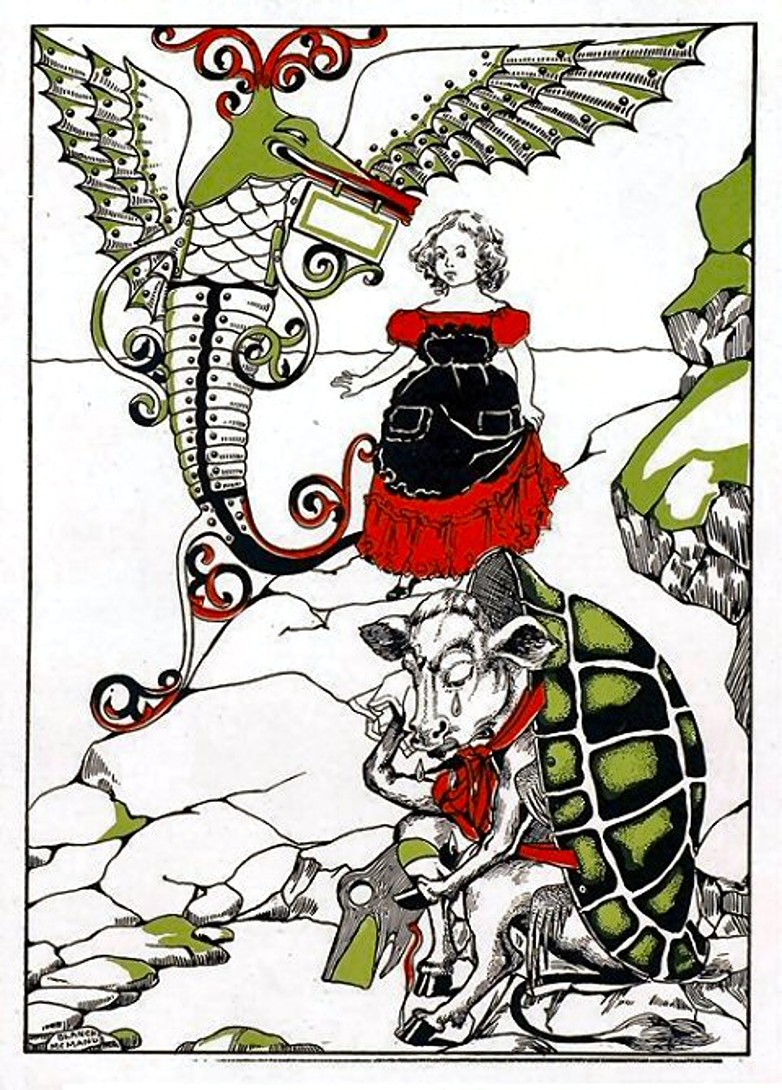
An exquisite Art Nouveau-inspired portrayal of the Mock Turtle and Gryphon, by Blanche McManus, 1899 (public domain)

In Carroll's account of the Gryphon and the Mock Turtle that the Queen of Hearts had taken Alice to meet, nothing of note concerning the morphology of either of them was included by him (devoting much of his coverage instead to their reciting and performing the Lobster Quadrille, a most unusual dance). Instead, all such details were imparted to the reader entirely by way of some excellent line drawings prepared by the renowned illustrator Sir John Tenniel working in strict accordance with Carroll's very exacting instructions. Carroll had initially planned to illustrate the book himself, and did so in a preliminary, then-unpublished, handwritten version entitled Alice's Adventures Under Ground (AAUG), which he presented to Alice Liddell on 26 November 1864. However, he recognised that his artistry was not of a sufficiently high standard for publication purposes, so he engaged Tenniel to prepare the required artwork for the final, longer version that became AAIW. (This was evidently a wise decision, judging at least from Carroll's bizarre illustration of the Mock Turtle that appeared in AAUG, in which its head resembled that of a seal, and its long, slender body looked as if it were composed entirely of overlapping roof tiles!)

Lewis Carroll's decidedly odd-looking drawing of the Mock Turtle, from Alice's Adventures Under Ground (public domain)

In Tenniel's drawings, the Gryphon was depicted in typical griffin form, as a composite of eagle and lion, deftly amalgamating the beaked head, taloned forelimbs, and plumed wings of the former with the furry body, clawed hind limbs, and long tuft-tipped tail of the latter. Conversely, whereas the Mock Turtle also appeared to be a composite creature, it did not resemble anything known to me from either fable or fact. Nor had I even heard of a mock turtle before. Evidently, therefore, I reasoned, unless it were an exceedingly obscure mythical beast it must have been one of Carroll's own inventions, but what had inspired him to fashion it in the extraordinary form that he had done, and where had its very distinctive, memorable name originated? These were the two questions that puzzled me for so long (back in those now far-distant days before the information super-highway of the internet had come into being!).

Sir John Tenniel's most famous depiction of the Mock Turtle and Gryphon, 1865 (public domain)

For in Tenniel's illustrations, this remarkable creature was portrayed with the familiar body shell and scaly front flippers of a real turtle, but sported the big-eared head, hoofed hind legs, and long tufted tail of a calf. In my youthful naivety, I simply assumed that the 'mock' aspect of its name related to the fact that because of these bovine attributes it wasn't a genuine turtle, with the latter attributes merely being humorous but hardly meaningful creations by Carroll. I now know of course that had I been alive during Victorian times when AAIW was written and published, I would have been readily aware of the true derivation of this term and the attendant significance of those attributes – especially as, albeit unrealised by me back in my childhood, Carroll had actually provided the answer to one of my afore-mentioned questions in his text:

Then the Queen left off, quite out of breath, and said to Alice, "Have you seen the Mock Turtle yet?"

"No," said Alice. "I don't even know what a Mock Turtle is."

"It's the thing Mock Turtle Soup is made from," said the Queen.

"I never saw one, or heard of one," said Alice.

Neither had I, but nor had I ever heard of mock turtle soup either, so I had assumed that this too was just another Carrollian invention. Many years later, however, I finally stripped bare the mystery surrounding the 'mock' moniker, and uncovered at last the truth behind this very tantalising turtle.

A colourised version of Tenniel's second original illustration of the Mock Turtle and Gryphon with Alice, 1865 (public domain)

It turned out that mock turtle soup was actually a bona fide dish, an English soup originally created during the mid-1700s but very commonly served in Victorian times. It earned its name from the fact that it was actually a cheap substitute for genuine turtle soup, which was a very expensive delicacy that few could afford. Instead of containing turtle flesh as its primary ingredient, mock turtle soup contained calf meat (veal), taken especially from those parts of a calf that were otherwise usually discarded, i.e. the head, hooves, and tail, and which therefore cost a lot less to produce than real turtle soup.

Classic illustration by Arthur Rackham of the Mock Turtle, Gryphon, and Alice, 1907 (public domain)

Suddenly, all became clear. His fondness for humorous word games, puns, and other literary trickery had clearly inspired Carroll to dream up a character that was then playfully put forward by him when recounting his story as the (non-existent) creature from which was derived a certain very common veal-containing dish from his time whose memorable name would be familiar to his young listeners and thus make them laugh – namely, mock turtle soup. That was why the Mock Turtle had a turtle's shell and front flippers but a calf's head, hind limbs, and tail – with typically witty Carrollian absurdity, it was the visual embodiment of what mock turtle soup pretended to contain (turtle) and what it actually did contain (the calf elements listed above).

In this illustration from 1916, the Gryphon and a particularly tearful Mock Turtle perform the Lobster Quadrille for a somewhat bemused Alice (public domain)

One further feature that was a major component of the Mock Turtle was its extremely lugubrious, sobbing demeanour. When Alice asked the Gryphon why his chelonian companion was so sorrowful, the Gryphon replied very dismissively that it was "all his fancy", that he didn't actually have any sorrow. Yet because the Mock Turtle briefly mentioned that he had once been a real turtle (but without providing any clues as to why he no longer was), there has been much speculation among Carrollian scholars as to whether this was the reason for his tearful melancholia, coupled perhaps with what may have been a poverty-stricken upbringing (when recounting his history to Alice, the Mock Turtle intimated that he was poor when young, revealing that he couldn't afford to study any extra subjects at school, only the regular ones).

The Mock Turtle is no less mournful in this illustration either, by Gwynedd Hudson, 1922, but Alice looks distinctly perturbed by their terpsichorean exuberance! (public domain)

As a wildlife enthusiast from the earliest of ages, however, it occurred to me a long time ago that a more likely origin for this particular characteristic of the Mock Turtle was that real turtles, which are all exclusively marine in the strict definition of the term 'turtle' traditionally employed in British English, rid their bodies of excess salt (derived from drinking seawater) by excreting it in the form of salty tear-like exudation trickling from glands near to their eyes, so that they look very much as if they are weeping profusely. Quite apart from being a mathematician and storyteller, Carroll was also a keen amateur naturalist (and is known to have made a particular study of those animals featuring in his Alice novels to ensure that his accounts of them were accurate). Consequently, he was assuredly aware of this specific behavioural occurrence in turtles, and had cleverly incorporated it with altered meaning into the Mock Turtle's persona, transforming it from a practical osmoregulatory activity into an entirely anthropomorphic emotional outpouring instead.

The Mock Turtle managed to be doleful even when dancing, as seen here in this lantern slide image from the early 1900s (public domain)

More than 150 years have passed since the Mock Turtle was introduced to the world in AAIW, and it has been depicted by over 70 artists within the numerous illustrated editions that have been published since the original one from 1865, containing Tenniel's drawings. It has also appeared in a considerable number of films and TV adaptations, in which it has been played by the likes of Cary Grant, Sir John Gielgud, Sir Michael Hordern, Donald O'Connor, Gene Wilder, and Ringo Starr, as well as being voiced by Alan Bennett in the 1985 film Dreamchild.

The Mock Turtle in a photo-still from Alice In Wonderland (1915), a very early silent film version written and directed by W.W. Young, starring Viola Savoy as Alice, and viewable online here (public domain)

What is particularly interesting, however, is that whereas earlier portrayals generally retained its appearance as originated by Tenniel following Carroll's instructions to him, there have been various later depictions that have strayed significantly from this. Moreover, the way in which they have strayed seems to indicate that those responsible may not have realised why this character's appearance was what it was in the original book, thereby, albeit inadvertently, making a veritable mockery of the Mock Turtle.

An illustration from 1907 by W.H. Walker featuring an accurately-depicted Mock Turtle but a very predatory-looking Gryphon in worryingly close proximity to Alice! (public domain)

The reason for my suspecting this to be the case is that the Mock Turtle has sometimes been depicted not as a half-turtle half-calf composite, but merely as a normal, ordinary turtle, i.e. with not just a turtle's body shell and front flippers but also a turtle's head, hind flippers, and tail – thereby entirely missing the etymological significance and origin of this Carrollian character. After all, if the Mock Turtle is presented as being exactly the same in appearance as a genuine turtle, how can the term 'mock' be justifiably applied to it? Equally, the crucial fact that it was specifically created by Carroll as the creature from which mock turtle soup is supposedly derived is wholly concealed visually if it is depicted simply as a totally normal-looking turtle. Consequently, I can only assume that those who have produced these latter images do not know about mock turtle soup. In a different but no less bizarre vein, I have also seen the Mock Turtle portrayed with the head, trotters, and curly tail of a pig, which if anything makes even less sense than depictions of it as a genuine turtle!

An unusual but thoroughly charming illustration from 1926 by A.L. Bowley, in which not only Alice but also apparently both the Mock Turtle and the Gryphon are depicted as youngsters (public domain)

Today, the Mock Turtle's fame stretches far beyond the confines of Carroll's beloved novel, appearing in a number of works by other authors inspired by Wonderland and its many strange but memorable inhabitants. As noted earlier, it features in many movie and TV dramatisations of AAIW too, as well as in various songs, and it has even lent its name to a popular Indie rock band, The Mock Turtles, hailing from Greater Manchester, England.

Still more dancing, but no sign of Alice in this illustration from 1928 – perhaps she'd become bored of it all by now and went home! (© Copyright holder and original source of this illustration presently unknown to me – reproduced here on a strictly non-commercial Fair Use basis only)

Nevertheless, at least for me there is one major disappointment associated with this memorable character – that it didn’t appear in Walt Disney's very colourful, classic animated film, Alice in Wonderland, first released in 1951. Very recently, however, I was most interested to discover that in fact, along with the Gryphon, the Mock Turtle had indeed been due to feature in it. In fact, cartoon versions of their characters had been produced, and were scheduled to appear in one scene, with the Mock Turtle even singing two specially-penned songs ('Beautiful Soup', sung to the tune of 'The Blue Danube', and 'Will You Join The Dance?', based upon the 'Lobster Quadrille' poem recited by this character in the novel'). Just before the film's completion, however, their scene and songs were axed. Happily, though, all was not entirely lost, because later on in the 1950s Disney produced an animated Wonderland-based commercial for Jell-O gelatin desserts in which the Mock Turtle and Gryphon did feature, together with Alice.

A very beautiful, colourful rendition of the Mock Turtle, Alice, and a fiery-plumed Gryphon by Harry Rountree, 1928 (© Harry Rountree, reproduced here on a strictly non-commercial Fair Use basis only)

Even so, failing to make the final cut in one of Disney's most delightful animated films would be enough, surely, to make anyone cry, let alone someone as famously weepy as the mournful Mock Turtle!

The Nursery "Alice" – a special edition of AAIW for very young children, simplified by Lewis Carroll and illustrated by Sir John Tenniel; it was published in 1890 and included both the Mock Turtle and the Gryphon on its front cover, prepared by one of Carroll's friends, E. Gertrude  Thomson (public domain)

To read a previous ShukerNature blog article concerning another of my favourite AAIW animal characters, the iconic and decidedly idiosyncratic Cheshire Cat, please click here.

One of my all-time favourite AAIW-inspired artworks, an absolutely spectacular and very original futuristic/fantasy take on the Mock Turtle, Gryphon, and Alice, by the world-renowned fantasy artist Rodney Matthews (© Rodney Matthews, included here on a strictly non-commercial Fair Use basis only)


Saturday, 12 July 2014

GRIFFINS, GRIFFINOSAURS, CYNOGRIFFINS, AND HIPPOGRIFFS – REVISITING SOME CLASSIC MIX 'N' MATCH MONSTERS FROM FABLE, FICTION, AND FACT

A beautiful majolica jardinière from the late 19th Century in the form of a senmurv or cynogriffin (© Dr Karl Shuker)

My maternal grandmother's family surname was Griffin, in honour of which I have a griffin tattoo, so this famous beast of ancient myth and legend has always been special to me. A fabulous mix 'n' match monster combining the body of a lion with the wings and head of an eagle, and alternatively spelled as 'gryphon', it apparently originated in the Levant region, with accounts of griffins from this area dating back more than 4000 years, but later spreading their mighty pinions westward into Europe.

A ceramic griffin figurine (© Dr Karl Shuker)

These amalgamated animals were well-known for their fondness for gold - Greek historian Herodotus, writing in the 5th Century BC, stated that griffins inhabited the lofty mountain peaks of India, where they dug up gold with which to construct their mighty nests, which in turn were greatly coveted by opportunist gold-hunters.

Griffin engraving from 1663

Also highly sought-after were their long curved talons, allegedly capable of detecting poison, and many were brought back to Europe during the Middle Ages by crusaders. Sadly, however, they invariably proved to be antelope or other ungulate horns, sold to the ingenuous crusaders by African entrepreneurs! As noted by Edward Peacock in the September 1884 issue of The Antiquary, for instance, a supposed griffin claw now preserved in the British Museum is believed to have been one of two contained in 1383 within the shrine of Saint Cuthbert at Durham Cathedral. However, it bears a very close resemblance indeed to the horn of an ibex!

Nubian ibex revealing its magnificent curled horns, once passed off as griffin claws by unscrupulous Middle Eastern vendors to gullible Crusaders (© Nino Barbieri/Wikipedia)

Traditionally, zoologists have sought to identify the griffin with a powerful species of vulturine bird of prey called the lammergeier Gypaetus barbatus, but in 1991 a very novel alternative candidate was proposed by Dr Adrienne Mayor, a classical scholar currently at California's Stanford University.

Lammergeier – a German chromolithograph from 1894

Dr Mayor noted that the Altai Mountains of central Asia, famous for their rich gold deposits and the locality of many ancient griffin legends, also contain the fossilised skeletons and eggs of a lion-sized species of quadrupedal ceratopsian dinosaur called Protoceratops andrewsi, whose most distinctive feature was its strikingly eagle-like beaked head.

Life-sized model of Protoceratops andrewsi (© Dr Karl Shuker)

Dating from the late Cretaceous Period (approximately 70 million years ago), if its remains had been encountered by early gold prospectors many centuries before the correct nature of dinosaurs as prehistoric reptiles was recognised, how would these veritable griffinosaurs have been explained by such people? Quite possibly as the skeletons of four-footed eagle-headed monsters - or, as we call them today, griffins.

Griffin statue spotted in the yard of a statue/figurine seller in Rome, 2001 (© Dr Karl Shuker)

Closely allied (if not directly ancestral) to the griffin, and sometimes termed the cynogriffin, is the senmurv ('dog-bird') of early Persian mythology, which combines the body of a lion, and the wings and talons of an eagle, with the head of a dog. Its home was a magical tree, whose seeds, scattered throughout the world whenever the senmurv alighted in its mighty branches, cured diseases and evils of every kind.

Embroidered senmurv, based upon the royal symbol of the Sassanian Empire of 224-651 AD (© Dr Karl Shuker)

Later Persian legends transformed the senmurv into a huge, resplendent bird known as the simurgh, which nested on the highest peak of northern Persia's Alburz Mountains, and was permanently hidden from mortal view behind a shimmering veil of darkness and light. Nevertheless, this supposedly unseen bird was frequently, and lavishly, portrayed in ancient bestiaries and manuscripts - a paradoxical situation that incited one short-tempered scholar long ago to pen the following terse but apt comment in the margin of an exquisite plate depicting the simurgh in a 13th Century bestiary: "Thou fool, if nobody has seen the simurgh, then how dost thou portray it?".

Simurgh depicted upon the portal of Nadir Divan-Beghi Madrasah, in Bukhara, Uzbekistan (© Alaexis/Wikipedia)

Folklorists consider it most likely that the simurgh was based upon one or more of the large vultures and eagles native to Iran and elsewhere in the Middle East, and its 'evolution' was probably also influenced by Arabian myths of the enormous roc or rukh - a gargantuan bird of prey that could carry elephants aloft in its huge talons and inhabited an unspecified island in the Indian Ocean. As documented in further detail elsewhere on ShukerNature (click here), fronds from the exceptionally large raffia palm tree Sagus ruffia were once believed to be the feathers of the roc.

Supposed roc feather, in reality a frond from the raffia palm tree (© Dr Karl Shuker)

Yet however improbable dinosaur-inspired griffins and dog-headed griffins (not to mention elephant-abducting giant birds!) might seem, they all pale into insignificance when compared with a certain category of griffin that was so unlikely it was specifically created to personify the concept of impossibility - namely, the hippogriff. According to mythology, the rapacious griffin would readily attack and devour a horse, and in any case these two animal types were entirely dissimilar in form from one another. So how could anyone believe that they might ever mate and yield viable offspring (always assuming, of course, that anyone could actually believe that griffins themselves were real)? Such an unnatural liaison would clearly be impossible, but even if somehow it might indeed take place, no offspring could ever result from it. Thus originated the notion of the hippogriff, as initially coined (though not actually named, merely alluded to) by Roman poet Virgil (70-19 BC) in his Eclogues, as the embodiment of all that could never be - except that like so many other fictitious monsters, the hippogriff ultimately took on a veritable life of its own.

'Roger Délivrant Angélique' ('Roger rescuing Angelica'), painted by Louis-Édouard Rioult in 1824

Uniting the head, plumed wings, and front limbs of an eagle with the body, hind limbs, and tail of a horse, the hippogriff presented such a spectacular image that it became a popular subject for Classical artists to portray, it appeared in heraldry on several notable coats of arms, and in the poem Orlando Furioso ('Mad Orlando') penned by Ludovico Ariosto in 1516 this monumentally mixed 'n' matched monster was formally designated the name 'hippogriff' (also spelled 'hippogryph'). In this latter literary work, the wandering knight Roger rescues the fair Angelica from a voracious sea dragon while riding the airborne hippogriff - a beast of such astounding flying ability that it can soar entirely around the earth without pausing, and even take wing to the moon and back. During the 19th Century, Gustave Doré (1832-1883) produced some striking images of the hippogriff in his celebrated series of engravings illustrating Ariosto's poem.

Roger rescuing Angelica, portrayed by Gustave Doré

Without any doubt, however, the most famous modern-day representation of this fabulous animal is Buckbeak, the prominently-featured hippogriff in the bestselling Harry Potter series of teenage wizard and wizardry novels by J.K. Rowling, which has introduced to millions of readers worldwide what had hitherto been for centuries a somewhat obscure fantasy beast. Not bad at all for a creature originally invented expressly to signify anything that could never exist!

Buckbeak the hippogriff as depicted upon the front cover of The Prisoner of Azkaban, the third Harry Potter novel (© J.K. Rowling/Bloomsbury)