Dr KARL SHUKER

Zoologist, media consultant, and science writer, Dr Karl Shuker is also one of the best known cryptozoologists in the world. He is the author of such seminal works as Mystery Cats of the World (1989), The Lost Ark: New and Rediscovered Animals of the 20th Century (1993; greatly expanded in 2012 as The Encyclopaedia of New and Rediscovered Animals), Dragons: A Natural History (1995), In Search of Prehistoric Survivors (1995), The Unexplained (1996), From Flying Toads To Snakes With Wings (1997), Mysteries of Planet Earth (1999), The Hidden Powers of Animals (2001), The Beasts That Hide From Man (2003), Extraordinary Animals Revisited (2007), Dr Shuker's Casebook (2008), Karl Shuker's Alien Zoo: From the Pages of Fortean Times (2010), Cats of Magic, Mythology, and Mystery (2012), Mirabilis: A Carnival of Cryptozoology and Unnatural History (2013), Dragons in Zoology, Cryptozoology, and Culture (2013), The Menagerie of Marvels (2014), A Manifestation of Monsters (2015), Here's Nessie! (2016), and what is widely considered to be his cryptozoological magnum opus, Still In Search Of Prehistoric Survivors (2016) - plus, very excitingly, his four long-awaited, much-requested ShukerNature blog books (2019-2024).

Dr Karl Shuker's Official Website - http://www.karlshuker.com/index.htm

IMPORTANT: To view a complete, regularly-updated listing of my ShukerNature blog's articles (each one instantly clickable), please click HERE!

IMPORTANT: To view a complete, regularly-updated listing of my published books (each one instantly clickable), please click HERE!

IMPORTANT: To view a complete, regularly-updated listing of my Eclectarium blog's articles (each one instantly clickable), please click HERE!

IMPORTANT: To view a complete, regularly-updated listing of my Starsteeds blog's poetry and other lyrical writings (each one instantly clickable), please click HERE!

IMPORTANT: To view a complete, regularly-updated listing of my Shuker In MovieLand blog's articles (each one instantly clickable), please click HERE!

IMPORTANT: To view a complete, regularly-updated listing of my RebelBikerDude's AI Biker Art blog's thematic text & picture galleries (each one instantly clickable), please click HERE!

Search This Blog


PLEASE COME IN, I'VE BEEN EXPECTING YOU...

PLEASE COME IN, I'VE BEEN EXPECTING YOU...
WELCOME TO SHUKERNATURE - ENJOY YOUR VISIT - BEWARE OF THE RAPTOR!


Showing posts with label manticore. Show all posts

Thursday, 6 September 2018

THORNY-TAILED CATS AND A DOMESTIC MANTICORE


A winged manticore with a decidedly scorpionesque sting-tipped tail, depicted on the front cover of Piers Anthony's novel A Spell For Chameleon – one of my all-time favourite fantasy novels, and the first in Anthony's exceedingly popular, long-running Xanth series (© Del Rey Books – reproduced here on a strictly non-commercial Fair Use basis for educational purposes only)

Quite apart from its mane in the male, the lion Panthera leo is also set apart morphologically from all other cat species, at least officially, by virtue of a remarkable characteristic of its tail. Not only does it terminate in a hairy tassle-resembling tuft, but sometimes concealed within that tuft is a thorn-like spine that measures just a few millimetres long.

This unexpected structure's function, if indeed it has one, is unknown, as is that of the hairy tuft. Known variously as a thorn, spine, prickle, or caudal claw, it is not present when a lion cub is born, but develops when the cub is around five months old, and is readily visible two months later.
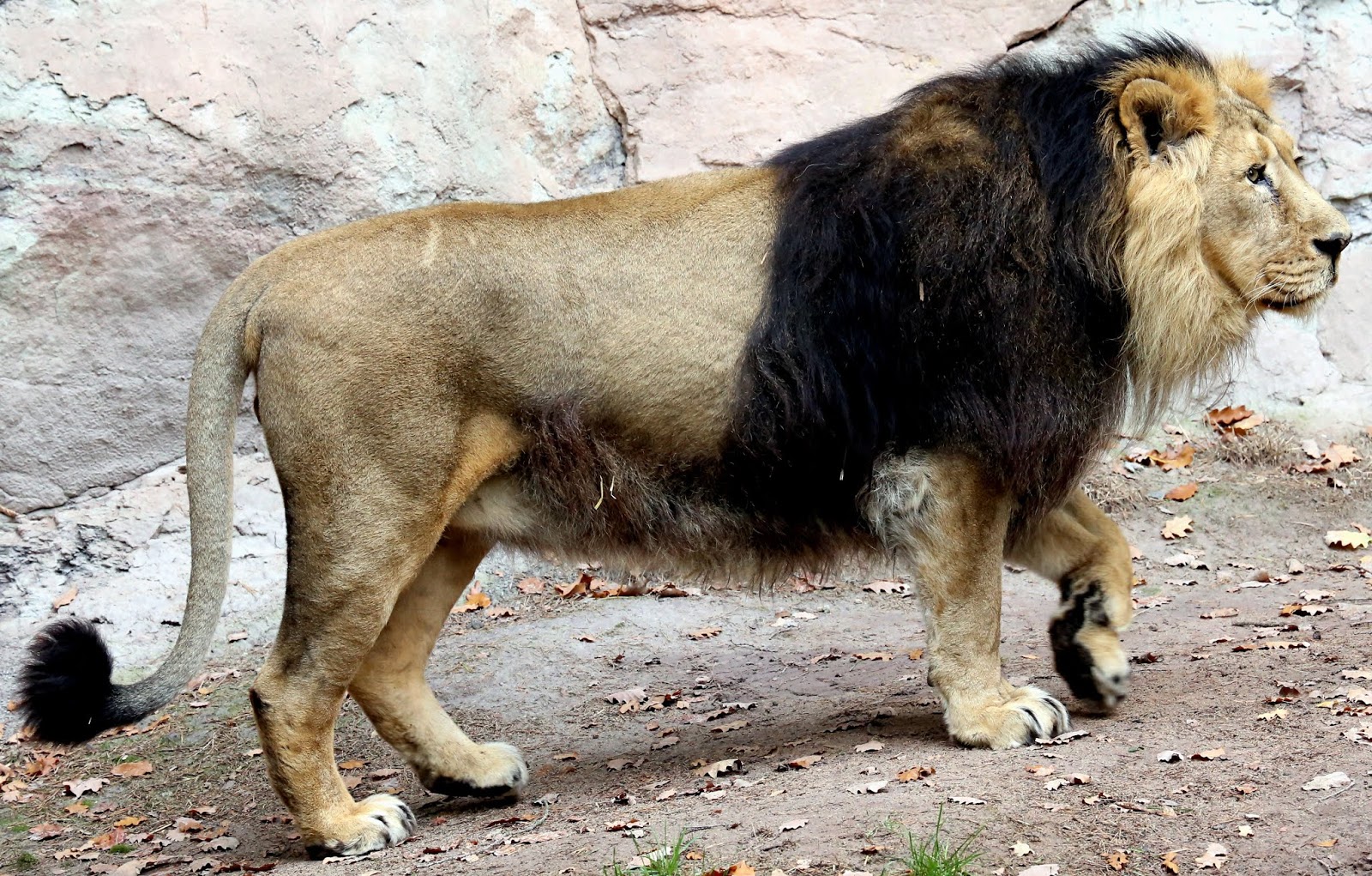
Lion showing the very distinctive tufted tail-tip that is peculiar to this species among felids (© Rufus46/Wikipedia – CC BY-SA 3.0 licence)

Click here (then scroll down to the end of this zoo news report) to view a close-up photograph of a leonine caudal claw, normally hidden by the hairy tuft at the tip of the lion's tail. This particular caudal claw is sported by an adult South African lion named Xerxes at Woodland Park Zoo in Seattle, Washington State, USA.

The most detailed coverage concerning caudal claws in lions that I have ever seen is an article originally published in Part 2 of the volume for 1832 of the now long-bygone journal Proceedings of the Committee of Science and Correspondence of the Zoological Society of London (it was subsequently republished in January 1833 within vol. 2, no. 7, of the third series of the London and Edinburgh Philosophical Magazine and Journal of Science). Not only does this fascinating if nowadays exceedingly little-known report document the then-recent description of one such specimen by H. Woods to the Committee of Science and Correspondence of the Zoological Society of London, it also provides a detailed history of how such oddities were first brought to scientific attention and early thoughts as to what their function may be. In view of its scientific significance, therefore, I am reproducing this hitherto-obscure article in its entirety below:

WOODS, H., 'On the Claw of the Tip of the Tail of the Lion (Felis leo, L.)', Proc. Comm. Sci. and Corres. Zool. Soc. London, pt 2: 146-148 (1832) – please click pages to enlarge them for reading purposes (public domain)

Although caudal claws are widely claimed to be sported only by the lion, I have encountered occasional reports of thorny-tailed tigers and leopards too (indeed, two such examples from leopards are briefly mentioned in the above-reproduced 1832 article). Although I have never seen an illustration of a caudal claw from either of these two latter species, the tail tip of such an animal must look very unusual – for as these species lack the lion's hairy tail tuft, the thorn of a thorny-tailed tiger or leopard would be visible, and may therefore resemble a scorpion-like sting!

In turn, such a bizarre image inevitably inspires speculation and theorising as to whether the sight of so oddly-equipped a big cat may have helped shape the legend of the fearsome if wholly fictitious manticore (click here to access my ShukerNature coverage of the manticore).

Close-up of the tufted tail-tip of a lion (public domain)

If so, then what might surely be dubbed 'the littlest manticore' is a certain domestic cat documented as follows by a Mr R. Trimen within a letter published on 3 March 1908 in the Proceedings of the Zoological Society of London:

My cat (pale grey with ordinary narrow black stripes much broken up into short streaks and spots) presents the remarkable peculiarity of a long spur or claw-like horny excrescence at the very tip of its tail. This appendage is firmly seated quite at the extremity of the last vertebra; its base appears to be expanded, and is covered all round by an elevation of the skin. It projects posteriorly in the line of the tail, is rather slender, gradually tapering, almost straight for about two-thirds of its length, and thence moderately curved downward to its moderately acute tip. In length it is nearly 7 lines [1 line = 1/12th of 1 inch], and more than a third projects beyond the surrounding fur. The colour of this spine or spur is dull reddish-brown varied with dull ochry-yellowish, here and there crossed by some broken, thin, whitish lines.

The cat in question is a female, small, but rather thick in body; the limbs are all rather short and the feet small, but the tail is noticeably long and broad with long dense fur. I am informed by the donor that it was born at Witney, near Oxford, and is now between seven and eight months old. I have endeavoured, with the kind aid of the donor, to ascertain from the original possessor of the animal whether any kitten of the same litter, or the mother, or other known relation, exhibited the peculiar appendage or any traces of it; but without success.

I may add that I have found the cat unexpectedly sensitive to any handling of the caudal claw, however gentle; she first endeavours to jerk her tail away, then gives a mild vocal remonstrance, and if the handling is continued employs her paws to stop it.

Perhaps this cat's tail thorn or caudal claw was a deformed supernumerary caudal vertebra whose exposed site rendered it vulnerable to being caught against objects as the cat moved, causing the flesh surrounding it to be abnormally sensitive to pain.

Mystery Animals of Ireland by Gary Cunningham and Ronan Coghlan (© Gary Cunningham and Ronan Coghlan/CFZ Press)

What may have been either a large domestic tabby or, more remarkably, a bona fide Irish wildcat (itself a feline cryptid of no little controversy that I documented comprehensively in my very first book, Mystery Cats of the World, 1989), was encountered during the 1940s or 1950s by the uncle and father of Pap Murphy in a shed at the end of the uncle's house on the Mullet, an island in northwest County Mayo, as documented by Gary Cunningham and Ronan Coghlan in their book Mystery Animals of Ireland (2010). Entangled in some fishing nets, the cat had growled at the men, who subsequently killed it. Examining its body, they were surprised to discover that it possessed a very sharp nail-like structure, possibly bony in composition, at the end of its tail.

It would be interesting to discover if any additional cases of 'domestic manticores' have been recorded.

Exquisite vintage engraving of a lion showing its characteristic tufted tail-tip – Plate 81 from General Zoology, or Systematic Natural History, by George Shaw, with plates engraved principally by Mr Heath; published in 1800 (public domain)

Finally: I have succeeded in tracking down a copy of the original article by German naturalist Prof. Johann F. Blumenbach that was extensively referred to in the above-reproduced 1832 article re H. Woods's description of the young Barbary lion's caudal claw. Blumenbach's article had been published in 1823 within the Edinburgh Philosophical Journal.

Accordingly, for the sake of completeness, I am reproducing it in its entirety below:

BLUMENBACH, Johann F., 'Art. VI. – Miscellaneous Notices in Natural History. 4. On the Prickle at the Extremity of the Tail of the Lion', Edinburgh Philosophical Journal, vol. 8, no. 16: 266-268 (1823) – please click pages to enlarge for reading purposes (public domain)

This ShukerNature blog article is excerpted and expanded from my book Cats of Magic, Mythology, and Mystery.


Tuesday, 11 December 2012

THE SMILE ON THE FACE OF THE MANTICORE AND LEUCROCUTA


Manticore, from Edward Topsell's The History of Four-Footed Beasts (1607)


“I know you,” whispered Strange again. “You are...You are...” He moved his hands through the empty air as if tracing magical symbols. “You are a Leucrocuta!”...

“You are the Wolf of the Evening! You prey upon men and women! Your father was a hyena and your mother a lioness! You have the body of a lion; your hooves are cloven. You cannot look behind you. You have one long tooth and no gums. Yet you can take human shape and lure men to you with a human voice!”

Susanna Clarke – Jonathan Strange & Mr Norrell


Medieval bestiaries contain many monsters, but few are stranger or more sinister than the following pair of feline fabulosi.

Combining the stature and body of a red lion, with the head and leering face of a bearded man (but sporting no less than three separate rows of shark-like teeth in each jaw), and the sting-tipped tail of a scorpion (which also bore a series of long spines that could be hurled from it with deadly accuracy at any would-be foe), the manticore was a rapacious beast originally from Persian mythology. However, it also entered European folklore after being documented in a now-lost book on India by Ctesias (a Greek physician and historian at the Persian court of King Artaxerxes II in the 4th Century BC), and later appeared in many medieval bestiaries. Not only did this ferocious monster attack and devour any human that it met, it even consumed their bones, clothes, and any belongings that they had with them, thus leaving behind not the slightest trace of its victim’s former existence.

A manticore in Liber de Proprietatibus Animalium, a 16th-Century bestiary

Zoologists have attempted to identify the manticore with the tiger (or even as a shape-shifting were-tiger), but there is scant – if, indeed, any? – similarity between the two creatures. Its sting-tipped tail has been explained by the occasional prominent presence of a horny claw-like structure at the extremity of a tiger’s tail. However, such structures are regularly present at the tip of lions’ tails, as well as those of leopards and even domestic cats on occasion, so this is hardly a characteristic exclusive to tigers. Equally unsatisfactory are claims that the manticore’s triple row of teeth was merely a misunderstanding based upon the fact that each molar of a mammalian carnivore bears three cusps or lobes. And why, if the manticore were indeed based upon a tiger, did it lack that great cat’s most distinctive feature – its stripes? (Incidentally, fantasy artwork featuring the manticore often gifts it with a pair of large bat-like wings, but this is a modern invention, which does not appear in early sources.)

Somewhat akin to the manticore but less well known was another mythological Asian monster – the leucrocuta (also spelled ‘leucrocota’, ‘leucrocotta’, 'crocotta', and other variants). Sometimes confounded in bestiaries with the hyaena (whose spotted species has been given the zoological name Crocuta crocuta), and said to frequent Ethiopia or India, the true leucrocuta was believed to be the hybrid offspring of a male hyaena and a lioness, but exhibited various features not possessed by either of these creatures - such as its hoofed feet, and, instead of normal separate teeth, having only a single unbroken ridge of bone in each jaw, forming one long continuous tooth without any gum.

A bestiary portrayal of the leucrocuta

Other characteristics included the head of a badger, the limbs of a stag, a lion’s neck, breast, and tail (as well as its bravery), a stature approaching that of a male ass coupled with the speed of a horse and the strength of a bull, plus an invulnerability to any weapon made of steel. Most bizarre of all, however, was its extraordinarily wide mouth, which allegedly stretched right back to its ears in a thoroughly unnerving grin!

Just like the manticore, the leucrocuta was a man-eater, but was much more cunning, luring its victims out of their houses at night by calling their names in a perfect imitation of a human voice. Indeed, and again like the manticore, the leucrocuta was often claimed to be a shape-shifter, able to adopt human form in order to increase the success of its voice’s ability to draw its victims within reach of its deadly jaws.

The Cheshire Cat's evil doppelganger? A manticore as portrayed by celebrated fantasy artist-author Una Woodruff

Even in modern times some vestigial fear of these man-faced, horror-jawed, semi-feline were-beasts survives. As recorded in Peter Costello’s book The Magic Zoo: The Natural History of Fabulous Animals (1979), novelist David Garnett revealed that in 1930, while visiting Spain, one of his friends, a Mr Richard Strachey, was mobbed by sedentary gypsies living in the Andalusian village of Ugijar after his beard led to his being mistaken for a manticore.

Peter Costello's book The Magic Zoo, featuring a manticore at bottom-left on the front cover (Sphere Books)

More recently, in 1964, Garnett learnt that another friend, an English lady who had stayed one evening with a bearded male companion at a small inn near the Alhambra Palace in Granada, Andalusia, was approached the next morning by the inn’s greatly-perturbed hostess, who revealed that all of her staff (hired from the local peasant population) were leaving straight away, because they believed that the lady’s male companion was a manticore who would steal their babies at night, cut them up, and eat them! Despite doing her best to assure their hostess that he would do nothing of the sort, the lady was only able to convince the peasants that her companion was human when she publicly kissed and caressed him while they all watched, hidden from his view, at a safe distance!

A winged manticore on the front cover of Piers Anthony's A Spell For Chameleon - one of my all-time favourite fantasy novels, and the first in Anthony's long-running Xanth series (Del Rey Books)

If such remarkable beliefs persist regarding the manticore, what about the leucrocuta? Perhaps it may be best, just in case, to view with extreme caution any stranger who calls your name and then greets you grinning, quite literally, from ear to ear!


This ShukerNature article is excerpted from my latest book, Cats of Magic, Mythology, and Mystery: A Feline Phantasmagoria (CFZ Press: Bideford, 2012), which is now available to pre-order at www.catsofmagicmythologyandmystery.com and is due to appear on Amazon within the next few days.