Dr KARL SHUKER

Zoologist, media consultant, and science writer, Dr Karl Shuker is also one of the best known cryptozoologists in the world. He is the author of such seminal works as Mystery Cats of the World (1989), The Lost Ark: New and Rediscovered Animals of the 20th Century (1993; greatly expanded in 2012 as The Encyclopaedia of New and Rediscovered Animals), Dragons: A Natural History (1995), In Search of Prehistoric Survivors (1995), The Unexplained (1996), From Flying Toads To Snakes With Wings (1997), Mysteries of Planet Earth (1999), The Hidden Powers of Animals (2001), The Beasts That Hide From Man (2003), Extraordinary Animals Revisited (2007), Dr Shuker's Casebook (2008), Karl Shuker's Alien Zoo: From the Pages of Fortean Times (2010), Cats of Magic, Mythology, and Mystery (2012), Mirabilis: A Carnival of Cryptozoology and Unnatural History (2013), Dragons in Zoology, Cryptozoology, and Culture (2013), The Menagerie of Marvels (2014), A Manifestation of Monsters (2015), Here's Nessie! (2016), and what is widely considered to be his cryptozoological magnum opus, Still In Search Of Prehistoric Survivors (2016) - plus, very excitingly, his four long-awaited, much-requested ShukerNature blog books (2019-2024).

Dr Karl Shuker's Official Website - http://www.karlshuker.com/index.htm

IMPORTANT: To view a complete, regularly-updated listing of my ShukerNature blog's articles (each one instantly clickable), please click HERE!

IMPORTANT: To view a complete, regularly-updated listing of my published books (each one instantly clickable), please click HERE!

IMPORTANT: To view a complete, regularly-updated listing of my Eclectarium blog's articles (each one instantly clickable), please click HERE!

IMPORTANT: To view a complete, regularly-updated listing of my Starsteeds blog's poetry and other lyrical writings (each one instantly clickable), please click HERE!

IMPORTANT: To view a complete, regularly-updated listing of my Shuker In MovieLand blog's articles (each one instantly clickable), please click HERE!

IMPORTANT: To view a complete, regularly-updated listing of my RebelBikerDude's AI Biker Art blog's thematic text & picture galleries (each one instantly clickable), please click HERE!

Search This Blog


PLEASE COME IN, I'VE BEEN EXPECTING YOU...

PLEASE COME IN, I'VE BEEN EXPECTING YOU...
WELCOME TO SHUKERNATURE - ENJOY YOUR VISIT - BEWARE OF THE RAPTOR!


Showing posts with label mystery monkeys. Show all posts

Friday, 23 December 2022

PERUVIAN BANDICOOTS, UNDISCOVERED TAPIRS, ZEBRA-STRIPED CARROT CREATURES, AND OTHER NEOTROPICAL NOVELTIES, COURTESY OF LEQUANDA & THIÉBAUT

 
Is this a bilby I see before me – in Peru?? (public domain)

In my previous ShukerNature blog article (click here to access it), I documented two unexpected creatures depicted in a magnificent mural-format pictorial encyclopaedia entitled Quadro de Historia Natural, Civil y Geografica del Reyno del Peru ('Painting of the Natural, Civil and Geographical History of the Kingdom of Peru'), or QHNCGRP for convenience hereafter in this present article. Consisting of numerous miniature oil paintings and accompanying text on a wood panel, it measures a very impressive 128 x 45.25 inches (325 x 115 cm).

Completed in Madrid, Spain, in 1799 and now on display at the Museo Nacional de Ciencias Naturales in Madrid (Spain's national museum of natural history), which has produced an exquisite,  lavishly-illustrated website devoted specifically to it (click here), QHNCGRP was authored by Basque-born but (for three decades) Peru-based scholar José Ignacio Lequanda, who commissioned French artist Louis Thiébaut to produce the 194 paintings illustrating it. As noted above, most of these are miniatures, with tiny but voluminous text by Lequanda accompanying all of the 160 miniatures depicting fauna and flora of Peru or its South American environs.

The vast majority of these miniatures depict readily-recognisable Neotropical species, including a large spotted rodent named the paca, a South American zorro or 'fox' (actually a species of Dusicyon canid), an otter, tapir, manatee, various monkeys, trumpeter bird, cock of the rock, spoonbill, hummingbird, Humboldt's penguin, skunk, caiman, giant anteater, fulgorid lantern-fly, llama, vicuna, armadillos, coati, and opossum, to mention but a few.
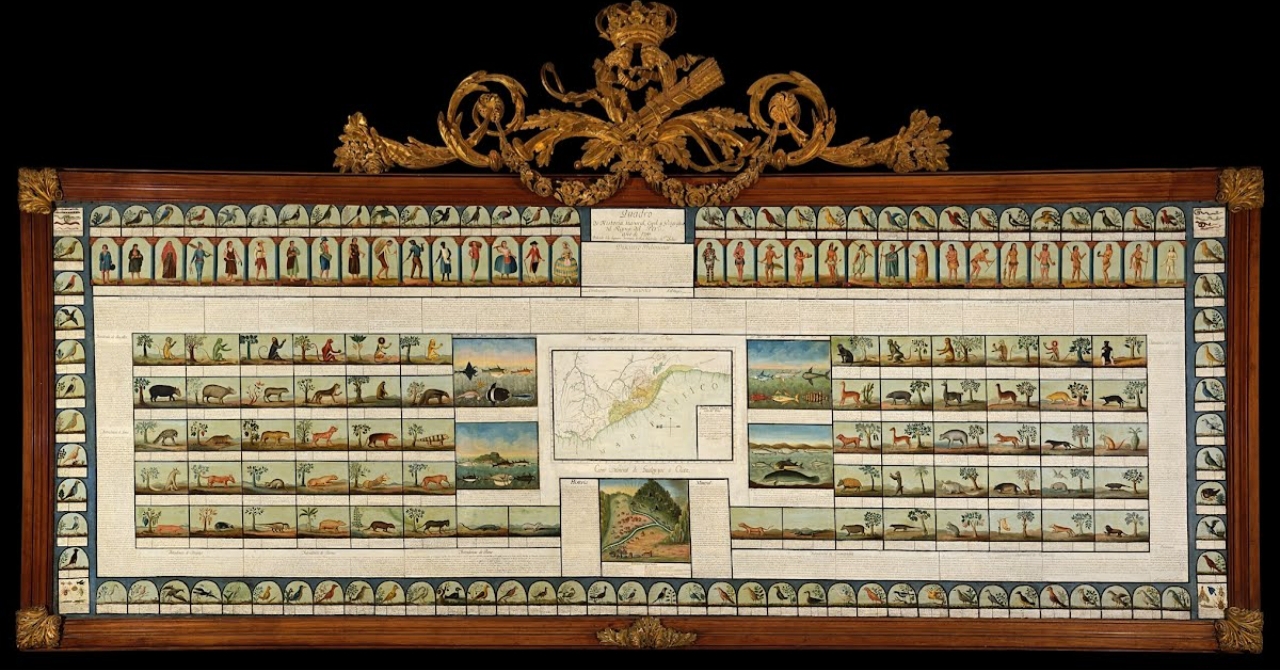
 
View of QHNCGRP in its entirety – click to enlarge for viewing purposes (© Museo Nacional de Ciencias Naturales – reproduced here on a strictly non-commercial Fair Use basis for educational/review purposes only)

Also present, however, are certain decidedly mystifying zoological portraits, such as that of a dramatically out-of-place Madagascan black-and-white ruffed lemur and one of a putative living ground sloth, both of which I documented in my previous QHNCGRP article.

Since writing that, I have been paying further close attention to this marvelous pictorial menagerie, and I've spotted several additional examples included within it that are nothing if not curious or controversial, for various differing but equally interesting reasons. So here they are – make of them what you will!

Take, for instance, the very distinctive creature portrayed in the QHNCGRP miniature that opens this present ShukerNature article. Whereas I am not aware of any South American mammal matching its morphology (Lequanda claimed it to be a vizcacha, and others have suggested the latter rodent's relative the chinchilla, but these bear little – in the case of the chinchilla – or no – in the case of the vizcacha – resemblance to it, I am aware that it does bear a remarkable similarity to a certain species of exclusively Australian marsupial. Namely, the lesser bilby (aka lesser rabbit-eared bandicoot) Macrotis leucura.

 
Mystery big-eared, long-snouted, plume-tailed QHNCGRP mammal (above) and a painting of a lesser bilby from English zoologist Oldfield Thomas's Catalogue of the Monotremes and Marsupials in the British Museum (Natural History) (below) (public domain)

Certainly, its long snout, lengthy plumed tail, and very sizeable ears all correspond very closely to those of the latter species. True, its forelimbs are much the same size as its hind ones, whereas those of the lesser bilby are shorter, and its fur is white rather than brown like the bilby's. However, the limb discrepancy may simply be an error on Thiébaut's part, especially if his subject's preserved skin had become distorted via shrinkage. Moreover, preserved skins frequently blanch if exposed too long to light (the taxiderm thylacine that was on public display in London's Natural History Museum when I visited in 2014, for example, was so faded, predominantly cream in colour all over, that its diagnostic stripes had vanished).

Deriving its English name from its very large, slender, rabbit-like ears, and characterized by its tail's long white hairy plume, the lesser bilby was once native to the deserts of central Australia, but has not been conclusively sighted since the 1950s, so is now deemed extinct. Back when QHNCGRP was created, however, it was still in existence, with preserved specimens in museums.

As apparently happened with the ruffed lemur, is it possible, therefore, that Lequanda and/or Thiébaut saw a museum specimen of the lesser bilby at Madrid's celebrated Royal Natural History Cabinet (founded in 1771, opened to the public in 1776, and whose contents were very familiar to Lequanda), or even elsewhere, and mistakenly assumed that it was a Neotropical species? Or might Thiébaut have based his miniature upon some pre-existing artwork by another artist? There is a notable QHNCGRP–linked precedent for this latter possibility.

 
Thiébaut's zebra-striped QHNCGRP mystery monkey (top left), Compañon's earlier artwork upon which Thiébaut's was based (top right), and a South American tree porcupine (below) (public domain / public domain / (© Eric Kilby/Wikipedia –
CC BY-SA 2.0 licence)

One of the several monkeys depicted as miniatures in QHNCGRP by Thiébaut is the extraordinary-looking striped example shown above. Its bold zebra-like body and limb markings instantly set it apart from any currently-known monkey species, as does the mid-dorsal row of spines running down its back. These are also alluded to by Lequanda, in his accompanying text. He referred to this fascinating fasciated creature as a casacuillo, and also mentioned that it lived upon fruit.

Rather than basing his illustration of this casacuillo upon first-hand observations of a living or preserved animal, however, Thiébaut used as his inspiration a pre-existing 18th-Century illustration. Namely, a water-colour prepared some years earlier with 1,410 others for inclusion in the Codex Martínez Compañon, a sumptuous nine-volume manuscript made by Baltasar Jaime Martínez Compañon, Bishop of Trujillo, Peru. This water-colour is also shown here, for comparison purposes alongside Thiébaut's oil painting.

Moreover, according to writer Carmen Martínez, writing in an online article from June 2021 devoted to QHNCGRP (click here to access it), this creature is not a monkey at all, but is instead a South American tree porcupine or coendou, of which there are many species, all sporting a prehensile tail. However, to me it looks no more like a tree porcupine than it does a monkey! Coendous are not striped and their fine spines are present profusely over their entire body, not merely along their back. So I am unconvinced by this identification.

 
A striped carrot on legs!! Another of Triébaut's bemusing mystery beasts included by him in QHNCGRP (public domain)

And speaking of zebra-patterned mystery beasts depicted in QHNCGRP, what are we to make of the example shown above? It looks for all the world like a striped carrot on legs! It seems to be furry, eared, and whiskered, and is included in the left-hand block of 30 mammal miniatures (according to Lequanda, moreover, it is, once again, a coendou!), so we must assume that it is indeed mammalian – or should we?

After all, also included in this same block of miniatures is the following bizarre beast, popularly if improbably(?) deemed to be a portrait of an iguana according to various sources consulted by me

Yet this latter beast is itself a major mystery. For it seems to possess a stiff pointed tail wholly unlike the highly flexible tail of an iguana, as well as long curved fangs emerging from its jaws, and what looks like a pair of wings pressed tightly against its flanks! Apparently, like the striped monkey/coendou illustration, Thiébaut based his miniature upon one from the Codex Martínez Compañon that was labelled as an iguana. Really??

 
A supposed iguana depiction by Thiébaut in QHNCGRP (above) and the original version in the Codex (below) (public domain)

Most improbable of all, however, must surely be the next example presented here. What on earth (or in the air!) is this extraordinary squirrel-like entity that sports not only two pairs of limbs and a bushy tail but also a pair of wings – and which are clearly functional, given that Thiébaut has portrayed it flying above a somewhat larger, rodent-like mammal in the same miniature?

Might it be the inaccurate result of Thiébaut painting not from direct observation of some physical specimen, but instead merely from a verbal description of a flying squirrel? True, the name of these rodents is something of a misnomer, seeing that they become airborne not with the assistance of wings but instead via a pair of gliding membranes (patagia), linking their wrist and ankle on each side of their body. But if a verbal description of such a creature does not make this distinction clear to an artist seeking to depict it, the result might well be an illustration of a squirrel-like creature boasting a pair of bona fide wings.

Yet even if that were true, there is still a fundamental problem in applying it as an explanation for this aerial anomaly as portrayed here, because although flying squirrels are widely distributed in North America, they do not occur anywhere in South America. So why would Thiébaut have depicted one in QHNCGRP? Yet another instance of someone wrongly assuming that a given creature is Neotropical when it definitely is not? Having said that, Thiébaut's illustration is yet again a copy of one from the Codex Martínez Compañon, but in that version the flying entity looks far more like a bird than a mammal, so why did Thiébaut convert it into one in his copied version? Conversely, at least according to Lequanda's accompanying description of it in QHNCGRP, it is indeed a rodent with wings, and is referred to by him as a mutmut. All very strange!

 
Thiébaut's bewildering winged squirrel in QHNCGRP (above) and the original bird-like version in the Codex (below) (public domain)

My concern with the ostensibly unidentifiable mystery creatures from QHNCGRP documented by me here is that, as already noted, most of the animals depicted in it by Thiébaut are readily recognisable. So as those were all accurately represented by him, why should the mystery beasts here not be too, unless he was indulging in some sly humour at Lequanda's expense, perhaps? Yet if they are accurate representations, why can we not identify them?

Might at least some of them not have arisen through misapprehensions regarding the origins of specimens utilized as subjects, or even as a result of poor verbal descriptions of such, but instead be bona fide native Neotropical species that have become extinct before ever becoming known to European scientists, so their morphological appearance is wholly unfamiliar to us?

The last anomalous animal to be considered here may provide key evidence that some of Thiébaut's miniatures depict significant creatures that were still unknown to science at the time when he depicted them.

 
The supposed lowland tapir depicted in QHNCGRP (public domain).

Just a few hours after I posted my previous QHNCGRP-themed ShukerNature article, on 22 December 2022, I received a very interesting, thought-provoking comment from a reader with the Google username Andrew, and which I duly posted beneath my article. It concerns the QHNCGRP miniature of what is officially assumed to be a specimen of the lowland (Brazilian) tapir Tapirus terrestris, the largest species of native mammal known to be alive today in South America, and occurring widely here, including in Peru. Here is Andrew's comment:

Thiébaut's depiction of the tapir looks like it could have been based on descriptions of the then-undiscovered mountain tapir, rather than the lowland species. It has no crest, its coat is almost black with a slight chestnut tint, and it seems to have white lips.

Smaller and darker in colour than the lowland tapir, the mountain tapir T. pinchaque is a very distinctive species that is indeed uncrested and white-lipped. It is also noticeably woolly, and looking at the tapir miniature in close-up its body surface does appear to be hairy. Moreover, of particular historical note is that this species, which is indeed native to Peru (occurring in its far north's montane cloud forests), was not formally described by science until 1829 – 30 years after the creation of QHNCGRP.

 
A lowland tapir (top) and a mountain tapir (bottom) (© Dr Karl Shuker / (© Richard Sifry/Wikipedia –
CC BY 2.0 licence)

In short, if the tapir miniature in QHNCGRP actually depicts a mountain tapir rather than a lowland tapir, this means that Thiébaut had portrayed a major mammalian species three decades before its official discovery. This in turn begs the question: what specimen was utilized by Thiébaut as the subject for his illustration?

Whichever it was, and wherever it was, its taxonomic significance as representing a dramatic new species had clearly not been recognized or appreciated by scientists of the day.

As I have revealed many times in my trio of books on new and rediscovered animals, this is a sad situation that has occurred countless times down through the centuries, with obscure museum specimens having been long overlooked before belatedly receiving serious attention, only for them then to be revealed as extraordinary new species whose existence had never previously even been suspected, let alone confirmed. So the potential example documented above has plenty of precedents, that's for certain!

 
My three books on new and rediscovered animals (© Dr Karl Shuker/HarperCollins/Stratus Publishing/Coachwhip Publications)


Saturday, 17 December 2022

JOCKO IS NO JOKE! A SHUKERNATURE PICTURE OF THE DAY

 
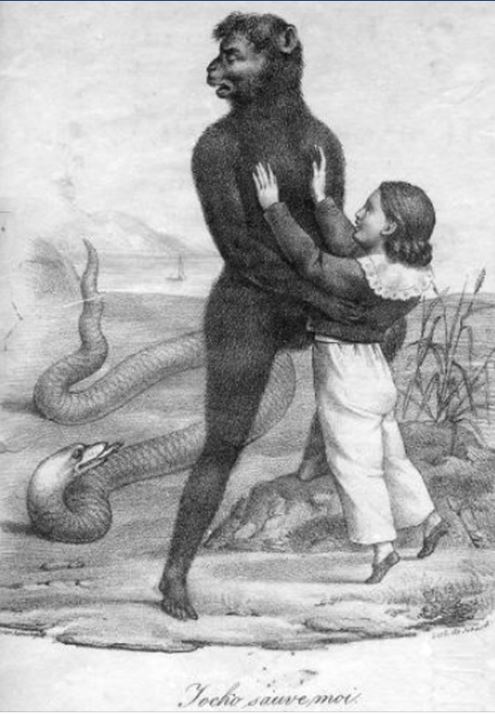
Vintage illustration for Jocko ou le Singe du Brésil (public domain)

It’s been quite a while since I last posted a ShukerNature Picture of the Day, so the recently-received eyecatching illustration presented above provides an ideal example with which to remedy this situation.

Not so long ago, I was sent this picture by a correspondent who had encountered it by chance online but without any accompanying details. So he wondered whether it may depict anything of cryptozoological interest or significance.

I had never seen this very dramatic-looking but decidedly strange image before, and was greatly intrigued by it, bearing in mind that it seemingly portrayed some form of giant indri-like lemur abducting a young child while being viewed closely by a large aquatic serpent. As I was unaware of any such event ever having been reported, however, I wondered whether it may instead be some form of satirical representation, a pictorial joke of some kind, rather than any literal depiction.

But as is so often the case with cryptozoological matters, first impressions can be deceiving, as I soon discovered after conducting an image search online.

It turns out that this picture is actually an illustration of an event in a two-act play by French writer and dramatist Edmond Rochefort entitled Jocko ou le Singe du Brésil ('Jocko or the Monkey of Brazil'), first staged in 1825, and inspired by Jocko, a bestselling novel by French author Charles de Pougens, published the previous year. Also inspired by this novel and again first staged in 1825 was a ballet by Fredéric-Auguste Blache, with music by Alexandre Piccinni, and sets by Pierre-Luc-Charles Cicéri, which proved so successful that numerous adaptations and copies of it were subsequently produced and staged for many years thereafter.

 
Famous French dancer and mime artist Charles-François Mazurier taking the role of Jocko in the original ballet version, as illustrated by French artist Godefroy Engelmann, 1825 (public domain)

The principal storyline of Jocko centres upon the capture of a large monkey in Brazil by a rich travelling Portuguese man, who names his captive Jocko. During the subsequent Atlantic crossing back to Europe, the man's vessel is shipwrecked, but Jocko saves the man's small son, Laurençon, from drowning, though in so doing Jocko is himself killed. When the play was performed for the very first time, however, the audience was so outraged by the death of the brave Jocko that it insisted he survive, and so in all subsequent performances he did!

What I find so interesting about the above picture, in which Jocko is in fact rescuing Laurençon from the clutches of the snake, is just how lemur-like, and just how monkey-unlike, he is portrayed, not to mention his great size and bipedal stance. Whoever had depicted him had clearly not based their portrayal upon an actual specimen of any known modern-day species of New World primate, that's for sure!

Speaking of known – or, rather, unknown – modern-day species of New World primate, however, Jocko's great size and bipedal nature do readily call to mind various cryptozoological reports describing alleged encounters with very large bipedal ape-like monkeys in many different parts of South America, including Brazil (where they are known locally as the caipora) – creatures that still remain undescribed by science.

(Indeed, incidentally, such reports even inspired the infamous hoax photograph of a supposed shot specimen of just such an entity that was published in an Illustrated London News article by Swiss geologist and Venezuelan explorer Dr François de Loys in 1929, and which French zoologist Prof. George Montandon deemed to be a major new species, naming it Ameranthropoides loysi – click here for Part 1 of my extensive 3-part ShukerNature coverage of this controversial saga, which is also contained in my book ShukerNature Book 2.)

Is it possible, I wonder, that the artist responsible for this illustration of Jocko had also heard of such reports, some of which do indeed date back as far as the early 19th Century (and even earlier, in fact), which duly influenced his portrayal of his simian subject? A memorable example, if true, of cryptozoology and culture combined!

 
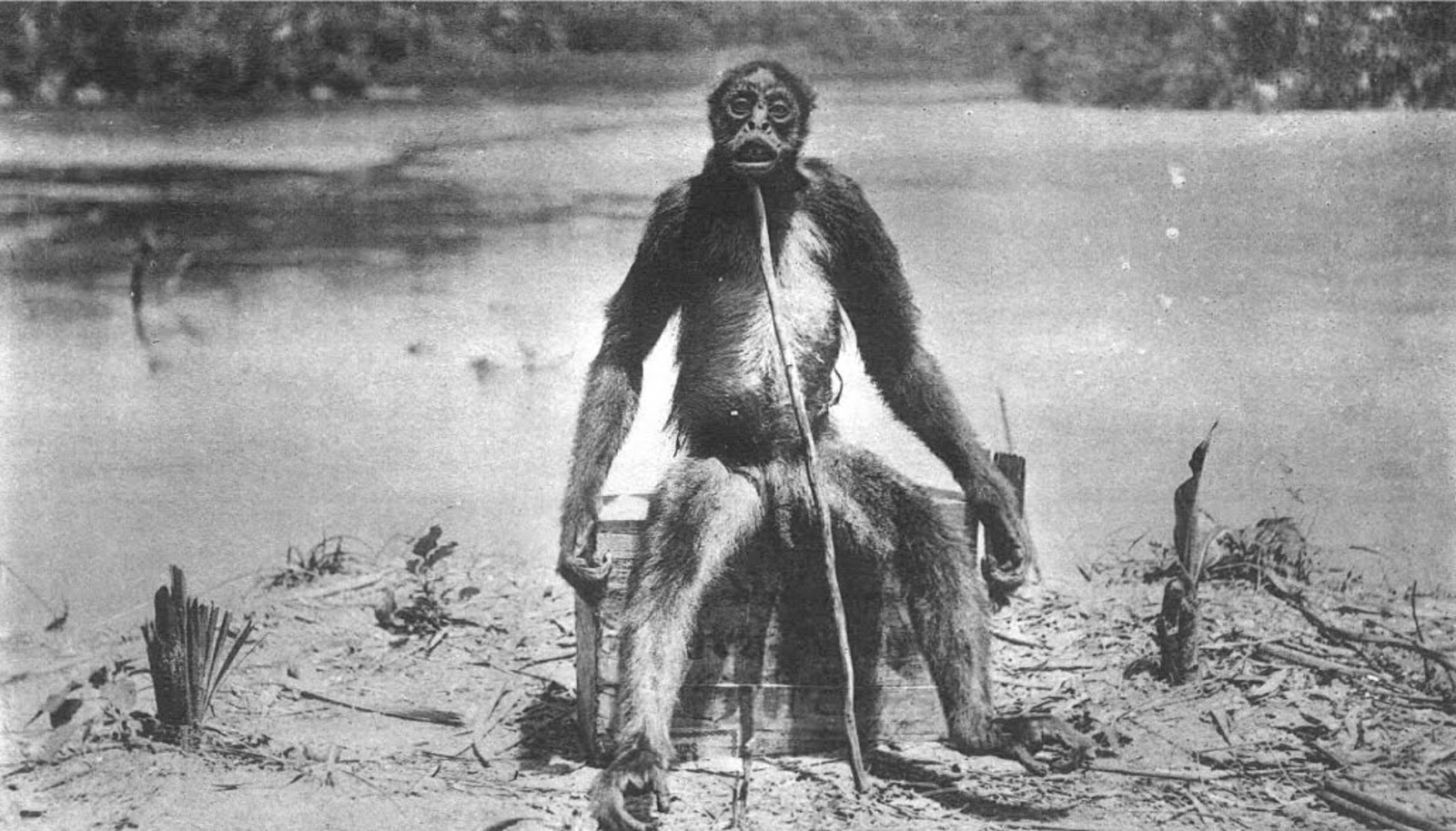
De Loys's infamous fake photograph of a supposed bipedal South American ape-like monkey shot by him in 1917 and subsequently dubbed Ameranthropoides loysi by Montandon – it was actually a dead pet spider monkey artfully arranged to look bigger than it actually was (public domain)


Monday, 31 July 2017

A PICTURE OF MONKEY BUSINESS - OR, HOW A SMALL FURRY PET BECAME A GIANT MYSTERY APE. PART 2: THE TRUE HISTORY OF AMERANTHROPOIDES LOYSI


The uncropped version of Dr François de Loys's photograph of the supposed South American ape Ameranthropoides loysi – one of the most controversial cryptozoological images of all time (public domain)

Welcome to my 600th post on ShukerNature! Befitting of such a momentous occasion, the subject documented by me in this post is of profound cryptozoological significance – revealing how one of the most infamous mystery beast frauds of all time was finally exposed. In Part 1 (click here) of this two-part ShukerNature article, I documented the 'official' history of a truly extraordinary mystery creature - a supposedly genuine, tailless, bipedal South American ape, reputedly encountered and killed in the Venezuelan jungle almost exactly a century ago by a team of geologists led by one Dr François de Loys, and subsequently dubbed Ameranthropoides loysi ('Loys's American ape') by a radical French zoologist called Prof. George Montandon who held very extreme, controversial views concerning human evolution. Now it's time to document this creature's true history, by presenting the crucial yet all-too-long-overlooked information that conclusively exposed the entire Ameranthropoides episode as a blatant, deliberate hoax.

The 'official' history of Ameranthropoides loysi began to unravel on 16 July 1962. This was when the Caracas, Venezuela, newspaper El Universal's historian Guillermo José Schael published in the paper a telegram lately received from the village of Casigua, in the Tarra River region of Venezuela, concerning a supposed giant spider that had allegedly strangled to death a ranch worker named Juancho. Not surprisingly, this dramatic news attracted considerable interest from readers, and elicited a letter from a hunter named Jerónimo Martínez-Mendoza, which was published on 18 July by El Universal.

In it, Martínez-Mendoza suggested that the report was mistaken, that it had probably been a giant spider monkey which had attacked and killed Juancho, and he drew comparisons in his letter with the Ameranthropoides incident from 1917. This letter was in turn read by Dr Enrique Tejera Guevara (1899-1980), a Venezuelan-born friend of de Loys in the field (as well as a decorated tropical physician and pathologist, ambassador, and minister in the Venezuelan government), who lost no time in replying via a letter of his own, but which contained a truly sensational disclosure.

Enrique Tejera Guevara (Wikipedia CC BY 4.0 licence)

Published in El Universal on 19 July 1962, Dr Tejera's letter revealed that back on 11 March 1929 (mistakenly given as 1919 in the newspaper-published version of his letter) he had attended a lecture at the Academy of Sciences in Paris, France, given by Montandon concerning Ameranthropoides, but that he had been very surprised to hear Montandon's claims about the creature being a very tall, bipedal, tailless South American ape. Consequently, at the end of the lecture Tejera had stood up, and, to a hushed audience, had brusquely dismissed Montandon's claims as nonsense.

Tejera informed them that he had actually been in the company of de Loys in 1917 when the famous encounter with the two apes and the shooting of one of them had supposedly taken place – but affirmed that no such encounter or shooting had in fact occurred. Instead, the creature in the photograph was nothing more than de Loys's own normal-sized pet marimonda spider monkey, which he had dubbed 'the monkey-man', and whose tail had been amputated after it had become infected. Moreover, after his pet spider monkey had later died, and again in the presence of Tejera, de Loys had decided, as a joke, to take a photo of its body propped upright and sitting on a crate.

And as the climax of his dramatic exposé, Tejera proclaimed that it was this joke picture that had subsequently become known as the now-infamous Ameranthropoides 'ape' photograph, thanks to Montandon, and which with Frankensteinian vigour had swiftly raged out of its creator's control - until in order to preserve his reputation as a serious scientist, a highly embarrassed de Loys, seeing no way of extricating himself from this most unwelcome situation without looking very foolish indeed, had thereby found himself unable to confess the truth.

Banana trees (public domain)

But that was not all. Far from being in an area of wild, uncharted jungle in peril from attacks by Motilone Indians at the time when the photograph was taken as claimed by de Loys, he and his party were actually in an oil exploration camp very close to civilisation. Furthermore, there was vital, conclusive proof of this statement contained in the uncropped version of the Ameranthropoides photograph, yet which had been overlooked by everyone for decades, even after Tejera's earth-shattering announcement in front of a shocked and stunned Montandon back in 1929.

The proof was the presence in this picture of a banana crop on the opposite side of the river from where the dead spider monkey was propped up and photographed. Banana trees are of Asian and Australasian origin, they are not native to the New World, having been introduced there by humans, and they can only grow near civilisation, not in the wild jungle region of South America where de Loys had averred that the photograph had been snapped. So the presence of banana trees in that picture verified that it had been snapped in the former location, not in the latter one that de Loys had alleged. This in turn also negates a claim made by him that whilst supposedly in the remote jungle, no fewer than 17 of his men had died due to the inhospitable conditions and the hostile Motilone Indians (in reality, there is no independent confirmation of this). In addition, Tejera revealed that rather than de Loys having led a single 4-year expedition to the Tarra River region as so frequently claimed in subsequent accounts of the Ameranthropoides case, he had instead led several much shorter ones (Tejera even provided their respective specific dates), and rarely beyond the perimeter of civilisation, as demonstrated, for instance, by the presence of banana trees in the Ameranthropoides photo.

Having said that, the portion of the photograph showing these trees is sufficiently blurred for their conclusive identification to be somewhat tricky. Tejera was there when the photo was taken, so obviously he could clearly discern their true nature, but the evidence for them from the photo alone is less certain. Happily, however, there is one additional aspect of this image that vindicates his statement. In the lower right quadrant of the photo, alongside the monkey in the foreground, a leafy shoot is present that is identifiable as a chopped-down but now-regenerating banana tree (I have shown this to various friends who have kept banana trees, and they have all affirmed that this shoot is indeed one). I have arrowed it in the uncropped photo reproduced below.

De Loys's full, uncropped Ameranthropoides photograph with the banana tree shoot in the foreground arrowed (public domain)

In addition, an aspect that, very surprisingly, seems not to have been considered previously is that for a creature supposedly killed by a hail of bullets, it seems in the photograph to be remarkably free of bullet holes or wounds, especially as it was supposedly shot from the front, not from the back or side. This of course is readily explained by the fact that, thanks to Tejera, we now know that the creature wasn't an attacking ape that had been shot, it was merely a pet monkey that had died of natural causes.

Equally, as the photographed 'ape' specimen was merely a marimonda spider monkey after all, de Loys's allegation that its dentition was different from that of spider monkeys was clearly yet another falsehood. And no doubt his so-convenient explanation of why the skull had not been retained for formal scientific examination (he claimed that the camp cook had converted it into a salt container and that it had then fallen apart), which of course would have readily identified its true taxonomic nature and exposed his dentition claim as false, was also a blatant lie. Little wonder, then, why de Loys was not able to escape from the web of deceit that he had spun when carrying out his joke, and which had ultimately and inextricably enveloped him.

But that was still not everything. At least two years before penning to El Universal his devastating letter outing and condemning Montandon and the entire Ameranthropoides charade, Tejera had actually revealed all of this to fellow medical practitioner Dr Raymond Fiasson, who had documented it in his book Des Indiens et des Mouches: Dans les Llanos du Vénézuela (1960). Yet this too had escaped attention from cryptozoologists and zoologists alike. So also had a section included by American physical anthropologist Prof. Earnest A. Hooton in his book Man's Poor Relations (1942) – a significant but hitherto-overlooked snippet until French cryptozoologist Michel Raynal had rediscovered it in 2007 (during that same year, Michel had also been instrumental in bringing Fiasson's documentation to public notice). Prof. Hooton had revealed that in late 1932, American geologist A. James Durlacher had written to him announcing that in 1927 he had spoken to various former members of de Loys's expeditions and had learnt from them that Ameranthropoides had indeed merely been a marimonda spider monkey. Even more frustrating, in 2001 Spanish researchers Bernardo Urbani, Dr Ángel L. Viloria, and Franco Urbani had presented much of this key information in a paper published by the Venezuelan journal Anartia, Publicaciones Ocasionales del Museo de Biologia de La Universidad del Zulia, in which they had concluded that the Ameranthropoides saga was certainly a hoax – but yet again, this revelation had somehow evaded widespread attention! (It is even possible that Tejera's dramatic intervention at the end of Montandon's lecture back in 1929 was subsequently documented in some French newspaper(s) and/or periodical(s), but if so these too failed to attract any public notice and still await rediscovery.)

The revelatory book by Bernardo Urbani and Dr Ángel L. Viloria – Ameranthropoides loysi Montandon 1929: The History of a Primatological Fraud (© Bernardo Urbani and Dr Ángel L. Viloria/Editorial LibrosEnRed – reproduced here on a strictly educational, non-commercial Fair Use basis only)

Happily, however, their skilful detective work uncovering this hoax was at last given its long-deserved international attention when, in 2008, Bernardo Urbani and Dr Viloria published all of their findings in book form – Ameranthropoides loysi Montandon 1929: The History of a Primatological Fraud. The book's text was presented in two separate languages, English and Spanish, and was fully referenced, thus constituting the most comprehensive, and now-definitive, study and exposé of the whole sorry Ameranthropoides saga.

One final point to consider here, which I haven't seen mentioned before but which has intrigued me for some time, is whether de Loys was at least partly inspired when setting up his hoax photo by a very distinctive illustration that was still famous back then, although much less so today.

In 1758, eminent English naturalist and wildlife painter George Edwards wrote and illustrated Gleanings of Natural History, an authoritative tome that would remain a major work on that subject for well over a century. One of its illustrations was a hand-coloured copper engraving by Edwards of a young orang utan, among the first pictures ever prepared of this great ape, in which the orang utan was portrayed sitting upright on a wooden bench holding a long tall wooden stick in one hand. If this illustration is compared with the iconic Ameranthropoides photo, a number of striking similarities can be seen, including the orientation and/or form of the feet, limbs, facial expression, and even the stick (albeit utilised for different purposes).

Comparison of the Ameranthropoides loysi photograph with the George Edwards illustration of an orang utan (public domain)

Consequently, as Gleanings of Natural History was still well known during the early 20th Century, it is not beyond the realms of possibility that de Loys had seen Edwards's orang utan illustration in it and had elected to reconstruct it using the dead spider monkey, but for practical purposes had transformed the stick into a supporting prop in his photo.

Ameranthropoides loysi RIP...? Although this specific case was a fraud from beginning to end, it should be noted that mystery animal researchers are well aware that large ape-like creatures, walking bipedally and lacking tails, have been frequently reported by natives and Western explorers alike from many parts of Central and South America, where they are referred to locally and variously by such names as the sisimite (in Belize), xipe (Nicaragua), shiru (Colombia), vasitri (Venezuela), didi (Guyana), tarma (Peru), mono rey (Bolivia), caipora and curupira (Brazil), and others too. Detailed documentation of such sightings lies outside the scope of this present article, but one extremely noteworthy, representative encounter occurred as recently as 1987, so is deserving of inclusion here.

That was when New York Botanical Gardens mycologist Gary Samuels was crouching down on the forest floor in Guyana, investigating fungi. Looking up, he was very startled to see a 5-ft-tall hairy ape-man, walking by at close range on its hind legs but seemingly unaware of him as he stayed kneeling, concealed on the ground. This remarkable entity, which uttered an occasional "hoo" cry as it passed by him, was presumably a didi.

O Curupira, by Brazilian painter Manoel Santiago, produced in 1926 and depicting the mythical(?) red-haired man-beast of Brazil known as the curupira (Wikipedia CC BY 4.0 licence)

Explorer Simon Chapman's book, The Monster of the Madidi: Searching For the Giant Ape of the Bolivian Jungle (2001), documented his search in Bolivia's Madidi region for the mono rey. Although he failed to find it, his book does contain a couple of tantalising snippets that were new to me. One was his claim that until recently, a local Bolivian actually owned a pelt from a mono rey, which was then purchased by "a gringo" (European) who took it home and sent it (or samples from it) off for DNA analysis, but the results (if any) were never revealed. No details were given in his book as to who the "gringo" was, where he came from, or where he sent the pelt/samples. The other snippet, which Chapman had apparently attempted unsuccessfully to substantiate, was that a living mono rey had allegedly once been exhibited at Bolivia's Santa Cruz Zoo! (This zoo is known in full as the Santa Cruz de la Sierra Municipal Zoo to distinguish it from others.)

Also worthy of note here is the existence of centuries-old carvings and statues depicting large, tailless, ape-like beasts, found among the crumbling relics from long-gone civilisations in various South American (and also Mexican) localities. Just coincidence – or representations of genuine creatures? There is even an unequivocally ape-like mask preserved at Chicago's Field Museum of Natural History, which had been carved in stone by Costa Rica's Guetar Indians and dates from 1200 to 1500 AD.

At one time, a major zoological stumbling block to accepting the possibility that any such entities actually do exist today in Latin America was the absence of fossil precedents. That all changed in 1995, however, with the publication of a paper by American anthropologist Dr Walter Hartwig in the Journal of Human Evolution, which documented the remains of a very sizeable Pleistocene monkey discovered in the Lagoa Santa cave system of Minas Gerais in southeastern Brazil. In fact, this large-bodied species had originally been described as long ago as 1838, by Danish naturalist Peter Lund, who had named the extinct species Protopithecus brasiliensis. However, later publications concerning it had not examined the original fossils and had underestimated this species' actual size. In his paper, however, Hartwig rectified that error, and estimated that P. brasiliensis may well have been more than twice as massive as any living New World monkey.

Reconstruction of Cartelles coimbrafilhoi (© Hodari Nundu)

Just a year later, on 23 May 1996, Hartwig published a second Protopithecus paper, this time in Nature and co-authored with Brazilian palaeontologist Dr Castor Cartelle. In it, they described a near-complete skeleton, which had been found in 1992 within Pleistocene cave deposits in Brazil's 60-mile-long Toca da Boa Vista, the longest cave in the Southern Hemisphere, located in the Brazilian state of Bahia. Intriguingly, this skeleton combined a howler monkey-like vocal sac with a spider monkey-like cranium, and sported a robust body with limbs adapted for brachiation (arm-swinging locomotion), similar to both spider monkeys and woolly monkeys (and also Old World gibbons).

The giant species represented by it, which would have weighed around 50 lb (in comparison, a marimonda spider monkey weighs 13-23 lb), is now housed within the spider monkey subfamily, Atelinae. Moreover, after detailed studies it was considered sufficiently distinct from the earlier Protopithecus material to warrant its reclassification as a new species (and genus) in its own right, which in 2013 was formally christened Cartelles coimbrafilhoi in a Journal of Human Evolution paper written by Drs Lauren B. Halenar and Alfred L. Rosenberger.

Also found in that same cave and at the same time was a near-complete skeleton of another, hitherto-unknown, species of giant Pleistocene ateline monkey. In a Proceedings of the National Academy of Science, USA paper published on 25 June 1996, Cartelle and Hartwig duly christened this new species Caipora bambuiorum (after the caipora, a small, peccary-riding humanoid entity in Brazilian Tupi-Guarani mythology), which would have weighed around 45 lb in life. And in 2000, after co-leading a palaeontological expedition to Toca de Boa Vista, Hartwig announced that thousands of fossils, mostly from extinct mammals, had been unearthed there – including the skull of a 55-lb giant spider monkey, over twice the size of any species alive today.

Artistic representation of a caipora riding a peccary (© Jakared/Wikipedia CC BY-SA 3.0 licence)

So perhaps it is premature after all to dismiss entirely the prospect that the Neotropical (platyrrhine) primate lineage may indeed have evolved a larger, ape-like representative via convergent evolution, one that occupies some of the ecological niches filled in the Old World by the apes, and which still awaits formal zoological discovery and recognition.

A very exciting possibility if true, that's for sure!

Further information concerning the history of Ameranthropoides loysi (including evidence supporting the intriguing prospect that some additional photographs taken by de Loys of his spider monkey in Ameranthropoides pose may also exist - click here for my examination of this possibility on ShukerNature too) can be found in my book Extraordinary Animals Revisited. It also features on its front cover a colourised version of de Loys's notorious yet never-to-be-forgotten South American 'ape' photograph – truly a cryptozoological icon, albeit for all the wrong reasons.


Sunday, 30 July 2017

A PICTURE OF MONKEY BUSINESS - OR, HOW A SMALL FURRY PET BECAME A GIANT MYSTERY APE. PART 1: THE 'OFFICIAL' HISTORY OF AMERANTHROPOIDES LOYSI


Cropped version of Dr François de Loys's photograph of the supposed South American ape Ameranthropoides loysi – one of the most controversial cryptozoological images of all time (public domain)

There will never be a more appropriate time than right now to document the following case here on ShukerNature, because this year, 2017, is its centennial – the hundredth anniversary of one of the most contentious zoological events in modern times. Namely, the alleged discovery of a hitherto-unrecognised species of ape in South America - a continent not known to possess any ape forms. This enigmatic episode thereafter remained a unique controversy in the annals of zoology for many decades before finally being resolved only in recent years. I have not previously documented on ShukerNature what became known as Ameranthropoides loysi, Loys's South American ape, so here's my take on it.

But let us begin at the very beginning of this truly exceptional case, by first of all presenting herewith its 'official' version of events, which was faithfully reiterated time and time again by cryptozoological chroniclers and commentators for many decades before the true but very different version eventually emerged.

From 1917 to 1920, Swiss geologist Dr François de Loys (1892-1935) and a team of colleagues had supposedly been conducting a scientific expedition through a little-explored forest-covered range of mountains called the Sierra de Perijá, straddling the border between Venezuela's Zulia State and Colombia's Cesar Department. It was said to be a forbidding, inhospitable region, with the hapless party reputedly beset by virulent tropical diseases, threatened by all manner of venomous fauna, and perpetually in fear of the hostile Motilone Indians with their deadly poison-tipped arrows.

Dr François de Loys (public domain)

Yet even when de Loys and his party returned to civilisation in 1920, however, their ordeal was far from over. Before the close of the 1920s, the expedition, and de Loys in particular, would be accused by many of perpetrating a deliberate, elaborate hoax - and all because of one very remarkable photograph.

According to an article written by de Loys that was published on 15 June 1929 by the Illustrated London News, in an unspecified year (but later revealed to have been 1917) his party had been exploring previously untrodden forests along the Tarra River, a tributary of the Rio Catatumbo, in southwestern Lake Maracaibo, Zulia State, Venezuela. Suddenly, near a bend in one of the Tarra's own, western tributaries, two strange creatures strode into view just ahead, resembling tall, hairy, tailless apes walking on their hind legs.

De Loys's Illustrated London News article for 15 June 1929 - click image to enlarge it for reading purposes (public domain)

Approaching the party, they became increasingly violent, screaming wildly and ripping branches and foliage off nearby vegetation in anger. As a further gesture of their barely contained fury, they even defaecated into their hands and threw their excrement at the explorers - who by then were not only astonished at the sight of such totally unfamiliar creatures, but were also thoroughly alarmed, fearing for their own safety. Consequently, when what seemed to be the male member of the pair, leading its mate towards them, drew even closer, de Loys and party opened fire at it with their guns. Just as they did so, however, the male moved to one side, in order for his mate to approach alongside him. As a result, he escaped the majority of the shots, which hit the female instead, killing her instantly - whereupon the male turned and fled.

The female's body was closely examined by the explorers, who were all completely mystified by its singular appearance. So, once back at camp, they sat the body upright on a packing case in their possession there, keeping it erect by propping it up with a long stick placed underneath its chin, then they measured it, and photographed it from the front (but seemingly not from the back - a critical component of this saga). According to de Loys, most of those b/w photographs were tragically lost a little later, when their boat capsized in a river, but one superb photograph was saved. This is reproduced here, not only in its well known background-cropped form that opens this present two-part ShukerNature article, but also in its less familiar uncropped form, reproduced below, because the latter version contains a key feature whose immense significance was entirely unnoticed by scientists for several decades (as will be revealed later in this article of mine).

The uncropped version of Dr François de Loys's photograph of the supposed South American ape Ameranthropoides loysi (public domain)

The surviving photograph plus the measurements recorded by de Loys implied a truly extraordinary creature. Fundamentally, it was most similar to the Ateles spider monkeys, possessing a number of features characterising these familiar South American primates.

For example: each of its eyes was encircled by a prominent ridge of bone; its genital organs were very large; its thumbs were extremely small; its hands and feet were shaped like those of spider monkeys; the triangular patch of pale pigment on its forehead compared closely with that of the long-haired or white-bellied spider monkey Ateles belzebuth (a species itself known from the Rio Tarra valley, and referred to locally as the marimonda); and, like all New World primates, not just spider monkeys, its nostrils opened sideways and were separated from one another by a thick division of cartilage (the platyrrhine - 'flat-nosed' - condition). Also, its clitoris was very large, yet another spider monkey characteristic, but one that has fooled quite a few people down through the years into mistakenly assuming that it was a male.

Marimonda spider monkey (© Ewa-Flickr/Wikipedia CC BY 2.0 licence)

Yet in stark contrast to spider monkeys, the largest of which never attain a total height much in excess of 3.5 ft, de Loys's paradoxical primate allegedly measured a mighty 5 ft 1.75 in - equalling all but the loftiest of chimpanzees. Also, its limbs appeared sturdier than those of spider monkeys - species specifically famed, and named, for their limbs' noticeably gracile, arachnine appearance. Similarly, its body seemed stockier, with broader shoulders. In his classic book On the Track of Unknown Animals (1958), veteran cryptozoologist Dr Bernard Heuvelmans opined that its thorax also seemed longer and flatter, more like that of an Old World ape than like that of a New World spider monkey. Most significant of all: according to de Loys's testimony, it was tailless (unlike any known species of South American primate), and only possessed 32 teeth (all known South American primates have 36, occasionally more).

Following his return to Europe, de Loys consulted Swiss-born French zoologist Prof. George Montandon, and provided him with much information concerning his party's baffling discovery, plus the precious photograph, but was unable to offer any physical remains - although this is not as surprising as it may initially seem. After all, the appalling conditions that the expedition had supposedly faced during its jungle forays had been more than enough to deal with, surely, without the additional problems that would have been posed by attempting to transport a hulking 5 ft carcase all too soon to transform into a stinking mass of putrefaction. Allegedly, they did salvage the skull, but their party's cook ill-advisedly used it as a salt container. As a result it had completely disintegrated before their departure for Europe. (And a comparably regrettable fate reputedly befell the specimen's skin of greyish-brown fur too.)

Prof. George Montandon (public domain)

Nevertheless, de Loys's testimony and the striking photograph sufficiently convinced Montandon that the creature had been something totally new and significant for him to publish a formal paper in the renowned French scientific journal Comptes Rendus de l'Académie des Sciences on 11 March 1929, introducing it to the scientific world. Moreover, so certain was Montandon that it represented a South American counterpart to the Old World apes, i.e. a New World species of comparable evolutionary status to the gibbons, gorillas, orang utans, and chimpanzees, that he named its species Ameranthropoides loysi - 'Loys's American ape'. Thus ends the 'official' version of events surrounding the discovery and scientific description of this anomalous entity (as will be seen later, however, the real, true version turned out to be very different indeed...).

Scientists throughout the world were astounded - the concept of a New World ape seemed so alien to zoological tradition (in which apes were strictly confined to the Old World) that most found it impossible to accept. So it was not long before a variety of published opposition to Montandon's views materialised. Among these was the uncompromising contribution by British primatologist Sir Arthur Keith, who sternly pronounced in August 1929 within the periodical Man that Ameranthropoides was nothing more than an ordinary spider monkey (he personally favoured Ateles paniscus, the black spider monkey). Keith was particularly sceptical about its alleged absence of tail, great size, and depauperate dentition. Consequently, he felt that at most it should merely have been named Ateles loysi, thereby allying it with the spider monkeys, and flatly rejecting Montandon's views that it was the Americas' answer to an ape.

Sir Arthur Keith (Wikipedia CC BY 4.0 licence)

Similar and sometimes even stronger views were expressed by many other zoologists too. One aspect that again attracted much adverse criticism and suspicion was the supposed taillessness of de Loys's 'ape'. Some authorities clearly felt that it appeared tailless in the photograph only because its tail had been deliberately cut off, or hidden from view. Certain others, like Francis Ashley-Montague, writing in Scientific Monthly in September 1929, seemed willing to accept that its taillessness was genuine, but suggested that this may not have been a natural feature. Instead, it could have resulted from an accident at early infancy (adult male monkeys have often been known to bite off the tails of their offspring).

Also engendering much heated discussion and dissension was the creature's impressive height. Once again, some suspected a hoax. And certainly, Montandon noticeably changed his mind several times between various publications before finally claiming that the standard size for petrol crates of the type supporting its body in the photograph was 18 in. If true, this would provide a standard measurement that could be used to estimate accurately the creature's total height from the photograph alone (i.e. independent of de Loys's measurements taken directly from the creature itself).

Montandon's assistant sitting on what Montandon claimed to be a similar type of crate to the one in the Ameranthropoides photo – but was it? (public domain)

Using this method and Montandon's claimed dimension for the crate, a total height of 5 ft was obtained for the creature, which agreed very closely with de Loys's statement. To emphasise further the notable size of Ameranthropoides, and using what he claimed to be equivalent crates to the example in de Loys's picture, Montandon even published a series of comparative photographs that showed a man (his assistant) and a spider monkey sitting on the crates in the same pose as that of Ameranthropoides in the original photo. His critics, however, remained unconvinced - and ultimately they won the day.

In 1930, as a final attempt to silence and satisfy his opponents, Montandon's full scientific treatment of the ambiguous Ameranthropoides was published, in the journal Archivio Zoologico Italiano, complete with a formidable list of pertinent references. It certainly silenced them, after a fashion - because it attracted no response at all. Instead, Ameranthropoides was summarily dismissed as at best a monster of misidentification, based upon a specimen of the marimonda (which is the most robust species of spider monkey), or at worst as assuredly a fraud (even though no actual evidence for this proposal had been offered up for examination at that time).

Ivan T. Sanderson's classic book Abominable Snowmen: Legend Come To Life (© Chilton Book Company, Philadelphia – reproduced here on a strictly educational, non-commercial Fair Use basis only)

In the opinion of renowned American cryptozoologist Ivan T. Sanderson (who was also, like Heuvelmans, a qualified zoologist), which he outlined tersely in his book Abominable Snowmen: Legend Come To Life (1961), the creature's very burly form was not the product of anatomical design at all. Instead, this was the outcome of advanced decomposition inside its carcase - which had correspondingly swollen or 'blown' to yield a bloated body that would bear little resemblance to its form in the living state. Sanderson did not believe that it was naturally tailless either, and he revealed that the type of petrol crate upon which it had been sat propped up and then photographed was not 18 in high, but only 15.5 in, thereby decreasing the creature's estimated height to within the marimonda spider monkey's range.

Primate researcher Don Cousins also questioned the crate's size, and in an April 1982 article published by the British monthly magazine Wildlife he too selected the marimonda as the likeliest identity for Ameranthropoides. Indeed, he even included a photograph of one that had been killed in the Tarra River region by American engineer/geologist A. James Durlacher while working there with the Shell Oil Company in 1927, and had then been posed in an upright sitting position to be photographed. Had its long tail not been readily visible, one might well be forgiven for assuming that this creature was a second Ameranthropoides specimen, so similar to the latter does it look, as seen here in Durlacher's 1936-published photo of it. (Incidentally, please keep Durlacher in mind, because he reappears in a very significant manner within Part 2 of this ShukerNature article.)

A. James Durlacher's 1936-published photograph of the dead marimonda spider monkey, posed in an upright sitting position (public domain)

Even so, as recently as 1981 Heuvelmans did not agree with Sanderson concerning this subject, still favouring instead the absolute authenticity of Ameranthropoides, as revealed in the following never-before-published passage excerpted from a letter concerning several different cryptids that Heuvelmans had written on 30 November of that year to English cryptozoological enthusiast Michael Playfair:

LOYS' [sic] APE; All I can is that Ivan is wrong. The calculations by M. Cintract are undoubtedly accurate. Loys' [sic] ape is possibly not an unknown ape, but certainly a gigantic spider monkey, possibly an over-sized specimen, but much more probably a representative of an unknown species.

Mr Cintract was a photographer whose attempts to calculate the likely height of the Ameranthropoides specimen, which he ultimately estimated to be between 5 ft and 5 ft 3 in, were cited by Montandon in his Comptes Rendus paper of 11 March 1929.

Painting from 1867 of a marimonda spider monkey, seen from the side and therefore readily revealing its long tail (public domain)

Conversely, in subsequent years a very sinister, previously-unpublicised ulterior motive for Montandon's desire to acquire scientific recognition for Ameranthropoides as a bona fide South American ape came to light, courtesy of research by American cryptozoologist Loren Coleman and French cryptozoologist Michel Raynal. In a revelatory article, published by The Anomalist in autumn 1996, they brought to attention that Montandon had proposed and actively promoted an extreme, racist theory of human evolution called hologenesis.

Put simply, his theory claimed that instead of the modern-day multi-racial human species Homo sapiens having arisen from a single common ancestor, its various races had sprung up simultaneously but independently of one another. Montandon claimed that white races had evolved from Cro-Magnon man but that non-white races had evolved from various different species of ape.

Front cover of The Anomalist #4, containing the Coleman-Raynal paper concerning Montandon and the Ameranthropoides photograph (© The Anomalist)

For example, Montandon believed that Africa's black nations had arisen from the gorilla, whereas Asia's oriental nations had arisen from the orang utan. However, a major flaw for him was that he could offer no suitable ape ancestor for the Native American nations – until, that is, Ameranthropoides had come along. Suddenly, Montandon had been presented with an opportunity to plug what for him had hitherto been a gaping hole in his hologenesis theory, thus explaining why he was so insistent in supporting the claim of Ameranthropoides as a legitimate ape rather than a mere monkey (and also why he had therefore increased his claim regarding the crate's dimensions – namely, to ensure that Ameranthropoides was physically big enough to be accommodated within his hologenesis theory).

Towards the end of World War II, however, Montandon was apparently shot by the French as a traitor, and, with him, his objectionable, ludicrous theory of hologenesis died too. The controversy regarding the zoological identity of Ameranthropoides, conversely, persisted – until 2007, when Michel Raynal made a remarkable announcement via Loren Coleman on the website Cryptomundo. Namely, he had discovered to his amazement that the true nature of Ameranthropoides – that in reality it was a blatant, deliberate hoax – had actually been made public as far back as the early 1960s. Moreover, it had been publicly reiterated three decades later too - but, incredibly, none of these crucial revelations had previously attracted any attention from either the cryptozoological community or the mainstream zoological world!

In Part 2 of this ShukerNature article, I shall be unfurling the vital yet long-overlooked information that unequivocally exposed the entire Ameranthropoides episode as a blatant, deliberate hoax. Don't miss it - click here!

Having read the above article concerning Ameranthropoides loysi and viewed its iconic photograph snapped in 1917, does this intriguing illustration from 1758 look in any way familiar to you...? (public domain) – Find out more in Part 2 - click here on ShukerNature!