Dr KARL SHUKER

Zoologist, media consultant, and science writer, Dr Karl Shuker is also one of the best known cryptozoologists in the world. He is the author of such seminal works as Mystery Cats of the World (1989), The Lost Ark: New and Rediscovered Animals of the 20th Century (1993; greatly expanded in 2012 as The Encyclopaedia of New and Rediscovered Animals), Dragons: A Natural History (1995), In Search of Prehistoric Survivors (1995), The Unexplained (1996), From Flying Toads To Snakes With Wings (1997), Mysteries of Planet Earth (1999), The Hidden Powers of Animals (2001), The Beasts That Hide From Man (2003), Extraordinary Animals Revisited (2007), Dr Shuker's Casebook (2008), Karl Shuker's Alien Zoo: From the Pages of Fortean Times (2010), Cats of Magic, Mythology, and Mystery (2012), Mirabilis: A Carnival of Cryptozoology and Unnatural History (2013), Dragons in Zoology, Cryptozoology, and Culture (2013), The Menagerie of Marvels (2014), A Manifestation of Monsters (2015), Here's Nessie! (2016), and what is widely considered to be his cryptozoological magnum opus, Still In Search Of Prehistoric Survivors (2016) - plus, very excitingly, his four long-awaited, much-requested ShukerNature blog books (2019-2024).

Dr Karl Shuker's Official Website - http://www.karlshuker.com/index.htm

IMPORTANT: To view a complete, regularly-updated listing of my ShukerNature blog's articles (each one instantly clickable), please click HERE!

IMPORTANT: To view a complete, regularly-updated listing of my published books (each one instantly clickable), please click HERE!

IMPORTANT: To view a complete, regularly-updated listing of my Eclectarium blog's articles (each one instantly clickable), please click HERE!

IMPORTANT: To view a complete, regularly-updated listing of my Starsteeds blog's poetry and other lyrical writings (each one instantly clickable), please click HERE!

IMPORTANT: To view a complete, regularly-updated listing of my Shuker In MovieLand blog's articles (each one instantly clickable), please click HERE!

IMPORTANT: To view a complete, regularly-updated listing of my RebelBikerDude's AI Biker Art blog's thematic text & picture galleries (each one instantly clickable), please click HERE!

Search This Blog


PLEASE COME IN, I'VE BEEN EXPECTING YOU...

PLEASE COME IN, I'VE BEEN EXPECTING YOU...
WELCOME TO SHUKERNATURE - ENJOY YOUR VISIT - BEWARE OF THE RAPTOR!


Showing posts with label From Flying Toads To Snakes With Wings. Show all posts

Thursday, 5 June 2025

MANIFESTING THE MULILO - A RAINBOW-SUMMONED HILL-DRAGON, OR A LOATHSOME BLACK SLUG-SNAKE?

 
Might the mulilo – if it exists – look something like this? (created by Dr Karl Shuker using Dream Lab)

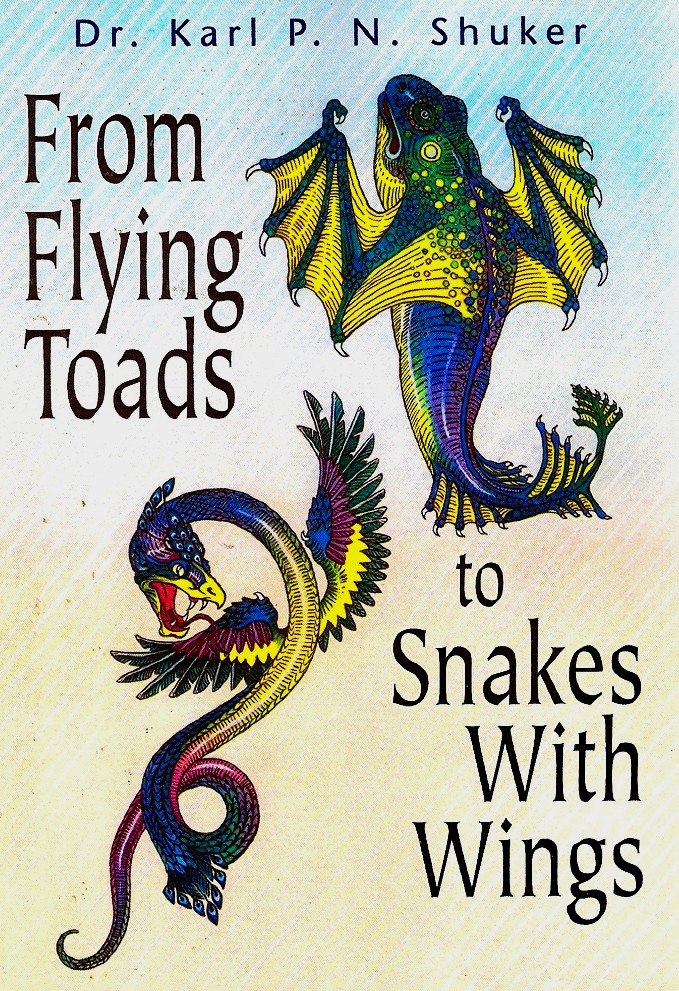
In more than 40 years of cryptozoological researches and writings, I have been proud and privileged to introduce to the cryptozoological community and beyond a considerable number and notable diversity of cryptids whose details had been hitherto consigned to obscure, overlooked periodicals, books, and other passed-over publications. One such mystery beast is the mulilo, whose details I uncovered in a long-since-forgotten Empire Review article, but which I duly documented and discussed in one of my own books, From Flying Toads To Snakes With Wings, first published in 1997, and which was the very first crypto-themed publication to include it.

 
My book From Flying Toads To Snakes With Wings (© Dr Karl Shuker)

Today, conversely, numerous online websites have also documented this creature, but as far as I can tell their coverages are merely paraphrasings  of my book's original version, with no new, additional content  Yet my book is seldom referenced as their source, sadly.

Consequently, coupled with the regrettable fact that certain of these online paraphrased coverages are far from accurate iterations of mine anyway, I've decided to present on ShukerNature my book's original, concise account of the mysterious mulilo – so here it is.

Dream a dream of a mysterious dragon that only appears when a rainbow is resting upon the vivid, viridescent hillsides of Zaire [now the Democratic Republic of Congo] and Zambia – a creature whose reality is widely accepted by many native people in these tropical African countries. One might expect such an Arcadian, picturesque scenario to inspire images of a bright, evanescent entity with sparkling opalescent scales, a proud noble head of classical profile, and sweeping, polychromatic butterfly wings – a golden, glittering creature of Faerie, of heady sunlit reverie.

Yet nothing could be further from the truth, because the image that these people do visualize when contemplating this creature is an evocation of much darker dreams. According to their belief, Central Africa's rainbow-summoned dragon, known as the mulilo, is a gigantic, coal-black, slug-like beast of loathsome form, almost 6 ft in length, over 1 ft in width, and leaving death in its wake – the deadly legacy of its poisonous breath.

 
Could the mulilo be a giant black slug? (created by Dr Karl Shuker using Grok X1)

One could certainly be forgiven for considering the mulilo to be nothing more than a fanciful folktale. Yet as reported in 1940 by W.L. Speight within an Empire Review article on African mystery beasts, a living, corporeal animal is apparently involved, because pieces of blackened flesh said to be from dead mulilos are worn by some natives as fertility charms.

There is no known species of slug that attains the size attributed to the mulilo; in any event, the bodies of slugs are relatively insubstantial, little more than slender gelatinous sacs - hardly the likeliest of materials to remain intact for utilization as charms. Perhaps, therefore, the blackened flesh is really from a slug-like snake, or even a serpentine salamander (like the sirens of North America).

Even so, the thorny question remains as to whether this corporeal creature is truly the mulilo, or whether its flesh is merely used by the natives to vindicate their belief in what is actually a non-existent, wholly mythical beast? If the flesh is from a mulilo (regardless of what species it may belong to), how do the natives obtain it?

 
Another giant black slug-inspired mulilo representation (created by Dr Karl Shuker using Grok X1)

According to Speight, they set a trap – building a secure cage, lined internally with sharp blades, and baited with a living cockerel. Then they simply wait each night, and listen. On the morning that no cock-crow is heard, the natives celebrate and journey joyfully to the cage – for they know that inside it they will find the mulilo, dead, impaled upon the blades during its capture of the cockerel.

Yet despite this apparently successful method of obtaining mulilo remains, the mulilo is as mysterious and unidentified today as it was when documented by Speight over half a century ago [almost a full century ago now]. Moreover, it does not even seem to have been reported again. Perhaps rainbows have been rare in Zaire and Zambia lately?

My view concerning the mulilo that I held back in the late 1990s remains unchanged today, almost 30 years later. Namely, that if it is indeed a real, flesh-and-blood entity, it is most likely to be some form of black-scaled snake, possibly a fairly thick-bodied or sturdy one, perhaps even a melanistic variety of a species already known to science.

Over the years I have documented a number of times with a variety of different examples that in the culture of many indigenous peoples from around the world, aberrant animal specimens, such as melanistic, albinistic, or extra-large individuals, for instance, are often categorised by them as being fundamentally (rather than merely superficially) distinct, wholly separate creatures from normal specimens of the same species, and are even given wholly separate names by them.

 
Is the mulilo based upon an unusual melanistic variety of snake? (created by Dr Karl Shuker using Dream Lab)

So if the mulilo were indeed nothing more than an all-black form of a known snake species but deemed special by the locals on account of its unexpected colouration, this would not be in any way surprising.

In addition, certain snakes, especially large meat-eating constricting species such as the African pythons, are notorious for the foul stench of their breath. So if the mulilo is simply a melanistic version of one such species, this could plausibly explain native testimony (conceivably somewhat exaggerated or embellished if retold to the more ingenuous of Westerners?) relating to its allegedly poisonous exhalations.

 
A large and sturdy melanistic specimen of constricting snake might inspire superstitious fear among local people encountering it (created by Dr Karl Shuker using Magic Studio)

If only further details could be obtained. So if anyone reading this ShukerNature article is aware of any addition information appertaining to the mulili, I'd love to hear from you, so please comment below with your news – many thanks indeed!

Excerpted from my book From Flying Toads To Snakes With Wings (Llewellyn: St Paul, 1997).

 
An intriguing image generated by Dream Lab, combining the serpentine scaly body of a melanistic snake with slug-like cephalic tentacles – the perfect mulilo? (created by Dr Karl Shuker using Dream Lab)


Tuesday, 31 December 2024

TONGUE-TIED BY THE TWO-TONGUES!

 
Is this what Malaya's mystifying two-tongued cryptids looked like? (created by me using Grok X1)

The days spanning Christmas and the New Year are traditionally ones filled with mystery and magic, a time of weirdness and wonder. So what better day than today, New Year's Eve, to present here on ShukerNature for your entertainment and enjoyument during this time the following cryptozoological conundrum?

In 1997, I included the following account in my book From Flying Toads To Snakes With Wings, hoping that someone reading it might be able to propose an identity for the mysterious creatures described, as I was thoroughly perplexed by them – but no-one ever did. Consequently, I can only assume that these cryptids left them as taxonomically tongue-tied as they have done with me. Nor have I ever uncovered any additional information concerning them. So, 26 years later, in 2023, I reprinted my account in my regular Alien Zoo column on mystery animals and animal mysteries for the British magazine Fortean Times as a fascinating crypto-riddle to ponder over during the festive season, just in case it did elicit a solution from someone that time. Once again, however, answer came there none.

 
My book From Flying Toads To Snakes With Wings (© Dr Karl Shuker/Llewellyn Publications)

Consequently, one year on from its appearance in Alien Zoo, and in the hope that the familiar phrase ""third time lucky" will indeed prove true on this occasion, here yet again is the my account recalling the tangled tale of the two-tongues, in case ShukerNature's redoubtable readers can provide the long-sought key to its locked box of beastly secrets:

On May 27 1939, Modern Wonder documented some 'ultra-mysterious' mammals, allegedly captured by a photographer in the Malayan jungles and later observed by bemused officials in Manila, in the Philippines. Each of the beasts (of unrecorded number) was described as being quadrupedal, weighing about 200 pounds, covered in a furry, mole-like pelage (i.e. dark, dense, and shiny?), with a raccoon-like head [masked?], a pair of owl-like eyes (thus large and staring?), and odd dentition - some of its teeth resembled a man's, others were cat-like – plus a fondness for bananas. Except for their extremely heavy weight (an error on the part of the original report?), there would seem to be a chance of identifying them with some known animal type – until, that is, their most distinctive characteristic is revealed.

For the description also stated that each of these beasts had two tongues! Furthermore, it alleged that they never drank, because they absorbed all of the moisture that they required directly through their skins. This is generally a feature of certain animals living in water or in moist habitats, but the animals concerned are normally amphibians, fishes, and lower life forms, not mammals. Conversely, it is true that many desert-dwelling rodents rarely if ever drink water, because they obtain it from their food (e.g. juicy plant tissues) or from metabolic water released as they digest the dry components of their diet, but they do not absorb water through their skins.


Masked palm civet Paguma larvata, native to Peninsular Malaysia, named after its raccoon-like facial mask (© Denise Chan/Wikipedia – CC BY-SA 2.0 licence)

In general appearance (and excluding weight), they are reminiscent of some of the lesser-known, mask-faced forms of Malay civet and badger – elusive, short-furred creatures of nocturnal lifestyle and partial to fruit within their largely omnivorous diet. Moreover, the owl-like eyes call to mind the tarsiers - those orb-eyed, sucker-fingered, lemur-like primates indigenous to southeast Asia (including the Malay Archipelago), and sufficiently strange in appearance to those not familiar with these rarely-seen nocturnal creatures to attract surprise and newspaper attention.

 
Sunda stink (=skunk) badger Mydaus javanensis, native to Indonesia and Malaysia, photographed in Malaysia (© Thompson Hyggen – copyright-free)

Even so, none of those identities can reconcile the mystery beasts' two tongues and the ability to absorb moisture directly through their skins. Could these attributes have been based upon misunderstanding or mistranslation, rather than upon reality? As nothing more is on record regarding the photographer's mystifying finds, there is no way of knowing. 

 
Tarsiers are nothing if not goblinesque, even otherworldly, in appearance, especially to anyone unfamiliar with these curious yet harmless creatures (© LDC Inc Foundation/Wikipedia – CC BY-SA 3.0 licence / (© Pieere Fidenci/Wikipedia – CC BY-SA 2.0 licence)

So there it is, the owl-eyed, twin-tongued, never-drinking plantain-eater – if nothing else (and confirming that I'm easily pleased!), it scans satisfyingly like the one-eyed, one-horned, flying purple people eater immortalised in a classic 1958 Sheb Wooley novelty song and 30 years later in a 1988 family movie directly inspired by it!

 
Failing abysmally in my attempts to generate a one-eyed, one-horned, flying purple people eater, here's a two-eyed, two-horned flying purple people eater instead! (created by me using Magic Studio)

Meanwhile, any thoughts or suggestions as to the two-tongues' possible identity, or any extra reports/information regarding them, would be very gratefully received!

 
A two-tongue with a banquet of bananas awaiting its pleasure! (created by me using Grok X1)

Incidentally, as some of you know, I've been experimenting with various AI image-generators, testing their capabilities and limitations so as to be better equipped to recognise AI-generated fake cryptozoologically-themed images with which the Net seems to be increasingly awash of late. So, as no image of the Malayan two-tongues has ever been created to my knowledge, I decided to put to the test two different AI image-generators that I've been exploring, Grok X1 and Magic Studio, and see how they performed when prompted to produce pictures of these bizarre beasts.

And, as I'm sure that those out there who are not AI fans will be delighted to learn, both programs were aptly rendered tongue-tied (or whatever the AI equivalent state is!) by the tortuous challenge posed by the two-tongues. Not only did they fail utterly to depict them as the very sizeable animals that anything weighing 200 lb must surely be (instead presenting what look far more like diminutive cubs!), but also, out of all the numerous images that they generated, only one, produced by Grok X1, actually featured creatures possessing two tongues apiece – and here it is:

 
A pair of two-tongues actually depicted with two tongues! (created by me using Grok)

Overall, Grok X1 was the superior creator with regard to this particular pictorial task, as it also created a number of images featuring creatures with a single but bilobed tongue that my own digital addition of a hand-drawn line separating the lobes into two separate tongues was sufficient to engender some satisfactory twin-tongued entities that I've included in this article. Even so, they still did not overly resemble the original 1977 verbal description of these creatures, quoted by me above.

As for Magic Studio: usually a very accurate depicter of animals (give or take some extra or deformed fingers/toes and the occasional additional leg, or two...): faced with providing an accurate portrayal of the two-tongues, it threw a veritable generative gasket, and yielded some illustrations of animals that bore no resemblance whatsoever to the two-tongues' verbal description. It even garbled my prompt for their tongues to be pink, bestowing upon its mixed-up mammals some portions of pink fur instead! However, albeit wholly inaccurate zoologically speaking, aesthetically some of the creatures thus created by Magic Studio were so attractive, appealing, and downright adorable that I couldn't bear to delete them. So here is a selection of them, in all of their delightful dottiness:


All three images created by me using Magic Studio

If nothing else, designers of prospective new cuddly toys could do a lot worse than be inspired by some of these ultra-cute beasties. You can pay me my 10% creator's commission later!

Today would have been the birthday of Nan, my maternal grandmother Gertrude Timmins (who once experienced a decidedly Fortean event of her own – click here to read all about it), who passed away peacefully in her sleep at the grand old age of 99 back in 1994. Just like me, and also like her daughter, my mother Mary Shuker, Nan loved wildlife and Nature in general, so I'm sure that she would have approved of my writing and presenting this fascinating fauna case here today on her birthday. God bless you Nan, and Mom, and all of my family, all of whom are long gone now but never forgotten by me. Ome day we shall be back together, never to be separated again.

 
My late grandmother, Gertrude Timmins, with Patch, my little wire-haired Jack Russell terrier (© Dr Karl Shuker)

Wishing all of my ShukerNature blog readers, and all of my Shuker In MovieLand blog readers too, a Happy New Year – may 2025 prove to be a kindly, successful year for you.

 
And it's toodle-pip from the two-tongues too! (created by me using Grok X1)


Tuesday, 20 August 2024

HIDING FROM THE HIDE? EERIE DEEPSEA ENCOUNTERS WITH ABYSSAL ABOMINATIONS

 
A photo-still from Encounter In The Abyss by Richard Svensson, depicting the nameless horror from the underwater abyss about to encapsulate the stricken shark while the terrified diver stood motionless, on a ledge at the abyss's edge, watching in petrified fascination  (© Richard Svensson)

The decidedly creepy cryptozoological report of a deadly underwater mystery beast documented by me here today is one of my all-time personal favourites, which I've included in several of my books and articles down through the years, and also previously on ShukerNature (click here). Now, thanks to a wonderful new animated short that brings the eerie encounter vividly to life for the very first time (full details at the end of the present blog article), I decided that it was time to revisit this terrifying denizen of a deepwater abyss and provide some additional information, so here it is.

In 1953, while testing a new type of deep-sea diving suit in the South Pacific, an Australian diver named Christopher Loeb encountered a Lovecraftian horror from the ocean’s unpenetrated depths. In my book From Flying Toads To Snakes With Wings (1997) and also in my previous ShukerNature coverage of it, I provided a much-abbreviated paraphrased version of Loeb's report, but here now is his full first-person account, as originally provided by Eric Frank Russell in his own book Great World Mysteries (1967:

All the way down I was followed by a fifteen foot shark which circled around full of curiosity but made no attempt to attack. I kept wondering how far down he would go. He was still hanging around some thirty feet from me, and about twenty feet higher, when I reached a ledge below which was a great, black chasm of enormous depth. It being dangerous to venture farther, I stood looking into the chasm while the shark waited for my next move.

Suddenly the water became distinctly colder. While the temperature continued to drop with surprising rapidity, I saw a black mass rising from the darkness of the chasm. It floated upwards very slowly. As at last light reached it I could see that it was of dull brown colour and tremendous size, a flat ragged edged thing about one acre in extent. It pulsated sluggishly and I knew that it was alive despite its lack of visible limbs or eyes. Still pulsating, this frightful vision floated past my level, by which time the coldness had become most intense. The shark now hung completely motionless, paralyzed either by cold or fear. While I watched fascinated, the enormous brown thing reached the shark, contacted him with its upper surface. The shark gave a convulsive shiver and was drawn unresisting into the substance of the monster.

I stood perfectly still, not daring to move, while the brown thing sank back into the chasm as slowly as it had emerged. Darkness swallowed it and the water started to regain some warmth. God knows what this thing was, but I had no doubt that it had been born of the primeval slime countless fathoms below.

Moreover, this may not be a unique report, for as revealed here by the online Encyclopaedia of Cryptozoology website:

According to Russian sources, at least two other sightings of the amorphous sea monster have been reported in local newspapers. Members of a Chilean hydrographic expedition to the South Pacific in 1968 told the press that they had seen an animal which resembled the Australian diver's "black mass," near an abyssal trench. A fatal encounter with such an animal allegedly occurred off Thailand in 2005, when a French scuba diver named Henri Astor told the press that he had observed a very large "strange brown mass" paralysing and killing a shoal of fish. Astor's unnamed companion allegedly disappeared after attempting to follow the entity.

 
Cirrothauma murrayi, a species of deepsea cirrate octopus (public domain)

In the past, a deepsea octopus has been offered as a possible identity for this disturbing creature, but as I discussed in detail within my book, a far more satisfactory candidate is a deepsea jellyfish, possibly akin to one of the known relatively shapeless types, such as Deepstaria enigmatica, which moves via peristalsis and lacks tentacles. This bizarre species remained undescribed by science until 1967, following its discovery by the famous French oceanographer Jacques Cousteau while exploring the deep waters of the central Pacific Ocean near Southwest Baker Island in a submarine called Deepstar 4000. It is known from the Pacific Ocean, Antarctica, and the Gulf of Mexico, but only at depths below 3,000 ft. Please click here and here to watch on YouTube a couple of short videos of this strange species filmed in its natual habitat.

Whereas all octopuses have tentacles, some deepsea jellyfishes do not. What they do have, however, are potent stinging cells called nematocysts on their bodies (and tentacles if they possess any), armed with venom that swiftly paralyses their prey. This would readily explain the immediate paralysis of the shark. Moreover, jellyfishes do not possess true eyes but they are equipped with sensory structures responsive to water movements. Consequently, the creature would have learnt of the shark’s presence by detecting its movements in the water. How lucky, then, that the diver had remained stationary!

 
Artistic representation of el cuero, the deadly Chilean hide (© Tim Morris)

Interestingly, Chilean legends tell of a very similar beast called el cuero or the hide, as it is likened in shape and size to a cowhide stretched out flat, with countless eyes around its perimeter, and four larger ones in the centre. As it happens, jellyfishes possess peripheral sensory organs called rhopalia that incorporate simple light-sensitive eyespots or ocelli.

Moreover, some jellyfishes also have four larger, deceptively eye-like organs visible at the centre of their bell. In reality, however, these organs are not eyes at all. Instead, they are actually portions of the jellyfishes' gut, known as gastric pouches, with the jellyfishes' horseshoe-shaped gonads sited directly underneath these pouches and also very visible (as in the familiar moon jellyfish Aurelia aurita).

 
Moon jellyfishes Aurelia aurita (© Tila Monto/Wikipedia – CC BY-SA 3.0 licence)

So perhaps the deadly hide is more than a myth after all, lurking like so many other maritime horrors reported down through the ages in the deep oceans' impenetrable black abyss, but only very rarely encountered by humankind – which in view of the dreadful fate that befell the hapless South Pacific shark in 1953 may be just as well!

And now, as noted above, this chilling cryptozoological vignette has been brought to vivid life by longstanding friend and awesome Swedish animator Richard Svensson, aka The Lone Animator, in a wonderful 3-minute mini-movie entitled Encounter In The Abyss, and available to watch for free on YouTube since 8 August 2024 – just click here. Don't miss it!

 
Thumbnail image on YouTube for Encounter In The Abyss by Richard Svensson (© Richard Svensson)


Wednesday, 22 September 2021

SNAKES WITH WINGS - AND OTHER STRANGE THINGS!

 
Artistic representation of the Namibian flying snake based upon eyewitness descriptions (© Philippa Foster)


I went once to a certain place in Arabia, almost exactly opposite the city of Buto, to make inquiries concerning the winged serpents. On my arrival I saw the back-bones and ribs of serpents in such numbers as it is impossible to describe: of the ribs there were a multitude of heaps, some great, some small, some middle-sized. The place where the bones lie is at the entrance of a narrow gorge between steep mountains, where there open upon a spacious plain communicating with the great plain of Egypt. The story goes that with the spring the winged snakes come flying from Arabia towards Egypt, but are met in this gorge by the birds called ibises, who forbid their entrance and destroy them all. The Arabians assert, and the Egyptians also admit, that it is on account of the service thus rendered that the Egyptians hold the ibis in so much reverence.

   Herodotus – The History, Book II


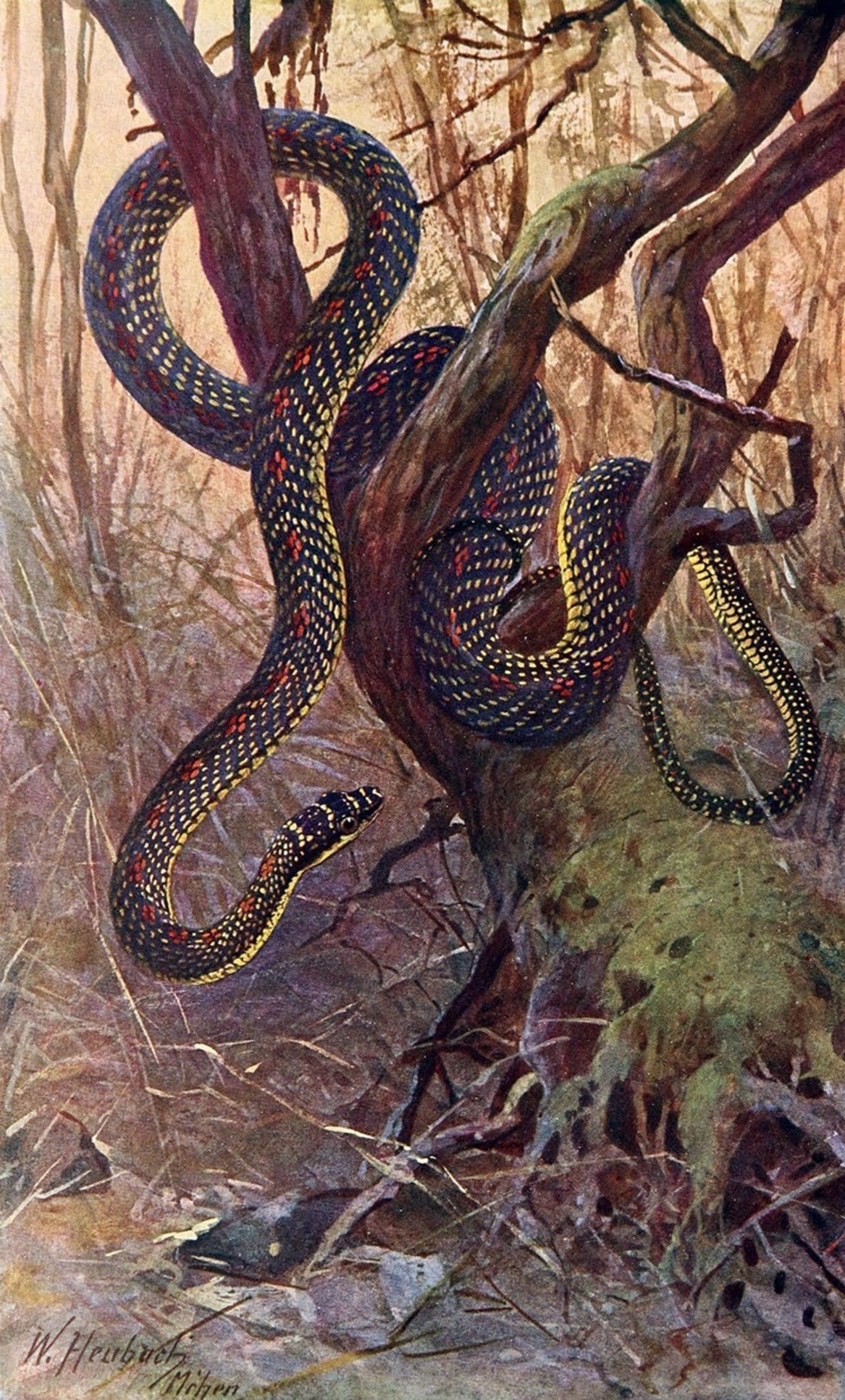
Despite its common name, the so-called flying snake Chrysopelea ornata of southeast Asia cannot actively fly. However, it is well known that this distinctive species can glide for up to 300 ft through the air by launching itself from a tree while simultaneously spreading its ribs and flattening its body, until its undersurface is concave, thereby transforming itself into a ribbon-shaped parachute.

 
Southeast Asia's known flying snake Chrysopelea ornata (public domain)

Yet according to some remarkable reports filed away within the bulging archives of cryptozoology, there may be some currently-undescribed species of snake that are capable of true flight, i.e. achieved with the aid of wings or comparable means of active propulsion.


THE NAMIBIAN FLYING SNAKE

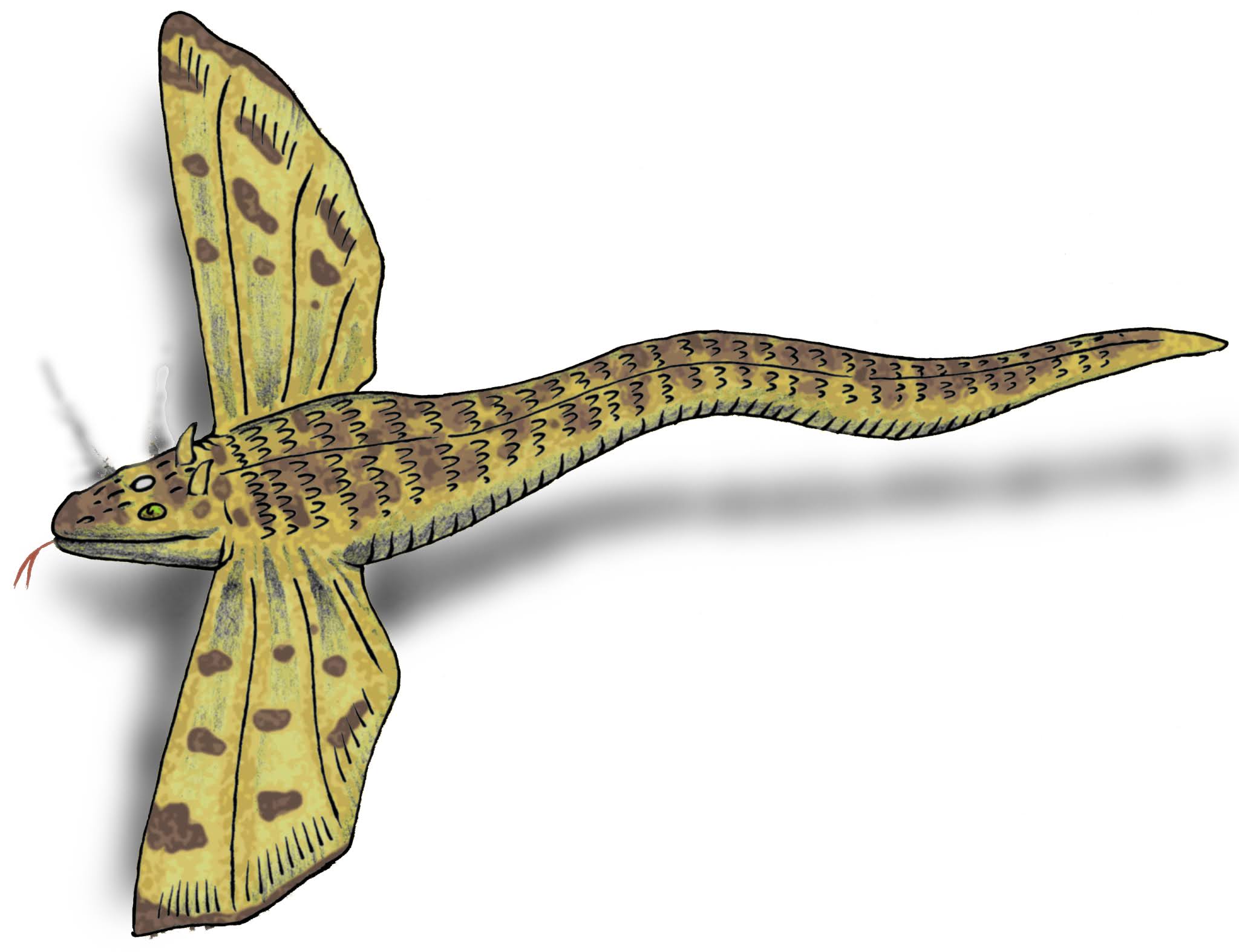
One such mystery beast is the supposed flying snake that has been reported not only by the native Namaqua people but also by a number of European eyewitnesses within the Namib Desert of southern Namibia. According to their generally consistent accounts, it has a brown or yellow body mottled with dark spots, an inflated neck, and a very large head bearing a pair of short backward-pointing horns - plus, very remarkably, a glowing 'torch' in the centre of its brow. Most astonishing of all, however, is the pair of membranous bat-like wings allegedly emerging from the sides of its neck or mouth.

Eyewitnesses have stated that this extraordinary snake launches itself from the summit of a high rocky ledge, then soars down to the ground, landing with an appreciable impact and producing scaly tracks in the dusty earth. In 1942, while tending sheep in the mountains at Keetmanshoop, teenager Michael Esterhuise threw a stone at what he had assumed to be a large monitor lizard lurking inside a rocky crack. When it emerged, however, it revealed itself to be a big snake with a pair of wing-like structures projecting from the sides of its mouth.

 
A second reconstruction of the Namibian flying snake's possible appearance (© Tim Morris)

On a separate occasion, moreover, one of these serpents soared down towards Esterhuise after having launched itself from a rocky ledge. When it landed, hitting the ground with great force, Esterhuise fainted, and when he was later found (unharmed though still unconscious) by a search party, the snake had gone but its tracks remained. They were subsequently examined by no less celebrated a naturalist than Marjorie Courtenay-Latimer – curator of South Africa's East London Museum and immortalised zoologically as the discoverer of that famous 'living fossil' fish the coelacanth Latimeria chalumnae in 1938. In her opinion, these tracks, containing the clear impression of scales, were indeed consistent with the marks that a snake would make.

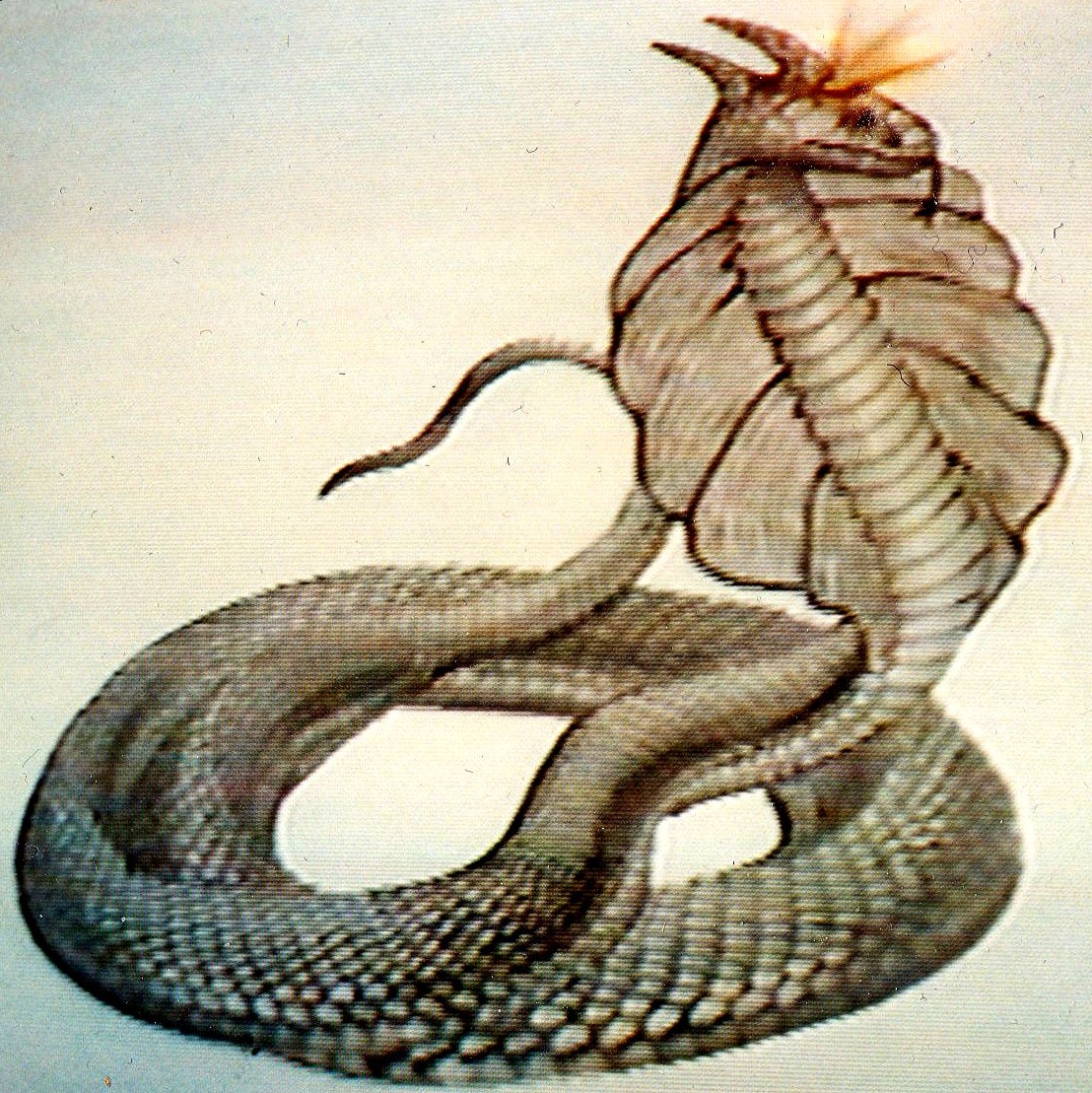
A South African television documentary by Angus Whitty Productions, entitled In Search of the Giant Flying Snake of Namibia and first broadcast in 1995, contained testimony from a number of alleged eyewitnesses, which provided estimates of this mystery serpent's total length that ranged from 9 ft to 15 ft. The programme also specially prepared and featured on-screen a detailed drawing of the latter snake's alleged appearance based upon such testimony.

 
Screenshot of the flying snake drawing from In Search of the Giant Flying Snake of Namibia (© Angus Whitty Productions – reproduced here on a strictly non-commercial Fair Use basis for educational/review purposes only)

Well worth noting is that Namibia is a former German colony, so it is not impossible that Teutonic legends of lightning snakes retold here by German settlers may have infiltrated and influenced native Namibian lore. However, such legends cannot leave physical, tangible tracks like those examined by Miss Courtenay-Latimer, so perhaps a real snake is indeed present but one whose appearance has been exaggerated or distorted in the telling due to shock by those who have unexpectedly encountered it.

If so, the Namibian flying snake may still be an undescribed species, but one that in reality merely sports a pair of extensible lateral membranes similar to those of the famous Asian gliding lizard Draco volans (though whether such structures would be sufficiently adept, aerodynamically, to bear so sizeable a snake through the air is another matter), plus a pair of horny projections resembling the 'eyebrow' horns of certain African vipers. As for its glowing 'torch', this may be nothing more mysterious than a highly-reflective patch of shining scales on its brow.


THE TL'IISH NAAT'A'I OR ARIZONA FLYING SNAKE

For a number of years, American cryptozoologist Nick Sucik has been investigating reports of an equally mystifying but even more obscure aerial anomaly of the serpentine kind - the tl'iish naat'a'í (pronounced 'kleesh-not-ahee' and translated as 'snake that flies'). Also known as the Arizona flying snake, apparently this bizarre reptile is a familiar creature there to the Navajo Nation, and to the Hopi Nation as well (who refer to it by names translating as 'sun snake'). They all describe it as being fundamentally serpentine in form, generally around 2 m long, and dull grey in colour (although sometimes said to have a red belly), but possessing a pair of retractable and virtually transparent wing-like membranes. These emerge from behind its head, run laterally along much of its body's length, can flap vigorously and very rapidly, and are thus used for active flight (rather than passive gliding) purposes.

Some eyewitnesses have stated that these membranes sparkle in the sun when illuminated at certain angles. They also claim that this mysterious reptile constructs a kind of nest from twigs, located along the sides of cliffs or among rocks; and that when airborne, its flying membranes make a hissing sound, likened by some witnesses to a passenger jet's noise when passing by overhead. Comparable reports have also emerged from both the Texas and the Mexican sides of the Rio Grande, including one sighting of an unusual snake-like entity flying amid a group of bats here that was videoed by a security camera at Lajitas, Texas, and can be viewed on YouTube. Sadly, the alleged serpent is only glimpsed briefly and even then not clearly. Some viewers have opined that it may itself have been a bat (albeit a much larger one) or even an owl, but Nick is not convinced by such identities.

The video can presently be accessed here on YouTube, where it was posted by a Gil Bartee on 26 June 2008. Sadly, however, the alleged serpent is only glimpsed very briefly (I assume that it is the entity appearing at 0:54 minutes into the video – Bartee provides no details), and even then not clearly. Some viewers have opined that it may itself have been a bat (albeit a much larger one) or even an owl, but Nick is not convinced by such identities.

 
Artistic representation of the Arizona flying snake (© Tim Morris)

On 10 November 2016, British cryptozoological researcher Richard Muirhead posted in Facebook's Cryptozoology Herpetological Research Group a hitherto-obscure newspaper article dealing principally with the afore-mentioned, long-known Asian flying snake Chrysopelea ornata, but whose final paragraph contained information that is definitely of cryptozoological interest. Published in the Oregonian on 15 March 1942, the paragraph in question reads as follows:

A western prototype [i.e. of Chrysopelea ornata] is reputed to exist somewhere in Southern Mexico, although snake experts have made many fruitless expeditions into the interior for living specimens.

Might this be a previously-unpublicised reference to the tl'iish naat'a'í? If so, however, it indicates that this mystery snake, or something comparable, exists further south in Mexico than the Rio Grande.

In 2004, Nick prepared a detailed paper documenting traditional folklore and contemporary sightings relating to the tl'iish naat'a'í, which could formerly be viewed online (at: http://www.azcentral.com/12news/pics/dragonsofthedine.pdf) but has now disappeared (happily, I downloaded a copy for my files while it was still online), and contains a number of fascinating eyewitness accounts of this truly extraordinary, zoologically-unknown snake.


EUROPEAN WINGED SNAKES

Remarkably, some intriguing but thoroughly mystifying, modern-day reports of aerial snakes have even been filed from Europe. For instance, one day during 1930 or 1931, the mother of André Mellira was preparing lunch in a hut deep within the forest at the mountain village of La Bollène-Vésubie, close to Nice, southern France, when she looked out of the window and saw what looked like a green snake with wings! Moreover, this amazing creature promptly flew down from the branches of a tree close by and landed upon the hut's window sill. When Mellira's mother cried out in fear and alarm, however, her unexpected winged visitor dived down into a bush and vanished. Intriguingly, there is a longstanding tradition of winged snakes inhabiting the southern Alps, but these have always been discounted by scientists as myths.

 
An illustration from a 1723 publication by Swiss scholar Johann Jakob Scheuchzer depicting an alleged alpine winged snake (public domain)

A 12-year-old Bulgarian girl called Hazel Göksu was walking towards a spring very near her home one summer evening in 1947 in order to fill two buckets with water. Suddenly, however, she noticed what initially looked like some branches lying on the path ahead, but as she drew nearer she realised that they were thin snakes. Black, grey, and white in colour, and 1-2 m long, they abruptly emitted a peculiar cry - and then launched themselves into the air, flying 2-3 m above the ground in a straight line to the spring, about 150 m away, before vanishing behind some trees. Hazel was so frightened by what she had seen that she ran back to her home immediately, and never visited the spring again alone.


A COUPLE OF REPTILIAN LONDON PECULIARS?

Perhaps the most unexpected flying snakes ever recorded from Europe, however, were reported even closer to home – West London. According to a correspondent writing as 'SB' in The Gentleman's Magazine on 20 April 1798, a truly remarkable animal was observed during early August 1776 just a few miles west of London:

The strange object was of the serpent kind: its size that of the largest common snake; and as well as it could be discovered from so transient a view of it, resembled it by a kind of grey mottled skin. The head of this extraordinary animal appeared about the size of a small woman's hand. It had a pair of short wings very forward on the body, near its head; and the length of the whole body was about two feet. Its flight was very gentle; it seemed too heavy to fly either fast or high; and its manner of flying was not in an horizontal attitude, but with its head considerably higher than the tail; so that it seemed continually labouring to ascend without ever being able to raise itself much higher than seven or eight feet from the ground.

 
Bestiary illustration of a flying snake-like reptile (public domain)

This same magazine subsequently published a second, more recent report, by a correspondent signing only as 'JR' - describing a sighting by a friend of the same (or a very similar) flying snake encountered at 10.30 pm on 15 July 1797 on the road between Hammersmith and Hyde Park Corner:

The body was of a dark colour, about the thickness of the lower part of a man's arm, about two feet long. The wings were very short, and placed near the head. The head was raised above the body. It was not seven or eight feet from the ground. Being an animal of such uncommon description, I was particular in noticing the day of the month, and likewise being the day preceding a most dreadful storm of thunder and lightning.

If we are willing to accept that these reports are not outright hoaxes (worth noting, however, is that neither of the authors supplied their name), or bizarre exaggerations of some large insect like a damselfly or robber fly (both of which when in flight sometimes hold their body in a similar pose to that described for this winged serpent), or some abstruse example of 18th-Century political satire, we can only assume that the observers were not zoologically-informed, and had mistaken some other, less bizarre creature for a flying snake.

 
 Robber fly (© Vengolis/Wikipedia – CC BY-SA 4.0 licence)

Indeed, this particular case reminds me of those occasions on which I have been asked to remove 'baby horned snakes' from neighbours' gardens during the summer, only to discover time and time again that they are actually the large, distinctive caterpillars of the great elephant hawk moth Deilephila elpenor. Having said that, however, and having read many times the authors' respective descriptions quoted above of what they allegedly saw, I still do not have even the slightest notion of what this enigmatic creature may have been!


EGYPT'S PLAGUE OF FLYING SERPENTS

Finally: no discussion of aerial snakes could be complete without considering the very curious case of Egypt's supposed plague of flying serpents.

In early times, small but highly venomous snakes of many different colours but all possessing membranous bat-like wings reputedly existed in Arabia, and congregated in great throngs upon the trees that produced the much-sought-after frankincense resin.

 
Bestiary engraving of two Arabian flying snakes and an ibis (public domain)

According to the celebrated Greek historian Herodotus of Halicarnassus (c.484–425 BC):

[The Arabians] gather frankincense by burning that storax [styrax resin] which Phoenicians carry to Hellas; they burn this and so get the frankincense; for the spice-bearing trees are guarded by small winged snakes of varied colour, many around each tree; these are the snakes that attack Egypt. Nothing except the smoke of storax will drive them away from the trees.

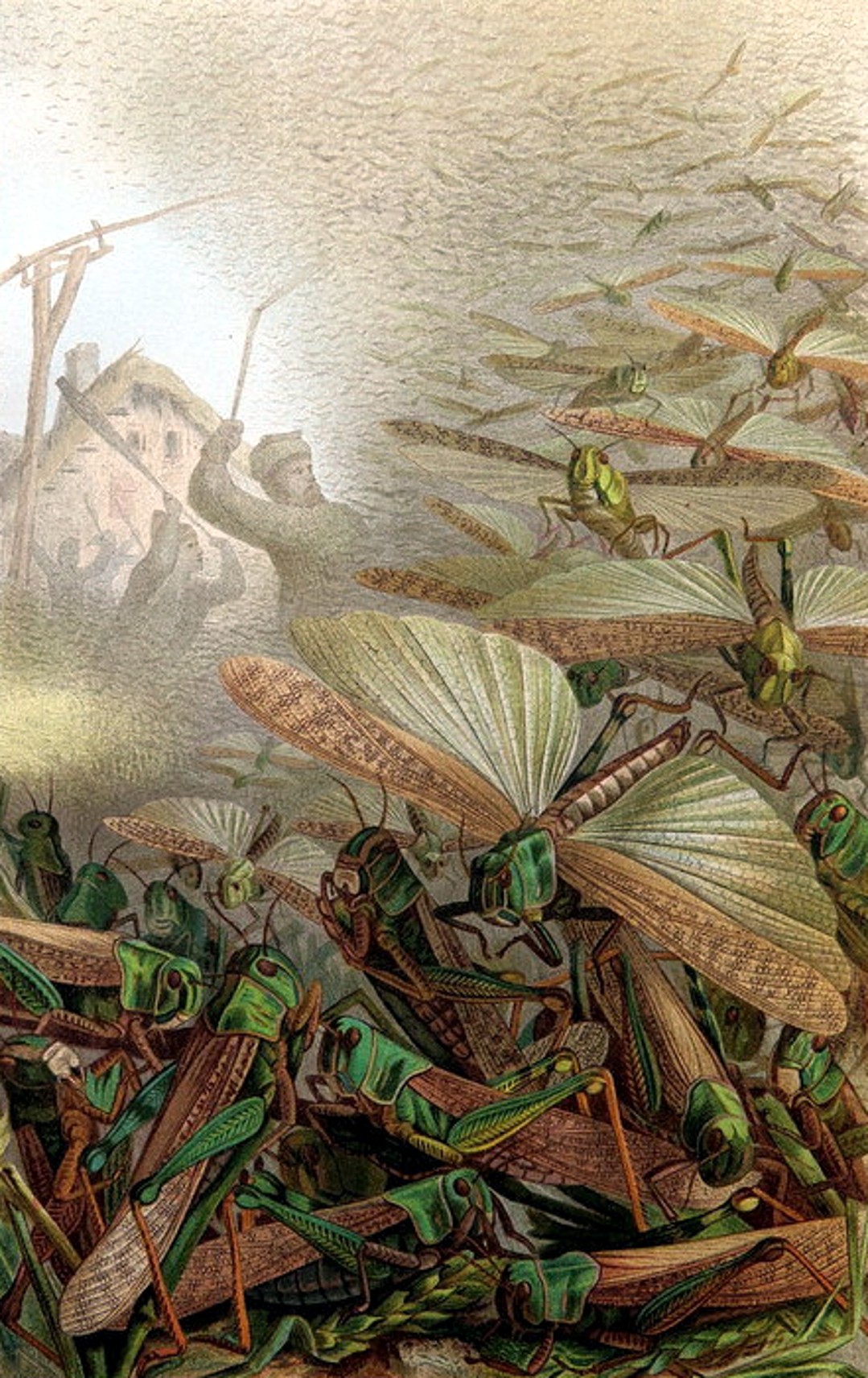
So numerous were they, in fact, that during their springtime migration from Arabia towards Egypt, the very air resounded with their incessant hissing and the unceasing beating of innumerable wings. Happily, however, Egypt's sacred ibises soon decimated these toxic ophidian locusts, devouring them in such vast quantities that none remained.

Many scholars believe that these winged wonders really were locusts, whose 'transformation' into snakes was due merely to exaggerated, elaborated retellings by successive storytellers down through the ages. Others claim that they really were snakes, but that their wings were either hearsay or fictitious additions purposefully supplied later by chroniclers anxious to enhance their tomes' dramatic content.

 
A swarm of locusts vividly depicted in a chromolithograph from 1890 (public domain)

Whatever the explanation, it can be said with certainty that in spite of Herodotus's first-hand observation of what he claimed to be masses of piled-up skeletons of these creatures (see this present ShukerNature article's opening quotation), no such snakes exist in the Middle East today. Presumably, therefore, the skeletons seen by him were not from snakes at all (with no detailed description or illustrations of them to examine, it is impossible to know for sure) – or perhaps their macabre mode of reproduction explains their demise.

For according yet again to the writings of Herodotus (and those of several other ancient historians too), at the very height of passion the female Arabian winged snake would bite her unfortunate partner's head off, rather like a serpentine praying mantis. And when the young snakes developing inside her afterwards had attained the required size for emerging into outside world, they would gnaw their way out of their mother's body, chewing through her uterus and gut, thereby killing her in the process.

Consequently, even if such fanciful creatures really did exist at one time, cursed with such a deadly mode of reproduction and birth it is perhaps little wonder that Arabia's flying serpents became extinct! In reality, however, it seems far more plausible that such claims were based upon misinterpretations of skin sloughing in snakes, with observers of such activity wrongly assuming that a matured snake offspring was bursting out through the skin of a dead parent. Or, to put it another way: in addition to being a highly influential scholar, Herodotus was nothing if not an imaginative one!


Finally: just in case you may be wondering – I certainly haven't forgotten the extraordinary winged feathered snakes reported from various localities in Wales, as documented by me in my book From Flying Toads To Snakes With Wings and also appearing on its front cover. The reason why they're not included above in this present ShukerNature article is that they've already been featured extensively in a previous one, devoted entirely to them – so please click here to access it.

 
From Flying Toads To Snakes With Wings (© Dr Karl Shuker/Llewellyn Publications)