Dr KARL SHUKER

Zoologist, media consultant, and science writer, Dr Karl Shuker is also one of the best known cryptozoologists in the world. He is the author of such seminal works as Mystery Cats of the World (1989), The Lost Ark: New and Rediscovered Animals of the 20th Century (1993; greatly expanded in 2012 as The Encyclopaedia of New and Rediscovered Animals), Dragons: A Natural History (1995), In Search of Prehistoric Survivors (1995), The Unexplained (1996), From Flying Toads To Snakes With Wings (1997), Mysteries of Planet Earth (1999), The Hidden Powers of Animals (2001), The Beasts That Hide From Man (2003), Extraordinary Animals Revisited (2007), Dr Shuker's Casebook (2008), Karl Shuker's Alien Zoo: From the Pages of Fortean Times (2010), Cats of Magic, Mythology, and Mystery (2012), Mirabilis: A Carnival of Cryptozoology and Unnatural History (2013), Dragons in Zoology, Cryptozoology, and Culture (2013), The Menagerie of Marvels (2014), A Manifestation of Monsters (2015), Here's Nessie! (2016), and what is widely considered to be his cryptozoological magnum opus, Still In Search Of Prehistoric Survivors (2016) - plus, very excitingly, his four long-awaited, much-requested ShukerNature blog books (2019-2024).

Dr Karl Shuker's Official Website - http://www.karlshuker.com/index.htm

IMPORTANT: To view a complete, regularly-updated listing of my ShukerNature blog's articles (each one instantly clickable), please click HERE!

IMPORTANT: To view a complete, regularly-updated listing of my published books (each one instantly clickable), please click HERE!

IMPORTANT: To view a complete, regularly-updated listing of my Eclectarium blog's articles (each one instantly clickable), please click HERE!

IMPORTANT: To view a complete, regularly-updated listing of my Starsteeds blog's poetry and other lyrical writings (each one instantly clickable), please click HERE!

IMPORTANT: To view a complete, regularly-updated listing of my Shuker In MovieLand blog's articles (each one instantly clickable), please click HERE!

IMPORTANT: To view a complete, regularly-updated listing of my RebelBikerDude's AI Biker Art blog's thematic text & picture galleries (each one instantly clickable), please click HERE!

Search This Blog


PLEASE COME IN, I'VE BEEN EXPECTING YOU...

PLEASE COME IN, I'VE BEEN EXPECTING YOU...
WELCOME TO SHUKERNATURE - ENJOY YOUR VISIT - BEWARE OF THE RAPTOR!


Showing posts with label fake photographs. Show all posts

Sunday, 30 November 2025

HIDING IN PLAIN SIGHT - TWO RECENTLY-REVEALED CRYPTOZOOLOGICAL EXAMPLES

 
What happens when you ask AI to generate an image of a tall bipedal tailless monkey confronting a gigantic octopus emerging from the sea onto the shore (Created by Dr Karl Shuker using Grok)

Cryptozoology is full of examples of cryptids that once their existence was finally confirmed officially by science were shown to have been long since known to the world anyway, but had somehow been overlooked, veritably rendered invisible – in other words, they had remained hidden in plain sight. So here are two recently-revealed additional examples.


MAPPING A CRYPTO-SPECIMEN

Cryptozoological specimens are notorious for being almost as elusive as the cryptids themselves, with a worrying tendency to vanish out of sight, never to be recorded again. So it is always a pleasant albeit rare surprise if such a specimen reappears somewhere, as was the case recently with one that has apparently been hidden in plain sight for quite some time.

On 26 August 2025, I was startled but delighted to learn from Florida resident and longstanding Facebook friend Adam Naworal that he had recently encountered a sample of tissue from the famous St Augustine globster. The sample was preserved and on public yet wholly unpublicised display in the map room at the St Augustine Historical Society – Oldest House Museum Complex – in Florida.

 
Aimee's photograph of the sample of St Augustine globster tissue (© Aimee & Adam Naworal, but free to use by any researcher)

As revealed in the above photograph snapped of this remarkable specimen by Adam's wife Aimee and included here with her and Adam's kind permission, it consists of several chunks of whitened flesh preserved in fluid (formalin?) inside a large vertical glass jar, labelled and firmly stoppered. The St Augustine globster is – or was – the huge rotting carcase that washed ashore on a beach near St Augustine during November 1896. Eminent cephalopod (octopus/squid/cuttlefish) expert Prof. A.E. Verrill from Yale University deemed it to be the remains of a hitherto-unknown species of truly gigantic octopus, but since then there has been a long-running dispute among scientists as to whether this is indeed what it was or whether, alternatively, it was simply the partial, highly-decomposed carcase of a whale, composed largely of blubber, and assuming an amorphous mass nowadays referred to as a globster.

Samples were taken from it at the time, and analysed, yielding contentious, contradictory results, but most of these samples were thought to have been lost or discarded. So this confirmed example at the St Augustine Historical Society is of special interest and scientific value, and now, thanks to keen-eyed Adam and Aimee, is duly documented here for cryptozoological posterity. Also, they have asked me to note here that they are making their photograph of this specimen freely available for all researchers to use at no charge, only a credit to Aimee is required – thanks guys! Incidentally, Adam has since informed me that the sample has now been taken off display, so it was extremely fortuitous that he and Aimee were visiting during the time when it was accessible for viewing by the public and were therefore able to place its existence on record.


AN INFERNAL FIND!

And staying with crypto-discoveries hidden in plain sight: Just two days before I learnt from Adam and Aimee about the St Augustine globster sample, another longstanding Facebook friend, Robert Schneck, had drawn my attention to an illustration that he'd lately discovered and had now uploaded to his Facebook page 'Historian of the Strange'. Prepared by German artist Hermann Wöhler (1897-1961) in c.1930, it was an exceedingly detailed line drawing entitled 'Inferno', depicting all manner of hideous monsters and other terrifying entities envisaged by him to be inhabiting Hell. But what had attracted Robert's particular attention was the creature depicted almost at the very centre of the illustration, because as he pointed out, it looked more than a little reminiscent of a certain alleged cryptid depicted in a notorious photograph during the early 1920s.

The cryptid in question was the so-called Loys's ape, reputedly encountered in the jungles on the border of Colombia and Venezuela by Swiss geologist Dr François de Loys while leading a party of explorers through this difficult, inhospitable terrain. The official narrative as provided by Loys was that they'd encountered two such creatures walking together on their hind legs and lacking tails. Threatened by them, the explorers shot one, the female, causing the male to flee. Taking the creature's lifeless carcase back to camp, they sat it on a crate, propped it upright with a long stick placed vertically beneath its chin, and photographed it. The carcase did not survive but the photo did, and for decades led to supposition that it portrayed one of the mysterious bipedal ape-like entities long reported from many different regions of South America, and inducing French/Swiss anthropologist Prof. George Montandon to formally dub their scientifically-undescribed species Ameranthropoides loysi.

 
'Inferno' by Hermann Wöhler, with the Loy's ape lookalike creature appearing almost dead-centre (left) and the hoax photo of Loys's ape (right) - please click dual image to enlarge it for viewing purposes (both images are now in the public domain)

Ultimately, however, long after Loys himself had died, one of his team's still-living members confessed that it had all been a hoax – the creature in the photo was nothing more than their pet spider monkey, which, after eventually dying, had been propped up and photographed (with its long tail either hidden or cut off) to yield the famous, but now infamous, Loys's ape picture. (The entire sordid saga of this hoax has already been documented by me in full here, here, and here on ShukerNature, so check it out.)

Bearing in mind that Wöhler's illustration had been created no more than ten years after Loys's photograph had first been published and had duly hit the headlines, it does indeed seem likely that this eyecatching image had directly inspired Wöhler to include a representation of it within his line drawing. For there is no doubt that the facial expression of Loys's ape as captured in the photo, with mouth agape and eyes staring widely, is certainly more than a little hellish, positively infernal, in fact! So, many thanks indeed to Robert for alerting me to a fascinating yet previously unrevealed and undocumented cryptozoological connection concealed within the art archives.

 
Another of my AI images, this time generated by Magic Studio, which took my verbal prompt to depict a giant ape confronting a giant octopus a little too far, inasmuch as it yielded a fascinating if wholly fictitious monkey-octopus hybrid! (Created by Dr Karl Shuker using Magic Studio)

This ShukerNature article originally appeared in the form of one of my regular Alien Zoo columns for the famous long-running British monthly magazine Fortean Times.


Sunday, 28 September 2025

BRINGING TO LIFE THE (IN)FAMOUS PHOTOGRAPH OF LOYS'S APE: A SHUKERNATURE VIDEO(S) OF THE DAY

 
A couple of photo-stills from my two AI-generated video clips of the familiar cropped version of the notorious Ameranthropoides loysi photograph (the centre image here) coming to life (AI photo-stills and videos created by me using Adobe Firefly)

It's been several months since I posted here on ShukerNature a ShukerNature Picture of the Day (click here to access the most recent one), and I have never posted a ShukerNature Video of the Day – until now, that is. Moreover, because I'm a generous kind of guy, I've posted two, not just one, as you can see. But what is their theme, their subject matter? Here's my answer:

Have you ever wondered what would have happened if Loys's ape Ameranthropoides loysi had been genuine, not a hoax, and its fake photograph had come to life? Wonder no longer!


These two video clips were generated for me yesterday by the AI image-generation program Adobe Firefly in response to two separate prompts provided to it by me – one was a detailed verbal description written by me, the other was a visual prompt consisting of the original Ameranthropoides loysi photograph, reproduced below:

Allegedly dating from 1917, this is the less familiar uncropped version of the notorious Loys's ape photograph, revealed several decades later to have been a hoax, featuring the dead body of a pet spider monkey (public domain)

One ever-present, ever-surprising factor that I've encountered numerous times when utilizing various different AI image-generation programs to create the pictures and most of the videos appearing in my pictorial biker/motorcycling-themed blog RebelBikerDude's AI Biker Art, is the sheer unpredictability and often truly surreal nature of their output, in which all manner of unexpected, wholly unprompted visual details are frequently included by the programs in their generated images (bikers anomalously sprouting wings comes readily to mind with my AI biker art blog!). Sure enough, the second video in this present ShukerNature article will be seen to include – albeit only very briefly – some strange large object appearing and disappearing behind the creature's back. What it is is anyone's guess!

To read my comprehensive three-part coverage on ShukerNature of the entire A. loysi photo saga, be sure to click here, here, and here. It also appears as an entire, fully-updated chapter in my book ShukerNature Book 2: Living Gorgons, Bottled Homunculi, And Other Monstous Blog Beasts.

There is also a shorter version in one of my earlier books, Extraordinary Animals Revisited: From Singing Dogs To Serpent Kings, which features a sepia-tinted version of the Loys's ape cropped photo on its front cover:

And which has an unnerving habit of coming to life if not watched closely!


Video created by me using Grok Imagine


Saturday, 30 December 2023

SNEAKING UP ON THE SNAKE CAT

 
The snake cat photograph (© unknown to me, despite in-depth searches made by me online; AI-generated, via person(s) unknown to me – reproduced here on a strictly non-commercial Fair Use basis for educational/review purposes only)

During early March 2023, I noticed a certain, very eyecatching photograph doing the rounds on social media and inciting all manner of speculation as to the creature that it portrayed. As seen above, it is a close-up head-and-shoulders image of a very spectacular cat, ornately adorned with vivid black and yellow markings.

According to claims accompanying this photo, the animal is a South American snake cat, up to 50 cm (20 in) long, weighing as much as 4 kg (9 lb), and allegedly the world's rarest species of wild cat, despite the claims also stating that it exists in a number of different countries, including Colombia, Venezuela, Ecuador, Peru, Bolivia, Guyana, French Guiana, and Suriname.

Within its ostensibly expansive distribution range, this exotic beast reputedly exists only in the most remote, inaccessible Amazon jungle locations, is poorly studied, and was not even photographed in the wild state until 2020. Yet the snake cat is supposedly well known to the indigenous locals, who sometimes even rear and tame cubs to use in keeping their homes free of its venomous serpentine namesakes and other undesirable creatures.

Looking at this single extraordinary photo – my subsequent investigations swiftly revealed that there were no other purported snake cat photos online – I had little doubt that it was a fake, as I had never encountered any information whatsoever of this mysterious mammal, yet I felt certain that such a visually-arresting beast would be extensively (and scientifically) documented online and elsewhere if it were indeed real.

Finally, courtesy of a Mexican article, I discovered the truth. As revealed in a Chihuahua Noticias news report from 14 March 2023 (click here to access it), the snake cat is wholly fictitious, with its unique photo actually being an AI (Artificial Intelligence) creation. Quelle surprise!

Looking again at its distinctive markings, I think it likely that photos of a large and very familiar, wide-ranging species of North American amphibian known as the tiger salamander Ambystoma tigrinum, whose bright yellow and black markings readily recall the snake cat's, may have played a part in this non-existent entity's photographic generation.

 
A tiger salamander (public domain)


Wednesday, 28 July 2021

DENYING A DEINOTHERE - WHEN THE CAMERA DOES LIE!

 
The fake deinothere photograph that inspired this ShukerNature blog article (© owner/photo manipulator unknown to me – reproduced here on a strictly non-commercial Fair Use basis for educational/review purposes only)

Thanks to the sophistication of readily-available digital photo-manipulation programs, photographic evidence for the existence of cryptids is of very little worth nowadays, at least in my opinion. This was readily demonstrated in mid-February 2021, following the widespread circulation online of a close-up, excellent-quality b/w photograph seemingly depicting the presence in some unidentified zoological gardens of a living deinothere.

Renowned for their huge body size and especially for their diagnostic downward-curving lower jaw and lower tusks but absence of upper tusks, deinotheres were prehistoric pachyderms distantly related to today's elephants. However, even the most recent fossils of these mega-mammals date back 1 million years.

Clearly, therefore, the existence of a specimen alive and well in any zoo would, if genuine, be a scientific sensation. Yet as the scientific world has made no mention whatsoever of any such prehistoric survivor thriving in captivity, the photo is evidently a fake.

 
Reconstruction of the likely appearance of a deinothere in life (© Concavenator/Wikipedia – CC BY-SA 4.0 licence)

Over the years, I have made a point of exposing many fake photos of the cryptozoological kind, as revealed in many ShukerNature blog articles, in the hope of ensuring that, by doing so, these hoax images can no longer mislead anyone. The most effective means of accomplishing this feat is to uncover the original, genuine photo that the hoaxer has photo-manipulated to yield the fake version, which I have successfully achieved on numerous occasions by conducting detailed image searches online. So when the deinothere picture was brought to my attention, I duly began one such search, but on this particular occasion a fellow cryptozoological researcher beat me to it.

German cryptozoologist and longstanding friend Markus Hemmler had seen the deinothere photo before I had done and had begun an online image search of his own for the original genuine picture straight away. Moreover, he soon met with success, discovering that the original image was a vintage photograph that actually depicted a hippopotamus living in what was then Leningrad Zoo in the USSR.

As he informed me on 14 February, Markus had found it in a Czech article from 4 March 2017, documenting the hardships that the zoo and its animals had suffered during World War 2 (click here to access this article). A reconstruction of what a deinothere may have looked like in life had been deftly superimposed over the hippo by some unknown hoaxer, hiding it completely. Case closed.

 
The vintage photograph of a hippopotamus living at Leningrad Zoo during WW2 that had been digitally manipulated by person(s) unknown to create the fake deinothere photograph (public domain)


Tuesday, 13 October 2020

EXPOSING A TRULY BATTY EXAMPLE OF A FAKE THUNDERBIRD PHOTOGRAPH

The fake thunderbird photograph exposed in this present ShukerNature article (photo-manipulator(s) unknown to me – reproduced here on a strictly non-commercial Fair Use basis for educational/review purposes only)

The case of the missing thunderbird photograph is unquestionably one of the most tantalizing – and tormenting – cryptozoological cases on file. I have already documented it in detail here on ShukerNature as well as in my two prehistoric survivors books, which should all be consulted for comprehensive coverage. However, serving to set the scene for this present article's subject, here is a concise quote from my afore-mentioned ShukerNature account of this elusive (or illusive?) image:

It all (allegedly) began back in 1886, when an Arizona newspaper called the Tombstone Epitaph supposedly published a very striking photograph, which depicted a huge dead pterodactyl-like bird with open beak and enormous outstretched wings, nailed to a barn and flanked by some men. This bird was reputed to be a thunderbird, and judging from the size scale provided by the height of the men standing alongside it, its wingspan appeared to be an awesome 36 ft! In other words, it was three times greater than that of the wandering albatross Diomedea exulans - the bird species currently holding the record for the world's biggest modern-day wingspan.

Since then, countless people claim to have seen this same photo in various magazines published some time during the 1960s or early 1970s, but no-one can remember precisely where. Those publications thought to be likely sources of such a picture include Saga, True, Argosy, and various of the many Western-type magazines in existence during this period in America, but searches through runs of these publications have failed to uncover any evidence of it.

Nor has anyone come forward with a copy of this photo as published elsewhere, and the archives of the Tombstone Epitaph do not have any copy of it either.

A number of photos claimed to be this evanescent, iconic image have been aired over the years, especially online, but these have all been exposed as hoaxes.

I should also point out here that some people have claimed that the ostensibly-vanished photo seen by them actually portrayed a bona fide pterodactyl, not merely a pterodactyl-like bird. However, just a few years after the thunderbird photo was supposedly first published, another story of a huge winged wonder began circulating, and in the same geographical region. This one concerned a huge bona fide pterodactyl having been shot in an American desert, i.e. a totally separate storyline but which has subsequently been conflated with the missing thunderbird photo's storyline, especially in online accounts. Consequently, this may explain those eyewitness reports of having seen a photo of a dead pterodactyl, rather than of a dead bird, pinned with wings outstretched to a barn door.

As will be seen if you search my ShukerNature blog, I have personally exposed a number of hoax thunderbird photos, because I feel that it is very necessary to remove from further consideration such fakes, as they serve only to confuse and detract from serious investigations being made by various researchers (myself included) regarding the original, genuine thunderbird photograph, if indeed such a picture really does exist. And now, yet another fake thunderbird photo has emerged, but one that I was able to expose very quickly, as now fully revealed here.

During the early hours of yesterday morning (12 October 2020), longstanding Facebook friend Randi MacDonald (aka Randi Mosasaur) brought to my attention via a private message on FB the following photograph that she had found on Pinterest, but with no details concerning its origin. I reproduced it at the opening of this present ShukerNature article of mine, but here it is again:

The fake thunderbird photograph found on Pinterest by Randi (photo manipulator(s) unknown to me – reproduced here on a strictly non-commercial Fair Use basis for educational/review purposes only)

As seen, it has the outward appearance of being a very old, sepia photograph depicting what looks initially like a dead pterodactylian pterosaur pinned with wings outstretched to the front of a barn, in front of which are standing a number of human figures that may conceivably be cowboys or soldiers, or some of each. In short, it closely matches verbal descriptions that have been given by those people claiming to have seen the original, missing thunderbird photograph but alleging that the creature in question was a pterodactyl or at least a pterodactyl-like entity rather than an unequivocal (albeit extremely large!) feathered bird.

However, even the most cursory of glances at this photograph revealed straight away to me that it was a hoax, due to the unambiguously fraudulent nature of the thunderbird portrayed in it. Even if we choose to ignore the scarcely inconsiderable fact that the most recent pterodactyls known from the current fossil record are at least 65 million years old, with no scientifically-confirmed modern-day living example known, thereby rendering as decidedly remote the likelihood of the thunderbird in this photo being genuine, the latter entity is instantly recognizable as a fake, because of its readily visible composite nature. For whereas it sports the crested, beaked head of a Pteranodon-like pterodactyl, the bone structure of its wings as seen through the wing membranes is diagnostically that of a bat!

Pterosaur wing's bone structure (top) and bat wing's bone structure (bottom) (© National Geographic – reproduced here on a strictly non-commercial Fair Use basis for educational/review purposes only)

As shown above, a pterosaur's wing only contains a single greatly elongated finger, the 4th, which runs along its outer edge within the wing membrane. Conversely, a bat's wing contains three greatly elongated fingers. These are the 3rd, which runs along its outer edge within the wing membrane, plus the 4th and the 5th, both of which are contained further down within the wing membrane. In addition, the less elongated 2nd finger is contained within the wing membrane above the 3rd finger. This bat wing structure is precisely the version exhibited by the fake thunderbird's wings.

Yet even though within just a few moments of having first seen it I knew categorically that this photo was a fake, I decided to see out of sheer curiosity whether  I could uncover the major original components in it that had been utilized and converted via digital manipulation to yield its image. I began with the barn, and using a combination of search engines I soon discovered the original, unmodified barn photograph that had been used. A full-colour modern-day photo, it appears on numerous websites, of which the earliest that I could find was in a 11 August 2010 post by Texas-based photographer Nancy Wingo Ridley (username = Rustic Images) on the Foundmyself website (please click here to access its site), being one of numerous attractive countryside-themed photographs that this website offers for sale. Please click here to see this photo on the Foundmyself site (where it is described as "Old barn and wagon near Fredricksburg, Tx"); and please click here to see Nancy's Foundmyself page containing her many exquisitely beautiful photographs that are available on this site.

When I compared this genuine full-colour modern-day photo of a barn with the fake thunderbird photo, it was immediately evident that the former had been used by the faker as the basis of the latter, as can be seen here:

Comparison of the fake thunderbird photograph (top) with the genuine full-colour modern-day photo of a barn (bottom) that was digitally manipulated by person(s) unknown to help create the fake thunderbird photo (creator(s) of fake thunderbird photo unknown to me / (© Rustic Photos – reproduced here in low-resolution format on a strictly non-commercial Fair Use basis for educational/review purposes only; please click here to visit the excellent Rustic Photos page of images where the original full-colour barn photograph is just one of numerous beautiful countryside-themed pictures produced by her that can be purchased)

As can also be seen, only three major changes have been made via digital manipulation to the actual structure of the barn. The barn door has been widened, the wheeled contraption in front of it has been removed, and the triangular section on the lower right-hand side of the barn roof has been digitally raised, i.e. stretched vertically, so that its outer edge is now tucked just underneath that of the barn roof's upper right-hand side. The effect of this is to make the barn horizontally wider at that particular point – but why would the faker choose to do this? The answer is quite simple – to make the barn wide enough at that particular point for the right-hand wingtip of the wings-outstretched pterodactyl to fit fully on it and thereby match the descriptions of claimed eyewitnesses of the original missing thunderbird photo. Had the faker not done this and had simply used the original full-colour barn photo unmodified, the pterodactyl's right-hand wingtip would have projected quite a way over the edge of the barn roof's lower right-hand edge instead of being contained entirely within it.

Added to the very decent job that the faker has done in converting the modern-day colour barn photo into an aged-looking, purposefully slightly blurry, sepia-tinted photo that one might indeed assume to be 150-or-so years old (as the original, missing thunderbird photo will be by now if it truly exists), this digital widening of the barn in order to make the pterodactyl fit upon it was, I felt, was a clever, well thought-out additional modification of the original full-colour barn photograph – or it would have been, were it not for one massive oversight that again instantly exposed the thunderbird photo to me as a hoax.

Enlarge the two photos, look at the trees surrounding the barn in the original full-colour barn photo, then look at them surrounding the barn in the thunderbird photo. As you will see, they are not just similar, they are identical in every way – every leaf, every twig, every angle of foliage in the original full-colour barn photo is duplicated exactly in the thunderbird photo! An exact match in every way.

One can only assume that either the faker had been careless and had not thought to modify digitally the trees and their foliage in the thunderbird photo so that they were visually distinct from those in the original barn photo, or had chosen simply to ignore this aspect of the photos in the hope that their identical nature would not be spotted (or perhaps the faker did try but found the process too difficult, so decided to leave this aspect alone?).

How long has this fake thunderbird photo been in existence? By using a combination of different search engines once again, the earliest instance of its presence online that I could find was 27 March 2017, on the website tunepk.me (but a link to it no longer operates), which was thrown up by the search engine TinEye. Here is a screenshot of that latter result:

Earliest search result for the fake thunderbird photo discovered by me, thrown up by TinEye (© TinEye – reproduced here on a strictly non-commercial Fair Use basis for educational/review purposes only)

In contrast, its 11 August 2010 appearance on the Foundmyself website for Rustic Images is the earliest appearance online that I could find for the full-colour barn photo, i.e. a full seven years before the fake thunderbird photo.

Turning my attention away from the barn and its surroundings to the composite pterodactyl-headed bat-winged thunderbird, I then decided to see if I could trace online the original photo from where the latter's wings had been obtained by the faker. This again proved surprisingly easy – I soon found a photo of a fruit bat in flight whose wings were identical to the thunderbird's, as readily revealed when this bat photo was simply rotated so that the orientation of the bat's wings lined up with that of the thunderbird's wings in order to make easier direct comparisons of the two images.

Of particular note is that a small notch, presumably the result of some injury, can be discerned at the edge of the section of membrane extending between the very elongated 4th and 5th fingers of the bat's dark brown right-hand wing. It shows up very well in the bat photo because of the pale blue sky visible through it. When these dark brown bat wings were added by the faker to the thunderbird photo, however, the notch is no longer so readily spotted because now it is the dark brown barn that is showing through it (rather than the much more contrasting pale blue sky in the original bat photo), but if you enlarge the thunderbird photo you can then detect the notch.

Here for comparison purposes is the fake thunderbird photo alongside the bat photo, the latter having been rotated by me so that its wing orientation corresponds with that of the bat-winged pterodactyl-headed thunderbird in order for direct visual comparisons to be more easily made:

Fake thunderbird photo (top) and bat photo (bottom) (photo-manipulator(s) unknown to me / (© 945ontwerp/cdc.gov – reproduced here in low-resolution format on a strictly non-commercial Fair Use basis for educational/review purposes only)

I discovered that this bat photo had been snapped by a photographer with the screen name 945ontwerp, who had first uploaded it onto a Getty Images website named iStock on 5 June 2007 (please click here to browse through his portfolio of spectacular photos available for purchase), but it has since appeared in numerous online publications. In particular, it opens an article written by Linda McIntosh and entitled 'Meet bats, creepy night critters' that appeared on the same day, 18 October 2016, in a number of different American newspapers, including the Chicago Tribune (click here to access it) as well as the Morning Call, San Diego Union-Tribune, Baltimore Sun, and New York Daily News (and in which the photo, oddly, is credited to cdc.gov).

Finally: the feet of the bat in the bat photo do not match those of the thunderbird, indicating that a separate photographic source was used by the faker to yield these. Sure enough, while seeking the photographic source of the bat wings, I actually came across several different bat photos in each of which the depicted bat's feet were sufficiently similar to those of the thunderbird that some only very minor digital modification and enlargement would be needed in order to create the latter appendages. Incidentally, after some consideration I decided not to expend any additional time on this photo, as would be required were I to seek out the original image sources for the men standing in front of the thunderbird, because as can clearly be seen here, I have already presented more than sufficient evidence to confirm that this photo is a fake. However, if anyone reading this ShukerNature blog article of mine does have the time and the patience to do so, I'd certainly be very interested to learn if you succeed in tracing them online.

Another cryptozoological fake conclusively exposed, Case solved.

My sincere thanks to Randi MacDonald/Mosasaur for kindly bringing this fake thunderbird photograph to my attention.

An extensive documentation of alleged modern-day sightings and encounters with thunderbirds can be found in my book Still In Search Of Prehistoric Survivors.

Still In Search Of Prehistoric Survivors (© Dr Karl Shuker/Coachwhip Publications)


Friday, 29 September 2017

CUTTING A PHONEY MEGA-PYTHON DOWN TO SIZE - OR, EXPOSING ANOTHER FAKE SNAKE


Photo-manipulated fake photograph of an ostensibly mega-sized reticulated python (creator of this fake photograph currently unknown to me)

When investigating the numerous online fake anaconda photographs exposed by me in my previous ShukerNature blog article (click here to access it), I frequently encountered various permutations of another fake snake image – the most abundant example of which opens this present ShukerNature article.

Here two some more of these python-portraying permutations, which again appear on countless sites online:

Two additional fake photographs utilising the same python image (their creator(s) is/are presently unknown to me)

Moreover, I soon discovered that they also frequently featured as video-thumbnail photographs for various YouTube videos concerning giant snakes, but invariably they were conspicuous only by their absence within the videos themselves. In short, they were simply being used as clickbait (just like the fake anaconda ones), enticing potential viewers to access the videos.

The snake portrayed in these fake photos is readily recognisable as a reticulated python Python reticulatus. Now, I am well aware that this species is the world's longest species of modern-day snake, with specimens regularly exceeding 20.5 ft, but even the current confirmed record-holder – a truly astonishing individual 32 ft 9.5 in long that was shot in 1912 on the Indonesian island of Sulawesi (=Celebes) – would not measure up in any sense of those words to the monstrous mega-python in the photographs under consideration here. Moreover, even forced perspective would be sorely challenged to yield a size-based visual illusion anywhere near as spectacular as the serpent depicted in them.

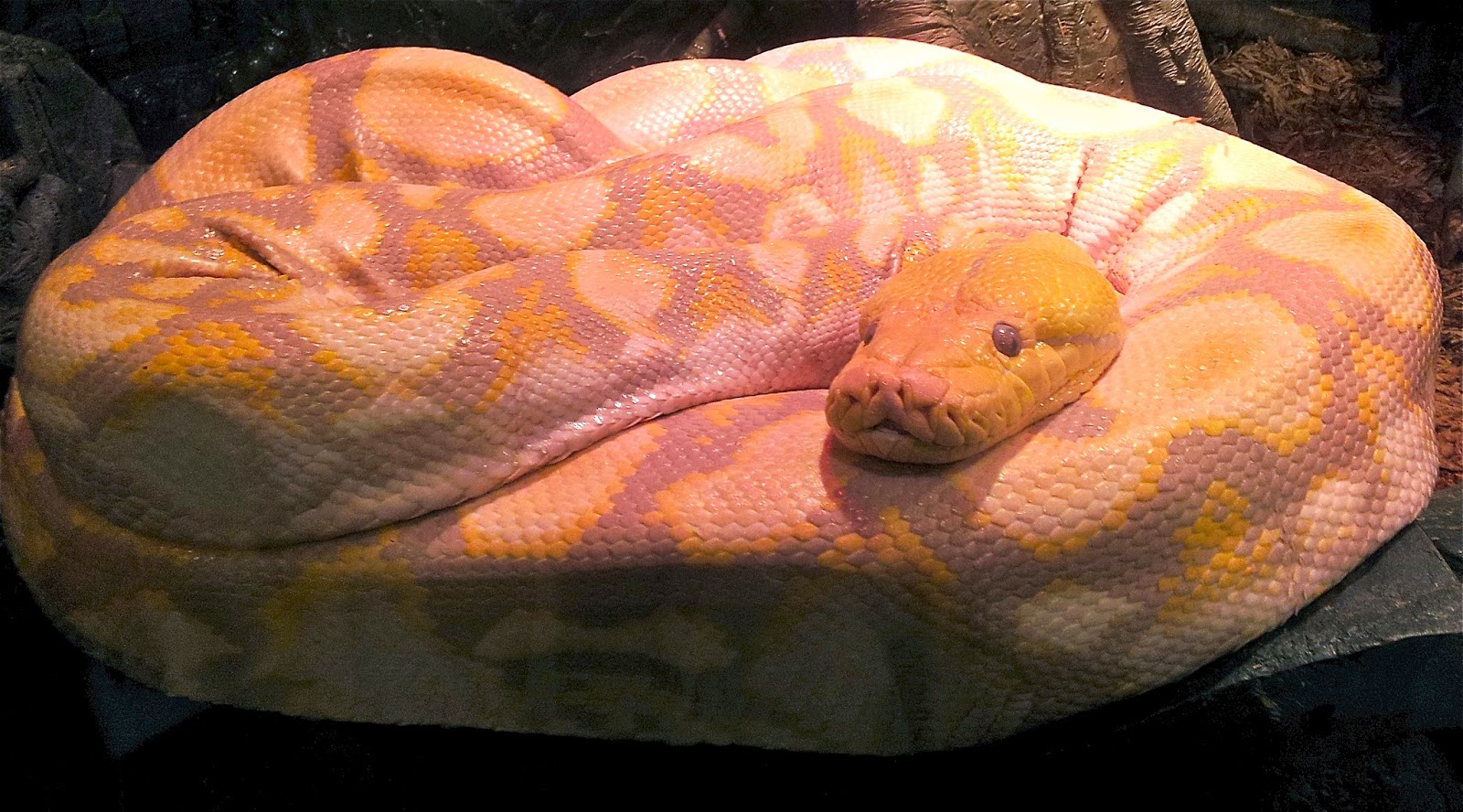
(Above) A genuine photograph of a wild-type reticulated python (public domain); (Below) A genuine photograph of Lemondrop, a lavender albino reticulated python housed at the California Academy of Sciences in Golden Gate Park, San Francisco, California, USA (© Maya Visvanathan/Wikipedia – CC BY-SA3.0 licence)

Clearly, therefore, these photos were fakes, produced by adding small images of humans into some original, genuine photograph of a reticulated python in order to make the latter snake appear immense, but the only way to verify this was to trace that original, genuine photo. Happily, however, unlike the search for the original anaconda image, finding this python precursor was much easier to accomplish. I soon discovered a version that was identical with the others relative to the python itself but lacked any people in it, only depicting the snake, so this was obviously the original, genuine photo whose image had been appropriated by the hoaxer(s). It was present on many sites dealing with snakes, and not surprisingly it was especially popular on southeast Asian sites, because the reticulated python is native to southeast Asia. But none of these sites provided any source for it, so where had this photograph originated?

Fortunately, within a very short time I succeeded in tracing it back to the website RFUK, or Reptile Forums UK in full, and specifically to a post by a RFUK member with the user name Mikee. On 15 September 2009, Mikee had posted on this site a number of photographs of some of his pet snakes, past and present, and one of these pictures was the sought-after original, genuine python photo lacking people in it (click here to access this particular RFUK page and scroll down it until you come to Mikee's post and photos). Here is that photograph (#3 as posted by Mikee):

The original, genuine photograph of a pet reticulated python that has since been utilised by hoaxer(s) unknown to create fake mega-python images (© Mike Andrews – reproduced here on a strictly educational, non-commercial Fair Use basis for review purposes only)

By clicking Mikee's name alongside his post, I was able to access his public profile on RFUK, and I discovered that his real identity was Michael Andrews, from Essex, England. His RFUK profile also included links to his Facebook page, and when I accessed this I found the same python photograph in one of his FB photo albums too (it is publicly accessible, so click here to view this python photo in it). The album in question is entitled 'My Passion', and is devoted to photographs of various of Michael's pet reticulated pythons. The specific python photograph under investigation by me here had been uploaded into this FB album by Michael on 17 May 2010.

Consequently, the mystery of the mega-python image is a mystery no longer – Michael's original, genuine photograph of one of his pet reticulated pythons has simply been photo-manipulated by creator(s) unknown, and without Michael's knowledge, to produce a range of fake pictures of purportedly gargantuan pythons that have flooded the internet and are proving particular popular as clickbait images for uploaded videos there. Interestingly, however, using TinEye's Reverse Image Search the earliest fake version that I was able to track down online had been uploaded on 16 May 2016, so unlike the fake anaconda photos these python equivalents seem to have been created only fairly recently.

Close-up of a spectacular life-sized statue of a reticulated python on display inside the Reptile House at Taronga Zoo in Sydney, Australia, when I visited it in 2006 (© Dr Karl Shuker)


Wednesday, 20 September 2017

A LYING LION AND AN ANACONDA CON - EXPOSING SOME MORE FAKE ANIMAL PHOTOS ONLINE


A genuine photograph of the green anaconda Eunectes murinus – the largest and most familiar of the four species of anaconda currently recognised by science (© Wagnermeier/Wikipedia – CC BY-SA 3.0 licence)

NB – Before reading any further, please note that ALL of the anaconda-encoiled animal photographs and anaconda-encoiled mechanical device photographs contained in this article are photo-manipulated FAKES (with the sole exception of the anaconda-encoiled white cow photos), so none of the apparent animal 'victims' in these photos were victims (except for the white cow, but it did survive – see later).

The internet is increasingly a limitless source not only of fake news but also of fake photographs, with animal subjects being particularly popular.

I was recently sent for my opinion as to its veracity what initially looked like an exceedingly unpleasant, tragic photograph of a lion roaring wildly as it struggled impotently to escape the crushing coils of what seemed to be a gigantic python coiled tightly around its body. Here is the photo in question:

Fake, photo-manipulated photograph of a lion supposedly being crushed by a giant constricting snake – in reality, no lion was harmed whatsoever in the making of this picture! (source/creator presently unknown to me, but this fake photo is contained in numerous websites online)

A closer look, however, soon revealed a very different scenario. To begin with, I could readily see from its markings and colouration that the 'python' in question was actually a green anaconda Eunectes murinus, the largest and most familiar of the four anaconda species currently recognised by science. Bearing in mind that lions occur naturally in the wild state only in Africa and limited regions in Asia whereas all anacondas are entirely restricted in the wild state to tropical America, it was obvious, therefore, that if this photo were genuine, the grisly scene that it portrayed could only have occurred somewhere in captivity. Moreover, examining the image itself in enlarged form soon revealed that it was an inexpertly-produced example of photo-manipulation, with the edges of the anaconda's coils in particular appearing far too sharp and crisp in comparison to the remainder of the image.

Consequently, I decided to conduct a Google-image search in an attempt to discover whatever original lion photo had been used in the creation of this fake version – and in less than 5 minutes I found it, contained in a fair few wildlife websites. Amusingly, it turned out that in the original photo the lion had been snapped in flagrante delicto with a lioness (which had been removed from the fake photo), thus explaining why it was roaring so energetically! (Incidentally, the fake lion/anaconda photo investigated here has been circulating online for a surprisingly long time – using TinEye's Reverse Image Search, I was able to discover examples of it dating back as far as 6 February 2008.)

(Top) The fake lion/anaconda photograph; (Bottom) The original, unmodified photograph of a lion and lioness from which the fake lion/anaconda photo has been created by person(s) unknown (source/creator of fake lion/anaconda photo presently unknown to me, but it is contained in numerous websites online) / © owner of lion/lioness photo currently undiscovered by me, but I'll insert the relevant details here if/when I discover them – reproduced here on a strictly educational, non-commercial Fair Use basis for review purposes only)

So in answer to my correspondent who sent me this lion/anaconda photograph for my opinion as to whether or not it was genuine: it's not – the lion was lying, inasmuch as in the original, genuine photo its roars were telling a very different story from the one depicted in this fake version, in which the anaconda was most definitely a con.

While investigating this fake lion/anaconda photograph, I also encountered a short YouTube mini-investigation video that had been uploaded on 13 November 2015 by Cary Darling with the user name Hoax Factor (click here to view it). In it, he begins by showing this same fake photo, which had been submitted to his Hoax Factor Facebook page by a reader called Chad, then after a fairly lengthy if light-hearted exposition he concludes his mini-video investigation of that photo by presenting the same original image of mating lions (albeit heavily pixellated) that I had independently discovered.

During my own researches, however, I was able to take this case further – much further, in fact – because it soon turned out that this fake lion/anaconda photograph was far from being unique. On the contrary, while pursuing it online in search of the original, genuine lion photo that has been used to create it, I swiftly discovered that a startling number and diversity of other fake anaconda-depicting photographs existed that featured a range of different 'victim' animals.

These include two other lion photos, two different tigers, two different jaguars, a black panther, cheetah, Alsatian dog, elephant, black-and-white cow, rabbit, and (inevitably) various versions featuring humans, as well as some mechanical items, such as a tractor and mechanical diggers or excavators, but all of them united by the presence of precisely the same anaconda coils and outstretched body.

These coils and/or body had been horizontally flipped in certain examples to give the false impression that it was a different specimen, and had occasionally been 'enhanced' by the crudely-achieved digital addition of fake wounds or blood. Moreover, some such photographs included more anaconda coils than others, but looking at these coils I immediately recognised from their markings and colouration that they were nothing more than identical, computer-generated replicates of the same single coil, these extra coils evidently having been digitally created and added in order to make the anaconda appear even longer than it already was. Here is a selection of some of the less lurid animal-featuring examples of these fake photos that I have discovered online (there are undoubtedly many other variations upon this clichéd visual theme out there too):

Fake photographs featuring different animals encoiled by an anaconda, but all of them containing exactly the same original anaconda image, whose coils have sometimes been replicated digitally to make the anaconda seem longer (source/creator(s) presently unknown to me, but these fake photos are contained in numerous websites online)

And here are some of the fake photographs featuring encoiled mechanical devices:

Fake photographs featuring mechanical devices bearing an anaconda, but all of them containing exactly the same original anaconda image, whose coils have sometimes been replicated digitally to make the anaconda seem longer (source/creator(s) presently unknown to me, but these fake photos are contained in numerous websites online)

As the anaconda coils and body were identical in all of the above fake photos, it seemed pointless wasting time seeking out the original, genuine photo for each and every one of them (especially as the more I looked online, the more fakes using this same anaconda image I found), but I did devote a little time to tracing those that had been used to create some of the more dramatic fakes. So, for instance, click here to view the original, genuine cheetah photo, here to view the original, genuine (flipped) black panther photo, and here for the original, genuine rabbit photo.

But that was not all. A second uniting factor was that all of these fake photographs were not only appearing in numerous websites but also turning up as introductory thumbnail pictures to videos that had been uploaded onto YouTube during the past couple of years or so, and by what appear to be a very sizeable number of users, judging from the number of different user names involved (but which, for all I know, may in reality all be one and the same person, or may at least be only a small number of persons but using a plethora of different user names).

And the third, key uniting factor was that not one of these fake thumbnail pictures actually appeared in the video that it was being used to introduce. In other words, based upon their graphic, sensationalised appearance, they were being used deliberately but dishonestly as click-bait, luring video viewers to watch the videos in order to see the action depicted in the photos, only to discover that no such action was contained in the videos.

(Having said that, and basing the following comment upon those specific examples viewed by me: what was contained in all of those videos introduced by one of the fake thumbnail photos depicting the anaconda coiled around an animal was genuine, graphic video footage of animals being attacked and killed by constricting snakes, and sometimes by other animals too, each such video often comprising a compilation of several different, shorter video segments linked together, one after another, to yield a total video often lasting 10 minutes or more. In my opinion, this is nothing but gratuitous, sickening 'video nasty' sensationalism, and I therefore shall not be providing links to any of those videos here.)

Genuine photograph showing the removal of a large anaconda from private grounds in Yopal, Colombia (© Aliciamoralesjackson/Wikipedia – CC BY-SA 3.0 licence)

All that remained for me to do now in order to bring this photo-detective investigation of mine to a successful close was to uncover the original, source photograph containing the anaconda and its coils that had been used to create all of the subsequent fake ones. So I conducted yet another, much lengthier Google search, but this time focusing upon the anaconda itself rather than upon the varied array of creatures or machinery that it was wrapped around in the series of fake photos that I had uncovered so far. To my great delight, I finally found it – and this is how.

First of all, I discovered a video that had been uploaded onto YouTube by someone with the user name GuruQA on 28 August 2015 (click here to view it). This video provided what turned out to be a major clue in relation to tracing the elusive original anaconda photograph.

Filmed in the wild in the anaconda's native homeland, Brazil, it consists of a segment of amateur video footage (which I'll refer to hereafter as AVS1) that begins with a split-second shot showing a woman with her back to the camera appearing at the right-hand edge of the screen. The camera then pans to a live white cow on the left-hand side of the woman, which is shown in its entirety, but once again only for just a split-second, lying down on all fours on some muddy grass, with a large anaconda coiled around its mid-body region. The camera then pans to the rear end of the cow's body but still showing the anaconda's coils, which can now be seen to be moving slightly. The anaconda then comes off the cow completely, followed immediately by the cow's tail and hind feet kicking up dust at the extreme left-hand edge of the screen as the cow evidently makes a very swift exit; it does not appear anywhere in AVS1 again.

Meanwhile, AVS1 now reveals the presence of several people (their excited voices, speaking and shouting in Portuguese, could be heard from the very beginning of AVS1 but the people themselves had not been seen until now, with the sole exception of the one afore-mentioned woman), who vainly attempt to move this very big snake by hauling upon its tail for a time before making a cautious but ultimately successful attempt to pick it up (the actual picking-up procedure is not shown, presumably because it took a fair length of time to accomplish), after which they all walk away, carrying the anaconda aloft with them, and are shown taking it to a stretch of water into which they then release it and watch it swim away. So we know that both the white cow and the anaconda ultimately survived.

Of especial note is that AVS1 includes a panning shot that directly links the anaconda moving off the cow (and the cow promptly fleeing) to the people beginning their attempt to pick it up, thereby establishing that these two activities are indeed part of a single continuous piece of footage, and not two separately-filmed pieces spliced together.

The key element present in AVS1, however, is the brief appearance of the rear end of the cow with the anaconda still wrapped around its mid-body and moving – because during my earlier searches I had found online in a number of different websites a series of still photographs depicting a live white cow lying down on all fours on grass with an anaconda encoiled around its centre, and whose coils and body in one particular photograph within that series were identical to those featured in all of the fake photos. Moreover, these same white cow/anaconda photos appear at the very beginning of AVS1, directly before the video footage itself begins. Here is that one particular online white cow/anaconda photo (which I'll refer to hereafter as the OWCA photo):

The OWCA photograph shown at the beginning of AVS1, and also found in various websites, depicting a white cow lying down on all fours with an anaconda wrapped around its mid-body (source/creator presently unknown to me)

Using TinEye's Reverse Image Search, I was able to trace examples of the OWCA photo online dating back as far as 17 November 2013 (this latter, earliest online example of it can still be viewed, as the tenth of ten photos, here).

I then produced a screenshot of the brief footage in AVS1 showing the rear end of the cow lying down on all fours on grass with the anaconda's slightly-moving coils still wrapped around its centre – and if you compare the cow's rear end, the orientation of its visible hind leg, and the anaconda's coils as seen in this video screenshot with those equivalent anatomical structures in the OWCA photograph found earlier by me online and also present at the beginning of AVS1, you will see that they unquestionably depict the same animals.

And now that this significant fact has been fully established, if you then view a second screenshot taken by me, capturing the split-second AVS1 footage of the encoiled cow as seen in its entirety this time (and occurring immediately before the footage of the cow's rear end and the anaconda's moving coils as captured in my first screenshot), even though the anaconda's coils don't move in this split-second earlier footage its screenshot provides further corroboration that the encoiled cow seen in AVS1 corresponds precisely with the encoiled cow seen in the OWCA photograph.

(Top) The OWCA photograph found by me online, depicting a white cow lying down on all fours on grass with an anaconda wrapped around its mid-body, and also shown at the beginning of AVS1; (Middle) My first video screenshot, of AVS1 footage showing the rear end of the white cow down on all fours on grass with the anaconda still wrapped around its centre and moving; (Bottom) My second screenshot, of AVS1 footage showing the encoiled white cow in its entirety down on all fours on grass just a split-second before the footage captured in my first screenshot (source(s)/creator(s) of AVS1 and the OWCA photograph presently unknown to me, but the OWCA photograph is contained in numerous websites online)

Clearly, therefore, alongside whoever filmed AVS1 was someone else who snapped some still photographs of the anaconda and its encoiled bovine victim – indeed, AVS1 actually shows a woman with a camera snapping photos of the anaconda and it is one of these genuine photos, specifically the OWCA one reproduced by me above, that has subsequently been used by person(s) unknown to manufacture the startling array and diversity of fake photos revealed and exposed by me here in this ShukerNature blog article.

Summarising all of this: the above three images collectively confirm that the OWCA still photograph whose anaconda coils and body are identical to those in all of the fake photos presented here is itself genuine, not fake, because the animals in it correspond precisely in form and pose with those actually seen moving in video footage contained within AVS1.

Since discovering AVS1 as posted on YouTube by GuruQA in August 2015, plus the OWCA photo and others in that same online series, my path has once again crossed with that of Cary Darling, because I subsequently found out that another short Hoax Factor mini-investigation video uploaded by him on YouTube, this time on 15 December 2015 (click here to view it), has also focused upon this same subject, and has actually included a clip from AVS1 (but he did not cite GuruQA or anyone else as his source for it) as well as the key OWCA photograph.

Crucially, however, although it has provided a most welcome service in drawing attention to the whole fake anaconda photos situation (and continues to do so), in my opinion the Hoax Factor mini-video does not provide an absolute guarantee from its clips alone that the specific cow/anaconda footage is a video, rather than merely a photograph. This is because AVS1's brief but key footage showing the anaconda's coils actually moving while wrapped around the cow is not included in the Hoax Factor mini-video. Equally, I personally feel that the latter mini-video does not provide unequivocal verification that the cow/anaconda footage and the anaconda/people footage are from the same video segment, because it does not include the specific footage from AVS1 that contains the all-important panning shot directly linking the cow/anaconda footage to the anaconda/people footage.

Conversely, by:
(a) my finding AVS1 as uploaded onto YouTube by GuruQA, and then specifically drawing attention here to both of those brief but all-important above-noted clips of footage contained in it that were not referenced in the Hoax factor mini-video; as well as:
(b) my highlighting the split-second footage in AVS1 that shows the encoiled cow in its entirety down on its knees on grass, then:
(c) my producing a screenshot of AVS1's footage of the cow's rear end that shows the moving anaconda coiled around the cow, and also my producing a screenshot of the split-second AVS1 footage that shows the encoiled cow in its entirety down on all fours on grass, and finally:
(d) my comparing those two separate AVS1-derived screenshots directly with the OWCA photograph containing the anaconda image that appears in all of the fake photos, I have been able to:
(e) confirm unequivocally that the OWCA photograph does indeed depict the same cow and anaconda that feature in AVS1's cow/anaconda incident, and that:
(f) it is indeed, therefore, both genuine and the source of the anaconda image that appears in all of the fake photos.
(g) QED.

And so: although the perpetrator(s) of the fake photographs investigated by me exclusively in this ShukerNature blog article presently remain(s) unidentified, it is definitely safe to say that no lions, tigers, panthers, elephants, cows. rabbits, etc etc were harmed in the making of any of these images.

(Above) If this fake rabbit/anaconda photograph were real, the rabbit would be an inordinately large one! (Below) The original, genuine photograph used by person(s) unknown to create the fake one (source/creator presently unknown to me, but this fake photo is contained in numerous websites online / © Diliff/Wikipedia - CC BY-SA 3.0 licence)

Thanks to some laborious but ultimately worthwhile and successful photo-detective work, another ostensibly complicated case, initially seemingly to be as encoiled as the anaconda featured within it, is duly unravelled and closed.

NB – Despite appreciable efforts made by me, so far I have been unable to identify the © owner/source of any of the photos included above, but all of them are reproduced here on a strictly educational, non-commercial Fair Use basis for reference purposes only.

A genuine photograph of a coiled-up green anaconda (© Dave Lonsdale-Wikipedia - CC BY 2.0 licence)


POSTSCRIPT
While conducting my researches relating to AVS1 as uploaded onto YouTube by GuruQA in August 2015 and showing the white cow/anaconda incident, I also discovered a second version of this segment (referred to hereafter by me as AVS2), which offered what may – or may not – be a very interesting additional insight into the videoed white cow/anaconda incident.

Uploaded onto YouTube by a user named Snake Channel on 9 January 2017 (viewable here), AVS2 cuts off abruptly at the end without showing the people actually releasing the anaconda into the stretch of water to which they had carried it after picking it up (as seen in AVS1). However, it includes some extra, earlier footage not seen in AVS1 and which is most intriguing.

AVS2 begins by showing some of the same photographs (including the OWCA photo) of the anaconda-encoiled white cow seen its entirety down on all fours on grass that were also shown at the very beginning of AVS1, after which it presents a short, narrated, professionally-made video section concerning anacondas in general that had seemingly been excerpted from a National Geographic documentary regarding this snake species (because the Nat. Geog's famous yellow rectangle logo is superimposed upon the opening footage of this section).

This opening section then morphs into the first of two amateur video sections (referred to by me hereafter as S1 and S2 respectively). S1 shows an anaconda emerging from some reeds at the edge of an expanse of freshwater (river or lake) and coiling swiftly around an unsuspecting white cow standing in the water nearby. In just a very short time, the anaconda's constricting actions appear to have rendered the cow at least unconscious, if not dead, because it soon lies motionless in the water. While this tragic scene plays out, the voices of S1's film-maker and some other people present in this scene and speaking Portuguese (but not actually seen in it) call out loudly, seemingly attempting to frighten off the anaconda (but apparently forgetting or not realising that snakes are deaf to most airborne sounds).

S1's footage then stops but new footage begins immediately, constituting S2, with the overlying title 'An Hour Later' appearing for a few moments. S2 turns out to be one and the same as AVS1, as uploaded by GuruQA, except that AVS1's split-second clip panning from the woman on the right-hand-side of the screen to the anaconda-encoiled white cow seen in its entirety down on all fours on grass is not included in S2. Instead, S2 begins with the shot of the rear end of the anaconda-encoiled white cow, after which its footage is identical to that in AVS1 (except that, as noted earlier, it cuts off before the anaconda is released by the people into the stretch of water).

Screenshot from the beginning of S2 in AVS2 (creator of this video presently unknown to me – screenshot reproduced here on a strictly educational, non-commercial Fair Use basis for review purposes only)

The overlying title 'An Hour Later' appearing for a few moments at the beginning of S2 is clearly meant to demonstrate that S1 and S2 are merely two scenes from the same incident, shot an hour apart but featuring the same white cow and anaconda. If this is correct, it also means, therefore, that the cow was indeed merely unconscious, not dead, in the water during S1, and that during the intervening hour between the end of the events seen in S1 and those beginning in S2, the cow had been rescued and hauled out of the water onto the grass by the people heard in S1 and both heard and seen in S2.

However, I must confess that I am by no means convinced that S1 and S2 do indeed depict two different scenes from the same incident, wondering instead whether they actually depict two entirely unrelated incidents, featuring two different cows and two different anacondas. The reason for my personal misgivings is that in S1, within moments of being captured and encoiled by the anaconda the cow is lying face down, partly submerged, and entirely motionless in the water, looking very much as if it has drowned. Yet in S2 (uploaded in slightly longer form as AVS1 by GuruQA), the cow looks very much alive, and indeed, beats a hasty retreat as soon as the anaconda comes off it.

Fortunately, the question of whether or not S1 in AVS2 does indeed depict an earlier part of the incident depicted in S2 has no bearing upon my findings concerning the direct relevance of S2 (in its longer form as AVS1) to the subsequent creation by person(s) unknown of the various fake photographs exposed by me in this present ShukerNature article.

Engraving of a green anaconda from 1878 (public domain)