Dr KARL SHUKER

Zoologist, media consultant, and science writer, Dr Karl Shuker is also one of the best known cryptozoologists in the world. He is the author of such seminal works as Mystery Cats of the World (1989), The Lost Ark: New and Rediscovered Animals of the 20th Century (1993; greatly expanded in 2012 as The Encyclopaedia of New and Rediscovered Animals), Dragons: A Natural History (1995), In Search of Prehistoric Survivors (1995), The Unexplained (1996), From Flying Toads To Snakes With Wings (1997), Mysteries of Planet Earth (1999), The Hidden Powers of Animals (2001), The Beasts That Hide From Man (2003), Extraordinary Animals Revisited (2007), Dr Shuker's Casebook (2008), Karl Shuker's Alien Zoo: From the Pages of Fortean Times (2010), Cats of Magic, Mythology, and Mystery (2012), Mirabilis: A Carnival of Cryptozoology and Unnatural History (2013), Dragons in Zoology, Cryptozoology, and Culture (2013), The Menagerie of Marvels (2014), A Manifestation of Monsters (2015), Here's Nessie! (2016), and what is widely considered to be his cryptozoological magnum opus, Still In Search Of Prehistoric Survivors (2016) - plus, very excitingly, his four long-awaited, much-requested ShukerNature blog books (2019-2024).

Dr Karl Shuker's Official Website - http://www.karlshuker.com/index.htm

IMPORTANT: To view a complete, regularly-updated listing of my ShukerNature blog's articles (each one instantly clickable), please click HERE!

IMPORTANT: To view a complete, regularly-updated listing of my published books (each one instantly clickable), please click HERE!

IMPORTANT: To view a complete, regularly-updated listing of my Eclectarium blog's articles (each one instantly clickable), please click HERE!

IMPORTANT: To view a complete, regularly-updated listing of my Starsteeds blog's poetry and other lyrical writings (each one instantly clickable), please click HERE!

IMPORTANT: To view a complete, regularly-updated listing of my Shuker In MovieLand blog's articles (each one instantly clickable), please click HERE!

IMPORTANT: To view a complete, regularly-updated listing of my RebelBikerDude's AI Biker Art blog's thematic text & picture galleries (each one instantly clickable), please click HERE!

Search This Blog


PLEASE COME IN, I'VE BEEN EXPECTING YOU...

PLEASE COME IN, I'VE BEEN EXPECTING YOU...
WELCOME TO SHUKERNATURE - ENJOY YOUR VISIT - BEWARE OF THE RAPTOR!


Showing posts with label bird of paradise. Show all posts

Monday, 31 May 2021

UNFURLING CHINA'S FENG-HUANG – THE 'OTHER' PHOENIX

 
A multicoloured feng-huang figurine that I brought back home from Hong Kong in 2005 (© Dr Karl Shuker)

One of the most famous legendary birds is the Egyptian phoenix, but traditional Chinese mythology has its very own equivalent of sorts – the 'other' phoenix, or, as it is commonly referred to in China, the feng-huang.

Just like the Egyptian phoenix, the feng-huang has been identified with a range of real birds. A very popular candidate is the familiar blue peacock Pavo cristatus (in depictions, the feng-huang's splendorous tail is frequently decorated with numerous ocelli or eyespots, thereby closely resembling the famously ornate train of this species).

 
A male blue peacock displaying its spectacular ocellated train, consisting of tail covert feathers (public domain)

A second candidate is Asia's crested argus pheasant Rheinardia ocellata, which is another large, exotic galliform species sporting eyespot-enhanced plumage.

In an earlier ShukerNature article (click here to read it), I revealed that there have been suggestions that Egypt's phoenix may have been based upon preserved skins of certain bird of paradise species brought back to Phoenicia from their far-off New Guinea homelands by early seagoing traders. Moreover, in 1967 a Chinese researcher postulated that one or more birds of paradise native to New Guinea may have been the basis for the feng-huang too.

 
A pair of crested argus pheasants painted by George Edward Lodge, the larger specimen being the male (public domain)

In a lengthy paper written principally in Chinese (and published by the Bulletin of the Institute of Ethnology of Taipeh, Academia Sinica, during autumn 1967), Tzu-Chiang Chou based his assertion upon four primary points, summarized as follows:

1. According to Tzu-Chiang Chou, in the Chinese hieroglyphics of the Shang Dynasty (1384—1111 BC), the shape of the Chinese character termed ‘Feng’, denoting the phoenix, resembled the typical, effusively-plumed Paradisaea birds of paradise more closely than any other proposed contender for this fabulous bird’s identity.

2. The shape used for the character denoting the wind within this system of hieroglyphics was comparable to the Feng character, implying that the phoenix was in some way associated with the wind.

 
A sumptuous Chinese wall plaque in which a Chinese phoenix is portrayed in shimmering nacre or mother-of-pearl (© Dr Karl Shuker)

3. He offers many examples from ancient Chinese writings and from bird designs on the bronzewares of ancient China’s pre-Chin period (i.e. prior to 221 BC) that suggest a Paradisaea species as their model.

4. He presents material that he interprets as evidence for believing that as recently as 1100 AD (during the Sung Dynasty), southern China was home to two native species of bird of paradise, which have since become extinct.

From the examples of Shang Dynasty hieroglyphics depicting the ‘Feng’ and ‘Wind’ that Tzu-Chiang Chou provides, a certain, but by no means unequivocal, similarity to at least two different birds of paradise (greater, Paradisaea apoda, and king, Cicinnurus regius) is present, but his claim that a third example specifically comprises a depiction of a composite bird of paradise (created from the most striking characteristics of a wide range of different species) is less convincing. As for the wind connection, he points out that in Chinese the birds of paradise are referred to as ‘wind-birds’, because they fly against the wind.

 
Chromolithograph from 1900 depicting a male greater bird of paradise (top) and a male king bird of paradise (bottom), plus a six-wired bird of paradise (centre) (public domain)

Within the ancient Chinese texts, the Chinese phoenix is described as having colourful plumage, long tufts of feathers sprouting from its flanks, a fondness for dancing, and communal behaviour – all features shared by the Paradisaea birds of paradise (whose males do display in groups rather than singly). Conversely, in more recent Chinese accounts a very different phoenix is described - a somewhat grotesque entity with a snake’s neck, a tortoise’s shell, and a fishtail – but Tzu-Chiang Chou believes that this image is wholly imaginary, not based upon observations of real forms.

So far, then, Tzu-Chiang Chou’s evidence for the identification of the Chinese phoenix as a Paradisaea bird of paradise is quite persuasive, but his fourth point is much more contentious. Quoting from various early Chinese encyclopedias, he provides descriptions of two exceptionally handsome birds supposedly native to China in those long-departed days, at least according to the authors of the descriptions.

 
Male red bird of paradise, in Cassell's Book of Birds, 1870s (public domain)

One bird, allegedly inhabiting Canton Province during the Sung Dynasty, referred to by the natives as the feng-huang, and said to have long sashes of red plumes on its flanks, beneath its wings, is identified by Tzu-Chiang Chou as the red bird of paradise Paradisaea rubra. This species is officially known only from the Western Papuan islands of Saonet, Waigeu, and Batanta (and perhaps Ghemien too).

The other mystery bird, reported from Kwangsi Province, again during the Sung Dynasty, and called the u-feng or black phoenix, was reputedly bluish-green and purple, with a head crest and an elongated tail with bunches of feathers at each end. Tzu-Chiang Chou considers this to be the long-tailed (=black) sicklebill bird of paradise Epimachus fastosus (formerly magnus).

 
Two males and one female of the long-tailed sicklebill bird of paradise, painted by Richard Bowdler Sharpe (public domain)

These identifications, however, are far from precise. Goldie’s bird of paradise Paradisaea decora and Count Raggi’s P. raggiana also have sprays of long red plumes emerging from their flanks beneath their wings; and the sicklebills do not have crests – the equally long-tailed species of astrapia do, but (in common with the sicklebills) they do not have bunches of feathers at each end of their tails. In any event, I consider it highly unlikely that any genuine birds of paradise have ever been native to China, even if we accept Tzu-Chiang Chou’s claim that in earlier days its climate was much warmer, and hence closer to the tropical temperatures of New Guinea.

Ornithological experts believe that the birds of paradise originated in the mid-mountain forests of New Guinea, and as the present diversity of species progressively evolved, the family’s range gradually expanded, infiltrating north-eastern Australia as its distribution’s southernmost limit and extending as far to the west as the Moluccas (home to Wallace’s standardwing Semioptera wallacei and the paradise crow Lycocorax pyrrhopterus).

 
Richard Bowdler Sharpe's 1890s painting of a pair of Goldie's bird of paradise (public domain)

It is reasonable to suppose, therefore, that if the family were to send representatives beyond the Moluccas, ultimately reaching southern China, it would do so either via the Philippines, a handy series of stepping stones to the Asian mainland and thence China, or via a longer Sulawesi-Borneo-Vietnam course. Yet there is no evidence for the former existence of birds of paradise in any of these countries, thereby undermining support for their onetime occurrence further north-west, in China itself.

A far more likely option is that early travellers visiting New Guinea arrived at China with preserved bird of paradise skins, and perhaps even some live specimens, whose outstanding appearance would guarantee their documentation in major Chinese texts of the day – their authors probably being unaware that these birds had originated from beyond China.

 
John Gould's painting of two adult male specimens of Count Raggi's bird of paradise (public domain)

Another legendary Chinese bird that may conceivably have been inspired at least in part by bird of paradise skins or specimens is the vermilion bird. Totally distinct from the feng-huang, this noble and elegant bird is a mythological spirit creature, one of the four symbols of the Chinese constellations. Representing the south of China and the summer season, it is very selective where it perches and what it eats, and its gorgeous plumage incorporates many different hues of reddish orange.

Sadly, however, like so much in cryptozoology, all of this is mere speculation, nothing but unconfirmed conjecture at present, especially as illustrations can be notoriously inaccurate or so stylized that the true morphological appearance of their original subjects remains obscure.

 
A Chinese phoenix exquisitely depicted by Katsushika Hokusai in c.1835 (public domain)


This ShukerNature blog article was adapted from a section in my book Extraordinary Animals Revisited.

 
A large, modern-day, Chinese-style vase very handsomely decorated with a pair of traditionally-depicted feng-huang birds, photographed in daylight (on left) and at night (on right) (© Dr Karl Shuker)


Tuesday, 30 March 2021

SINGING THE PRAISES OF OUR NATIONS' FEATHERED AMBASSADORS

 
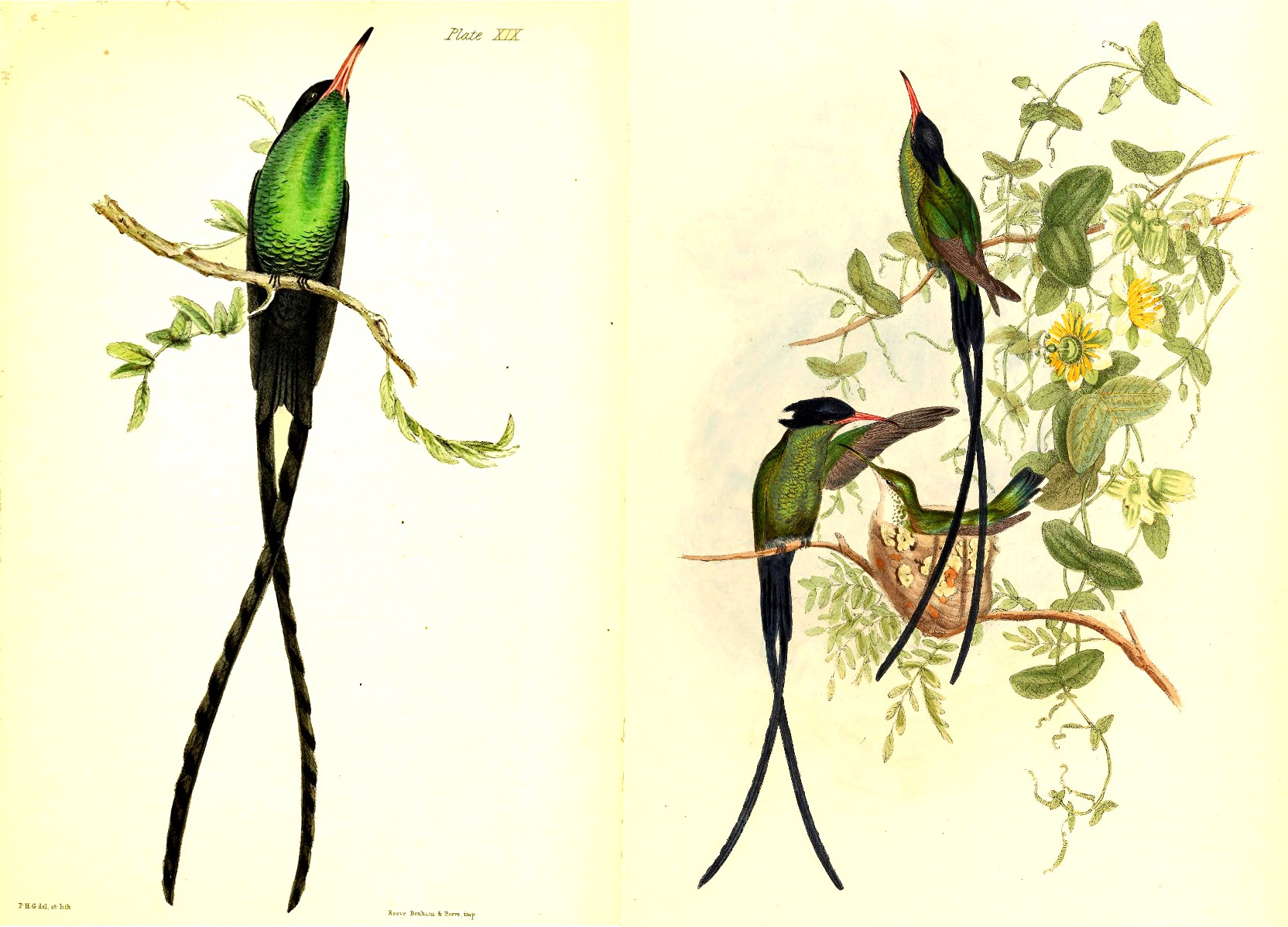
A male doctor bird, Jamaica's national bird, in Philip Henry Gosse's book The Birds of Jamaica, 1849 (public domain) / Doctor birds (two males, one female), in John Gould's tome A Monograph of the Trochilidae, or Family of Humming-birds, Vol. 2, 1861 (public domain)

Despite being a nation intimately associated with birdwatching and a love of all things ornithological in general, the United Kingdom, most surprisingly, is one of the very few nations on Earth that does not have an official national bird. True, several years ago a countrywide poll was held to decide which species should serve as our own representative, and revealed as its winner the robin Erithacus rubecula – a friendly, familiar species beloved of gardeners and Christmas card illustrators, and which has traditionally if unofficially occupied that very same role for untold years anyway. However, even this newsworthy poll failed to convince the powers-that-be to elect the robin formally as our nation's feathered ambassador, and so, at least for now, the wait continues. Elsewhere around the world, conversely, is a vast array of national birds, chosen for many different reasons as their respective country's much-loved avian symbol – from its links to its country's beliefs or culture, or as an eyecatching example of its rich biodiversity, to the longstanding admiration that it has inspired among those people sharing its homeland, or even as a means of highlighting its modern-day rarity and need for conservation. So here, to demonstrate this eclectic variety, is a global twitching tour, highlighting some of the most distinctive national birds with fascinating facts explaining why they are so memorable.

 
European robin, painted by Frederick W Frohawk, 1907 (public domain)

Birds of prey have always been greatly admired as symbols of power, strength, intelligence, wisdom, and keen vision, so it is hardly surprising that they have also been popular choices as national birds. Perhaps the most famous example in this capacity is the bald eagle Haliaeetus leucocephalus, the national bird of the USA. One of the world's several species of fish-eating eagle, and named after the adult bird's characteristic white-plumed head (it is brown in juveniles), the bald eagle was officially adopted as the USA's feathered representative on 20 June 1782, when the design of the Great Seal of the United States portraying a bald eagle grasping in its talons 13 arrows representing the 13 founding states plus an olive branch signifying peace was formally adopted by the Continental (Philadelphia) Congress, containing delegates from those states.

 
Bald eagle, hand-coloured engraving, 1840 (public domain)

Another country with a tradition of eagle imagery is Germany, and it too has an eagle as its generally-recognised national bird, but this time the golden eagle Aquila chrysaetos. Indeed, the magnificent plumage and stately poise of this species is so imposing that several other countries have also adopted it in this role, including Afghanistan, Armenia, Egypt, Mexico, and Scotland, although in Egypt and Scotland it is presently still in an unofficial capacity, rather like our robin. Moreover, the African fish eagle Haliaeetus vocifer, a close Old World relative of the bald eagle and sporting a very striking brown and white plumage, is so well-regarded on its native African continent that it is the official national bird of no fewer than four different nations – Namibia, South Sudan, Zambia, and Zimbabwe.

 
Golden eagles (Wikipedia – public domain)

One of the most spectacular yet also one of the rarest of all eagles is the Philippine eagle Pithecophaga jefferyi. Originally dubbed the monkey-eating eagle as it is large and powerful enough to prey upon sizeable monkeys here, it was subsequently renamed the Philippine eagle and formally installed as its country's national bird on 4 July 1995 by the then president Fidel V. Vamos. This was done in a bid to raise awareness regarding its critically endangered status, a result of longstanding habitat destruction, especially via widespread deforestation. Less than 1,000 individuals are currently thought to exist.

 
Philippine eagle, by Henrik Grönvold, 1910 (public domain)

Other powerful birds of prey declared as national birds include the harpy eagle Harpia harpyja in Panama, the white-tailed sea eagle or erne Haliaeetus albicilla (Poland), and the gyrfalcon Falco rusticolus (Iceland). Vultures may not seem the most photogenic or behaviourally refined of species to serve as national birds, yet they too clearly have their supporters, because the griffon vulture Gyps fulvus is the national bird of Serbia, and the mighty-pinioned Andean condor Vultur gryphus serves in this role for a quartet of major South American nations (Bolivia, Chile, Colombia, and Ecuador). Smaller raptorial species are not overlooked either, with the peregrine Falco peregrinus representing Angola and the United Arab Emirates, the European kestrel F. tinnunculus Belgium, and the saker falcon F. cherrug Hungary and Mongolia.

 
Andean condor, 1800s engraving (public domain)

As for owls, back in classical times the little owl Athene noctua was the sacred bird of Athena, the Greek goddess of wisdom, so in modern-day times it is the national bird of Greece. And the Aruba burrowing owl A. cunicularia arubensis represents the Caribbean island of Aruba. Perhaps the strangest of all birds of prey is the secretary bird Sagittarius serpentarius, named after its straggly crest that has been fancifully likened to an untidy sheaf of quills that a secretary from bygone times might have placed behind one of his ears. This bizarre-looking species somewhat incongruously combines a hawk-like body with the lengthy legs of a stork, and is famed for its snake-killing abilities in its native Sudan where it is commemorated as that country's national bird.

 
19th-Century painting of a secretary bird, from Dictionnaire Histoire Naturelle by Charles Orbigny (public domain)

Waterbirds are another popular choice for national birds. The mute swan Cygnus olor represents Denmark, and the whooper swan C. cygnus Finland, whereas more colourful feathered symbols include the American flamingo Phoenicopterus ruber for the Bahamas, the scarlet ibis Eudocimus ruber for Trinidad and Tobago, and the magnificent frigate bird Fregata magnificens (noted for the breeding male's vivid scarlet, greatly-inflatable throat pouch) for not only the Pacific island nation of Kiribati but also the twin-island Caribbean nation of Antigua and Barbuda. Its smaller but no less distinctive relative the great frigate bird F. minor does the honours for Nauru, and on account of their extraordinarily prehistoric appearance when seen high overhead in flight, frigate birds are regularly mistaken by unknowledgeable observers for living pterodactyls!

 
Adult male magnificent frigate bird, painting from The Birds of North America, 1903 (public domain)

Their impressive, imposing stature and noble mien no doubt explains why cranes and storks also include several national birds among their assemblage. Most celebrated of these is the blue crane Grus paradisea (aka the paradise or Stanley crane), representing South Africa. Its cultural links to this country include a longstanding tradition among the Xhosa people here, whereby the honour bestowed upon a man who had distinguished himself in battle was to be decorated with blue crane plumes placed in his hair by a chief during a special ceremony known as ukundzabela. Other African nations with a crane as their official symbol include Uganda (its national bird is the grey crowned crane Balearica regulorum) and Nigeria (the black crowned crane B. pavonina). The white stork Ciconia ciconia, a species beloved throughout Europe as the traditional bringer of babies according to fairytales and folklore, is the national bird in both Belarus and Lithuania, whereas the hammerhead or hamerkop Scopus umbretta, an odd stork-like but pelican-related species native to much of sub-Saharan Africa and Madagascar, is the national bird of Gambia, and is widely if erroneously claimed to induce lightning. And speaking of pelicans: the brown pelican Pelecanus occidentalis represents the Caribbean nation of St Kitts and Nevis.

 
Blue, paradise, or Stanley crane, from A Monograph of the Cranes, 1897, by Frans Ernst Blaauw (public domain)

Many species of tropical bird have dazzling, multicoloured plumage exhibiting truly extravagant displays of feathered flamboyance, so it is little wonder that some of the most beautiful examples have been adopted by their homelands as national birds. Count Raggi's bird of paradise Paradisaea raggiana, for instance, in which the adult male boasts a fiery explosion of long scarlet plumes with which to tempt and entreat dowdy brown females to mate with him when he dances before them during the breeding season, is the national bird of Papua New Guinea, whose tropical rainforests are home to many of the world's 40-odd bird of paradise species.

 
19th-Century painting of an adult male Count Raggi's bird of paradise, by John Gould (public domain)

Another series of bird species with feathers of the fantastically fabulous kind constitutes the peafowl and pheasants. The blue peacock's famous eye-spotted tail-train when unfurled and held vertically to entice what he hopes are suitably bedazzled peahens is said to owe its distinctive ocellated patterning to the Greek goddess Hera (or Juno in equivalent Roman retellings). Distraught when the messenger god Hermes slew her loyal hundred-eyed watchman Argus at the behest of Zeus, she placed Argus's eyes in the train of the peacock, and adopted it thereafter as her sacred bird. No doubt, therefore, she would be pleased to know that this very familiar species, Pavo cristatus, is honoured as India's national bird. Turning to pheasants, the green pheasant Phasianus versicolor claims comparable prestige in Asia as Japan's national bird, as does the Himalayan monal Lophophorus impejanus for Nepal, the Siamese fireback Lophura diardi for Thailand, and the confusingly-named grey peacock-pheasant Polyplectron bicalcaratum for Myanmar (the last-mentioned species is so-called because although it is a pheasant, it has spotted plumage whose markings recall the ocelli in the peacock's train).

 
Himalayan monal, from A Century of Birds From the Himalaya Mountains, 1831 (public domain)

Parrots were always going to be sought after as national birds by tropical countries fortunate enough to be home to these vividly-plumed perennial favourites among aviculturalists and ornithologists alike, and sure enough, several species have indeed gained that exalted status. The largest, and gaudiest, is undoubtedly the scarlet macaw Ara macao, an animate tricolor of red, blue, and gold, representing Honduras but native to much of northern South America too. Several Caribbean island nations have their very own endemic amazon parrot species – large, brightly-coloured, and found nowhere else – so for reasons of national pride in their avifauna and also to highlight that these species are endangered in many cases, they have duly declared them as their national birds, as with the St Lucia parrot Amazona versicolor for St Lucia, the St Vincent parrot A. guildingii for St Vincent and the Grenadines, and the imperial parrot A. imperialis for Dominica. Nor should we forget the near-threatened Grand Cayman parrot A. leucocephala, the national bird of the Cayman Islands but also found in Cuba and the Bahamas.

 
St Lucia parrot, painted by Joseph Smit, Proceedings of the Zoological Society of London, 1875 (public domain)

The pink-plumaged hoopoe Upupa epops with huge black-and-white wings that bestow upon it the extraordinary guise of a giant butterfly when seen in flight is Israel's national bird, and is intimately linked with biblical lore and legends. According to one such story, hoopoes once bore crests of solid gold, but they were so persecuted by hunters seeking their precious head plumes that they beseeched King Solomon to save them. So in response to their plea, he very kindly transformed their crests into normal feathers, which of course were of no interest to the hunters, and which they have thus borne ever since.

 
A family of hoopoes, painted by John Gould, 1837 (public domain)

Hoopoes are closely related to kingfishers, rollers, hornbills, and motmots, many of which are brilliantly-plumaged and as a consequence include several national birds among their number, such as the lilac-breasted roller Coracias caudatus for Botswana (and also unofficially for Kenya), the rhinoceros hornbill Buceros rhinoceros for Malaysia, the turquoise-browed motmot Eumomota superciliosa for El Salvador and Nicaragua, and the grey-headed kingfisher Halcyon leucocephala for Cape Verde. Superficially similar to the Old World hornbills due to their comparably top-heavy beaks, but less closely related to them zoologically speaking, are the New World toucans, with the keel-billed toucan Rhamphastos sulfuratus serving Belize as its national bird.

 
Rhinoceros hornbills, in Daniel Giraud Elliot's A Monograph of the Bucerotidæ, or Family of the Hornbills, 1882 (public domain)

However, the epitome of tropical birds as far as breathtakingly gorgeous plumage is concerned must surely be the trogons. Again distantly related to kingfishers, rollers, and hoopoes, and native to Africa, Asia, and Latin America, these typically thrush-sized birds resemble living jewels when spot-lit by shafts of bright sunlight filtering through the leafy canopy in their jungle domain. Inevitably, therefore, several of them have been adopted as national birds, such as the Hispaniolan trogon Priotelus roseigaster in Haiti, the Cuban trogon P. temnurus in Cuba itself, and the bar-tailed trogon Apaloderma vittatum in Malawi. However, the trogon par excellence – indeed, a leading contender for the world's most beautiful species of bird – is the aptly-named resplendent quetzal Pharomachrus mocinno of Guatemala, whose history, both natural and national, makes fascinating reading.

 
Bar-tailed trogon, by John G. Keulemans, 1892 (public domain)

According to the ancient traditions of the Aztec nation, which formerly inhabited what is today Mexico (and which in turn formerly included present-day Guatemala within its borders), one of their principal deities, the sky god Quetzalcoatl, would sometimes appear to them in the form of a great airborne feathered serpent with bright emerald-coloured plumes. Today, it is believed that this curious legend arose from real-life observations by the Aztecs of the resplendent quetzal, because during the breeding season the green-plumaged male, which is normally no more than 1 ft long, grows a pair of exceptionally lengthy, elongate tail plumes, also green, but each measuring up to 3 ft long – and when it flies, these two streamer-like feathers extend horizontally behind it and undulate, so that it bears more than a passing resemblance to an extraordinary plumed snake in flight. Such a famous bird of legend has made an immense cultural impact upon Guatemala, one of several Central American countries where this spectacular bird exists (as well as in present-day Mexico) – so much so, in fact, that not only is it Guatemala's national bird but it has given its name to this country's currency too (100 centavos = 1 quetzal since the year 1925), as well as appearing upon both its national flag and its official coat of arms, and also upon its bank notes and many of its postage stamps.

 
Late 1800s chromolithograph portraying a pair of quetzals (public domain)

Also deserving of mention here is a veritable 'quetzal in miniature' that is itself a national bird – the doctor bird Trochilus polytmus, hailing from Jamaica. Indigenous to that island nation, this iridescent green-plumaged hummingbird is characterised by the male's pair of extremely long ribbon-like tail feathers, which make a humming sound as it flies. There is speculation that because these feathers resemble the long silk tail-coats worn by doctors in olden days, this is why the species is called the doctor bird.

 
Delightful short video of two male doctor birds boldly perching on visitors' fingers as they drink sugar water from bottles (© Conley Salmon/YouTube – inserted here on a strictly non-commercial Fair Use basis for educational/review purposes only)

Of course, not all national birds are chosen for their dramatic appearance or links to mythology. Quite a few have been specifically selected for their basic 'everyman' appeal and popularity, familiar to everyone and loved by all. Italy has as its national bird the Italian sparrow, a cheeky little upstart that is abundant and instantly recognisable everywhere here. Long the subject of controversy as to its precise taxonomic status because it appears intermediate in form between the Spanish sparrow Passer hispaniolensis and the house sparrow P. domesticus, it was formerly thought to be a hybrid of these two. Nowadays, however, it is often deemed to be a separate, valid species in its own right, albeit one that may indeed have originated via hybridisation between the two afore-mentioned species, and has been dubbed P. italiae, because this is where it predominantly occurs.

 
A pair of Italian sparrows, by John Gould, from The Birds of Europe, 1837 (public domain)

Other well known but visually modest avian groups with national birds among their membership are the wagtails (the white wagtail Motacilla alba being Latvia's national bird), the crows (Bhutan's is the common raven Corvus corax), swallows (the European or barn swallow Hirundo rustica represents both Austria and Estonia), thrushes (the common blackbird Turdus merula for Sweden, the redwing T. iliacus for Turkey), doves (mourning dove Zenaida macroura for the British Virgin Islands, zenaida dove Z. aurita for Anguilla, Grenada dove Leptotila wellsi for Grenada), and finches (Sinai rosefinch Carpodacus synoicus for Jordan).

 
Adult male Sinai rosefinch, painted by Nicolas Huet, 1838 (public domain)

But perhaps the last word on national birds should be reserved for the most poignant example – namely, the species that represents the Mascarene nation of Mauritius in the Indian Ocean. For alone of all such birds, it is no longer in existence, having been slaughtered for its meat more than three centuries ago, only for it afterwards to become an icon in its former island homeland. Today, its instantly recognisable form can be seen everywhere in Mauritius – decorating picture postcards, appearing in advertisements, reproduced as toys of every conceivable composition, and serving as the number one choice for countless visually-inspired souvenirs. And the name of this extinct, exterminated superstar? What else could it be? Raphus cucullatus – the dodo.

 
Dodo, 17th-Century Dutch illustration, colour-corrected (public domain)


Tuesday, 28 April 2020

THE PHOENIX AND THE PARADISE BIRDS

Exquisite vintage chromolithograph depicting three different bird of paradise species - greater, six-wired, and little king (public domain)

In the Garden of Paradise, beneath the Tree of Knowledge, bloomed a rose bush. Here, in the first rose, a bird was born: his flight was like the flashing of light, his plumage was beauteous, and his song ravishing.

But when Eve plucked the fruit of the knowledge of good and evil, when she and Adam were driven from Paradise, there fell from the flaming sword of the cherub a spark into the nest of the bird, which blazed up forthwith. The bird perished in the flames; but from the red egg in the nest there fluttered aloft a new one - the one solitary Phoenix bird. The fable tells us that he dwells in Arabia, and that every hundred years he burns himself to death in his nest; but each time a new Phoenix, the only one in the world, rises up from the red egg.

The bird flutters round us, swift as light, beauteous in colour, charming in song. When a mother sits by her infant’s cradle, he stands on the pillow, and, with his wings, forms a glory around the infant’s head. He flies through the chamber of content, and brings sunshine into it, and the violets on the humble table smell doubly sweet.

But the Phoenix is not the bird of Arabia alone. He wings his way in the glimmer of the Northern Lights over the plains of Lapland, and hops among the yellow flowers in the short Greenland summer. Beneath the copper mountains of Fahlun and England’s coal mines, he flies, in the shape of a dusty moth, over the hymn-book that rests on the knees of the pious miner. On a lotus leaf he floats down the sacred waters of the Ganges, and the eye of the Hindoo maid gleams bright when she beholds him.

The Phoenix bird, dost thou not know him? The Bird of Paradise, the holy swan of song! On the car of Thespis he sat in the guise of a chattering raven, and flapped his black wings, smeared with the lees of wine; over the sounding harp of Iceland swept the swan’s red beak; on Shakespeare’s shoulder he sat in the guise of Odin’s raven, and whispered in the poet’s ear "Immortality!" and at the minstrels’ feast he fluttered through the halls of the Wartburg.

The Phoenix bird, dost thou not know him? He sang to thee the Marseillaise, and thou kissedst the pen that fell from his wing; he came in the radiance of Paradise, and perchance thou didst turn away from him towards the sparrow who sat with tinsel on his wings.

The Bird of Paradise – renewed each century - born in flame, ending in flame! Thy picture, in a golden frame, hangs in the halls of the rich, but thou thyself often fliest around, lonely and disregarded, a myth - "The Phoenix of Arabia."

In Paradise, when thou wert born in the first rose, beneath the Tree of Knowledge, thou receivedst a kiss, and thy right name was given thee – thy name, Poetry.

   Hans Christian Andersen – ‘The Phoenix Bird’, in Hans Christian Andersen’s Fairy Tales


Native to New Guinea, its outlying islands, and (in the case of four species known as riflebirds) the north-eastern perimeter of Australia, the dazzling, flamboyantly plumed birds of paradise first became known to a greater portion of the world during the 16th Century, when skins of these exquisite species were brought to Europe by one of Ferdinand Magellan’s vessels. That, at least, is the official history of these birds.

Less well-publicised, however, is fascinating evidence which strongly implies that the birds of paradise were known beyond Australasia many centuries before this, and also that they may well hold the key to the identity of a spectacular, much-celebrated bird of ancient mythology.

The Egyptian phoenix must surely be the most famous of all fabulous birds. According to its legend’s most familiar version, every 500 years (or every century in certain other versions) it would construct its nest from twigs, cinnamon, myrrh, and perfumed herbs; then, as the heat from the intense Eastern sun ignited its nest, transforming it into a blazing pyre of conflagration, the phoenix would raise its outstretched wings and dance, before perishing utterly amidst the flames, which would flicker and burn as the years passed by until only ash remained. From this spent mass of cinders, a new phoenix would rise, reborn and whole, and wrap the remains of its nest in myrrh enclosed within aromatic leaves; it would then fashion this into an egg, and fly triumphantly to the temple of the Sun King at Heliopolis, Egypt, to place its egg on the temple’s altar, before departing to construct a new nest and begin the cycle of self-immolation and resurrection all over again.

Traditional concept of the phoenix and its burning nest, dramatically depicted here in an early engraving (public domain)

Most of this has traditionally been dismissed as imaginative fiction. Admittedly, scholars have attempted to identify the phoenix with various known species, ranging from the peacock, flamingo, and golden pheasant Chrysolophus pictus to (with somewhat less conviction) certain exotic parrots and other brightly plumaged cage-birds imported from the tropics, but none of these identifications is very satisfactory. Alternatively, certain species of perching bird, particularly some crows, seemingly experience a pleasurable sensation from fanning their wings over burning straw or twigs; sightings of this could have contributed to the phoenix legend - discussed by Dr Maurice Burton in Phoenix Reborn (1959).

As documented by Texas University researcher Thomas Harrison (Isis, 1960), there had even been suggestions by some of the early naturalists and poets that the phoenix could have been based upon a bird of paradise, but as the phoenix legend considerably precedes these birds’ ‘official’, 16th-Century debut in the West, this possibility received short shrift - until 1957. But before we investigate this further, we should recall how the birds of paradise themselves first came to Western attention.

It was September 1522 when the survivors of the once-mighty expeditionary fleet of renowned Portuguese explorer Ferdinand Magellan returned home to Europe, arriving in Seville, Spain, and bringing with them all manner of exotic treasures and relics from far-flung corners of the globe. Among these was a series of truly exceptional bird skins, which had been purchased from natives of New Guinea and various of its outlying islands. Their most immediately-striking features were their extravagantly flamboyant feathers - spectacular flourishes of gauzy, rainbow-hued plumes that billowed like dazzling fountains from beneath their wings and tail.

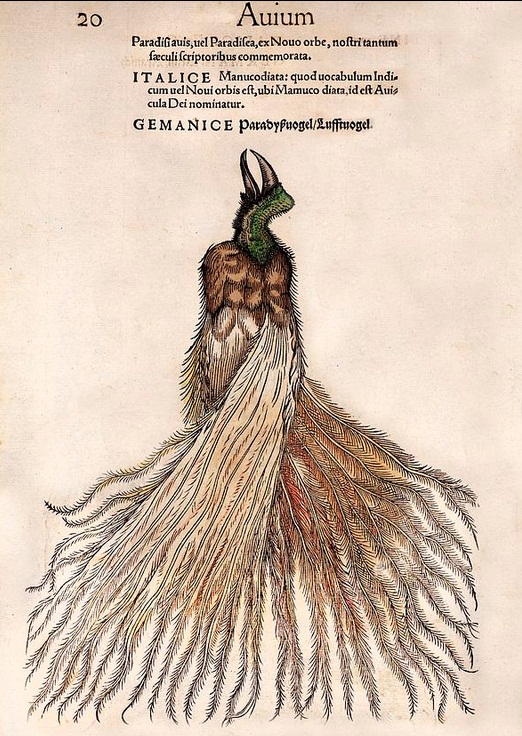
Bestiary compiler Conrad Gesner's famous woodcut of an ostensibly footless bird of paradise from his Historia Animalium (1551-1558) (public domain)

When examined more closely, however, these resplendent specimens revealed an even more remarkable characteristic - they were wholly devoid of flesh, blood, and bones. Their heads came complete with eyes and a beak, and their bodies had wings, but otherwise it seemed that these extraordinary birds were composed entirely of feathers - they did not even possess any feet! Yet there were no recognisable signs that the skins had been in any way tampered with, so the possibility of a hoax was discounted.

The belief in fabulous sylph-like creatures such as these recurs in mythology throughout the world, but never before had science obtained any hard evidence in support of their reality. Needless to say, therefore, zoologists were totally bemused, but at the same time thoroughly captivated, by these astonishing specimens, and concluded from their near-weightless, fleshless, and footless forms that they undoubtedly lived an exclusively aerial existence - spending their entire lives, from birth to death, drifting ethereally through the heavens, and presumably sustained solely upon an ambrosial diet of nectar and dew imbibed in flight.

To quote one zoologist of that time, they were nothing less than "...higher beings, free from the necessity of all other creatures to touch the ground". Not surprisingly, as birds that seemed to have originated from Paradise itself, their species ultimately became known as the bird of paradise, and also as the manucodiata ('birds of God'), the latter name preserved today by several bird of paradise species that are referred to zoologically as manucodes.

Early engraving of a manucodiata (public domain)

Subsequent expeditions to New Guinea brought back more skins, again purchased directly from native tribes, and it soon became obvious that these exquisite creatures comprised many different species, delineated from one another by their distinct but all equally splendid plumages. No living specimens, however, were captured, and it was not until the 19th Century that Western scientists penetrated the dark New Guinea jungles to spy these gorgeous birds for themselves – one such encounter calling forth a paean of praise and wonder from the pen of naturalist Alfred Russel Wallace, who wrote in his diary:

The feelings of a naturalist who at last sees with his own eyes a creature of such extraordinary beauty and rarity so long sought after, would require a touch of the poet to reach full expression. I found myself on a remote island, far from the routes of the merchant fleets, I wandered through luxuriant tropical forests...And here, in this world, I gazed upon the bird of paradise, the quintessence of beauty. I thought of the long vanished ages during which generation after generation of this creature...lived and died - in dark, gloomy forests, where no intelligent eye beheld their loveliness. And I wondered at this lavish squandering of beauty.

Only then did scientists finally expose these extraordinary birds’ long-hidden secret. The skins that had been arriving back in Europe were incomplete ones - the New Guinea natives had developed to a fine art the immensely skilled process of skin preparation whereby the flesh, blood, bones, and feet of these birds were removed without leaving behind any readily-noticeable signs of their former presence. In short, the birds of paradise were not ethereal, everlastingly-airborne beings at all.

19th-Century bird painter John Gould's superb illustration of a male and female greater bird of paradise Paradisaea apoda – 'apoda' translating as 'footless', derived from the earlier mistaken belief that this and related species did indeed lack feet (public domain)

In fact, as ornithologists swiftly discovered when at last able to examine complete specimens, they were nothing more than gaudy relatives of the sombrely-garbed rooks and ravens. Happily, however, their wonderful feathers were genuine (although in most cases it was only males that sported such sumptuous plumage), therefore offering at least a measure of consolation and compensation to scientists and poets alike for the otherwise traumatic transformation of the miraculous manucodiata into first-cousins (albeit very beautiful ones) of the crow family!

Upon the arrival of the first bird of paradise skins in Europe, their unparalleled beauty attracted equally unparalleled attention, not only from the scientific world, however, but also from the fashion industry, whose wealthier patrons yearned to be as glamorously decorated in these extravagantly beautiful plumes as the birds of paradise themselves. During the 19th Century, when Wallace and others finally spied living specimens in their native homelands, this insatiable demand set in motion a traffic in bird of paradise skins on so great a scale that it soon became evident to all that, if this trade continued for much longer, many species would become extinct within a very short space of time.

Accordingly, many countries banned all import of these skins, and in the 1920s New Guinea banned their export, thereby freeing the most famous and magnificent members of its avifauna from any further massacres in the name of fashion, and enabling their much-depleted numbers to recover. Nevertheless, a certain degree of skin trade still occurred within New Guinea, and in 1957 a team of Australian scientists set out to discover the extent of this traffic - never dreaming that one of the outcomes of their investigations would be the disclosure of a hitherto unknown facet of the Egyptian phoenix myth.

Phoenix with wings outstretched amidst its fiery nest, illustration from Kinderbuch by Friedrich Justin Bertuch, 1806 (public domain)

According to a detailed account in Purnell’s Encyclopedia of Animal Life (1968-70, edited by British zoologists Dr Maurice Burton and Robert Burton), the scientists learned to their astonishment that the New Guinea native tribes had been killing the birds of paradise to obtain their skins for trade with visiting Western seafarers long before the 16th Century. In fact, this had been taking place as far back as 1000 BC, when bird of paradise skins were transported thousands of miles westwards to Phoenicia - birthplace of the phoenix legend. But that was not all.

To preserve the skins’ delicate plumes during their long sea journey from New Guinea to Phoenicia, the tribesmen had presented them to the sailors carefully wrapped in a covering of myrrh skilfully fashioned into an egg-shaped capsule, in turn enclosed within a parcel of burnt banana leaves. If we equate the banana leaves of reality with the aromatic leaves of legend, the result is an extraordinarily close correspondence with the famous myth of the phoenix.

All that is missing is the blazing fire encompassing the bird on all sides - but this is the easiest aspect of all to explain via the bird of paradise hypothesis. One of the most magnificent and also one of the most abundant species (even during the height of the fashion trade, and even though it was especially sought-after due to its sumptuous plumes) is Paradisaea raggiana, Count Raggi’s bird of paradise.

John Gould's gorgeous painting of a male Count Raggi's bird of paradise Paradisaea raggiana exhibiting its spectacular fiery plumage (public domain)

A crow-sized species, the male is a truly resplendent sight during the breeding season, set apart by the breathtaking brilliance of the scarlet plumes that surge from each side of its breast, cascading all around like a blazing eruption of scorching flames. During the male’s pre-mating display, moreover, it expands and elevates these huge sprays of plumes, and vibrates its body, so that the resulting effect is uncannily like that of a bird dancing in the midst of a coruscating inferno of flame!

Considering that the abundance, the gorgeous appearance, and the notable popularity among plume-hunters of Count Raggi’s bird of paradise would ensure that it was well-represented in all series of skins sold by the natives to the Phoenicians, and that the natives undoubtedly regaled them with vivid descriptions of its striking courtship display, need we really look any further for the origin of the Egyptian phoenix, and its dramatic dance of death in the fiery heart of its blazing nest?

Additionally, in his book Fabulous Beasts (1951) Peter Lum stated that the Roman emperor Heliogabalus (reigned 218-222 AD) is said to have dined upon a bird of paradise. Also, as V. Kiparsky noted in an Arsbok-Societas Scientiarum Fennica paper from 1961, basing his ideas upon accounts in ancient Russian literature tantalizingly comparable to bird of paradise descriptions (most notably the famous Russian firebird or zhar ptitsa), a trade in their plumes may have been taking place at a very early date in eastern Europe.

Stealing a plume from the Russian firebird (public domain)

Finally: Well worth pointing out here is that trade in bird of paradise plumes was also taking place at an early age between New Guinea and China – as long ago as China's Bronze Age (3100-300 BC), in fact, according to a fascinating section in Civilisation Recast: Theoretical and Historical Perspectives by Stephan Feuchtwang and Michael Rowlands, in which they state:

…tropical forest products and most importantly birds of paradise feathers were being sought by the Bronze Age 'civilisations' of the China Sea.

(Incidentally, China does of course have its very own phoenix, the feng-huang, but this avian entity seemingly has a totally separate folkloric origin from Egypt's version, being widely believed to have been inspired by various species of Asian pheasant and peafowl, but as revealed elsewhere on ShukerNature there is nonetheless a line of conjecture linking it to birds of paradise too.) Moreover, I recently learned from Australian Facebook friend Yarree Denamundinna that some bird of paradise plumes had allegedly been discovered inside an ancient Egyptian tomb. I asked Yarree if he could supply me with any published sources confirming this fascinating claim, and if he can do so I shall publish details here.

A pair of blue birds of paradise Paradisornis rudolphi (my favourite species), painted by okapi-discoverer Sir Harry Johnston (aka Sir Henry Hamilton Johnston), from Marvels of the Universe, Vol I (public domain)

This ShukerNature blog article is excerpted and adapted from my book Extraordinary Animals Revisited.