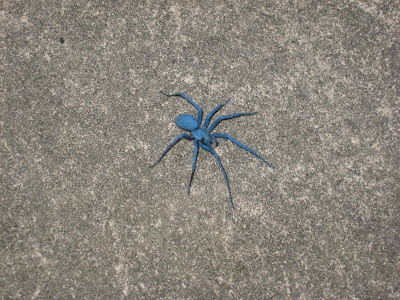
 The blue mystery spider of Batley (Mary Howard)
Hot on the many heels of the shrieking centipede and the ant-mimicking tiger beetle documented in the previous ShukerNature comes yet another anomalous arthropod. This time? It's a bright-blue, seven-legged spider!
The original info was forwarded to me by Fortean Times, for whom I am preparing a full account of this remarkable case, and I have since been in contact with the eyewitnesses themselves, but here are the principal facts - and the all-important photograph:
The photo was snapped by Mary Howard, a retired biology teacher, outside her home in Batley, W Yorkshire, one early evening in June 2009, where it was also seen by her daughter, Louise Howard. In basic shape and form, the spider resembles a wolf spider or even one of those familiar long-legged Tegenaria house spiders that we've all seen scuttling across the carpet suddenly or attempting to clamber out of the bath, except for this extraordinary blue colour.
So, what are the options regarding its identity?
Is it:
1) A non-native species;
2) A freak blue specimen of a native species;
3) A normal spider exposed to UV light when photographed, making it fluoresce blue (many spiders do this);
4) A normal spider that has inadvertently covered itself in some blue dye, paint, chalk, etc;
5) A normal spider that has been deliberately painted blue, and probably held in place by one leg with tweezers while this was done (if the spider pulled away and its leg snapped off, this option would also explain its seven-legged state);
6) A normal spider in a photograph in which the spider has been photoshopped blue?
Those, as Shakespeare never wrote, are the questions!
Any thoughts or opinions would be greatly welcomed!
UPDATE - 20 April 2012
Since writing the above post, there have been several interesting developments, which I've documented in various of my Alien Zoo columns for
Fortean Times, as well as in a longer, more detailed
FT article. So here is an update of what has been happening in the world of mystery blue spiders!
Among the various comments that my above post elicited here on ShukerNature was one from a reader called Colin. After reading my longer
FT article, Colin contacted me directly, and he now provided me with a more detailed account of his sighting. (In accordance with his request, I am not revealing Colin’s full name or address, but I have them on file.) Confessing that he hadn’t checked back on my blog after posting his original comment and thus hadn’t realised that I’d replied to it, Colin informed me that the location of his sighting was his own back garden in the town of Holmfirth – most famous until now as the setting for the filming of the BBC’s recently-ended long-running comedy series ‘Last of the Summer Wine’. Here is his description:
"The spider was almost precisely like the one in Mary Howard's picture, a bright royal blue but quite small, about 1 cm, or no more than 1/2". The plant pot I was removing had been weakened by frost damage over the last eight years and fell to pieces, spilling soil on to the hard standing where I park the car. There were various creepy crawlies, woodlice and such like running in all directions, including the blue spider. There was no 'nest' or multiple blue spiders, just the one and although it was remarkable enough in colour, it was small and my mind was on how I was going to gather up the soil from the pebbles...The location is in a small valley, south facing, sheltered and very warm for Northern England...Just to confirm, it wasn't a bit blue, or covered in a stain (though I have since wondered whether it was the result of a phosphorescent fungus from its dark, moist home) but really very bright, even vivid."
Phosphorescent fungi do sometimes stick to animals but usually glow green rather than blue, and the glow is normally noticeable only in the dark, not in daylight. In any case, why should only a single spider have become covered in it, and why have such spiders (or glowing woodlice too, etc) not been reported before? Clearly, the mystery of Yorkshire’s blue spiders has yet to receive a satisfactory explanation - unless of course Foggy, Compo, and Clegg have something to do with it?!
And still they came! After two separate but equally anomalous blue spiders had come to light in West Yorkshire within the space of a year, I subsequently learnt of a comparable encounter in the south of England. On 9 November 2010, after having read my
FT article on these oddly-hued arachnids, long-time
FT reader Carl Schalck sent me the following exciting news:
"Just thought I should let you know that last summer we had a fair few blue and black spiders in our garage in Lewes, East Sussex.
"I thought they were a bit strange, but I had no idea they were that rare. I think there were three of them, very similar to common garden spiders but covered in blue and black patches. They lived on the inside of the garage door."What makes this report even more interesting is that, judging from Carl’s description, these spiders (unlike those from Yorkshire) do not appear to have been painted. This is because whereas even daubing a spider uniformly would not be an easy task, painting each of three spiders with a covering of blue and black spots would surely be nigh on impossible. And why on earth would anyone go to such an inordinate amount of trouble anyway? I already have on file records of confirmed colour mutation (though as yet not blue) in the common garden spider
Araneus diadematus, so perhaps this trio represents a hitherto-unreported mutant version.
In July 2011, after reading my earlier blue spider accounts, Brian Weilert and his wife Stacia, a teacher, each sent me an email concerning a cobalt-blue spider with seven legs (a moulting injury?) that Stacia had captured a fortnight earlier in their garden in southeastern Kansas, USA. Since doing so, they had maintained it in a small specially-created habitat, and had been feeding it on live insects. It subsequently developed an eggsac, and produced a burrow. In response to their request for suggestions as to whom they should contact concerning this very notable spider, I urged them to bring it to the attention of researchers at any local museum, scientific institution, nature centre, or zoo, especially (in view of its eggsac) as it might well soon be bringing into the world an entire brood of spiderlings – which may or may not themselves be blue, depending upon the origin of their mother’s blue colouration. The Weilerts also sent me a couple of photographs of it, the clearer one of which I am reproducing here. It appears to be a lycosid wolf spider, of the genus
Hogna – which is not known for natural blue species.
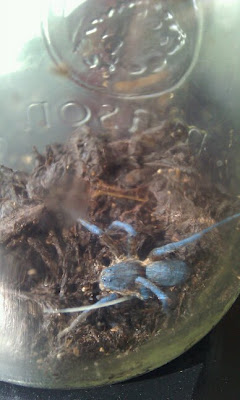 The blue wolf spider of Kansas (Brian and Stacia Weilert)
Until recently, the only logical non-hoax explanation for non-natural blue spiders seemed to be contact with some external source of blue pigment, such as paint or ink. On 4 January 2011, however, Norwegian correspondent Terje Jonassen alerted me to a remarkable but hitherto little-publicised discovery (documented in the
Norwegian Journal of Entomology, 14 December 2010), which is as follows.
In recent times mostly, there have been over a hundred fully-confirmed, non-hoax cases of non-natural blue invertebrates, in particular woodlice, as well as dipterans (true flies) with aquatic larvae, which, when examined, were found to have been infected by a certain type of soil-inhabiting virus known as an invertebrate iridovirus (IIV). This virus is present in such high concentrations within the infected creature’s tissues that it forms crystalline aggregations. These emit a bright blue iridescence and thereby bestow this colouration upon the creature. IIV infection can be caused by feeding upon infected animals and also by parasitic nematode worms.
So it seems conceivable that the answer to the mystery of the blue spiders (or at least to some of them) may not involve encounters with external pigments or dyes but rather to internal IIV infection, most likely due to the spiders having consumed infected prey. Consequently, as noted earlier, I recommended to the Weilerts that they show their captive blue spider to local scientists, as that may provide the much-needed opportunity to investigate this exciting possibility directly.
I had been awaiting further news regarding the Weilerts' blue spider with great anticipation for some time, but when it finally came, via an email from Brian Weilert on 23 August 2011, it was not at all what I had hoped for or expected:
"Just a note to let you know how it all ended. The spiderlings hatched and were brown. We went away for a few days and when we returned she was dead and so were the babies. During this time Purdue University had contacted me. I took some photos of her, post mortem, as they requested and am sending them her body. Thanks for all your help during this episode."I have already noted how infection by an iridovirus can result in freak blue invertebrates, which may therefore explain this and other, previously-reported freak blue spiders. But could the viral infection be directly transmitted from parent to offspring? Had the spiderlings been blue, this would not only have demonstrated pretty effectively that an iridovirus infection was indeed responsible here but also that it was directly transmissible. As they were not, however, the only hope left for a solution to the mystery of this particular blue spider is if the Purdue University researchers' investigations can conclusively identify the cause of its novel colouration. Once again, therefore, I now await further news from the Weilerts, and this time we can but hope that it is of a more positive, happier nature.


 Posts
Posts