Dr KARL SHUKER

Zoologist, media consultant, and science writer, Dr Karl Shuker is also one of the best known cryptozoologists in the world. He is the author of such seminal works as Mystery Cats of the World (1989), The Lost Ark: New and Rediscovered Animals of the 20th Century (1993; greatly expanded in 2012 as The Encyclopaedia of New and Rediscovered Animals), Dragons: A Natural History (1995), In Search of Prehistoric Survivors (1995), The Unexplained (1996), From Flying Toads To Snakes With Wings (1997), Mysteries of Planet Earth (1999), The Hidden Powers of Animals (2001), The Beasts That Hide From Man (2003), Extraordinary Animals Revisited (2007), Dr Shuker's Casebook (2008), Karl Shuker's Alien Zoo: From the Pages of Fortean Times (2010), Cats of Magic, Mythology, and Mystery (2012), Mirabilis: A Carnival of Cryptozoology and Unnatural History (2013), Dragons in Zoology, Cryptozoology, and Culture (2013), The Menagerie of Marvels (2014), A Manifestation of Monsters (2015), Here's Nessie! (2016), and what is widely considered to be his cryptozoological magnum opus, Still In Search Of Prehistoric Survivors (2016) - plus, very excitingly, his four long-awaited, much-requested ShukerNature blog books (2019-2024).

Dr Karl Shuker's Official Website - http://www.karlshuker.com/index.htm

IMPORTANT: To view a complete, regularly-updated listing of my ShukerNature blog's articles (each one instantly clickable), please click HERE!

IMPORTANT: To view a complete, regularly-updated listing of my published books (each one instantly clickable), please click HERE!

IMPORTANT: To view a complete, regularly-updated listing of my Eclectarium blog's articles (each one instantly clickable), please click HERE!

IMPORTANT: To view a complete, regularly-updated listing of my Starsteeds blog's poetry and other lyrical writings (each one instantly clickable), please click HERE!

IMPORTANT: To view a complete, regularly-updated listing of my Shuker In MovieLand blog's articles (each one instantly clickable), please click HERE!

IMPORTANT: To view a complete, regularly-updated listing of my RebelBikerDude's AI Biker Art blog's thematic text & picture galleries (each one instantly clickable), please click HERE!

Search This Blog


PLEASE COME IN, I'VE BEEN EXPECTING YOU...

PLEASE COME IN, I'VE BEEN EXPECTING YOU...
WELCOME TO SHUKERNATURE - ENJOY YOUR VISIT - BEWARE OF THE RAPTOR!


Showing posts with label blue tiger. Show all posts

Friday, 29 December 2017

'MYSTERY CREATURES OF CHINA: THE COMPLETE CRYPTOZOOLOGICAL GUIDE', BY DAVID C. XU - A LANDMARK IN THE LITERATURE OF UNKNOWN ANIMALS


The exquisite artwork on the front cover of David C. Xu's wonderful book (© David C. Xu/Coachwhip Publications)

December 2017 may seem rather early for anyone to put forward a major contender to receive in a year's time the accolade of Best Cryptozoology Book of 2018, but in my opinion the truly exceptional work by David C. Xu to which this present ShukerNature blog post is devoted, and which is officially published at the beginning of next month by Coachwhip Publications, more than justifies being nominated for such an honour.

When David very kindly asked me a while ago if I would pen a foreword to his book on Chinese cryptozoology, I was delighted to do so, because Sinian mystery beasts have always fascinated and frustrated me in equal amounts – fascinated by those select examples recorded in Western-language publications, and frustrated by the certain knowledge that there were many additional examples hidden from my investigative capabilities as I do not read or speak any of China's native tongues.  And my latter suspicion was more than confirmed by the incredible diversity of such latter beasts that David's book revealed to me as I read through it in advance of preparing my foreword.

So now, as an exclusive pre-publication taster of what to expect in this incredible, thoroughly engrossing volume, and with David's kind permission, here is my foreword to his book, reproduced in full:

I consider myself very fortunate to possess at least a working knowledge of several different European languages, which has enabled me to research and bring to international cryptozoological attention via my writings a considerable number of fascinating but hitherto-obscure cryptids that had never previously been documented in any English-language publication.

However, there is one massive geographically-based archive of cryptozoological information that until now has remained largely unattainable for me, due simply to the frustrating fact that I have no comparable knowledge or experience of any of the languages indigenous to that vast country in question – the latter country being, of course, China. True, down through the ages, a number of English-language books have chronicled some of the most famous and spectacular of its mythological fauna – such as the Chinese dragons (long, etc), Chinese phoenix (fenghuang), Chinese unicorn (qilin), celestial stag, and winged hua fish. A smaller number of cryptids have also been highlighted internationally, in particular the yeren or Chinese wildman, the blue tigers of Fujian, the aquatic monsters of Lake Tianchi, and the bizarre 'hippoturtleox' of Tibet. Nevertheless, to adapt one of Sir Isaac Newton's most quoted of quotations, to me these are little more than just a few pebbles or seashells lying on the beach, perhaps a little smoother or prettier than some others, but with the great ocean of Sinian cryptozoology lying all undiscovered before me – but not any more!

Thanks to the superb book before you now, the vast and previously-concealed, unseen menagerie of Chinese mystery beasts is enshadowed and encrypted no longer, its fascinating panoply of scientifically unknown animals laid bare at last to an international readership that has waited so long for a knowledgeable guide adept in English to lead it into these secret creatures' enthralling domain.

Having been wholly immersed in cryptozoology from both an investigative and a chronicling standpoint for over 30 years, whenever I read any new such book nowadays I expect to be (and generally am) already familiar with the majority of mystery beasts presented within it – but not this time! To my surprise but total delight, page after page in this extremely comprehensive volume unfurled extraordinary cryptids that I had never previously encountered – confirming my long-held suspicion as outlined earlier here that China's crypto-chronicles held all manner of treasures formerly hidden from me by virtue of my inability to read any Sinian language. And I have no doubt whatsoever that countless other readers similarly limited linguistically will experience the same thrill of discovery as I did when first reading this book, and am still doing when re-reading it.

After all, where else could a non-Chinese cryptozoological reader readily encounter (and especially all within the same single volume) such captivating creatures as cyan lake goats and aquatic oxen, coffin beasts and mountain crashers, elusive water monkeys (one of my favourite 'new' cryptids) and blood-sucking blanket beasts, the tamarisk children and the water man-bear, false-eyed ungulates, and wolf-pack interlopers, a bewilderment of mystery big cats and an extraordinary diversity of man-beasts all meticulously disentangled and delineated, relict chilotheres and living chalicotheres (or at least some mystifying cryptids very like them in appearance), vanishing three-humped camels (another particular favourite of mine) and colour-changing deer, living dragons and latter-day unicorns (not so mythological after all, it would seem), giant birds and birds with four wings, a veritable plethora of putative prehistoric survivors, and even a supposed flying centipede, plus many, many more. Some are undoubtedly more folkloric than factual, but in every instance their case makes compelling reading.

The history of each cryptid is chronicled comprehensively, followed by an equally detailed assessment of the various possible identities on offer for it, and concluding with a very valuable bibliography of sources. There is also a very considerable number of illustrations, including some very eyecatching reconstructions of what many of the cryptids under consideration here may look like, based at least upon eyewitness descriptions.

Today, thanks to the ease with which specialised books on mystery animals that would once have struggled to find a mainstream publisher can now appear in print due to POD technology, e-readers, and other advances, cryptozoology is experiencing a veritable Golden Age within the publishing world, with more titles appearing – and staying – in print than at any other time in this subject's history. In short, crypto-readers nowadays can all too easily find themselves in the previously unexpected but thoroughly delightful position of being spoilt for choice when deciding which book(s) to buy. So here, as a gift from me to you, is a personal recommendation – buy this book, and I absolutely guarantee that you will not be disappointed.

True, I have to confess that when I first read its subtitle I had to suppress an instinctive inward shudder, because I have seen the phrase "Complete…Guide' or similar appear so often in book titles across a vast range of subjects, only for a reading of the books to reveal all too readily how inappropriate and grandiose was the application of such a title to them – but not in this instance. David Xu must be very heartily congratulated, because he has prepared a truly exemplary work of cryptozoological scholarship and erudition, one that in my opinion can stand alongside any of the greatest works on mystery beasts ever published, and, in terms of its specific subject, one that has absolutely no peers or competitors of any kind. It is, quite simply, unique, one of a kind, a cryptozoological sui generis – there really is nothing else like it in existence, and its comprehensiveness is such that I consider it highly unlikely that there ever will be.

So, if you're looking for a fascinating, entirely original cryptozoological book to read (and I am obviously assuming that you have already purchased and read all of mine!), then this is the book for you – it really is as simple as that.

David's book can be ordered here on Amazon's USA site and here on Amazon's UK site – if you do so, I guarantee that it will be one of the most spellbinding cryptozoological books that you will ever read, because it is a monumental landmark in the literature of unknown animals.

The back cover of David's book, containing more information concerning its contents (© David C. Xu/Coachwhip Publications)


Friday, 30 June 2017

GREEN GROW THE TIGERS, O – AT LEAST IN VIETNAM?


Here's one I made earlier - a green tiger created by me via computerised photo-manipulation (© Dr Karl Shuker)

Quoting from a previous ShukerNature blog article of mine (click here to read it):

In various of my books, articles, and ShukerNature posts concerning cryptozoological and mythological big cats, I have documented lions of many different hues and shades, including black lions (click here, here, and here), white lions (click here), grey lions, red lions, golden lions, and even an alleged green lion (click here) – but never a blue lion. Blue tigers, yes (click here) – blue lions, no. Until now, that is.

I then went on to reveal that I had recently discovered some African and Asian legends relating to blue lions that I had never known about before, and I devoted the rest of that blog article to them.

But why am I reiterating all of this here? The reason is that I now find myself in a comparable situation with tigers. Over the years, I have documented tigers in virtually every conceivable shade and stripe version – blue tigers as already noted, plus black tigers (click here), white tigers (here), golden tigers (here), snow tigers (here), red tigers, brown tigers, double-striped tigers, and even stripeless tigers (all of which are also collectively documented in my books Mystery Cats of the World and Cats of Magic, Mythology, and Mystery) – except for one. I had never encountered a report or sighting of a green tiger – until now, that is.

In an earlier ShukerNature article, I mentioned how correspondent James Nicholls from Perth, Australia, had sent me a fascinating email on 27 June 2017 referring to a hitherto-obscure published account from 1821 concerning giant oil-drinking spiders reputedly inhabiting two of Europe's very notable edifices of worship, an account that almost certainly inspired Bram Stoker to insert a short, comparable account in his classic Gothic novel Dracula (1897). Click here to read on ShukerNature my investigation of this fascinating subject. However, that wasn't the only remarkable piece of information contained in James's email to me.

It also included a link to a thoroughly extraordinary account on the website Reddit, which had been posted on Christmas Day 2016 by someone with the username AnathemaMaranatha and seemingly of American nationality (judging from their style of grammar and spelling, and various other Reddit posts by them), and consisted of their supposed first-hand eyewitness description of a truly unique mystery cat. It reads as follows: (Or click here to view it in its original format on Reddit.)

Okay. I saw a green tiger. I wasn't alone.

We were out towards the Cambodian border in summer of 1969, an American light infantry company of about 100 or so guys. We were operating in flatlands, thick jungle, along a river. (Saigon River? Not sure.) Bright, sunny day.

We were proceeding single file when point platoon came to a stop, there was some yelling (we were stealthy - yelling is bad) from the point, then point platoon radioed for the Command Post (CP - the company commander and his people) to come up to point.

When we got there, we found the point team glaring at each other - some kind of tussle. Point and drag were standing in the machine gunner's line of fire glaring at him. The machine gunner had wanted to shoot. Point and drag stopped him. He didn't like that.

The object of discussion was across a jungle opening maybe 15 meters away, just peeking at us over the elephant grass. It was a big tiger - biggest I've ever seen, Frank Frazetta-style big, but without the lady.

Here's the insane part. The tiger was white where a tiger is white and black where a tiger is black, but all the orange parts were a pale green. We all saw it, maybe twenty grunts and me. The machine gunner was arguing that we have to shoot it, because otherwise no one would believe it. He had a point.

But the rest of us were just awestruck. I mean, it might as well have been an archangel, wings halo and all. I felt an impulse to kneel. I don't think I was alone.

The tiger stood there checking us out for maybe 15 minutes, not worried, not angry, just a curious cat. Then he turned and disappeared.

Don't believe me? That's okay. I don't believe it myself. I mean WTF was that? Hallucinogenic elephant grass? Some trick of the light? The tiger walked through some kind of green pollen just before we saw it? No freakin' idea.

There it is, OP. I don't believe it, and I saw it. Or hallucinated it. Me and all my blues. Make of it what you will. I'm done.

In fact, this person did make a few additional, minor comments in reply to various responses from other Reddit readers, of which the following one is well worth recording here:

I apologize for not making clear that the tiger was scaring the shit out of all us. He did NOT look sick or malnourished. He looked like he could be right in the middle of all of us in no time flat. He thought so, too. Didn't seem the least bit scared of us.

And I guess he wasn't hungry.

Another of my computer-generated green tigers (© Dr Karl Shuker)

Not surprisingly, faced with an account from someone claiming to have encountered a green tiger, my initial reaction was to assume that it was just a spoof, a joke, not to be taken seriously. But then I decided to investigate the credentials of the person who had posted it, especially as their account did sound as if it had been written by someone familiar with military action in Vietnam, and I was very intrigued to discover that they had written a number of other, much more mainstream and very detailed accounts on Reddit concerning their alleged time and military service there during the Vietnam War that all seemed entirely authentic (e.g. click here), and had been well-received by Vietnam veterans who would surely spot and soon expose any imposter. Consequently, it seems both reasonable and parsimonious to assume that this person's Vietnam-related testimony is indeed genuine.

But a green tiger? Really? I noticed that the green tiger account had attracted an interesting response (by someone with the unfortunate username eggshitter):

It was a bright sunny day right? Is there any chance that there was some murky green pool that reflected the light on to the tiger? Maybe he had just been rolling around in the grass?

Other, later posters made similar comments. They reminded me of a suggestion that has been put forward in the past concerning the blue tigers of Fujian, China – namely, that perhaps their distinctive fur colouration was simply due to their having rolled in bluish-coloured mud. However, as I have pointed out when responding to this suggestion, if that were true the entire tiger would look blue, whereas eyewitnesses have specifically mentioned seeing their black stripes and pale underparts, which of course would have been obscured if they had rolled in mud. The same logic, therefore, can be applied to the green tiger had it merely been rolling around in grass, or even, perhaps, in an alga-choked jungle pool.

Conversely, an optical illusion induced by reflected light is certainly possible. Yet bearing in mind the substantial length of time of the observation (15 minutes), and which was made by several different people simultaneously rather than just a single observer, this might initially seem somewhat improbable too.

On 19 November 2012, however, after having blogged about an alleged green lion seen in Uganda, East Africa (click here), I had received a fascinating response from John Valentini Jr (a Cryptomundo website reader who had seen a link to my article posted there by fellow cryptozoologist Nick Redfern), and which is also directly relevant to this present green tiger conundrum. So here is the summary of John's response that I added as a comment below my green lion blog article:

One day, while visiting a local zoo, John photographed a lioness, of totally normal colouration, but when he received his negatives and prints back from the developers (i.e. back in the days before digital photography), he was very surprised to discover that in them the lioness was green! She had been walking through an expanse of grass with her body held low when he had photographed her, and at the precise angle that John was photographing her the green light reflecting from the grass had made her look green. (Some grass, noted John, can be around 18-26% reflective.) Having to concentrate keeping his camera focused upon her through only a small viewfinder and thick glass, however, John hadn't noticed this optical effect himself - not until the negatives and prints had subsequently revealed it. Consequently, John speculates that perhaps, if viewed at precisely the correct angle, a similar effect could occur with a lion observed in the wild in decent light conditions but with plenty of green foliage around it, and that this may explain the Ugandan prospector's claimed sighting of a green lion.

Needless to say, I am delighted that John documented his extraordinary photographic experience on Cryptomundo in response to the link to this ShukerNature article of mine, as it may indeed offer a very plausible, rational explanation for the alleged green lion of Uganda - but one so remarkable that I would never even have thought of it, had John not posted it - so many thanks, John, once again!

Yes indeed, and it may also offer an equally plausible, rational explanation for the alleged green tiger of Vietnam – always assuming, of course, that the report is genuine. And there, at least for now, is where this most intriguing case rests, currently unproven but undeniably curious.

Of course, despite having bewailed the fact that I had never previously encountered anything about green tigers, there is one undoubted exception…of sorts. And that exception, as cartoon and super-hero fans everywhere are no doubt only too ready and waiting to remind me, is of course a certain golden-striped green tiger named Cringer – the very large but also very cowardly feline companion of Prince Adam, aka He-Man, in the very popular Masters of the Universe cartoon TV series (1983-1985) produced by Filmation (and also in the later movie starring Dolph Lundgren). Of course, when He-Man points his sword towards Cringer and fires an energy beam at him, Cringer redeems himself by transforming (albeit reluctantly) into his even bigger and now totally fearless, ferocious alter-ego felid called Battle Cat.

Two views of my original 1983 model of Cringer/Battle Cat (© Dr Karl Shuker)

As far as I am aware, however, neither as Cringer nor as Battle Cat has this green-furred tigerine celebrity ever paid a visit to Vietnam…

Finally: just in case anyone is confused by this ShukerNature article's main title, it is a play on the title of a traditional English folk song, 'Green Grow The Rushes, O', which was also often used with children as a counting song (and should not be confused, incidentally, with the similarly-titled song 'Green Grow The Rushes' by Robert Burns).

I am extremely grateful to James Nicholls for very kindly bringing this apparent eyewitness report of a green tiger to my attention.

My two books on mystery cats (© Dr Karl Shuker)


Tuesday, 3 June 2014

BLUE LIONS OF AFRICA AND ASIA

Computer-generated image of a blue lion (© Dr Karl Shuker)

Welcome to the 400th ShukerNature blog post! To celebrate this milestone, I now have pleasure in presenting a creature that is unusual even by ShukerNature standards! Namely, the blue lion.

In various of my books, articles, and ShukerNature posts concerning cryptozoological and mythological big cats, I have documented lions of many different hues and shades, including black lions (click here, here, and here), white lions (click here), grey lions, red lions, golden lions, and even an alleged green lion (click here) – but never a blue lion. Blue tigers, yes (click here) – blue lions, no. Until now, that is.

Fractal blue lion (© Artisenems)

Within the past fortnight, however, I have encountered two entirely independent sources of blue lions – one from Africa, the other from Asia. So here they are.

The first is an African folktale contained in a fascinating, beautifully-illustrated book that I recently purchased. Entitled Fabulous Beasts: Myths and Legends and published in 1994, it is the English-language edition of an original French book - Les Animaux Fantastiques (1991), written by Claude-Catherine Ragache, and illustrated by Marcel Laverdet.

Fabulous Beasts: Myths and Legends (incidentally, the monkey riding the blue lion in this book's front cover illustration is actually from a different folktale in the book, not from the one featuring the blue lions) (© Cherrytree Books/Marcel Laverdet)

According to the folktale in question, at the bottom of a certain great river in Africa lives a pride of lions with deep blue fur. These exotic felids seek out their prey on land each evening, and whatever – or whoever – they capture is then brought back by them to their underwater den, and stored inside one of many huge glass jars that serve as their larder. One day, they captured a newborn baby and duly placed it, still alive, inside one of their jars, to be devoured later. Devastated, its distraught mother flung herself into the river, but when her husband learnt what had happened, he dived in and followed her footprints along the river bed (this river possesses magical powers that prevent anyone entering it from drowning). He soon found her, so together they then trekked to the den of the blue lions, cautiously entered it, and found the jar containing their baby. But before they were able to rescue it, one of the blue lions caught sight of them, and forced them inside the jar too.

Fortunately, however, the husband had brought with him a magic ngona (antelope) horn, which, when he pointed it at each of them, so reduced them in size that they were all able to crawl inside the horn and remain hidden there. The following day, the blue lion that had discovered the husband and wife came to the jar to take them out with their baby so that the pride could devour all three of them, but the only thing that the lion could see inside the jar was an old antelope horn. The perplexed cat angrily bit it, but instead of the horn crunching up, it was the lion's teeth that shattered! Totally enraged by now, the lion spat the horn out, and with such force that it flew up through the water and out of the river altogether, landing safely on the river bank – where the family swiftly crawled out, regained their normal size, picked up the magic horn, and ran home to their village, with their rescued baby safe and sound.

A blue lion confronting the husband and wife with their baby – a gorgeous illustration from Fabulous Beasts: Myths and Legends (© Marcel Laverdet)

No specific details regarding the origin of this folktale (other than it is African) is given in the above book. However, African Genesis (1983) by Prof. Leo Frobenius and Douglas C. Fox contains a very similar folktale, which is attributed to the Wahungwe of Zimbabwe. Indeed, the only notable difference is that in the latter version, there is no mention that the water lions' fur was blue.

Although this is merely a traditional native folktale, the annals of African cryptozoology contain many accounts of supposedly genuine aquatic mystery cats, including various ones known locally as water lions - though as far as I am aware, none of them has blue fur!

A cosmic blue lion (artist unknown to me)

As for Asia's blue lion: in Buddhism, Bodhisattvas are beings who are seeking enlightenment or are on the path to enlightenment, and are sometimes deemed to be deities. The most significant Bodhisattva, and one of the Lord Buddha's most important disciples, is Manjusri, who is associated with transcendent wisdom. According to popular Chinese mythology, as noted in Patricia Bjaaland Welch's book Chinese Art: A Guide to Motifs and Visual Imagery (2008), consulted by me recently, Manjusri (aka Wenshu in Chinese) has been linked with the five-peaked holy mountain of Wutai Shan in Shanxi Province since the 4th Century, and has supposedly been sighted riding a blue lion in this mountain's higher reaches, above the many temples and monasteries located here.

Blue lion (© Artisenems)

For more information on varicoloured lions, check out my books Mystery Cats of the World (1989) and Cats of Magic, Mythology, and Mystery (2012).


Wednesday, 30 January 2013

FROM BLACK LIONS TO LIVING SABRE-TOOTHS - MY TOP TEN MYSTERY CATS

Photoshopped  photograph of a black lion ((PAulie-SVK/deviantART.com)

As I have revealed in my very first book, Mystery Cats of the World (1989), and also in my very latest book, Cats of Magic, Mythology, and Mystery (2012), among mammalian cryptids there is an unrivalled diversity of mystery cats on file. Some of these, the so-called alien big cats (ABCs) of black pantheresque or brown puma-like form frequently reported in particular from Britain, Continental Europe, North America, and Australasia, are most probably nothing more than escapee/released specimens of known but non-native species (or out-of-place native species in the case of pumas in the eastern USA). Much more exotic and intriguing are those crypto-cats that may be unconfirmed mutant forms of known species, entirely new but still-undescribed species, or even bona fide prehistoric survivors. So here, in no particular order, are my own personal Top Ten mystery cats of these more exotic varieties – check them out and decide for yourself what they might, or might not, be!


BLACK LION

Judging from the unprecedented amount of online interest in this particular mystery cat as well as various impressive but confirmed fake (i.e. photoshopped) photographs of such creatures that have been circulating on the Net for some time (one ShukerNature post of mine on this subject – click here – has so far notched up more than three quarters of a million hits in just a few months!), the black lion may well lay claim to being the most fascinating of all feline cryptids. Moreover, several sightings have been reported over the years, but none has ever been confirmed.

For instance, in his autobiography My Pride and Joy (1986), George Adamson of 'Born Free' fame briefly referred to "an almost entirely black lion" allegedly having been spied in Tanzania, but he provided no additional details. Six years earlier, wild cats author C.A.W. Guggisberg, writing to American cryptozoologist Loren Coleman, mentioned that black lion cubs had lately been reported from western Tanzania, but their existence had not been verified. In her book Okavango, June Kay included an account of a black lioness having been sighted at very close range; and at the end of the 19th Century archaeologist Sir Henry Layard apparently observed the body of a very dark brown lion killed by soldiers of the Luristan regiment. Most dramatic of all, however, was the claim made in 1940 by W.L. Speight that an experienced game warden had once stated that he had spied an entire pride of pitch-black lions in the Kruger National Park.

A second photoshopped photograph of a black lion (tumblr.com)

I cannot help but wonder whether such creatures as those were nothing more than ordinary lions that had rolled in thick black mud – photos of mud-caked lions show that they can indeed appear black in colour. Equally, however, melanism is a fully-confirmed phenomenon among several other species of wild cat, including the leopard, jaguar, serval, clouded leopard, and Temminck's golden cat, to name but a few. So perhaps a few genuine specimens of melanistic lion have indeed occurred from time to time – but until the existence of one is scientifically verified, the black lion must remain a cat of cryptozoology.


ONZA

On the evening of 1 January 1986, Andres Rodriguez encountered a very large form of cat near his home in Sinaloa, Mexico. Fearing that it was about to attack him, Rodriguez was forced to shoot it dead. He expected it to be either a puma Puma concolor or a jaguar Panthera onca, Mexico’s two largest species of cat, and was very surprised, therefore, to discover that it differed from both of them.

Although it resembled a puma in colour, the creature’s legs were longer and its body was much slimmer, so that in basic outline it seemed more like a cheetah. When a local naturalist examined it, he announced at once that it was an onza – Mexico’s legendary, third type of big cat.

The Rodriguez onza (International Society of Cryptozoology)

For over three centuries, Mexicans had been reporting sightings of a very distinctive form of long-limbed, tan-furred cat that they referred to as an onza, but scientists had always assumed that such accounts were merely based upon poorly-observed pumas. Now that a complete onza specimen had finally been obtained, however, it seemed that the Mexicans had been correct after all. But what is the onza? Several identities have been offered, including a starved puma, a crossbreed of puma and jaguar, a new puma subspecies, and a completely new species in its own right. Perhaps the most intriguing suggestion was that it is a bona fide living fossil. Twelve thousand years ago, the New World still housed a native species of puma-like cheetah (sometimes considered, conversely, to be a cheetah-like puma) known as Truman's cheetah Miracinonyx trumani, so could the onza be a direct descendant of this species?

The Rodriguez onza’s body was transported to a scientific laboratory in Mexico, where it became the subject of detailed research. Early studies showed that it contained adequate amounts of body fat, proving that it was not merely an emaciated puma, and further research ruled out the crossbreed option and also the living fossil possibility. Indeed, when the full studies were eventually published in the late 1990s, they revealed that no genetic differences had been found between this specimen and specimens of the puma, suggesting that despite its distinctive appearance the Rodriguez onza was nothing more than a puma after all. This find corresponded with the predictions made by me in 1998 when I opined in an article documenting this mystery cat that the onza as a whole was most probably no more than a somewhat gracile (long-limbed) mutant version of the puma (and hence would be extremely similar genetically to normal pumas), and that the Rodriguez specimen may not even be a genuine onza, but merely an infirm, malformed puma.


NUNDA

Judging from an appreciable amount of intriguing, reliable anecdotal evidence currently on record, Africa may house several types of large cat still eluding scientific detection. The most formidable of these is assuredly the nunda (‘fierce animal’) or mngwa (‘strange one’ in Swahili), reported from Tanzania's coastal forests. It is described by native hunters as a huge, terrifying man-eating cat, with tabby-striped fur, and great claw-bearing paws that leave behind tracks resembling a leopard's in shape, but comparable in size to those of the very largest lions.

Reconstruction of a nunda attack (William Rebsamen)

Victims of alleged attacks by nundas, as well as nunda fur and tracks, have been examined by animal experts, who are convinced that such a creature does exist. It has been suggested by some cryptozoologists that the ferocious nunda, which has occasionally been heard to purr but never roar, may be a gigantic version of the African golden cat Profelis aurata. This is a medium-sized species with an extraordinarily variable coat, which inhabits many parts of tropical Africa, and is greatly feared by its human neighbours, but is very elusive and rarely seen.


FUJIAN BLUE TIGER

In September 1910, while hunting in southeastern China’s Fukien (now Fujian) Province, American missionary Harry R. Caldwell was watching a goat when one of his native helpers directed his attention towards something else, moving nearby. Caldwell thought at first that it was another native, dressed in the familiar blue garment worn by many in that region, but when he peered more closely he realised to his great surprise that he was actually looking at the chest and belly of a very large tiger. However, this was no ordinary tiger, because its black-striped fur was not orange-brown in colour as in normal specimens, but was instead a very distinctive shade of blue.

Caldwell decided to shoot this extraordinary creature, in order to prove that it really did exist, but the tiger was watching two children gathering vegetation in a ravine nearby, and he knew that if he tried to shoot it from where he was sitting he might injure the children too. Consequently, he moved a little to one side, to alter the direction of his planned shot, but while he was doing this the tiger disappeared into the forest and was not seen by him again that day. Nevertheless, he knew that blue tigers had been spied several times here (Caldwell himself had sighted such a creature once before, in spring 1910), and others have been seen since, but none has ever been shot or captured, though a few tantalising blue hairs have been observed on their trails.

Painting of a Fujian blue tiger based upon Caldwell's description (William Rebsamen)

Although a blue tiger may seem impossible, in reality it is quite easily explained. Such tigers almost certainly possess two mutant gene forms that in combination are responsible for the smoky blue-mauve fur colouration (termed ‘blue dilution’) characterising the Maltese breed of domestic cat (as well as a few freak specimens of blue lynx and blue bobcat obtained over the years). As for its black stripes, these may well be a polygenic creation, i.e. they are due to the action of modifying genes functioning independently of the combined effect of the non-agouti and dilute alleles.

Indian white tigers are well known nowadays, and a black tiger was born at an Oklahoma zoo during the 1970s. So perhaps one day a Fujian blue tiger will be captured, finally confirming the reality of these beautiful if highly unusual, ethereal animals too.


DINGONEK

One of tropical Africa’s most extraordinary cryptids is an unexpectedly walrus-like water beast known to the Wa-Ndorobo tribe as the dingonek. Its most famous western eyewitness was an explorer called John Alfred Jordan, who in 1907 spied and unsuccessfully shot at one in the River Maggori (Migori), which runs into Lake Victoria. He described it as being 4.6-5.5 m long, covered in scales, with a spotted back as wide as a male hippo’s, hippo-sized footprints too but also possessing long claws, a broad tail, and a massive head whose jaws sported a huge pair of projecting walrus-like upper tusks. If the scales were merely clumps of wet fur, as some cryptozoologists have suggested, then the dingonek is probably mammalian and bears a close resemblance to similar mystery beasts reported elsewhere in Africa, such as the mourou n’gou (‘water leopard’) in the Central African Republic, the coje ya menia (‘water lion’) in Angola, and the simba ya mail (‘water lion’) in the Democratic Republic of Congo (formerly Zaire).

Brackfontein Ridge cave painting of a walrus-like mystery beast

Veteran cryptozoologist Dr Bernard Heuvelmans boldly speculated that such creatures may represent living sabre-tooths that have become secondarily aquatic. Intriguingly, there is an ancient cave painting at Brackfontein Ridge in South Africa’s Orange Free State that depicts a still-unidentified creature bearing a remarkable resemblance to a walrus, including its long downward-curving tusks, lengthy elongated body, and paddle-like limbs. Moreover, unlike a true walrus but like the mystery beasts noted here, it also possesses a long tail. Could this be an early portrait of a dingonek-type cryptid?


QUEENSLAND TIGER

Since the mid-1800s, reports have regularly emerged from the forested areas of northern Queensland, Australia, that tell of confrontations by aboriginals and Western settlers with a large, tiger-like creature. Reportedly the size and shape of a leopard, but bearing black/dark grey and white bands around its body, with a distinctly cat-like head, and with very prominent, peculiarly tusk-like teeth at the front of its mouth, this unidentified feline animal has become known as the Queensland tiger or yarri (an aboriginal name for it, meaning ‘attack’ or ‘threaten’).

Due to its extremely aggressive nature, this cryptid has generally been avoided by eyewitnesses who have encountered it, but occasionally a specimen has been shot and killed. Ironically, however, not realising its scientific significance, on each occasion that this has happened its carcase has been discarded, rather than made available for scientific study. In one instance, the carcase was simply left outside, where its head and body were soon devoured by wild pigs, and its pelt rotted away.

The Queensland tiger, based upon eyewitness accounts (Dami Editore s.r.l.)

As almost all of Australia's native mammals are marsupials (pouched mammals), this mysterious beast is probably a marsupial too, but it does not resemble any living species discovered by science so far. A mere 10,000 years ago, however, many more Australian marsupials existed, including a sizeable cat-like species known as the marsupial lion Thylacoleo carnifex, whose fossil remains have been found in Queensland.

Very significantly, reconstructions of its likely appearance when alive, based upon studies of its remains, portray a creature bearing a remarkable resemblance to eyewitness descriptions of the Queensland tiger - sharing its size, shape, and even its strange tusk-like teeth (in Thylacoleo, its tusks were incisors, not canines, and were thus located at the front of its mouth, just like the Queensland tiger's tusks). As the marsupial lion is believed to have been a tree-climbing, forest-dwelling species, it was probably striped too, for effective camouflage.

Accordingly, some cryptozoologists have postulated that the Queensland tiger may turn out be a modern-day species of marsupial lion. Whether it proves to be a living species, conversely, is another matter; there have been very few reports of Queensland tigers in recent years, leading to speculation that this remarkable beast may have lately died out, before science was even able to confirm its reality, let alone its identity.


TSHENKUTSHEN

According to the Shuar Indians in the Macas region of Ecuador, this locality is home to a rare but very remarkable mystery cat known as the tshenkutshen or rainbow tiger – for good reason. Reputed to be the size of a jaguar, it is predominantly black in colour, but is ornately decorated with several stripes of different colours – black, white, red, and yellow – on its chest, “just like a rainbow”, in the words of one native hunter interviewed by Spanish cryptozoologist Angel Morant Forés during a visit to southern Ecuador in July 1999. Said to inhabit the Trans-Cutucú region, Sierra de Cutucú, and the Sangay volcano area near Chiguaza, Ecuador’s mystifying rainbow tiger is described by the Shuar as having monkey-like forepaws and being an exceptionally good tree-climber, leaping from tree-trunk to tree-trunk at great speed, and greatly feared as an extremely dangerous animal.

Representation of the tshenkutshen (Tim Morris)

One such cat may well have been killed in 1959 by Policarpio Rivadeneira, a Macas settler, while walking through the rainforest of Cerro Kilamo, a low mountain near the Abanico River. He had seen the creature leaping from tree to tree and, scared that it would attack him, shot it. When he examined it, he discovered that it was a jaguar-sized cat, but instantly distinguishable from all cats that he had ever seen by virtue of the series of multicoloured stripes running across its chest, as well as by a hump on its back, and also by its clawed but otherwise remarkably simian forepaws. Sadly, Rivadeneira does not appear to have retained the creature’s carcase, or even its pelt, so as yet there is no physical evidence available to verify this extraordinary felid’s existence.

I find it difficult to believe that any felid would exhibit such a dramatic pelt. Conversely, its arboreal adeptness calls to mind the southeast Asian clouded leopards, so I have less problem accepting this aspect of the rainbow tiger.


MOUNTAIN TIGER

The Zagaoua tribe of Ennedi in northern Chad, West Africa, believe in the existence of a remarkable mystery cat known as the mountain tiger or tigre de montagne. According to their testimony, this unidentified animal is as large as a lion, with red fur and white stripes, no tail, and a huge pair of fangs that project conspicuously from its mouth. When an old native game tracker was shown pictures of various animals, living and extinct, by Christian Le Noel, a French hunting guide, in the 1960s, he positively identified the mysterious mountain tiger as Machairodus – the African sabre-toothed tiger, officially believed to have died out over a million years ago.

The mountain tiger, based upon eyewitness accounts (Tim Morris)

A very similar creature to Chad’s mountain tiger has also been reported from the Central African Republic, where it is referred to variously as the gassingram and vassoko. The mountain ranges of these countries are extremely remote and little-explored, making it difficult to rule out the possibility that a large unknown species of cat does indeed exist here.

Moreover, comparable beasts have been documented from certain South American countries too, including Colombia and Peru, where they are said to be striped and extremely elusive, as well as from Mexico.


MAROZI

Kenya’s Aberdares Mountains are believed by local hunters as well as some western naturalists to harbour small maneless lions that retain their juvenile spots throughout their lives, instead of losing them when mature. Skins of this strange form of lion, referred to by native people here as the marozi (‘solitary lion’ – it does not live in prides like savannah lions do), have occasionally been obtained. One pair of skins – a male and female - received favourable attention and interest from carnivofre expert Reginald Pocock at London’s Natural History Museum, where they are still preserved.

A pair of marozis (William Rebsamen)

Sceptics dismiss marozis as merely freak specimens of the normal lion, but it is interesting to note that they are only reported from shady mountain forests, where their mottled coat, smaller body size, and near-absence in the male of a mane would all be favourable traits for a feline predator here, aiding camouflage and movement in this particular terrain. Perhaps the lion has evolved a distinct montane version, specifically adapted for success in this very different habitat from the lion’s more typical savannah home.

Supporting this possibility is the apparent existence of comparable mystery cats in other mountain ranges in East and Central Africa. Here they are referred to variously as the ntarargo (in Uganda), ikimizi (in Rwanda), bung bung (Cameroon), and abasambo (Ethiopia).


WINGED CATS

The concept of domestic cats with wings would normally be confined to fantasy books and ‘silly season’ tabloid stories, were it not for the remarkable fact that such creatures are unquestionably real. As the world’s leading investigator of winged cats, I have revealed and documented dozens of verified cases from around the world. One of the earliest, and still among the most famous, cases was that of a kitten from Wiveliscombe in Somerset, which was photographed in the Strand Magazine in November 1899, clearly revealing a pair of large fluffy wing-like extensions arising from its back.

Other noteworthy examples include: a black-and-white cat with a very sizeable pair of ‘flappable’ furry dorsal ‘wings’ that was captured in some stables at Summerstown, Oxford, in 1933 and later photographed for news reports and exhibited at the local zoo; a record-breaking Swedish example from 1949 with a wingspan of almost 30 cm; a beautiful winged Angora cat called Angolina, owned by a porter living near Spain’s Houses of Parliament, which entranced Madrid’s media in 1959; also in 1959, a specimen of confused sex from Pineville, West Virginia, known in press reports as Thomas-Mitzi that was the subject of an ownership case but shed its wings while being exhibited in court; another densely-furred winged cat photographed sometime prior to the 1970s that made a home for itself in a Manchester builder’s yard; a fluffy-winged tabby spied in April 1995 in Backbarrow, Cumbria, and owned by the village’s retired postman; a Japanese specimen stroked by Rebecca Hough while staying in Kumamoto, Kyushu, on 23 May 1998; and even a historical report of a winged cat encountered in some woods at Walden, in Concord, Massachusetts, by writer Henry David Thoreau and later documented by him in his book Walden; Or Life in the Woods (1854).
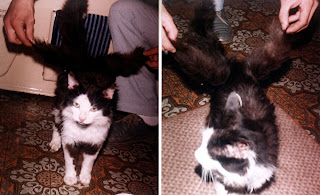
The Anglesey winged cat (Wyn Williams)

Yet despite the relative abundance of winged cat reports and photos, any explanation for these extraordinary animals remained conspicuous only by its absence, until in the early 1990s I uncovered the long-awaited answer while researching for clues in various obscure tracts of veterinary literature. I discovered that true winged cats (as opposed to ones whose wings are merely clumps of matted fur) exhibit a rare, little-known genetic disorder known as feline cutaneous asthenia (FCA), in which the skin is extremely stretchable, especially on the back, haunches, and shoulders – so much so that even if a cat with FCA merely rubs itself against something, or grooms itself with its paws, this can be enough to stretch its skin outwards in long, furry, wing-like extensions. And because these extensions often contain muscle fibres, they can sometimes even be gently raised or lowered, exactly as reported by certain winged cat eyewitnesses. Moreover, because the skin of FCA cats is so fragile, occasionally the wings are stretched out too far, and they will then simply peel away from the rest of the cat’s skin, falling off as if moulted and without any bleeding occurring, which would therefore explain Thomas-Mitzi’s dramatic loss of wings in the courtroom. After countless years of baffling their startled observers, the mystery of the winged cats was finally solved.


Some of the above accounts are excerpted or adapted from those that I wrote for Chambers Dictionary of the Unexplained (2009). For additional information concerning all of the mystery cats documented here, and many others too, don't miss my latest book, Cats of Magic, Mythology, and Mystery (CFZ Press: Bideford, 2012).