Dr KARL SHUKER

Zoologist, media consultant, and science writer, Dr Karl Shuker is also one of the best known cryptozoologists in the world. He is the author of such seminal works as Mystery Cats of the World (1989), The Lost Ark: New and Rediscovered Animals of the 20th Century (1993; greatly expanded in 2012 as The Encyclopaedia of New and Rediscovered Animals), Dragons: A Natural History (1995), In Search of Prehistoric Survivors (1995), The Unexplained (1996), From Flying Toads To Snakes With Wings (1997), Mysteries of Planet Earth (1999), The Hidden Powers of Animals (2001), The Beasts That Hide From Man (2003), Extraordinary Animals Revisited (2007), Dr Shuker's Casebook (2008), Karl Shuker's Alien Zoo: From the Pages of Fortean Times (2010), Cats of Magic, Mythology, and Mystery (2012), Mirabilis: A Carnival of Cryptozoology and Unnatural History (2013), Dragons in Zoology, Cryptozoology, and Culture (2013), The Menagerie of Marvels (2014), A Manifestation of Monsters (2015), Here's Nessie! (2016), and what is widely considered to be his cryptozoological magnum opus, Still In Search Of Prehistoric Survivors (2016) - plus, very excitingly, his four long-awaited, much-requested ShukerNature blog books (2019-2024).

Dr Karl Shuker's Official Website - http://www.karlshuker.com/index.htm

IMPORTANT: To view a complete, regularly-updated listing of my ShukerNature blog's articles (each one instantly clickable), please click HERE!

IMPORTANT: To view a complete, regularly-updated listing of my published books (each one instantly clickable), please click HERE!

IMPORTANT: To view a complete, regularly-updated listing of my Eclectarium blog's articles (each one instantly clickable), please click HERE!

IMPORTANT: To view a complete, regularly-updated listing of my Starsteeds blog's poetry and other lyrical writings (each one instantly clickable), please click HERE!

IMPORTANT: To view a complete, regularly-updated listing of my Shuker In MovieLand blog's articles (each one instantly clickable), please click HERE!

IMPORTANT: To view a complete, regularly-updated listing of my RebelBikerDude's AI Biker Art blog's thematic text & picture galleries (each one instantly clickable), please click HERE!

Search This Blog


PLEASE COME IN, I'VE BEEN EXPECTING YOU...

PLEASE COME IN, I'VE BEEN EXPECTING YOU...
WELCOME TO SHUKERNATURE - ENJOY YOUR VISIT - BEWARE OF THE RAPTOR!


Showing posts with label australia. Show all posts

Wednesday, 4 January 2023

STREWTH! IS STRUTHIO THE AUSSIE SPINIFEX MAN?

 
Vintage illustration from 1792 of a male specimen of Struthio camelus, the African ostrich – but is this species alive and well and living in Australia too? (public domain)

During summer 1970, dingo hunter Peter Muir found and photographed some strange two-toed tracks in the spinifex (a spiny-seed grass) desert area near Laverton, Western Australia. Local aboriginals claimed that they were from an ogre-like monster – the tjangara or spinifex man.

 
Emu (© Donald Hobern/Wikipedia CC BY 2.0 licence)

Scientists initially assumed that these were merely tracks of the common Australian emu Dromaius novaehollandiae, but swiftly retracted this view – because emus leave three-toed versions. Only one known creature produces two-toed tracks like those at Laverton – Struthio camelus, the African ostrich!

 
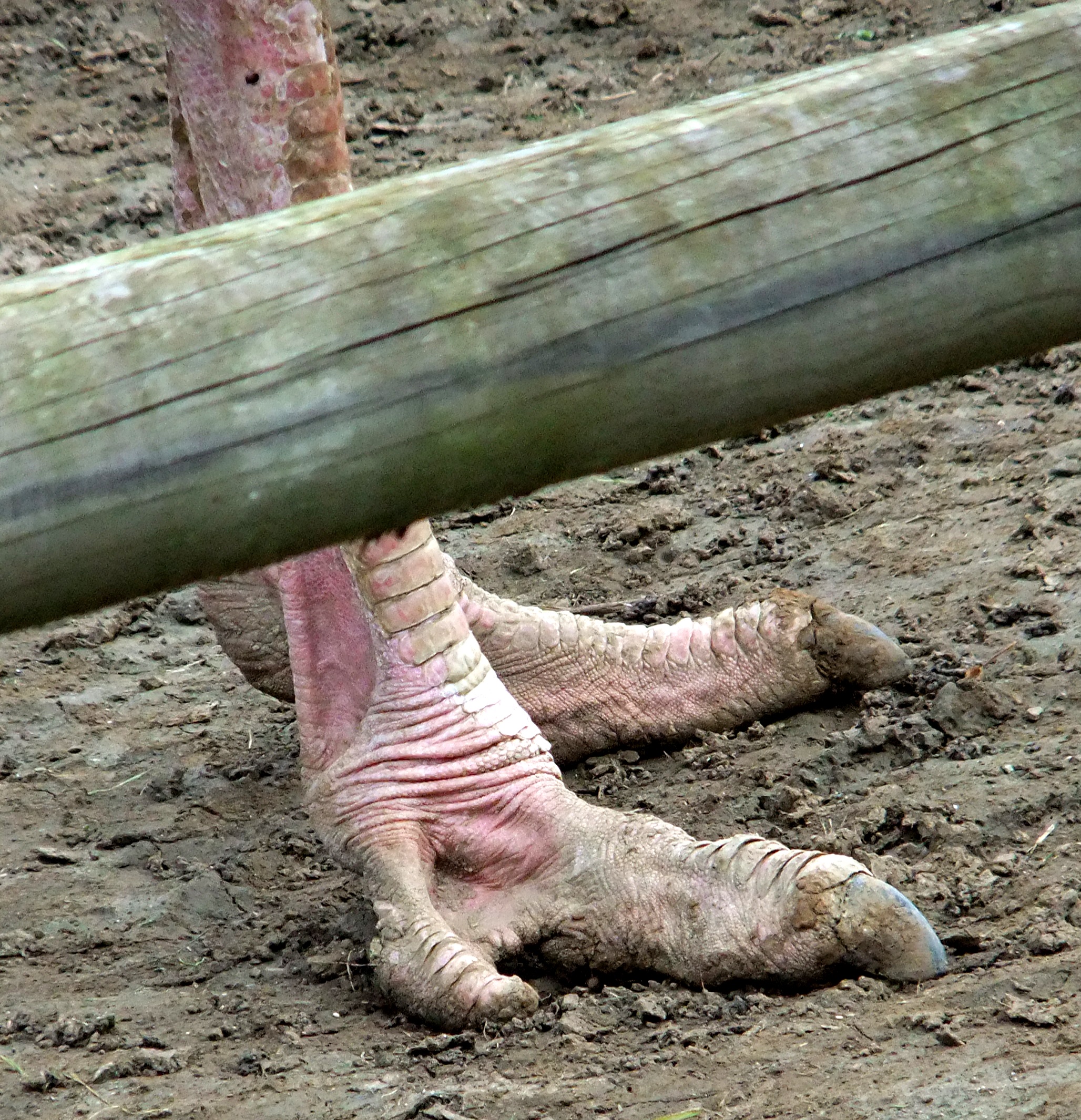
Close-up of ostrich foot showing its fundamentally two-toed format – its very small third toe is too short to leave any noticeable impression in footprints (© Dr Karl Shuker)

Yet the concept of ostriches living wild in Australia is by no means ludicrous – far from it. Small populations of feral (run-wild) ostriches still persist north of Adelaide, South Australia, for instance, descended from specimens released by ostrich farmers after World War I, when the feather market collapsed.

 
Ostriches were formerly maintained in captivity on Australian farms for their once highly-valued plumes (© Dr Karl Shuker)

As the ostrich is a desert-hardy bird that can travel great distances in short periods of time, in 1971 veteran American zoologist and cryptozoologist Ivan T. Sanderson suggested in a short Pursuit article that some ex-farm specimens may not only have survived and bred but also have discreetly extended their range across the intervening desertlands into Western Australia, and thence to Laverton.  (Incidentally, it is known that ostriches were released in Western Australia before 1912, but these 'officially' died out without establishing a population.)

 
Female ostrich (© Dr Karl Shuker)

This would offer a plausible explanation for the mystery of the two-toed tracks and their unseen originator(s) – aptly dubbed by Australian wags 'the abominable spinifex man'. Indeed, if the Laverton environs were not so sparsely populated, the existence of ostriches there may have been confirmed by now.

 
Vintage curio photograph of an ostrich-drawn cart (public domain)

This ShukerNature article is excerpted from my book The Beasts That Hide From Man (2003).


Monday, 1 May 2017

THE YARA-MA-YHA-WHO

The yara-ma-yha-who (© Andy Paciorek)

Also known as the yaroma, the yara-ma-yha-who is one of Australia's most feared supernatural entities, but it may also have a basis in reality, at least according to veteran cryptozoologist Dr Bernard Heuvelmans. For he speculated in his classic tome On the Track of Unknown Animals (1958) that perhaps it was inspired by ancient memories of southeast Asian tarsiers, those small but exclusively carnivorous, nocturnal primates with gargantuan orbs for eyes and weird superficially sucker-like finger-tips and toe-tips.

Heuvelmans deemed it possible that their unearthly, goblinesque appearance may have sufficiently impressed itself upon the native peoples whose descendants subsequently travelled to and settled in Australia, giving rise there to the aboriginal nations, for their collective memories, passed down from generation to generation Down Under, to have preserved a still-lingering version of it, distorted and embellished with lurid imaginings, ultimately yielding the nightmarish yara-ma-yha-who.

Whatever the explanation for it, however, the yara-ma-yha-who is truly terrifying, not only in appearance but also in activity, as now revealed here in my retelling of its traditional grisly behaviour upon encountering an unfortunate human.

Did ancient memories of tarsiers inspire native aboriginal belief in the yara-ma-yha-who? (© LDC, Inc Foundation/Wikipedia – CC BY-SA 3.0 licence; © Pierre Fidenci/Wikipedia – CC BY-SA 2.5 licence)

Creatures of shadow come in many forms, but few are not only more monstrous in physical form but also more hideous in predatory behaviour than the horrific yara-ma-yha-who of the Australian bush, which is active during the daylight hours but lurks hidden in tall fig trees amid the concealing darkness encompassed by their burly overlapping branches. Here it sits, waiting…

Twilight had not yet fallen as the hunter walked down a long tree-fringed path leading towards his settlement just beyond the forest’s perimeter. Peering fearfully all around, he inwardly cursed himself for not having waited until the sun had set in the sky before journeying through this ill-omened place. For his people’s ancient lore warned of the terrors that dark, lonely locales concealed within their black hearts even during the span of daytime.

Shafts of sunlight filtered through the roof-like canopy of interspersed branches overhead, lighting the gloom below – and revealing a fairly large creature squatting on a sturdy branch just ahead. A koala, perhaps, or even a tree kangaroo? Gripping his spear, he moved closer, as the sunlight slowly transformed the entity from a featureless silhouette into a furry being that seemed to have scarlet skin.

Surely, though, reasoned the hunter, this abnormal hue was due merely to the fiery rays of the soon-to-be-setting sun falling upon it? He fervently hoped so, because the alternative was too terrifying even to contemplate. Fortunately, the creature was sitting with its back to him, so if he could just walk by softly, without attracting its attention, all would be well.

Unfortunately, his foot trod heavily upon a dry, shed twig, which snapped loudly in the evening stillness. Immediately, the creature turned, and as the hunter gazed up into that hideous visage, he knew without hesitation that it was already too late. Just as he had dreaded, what he had encountered was neither koala nor tree kangaroo but was, instead, a yara-ma-yha-who!

(Public domain/Pete Linforth)

The eyes of this fiendish entity were enormous – twin globes of glowing evil that almost filled its entire face within its disproportionately large head. And as its hands stretched towards him, the doomed hunter observed with skin-crawling fascination that each of its long spindly fingers and toes bore a large flat sucker at its tip. Instantly, the yara-ma-yha-who leaped down upon the terrified hunter, knocking him onto the floor, its suckers pressed against his quivering body. And as he lay there, with this foul vampyric beast upon his chest, he could feel each sucker drawing blood from his body, draining him of his life-force.

That alone would have been more than enough horror to withstand, but the hunter knew from his people’s lore that there was even worse to come – much, much worse. Suddenly, when finally satiated with blood, the yara-ma-yha-who opened its wide toothless mouth - and, just like a snake, dislocated its jaws, so that its gaping maw now resembled an immense black cavern. Then, leaning forward, in a single enormous gulp it swallowed whole the hapless hunter, weak and paralysed with fear, but still living.

After executing a macabre dance designed solely to facilitate the movement of its engulfed human victim down its gullet into its distended stomach, the yara-ma-yha-who squatted back down...and waited. After a while, it opened its gigantic mouth again, and vomited forth its prey. Although hideously disfigured by the creature’s highly corrosive gastric juices, the hunter, incredibly, remained alive, but was somewhat smaller in size. When the yara-ma-yha-who saw this, it promptly swallowed him once more, then performed its bizarre dance of digestion.

This grotesque sequence of events was repeated several times, until finally, when vomited up yet again, the hunter, barely living but still breathing, was no bigger than the yara-ma-yha-who, and totally unrecognisable. When it inspected him this time, the yara-ma-yha-who seemed satisfied, and in an instant it had gone, leaping into a nearby tree – to await another victim.

What had formerly been the hunter, meanwhile, lay there on the ground as it gradually revived, its furry skin burnt scarlet from the yara-ma-yha-who’s metabolic acid. Then it raised itself up onto its haunches, its huge eyes blinking in the darkness, its suckered fingers twitching as if electrified. Soon, just like its creator, it would leap into a tree, to watch, and wait – a new yara-ma-yha-who, hungry for human blood and life-force, having already forgotten that it too had once been human.


This ShukerNature blog article is exclusively excerpted from Creatures of Shadow and Night, a book-in-progress written by me in which I retell the legends associated with a global range of supernatural entities of darkness, and complemented throughout by spectacular full-colour illustrations specially prepared by highly-acclaimed graphics artist Andy Paciorek.


Thursday, 26 February 2009

FRILLED LIZARD FACTOID


On Friday, I posted this picture of an Australian frilled lizard and wrote that the frill is used in territorial and sexual displays and is supported by long spines of cartilage. When the lizard is frightened, it gapes its mouth, showing a bright pink or yellow lining, and the frill flares out, displaying bright orange and red scales. The frill may also aid in thermoregulation.

But I also asked: What other use, allegedly, is the frill used for?

Here is an excerpt from my book Extraordinary Animals Revisited (CFZ Press: Bideford, 2008):


"Not long after the publication of this book’s original edition [Extraordinary Animals Worldwide, 1991], I learnt of an additional, equally controversial glider – none other than Australia’s famous frilled lizard Chlamydosaurus kingii. [...] It is renowned for the extraordinary crenated frill around its head and neck, which it expands if threatened, in order to startle and ward off any would-be attacker. However, some writers contend that it also utilizes its frill for volplaning, enabling it to glide from tree to tree.

"In his book Bunyips and Billabongs (1933), Australian scientist Dr Charles Fenner included a remarkable statement made by Queensland naturalist Mrs Adam Black concerning this distinctive reptile:

"...a pair lived outside our garden fence for years. They would run up a tree if one approached, and I’ve often seen my husband put his hand round the tree (they always climb up the opposite side to where you are) and catch one’s tail; he would then hold it and go round and stroke the lizard’s back and frill. If really alarmed when up a tree they extend their gaily-coloured frill and glide down to the root of another tree.

"Sadly, Black gave no description of the volpaning itself. I can only assume that if it does occur, the frill must act like a parachute, opening out, thence enabling the lizard to drift passively downwards.

"Summing up, Fenner stated:

"I believe that Mrs Black and other observers have produced convincing evidence that we have an Australian “flying lizard”. It is to be hoped that some zoologist will take steps to observe these volplane flights of Chlamydosaurus.

"Unfortunately, this does not seem to have happened, so for now, this intriguing subject is very much up in the air. Whether the same can be said of the frilled lizard itself, therefore, remains to be seen - literally!"

JUST FOR FUN - A FRILLED LIZARD CONUNDRUM

This is, of course, the Australian frilled lizard Chlamydosaurus kingii, so called because of the large ruff of skin that usually lies folded back against its head and neck.

The frill is used in territorial and sexual displays, and is supported by long spines of cartilage. When the lizard is frightened, it gapes its mouth, showing a bright pink or yellow lining, and the frill flares out, displaying bright orange and red scales. The frill may also aid in thermoregulation.

Now, here's a question for you. What other use, allegedly, is the frill used for? If you want to make a guess, please post your ideas here, and I'll give the answer on Sunday...

Have a great weekend!