Are there living pterosaurs in Zambia's swamplands?
Those iconic winged
reptiles of prehistory known as the pterosaurs died out alongside the last
dinosaurs over 60 million years ago…didn’t they? Most mainstream zoologists
would say that they did. Then again, most mainstream zoologists have probably
never heard of the kongamato, the ropen, the duah, or a veritable phalanx of
other winged mystery beasts reported from around the world that bear a
disconcerting resemblance to those supposedly long-vanished rulers of the
ancient skies. Could these cryptozoological creatures possibly be surviving
pterosaurs? Read their histories here, and judge for yourself.
THE
KONGAMATO – AN AFRICAN ANOMALY
The Jiundu marshes of western
Zambia’s Mwinilunga District
comprise a huge but remote expanse of densely-foliaged, forbidding,
near-impenetrable swampland rarely visited even by the native people, let alone
Westerners. This is due in no small way to the persistent local belief that
this foetid morass is home to a frightening horror of a creature whose very
name strikes terror among the neighbouring populace – the kongamato. It first
attracted popular attention in 1923, when documented in traveller Frank H.
Melland’s book In Witchbound Africa. Discussing it with the local Kaondé
people, Melland learnt that this greatly-feared entity allegedly resembles a
reddish-coloured lizard with membranous bat-like wings measuring 1-2 m across,
a long beak crammed with teeth, and no fur or feathers on its body, just bare
skin. When shown books filled with pictures of animals living and extinct,
every native present immediately selected pictures of pterosaurs and identified
them as representations of the kongamato. And indeed, there is no doubt that
the above description of a kongamato bears a startling similarity to that of
certain early, medium-sized pterosaurs known as rhamphorhynchoids, typified by
their toothy beaks, as well as their long tails (the later pterodactyloids
lacked teeth and tails). Nor were reports of such an animal limited to Zambia (then Northern Rhodesia).

Kongamatos
attacking boats (William Rebsamen)
At much the same time,
accounts of an identical mystery beast were also emanating from a comparably
dense, inhospitable swamp in Southern Rhodesia (now Zimbabwe), and during the
1940s game warden Captain Charles R.S. Pitman referred to the reputed existence
of a pterodactyl-like creature amid swamp forests near the border of Angola and
the Belgian Congo (now the Democratic Congo). So-called flying dragons were
even mentioned by celebrated South African ichthyologist Prof. J.L.B. Smith –
immortalised as the co-discoverer of another prehistoric survivor, the
lobe-finned coelacanth fish back in 1938. In his book Old Fourlegs
(documenting the coelacanth’s discovery), he noted that the descendants of a
missionary who had lived near Mount Kilimanjaro in East Africa had long heard reports
and claimed sightings of such beasts from the local people. Prof. Smith was
even bold enough to state: “I did not and do not dispute at least the
possibility that some such creature may still exist” – and, as someone who had
recently resurrected another prehistoric lineage from many millions of
‘official’ extinction, his opinion could not be readily discounted.

My Pan paperback
first edition of Old Fourlegs (Pan Books)
During the 1950s, there
was much correspondence in Rhodesian newspapers on the subject of living
pterosaurs, in which several zoologists, but most notably Dr Reay Smithers –
director of Southern Rhodesia’s National Museum – attempted to dismiss such a
notion by offering various modern-day candidates as the identity of these
winged wonders. The most popular one was the shoebill Balaeniceps rex - a
large superficially stork-like bird with an enormous beak, and a very
impressive wingspan, which can indeed appear deceptively prehistoric when seen
in flight, especially by someone not familiar with this unusual species.
However, also on file are reports of natives claiming to have been attacked and
severely wounded by the kongamato when it has stabbed them with its long beak -
something that the shy shoebill, whose beak is in any case the wrong shape to
accomplish such a deed, is unlikely to do.
The
shoebill (Wikipedia)
In one instance from the
1920s, a native boldly decided to penetrate a vast Southern Rhodesian swamp
traditionally deemed by his tribe to be the abode of demons, from which no-one
who entered it ever returned alive, and see for himself just what did inhabit
this accursed realm. Happily, he did return alive – but only just, having been
badly injured, resulting in a major chest wound. When a civil servant for the
region asked him what had happened, the native told him that he had encountered
a huge bird of a type that he had never seen before, with a long sharp beak.
Shown a book of animal pictures, he flicked through it in a desultory manner –
until he came to an illustration of a pterodactyl, whereupon he let out a
terrified shriek and ran out of the civil servant’s house. A comparable
incident was reported from Zambia’s Lake Bangweulu swamps during the
1950s, and when the wounded native, who was taken to a Fort Rosebery hospital, was given some
paper and a crayon to sketch the creature that had attacked him, the result was
a silhouette that corresponded precisely with that of a pterodactyl.
Moreover, at much the
same time, while working in the Zambezi Valley, Daily Telegraph
correspondent Ian Colvin not only saw but actually photographed what was later
claimed by one observer to be a pterodactyl. Zoologists disagreed, some stating
that it was a shoebill, others a saddle-backed stork Ephippiorhynchus
senegalensis – a tall bird with a very long beak that could certainly cause
the kind of chest injuries noted above but which bears no resemblance to a
pterosaur (or, incidentally, to a shoebill). Nor can a mammalian identity, such
as a bat or gliding rodent, provide a convincing answer.
Saddle-billed
stork (hyper7pro/Flickr/Wikipedia)
Attempts have also been
made to explain away native beliefs in pterosaurian monsters as the result of
cross-cultural contamination – their beliefs influenced by the discovery in
those African regions of pterosaur fossils. However, cryptozoological
researches have shown that such beliefs considerably predate any palaeontological
discoveries made there.
Today, Africa’s
neo-pterosaurs have been largely forgotten in the wake of other, newer
cryptozoological stars, but the Jiundu swamps and similar ‘monster-haunted’
terrain still exist, awaiting exploration by anyone enthusiastic, and brave,
enough to venture into their shadowy realms in search of their mysterious,
potentially deadly inhabitants.
WINGING
ACROSS THE AMERICAS
Amazing as it may seem,
some of the most compellingly pterosaurian mystery beasts on record have been
reported not from the remote wildernesses of tropical Africa but from the
supposedly well-explored heartlands of North America, with Texas as the
epicentre of such sightings.
Perhaps the single most
dramatic modern-day pterosaur report from the New World is that of ambulance
technician James Thompson, who was driving along Highway 100 to Harlingen,
midway between Raymondville and Brownsville (two Texas towns that had both
previously hosted pterosaur reports), on 14 September 1983 when an
extraordinary creature flew across the road about 50 m ahead of him with
distinct flapping wingbeats. He was so amazed by what he had seen that he
stopped his ambulance and got out to get a better look at it. In his subsequent
description, Thompson stated that the creature was 2.5-3-m long, with a thin
body and a long tail that ended in a fin, a wingspan at least equal to the
ambulance’s width (roughly 2 m), a virtually non-existent neck, but a hump on
the back of its head, a pouch-like structure close to its throat, and a rough,
featherless, blackish-grey skin
Attempts by others to
identify what Thompson had seen with mainstream identities such as a pelican
(suggested by its throat pouch but not explaining its tail fin or lack of
feathers) and even an ultralight aircraft (since when have these been able to
flap their wings?!) failed miserably. The only creature living or extinct that
resembles it is a rhamphorhynchoid pterosaur, known to have possessed a long
tail terminating in a fin.
Modern-day
reconstruction of a rhamphorhynchoid pterosaur (public domain)
A remarkably similar
beast was sighted during much the same time period, flying roughly 40 m away at
a height of about 16 m off the ground, by Richard Guzman and a friend, Rudy,
one early evening in Houston. A sketch produced by Guzman appears in Ken
Gerhard’s book Big Bird! (2007), and depicts an indisputably
pterosaurian entity – complete with a prominent bony head crest and a long
finned tail (crests are traditionally a pterodactyloid characteristic, but at
least two fossil rhamphorhynchoids are now known to have been crested too).
Ken
Gerhard (CFZ)
In his book, Ken notes
how, after interviewing Guzman personally (on 9 October 2003), he then read out
loud from his copy of my own book In Search of Prehistoric Survivors (1995) my documentation of
Thompson’s sighting to an enthralled Guzman who, inexplicably, had not seen my
book before (what?!!), and had not previously known about Thompson’s encounter.
Another notable Texan
sighting had taken place back on 24 February 1976, when three school teachers
driving along a lonely road southwest of San Antonio saw a huge shadow fall
across the road, and when they looked up were shocked to spy a monstrous flying
creature soaring overhead with a wingspan estimated by them to be 5-6 m. Its
body was encased in a grey skin and its wings were membranous, seeming to them
to be distinctly bat-like. They were unable to name what they had seen until,
after perusing several encyclopedias, they finally came upon a creature that
resembled it – America’s giant Cretaceous pterosaur, Pteranodon.
Reconstruction
of Pteranodon in flight (Dr Karl Shuker)
Perhaps the most
controversial case involving a reputed modern-day American pterosaur was
supposedly reported by the Tombstone Epitaph newspaper on 26 April 1890,
six days after the event in question had occurred. Two ranchers riding through
the Huachuca desert not far from Tombstone had allegedly encountered a gigantic
monster stranded on the ground and flapping its leathery featherless wings
frantically as it attempted to become airborne. With a gargantuan total length
of 30 m and a colossal wingspan of around 50 m, not to mention a massive beak
filled with teeth, this terrifying entity petrified the ranchers – until, that
is, they opened fire with their Winchester rifles, killing it outright. To
confirm their story, they cut off one of the creature’s wingtips and took it
back home with them, but what became of it is a mystery – just like the story
itself, because no-one has so far succeeded in tracing the elusive newspaper
report describing it.
However, in 1969, an
elderly man called Harry McClure read about this alleged incident in a
magazine, and announced that he had actually known the ranchers in question as
a young man, and remembered the incident well. Even so, he claimed that it had
been greatly exaggerated, stating that the beast had ‘only’ been 6.5-9 m long,
possessed a single pair of sturdy legs and very large eyes, and had twice tried
to become airborne before being shot at (but not killed) by the ranchers, who
finally abandoned it, still attempting to take flight.
This
representation of an alleged desert-stranded Tombstone pterosaur
is more like a winged crocodile! (Orbis Publishing)
Pterosaur reports have
also emerged from Mexico, and from South America. The late J. Richard
Greenwell, onetime secretary of the International Society of Cryptozoology, had
a Mexican correspondent who claimed that there are living pterosaurs in Mexico's
eastern portion and was (still is?) determined to capture one, to prove beyond
any shadow of doubt that they do exist. Worthy of note is that certain
depictions of deities, demons, and strange beasts from ancient Mexican
mythology are decidedly pterodactylian in appearance. One particularly
intriguing example is the mysterious 'serpent-bird' portrayed in relief
sculpture amid the Mayan ruins of Tajin, in Veracruz's northeastern portion -
noted in 1968 by visiting Mexican archaeologist Dr José Diaz-Bolio, and dating
from a mere 1000-5000 years ago. Yet all pterosaurs had officially become
extinct at least 64 million years ago. So how do we explain the Mayan
serpent-bird - a non-existent, imaginary beast, or a creature lingering long
after its formal date of demise? Although neither solution would be
unprecedented, only one is correct - but which one?
Around February 1947, J.A.
Harrison from Liverpool was on a boat navigating an estuary of the Amazon river
when he and some others aboard spied a flock of five huge birds flying overhead
in V-formation, with long necks and beaks, and each with a wingspan of about 3.75
m. According to Harrison, however, their wings resembled brown leather and
appeared to be featherless. As they soared down the river, he could see that
their heads were flat on top, and the wings seemed to be ribbed. Judging from
the sketch that he prepared, however, they bore little resemblance to
pterosaurs, and were far more reminiscent of a large stork - three of which,
the jabiru Jabiru mycteria, maguari Ciconia maguari, and wood
ibis (aka wood stork) Mycteria americana, are native here.
Wood ibis
in flight (Dennis Hawkins/Wikipedia)
In any case, it is North
America, which was once home to such prehistoric giant versions as Pteranodon
and Quetzalcoatlus, where most alleged pterosaur sightings have been
claimed within the New World, leading some cryptozoologists to speculate
whether these latter forms have undiscovered descendants existing here. It
seems exceedingly unlikely, but the sightings remain on file to tantalise and
bemuse, with conservative identities such as pelicans and condors failing to
match eyewitnesses’ descriptions.
Having said that: one
early evening in 2007, I was standing at the top of Sugarloaf Mountain in Rio
de Janeiro, Brazil, when, looking upwards, I was startled to see a number of
superficially pterosaurian creatures circling high above in the sky overhead.
Raising my trusty birdwatching binoculars to my eyes, however, swiftly
dispersed the illusion, as these putative prehistoric survivors were instantly
exposed as frigate birds (specifically the magnificent frigate bird Fregata
magnificens).
Magnificent
frigate birds in flight (David Adam Kess/Wikipedia)
These long, angular-winged
relatives of pelicans do appear positively primeval on first sight, and might
well deceive ornithologically-untrained eyes into believing that they had truly
witnessed a phalanx of flying reptiles from the ancient past.
NOT IN NEW ZEALAND,
SURELY…?
New Zealand, a land of
many indigenous birds but few reptiles and even fewer mammals, is surely the
last place one might expect to encounter any kind of 20th-Century
pterosaur, let alone a multicoloured one. Nevertheless, according to Whangarei
resident Phyllis Hall, some time prior to the early 1980s she had been walking
along a new motorway, not yet opened to traffic, when a strange creature that
looked to her like a pterodactyl flew “out of nowhere”. Its under-wings were
blue, but the rest of it was red, and it flew with an undulating motion. This
description does not fit anything known to exist anywhere in New Zealand.
A
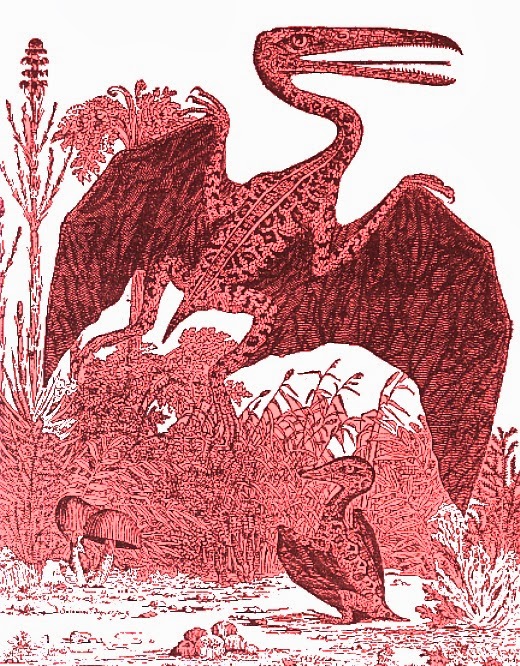
delightful late 1800s/early 1900s illustration of pterodactyls (Heinrich
Harder)
CRYPTO-CRETE
Greek mythology tells of many winged monsters, including the harpies and
the Stymphalian birds, but I don’t recall any mention of pterodactyls.
Nevertheless, Crete was the setting for the appearance of just such a creature,
it would seem, when, one morning in summer 1986, three young hikers passing by
a river in the Asterousia Mountains saw a bizarre creature flying overhead.
They described it as resembling a giant dark-grey bird but with bat-like wings
that sported finger-like projections at their tips, long sharp talons, and a
pelicanesque beak. It reminded all three of them of a pterodactyl (though it is
true that boys do tend to be more clued-up regarding dinosaurs and other
prehistoric monsters than birds), and certainly their description sounds more
pterosaurian than avian. Conversely, it hardly need be said that a colony of
modern-day pterosaurs on Crete would surely have been uncovered by science long
ago.
NEWS FROM NEW GUINEA
The most recent
pterosaur-lookalike to attract attention is not one mystery beast but two. During
the late 1990s, stories of a gigantic luminous pterodactylian creature termed
the ropen emerged from missionaries based in Papua New Guinea. With a 6-7-m
wingspan, a Pteranodon-like bony crest on its head, and a glowing
underside (highly-reflective scales?), it had been seen circling over a lake,
and resting in a mountain cave.
Could
highly-reflective scales explain reports of glowing pterodactylian cryptids in Papua
New Guinea? (Tim
Morris)
However, when field
cryptozoologist Bill Gibbons later contacted me with full details, he revealed
that this beast was actually known as the duah, and that a second, much smaller
mystery pterosaur was the true ropen, which was found only on two small
offshore New Guinea islands – Rambutyo and
Umboi. Sporting a 1-m wingspan, a slender tail tipped with a diamond-shaped
fin, and a long beak brimming with teeth, this ropen seems much closer in
appearance to the rhamphorhynchoids. It is said to inhabit caves, but is
greatly attracted by the smell of rotting flesh – so much so that it has been known
to attack funeral gatherings – and will also snatch fish out of the boats of
native fishermen (a trait reported for the Zambian kongamato too).
The
ventrally-aglow duah (William Rebsamen)
Investigator Bruce Irwin
visited Papua New Guinea in summer 2001 and interviewed several native
eyewitnesses, who confirmed that back in the 1970s the duah had been much more
common and used to be seen flying together in small groups at night, but nowadays
only solitary specimens were observed. Visiting the nearby island of Umboi to
investigate ropen sightings there, Irwin interviewed a policeman and other
locals who had seen it, and on nearby Manaus Island he spoke to a school
headmaster who saw one in a tree on Goodenough Island, but he did not succeed
in doing so himself. Fellow investigator Jonathan Whitcomb also interviewed
eyewitnesses on Umboi, including some who claimed to have spotted a huge specimen
(a duah?) while hiking near Lake Pung as boys in or around 1994, - as revealed
in Jonathan’s book Searching For Ropens: Living Pterosaurs In Papua New
Guinea (2006), which is the first of several authored by him on the subject
of living pterosaurs there and elsewhere around the world.

Searching
For Ropens
There seems little doubt
that something very unusual, which cannot be readily dismissed as either a bird
or a mammal, is being seen in various far-flung regions of the world. Whether
it is truly a living pterosaur is another matter entirely. After all, there are
no pterosaur fossils on record from beyond the end of the Cretaceous Period, 64
million years ago. Then again, many modern-day reports come from areas such as
tropical forests where fossilisation is rare, or from inaccessible mountain
ranges where fossils have not been sought. Ultimately, only physical evidence
can confirm just what these winged wonders are, but in view of what happened to
the brave native investigator who sought one such creature amid Southern Rhodesia’s
nightmarish swamplands, only to re-emerge with a serious chest injury, such an
undertaking is clearly not for the fainthearted.
As veteran
cryptozoologist Dr Bernard Heuvelmans once wrote: “The trail of unknown animals
sometimes leads to Hell”.
Keeping my
distance from a life-sized, unnervingly animatronic Quetzalcoatlus (Dr
Karl Shuker)




 Posts
Posts