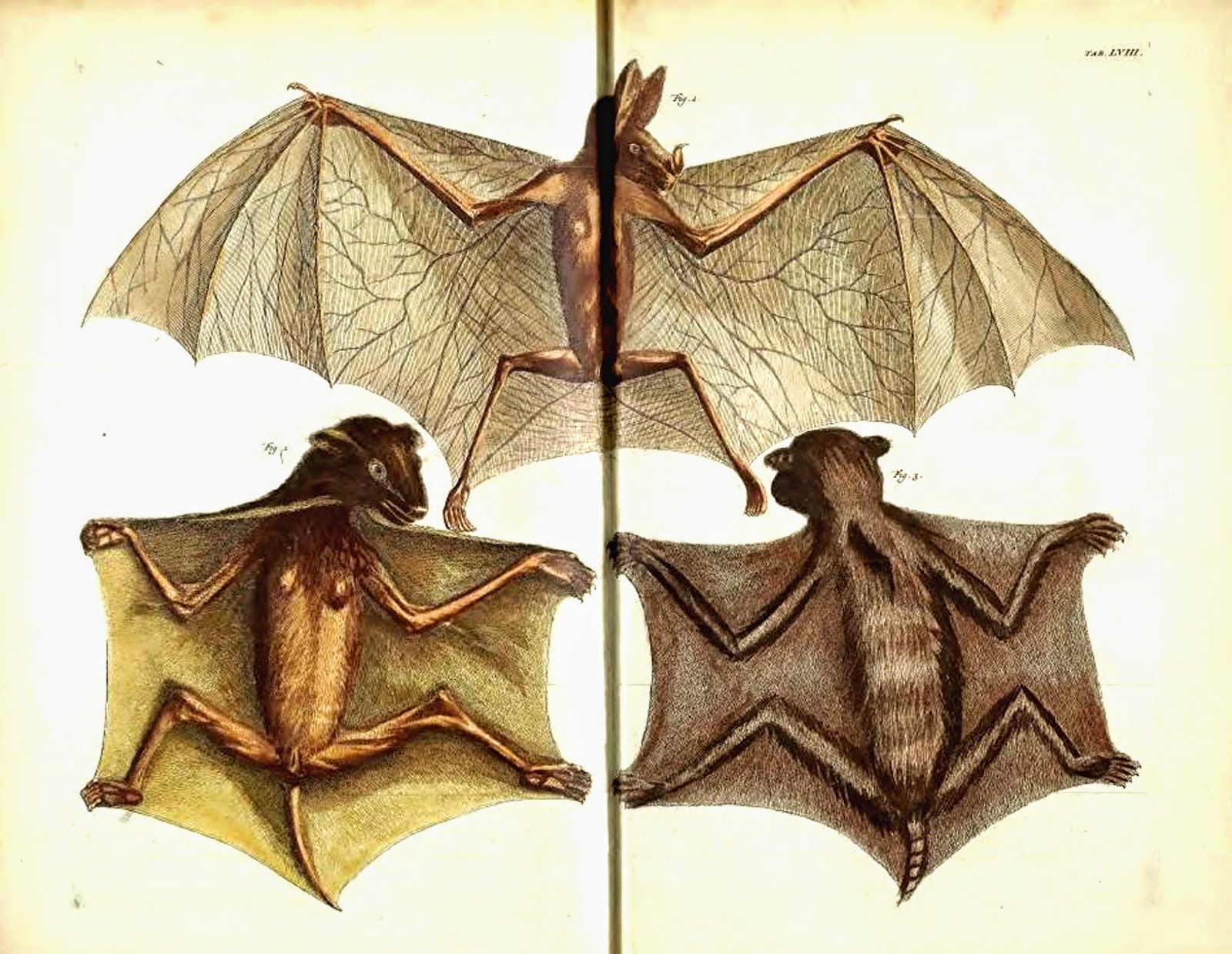
Ventral and dorsal view of a Philippines colugo, plus an American false
vampire bat (above), depicted in Plate 58 from the first volume of Albertus
Seba's Thesaurus (1734)
Colugos must surely be
among the most bizarre yet bewitching of all mammals. Native to the
tropical forests of southeast Asia, most famous for the extensive gliding
membrane (patagium) connecting their limbs, tail, and even the digits of their
paws, and as big as a medium-sized possum or very large squirrel, the two
modern-day species of colugo are the only surviving members of the mammalian
order Dermoptera.
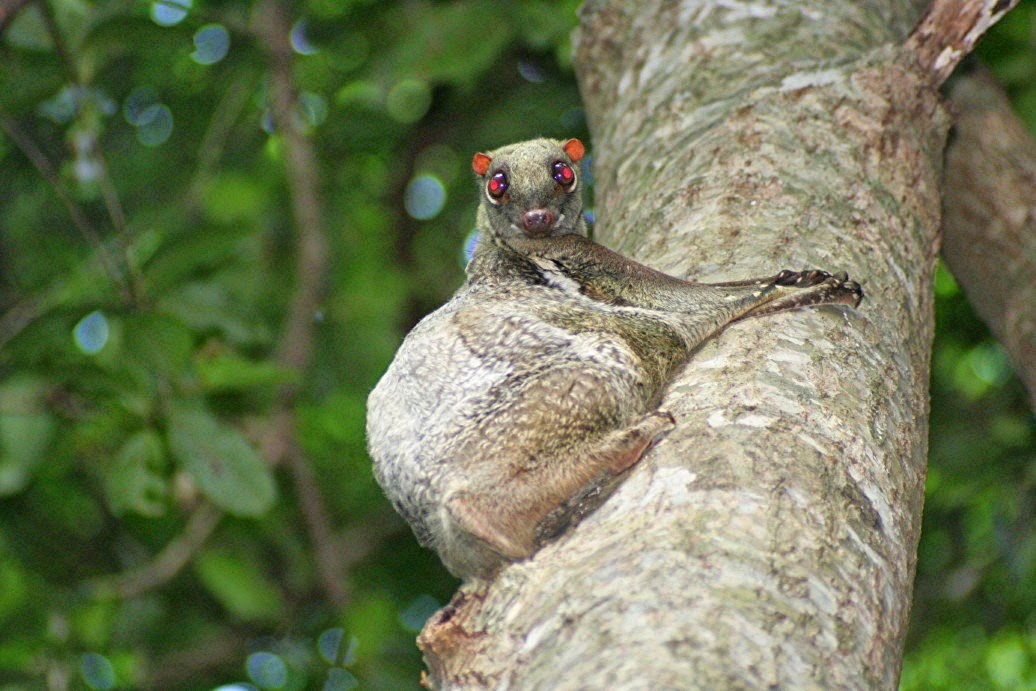
Photograph of a colugo at rest upon a tree trunk (public
domain)
The larger and more familiar of these two species is the Philippines colugo Cynocephalus
volans, which is endemic to this multi-island southeast Asian nation, and
measures up to 17 in long. The second, smaller, and less familiar species is the
Malayan or Sunda colugo Galeopterus variegatus, but this colugo has a
much wider distribution - occurring in Borneo, Java, Sumatra, Singapore, peninsular Malaysia, Cambodia, Vietnam, Thailand, and Laos.
Widely deemed from the findings of recent molecular phylogenetic
studies to be the primates' closest living relatives, these extraordinary yet
surprisingly little-known gliding mammals are also called caguans and cobegos,
as well as flying lemurs - even though they glide rather than fly and are not
lemurs!
Perhaps the most memorable description of a colugo that I've
ever read appears in Bill Garnett's book Oddbods! (1984):
"Imagine a floppy
shopping bag with an avocado sticking out sideways at the top; hang it by claws
beneath a branch; put a huge round eye on the avocado - and cover the lot in a
soft furry pelt, mottled fawn and grey. You've now got yourself a colugo."
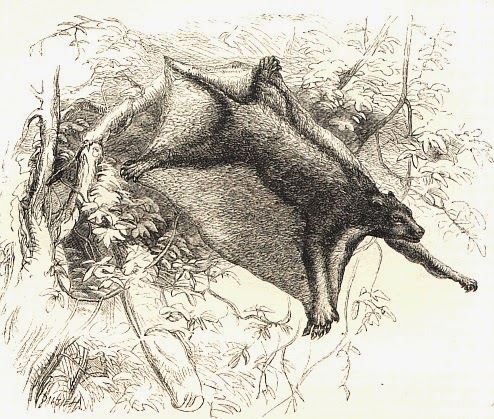
19th-Century engraving of a colugo gliding,
revealing its extensive patagium
But what on earth (or in the air!), I hear you ask, do colugos
have to do with flying cats? I'm very glad that you asked me that question!
Let me begin answering it by introducing the grotesque Asian bat-cat
depicted in the eminent Jesuit scholar Athanasius Kircher's tome China Monumentis (1667). Kircher claimed that such creatures (which he referred to as flying cats - 'Catti Volantes' - in his Latin text) existed in the forested mountains of India's Kashmir Province, but that upon closer examination they merely proved to be bats, albeit ones as big as (if not bigger than) chickens or geese.

Athanasius Kircher’s bat-cat engraving
Zoologically speaking, however, the animal in this weird illustration does not resemble a bat, not least because the membranes of its wings are much more extensive than those of bats. Instead, it may conceivably have been an early attempt to portray a colugo, because the bat-cat's wings are actually pictured as a membrane
extending from the forelegs to the hind legs and onto the tail, exactly
mirroring the gliding membrane of colugos. But it could well be that as someone not trained in zoology, Kircher might simply have considered colugos to be bats anyway
Moreover, a distorted, secondhand (or more) account of a colugo may explain traveller Marco Polo's curious mention of a still-unidentified beast from the Far East known as a cat-a-mountain. This was said to be a predatory cat with the body of a leopard but also with a strange skin that stretched out when it hunted, enabling it to fly in pursuit of its prey.
Moreover, a distorted, secondhand (or more) account of a colugo may explain traveller Marco Polo's curious mention of a still-unidentified beast from the Far East known as a cat-a-mountain. This was said to be a predatory cat with the body of a leopard but also with a strange skin that stretched out when it hunted, enabling it to fly in pursuit of its prey.

A somewhat aggressive-looking colugo in an early
engraving
A third potential case of cat-into-colugo reared its furry head
in the 1990s, because that was when I uncovered the following intriguing but (at
that time) previously-unpublicised report, entitled 'Flying Cat', which had
been published in the volume for 1868 of a long-forgotten British journal
entitled The Naturalist's Note Book:
"A nondescript animal, said to be a
flying cat, and called by the Bhells pauca billee, has just been shot by
Mr. Alexander Gibson, in the Punch Mehali [India]. The dried skin was exhibited
at the last meeting of the Bombay Asiatic Society. It measured 18 inches in
length, and was quite as broad when extended in the air. Mr. Gibson, who is
well known as a member of the Asiatic Society and a contributor to its journal,
believes the animal to be really a cat, and not a bat or a flying-fox [fruit
bat], as some contend."
As I pondered in various articles and later in my book Dr Shuker's Casebook (2008), could this extraordinary animal have been an early example of a
winged cat (click here for more info re
these bizarre yet totally bona fide felids, and here for a video of one such individual)? Or was it a large species of bat –
or even a colugo?
More than 145 years have now passed by since this strange
creature was reported in The Naturalist's Note Book, yet its taxonomic
identity remains unclear – or does it? In fact, thanks to a wonderful tome that
I acquired only very recently, I have finally solved the tenacious mystery of
Gibson's flying cat.

My copy of Taschen's spectacular compendium of the
illustration plates from Albertus Seba's Thesaurus (© Taschen)
Entitled Cabinet of Natural Curiosities and first published
by Taschen in 2001 (mine is a 2011 reprint of it), the spectacular book in
question that I purchased last month is a lavishly reproduced compendium of all
of the glorious illustration plates from the four-volume magnum opus of
Albertus Seba (1665-1736). An exceedingly wealthy Dutch businessman who was one
of the most celebrated collectors of natural history specimens ever, Seba had
amassed not one but two immense, internationally-renowned collections (click here to access a separate ShukerNature post
containing additional details concerning Seba and his collections), and his
four-volume tome, his Thesaurus as he entitled it, was basically a sumptuously-illustrated catalogue of his collections' numerous specimens,
containing more than 400 colour plates and published from 1734 to 1765.

Portrait of Albertus Seba, by
Jacobus Houbraken (1698-1780)
Taschen's compendium of Seba's Thesaurus plates does not
include any of his original accompanying text, which was written in both Latin and
French and described each specimen in detail, but it does contains a lengthy
introduction written by this compendium's German compilers. And it was tucked
within this where, with great excitement and delight, I came upon an ostensibly
inauspicious yet truly revelatory paragraph - a hitherto-cryptic nugget of
knowledge that finally and fully elucidated the longstanding enigma of the
flying cats. Contained within a section headed 'Curiosities and Special
Attractions in the Thesaurus', this crucial paragraph reads as follows:
"A particular
rarity in the Thesaurus are the so-called "Fliegende Katzen"
(flying cats) and "Fliegende Hunde" (flying dogs) from tropical
regions, although – contrary to what their names imply – they are not related
to feline or canine species. Flughund (lit. flying dog) nevertheless
remains the German designation for the fruit bat even today (in English it is
also called a flying fox). Amongst the animals which Seba describes as
"flying dogs" is a true fruit bat (Pteropus sp., I, 57, Figs.
1-2) and a tropical American false vampire bat (Vampyrum spectrum, I,
58, Fig. 1). Among the "flying cats" in the Thesaurus (I, 58,
Figs. 2-3) we find the giant flying lemur of the Philippines (Cynocephalus
volans), which together with another species forms a separate group of
mammals."
Plate 58 is the
illustration opening this present ShukerNature blog post, which does indeed
portray the American false vampire Vampyrum spectrum (which happens to
be the world's largest species of carnivorous bat) plus the ventral and dorsal
view of a Philippines colugo. Below
is the clearer version of this plate that appears in the Taschen compendium.

Ventral and dorsal view of a Philippines colugo, plus an American false
vampire bat (above), depicted in Plate 58 as reproduced within the Taschen compendium
of Albertus Seba's Thesaurus plates (© Taschen)
Spurred on by this vital insight, yesterday I tracked down and consulted
online a pdf of the original Seba's Thesaurus, which not only contained
the plates but also Seba's own descriptions of the specimens depicted in them. And
sure enough, the colugo was referred to by Seba in his descriptions as Felis
volans ('flying cat'), and the Chat qui volé ('cat that flies'), as revealed
here:

The colugo-relevant Latin and French text from the
original 1734 edition of Seba's Thesaurus, Vol. 1
So there it is – the mystery laid bare, a mystery no longer.
Asia's so-called flying cats were indeed colugos - or flying lemurs, as they are
still popularly referred to. Bearing in mind, however, that colugos have very
dog-like heads (as indeed have some lemurs, hence 'flying lemur' as a name
applied to colugos), it's something of a riddle how they ever came to be dubbed
'flying cats', but at least the suspected connection has now finally been
verified.
Only one mysterious aspect of this case remains unsolved. Colugos
are southeast Asian species; they are not native to anywhere in India - including the disputed Kashmir territory (remember Kircher's bat-cat?). Perhaps, therefore,
the Gibson 'flying cat' was not actually shot in India after all, but had merely
been preserved or exhibited there - with the claim that it had originally been
shot there too merely being a journalistic error. It certainly wouldn't be the
first time that an unusual animal has incited all manner of outlandish,
error-ridden reporting by poorly-informed or overly-imaginative hacks.
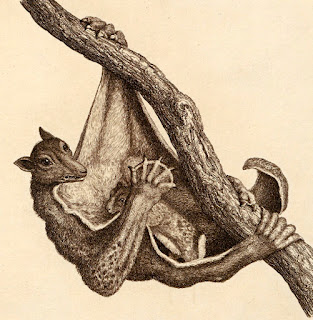

Pre-1880 illustration of a Philippines colugo with young
Far less likely, but by no means impossible, and certainly much
more intriguing, is the possibility that there were once (and maybe still are?) colugos belonging to one or other of the two known species– or perhaps
even to an entirely-distinct third colugo species – inhabiting regions of Asia such as India and Kashmir that fall outside their currently-confirmed modern-day distribution range, but have remained undiscovered and undescribed by science. Who knows – those erstwhile 'flying
cats' may still have the potential to surprise us after all.
And indeed: one further example of their ability to surprise, and even startle, can be seen with the following photograph (of seemingly unknown source), which has been circulating online for some considerable time and has stimulated all manner of astonishment and controversy among many people who have encountered it:
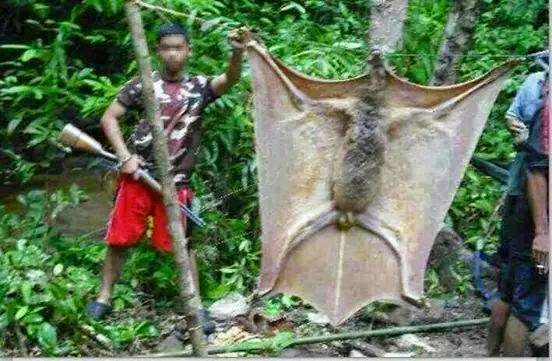
Claims concerning the supposed mystery beast depicted in it include allegations that it is a gigantic bat, or even a still-undiscovered flying monster. In reality, it is neither. Instead, as I confirmed as far back as 5 October 2012 when consulted about it by fellow cryptozoologist Loren Coleman for a Cryptomundo article (click here), it is merely a Philippines colugo, held much closer to the camera than the men beside it, so that it appears much larger than it actually is - a familiar optical illusion known as forced perspective. End of mystery, and monster.
And indeed: one further example of their ability to surprise, and even startle, can be seen with the following photograph (of seemingly unknown source), which has been circulating online for some considerable time and has stimulated all manner of astonishment and controversy among many people who have encountered it:
Claims concerning the supposed mystery beast depicted in it include allegations that it is a gigantic bat, or even a still-undiscovered flying monster. In reality, it is neither. Instead, as I confirmed as far back as 5 October 2012 when consulted about it by fellow cryptozoologist Loren Coleman for a Cryptomundo article (click here), it is merely a Philippines colugo, held much closer to the camera than the men beside it, so that it appears much larger than it actually is - a familiar optical illusion known as forced perspective. End of mystery, and monster.

19th-Century engraving of a
Philippines colugo


 Posts
Posts