Reconstruction of the makalala's
possible appearance in life (© Markus Bühler)
Here's something suitable for Hallowe'en from the
cryptozoological chronicles – a monster bird with a taste for flesh...human
flesh.
No one doubts
that the tallest species of bird alive today is Struthio camelus, the
ostrich - no-one, that is, except for the Wasequa people (most probably an alternative, kiSwahili name for the Zigua - see Pat the Plant's very informative comments posted at the end of this ShukerNature blog article - thanks Pat!), who inhabit
an unspecified interior region of mainland Tanzania 8-9 days' journey from the coast of
Zanzibar (the Zigua do live directly inland from Zanzibar).
According to a
report by a Count Marschall (Bulletin de la Société Philomatique,
1878-9), as recently as the 1870s these people averred that their territory
harboured a monstrous bird even taller than the 8-ft-high ostrich, equipped
with very long legs, the head and beak of a bird of prey (which it puts to good
use when feeding on carrion from animal carcases), and the ability to take to
the air in sustained, powerful flight. Also, each of its wingtips bears hard
plates composed of a horny, compact substance, and when it strikes its wings
together they produce a very loud noise, earning this bird its local name -
makalala ('noisy').
Marschall claimed that the makalala is
said by the Wasequas to be very fierce, but can be killed if the correct
strategy is employed. Engaging upon an extremely hazardous version of 'playing
possum', the would-be assassin has to lie on the ground and feign death, until
the makalala approaches close enough to seize the supposed human carcase -
whereupon the latter must reanimate himself instantly and deliver the fatal
blow before the makalala can rectify its mistake!

A
second reconstruction of the makalala's possible appearance in life (© Tim
Morris)
So far, this
could all be discounted as fanciful native folklore - but physical remains of
the makalala may have been recorded too. Marschall mentioned a Dr Fischer, who
saw in Zanzibar an object that he identified
unhesitatingly as a rib from some form of gigantic bird. Narrowing from one end
to the other, this alleged rib had a width of 8
in at its widest end, and was just under 1
in at its narrowest end. Unfortunately, Marschall did not record
whether Fischer sent it to a scientific institution for conclusive
identification and retention.
However,
Marschall did record another possible source of makalala remains - because he
noted that native chiefs placed makalala skulls on their heads, using them as
helmets! Could any of these bizarre examples of protective headgear still be
owned today by Wasequa tribesmen?
Thanks to my afore-mentioned correspondent Pat, I now have a copy of a second makalala document from the same time period - namely, the published account by the Dr Fischer alluded to by Marschall in his own report. He was Dr Gustav A. Fischer, and his account of the makalala was part of a much longer report co-authored in German with Dr A. Reichenow, which was published in 1878 within the Journal für Ornithologie. Interestingly, in his own account Fischer described the makalala as being very shy (rather than very fierce as claimed for him by Marschall in his report), and stated that he was reluctant to believe that the rib-like structure came from a bird (whereas Marschall claimed that Fischer readily identified it as such), but otherwise the two descriptions correspond well with one another.
Thanks to my afore-mentioned correspondent Pat, I now have a copy of a second makalala document from the same time period - namely, the published account by the Dr Fischer alluded to by Marschall in his own report. He was Dr Gustav A. Fischer, and his account of the makalala was part of a much longer report co-authored in German with Dr A. Reichenow, which was published in 1878 within the Journal für Ornithologie. Interestingly, in his own account Fischer described the makalala as being very shy (rather than very fierce as claimed for him by Marschall in his report), and stated that he was reluctant to believe that the rib-like structure came from a bird (whereas Marschall claimed that Fischer readily identified it as such), but otherwise the two descriptions correspond well with one another.
Assuming,
against all the odds, that the makalala is real - that the frightening scenario
of a carnivorous bird taller than the ostrich surviving into historical times somewhere in
mainland Tanzania's interior is not a
grotesque fantasy but a sober fact - what could it be? Several interesting,
albeit mutually-exclusive lines of speculation compete for attention.
The first of
these to be discussed here was kindly brought to my attention by German
cryptozoologist Markus Bühler. Breeding throughout much of sub-Saharan Africa, sporting
an immense wingspan of up to 10.5 ft (even greater
spans have been claimed but presently not verified), standing up to 5
ft tall, and weighing as much as 20
lb, the well known marabou stork Leptoptilos crumenifer (syn.
crumeniferus) is certainly an extremely impressive, potentially
formidable bird. Indeed, when specimens are scavenging from a carcase, they will
sometimes even ward off vultures once the latter birds of prey have torn chunks
of flesh from the carcase with their hooked beaks (which marabous lack). Even
so, it seems unlikely that such a familiar species could have somehow been converted
by local myth and superstition into a mystery bird.

The
marabou stork (© DickDaniels/Wikipedia CC BY-SA 3.0 licence)
However, as Markus pointed out, during
the Pliocene, Africa was also home to an even bigger species of marabou
stork, L. falconeri, Falconer's marabou. Like L. crumenifer, it
was widespread across northern and eastern Africa but stood
around 6.5 ft tall (taller than
an adult human of average height) and weighed up to 44
lb (as heavy as a small child). In comparison to L. crumenifer,
Falconer's marabou exhibited a slight reduction in wing size, therefore
possibly being more terrestrial than its modern-day relative, but it was still
fully able to fly. As birds often look much bigger than they actually are, due
to their plumage and pneumatic internal system adding substantial volume to
their forms, this already-huge species would have been truly monstrous in
appearance, added to which its possibly greater terrestrial lifestyle means
that it may possibly have been able to kill and eat bigger creatures than L.
crumenifer.
Based upon
fossil evidence, Falconer's marabou stork had become extinct by the end of the
Pliocene 2.5 million years ago, but if it had somehow survived into historical
times (with what would be its more recent fossils not having been uncovered so
far), there is no doubt that it could have been a thought-provoking makalala
candidate (albeit one lacking the raptorial beak claimed by the Wasequas for
the makalala). Even the latter's supposed wing-clapping sounds might in reality
have been a confused memory of the beak-clapping sounds often produced by
storks, and which would have been very loud if made by Falconer's marabou. However,
there is currently no scientific evidence that the latter species did survive
into historical times.
Another very
large and intriguing species of bird that once inhabited Africa is Eremopezus
eocaenus, which, as its name indicates, lived during the Eocene (specifically
the late Eocene, between 36 and 33 million years ago). Its fossil remains,
which have been obtained from Jebel Qatrani
Formation deposits around the Qasr el Sagha escarpment, north of the Birket
Qarun lake near Faiyum in Egypt, indicate that this was a very large,
flightless, and quite possibly predatory bird, probably as tall as a small emu
or large rhea but bulkier in form. Its taxonomic position has incited much
debate, and it has yet to be confidently allied with any existing avian
lineage, but the enigmatic Eremopezus does possess certain interesting
and quite specific anatomical similarities with the secretary bird – a highly
distinctive African species that will feature a little later in this discussion
of potential makalala identities.
Could Eremopezus itself, however, be linked to the
latter mystery bird? It seems implausible that this species could have lingered
on into the present day or given rise to modern-day descendants without some
geographically intervening remains have been found somewhere between Egypt and Tanzania's
portion of East Africa. Then again, the fossil record is famously incomplete.

Height
comparison of Homo sapiens alongside a selection of terror bird species (from
left to right) Kelenken guillermoi, Phorusrhacos longissimus, and
Titanis walleri, plus the diatrymid Gastornis parisiensis (public
domain)
With flagrant
disregard for zoogeographical dictates, the makalala readily recalls the phorusrhacids
or terror birds. These were an aptly-named taxonomic group of huge flesh-eating
birds known predominantly (but not exclusively) from the New World, and which attained
their awesome zenith with a truly gigantic, spectacular species from Argentina's Patagonia region called Kelenken
guillermoi.
Sporting a massive
28-inch-skull armed with an enormous hooked beak, this 10-12-ft-tall horror died
out approximately 15 million years ago during the mid-Miocene, whereas Titanis
walleri (originally thought to have been 10-12
ft tall too until further finds led it to be downsized to a
still-daunting 5-6 ft) not only
reached North America but lived there in Texas and Florida until as least as
recently as 2.5 million years ago, making it the youngest terror bird species
currently known. However, these fearful birds were flightless, as their wings
were vestigial. Moreover, although confirmed terror bird fossils have been
discovered in the Americas and also Antarctica, the only known fossil evidence
for their erstwhile existence in Africa is a single femur from an individual that had lived during the early or
early-to-mid-Eocene (i.e. between 52 million years and 46 million years ago) in
what is today southwestern Algeria. In 2011, this mysterious species was named Lavocatavis
africana.

Red-legged
seriema Cariama cristata (© Dr Karl Shuker)
Even so, could
the makalala be an undiscovered modern-day species? There is one notable
precedent for such speculation, because some zoologists consider it plausible
that a living, flying species of phorusrhacid-related bird is already known
from Africa – namely, that strange, stork-like bird of
prey called the secretary bird Sagittarius serpentarius. Although it is
commonly classed as an aberrant accipitrid based upon molecular analyses, egg albumen comparisons have suggested in the past a
closer taxonomic allegiance between this species and a pair of South American
birds known as seriemas - which constitute the last surviving members of a
phorusrhacid-allied taxonomic family.

The
secretary bird (© Brian Ralphs/Wikipedia CC BY 2.0 licence; photo cropped)
In any event, the
secretary bird affords a compelling correspondence to the makalala's morphology
(albeit on a rather more modest scale). Standing up to 4.5
ft tall on notably long, crane-like legs, and endowed with strong
wings that support a powerful, soaring flight, plus the head and hooked beak of
a bird of prey, the secretary bird constitutes a very acceptable makalala in
miniature. Furthermore, when attacking snakes (an important part of its diet)
it frequently shields itself from potentially fatal strikes with its
outstretched wings, which are equipped with horny tips - i.e. claws on the tips
of its 'finger bones' (phalanges), instantly recalling those of the makalala.
This
last-mentioned correspondence is particularly telling, because there are very
few species of bird alive today that are equipped with these wingtip claws.
Indeed, other than the secretary bird, the only ones presently known are the
three species of crane-allied birds called finfoots or sun-grebes, plus three
vaguely grouse-like relative of waterfowl known as screamers, native to South America, and including the black-necked screamer Chauna
chavaria, the cross-sectional shape of whose wing spurs is such that they are particularly noisy when clapped together. In addition, a strange
pheasant-like bird known as the hoatzin Opisthocomus hoazin,
again from South America, produces curiously reptile-like offspring
able to crawl along tree branches by virtue of two large, mobile claws on each
wing, but these are lost as the chicks mature. Over the years, the hoatzin has been classified with numerous different avian groups, including the galliforms, cuckoos, touracos, mousebirds, waders, sand-grouses, and many others, but it is currently deemed to represent the oldest living avian lineage, discrete from all others alive today.
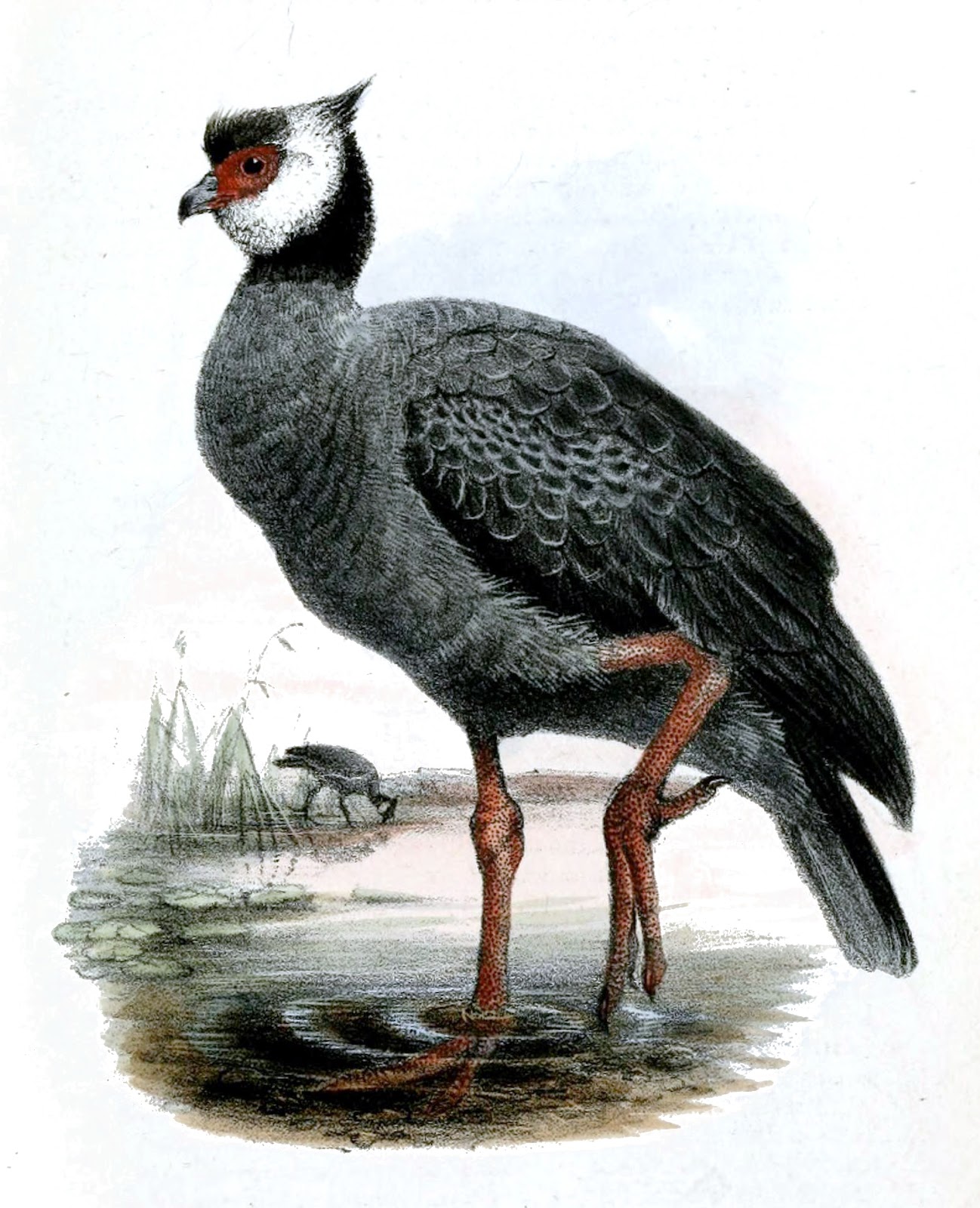
Illustration
of the black-necked screamer, by Joseph Wolf, 1864 (public domain)
Certain other
birds, like the jacanas or lily-trotters, the spur-winged goose Plectropterus
gambensis, the spur-winged plover Vanellus spinosus, and a pair of
Antarctic endemics called sheathbills, possess horny spurs on their wings, used
in combat - but these are variously sited on the 'wrist bones' (carpals) or
'hand bones' (metacarpals), not upon the finger tips.
Out of all of
these species, moreover, only one - the secretary bird - is predominantly
carnivorous. Could the makalala, therefore, be some form of extra-large
secretary bird - not necessarily as tall as the Wasequas state (their fear of
it could certainly have inflated their estimate of its height), but much bigger
than today's single known species? If so, a suitable scientific name for it, based upon its morphological description given above,
would be Megasagittarius clamosus - 'the noisy, giant secretary bird'.
Staying with the
secretary bird line of speculation, is it conceivable, alternatively, that the
makalala was a false secretary bird, i.e. some other raptorial species,
possibly another accipitrid (the eagles, hawks, and Old World vultures), that
had assumed via convergent evolution a form outwardly comparable to Sagittarius?
Although this is just another suggestion with no tangible evidence to support
it directly, there is actually an interesting confirmed precedent for such an ostensibly
unlikely premise.
In 1989, Drs Alan Feduccia and Michael R. Voorhies formally described a remarkable new species of North American fossil accipitrid from the late Miocene whose tarsometatarsal structure was nearly identical morphologically to that of the secretary bird. Indeed, the convergence was so striking that they christened this species Apatosagittarius terrenus, which translates as 'terrestrial false secretary bird', because they considered it likely that just like the true secretary bird, it had exhibited a predominantly terrestrial hunting lifestyle. In fact, it was only because the tarsometatarsus bore some attached phalanges whose structure was very different from those of the secretary bird that Feduccia and Voorhies were able to confirm that Apatosagittarius was not a true secretary bird, but was merely an anatomical impersonator.

In 1989, Drs Alan Feduccia and Michael R. Voorhies formally described a remarkable new species of North American fossil accipitrid from the late Miocene whose tarsometatarsal structure was nearly identical morphologically to that of the secretary bird. Indeed, the convergence was so striking that they christened this species Apatosagittarius terrenus, which translates as 'terrestrial false secretary bird', because they considered it likely that just like the true secretary bird, it had exhibited a predominantly terrestrial hunting lifestyle. In fact, it was only because the tarsometatarsus bore some attached phalanges whose structure was very different from those of the secretary bird that Feduccia and Voorhies were able to confirm that Apatosagittarius was not a true secretary bird, but was merely an anatomical impersonator.

The shoebill - close-up of its head revealing its immense hooked beak, and a beautiful shoebill illustration from 1901 (© Dr Karl Shuker/public domain)
Finally, a sizeable bird native to western Tanzania but possibly venturing eastward occasionally into the region supposedly inhabited by the makalala is the shoebill Balaeniceps rex. Once deemed to be an aberrant stork but nowadays considered to be more closely related to pelicans, this highly distinctive species stands up to 5 ft tall, sports a very impressive 8.5-ft wingspan, is famed for its enormous hooked beak, and has such a positively prehistoric appearance when seen in flight that it has been proposed by some zoologists as the identity of supposed living pterosaurs spasmodically reported from various regions of East and Central Africa - click here for a ShukerNature blog article on this subject.
However, the shoebill's wings do not possess horny tips, so it could not make the loud wing-claps characterising the makalala. In addition, being principally piscivorous it doesn't scavenge carcases, it is shy of humans, and as its overall appearance is so singular that it seems unlikely the Wasequa would confuse such an unmistakeable species with anything else or convert it into a much larger, quite different mystery bird, this would seem to rule out the shoebill from further consideration concerning the makalala - unless, of course, there is a still-undiscovered species of giant shoebill out there...?

With a life-sized model of the North American terror bird Titanis walleri (©
Dr Karl Shuker)
All of the lines
of speculation discussed above – with identity contenders ranging from marabou
storks, shoebills, and terror birds to secretary birds, false secretary birds, and even the
anomalous Eremopezus – are certainly absorbing and thought-provoking,
but even if any of them is valid, it is scarcely likely to yield a living
makalala, sadly. After all, a bird as large and as visually distinctive as this
one would surely be hard-pressed indeed to remain undiscovered by science for
long, regardless of the geographical locality involved - yet there do not
appear to be any post-19th-Century reports of its existence.
Consequently, even if the makalala was a reality in the 1870s, presumably it no longer survives - but that does not mean that its former existence cannot be verified. As noted earlier, among the valued possessions and relics of present-day Wasequas there may still be one or more of the revered helmets worn by long-departed chiefs. Should one of these tribal heirlooms pass into the hands of an ornithologist, the lucky recipient could well find himself holding a bona fide makalala skull!
Consequently, even if the makalala was a reality in the 1870s, presumably it no longer survives - but that does not mean that its former existence cannot be verified. As noted earlier, among the valued possessions and relics of present-day Wasequas there may still be one or more of the revered helmets worn by long-departed chiefs. Should one of these tribal heirlooms pass into the hands of an ornithologist, the lucky recipient could well find himself holding a bona fide makalala skull!
The above
ShukerNature blog article is excerpted from my long-awaited updated edition of In Search of Prehistoric Survivors – coming
soon…
And staying with monstrous birds, be sure to click here to read my ShukerNature article about the
seriously scary giant marabou 'stork of doom' pictured below that was still
alive in southeast Asia as recently as the late Pleistocene, approximately
18,000 years ago.

Leptoptilos robustus, the spectacular if flightless giant
marabou stork of Flores, and one of the diminutive real-life hobbits (Flores Man Homo floresiensis) that
lived in its formidable shadow (© Hodari Nundu)
For a comprehensive coverage of the terror birds'
evolution and fossil history, check out my book The Menagerie of Marvels, which features on its front and back
covers a spectacular pair of terror birds depicted by acclaimed artist Anthony
Wallis – thanks Ant!


 Posts
Posts