Dr KARL SHUKER

Zoologist, media consultant, and science writer, Dr Karl Shuker is also one of the best known cryptozoologists in the world. He is the author of such seminal works as Mystery Cats of the World (1989), The Lost Ark: New and Rediscovered Animals of the 20th Century (1993; greatly expanded in 2012 as The Encyclopaedia of New and Rediscovered Animals), Dragons: A Natural History (1995), In Search of Prehistoric Survivors (1995), The Unexplained (1996), From Flying Toads To Snakes With Wings (1997), Mysteries of Planet Earth (1999), The Hidden Powers of Animals (2001), The Beasts That Hide From Man (2003), Extraordinary Animals Revisited (2007), Dr Shuker's Casebook (2008), Karl Shuker's Alien Zoo: From the Pages of Fortean Times (2010), Cats of Magic, Mythology, and Mystery (2012), Mirabilis: A Carnival of Cryptozoology and Unnatural History (2013), Dragons in Zoology, Cryptozoology, and Culture (2013), The Menagerie of Marvels (2014), A Manifestation of Monsters (2015), Here's Nessie! (2016), and what is widely considered to be his cryptozoological magnum opus, Still In Search Of Prehistoric Survivors (2016) - plus, very excitingly, his four long-awaited, much-requested ShukerNature blog books (2019-2024).

Dr Karl Shuker's Official Website - http://www.karlshuker.com/index.htm

IMPORTANT: To view a complete, regularly-updated listing of my ShukerNature blog's articles (each one instantly clickable), please click HERE!

IMPORTANT: To view a complete, regularly-updated listing of my published books (each one instantly clickable), please click HERE!

IMPORTANT: To view a complete, regularly-updated listing of my Eclectarium blog's articles (each one instantly clickable), please click HERE!

IMPORTANT: To view a complete, regularly-updated listing of my Starsteeds blog's poetry and other lyrical writings (each one instantly clickable), please click HERE!

IMPORTANT: To view a complete, regularly-updated listing of my Shuker In MovieLand blog's articles (each one instantly clickable), please click HERE!

IMPORTANT: To view a complete, regularly-updated listing of my RebelBikerDude's AI Biker Art blog's thematic text & picture galleries (each one instantly clickable), please click HERE!

Search This Blog


PLEASE COME IN, I'VE BEEN EXPECTING YOU...

PLEASE COME IN, I'VE BEEN EXPECTING YOU...
WELCOME TO SHUKERNATURE - ENJOY YOUR VISIT - BEWARE OF THE RAPTOR!


Showing posts with label hoopoe. Show all posts

Tuesday, 30 March 2021

SINGING THE PRAISES OF OUR NATIONS' FEATHERED AMBASSADORS

 
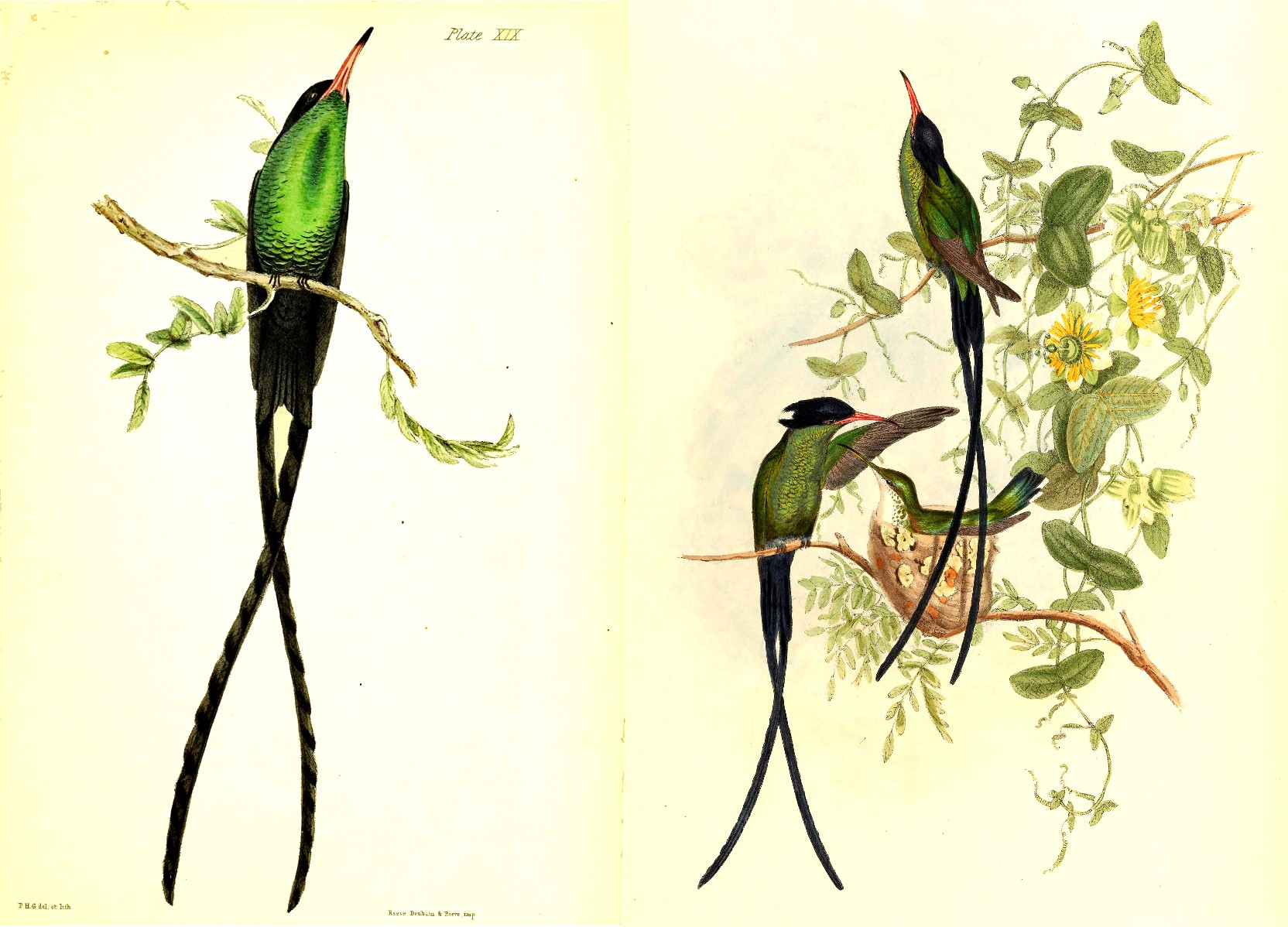
A male doctor bird, Jamaica's national bird, in Philip Henry Gosse's book The Birds of Jamaica, 1849 (public domain) / Doctor birds (two males, one female), in John Gould's tome A Monograph of the Trochilidae, or Family of Humming-birds, Vol. 2, 1861 (public domain)

Despite being a nation intimately associated with birdwatching and a love of all things ornithological in general, the United Kingdom, most surprisingly, is one of the very few nations on Earth that does not have an official national bird. True, several years ago a countrywide poll was held to decide which species should serve as our own representative, and revealed as its winner the robin Erithacus rubecula – a friendly, familiar species beloved of gardeners and Christmas card illustrators, and which has traditionally if unofficially occupied that very same role for untold years anyway. However, even this newsworthy poll failed to convince the powers-that-be to elect the robin formally as our nation's feathered ambassador, and so, at least for now, the wait continues. Elsewhere around the world, conversely, is a vast array of national birds, chosen for many different reasons as their respective country's much-loved avian symbol – from its links to its country's beliefs or culture, or as an eyecatching example of its rich biodiversity, to the longstanding admiration that it has inspired among those people sharing its homeland, or even as a means of highlighting its modern-day rarity and need for conservation. So here, to demonstrate this eclectic variety, is a global twitching tour, highlighting some of the most distinctive national birds with fascinating facts explaining why they are so memorable.

 
European robin, painted by Frederick W Frohawk, 1907 (public domain)

Birds of prey have always been greatly admired as symbols of power, strength, intelligence, wisdom, and keen vision, so it is hardly surprising that they have also been popular choices as national birds. Perhaps the most famous example in this capacity is the bald eagle Haliaeetus leucocephalus, the national bird of the USA. One of the world's several species of fish-eating eagle, and named after the adult bird's characteristic white-plumed head (it is brown in juveniles), the bald eagle was officially adopted as the USA's feathered representative on 20 June 1782, when the design of the Great Seal of the United States portraying a bald eagle grasping in its talons 13 arrows representing the 13 founding states plus an olive branch signifying peace was formally adopted by the Continental (Philadelphia) Congress, containing delegates from those states.

 
Bald eagle, hand-coloured engraving, 1840 (public domain)

Another country with a tradition of eagle imagery is Germany, and it too has an eagle as its generally-recognised national bird, but this time the golden eagle Aquila chrysaetos. Indeed, the magnificent plumage and stately poise of this species is so imposing that several other countries have also adopted it in this role, including Afghanistan, Armenia, Egypt, Mexico, and Scotland, although in Egypt and Scotland it is presently still in an unofficial capacity, rather like our robin. Moreover, the African fish eagle Haliaeetus vocifer, a close Old World relative of the bald eagle and sporting a very striking brown and white plumage, is so well-regarded on its native African continent that it is the official national bird of no fewer than four different nations – Namibia, South Sudan, Zambia, and Zimbabwe.

 
Golden eagles (Wikipedia – public domain)

One of the most spectacular yet also one of the rarest of all eagles is the Philippine eagle Pithecophaga jefferyi. Originally dubbed the monkey-eating eagle as it is large and powerful enough to prey upon sizeable monkeys here, it was subsequently renamed the Philippine eagle and formally installed as its country's national bird on 4 July 1995 by the then president Fidel V. Vamos. This was done in a bid to raise awareness regarding its critically endangered status, a result of longstanding habitat destruction, especially via widespread deforestation. Less than 1,000 individuals are currently thought to exist.

 
Philippine eagle, by Henrik Grönvold, 1910 (public domain)

Other powerful birds of prey declared as national birds include the harpy eagle Harpia harpyja in Panama, the white-tailed sea eagle or erne Haliaeetus albicilla (Poland), and the gyrfalcon Falco rusticolus (Iceland). Vultures may not seem the most photogenic or behaviourally refined of species to serve as national birds, yet they too clearly have their supporters, because the griffon vulture Gyps fulvus is the national bird of Serbia, and the mighty-pinioned Andean condor Vultur gryphus serves in this role for a quartet of major South American nations (Bolivia, Chile, Colombia, and Ecuador). Smaller raptorial species are not overlooked either, with the peregrine Falco peregrinus representing Angola and the United Arab Emirates, the European kestrel F. tinnunculus Belgium, and the saker falcon F. cherrug Hungary and Mongolia.

 
Andean condor, 1800s engraving (public domain)

As for owls, back in classical times the little owl Athene noctua was the sacred bird of Athena, the Greek goddess of wisdom, so in modern-day times it is the national bird of Greece. And the Aruba burrowing owl A. cunicularia arubensis represents the Caribbean island of Aruba. Perhaps the strangest of all birds of prey is the secretary bird Sagittarius serpentarius, named after its straggly crest that has been fancifully likened to an untidy sheaf of quills that a secretary from bygone times might have placed behind one of his ears. This bizarre-looking species somewhat incongruously combines a hawk-like body with the lengthy legs of a stork, and is famed for its snake-killing abilities in its native Sudan where it is commemorated as that country's national bird.

 
19th-Century painting of a secretary bird, from Dictionnaire Histoire Naturelle by Charles Orbigny (public domain)

Waterbirds are another popular choice for national birds. The mute swan Cygnus olor represents Denmark, and the whooper swan C. cygnus Finland, whereas more colourful feathered symbols include the American flamingo Phoenicopterus ruber for the Bahamas, the scarlet ibis Eudocimus ruber for Trinidad and Tobago, and the magnificent frigate bird Fregata magnificens (noted for the breeding male's vivid scarlet, greatly-inflatable throat pouch) for not only the Pacific island nation of Kiribati but also the twin-island Caribbean nation of Antigua and Barbuda. Its smaller but no less distinctive relative the great frigate bird F. minor does the honours for Nauru, and on account of their extraordinarily prehistoric appearance when seen high overhead in flight, frigate birds are regularly mistaken by unknowledgeable observers for living pterodactyls!

 
Adult male magnificent frigate bird, painting from The Birds of North America, 1903 (public domain)

Their impressive, imposing stature and noble mien no doubt explains why cranes and storks also include several national birds among their assemblage. Most celebrated of these is the blue crane Grus paradisea (aka the paradise or Stanley crane), representing South Africa. Its cultural links to this country include a longstanding tradition among the Xhosa people here, whereby the honour bestowed upon a man who had distinguished himself in battle was to be decorated with blue crane plumes placed in his hair by a chief during a special ceremony known as ukundzabela. Other African nations with a crane as their official symbol include Uganda (its national bird is the grey crowned crane Balearica regulorum) and Nigeria (the black crowned crane B. pavonina). The white stork Ciconia ciconia, a species beloved throughout Europe as the traditional bringer of babies according to fairytales and folklore, is the national bird in both Belarus and Lithuania, whereas the hammerhead or hamerkop Scopus umbretta, an odd stork-like but pelican-related species native to much of sub-Saharan Africa and Madagascar, is the national bird of Gambia, and is widely if erroneously claimed to induce lightning. And speaking of pelicans: the brown pelican Pelecanus occidentalis represents the Caribbean nation of St Kitts and Nevis.

 
Blue, paradise, or Stanley crane, from A Monograph of the Cranes, 1897, by Frans Ernst Blaauw (public domain)

Many species of tropical bird have dazzling, multicoloured plumage exhibiting truly extravagant displays of feathered flamboyance, so it is little wonder that some of the most beautiful examples have been adopted by their homelands as national birds. Count Raggi's bird of paradise Paradisaea raggiana, for instance, in which the adult male boasts a fiery explosion of long scarlet plumes with which to tempt and entreat dowdy brown females to mate with him when he dances before them during the breeding season, is the national bird of Papua New Guinea, whose tropical rainforests are home to many of the world's 40-odd bird of paradise species.

 
19th-Century painting of an adult male Count Raggi's bird of paradise, by John Gould (public domain)

Another series of bird species with feathers of the fantastically fabulous kind constitutes the peafowl and pheasants. The blue peacock's famous eye-spotted tail-train when unfurled and held vertically to entice what he hopes are suitably bedazzled peahens is said to owe its distinctive ocellated patterning to the Greek goddess Hera (or Juno in equivalent Roman retellings). Distraught when the messenger god Hermes slew her loyal hundred-eyed watchman Argus at the behest of Zeus, she placed Argus's eyes in the train of the peacock, and adopted it thereafter as her sacred bird. No doubt, therefore, she would be pleased to know that this very familiar species, Pavo cristatus, is honoured as India's national bird. Turning to pheasants, the green pheasant Phasianus versicolor claims comparable prestige in Asia as Japan's national bird, as does the Himalayan monal Lophophorus impejanus for Nepal, the Siamese fireback Lophura diardi for Thailand, and the confusingly-named grey peacock-pheasant Polyplectron bicalcaratum for Myanmar (the last-mentioned species is so-called because although it is a pheasant, it has spotted plumage whose markings recall the ocelli in the peacock's train).

 
Himalayan monal, from A Century of Birds From the Himalaya Mountains, 1831 (public domain)

Parrots were always going to be sought after as national birds by tropical countries fortunate enough to be home to these vividly-plumed perennial favourites among aviculturalists and ornithologists alike, and sure enough, several species have indeed gained that exalted status. The largest, and gaudiest, is undoubtedly the scarlet macaw Ara macao, an animate tricolor of red, blue, and gold, representing Honduras but native to much of northern South America too. Several Caribbean island nations have their very own endemic amazon parrot species – large, brightly-coloured, and found nowhere else – so for reasons of national pride in their avifauna and also to highlight that these species are endangered in many cases, they have duly declared them as their national birds, as with the St Lucia parrot Amazona versicolor for St Lucia, the St Vincent parrot A. guildingii for St Vincent and the Grenadines, and the imperial parrot A. imperialis for Dominica. Nor should we forget the near-threatened Grand Cayman parrot A. leucocephala, the national bird of the Cayman Islands but also found in Cuba and the Bahamas.

 
St Lucia parrot, painted by Joseph Smit, Proceedings of the Zoological Society of London, 1875 (public domain)

The pink-plumaged hoopoe Upupa epops with huge black-and-white wings that bestow upon it the extraordinary guise of a giant butterfly when seen in flight is Israel's national bird, and is intimately linked with biblical lore and legends. According to one such story, hoopoes once bore crests of solid gold, but they were so persecuted by hunters seeking their precious head plumes that they beseeched King Solomon to save them. So in response to their plea, he very kindly transformed their crests into normal feathers, which of course were of no interest to the hunters, and which they have thus borne ever since.

 
A family of hoopoes, painted by John Gould, 1837 (public domain)

Hoopoes are closely related to kingfishers, rollers, hornbills, and motmots, many of which are brilliantly-plumaged and as a consequence include several national birds among their number, such as the lilac-breasted roller Coracias caudatus for Botswana (and also unofficially for Kenya), the rhinoceros hornbill Buceros rhinoceros for Malaysia, the turquoise-browed motmot Eumomota superciliosa for El Salvador and Nicaragua, and the grey-headed kingfisher Halcyon leucocephala for Cape Verde. Superficially similar to the Old World hornbills due to their comparably top-heavy beaks, but less closely related to them zoologically speaking, are the New World toucans, with the keel-billed toucan Rhamphastos sulfuratus serving Belize as its national bird.

 
Rhinoceros hornbills, in Daniel Giraud Elliot's A Monograph of the Bucerotidæ, or Family of the Hornbills, 1882 (public domain)

However, the epitome of tropical birds as far as breathtakingly gorgeous plumage is concerned must surely be the trogons. Again distantly related to kingfishers, rollers, and hoopoes, and native to Africa, Asia, and Latin America, these typically thrush-sized birds resemble living jewels when spot-lit by shafts of bright sunlight filtering through the leafy canopy in their jungle domain. Inevitably, therefore, several of them have been adopted as national birds, such as the Hispaniolan trogon Priotelus roseigaster in Haiti, the Cuban trogon P. temnurus in Cuba itself, and the bar-tailed trogon Apaloderma vittatum in Malawi. However, the trogon par excellence – indeed, a leading contender for the world's most beautiful species of bird – is the aptly-named resplendent quetzal Pharomachrus mocinno of Guatemala, whose history, both natural and national, makes fascinating reading.

 
Bar-tailed trogon, by John G. Keulemans, 1892 (public domain)

According to the ancient traditions of the Aztec nation, which formerly inhabited what is today Mexico (and which in turn formerly included present-day Guatemala within its borders), one of their principal deities, the sky god Quetzalcoatl, would sometimes appear to them in the form of a great airborne feathered serpent with bright emerald-coloured plumes. Today, it is believed that this curious legend arose from real-life observations by the Aztecs of the resplendent quetzal, because during the breeding season the green-plumaged male, which is normally no more than 1 ft long, grows a pair of exceptionally lengthy, elongate tail plumes, also green, but each measuring up to 3 ft long – and when it flies, these two streamer-like feathers extend horizontally behind it and undulate, so that it bears more than a passing resemblance to an extraordinary plumed snake in flight. Such a famous bird of legend has made an immense cultural impact upon Guatemala, one of several Central American countries where this spectacular bird exists (as well as in present-day Mexico) – so much so, in fact, that not only is it Guatemala's national bird but it has given its name to this country's currency too (100 centavos = 1 quetzal since the year 1925), as well as appearing upon both its national flag and its official coat of arms, and also upon its bank notes and many of its postage stamps.

 
Late 1800s chromolithograph portraying a pair of quetzals (public domain)

Also deserving of mention here is a veritable 'quetzal in miniature' that is itself a national bird – the doctor bird Trochilus polytmus, hailing from Jamaica. Indigenous to that island nation, this iridescent green-plumaged hummingbird is characterised by the male's pair of extremely long ribbon-like tail feathers, which make a humming sound as it flies. There is speculation that because these feathers resemble the long silk tail-coats worn by doctors in olden days, this is why the species is called the doctor bird.

 
Delightful short video of two male doctor birds boldly perching on visitors' fingers as they drink sugar water from bottles (© Conley Salmon/YouTube – inserted here on a strictly non-commercial Fair Use basis for educational/review purposes only)

Of course, not all national birds are chosen for their dramatic appearance or links to mythology. Quite a few have been specifically selected for their basic 'everyman' appeal and popularity, familiar to everyone and loved by all. Italy has as its national bird the Italian sparrow, a cheeky little upstart that is abundant and instantly recognisable everywhere here. Long the subject of controversy as to its precise taxonomic status because it appears intermediate in form between the Spanish sparrow Passer hispaniolensis and the house sparrow P. domesticus, it was formerly thought to be a hybrid of these two. Nowadays, however, it is often deemed to be a separate, valid species in its own right, albeit one that may indeed have originated via hybridisation between the two afore-mentioned species, and has been dubbed P. italiae, because this is where it predominantly occurs.

 
A pair of Italian sparrows, by John Gould, from The Birds of Europe, 1837 (public domain)

Other well known but visually modest avian groups with national birds among their membership are the wagtails (the white wagtail Motacilla alba being Latvia's national bird), the crows (Bhutan's is the common raven Corvus corax), swallows (the European or barn swallow Hirundo rustica represents both Austria and Estonia), thrushes (the common blackbird Turdus merula for Sweden, the redwing T. iliacus for Turkey), doves (mourning dove Zenaida macroura for the British Virgin Islands, zenaida dove Z. aurita for Anguilla, Grenada dove Leptotila wellsi for Grenada), and finches (Sinai rosefinch Carpodacus synoicus for Jordan).

 
Adult male Sinai rosefinch, painted by Nicolas Huet, 1838 (public domain)

But perhaps the last word on national birds should be reserved for the most poignant example – namely, the species that represents the Mascarene nation of Mauritius in the Indian Ocean. For alone of all such birds, it is no longer in existence, having been slaughtered for its meat more than three centuries ago, only for it afterwards to become an icon in its former island homeland. Today, its instantly recognisable form can be seen everywhere in Mauritius – decorating picture postcards, appearing in advertisements, reproduced as toys of every conceivable composition, and serving as the number one choice for countless visually-inspired souvenirs. And the name of this extinct, exterminated superstar? What else could it be? Raphus cucullatus – the dodo.

 
Dodo, 17th-Century Dutch illustration, colour-corrected (public domain)


Saturday, 19 July 2014

THE CLIFDEN NONPAREIL – BEWITCHED BY NABOKOV'S ELUSIVE BLUE UNDERWING

Suitably named – the truly unparalleled, peerless clifden nonpareil, gorgeously portrayed in Dr F. Nemos's book Europas bekannteste Schmetterlinge. Beschreibung der wichtigsten Arten und Anleitung zur Kenntnis und zum Sammeln der Schmetterlinge und Raupen (c.1895)

In a previous ShukerNature blog article (click here), I reminisced about my lifelong ambition (finally fulfilled after 48 years of ongoing frustration!) to see the bird above all others that had bewitched me from my earliest days – that cerise-plumed, butterfly-winged wonder known as the hoopoe, which is a rare but annual visitor to Great Britain.

So too is another species – one that to me is the hoopoe of the moth world, because the thought of seeing this spectacular creature one day fills me with just as much enthusiasm and passion as I felt for so long and so earnestly in relation to the hoopoe. Yet whereas the latter is finally on my list of observed species, its equally charismatic lepidopteran counterpart remains resolutely unseen, still unencountered by me more than 54 years on from when I made my debut on the planet that I share with it.

Clifden nonpareil depicted upon a postage stamp issued in 1974 by Hungary

So what is this peerless, unparalleled species? None other than the fittingly-named clifden nonpareil Catocala fraxini ('nonpareil' translates from the French as 'without equal'). One of Britain's largest species of moth, it is also known, again appropriately albeit somewhat less romantically, as the blue underwing.

Indeed, so noteworthy is this moth's appearance that it even attracted the attention of eminent Russian novelist Vladimir Nabokov. Well known for his passion for Lepidoptera, he immortalised the clifden nonpareil in his novel The Gift (1938, English translation 1963): "Your blue stripe, Catocalid, shows from under its gray lid".

Clifden nonpareil (© Harald Süpfle/Wikipedia Creative Commons Attribution-ShareAlike 3.0)

This celebrated species belongs to the taxonomic family Noctuidae, the owlet moths, which is the largest family of moths, is of worldwide distribution, and contains over 35,000 species. Within this family is the genus Catocala, containing over 250 species, native to Eurasia and North America, which are popularly termed underwings or underwing moths (Catocala is Greek for 'beautiful hind ones'). This name refers to the usually bright stripes of colour present on the upper side of their hindwings. At rest, an underwing moth's hindwings are concealed beneath its larger but very drab, grey-brown, cryptically-patterned forewings, allowing it to remain hidden from predators when resting in the open on the trunks of trees, etc. Should its presence be detected, however, in order to startle the predator momentarily and thus provide valuable escape time the moth will flash its brightly-coloured hindwings, abruptly revealing their colours. Due to the semi-circular shape of the stripes, moreover, it has been speculated that they may look like owl eyes to smaller birds, which would therefore frighten them away, saving the moth.

These stripes occur in a wide range of colours, varying between species, and many Catocala species are named accordingly. Thus there are red underwings, crimson underwings, rosy underwings, scarlet underwings, pink underwings, and so forth. Moreover, certain members of related genera that possess comparable hindwings are also referred to as underwings, such as the copper underwings Amphipyra spp., yellow underwings Noctua spp., and the brown underwing Minucia lunaris. In addition, there are two species of orange underwing Archlearis spp., but these belong to a separate taxonomic family, Geometridae.

A red underwing Catocala nupta (top) and a clifden nonpareil (bottom), pictured in The Natural History of British Moths (1836), by J. Duncan

Yet despite the difference in specific colours, these many species' hindwing stripes all occur in the red portion of the colour spectrum – all except the stripes of one very singular, special species, that is. Lone among all underwings, the stripes of the clifden nonpareil are blue, and not just some nondescript grey-blue shade either, but instead a bright, truly spectacular blue, which must be genuinely dazzling if suddenly flashed in the face of an inquisitive, too-close-for-comfort avian observer.

Blue has always been far and away my all-time favourite colour – so much so in fact that I sometimes wonder whether my wardrobe would have been so plentifully packed with Levis and other jeans, not to mention trucker jackets and shirts, had the predominant dye for denim been anything other than blue! Hence it was inevitable that a blue underwing – and especially when it is the only blue underwing – would attract my enduring interest and attention once I'd learnt of such an exotic creature's existence, and thus has it proved.

Clifden nonpareil in grass (public domain)

Moreover, boasting a 4-inch wingspan the clifden nonpareil is set apart from all other underwings not only by its blue hindwing stripes but also by its very large size – indeed, it is the world's largest species of Catocala underwing. It was scientifically named by none other than Linnaeus, in 1758, who dubbed it Phalaena fraxini (noting its sometime occurrence on ash trees, Fraxinus spp.) but it was subsequently rehoused in the genus Catocala after the latter was coined in 1802 by German entomologist Franz von Paula Schrank. It has a wide Old World distribution, being found as a resident in deciduous woodlands (especially near water) of northern and central Europe (and as a migrant in eastern and southern Europe), as well as in northern Asia, and in temperate eastern Asia as far as Japan. However, it is its famed rarity in Britain that has earned it its reputation as a near-legendary species - one that was prized above all others by moth collectors during the Victorian era.

The first published reference to the clifden nonpareil's occurrence in Britain was by Benjamin Wilkes in his book The English Moths and Butterflies (1749), in which he recorded a specimen lately collected by a Mr Davenport on an ash tree near Clifden (now known as Cliveden) in Buckinghamshire – the location which, together with its unrivalled beauty, earned this species its common name. However, it had been known in Britain since at least 1740 – the year in which a specimen now in the Dale Collection within Oxford's Hope Museum was collected in Dorset. Since then, usually single specimens have been reported in a number of English counties spasmodically up until the 1940s and 1950s, during which period sightings increased as its range temporarily expanded due to favourable climatic conditions, even giving brief hope that this evanescent species had permanently established itself as a resident in Kent and the Norfolk Broads. Sadly, however, that hope was not fulfilled, because sightings fell again following the return of less favourable climate by the early 1960s, and it once more became merely an irregular immigrant.

Clifden nonpareil – extracted from Duncan's above-reproduced 1836 colour print

Favouring the aspen as its larval foodplant (though also selecting other poplar species if aspen are not present, and sometimes found on ash trees too), the clifden nonpareil is most commonly sighted in September, particularly in southern and southeastern England. In recent years, however, there have been well-publicised records from the Westcountry counties too (one specimen turned up at Cornwall's Lost Gardens of Heligan in autumn 2010), and there is even a faint possibility that small colonies are establishing themselves in Suffolk. The recolonisation of southern England by this exquisite species would be a wonderful occurrence, so we can but hope that prevailing climatic conditions continue to encourage this most welcome trend. And who knows – if this does occur, one day the clifden nonpareil might expand its range even further, taking in my home county of the West Midlands. In 1872, there was a record from the neighbouring county of Shropshire, plus there are several 19th-Century records from northern England, and even Scotland and Ireland too, so it was clearly not a confirmed southerner back then.

What a marvellous, magical experience it would be if, finally, some day in the not-too-distant future I could encounter a large grey moth that suddenly flashed its hindwings at me to reveal a dazzling stripe of bright blue. For me, such an event would definitely be peerless, truly unparalleled – just like the clifden nonpareil itself.

19th-Century colour plate featuring a clifden nonpareil


Monday, 24 February 2014

THE SHAMIR AND THE STONE WORM

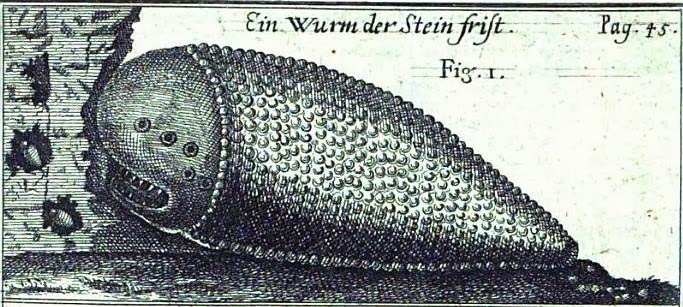
The first of two engravings of a medieval and highly mysterious stone worm contained within a late 17th-Century book by Eberhard Werner Happel

There are a number of mysterious and controversial biblical creatures with potential relevance to cryptozoology, of which the most famous examples are undoubtedly Leviathan and Behemoth (click here and here to see my ShukerNature investigations of them). Much less famous but no less remarkable than those two, however, is the small yet highly intriguing subject of this present ShukerNature post - the shamir.

Also spelled 'samir' or 'schamir', this is the Hebrew name given to a tiny worm-like creature referred to in certain Jewish holy books, including the Midrashim and the Talmud (particularly the Gemara – the component of the Talmud that consists of rabbinical analysis of, and commentary upon, an earlier work known as the Mishnah).

The shamir as depicted within the Rosslyn Missal (an Irish manuscript dating from the late 13th or early 14th Century)

According to Jewish tradition contained within these and other sources, the shamir was one of ten miraculous items created by God at twilight upon the Sixth Day of the Hexameron (the six days of Creation). Although it was only the size of a single grain of barley corn, the shamir was so incredibly powerful that merely its gaze was sufficient to cut through any material with ease, even through diamond itself, the hardest substance on Earth. Such a wondrous creature needed to be safeguarded, so God entrusted the shamir to the hoopoe (or woodcock or moorhen, depending upon which version of the legend is consulted), commanding this bird to protect the shamir from all harm.

In order to contain this mighty if minuscule worm, the hoopoe placed it among a quantity of barley corns, then wrapped them all up together in a woollen cloth, which in turn was placed inside a box fashioned from lead – the only material strong enough to contain the shamir effectively but without disintegrating from the intensity of its laser-like gaze. So here, safely and comfortably ensconced within its leaden domicile, which was retained by the hoopoe in the Garden of Eden, it passed through all the ages that followed.

Hand-coloured engraving of a hoopoe from 1840

Only once did the shamir emerge – during the time of Aaron and Moses, when God commanded the hoopoe to lend this worm to Him for the etching of the names of the 12 tribes of Israel upon the precious stones on 12 special priestly breastplates (the Hoshen), one breastplate for each of the tribes and each breastplate composed of a different stone. The task was a very difficult one, but when these stones were shown in turn to the shamir this astonishing creature accomplished it so expertly that not a single atom of precious stone was lost or destroyed.

After this, the shamir was placed back inside its lead casket, entrusted once more to the hoopoe's care, and there it remained, in undisturbed obscurity – until the time of King Solomon the Wise. Solomon wished to erect a glorious temple, but he was very mindful of God's instructions, laid down long ago to Moses, that no place of worship, not even an altar (let alone a temple), should be constructed using any tool made from iron - because iron was a substance of war, and that if anything related to war should ever touch a place of worship, it would be instantly and irrevocably defiled. But if Solomon could not use iron tools, how could the stones needed for constructing his temple be hewn?

An etching of the famous and much-exhibited model of Solomon's Temple created during the 1600s by Rabbi Jacob Jehudah Leon, which measured 80 ft in circumference and 13 ft high, and was based upon information contained within the Bible's Book of Kings, Book of Samuel, and Book of Chronicles

In an attempt to solve this riddle, Solomon enquired far and wide, and eventually he learnt about the incredible stone-searing shamir. Determined to utilise its extraordinary power, Solomon dispatched a servant to seek out this wonderful creature and bring it back to him. After a long search, the servant succeeded, and Solomon duly employed the shamir to cut the rocks required for building his celebrated temple – the First Temple in Jerusalem. But that is where the story ends abruptly – because after this magnificent edifice was completed, the shamir allegedly lost its power, then vanished, and has never been heard of again…or has it?

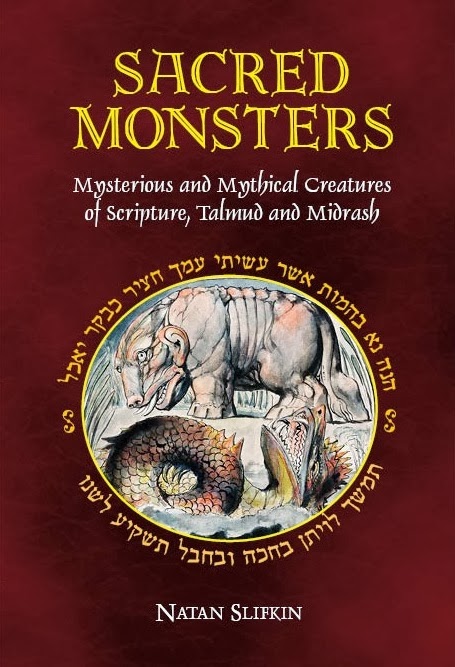
In his engrossing book Sacred Monsters (2nd edit., 2011), Rabbi Natan Slifkin wondered if the shamir might have been based upon a real but not particularly well known creature native to the Negev Desert - the rock-eating snail Euchondrus, represented there by three closely-related species, E. albulus, E. desertorum, and E. ramonensis. Less than half an inch long, these mini-molluscs eat lichens that grow beneath the surface of rocks, and use a toothed tongue-like organ known as the radula to rasp away the intervening rock with great ease and rapidity. However, if such snails were indeed the identity of the shamir, surely the holy books and scriptures would have alluded to their shells? Yet no mention of any such structure possessed by the shamir exists. Also, these sources state categorically that the shamir does not destroy any portion of the rocks or precious stones that it cuts through, unlike the activity of these snails.


Intriguingly, there is an alternative school of thought postulating that the shamir was not a living creature at all, but rather a mineral itself, specifically an exceptionally hard green stone, which could cut through all other substances. Yet this identification fails to explain how the stones needing to be cut could be by merely being shown to the shamir, i.e. without the shamir making any direct contact with the stones, using only its gaze to achieve its appointed task. As noted by Rabbi Slifkin, however, one maverick scientist proposed an extremely ingenious, and plausible, solution to this dilemma. Immanuel Velikovsky (1895-1979) is best-remembered for his highly controversial theories of global catastrophic events producing profoundly revised datings of major events in ancient history, as propounded in bestselling books such as Worlds in Collision (1950) and Earth in Upheaval (1955). Turning his attention to the shamir enigma, Velikovsky suggested that perhaps it was a radioactive substance, which could certainly explain some of the most notable riddles encompassing it.

For instance: such a substance could produce its effects upon other substances merely by having them placed near (or shown) to it, not requiring direct contact with them. Also, what better container for a radioactive substance to be housed safely inside than a casket of lead, which would very effectively shield its potent effects? And as its radioactivity would diminish with time (i.e. its half-life), this could explain why the shamir's potency had ultimately faded away by the time that King Solomon's temple had been completed. If it were truly a living creature, however, the shamir's abilities could not be explained by any such theory.

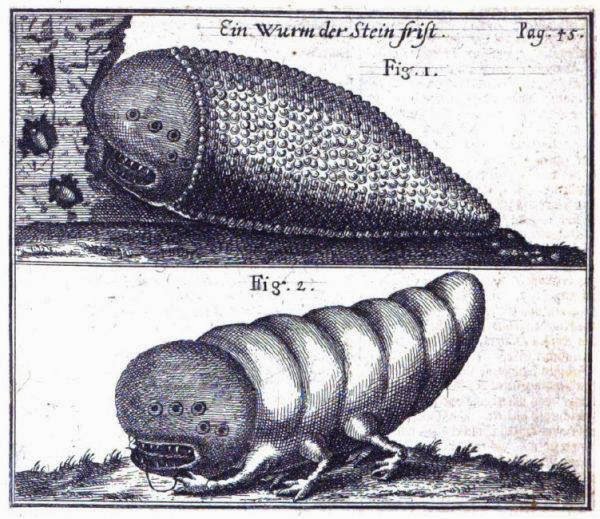
In any event, I had always assumed that this incredible entity was entirely mythical – until 28 November 2013, that is, when Facebook friend Robert Schneck very kindly brought to my attention an astonishing but hitherto exceedingly obscure mystery beast that seemed at least on first sight to be a veritable shamir of the Middle Ages. Robert revealed to me two engravings of bizarre-looking beasts known as vermes lapidum or stone worms, and which had appeared in a hefty German tome authored by Eberhard Werner Happel and entitled Relationes Curiosae, oder Denckwürdigkeiten der Welt, which was originally published in five volumes between 1683 and 1691.

Two engravings of alleged stone worms from Happel's Relationes Curiosae, oder Denckwürdigkeiten der Welt

According to Happel, the stone worms had originally been brought to public attention by a 17th-Century monk called de la Voye, from a Normandy monastery, who in 1666 had written a letter to a Lord Auzout describing his remarkable discovery. One day, de la Voye had found some of these very small, decidedly odd-looking creatures moving about incessantly inside some holes of their own making in an old wall, much of whose rocky composition had allegedly been eaten away and converted into dust by the devouring nature of the worms. When he pulled out some of them and examined them under a magnifying glass, the monk observed that they were each the size of a single barley corn (the very same description, intriguingly, as used in the Jewish holy books for the shamir) and enclosed in a grey shell, as depicted in the first (labelled Fig. 1) of the two engravings presented above. As quoted by Happel in his book, the monk continued his account of the stone worms in his letter to Lord Azout as follows:

"…on the tip [of the worm's body] there is a hole, through which the excrements can be excreted. On the other end there is a larger hole, trough which the head can be protruded.

They are entirely black, the body shows various segments, near the head there are three legs, each has two joints, not dissimilar to these of a flea.

When they move their body is suspended in air, the mouth but is still oriented to the rock. The head is bulky, a bit smooth, similar in shape and colour to the shell of a snail...also the mouth is similar large, with four kinds of teeth disposed in cross like manner."

The second engraving (Fig. 2) presumably shows the stone worm in a more advanced state of development than in Fig. 1, as it is now equipped with three pairs of legs. However, both forms seem only to possess small, primitive, laterally-sited ocellus-like eyes (round and black, according to de la Voye), rather than large, compound eyes, thereby indicating that if the stone worm is an insect, as seems at least remotely possible, it is a larval form rather than an adult (larval insects do not possess compound eyes, only ocelli).

Tegenaria domestica, a common species of funnel-weaving spider

Conversely, some authors have sought to discount the stone worms as (very) fanciful representations of funnel-weaving spiders, three pairs of legs rather than four notwithstanding and the stone worms' reputed rock-devouring proclivities discounted as apocryphal. Perhaps the presence of multiple ocelli, a characteristic of many spiders (which never possess compound eyes like most adult insects do), influenced their choice of an arachnid identity for these creatures, as there seems little else that would have done so? Certainly, the heavily segmented abdomen of the creature in the second engraving, and the seemingly limbless, shelled form of the creature in the first one, present major problems in reconciling them with any spider.

To be honest, however, the creatures depicted in these two engravings are so bizarre that it is impossible to identify them confidently with any known animal form. If they were indeed real, and not a hoax perpetrated by de la Voye, we can only assume that these engravings are exceedingly fanciful representations, so much so that the worms' true morphology has been enshrouded in exaggeration or error.

As for their stone-devouring diet, this too is baffling in the extreme. Perhaps de la Joye saw these creatures amid the wall's crumbling masonry and wrongly presumed that they were responsible? Who can say? All that can be stated is that except for a couple of brief mentions in some early 18th-Century dictionaries of natural science, the stone worm rapidly faded into total scientific oblivion shortly after Happel's book was published.

Happel's Relationes Curiosae, 1683

Could it be that, as a monk, de la Voye was well-read across a wide spectrum of religious tracts, was therefore familiar with the mythical shamir from Jewish holy books, and had mistakenly thought that the creatures that he had discovered were similar? In reality, however, even his stone worms' ostensible comparability to the shamir does not stand up to close scrutiny. For whereas the latter beast disintegrated and annihilated rocks using its formidable, basiliskian gaze, the stone worm actually devoured rocks and stones, at least according to de la Voye's testimony.

Almost 350 years have passed since de la Voye wrote his intriguing letter documenting the stone worms, but its subjects remain as mystifying and as unsatisfactorily 'explained' today as they were then. Unless the entire episode of their discovery was indeed a hoax and a nonsense, the stone worms must have been something – but what?

The second of two engravings of a medieval and highly mysterious stone worm contained within a late 17th-Century book by Eberhard Werner Happel