Dr KARL SHUKER

Zoologist, media consultant, and science writer, Dr Karl Shuker is also one of the best known cryptozoologists in the world. He is the author of such seminal works as Mystery Cats of the World (1989), The Lost Ark: New and Rediscovered Animals of the 20th Century (1993; greatly expanded in 2012 as The Encyclopaedia of New and Rediscovered Animals), Dragons: A Natural History (1995), In Search of Prehistoric Survivors (1995), The Unexplained (1996), From Flying Toads To Snakes With Wings (1997), Mysteries of Planet Earth (1999), The Hidden Powers of Animals (2001), The Beasts That Hide From Man (2003), Extraordinary Animals Revisited (2007), Dr Shuker's Casebook (2008), Karl Shuker's Alien Zoo: From the Pages of Fortean Times (2010), Cats of Magic, Mythology, and Mystery (2012), Mirabilis: A Carnival of Cryptozoology and Unnatural History (2013), Dragons in Zoology, Cryptozoology, and Culture (2013), The Menagerie of Marvels (2014), A Manifestation of Monsters (2015), Here's Nessie! (2016), and what is widely considered to be his cryptozoological magnum opus, Still In Search Of Prehistoric Survivors (2016) - plus, very excitingly, his four long-awaited, much-requested ShukerNature blog books (2019-2024).

Dr Karl Shuker's Official Website - http://www.karlshuker.com/index.htm

IMPORTANT: To view a complete, regularly-updated listing of my ShukerNature blog's articles (each one instantly clickable), please click HERE!

IMPORTANT: To view a complete, regularly-updated listing of my published books (each one instantly clickable), please click HERE!

IMPORTANT: To view a complete, regularly-updated listing of my Eclectarium blog's articles (each one instantly clickable), please click HERE!

IMPORTANT: To view a complete, regularly-updated listing of my Starsteeds blog's poetry and other lyrical writings (each one instantly clickable), please click HERE!

IMPORTANT: To view a complete, regularly-updated listing of my Shuker In MovieLand blog's articles (each one instantly clickable), please click HERE!

IMPORTANT: To view a complete, regularly-updated listing of my RebelBikerDude's AI Biker Art blog's thematic text & picture galleries (each one instantly clickable), please click HERE!

Search This Blog


PLEASE COME IN, I'VE BEEN EXPECTING YOU...

PLEASE COME IN, I'VE BEEN EXPECTING YOU...
WELCOME TO SHUKERNATURE - ENJOY YOUR VISIT - BEWARE OF THE RAPTOR!


Showing posts with label green lion. Show all posts

Friday, 30 June 2017

GREEN GROW THE TIGERS, O – AT LEAST IN VIETNAM?


Here's one I made earlier - a green tiger created by me via computerised photo-manipulation (© Dr Karl Shuker)

Quoting from a previous ShukerNature blog article of mine (click here to read it):

In various of my books, articles, and ShukerNature posts concerning cryptozoological and mythological big cats, I have documented lions of many different hues and shades, including black lions (click here, here, and here), white lions (click here), grey lions, red lions, golden lions, and even an alleged green lion (click here) – but never a blue lion. Blue tigers, yes (click here) – blue lions, no. Until now, that is.

I then went on to reveal that I had recently discovered some African and Asian legends relating to blue lions that I had never known about before, and I devoted the rest of that blog article to them.

But why am I reiterating all of this here? The reason is that I now find myself in a comparable situation with tigers. Over the years, I have documented tigers in virtually every conceivable shade and stripe version – blue tigers as already noted, plus black tigers (click here), white tigers (here), golden tigers (here), snow tigers (here), red tigers, brown tigers, double-striped tigers, and even stripeless tigers (all of which are also collectively documented in my books Mystery Cats of the World and Cats of Magic, Mythology, and Mystery) – except for one. I had never encountered a report or sighting of a green tiger – until now, that is.

In an earlier ShukerNature article, I mentioned how correspondent James Nicholls from Perth, Australia, had sent me a fascinating email on 27 June 2017 referring to a hitherto-obscure published account from 1821 concerning giant oil-drinking spiders reputedly inhabiting two of Europe's very notable edifices of worship, an account that almost certainly inspired Bram Stoker to insert a short, comparable account in his classic Gothic novel Dracula (1897). Click here to read on ShukerNature my investigation of this fascinating subject. However, that wasn't the only remarkable piece of information contained in James's email to me.

It also included a link to a thoroughly extraordinary account on the website Reddit, which had been posted on Christmas Day 2016 by someone with the username AnathemaMaranatha and seemingly of American nationality (judging from their style of grammar and spelling, and various other Reddit posts by them), and consisted of their supposed first-hand eyewitness description of a truly unique mystery cat. It reads as follows: (Or click here to view it in its original format on Reddit.)

Okay. I saw a green tiger. I wasn't alone.

We were out towards the Cambodian border in summer of 1969, an American light infantry company of about 100 or so guys. We were operating in flatlands, thick jungle, along a river. (Saigon River? Not sure.) Bright, sunny day.

We were proceeding single file when point platoon came to a stop, there was some yelling (we were stealthy - yelling is bad) from the point, then point platoon radioed for the Command Post (CP - the company commander and his people) to come up to point.

When we got there, we found the point team glaring at each other - some kind of tussle. Point and drag were standing in the machine gunner's line of fire glaring at him. The machine gunner had wanted to shoot. Point and drag stopped him. He didn't like that.

The object of discussion was across a jungle opening maybe 15 meters away, just peeking at us over the elephant grass. It was a big tiger - biggest I've ever seen, Frank Frazetta-style big, but without the lady.

Here's the insane part. The tiger was white where a tiger is white and black where a tiger is black, but all the orange parts were a pale green. We all saw it, maybe twenty grunts and me. The machine gunner was arguing that we have to shoot it, because otherwise no one would believe it. He had a point.

But the rest of us were just awestruck. I mean, it might as well have been an archangel, wings halo and all. I felt an impulse to kneel. I don't think I was alone.

The tiger stood there checking us out for maybe 15 minutes, not worried, not angry, just a curious cat. Then he turned and disappeared.

Don't believe me? That's okay. I don't believe it myself. I mean WTF was that? Hallucinogenic elephant grass? Some trick of the light? The tiger walked through some kind of green pollen just before we saw it? No freakin' idea.

There it is, OP. I don't believe it, and I saw it. Or hallucinated it. Me and all my blues. Make of it what you will. I'm done.

In fact, this person did make a few additional, minor comments in reply to various responses from other Reddit readers, of which the following one is well worth recording here:

I apologize for not making clear that the tiger was scaring the shit out of all us. He did NOT look sick or malnourished. He looked like he could be right in the middle of all of us in no time flat. He thought so, too. Didn't seem the least bit scared of us.

And I guess he wasn't hungry.

Another of my computer-generated green tigers (© Dr Karl Shuker)

Not surprisingly, faced with an account from someone claiming to have encountered a green tiger, my initial reaction was to assume that it was just a spoof, a joke, not to be taken seriously. But then I decided to investigate the credentials of the person who had posted it, especially as their account did sound as if it had been written by someone familiar with military action in Vietnam, and I was very intrigued to discover that they had written a number of other, much more mainstream and very detailed accounts on Reddit concerning their alleged time and military service there during the Vietnam War that all seemed entirely authentic (e.g. click here), and had been well-received by Vietnam veterans who would surely spot and soon expose any imposter. Consequently, it seems both reasonable and parsimonious to assume that this person's Vietnam-related testimony is indeed genuine.

But a green tiger? Really? I noticed that the green tiger account had attracted an interesting response (by someone with the unfortunate username eggshitter):

It was a bright sunny day right? Is there any chance that there was some murky green pool that reflected the light on to the tiger? Maybe he had just been rolling around in the grass?

Other, later posters made similar comments. They reminded me of a suggestion that has been put forward in the past concerning the blue tigers of Fujian, China – namely, that perhaps their distinctive fur colouration was simply due to their having rolled in bluish-coloured mud. However, as I have pointed out when responding to this suggestion, if that were true the entire tiger would look blue, whereas eyewitnesses have specifically mentioned seeing their black stripes and pale underparts, which of course would have been obscured if they had rolled in mud. The same logic, therefore, can be applied to the green tiger had it merely been rolling around in grass, or even, perhaps, in an alga-choked jungle pool.

Conversely, an optical illusion induced by reflected light is certainly possible. Yet bearing in mind the substantial length of time of the observation (15 minutes), and which was made by several different people simultaneously rather than just a single observer, this might initially seem somewhat improbable too.

On 19 November 2012, however, after having blogged about an alleged green lion seen in Uganda, East Africa (click here), I had received a fascinating response from John Valentini Jr (a Cryptomundo website reader who had seen a link to my article posted there by fellow cryptozoologist Nick Redfern), and which is also directly relevant to this present green tiger conundrum. So here is the summary of John's response that I added as a comment below my green lion blog article:

One day, while visiting a local zoo, John photographed a lioness, of totally normal colouration, but when he received his negatives and prints back from the developers (i.e. back in the days before digital photography), he was very surprised to discover that in them the lioness was green! She had been walking through an expanse of grass with her body held low when he had photographed her, and at the precise angle that John was photographing her the green light reflecting from the grass had made her look green. (Some grass, noted John, can be around 18-26% reflective.) Having to concentrate keeping his camera focused upon her through only a small viewfinder and thick glass, however, John hadn't noticed this optical effect himself - not until the negatives and prints had subsequently revealed it. Consequently, John speculates that perhaps, if viewed at precisely the correct angle, a similar effect could occur with a lion observed in the wild in decent light conditions but with plenty of green foliage around it, and that this may explain the Ugandan prospector's claimed sighting of a green lion.

Needless to say, I am delighted that John documented his extraordinary photographic experience on Cryptomundo in response to the link to this ShukerNature article of mine, as it may indeed offer a very plausible, rational explanation for the alleged green lion of Uganda - but one so remarkable that I would never even have thought of it, had John not posted it - so many thanks, John, once again!

Yes indeed, and it may also offer an equally plausible, rational explanation for the alleged green tiger of Vietnam – always assuming, of course, that the report is genuine. And there, at least for now, is where this most intriguing case rests, currently unproven but undeniably curious.

Of course, despite having bewailed the fact that I had never previously encountered anything about green tigers, there is one undoubted exception…of sorts. And that exception, as cartoon and super-hero fans everywhere are no doubt only too ready and waiting to remind me, is of course a certain golden-striped green tiger named Cringer – the very large but also very cowardly feline companion of Prince Adam, aka He-Man, in the very popular Masters of the Universe cartoon TV series (1983-1985) produced by Filmation (and also in the later movie starring Dolph Lundgren). Of course, when He-Man points his sword towards Cringer and fires an energy beam at him, Cringer redeems himself by transforming (albeit reluctantly) into his even bigger and now totally fearless, ferocious alter-ego felid called Battle Cat.

Two views of my original 1983 model of Cringer/Battle Cat (© Dr Karl Shuker)

As far as I am aware, however, neither as Cringer nor as Battle Cat has this green-furred tigerine celebrity ever paid a visit to Vietnam…

Finally: just in case anyone is confused by this ShukerNature article's main title, it is a play on the title of a traditional English folk song, 'Green Grow The Rushes, O', which was also often used with children as a counting song (and should not be confused, incidentally, with the similarly-titled song 'Green Grow The Rushes' by Robert Burns).

I am extremely grateful to James Nicholls for very kindly bringing this apparent eyewitness report of a green tiger to my attention.

My two books on mystery cats (© Dr Karl Shuker)


Tuesday, 3 June 2014

BLUE LIONS OF AFRICA AND ASIA

Computer-generated image of a blue lion (© Dr Karl Shuker)

Welcome to the 400th ShukerNature blog post! To celebrate this milestone, I now have pleasure in presenting a creature that is unusual even by ShukerNature standards! Namely, the blue lion.

In various of my books, articles, and ShukerNature posts concerning cryptozoological and mythological big cats, I have documented lions of many different hues and shades, including black lions (click here, here, and here), white lions (click here), grey lions, red lions, golden lions, and even an alleged green lion (click here) – but never a blue lion. Blue tigers, yes (click here) – blue lions, no. Until now, that is.

Fractal blue lion (© Artisenems)

Within the past fortnight, however, I have encountered two entirely independent sources of blue lions – one from Africa, the other from Asia. So here they are.

The first is an African folktale contained in a fascinating, beautifully-illustrated book that I recently purchased. Entitled Fabulous Beasts: Myths and Legends and published in 1994, it is the English-language edition of an original French book - Les Animaux Fantastiques (1991), written by Claude-Catherine Ragache, and illustrated by Marcel Laverdet.

Fabulous Beasts: Myths and Legends (incidentally, the monkey riding the blue lion in this book's front cover illustration is actually from a different folktale in the book, not from the one featuring the blue lions) (© Cherrytree Books/Marcel Laverdet)

According to the folktale in question, at the bottom of a certain great river in Africa lives a pride of lions with deep blue fur. These exotic felids seek out their prey on land each evening, and whatever – or whoever – they capture is then brought back by them to their underwater den, and stored inside one of many huge glass jars that serve as their larder. One day, they captured a newborn baby and duly placed it, still alive, inside one of their jars, to be devoured later. Devastated, its distraught mother flung herself into the river, but when her husband learnt what had happened, he dived in and followed her footprints along the river bed (this river possesses magical powers that prevent anyone entering it from drowning). He soon found her, so together they then trekked to the den of the blue lions, cautiously entered it, and found the jar containing their baby. But before they were able to rescue it, one of the blue lions caught sight of them, and forced them inside the jar too.

Fortunately, however, the husband had brought with him a magic ngona (antelope) horn, which, when he pointed it at each of them, so reduced them in size that they were all able to crawl inside the horn and remain hidden there. The following day, the blue lion that had discovered the husband and wife came to the jar to take them out with their baby so that the pride could devour all three of them, but the only thing that the lion could see inside the jar was an old antelope horn. The perplexed cat angrily bit it, but instead of the horn crunching up, it was the lion's teeth that shattered! Totally enraged by now, the lion spat the horn out, and with such force that it flew up through the water and out of the river altogether, landing safely on the river bank – where the family swiftly crawled out, regained their normal size, picked up the magic horn, and ran home to their village, with their rescued baby safe and sound.

A blue lion confronting the husband and wife with their baby – a gorgeous illustration from Fabulous Beasts: Myths and Legends (© Marcel Laverdet)

No specific details regarding the origin of this folktale (other than it is African) is given in the above book. However, African Genesis (1983) by Prof. Leo Frobenius and Douglas C. Fox contains a very similar folktale, which is attributed to the Wahungwe of Zimbabwe. Indeed, the only notable difference is that in the latter version, there is no mention that the water lions' fur was blue.

Although this is merely a traditional native folktale, the annals of African cryptozoology contain many accounts of supposedly genuine aquatic mystery cats, including various ones known locally as water lions - though as far as I am aware, none of them has blue fur!

A cosmic blue lion (artist unknown to me)

As for Asia's blue lion: in Buddhism, Bodhisattvas are beings who are seeking enlightenment or are on the path to enlightenment, and are sometimes deemed to be deities. The most significant Bodhisattva, and one of the Lord Buddha's most important disciples, is Manjusri, who is associated with transcendent wisdom. According to popular Chinese mythology, as noted in Patricia Bjaaland Welch's book Chinese Art: A Guide to Motifs and Visual Imagery (2008), consulted by me recently, Manjusri (aka Wenshu in Chinese) has been linked with the five-peaked holy mountain of Wutai Shan in Shanxi Province since the 4th Century, and has supposedly been sighted riding a blue lion in this mountain's higher reaches, above the many temples and monasteries located here.

Blue lion (© Artisenems)

For more information on varicoloured lions, check out my books Mystery Cats of the World (1989) and Cats of Magic, Mythology, and Mystery (2012).


Sunday, 18 November 2012

GREEN LION...OR GREEN LEOPARD? ON THE TRACK OF HEUVELMANS'S UNKNOWN MYSTERY CAT

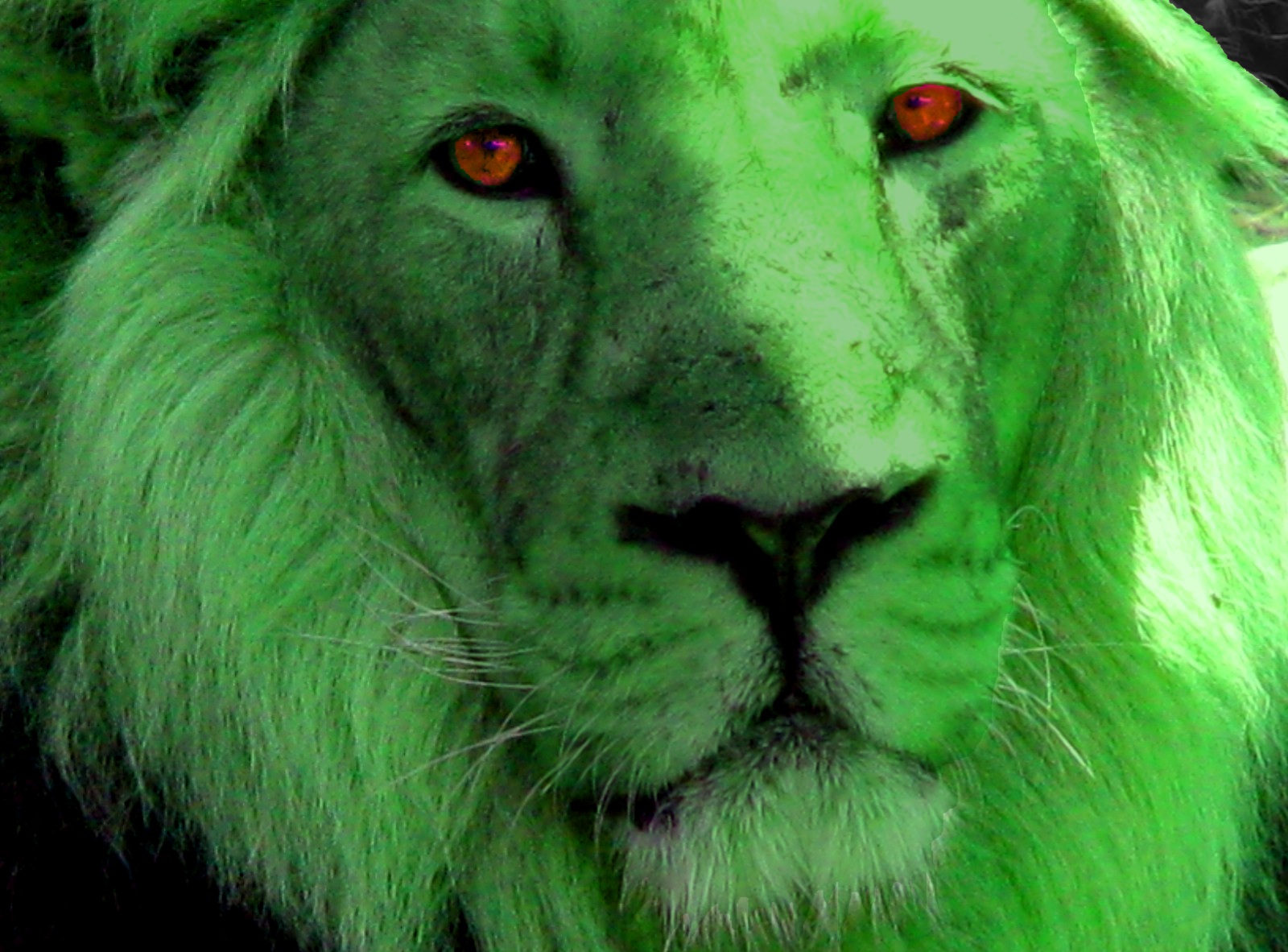
A green lion
(Public domain image photomanipulated by Dr Karl Shuker)

If a black lion (click here for more information) or even a white lion (click here for more information) seems unlikely, how much more so a green lion? Remarkably, however, as very briefly mentioned in C.A.W. Guggisberg’s book Simba: The Life of the Lion (1961) and subsequently recalled in my own book Mystery Cats of the World (1989), what was claimed to be a bona fide green lion was allegedly spied on one occasion by a prospector in the forests of western Uganda. Could it have been an individual covered in greenish slime from a stagnant, alga-choked pool in which it had recently bathed? Possibly, although Guggisberg took a rather more pragmatic view:

"[It] no doubt emerged from a whisky bottle!"

Whatever the answer, this is not the only green-furred big cat on record from Africa.

Was a green lion once seen in Uganda?
(artwork © Felipe Solero)

In his annotated checklist of cryptozoological animals, published in 1986 within Cryptozoology, the former scientific journal of the now-defunct International Society of Cryptozoology (ISC), pioneering mystery beast chronicler Dr Bernard Heuvelmans included the following tantalising sentence:

"Anomalous felines, such as black, red, or white lions, green leopards, and striped cheetahs, reported from many African countries (Heuvelmans, 1983b)."

The reference that he cited there was his own, then-unpublished book manuscript Les Félins Encore Inconnus d’Afrique (The Still-Unknown Cats of Africa). In 2007, however, six years after his death, this important cryptozoological work was finally published, but although I have perused it carefully, I have been unable to find any mention of green leopards in it.

Consequently, earlier this year I contacted French cryptozoologist Michel Raynal, who had been in close cryptozoological contact with Heuvelmans for many years, and asked his views on this subject. In his reply to me of 22 June 2011, Michel stated that Heuvelmans had been wrong, and he confirmed that no mention of green leopards was present in his African mystery cats book. So the original source of this extraordinary claim remains unknown.

 
Is this what a green leopard would look like?
(Public domain image photomanipulated by Dr Karl Shuker)

However, I strongly suspect that the answer may simply be that Heuvelmans had misremembered the short note concerning green lions in Guggisberg’s Simba (with which he was familiar and had referred to in several of his own works), confusing lion with leopard, and thereby inadvertently inventing a mystery cat that had never existed even in legend, let alone in reality.

Having said that, even if a green leopard truly existed it is highly unlikely that we would ever know. After all, concealed amid leafy jungle foliage or verdant grasslands, such a creature would be an unrivalled master of camouflage!

While researching the mystifying case of Heuvelmans's missing green leopard, I was intrigued to learn that the Chiriguani people of Bolivia believe that solar and lunar eclipses are caused by Yaguarogui, a supernatural green jaguar, attempting to devour the sun and the moon.

Yaguarogui
(Public domain image photomanipulated by Dr Karl Shuker)

So now we know of reported examples, mistaken or otherwise, of green lions, green leopards, and green jaguars - what about green tigers?

Eastern mythology includes celestial tigers of several different colours – blue, red, yellow, white, and black, but nothing green. Despite prolonged searches, moreover, I was disappointed to uncover nothing whatsoever on the subject of green tigers – except, that is, for an indisputably green, striped, tigerine companion of Prince Adam, the true identity of super-hero He Man in the popular 'Masters of the Universe' television cartoon series produced by Filmation.

Cringer/Battle Cat
(© Alan Oppenheimer/Filmation/Wikipedia)

This unusual cat, made even more so by his ability to speak, is called Cringer and is normally a cowardly, easily-scared creature, but when Prince Adam transforms into his alter ego He Man and points his sword at him, emitting a bolt of energy, Cringer is also transformed – into a huge, fearless, extremely powerful version of himself known as Battle Cat.

Happily, however, there is one realm where even as sequestered a cryptid as a green tiger can be readily found - among the fabulous fauna of Photoshop. So here, to bid you adieu, is a stunning example!

Green tiger
(© Deathangle121.deviantart.com)


UPDATE: 19 November 2012

Today, Nick Redfern added a link to this present ShukerNature blog post of mine on the Cryptomundo website, and only a short time later one of Cryptomundo's regular readers, with the user name PhotoExpert, posted a fascinating response, which I found so interesting and relevant to the subject of green lions that I requested permission to document it here. PhotoExpert very kindly agreed to my doing so, and also allowed me to credit him via his real name, which is John Valentini Jr. So here is a summary of John's Cryptomundo response.

One day, while visiting a local zoo, John photographed a lioness, of totally normal colouration, but when he received his negatives and prints back from the developers (i.e. back in the days before digital photography), he was very surprised to discover that in them the lioness was green! She had been walking through an expanse of grass with her body held low when he had photographed her, and at the precise angle that John was photographing her the green light reflecting from the grass had made her look green. (Some grass, noted John, can be around 18-26% reflective.) Having to concentrate keeping his camera focused upon her through only a small viewfinder and thick glass, however, John hadn't noticed this optical effect himself - not until the negatives and prints had subsequently revealed it. Consequently, John speculates that perhaps, if viewed at precisely the correct angle, a similar effect could occur with a lion observed in the wild in decent light conditions but with plenty of green foliage around it, and that this may explain the Ugandan prospector's claimed sighting of a green lion.

Needless to say, I am delighted that John documented his extraordinary photographic experience on Cryptomundo in response to the link to this ShukerNature article of mine, as it may indeed offer a very plausible, rational explanation for the alleged green lion of Uganda - but one so remarkable that I would never even have thought of it, had John not posted it - so many thanks, John, once again!

By sheer coincidence, on this same day I have also discovered the following delightful photograph online of a green tiger of the topiary kind, at Busch Gardens, in Tampa Bay, Florida:

A green topiary tiger (Busch Gardens, Tampa Bay, Florida)


SECOND UPDATE: 30 June 2017

Three days ago, I received an email from Australian correspondent James Nicholls containing details of an allegedly genuine sighting of a green tiger in Vietnam made during the Vietnam War. Needless to say, I duly investigated this extraordinary claim, and then documented it here on ShukerNature.


This ShukerNature post is excerpted from my latest book, Cats of Magic, Mythology, and Mystery: A Feline Phantasmagoria (CFZ Press: Bideford, 2012).


Sunday, 10 April 2011

HOW GREEN WAS MY POLAR BEAR?

Green polar bear at Singapore Zoo in 2004 (Singapore Zoo)


Although very commonly exhibited by birds, reptiles, amphibians, fishes, and an immense variety of invertebrates, green as a predominant colour is only very rarely displayed by mammals. Bearing in mind that many mammalian species live (or spend at least part of their time) in trees, or remain hidden amid bushes or dense undergrowth foliage from predators, one might have expected a substantial number of green mammals to exist, having evolved green fur for effective camouflage. Yet, strangely, this particular adaptation for survival has seldom occurred.

IT’S NOT EASY BEING GREEN...

One of the most notable of the few exceptions to this odd rule is West Africa’s green bush squirrel Paraxerus poensis. Its distinctive olive-green upperparts and greenish-yellow underparts do indeed provide it with efficient camouflage within its savannah and woodland habitat, protecting it in particular from predation by airborne squirrel-devouring eagles.

Green bush squirrel (Studio Creazioni Dami)

A marsupial counterpart of sorts is the green ringtail possum or toollah Pseudochirops archeri of northern Queensland, Australia. On 20 May 1961, a detailed analysis of the greenish-yellow colouration of this species’ fur was published by zoologists Drs Hobart M. Van Deusen and E.L. Stearns in the Journal of Mammalogy. This study revealed that its fur’s colour was due to a mingling of yellow, white, and black colours, produced in turn by the effects of varying amounts of melanism and xanthin (a yellow pigment) within individual hairs in combination with reflection of white light from the fur. Much the same effect is also responsible for the olive-tinted fur of the green (vervet) monkey Chlorocebus pygerythrus.

ALGAL ASSOCIATIONS AND INFESTATIONS

In addition to these naturally-green species, however, green colouration can also occur in mammals via botanical intervention. The most familiar example of this phenomenon is the green hue of sloths’ fur. The outer surface of each hair bears a number of diagonal ridges, and each of these ridges contains unicellular Cyanoderma and Trichophilus blue-green algae or cyanophytes. These thrive in the moist, warm climate of the sloth’s Neotropical rainforest habitat, and the sloth benefits from the effective camouflage that it gains from its alga-impregnated pelage. Consequently, the alga-sloth association is truly symbiotic, because both partners benefit from it.

Sloth on ground, revealing its fur’s green colouration

So far, therefore, all of the examples of green mammals presented here have involved species in which such colouration is, for one reason or another, a normal occurrence – nothing special or aberrant. Conversely, there are various other cases on record in which this particular hue’s occurrence is anything but normal, resulting in some decidedly strange and spectacular outcomes.

During the late 1970s, for instance, Canadian fur trappers were a source of considerable bewilderment to the international zoological community – because they insisted that they often encountered polar bears Ursus maritimus with bright green fur! Needless to say, such claims initially received short shrift from science, but the reports persisted – and eventually a green polar bear was actually captured!

At much the same time, and once again to the great surprise of zoologists everywhere, news emerged that polar bears in at least two California zoos (San Diego and Fresno) had turned green too. Detailed fur examinations took place, utilising hair samples not only from the captured green polar bear but also from the verdurous zoo specimens. The answer obtained from all of these specimens was the same, and involved a very curious twist to the trichological tale already documented here for the green sloths.

As published on 29 March 1979 in the scientific journal Nature by San Diego-based researchers Drs Ralph A Lewin and Phillip T. Robinson, it transpired that just as with sloths, the polar bears’ green colouration was due to attached cyanophyte algae - but there the similarity ended. For whereas the sloths’ algae were sited externally upon their fur, those of the polar bears were located internally. That is, they were actually present within the medulla (the hollow tubular section) of certain hairs in the bears’ pelage – predominantly the wider, stiffer guard hairs of the bears’ outer coat.

On initial consideration, one might imagine that the bright green hue bestowed upon them by this algal infestation would put the affected polar bears at a very considerable disadvantage, by making them extremely conspicuous against their snowy-white Arctic surroundings. With the exception of humans, however, the polar bear, being the top predator in this region, is not preyed upon or killed by any other species (though they will sometimes attack one another and even resort to cannibalism). Consequently, the enhanced visibility caused by the algae is less deleterious than would otherwise be the case. As for the California zoos’ green polar bears, a salt solution was applied to rid them of their unwanted algae.

A similar outbreak of green polar bears took place at Singapore Zoo in 2004, but this time they were cured of their algae by bleaching their fur with a hydrogen peroxide solution. In addition, three polar bears at Japan’s Higashiyama Zoo became stained with green during July 2008 after swimming in a pond overgrown with algae. A YouTube video of one of these Japanese green polar bears showing its unusual condition can be accessed here.

Alga-stained green polar bear at Higashiyama Zoo, Japan (Higashiyama Zoo)

As it happens, scientists should not have been too surprised about reports concerning green polar bears. A decade earlier, they had already been baffled by comparable stories of green seals, which by coincidence also emerged from Canada. The species in question was the grey seal Halichoerus grypus, and subsequent investigations revealed that algae were indeed involved (specifically, Enteromorpha groenlandica), but this time growing among the hairs present on the seals’ backs. Moreover, various currently-unidentified green algae may sometimes colour the pelage of monk seals Monachus spp.

A COUPLE OF PEPPERMINT PUPPIES...

Very occasionally, reports of green dogs and cats appear in the media. Usually, of course, there is a perfectly straightforward explanation – often involving an unfortunate interaction with a pot of green paint! Much more mysterious, conversely, was a case highlighted by several newspapers during April 1984 (but not on 1 April, I hasten to add!), concerning the alleged birth in northern Italy of a puppy with green fur. Apparently it was one of six puppies born to a farmer’s gun dog, yet the other five puppies were all normally-coloured.

Bearing in mind the considerable novelty of this occurrence if found to be genuine, the zoological world was surprisingly uninterested and unwilling to investigate it, though some unnamed scientists did suggest rather non-specifically that it may be due to a spontaneous mutation. More memorable was the opinion proffered by an equally nameless vet that it may be a form of dandruff. Any pet owner faced with the dilemma of a dog with green dandruff could perhaps be forgiven for wondering momentarily whether they should treat their unfortunate pet’s fur with shampoo or with weedkiller!

After being alerted to its existence by a report in the local Middlesbrough Evening Gazette newspaper on 29 January 1987, English cryptozoological researcher Richard Muirhead was able to view a week-old green puppy when he visited the home of its owners. The peppermint-tinted individual in question was one of nine puppies born to a three-year-old Labrador x collie bitch. As with the Italian green puppy, however, all of its siblings were of wholly unremarkable colour. A vet suggested that the extraordinary hue of the Middlesbrough individual may be due to ‘utera verdi’ [sic], i.e. uteroverdin.

First documented back in 1830, this is a thick, dark-green discharge (lochia) released by the placenta into the womb (uterus), staining anything with which it comes into contact, and can be observed passing from the vulva at the time of parturition, indicating placental separation for one or more puppies, and reliably signalling that whelping should begin within a few hours for a term bitch. However, as Richard rightly pointed out, if uteroverdin were responsible for the green colouration of this puppy’s fur, why hadn’t it also stained the fur of the puppy’s eight siblings? All nine of the puppies had shared their mother’s womb at the same time, so all nine should have exhibited at least some degree of staining. Moreover, if uteroverdin were indeed responsible here, there should be numerous reports on file of other green newborn puppies, because uteroverdin secretion is a common, typical occurrence.

AND A CUPRINOUS KITTEN FROM DENMARK

A no less extraordinary case, but this time featuring a bright green kitten, hit the news headlines in autumn 1995, just in time for me to prepare and include the following box feature concerning it in my book The Unexplained (1996):

‘Denmark’s Green Kitten’ (click the above box feature to read it directly in greatly-enlarged format)

During this viridescent kitten’s all-too-short time in the limelight (pun definitely intended!), I was kept up to speed regarding it by fellow zoologist and anomalous animals enthusiast Lars Thomas from Copenhagen University. By early February 1996, however, the remarkable saga itself was all but over, yet the mystery surrounding it remained unresolved, as noted by Lars in the last of various letters on this subject that I’d received from him during the previous weeks:

“Alas, the green cat is no longer green. Its colour has been fading all the time, and now you can only just, if the lighting is good, make out a weak greenish tinge on the legs and the stomach. And even that will probably disappear in a few weeks as well.

“No one has been able to ascertain the reason for the cat’s rather strange colour. At first it looked like the colour was purely structural, i.e. it was caused by the light being reflected in a certain way from the uneven surface of the hairs. But further studies showed that it was the actual hairs being green.

“The general theory is that the colour is the result of something the kitten has eaten or drunk. And the reason the colour is now fading is because the cat is now a pet, drinking clean water and milk, and getting food from a tin. But as to the substance that caused the colour, no-one has the faintest idea. The forensic laboratory in the State Hospital in Copenhagen has been studying hair samples of the cat for several months now, but has not come to any conclusion yet...

“I did manage to get one of the doctors at the laboratory talking, and he suggested that the colour might be caused by some form of mild copper-poisoning. This is very difficult to believe, as the cat has always been very healthy. A few cases of humans developing greenish hair from drinking copper-polluted water are known, but they had white [i.e. blonde] hair, and even then, the [green] colour was very weak. This kitten’s natural colour is bluish-grey, and the green colour was very strong.

“So, as you can see, the mystery has still not been solved.”

And as far as I’m aware, the same is true even today – but just in case I am mistaken about this, over to you Lars...!

A GREENER SHADE OF LION, THE EMERALD ISLE’S PHANTOM GREEN CAT, AND MR GREEN GENES – THE WORLD’S FIRST TRANSGENIC GLOWING GREEN CAT

Finally, three green felids of differing yet equally exotic form. In his book Simba: The Life of the Lion (1962), C.A.W. Guggisberg briefly mentioned that a prospector had once claimed to have spied a green lion in the forests of western Uganda. Whether the said green lion was stalking pink elephants at the time is not recorded!

Exquisite painting of a green lion (Felipe Soltero, at www.redbubble.com/people/SolteroArt)

As an interesting (albeit wholly unconnected!) aside, in alchemy the symbol representing Nature’s green raw energy was a green lion. This was also used to symbolise aqua regis – a greenish-tinged liquid created by mixing nitric acid with hydrochloric acid, and so corrosive that it could even dissolve gold - the noblest of all metals to the alchemist. This chemical process was often illustrated in alchemical manuscripts by images of a green lion devouring the golden sun.

Green lion devouring the sun, from the Rosarium Philosophorum (1550), an important alchemical treatise

In 1996, residents of Balbriggan, a town in County Dublin, Ireland, were claiming that a glowing green phantom cat had been seen there. Bearing in mind that a popular nickname for Ireland is the Emerald Isle, any reports of a green-hued spectre there – feline or otherwise - are nothing if not appropriate!

Nor should we – or, indeed, could we – forget the transgenic glowing green cats (not to mention mice, rabbits, pigs, and even monkeys) that have been created by various scientific teams during the past two decades by introducing genes controlling bioluminescence in certain animal species into the DNA of feline and several other mammalian embryos. In October 2008, the world’s first transgenic glowing green cat – created by scientists at New Orleans’s Audubon Centre for Research of Endangered Species - was introduced to the media. Named Mr Green Genes, in ordinary light he looked just like any other six-month-old cat, but when viewed in ultraviolet light his eyes, gums, and tongue glowed a vivid lime green. The gene responsible for this uncanny effect was derived from a jellyfish.

Moreover, in 1995 the world’s first transgenic glowing mammals were produced by a Japanese research team from Osaka University’s Microbiology Disease Research Institute. They created mice that glowed green under artificial light by taking a gene controlling the production of a luminous protein called aequorin in Aequorea victoria, a species of Pacific jellyfish, and incorporating it into mouse embryos.

Happily, these luminescent mammals’ weird-looking ability to glow like jellyfishes has not been accompanied by a similar ability to sting like them too! Firefly genes controlling the production of luminous enzymes called luciferases have also been incorporated into various transgenic mammals to induce glowing.

Continuing this theme of exotic and unexpected green fauna, in the very next ShukerNature blog post I’ll be examining my all-time favourite mystery beast from classic cryptofiction, surveying some Celtic canids of the supernatural variety, and reporting an extraordinary new discovery in the real world that represents the most intimate phytozoological association currently known that involves a vertebrate species – so don’t miss it!


This present article is excerpted from one of my in-progress books, The Anomalarium of Doctor Shuker, scheduled for completion and publication in 2012.