Plate XXXIII from Lord Walter
Rothschild's definitive cassowary monograph, portraying the still-mysterious
Sclater's cassowary Casuarius philipi (public domain)
Distributed widely through Australasia, the
cassowaries constitute a trio of imposing, forest-dwelling ratite species with
black, spine-like feathers enlivened by brilliantly-coloured patches of red,
mauve, or blue skin on their neck; a multifarious assemblage of commensurately
gaudy neck wattles; and a horny helmet-like casque, again of varying appearance,
on top of their head. The native tribes sharing their jungle domain often keep
young cassowaries as pets, but greatly fear the adult birds on account of their
formidable claws - with which, the natives aver, they can readily disembowel
with a single kick anyone foolish enough to threaten them.
Even so, this does not prevent many tribes
from utilising cassowaries as a form of feathered currency, trading living
specimens or select portions of dead ones (particularly the casque, claws, and
feathers) far and wide in exchange for useful items such as domestic livestock
- and wives! The late Dr Thomas Gilliard, an expert on New
Guinea avifauna, learnt that
in Papua the rate of exchange for one live cassowary was eight pigs, or one
woman!
Photograph of an
adult double-wattled cassowary in captivity (© Dezidor/Wikipedia)
During the early 17th Century, scholar
Charles de l'Écluse placed on record the eventful history of the first
cassowary ever seen in Europe - a much-travelled specimen originally captured
on the Moluccan island of Seram (Ceram), but brought back to Amsterdam in 1597
from Java (after locals had taken it there some time earlier from Banda, another
Moluccan island) by the first Dutch expedition to the East Indies. Given to the
expedition by the ruler of the Javanese town of Sydayo
(only a day or so before he then murdered the expedition's skipper!), it lost
no time in becoming a much-coveted cassowary following its arrival in Holland.
Effortlessly ascending ever higher through
the rarefied strata of European high society, after a period of several months
as the star of a highly successful public exhibition at Amsterdam this
distinguished bird passed into the hands of Count George Everard Solms and
journeyed to the Hague, and later it was owned for a time by the Elector
Palatine, Prince Ernestus of Cologne, before attaining the zenith of its fame
by becoming the property of no less a personage than Emperor Rudolph II of the
Holy Roman Empire.
Beautiful 7.5-in-tall resin
model (manufacturer unknown to me) of the double-wattled (southern) cassowary Casuarius
casuarius, bought for me by my mother Mary Shuker in 2012 (photo © Dr Karl
Shuker)
Its species became known as Casuarius
casuarius, the Seram
or common cassowary, which is the tallest of the three modern-day species of
cassowary, averaging 5.5
ft in height (including its lofty casque). It
generally bears two wattles on its neck, so today it is most frequently called
the double-wattled cassowary (a name originally given to C. bicarunculatus,
but which is now known to be conspecific with C. casuarius anyway – see
later in this article). Moreover, due to its most southerly distribution among
cassowaries, occurring not only in New
Guinea and various much
smaller northerly islands close by but also as far south as Australia,
C. casuarius is additionally referred to as the southern cassowary.
Casuarius casuarius illustration from 1861 (public domain)
Based in most cases upon only the most
trivial of differences in the colour, number, and shape of their wattles and
also upon the shape of their casque (all characteristics now known to be
exceedingly variable and of little if any taxonomic significance), a highly
confusing plethora of species and subspecies all supposedly distinct from Seram's
C. casuarius were described during the 19th Century, particularly by
Lord Walter Rothschild, who documented a bewildering array of them in his
comprehensive study 'A monograph of the genus Casuarius', published in December
1900 as an extensive, fully-illustrated paper within the Transactions of the
Zoological Society of London.
(Indeed, Rothschild held such a passion for
these striking birds that for research purposes he had no less than 62 mounted
specimens prepared and housed at his once-private natural history museum at
Tring, in Hertfordshire, which is now the ornithological section of London's
Natural History Museum, where they remain today; and he also maintained a number
of living specimens for study there.)
Seram cassowary Casuarius casuarius on left; Australian
cassowary C. (c.) australis in centre; and Aru Islands
double-wattled cassowary C. bicarunculatus on right – painted by
Keulemans, from Rothschild's monograph (public domain)
Beccari's cassowary C.
(c.) beccarii on left and blue-necked cassowary C. (c.) intensus on
right – painted by Keulemans, from Rothschild's monograph (public domain)
These once-discrete species and subspecies included
the Australian cassowary C. (c.) australis (from northeastern Australia,
first recorded by Europeans in 1854); Beccari's cassowary C. (c.) beccarii,
the violet-necked cassowary C. (c.) violicollis, and the Aru Islands
double-wattled cassowary C. bicarunculatus (all three from the Aru
Islands); Salvadori's cassowary C. (c.) tricarunculatus [aka salvadorii]
(Geelvink Bay in Indonesian New Guinea or Irian Jaya); the blue-necked
cassowary C. (c.) intensus (provenance unrecorded); and the
single-wattled cassowary C. unappendiculatus (Salawati Island).
Salvadori's cassowary C.
(c.) tricarunculatus on left and violet-necked cassowary C. (c.)
violicollis on right – painted by Keulemans, from Rothschild's monograph
(public domain)
Only the last-mentioned form, however, is
still recognised as a genuinely separate species (indeed, today most
ornithologists do not even split C. casuarius into any subspecies, let
alone species). Standing 4.5-5.5
ft tall and known both as the single-wattled cassowary
and as the northern cassowary, C. unappendiculatus also inhabits mainland
New Guinea
and the offshore islands of Misol and Japen.
Single-wattled cassowaries, painted by John Gould during the 19th Century (public domain)
It was first made known to science
by Edward Blyth in January 1860, by way of a living specimen of unrecorded
provenance but which had been brought to Calcutta,
India,
and was observed by him there in an aviary owned by the Bábu Rajendra Mullick.
Single-wattled cassowary and
brown-plumed juvenile, painted by Keulemans, from Rothschild's monograph
(public domain)
Three years earlier, Dr George Bennett, a
surgeon and biologist from New South Wales, Australia, had recorded the
existence on the large island of New Britain (just off eastern New Guinea) of a
cassowary whose unusually small size, lack of wattles, and noticeably flattened
casque left no room for doubt that, unlike so many other forms being described
and named at around that time, this really was a radically new, well-delineated
species. Known to the natives as the mooruk and only up to 3.5 ft
tall, it was christened C. bennetti, Bennett's cassowary aka the dwarf
cassowary, by John Gould, with Bennett sending a specimen to London.
An inquisitive-looking mooruk
and chick portrayed in an illustration from 1860 (public domain)
Greatly intrigued by this diminutive
species, Bennett obtained two mooruks from New Britain and gave them the
freedom of his home in Sydney – discovering that they made entertaining if
inquisitive house-guests, as summarised in W. H. Davenport Adams's book The
Bird World (1885):
"The birds…were
very tame; they ran freely about his house and garden - fearlessly approaching
any person who was in the habit of feeding them. After a while they grew so
bold as to disturb the servants while at work; they entered the open doors,
followed the inmates step by step, pried and peered into every corner of the
kitchen, leaped upon the chairs and tables, flocked round the busy and
bountiful cook. If an attempt were made to catch them, they immediately took to
flight, hid under or among the furniture, and lustily defended themselves with
beak and claw. But as soon as they were left alone they returned, of their own
accord, to their accustomed place. If a servant-maid endeavoured to drive them
away, they struck her and rent her garments. They would penetrate into the
stables among the horses, and eat with them, quite sociably, out of the rack.
Frequently they pushed open the door of Bennett's study, walked all around it
gravely and quietly, examined every article, and returned as noiselessly as
they came."
The discovery of Bennett's cassowary was
followed by the documentation of other, similarly undersized, wattle-less
types, initially treated as distinct species, especially once again by
Rothschild. These included Westermann's cassowary C. papuanus (Arfak
Peninsula
in northwestern Indonesian New Guinea), Loria's cassowary C. loriae
(southern Papua New Guinea),
and the painted cassowary C. picticollis (southeastern Papua
New Guinea), but all of
them are classified today as being conspecific with C. bennetti.
Westermann's cassowary C.
papuensis on left; Loria's cassowary C. loriae in centre; and
painted cassowary C. picticollis on right – painted by Keulemans, from
Rothschild's monograph (public domain)
And so, whittled down from a considerable
number formerly deemed to be taxonomically distinct species of cassowary, only
three are recognised nowadays (with no subspecies among any of them). A fourth
valid species, the pygmy cassowary C. lydekkeri, which was very closely
related to Bennett's cassowary yet even smaller in size, existed in the Southern
Highlands of Papua New Guinea and also in Australia during the Late Pleistocene
epoch, occurring as far south as the Wellington Valley of New South Wales, but
it is now extinct.
In addition, however, there is one truly
enigmatic form that remains mystifying and unique even today – Sclater's
cassowary.
Formally described and christened Casuarius
philipi in 1898 by Rothschild in his own scientific journal Novitates
Zoologiae and fully documented in his monograph two years later, Sclater's
cassowary was named in honour of the eminent British zoologist Dr Philip L. Sclater.
Over a century later, however, it is still known only from its type specimen,
which was living at London Zoo when Rothschild's monograph was written, having
been shipped there from Calcutta, but whose native provenance is unknown (though
Rothschild speculated that it may have come from eastern German New Guinea, now
Papua New Guinea's northeastern portion). Moreover, the only image of it known
to me is the 'head-and-shoulders' full-colour painting of it produced by the renowned
Dutch bird illustrator John Gerrard Keulemans, who prepared it from the living
bird, and which appears as Plate XXXIII in Rothschild's monograph. Here it is:
Keulemans's painting (close-up
view) of Sclater's cassowary, from Rothschild's monograph (public domain)
Although he allied it most closely to the
single-wattled (northern) cassowary (and is deemed conspecific with that latter
species by current ornithological consensus), judging from Rothschild's verbal account
of its complete form, however, this individual bird must have been truly
extraordinary in overall appearance. Here is Rothschild's full description of
it in his monograph:
Rothschild's description of
Sclater's cassowary on pp. 138-139 of his monograph – click to enlarge for
reading purposes (public domain)
As can be seen, Rothschild revealed that
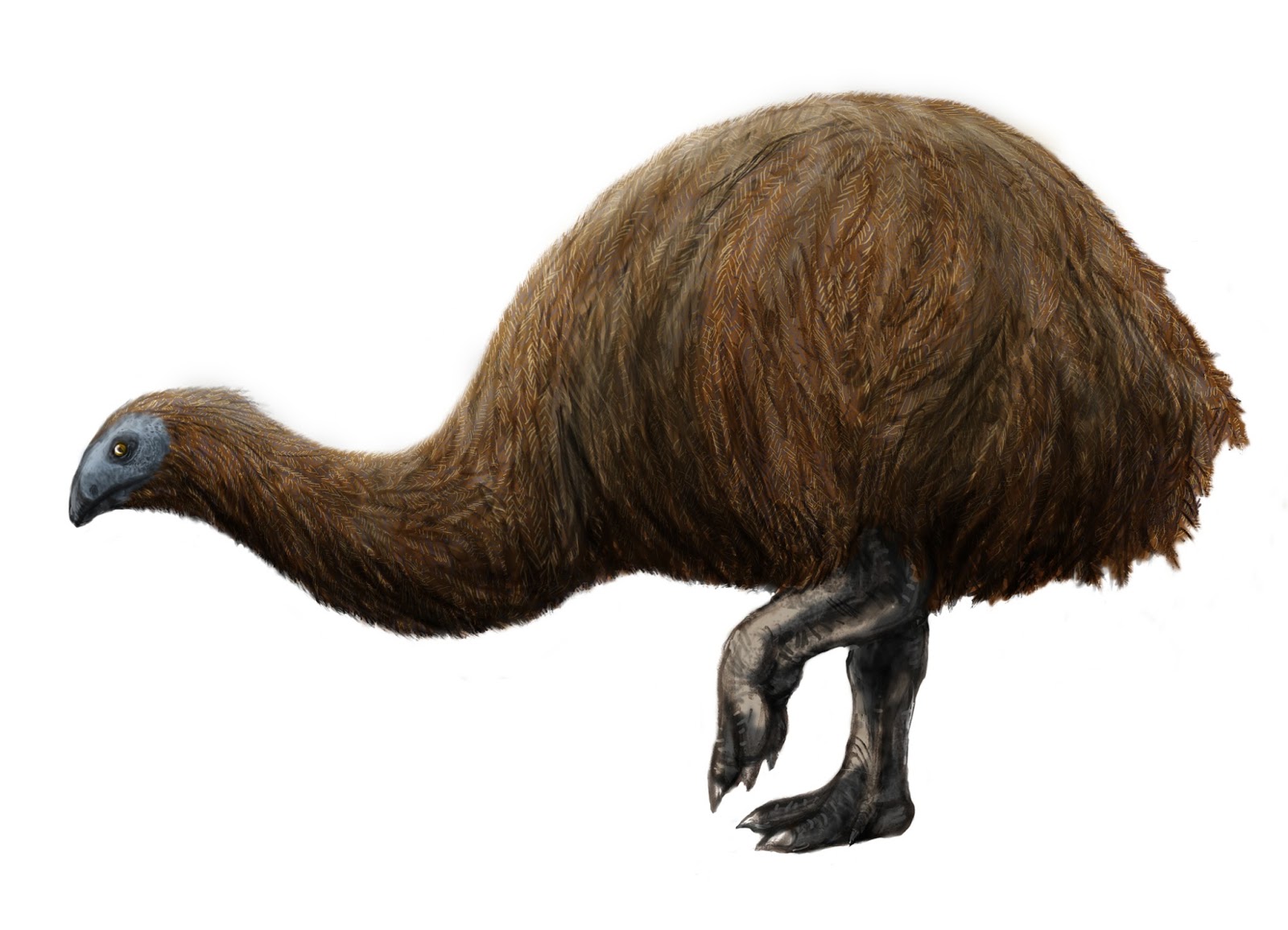
although in height Sclater's cassowary was no taller than Bennett's dwarf moa C.
bennetti due to its very stout but short legs, in overall proportions it
was exceptionally robust – so much so, in fact, that he went so far as to liken
its form to that of the bulkiest, sturdiest species of New Zealand moa, the
aptly-named heavy-footed moa Pachyornis elephantopus (elephantopus
actually translates as 'elephant-footed'). Moreover, its very bulky body was
set very low on its legs, drawing further comparisons with the latter moa.
Bearing in mind that Sclater's cassowary is
known entirely from just one specimen, however, it would not be outlandish to
explain its remarkable form merely as extreme individual variation upon the
normal single-wattled cassowary theme – but its body stature and poise were not
the only anomalous features exhibited by this extraordinary bird.
Reconstruction of the heavy-footed
moa Pachyornis elephantopus from here (© niaolei.org.cn)
Equally bizarre were its feathers, which
were not disintegrated in structure like those of all other cassowaries, and
were abnormally long on its rump, to the extent that some of those latter
feathers actually touched the ground. Moreover, by being not only compressed
laterally but also depressed posteriorly, its casque seemed to be a unique
composite of the two different casque forms individually recorded from all
other cassowaries. Even its cry – described by Rothschild as very loud and
resembling a deep roar – instantly distinguished this most contentious of
cassowaries from all others.
So what exactly was Sclater's
cassowary – simply a one-off freak specimen of the single-wattled cassowary, or
might it possibly be the only scientifically recorded specimen of a
taxonomically distinct subspecies or even species in its own right? Over a
century later, we still have no answer to this tantalising question, but as its
holotype is retained at Tring Natural History Museum, we must hope that one day
some genetic analyses will be conducted upon it to reveal its true identity at
last.
Bennett's cassowary or
mooruk, painted by Keulemans in 1872 (public domain)
Among the wealth of myth and folklore
associated with cassowaries is a most curious conviction fostered by such
tribes as the Huri and the Wola from Papua New Guinea's remote Southern
Highlands Province. According to their lore, a female Bennett's cassowary
maintained in captivity is able to reproduce even if she is not provided with a
male partner. All that she has to do is locate a specific type of tree and
thrust her breast against its trunk, again and again, in an ever-intensifying
frenzy, until at last she collapses onto the floor in a state of complete
exhaustion, suffering from internal bleeding that festers and clots to yield
yellow pus. This in turn proliferates, producing yolk-containing eggs that the
female lays, and which are incubated and hatch as normal.
Although a highly bizarre tale, it is worth
recalling that cases of parthenogenesis (virgin birth) are fully confirmed from
a few species of bird, notably the common turkey, in which the offspring are
genetically identical to their mother. Perhaps, therefore, this odd snippet of
native folklore should be investigated - just in case (once such evident
elements of fantasy as the pus-engendered yolk are stripped away) there is a
foundation in fact for it, still awaiting scientific disclosure.
Bennett's cassowaries, painted by John Gould during the 19th Century (public domain)
An even more imaginative Wola belief
regarding Bennett's cassowary concerns its migratory habits. As revealed by
Paul Sillitoe during a filming expedition to Wola territory in 1978 (Geographical
Journal, May 1981), these birds only visit this area when the fruits upon which
they feed are in season here. At the season's end they travel further afield
again, but the Wola are convinced that they have gone to live in the sky with a
thunder goddess (though they neglect to reveal how these flightless birds
become airborne!).
A pair of double-wattled
cassowaries, painted by Henry Constantine Richter in 1851 (public domain)
Irrespective of these charming tales, it is
true that for flightless birds the cassowaries do exhibit an extraordinarily
dispersed, far-flung distribution - occurring on a surprising number of
different islands. Admittedly, many of these islands were once joined to one
another in the not-too-distant geological past, but some ornithologists remain
doubtful that the cassowaries' range is entirely natural - suggesting instead
that they may have been introduced onto certain of their insular territories via
human agency.
Double-wattled cassowaries,
painted by John Gould, from his book The Birds of New Guinea and the
Adjacent Papuan Islands (1888) (public domain)
For example, Drs A.L. Rand and Thomas
Gilliard proposed in their Handbook of New Guinea Birds (1967) that
C. casuarius may well have been brought by humans to Seram. In view of the
New Guinea tribes' very extensive trade in cassowaries - not only transporting
them across land but also exporting them far and wide in boats (a tradition
known to have been occurring for at least 500 years) - such a possibility is by
no means implausible. It was raised in 1975 by Dr C.M.N. White too, within the
British Ornithologists Club's bulletin, and he offered a corresponding
explanation in the same publication the following year for the presence on New
Britain of Bennett's cassowary.
Incidentally, another intriguing
zoogeographical anomaly featuring Bennett's cassowary is its unexpected
portrayal upon a postage stamp issued on 1 July 1909 by North Borneo (now the
Borneo-sited Malaysian state of Sabah), bearing in mind that this species does
not occur anywhere on Borneo. In fact, as revealed in The Stamps and Postal
History of North Borneo, Part III: 1909-1938 by L.H. Shipman and P.K.
Cassels, the explanation for this philatelic puzzle is that the intended bird
for this particular stamp was not Bennett's cassowary at all, but rather a megapode
(specifically the Philippine megapode Megapodius cumingii, which is
indeed native here – not the dusky megapode M. freycinet,
incidentally, as erroneously claimed in certain sources, which is not
native here). But somehow the wrong bird was chosen for the design, and the
stamp was duly prepared and issued before the mistake was discovered. In wry
recognition of the error, however, this stamp has been referred to ever since
in North Borneo as the megapode stamp.
The infamous cassowary
postage stamp issued in 1909 by North Borneo (public domain)
Probably the most unexpected variation on
the theme of displaced cassowaries, however, is a case aired by Drs G.H. Ralph
von Koenigswald and Joachim Steinbacher in a Natur und Museum paper
published in 1986. They reported the presence of a bas-relief glyph depicting a
readily-identifiable cassowary at Tjandi-Panataran – a Hindu temple not far from Wadjak in
eastern Java, and dating from around the 12th-15th
Century AD. As there is no evidence to imply that Java ever harboured a
native form of cassowary, this depiction lends itself to a variety of different
cultural interpretations.
The cassowary glyph present
at eastern Java's Tjandi-Panataran temple (public domain)
For instance, it suggests that the
centuries-old tradition of cassowary trade and export from New Guinea may have even
extended as far afield as Java, or at least that the cassowary had been taken
to Java from some other nearby island that may have originally received it from
New Guinea (e.g. Banda, Seram).
Alternatively, the depiction might simply have been based upon descriptions
of cassowaries, recounted to the Javan natives by visiting New Guinea traders.
There is even the chance that the Javan tribe responsible for this glyph was
descended from one that had migrated to southeast Asia from New
Guinea, and the glyph's image
was inspired by orally-preserved traditions among this translocated people of
birds known to their ancestors in New
Guinea.
When dealing with birds as unforgettable as
the incomparably compelling and effortlessly memorable cassowaries, (almost)
anything seems possible!
Westermann's cassowaries, painted by John Gould during the 19th Century (public domain)
This ShukerNature blog article is
excerpted and greatly expanded from my book The
Beasts That Hide From Man.




 Posts
Posts