Dr KARL SHUKER

Zoologist, media consultant, and science writer, Dr Karl Shuker is also one of the best known cryptozoologists in the world. He is the author of such seminal works as Mystery Cats of the World (1989), The Lost Ark: New and Rediscovered Animals of the 20th Century (1993; greatly expanded in 2012 as The Encyclopaedia of New and Rediscovered Animals), Dragons: A Natural History (1995), In Search of Prehistoric Survivors (1995), The Unexplained (1996), From Flying Toads To Snakes With Wings (1997), Mysteries of Planet Earth (1999), The Hidden Powers of Animals (2001), The Beasts That Hide From Man (2003), Extraordinary Animals Revisited (2007), Dr Shuker's Casebook (2008), Karl Shuker's Alien Zoo: From the Pages of Fortean Times (2010), Cats of Magic, Mythology, and Mystery (2012), Mirabilis: A Carnival of Cryptozoology and Unnatural History (2013), Dragons in Zoology, Cryptozoology, and Culture (2013), The Menagerie of Marvels (2014), A Manifestation of Monsters (2015), Here's Nessie! (2016), and what is widely considered to be his cryptozoological magnum opus, Still In Search Of Prehistoric Survivors (2016) - plus, very excitingly, his four long-awaited, much-requested ShukerNature blog books (2019-2024).

Dr Karl Shuker's Official Website - http://www.karlshuker.com/index.htm

IMPORTANT: To view a complete, regularly-updated listing of my ShukerNature blog's articles (each one instantly clickable), please click HERE!

IMPORTANT: To view a complete, regularly-updated listing of my published books (each one instantly clickable), please click HERE!

IMPORTANT: To view a complete, regularly-updated listing of my Eclectarium blog's articles (each one instantly clickable), please click HERE!

IMPORTANT: To view a complete, regularly-updated listing of my Starsteeds blog's poetry and other lyrical writings (each one instantly clickable), please click HERE!

IMPORTANT: To view a complete, regularly-updated listing of my Shuker In MovieLand blog's articles (each one instantly clickable), please click HERE!

IMPORTANT: To view a complete, regularly-updated listing of my RebelBikerDude's AI Biker Art blog's thematic text & picture galleries (each one instantly clickable), please click HERE!

Search This Blog


PLEASE COME IN, I'VE BEEN EXPECTING YOU...

PLEASE COME IN, I'VE BEEN EXPECTING YOU...
WELCOME TO SHUKERNATURE - ENJOY YOUR VISIT - BEWARE OF THE RAPTOR!


Showing posts with label flores man. Show all posts

Saturday, 14 November 2020

OVER TO THE ORANG KARDIL – SUMATRA'S 'OTHER' ORANG PENDEK?

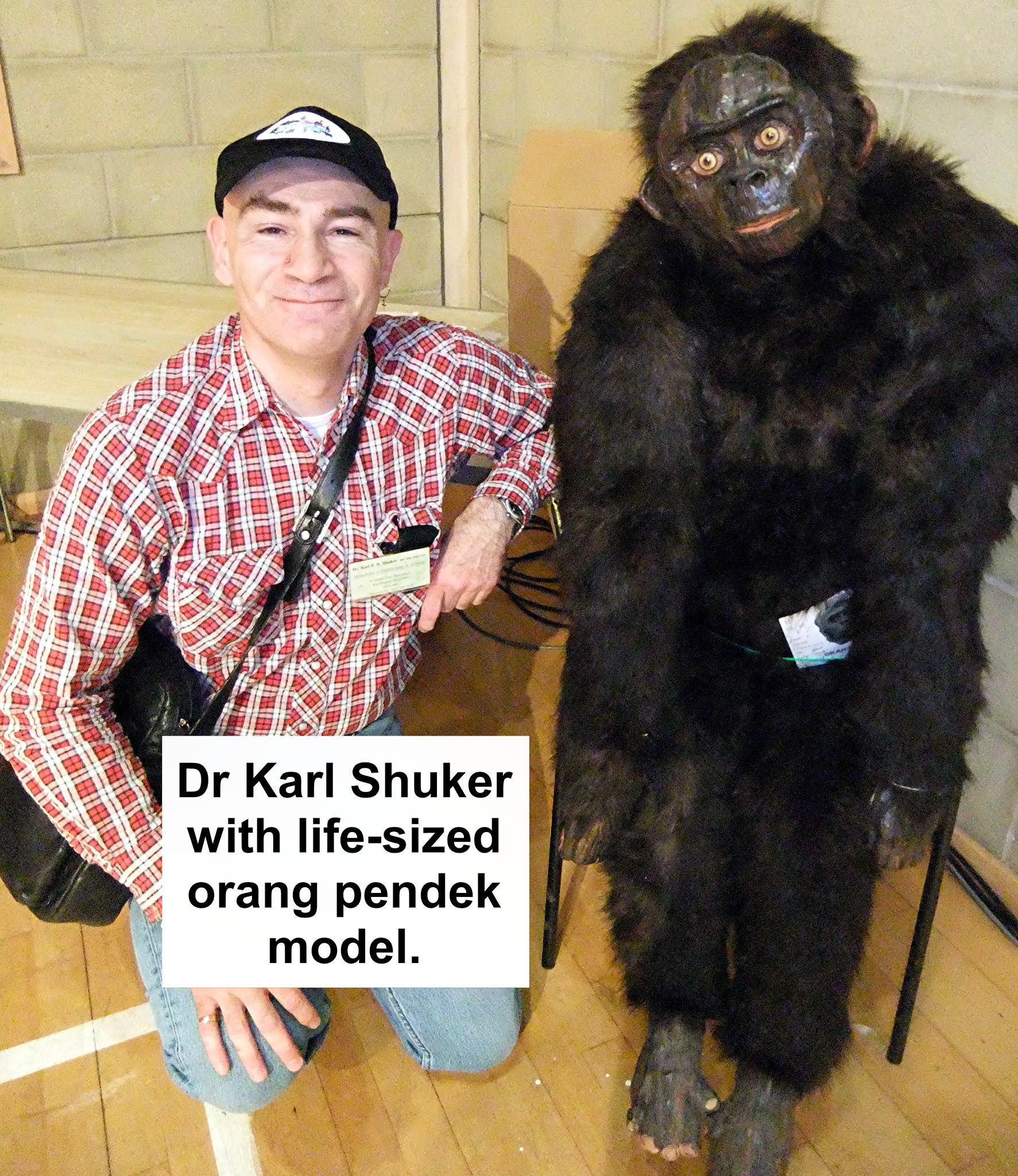
Alongside a life-sized representation of the orang pendek created for the CFZ (© Dr Karl Shuker / CFZ)

Once upon a long ago in the wonderful world of cryptozoology, only a single type of diminutive Indonesian mystery man-beast was widely reported – the orang pendek ('short man') or sedapa of Sumatra, in this southeast Asian country's Greater Sundas island group, reported by locals and Westerners alike for well over a century. Physically represented by unidentifiable hair samples and wholly distinct footprint casts, this reddish-furred, bipedal, tailless entity is usually said to stand a mere 3-4.5 ft tall.

Plaster cast of an alleged orang pendek footprint, revealing its very distinctive form (© Dr Karl Shuker)

Suggested identities on offer for the orang pendek have ranged from a terrestrial form of orang utan or gibbon to a bona fide human species, possibly even a relict representative of our own species' predecessor, Homo erectus. So far, so simple (relatively speaking).

An orang utan standing upright in the wild (© Tom Low/Wikipedia – public domain)

Then in 2003, the first skeletal remains of what, after much contention, is nowadays accepted by most researchers to have been a bona fide diminutive human species (rather than merely stunted, freak Homo sapiens) were found on the small island of Flores in Indonesia's Lesser Sundas group. Formally dubbed Homo floresiensis but known colloquially as Flores Man or the hobbit, it is believed to have only stood around 3.5 ft tall, and to have become extinct at least 50,000 years ago – or did it?

Replica skull of Flores Man aka the hobbit (© Dr Karl Shuker)

Researchers began hearing native folklore and stories concerning the ebu gogo, described not only as very short human entities but also as still very much alive in the wilder, more remote regions of Flores. If such beings really do exist, might they be living, modern-day representatives of Homo floresiensis? Some cryptozoological investigators have taken this line of speculation even further, by linking Flores Man with the Sumatran orang pendek, even though the latter seems taller and more ape-like, not to mention zoogeographically separate. But then came news of an additional component to the Indonesian man-beast/mini-human mystery that makes matters even more complex and potentially confusing.

A reconstruction of the orang pendek as a hairy ape-like biped (© Randy Merrill)

As publicised recently in a number of online articles and reports (click here to access one of them), Sumatra may also be home to a second, fundamentally different man-beast from the orang pendek, one which, moreover, is very reminiscent of the ebu gogo and, in turn, Flores Man. Known as the orang kardil (aka orang kardill), according to native testimony this entity is definitely some form of human, not ape, hunting aggressively with spears and even deemed to have killed villagers on occasion, but is even shorter in stature than the orang pendek.

Reconstruction of the possible appearance and stature of the ebu gogo compared with an average human (© Connor Lachmanec)

Consequently, is it possible that a truly miniature Indonesian species of human has existed at one time or another not just on Flores, due to its savage nature has infiltrated traditional Indonesian folklore under various local names such as ebu gogo and orang kardil, and may even still survive today in remote regions of Flores, Sumatra, and perhaps elsewhere in this multi-island country too? All of this is total conjecture, of course, but less than 20 years ago even Flores Man's own existence was entirely unknown to science.

Orang pendek, orang kardil, ebu gogo – are such entities more than just a briefly-glimpsed face in the forest? (© William M. Rebsamen)


UPDATE - 14 November 2020

Just a few hours after I uploaded my above article onto ShukerNature and posted links to it in my various Facebook groups, CFZ cryptozoologist Richard Freeman, who has led CFZ expeditions seeking the orang pendek in Sumatra, posted the following fascinating account regarding the orang kardil in my 'Beasts of Legend, Myth & Fantasy' FB group:

"Our late guide Sahar Dimus said that his father and a friend had encountered the Orang-kardill in 1981. The pair had been in a remote part of what is now Kerinci Sablat National Park trading rice for goods in isolated villages. One evening whilst camping in the jungle and cooking rice a tiny man like creature with long hair on the head but a naked body emerged from the rainforest and tried to steal the rice. Sahar's father's friend killed it with a parang (similar to a machete). Then more of the creatures ran out of the forest armed with bamboo spears and killed the man. They did not attack Sahar's father. Sahar said there had been no recent sightings of orang-kardill though there were many of orang-pendek. On my last Sumatran trip a large group of witnesses were gathered in Sahar's village close to Gunung Tuju. All had seen orang-pendek and / or its tracks but none had seen orang-kardill or had heard of any recent sightings. They were quite clear that the two were different."

Thank you so much for making this greatly-welcomed information available, Rich!


 2ND UPDATE - 15 November 2020

Earlier today, Indonesian Facebook friend Ben Haryo informed me of a third spelling for this entity's native name - 'orang kerdil'. He also informed me that the term:

"...means "dwarf" in our Indonesian language. We believe they exist as a race of very reclusive tribe of diminutive human-like creatures, but more human than spirits. Their counterparts are Tuyul who are not humans but evil genies."

Thanks very much, Ben, for these very valuable additional details!


Friday, 3 January 2014

FLORES HOBBITS AND THE GIANT STORK OF DOOM


Homo floresiensis vs Leptoptilos robustus (© Hodari Nundu/deviantart)

I am extremely fortunate to count among my friends and colleagues a number of extremely talented artists, and the pseudonymous 'Hodari Nundu' (aka 'Justin Case') is one of these very gifted persons, as immediately demonstrated by the particularly vibrant example of his artwork presented above (click it to enlarge it), which showcases two most remarkable island-confined species.

Where on Earth would you find all within the very selfsame location a unique, Alice-in-Wonderland-reminiscent assemblage of mega-rats and mini-humans, gargantuan lizards, dwarf elephants, and gigantic storks? Only on Flores – a small island in Indonesia's Lesser Sundas group that provides some classic examples of both island gigantism and insular dwarfism.

Between 20,000 and 10,000 years ago, it was home to: two extra-large species of giant rat, Papagomys armandvillei and P. theodorverhoeveni, the former of which still survives today (and indeed, according to some researchers the latter may do too); a dwarf subspecies of elephant-related stegodont proboscidean Stegodon florensis insularis, which died out around 12,000 years ago and is the youngest stegodont form on record from southeast Asia; the Komodo dragon Varanus komodoensis, the world's largest living species of lizard, which still survives on Flores today (as well as on the neighbouring islands of Komodo, Rintja, and Padar) and undoubtedly preyed upon Flores's dwarf stegodonts; plus the two highly significant species featured in this ShukerNature article's opening illustration.

If it can't see me, it can't eat me, right? Wrong! Never under-estimate its very highly-developed sense of smell! Posing with a life-sized Komodo dragon model at Chester Zoo, England (© Dr Karl Shuker)

One of these is the now world-famous 'hobbit' – the informal nickname given to Flores Man Homo floresiensis. With its most complete recorded specimen estimated at approximately 18,000 years old, this controversial, diminutive species of hominid apparently stood little more than 3 ft tall, may be descended from Homo erectus, and is believed to represent another case of insular dwarfism. Its first scientifically-documented remains were discovered in September 2004 at Liang Bua Cave in western Flores.

Life-size replicas of Homo erectus and Homo floresiensis skulls for comparison purposes (© Dr Karl Shuker)

And the other species, whose remains were also uncovered in that very same cave, may have been one of the Flores hobbits' deadliest antagonists. It is a marabou stork, but far bigger than any of today's trio of marabou species. Yet it remained undescribed by science until as recently as 2010. Formally dubbed Leptoptilos robustus, the giant stork of Flores stood approximately 6 ft tall and weighed up to 35 lb, due to its extremely heavy leg bones – on account of which it is likely to have been predominantly if not exclusively flightless.

Even so, Smithsonian Institution palaeontologist Dr Hanneke J.M. Meijer and Dr Rokus A. Due from Jakarta's National Center for Archaeology, who jointly described its fossilised remains (dated at between 20,000 and 50,000 years old) in a Zoological Journal of the Linnean Society paper, believe that it was still theoretically capable of hunting and devouring juvenile hobbits. Having said that, there is presently no direct evidence confirming such activity; in the words of Dr Meijer as spoken during a 2010 interview with the UK's BBC television news service: "Whether or not this animal may have eaten hobbits is speculative: there is no evidence for that." Then again, as Dr Meijer also conceded in that same interview: "But can not be excluded either."

In European tradition, the stork brings newborn human babies to their parents - but in a major reversal of that benevolent role, Indonesia's giant stork of doom may conceivably have hunted down such babies (possibly even older infants too) and devoured them. Only on the topsy-turvy island of Flores!

Were the hobbits of Flores stalked by a stork? (© Inge van Noortwijk)