Dr KARL SHUKER

Zoologist, media consultant, and science writer, Dr Karl Shuker is also one of the best known cryptozoologists in the world. He is the author of such seminal works as Mystery Cats of the World (1989), The Lost Ark: New and Rediscovered Animals of the 20th Century (1993; greatly expanded in 2012 as The Encyclopaedia of New and Rediscovered Animals), Dragons: A Natural History (1995), In Search of Prehistoric Survivors (1995), The Unexplained (1996), From Flying Toads To Snakes With Wings (1997), Mysteries of Planet Earth (1999), The Hidden Powers of Animals (2001), The Beasts That Hide From Man (2003), Extraordinary Animals Revisited (2007), Dr Shuker's Casebook (2008), Karl Shuker's Alien Zoo: From the Pages of Fortean Times (2010), Cats of Magic, Mythology, and Mystery (2012), Mirabilis: A Carnival of Cryptozoology and Unnatural History (2013), Dragons in Zoology, Cryptozoology, and Culture (2013), The Menagerie of Marvels (2014), A Manifestation of Monsters (2015), Here's Nessie! (2016), and what is widely considered to be his cryptozoological magnum opus, Still In Search Of Prehistoric Survivors (2016) - plus, very excitingly, his four long-awaited, much-requested ShukerNature blog books (2019-2024).

Dr Karl Shuker's Official Website - http://www.karlshuker.com/index.htm

IMPORTANT: To view a complete, regularly-updated listing of my ShukerNature blog's articles (each one instantly clickable), please click HERE!

IMPORTANT: To view a complete, regularly-updated listing of my published books (each one instantly clickable), please click HERE!

IMPORTANT: To view a complete, regularly-updated listing of my Eclectarium blog's articles (each one instantly clickable), please click HERE!

IMPORTANT: To view a complete, regularly-updated listing of my Starsteeds blog's poetry and other lyrical writings (each one instantly clickable), please click HERE!

IMPORTANT: To view a complete, regularly-updated listing of my Shuker In MovieLand blog's articles (each one instantly clickable), please click HERE!

IMPORTANT: To view a complete, regularly-updated listing of my RebelBikerDude's AI Biker Art blog's thematic text & picture galleries (each one instantly clickable), please click HERE!

Search This Blog


PLEASE COME IN, I'VE BEEN EXPECTING YOU...

PLEASE COME IN, I'VE BEEN EXPECTING YOU...
WELCOME TO SHUKERNATURE - ENJOY YOUR VISIT - BEWARE OF THE RAPTOR!


Showing posts with label sea-monkey. Show all posts

Monday, 8 April 2019

PUBLISHED TODAY! – SHUKERNATURE BOOK 1: ANTLERED ELEPHANTS, LOCUST DRAGONS, AND OTHER CRYPTIC BLOG BEASTS

Hot off the press – with magnificent front-cover artwork by Anthony Wallis, here is my very first ShukerNature book! (© Dr Karl Shuker/Coachwhip Publications)


If I wish to read a blog which is *only* about the narrow, limited topics of my own interests, I'll write it myself. If I wish to read a well written, extremely well researched blog on a wide variety of suspected, imagined, claimed, portrayed creatures from the mundane to the monstrous, from the Byzantine and the bizarre to the modern and the miraculous - I'll read ShukerNature.

Richard S. White, retired museum professional and vertebrate palaeontologist 
 – Facebook, 12 August 2017


It's been a long time coming – over eight years, in fact, since I first mooted the idea of preserving my ShukerNature blog posts in permanent, hard-copy book format – but it's finally here. In what is planned to be a regular series, today, 8 April 2019, sees the official publication of ShukerNature Book 1: Antlered Elephants, Locust Dragons, and Other Cryptic Blog Beasts.

Although I first became yoked to the internet via an email account back in 1997, followed by my own official website a year later (created by the late, much-mourned American cryptozoologist Scott T. Norman), I steadfastly remained immune to the world of online blogging until as relatively recently as 2009 – 20 January 2009, to be precise, when I finally gave in to temptation.

For after the Centre of Fortean Zoology (CFZ) kindly established it for me in tandem with their own 'umbrella' of CFZ-affiliated blogs called the CFZ Bloggo, that was the fateful date upon which a short item entitled 'Wolves of the Weird' (click here to read it) became the first of what currently stands at over 600 illustrated articles of varying lengths and exceedingly varied subjects that have been researched, written, and uploaded by me onto my very own, unique blog. As its many loyal readers will confirm, ShukerNature is devoted to cryptozoology, zoomythology, anomalous animals, animal anomalies, and unnatural history of every kind, as well as some investigations and reviews of certain ostensibly zooform entities that may be of paranormal, supernatural identity rather than corporeal creatures of zoology. It has also enabled me to preview various in-progress and forthcoming books of mine from 2009 onwards, and, via its Comments section at the end of each of my articles, allows readers to post their own thoughts, opinions, and information, thereby becoming a valuable source of original ideas, news, and data.

Knowing that my blog's contents would cover such a vast diversity of subjects, and that they would all be written in my own particular style (unencumbered by the necessities to conform to any one specific style convention as is so often the case when writing for specific publishers or publications), posed an especial problem for me with regard to what my blog's name would be. How could I possibly come up with a title that would encompass all of those subjects in a succinct yet definitive manner, and also emphasise that these were my writings, penned in my style? In fact, as it turned out, I didn't come up with such a title – someone else did.

That person was fellow cryptozoologist and CFZ colleague Oll Lewis. After hearing that I was having trouble coining a suitable title for my blog, he achieved what to me seemed the impossible – suggesting a title that fulfilled every requirement, covered every subject, incorporated a direct reference to me in it, and much more besides, yet, incredibly, did all of this by way of just a single word! And that word, which did indeed become my blog's title? ShukerNature. Oll has never disclosed his inspirations for what was indeed a truly inspired suggestion; but because he and I are of similar generations, I think it likely that a certain book and also quite possibly a certain song that both achieved considerable fame during our youth may have played their part, consciously or otherwise.

The book was the bestseller Supernature, written by the late anthropologist/ethologist Dr Lyall Watson, and first published in 1973. Its self-explanatory subtitle A Natural History of the Supernatural also set the scene for many of his equally-acclaimed future books; as did its very memorable front-cover illustration by renowned American artist Jerry Pinkney, depicting a flowering plant growing out of an egg. Indeed, this eyecatching artwork became something of an icon in its own right (and may be a homage to 'Geopoliticus Child Watching the Birth of the New Man' - a famous painting from 1943 by the celebrated Spanish surrealist artist Salvador Dali, which contains a reminiscent image). And speaking of homages:

A ShukerNature homage to Dr Lyall Watson's inspirational book Supernature and to Jerry Pinkney's iconic front-cover illustration for it (© Mark North / © Jerry Pinkney - reproduced here on a strictly non-commercial Fair Use basis for educational/review purposes only)

The song, entitled 'SuperNature' and released in 1977, was a disco classic by Cerrone (aka the Italio-French disco drummer/composer/record producer Marc Cerrone). In its original format, more than 10 minutes long, this song was the title (and opening) track of Cerrone's third album; but in a shorter format, just under 4 minutes long, it hit the singles charts all around the world in 1978. Its verses' lyrics (written by an uncredited Lene Lovich) took as their unusual theme for a dance song the dangers of tampering with the environment, turning ordinary creatures into dangerous monsters, with its infuriatingly-catchy chorus simply the repeatedly-sung word 'SuperNature'.

Thus was my blog, ShukerNature, born. (Amusingly, some time afterwards, a reader wrote to me saying how he had always been puzzled by my blog's title, wondering how and where it had originated – until one day, that is, when, while he had been thinking about this mystery yet again, Cerrone's song had suddenly begun to play inside his head, and the proverbial penny duly dropped with a loud clang!)

Within just a couple of years from my blog's creation, I was already receiving enquiries from readers as to whether I would be producing a ShukerNature companion book, or books, at some stage, containing selections of its most popular and intriguing blog articles. And when I enquired both on the blog itself and also via my various cryptozoology-linked Facebook pages and groups (including one devoted specifically to ShukerNature) whether there was indeed an interest out there for such a project, I swiftly received a very emphatic affirmative.

An additional reason for doing so was that by converting selections of my ShukerNature articles into a hard-copy published format, they would be rendered permanently accessible in a manner that online data, so often ephemeral in status, can rarely emulate. For whereas a book, once in print, has a guaranteed existence, a website can exist online one moment and vanish the next, thereby expunging a fund of unique, irreplaceable information.

And so I began planning what at that stage I was referring to as ShukerNature: The Book, alongside various additional writings. However, as sometimes happens, life – and death – had other plans for the direction in which my future would take. Or, as my wise little Mom used to remind me gently if I railed against my dreams and ambitions faltering or falling into disarray: "Man proposes, but God disposes" (which is a translation of the Latin phrase 'Homo proponit, sed Deus disponit', from Book I, chapter 19, of The Imitation of Christ by the German cleric Thomas à Kempis).

Thus it came to pass that my blog book was set to one side, and other projects that for one reason or another needed to take precedence were duly completed and published in its stead. Notable among these were my second, long-planned, and extremely comprehensive dragons book – Dragons in Zoology, Cryptozoology, and Culture; a wide-ranging compilation of my most notable Loch Ness monster writings – Here's Nessie!; and of course my fully-updated, massively-enlarged, biggest-ever cryptozoology volume – Still In Search Of Prehistoric Survivors.

My three above-mentioned books (© Dr Karl Shuker)

These are all now published, and in the meantime the very many additional blog articles that I have continued to research, write, and post each year have provided me with an immensely expanded list of possible examples to include in my eventual ShukerNature compendium.

Formulating how such a book could be prepared, however, was not an easy task, and took a long time to accomplish to my own satisfaction. Indeed, the eventual volume that resulted proved to be so sizeable that the decision was finally taken to divide it into two separate ones, of equal length, to be published sequentially. Consequently, and after much deliberation in the choosing of its specific subjects, I now have great pleasure in publicising herewith on its official date of publication, 8 April 2019, the first of those two volumes, in what I hope will be an ongoing series of ShukerNature books.

Its contents – now saved forever from the vicissitudes of the internet, available for you to read and re-read whenever and wherever you choose to do, updated and expanded when new information has come my way since the original articles were uploaded online, and unequivocally unlike any other collection of writings, whether in print or out of it - document some of the most remarkable, spellbinding entities from my blog's furthest frontiers and most shadowy hinterlands.

After all, where else, within the covers of a single 418-page book (and sumptuously illustrated throughout via spectacular full-colour and rare vintage b/w pictures), are you likely to find such exotic zoological esoterica as locust dragons, antlered elephants, North America's alligator men and Egypt's crocodile children, reptilian seals and seal dragons, king hares and giant rabbits, fan-tailed mermen and scaly bishops, flying cats and even flying elephants, green tigers and blue lions, giant oil-drinking spiders and bemusing sea-monkeys, demonic dragonflies and fury worms, marginalia snail-cats and elephant rats, pukwudgies and Pigasus, ape-man Oliver, lightbulb lizards, mini-mummies, my very own mystery animal, and how ShukerNature famously hit the cryptozoological headlines globally with a series of astonishing world-exclusives exposing the long-awaited truth about Trunko?

To find out more about all of these, and numerous other no less fascinating, equally eclectic fauna too, loiter no longer – it's time to pay a visit to the weirdly wonderful (and wonderfully weird!) world of ShukerNature. So, please come in, I've been expecting you...

And if you're wondering how can I possibly follow all of that, the answer is simple – ShukerNature Book 2: Living Gorgons, Bottled Homunculi, and Other Monstrous Blog Beasts – due out later this year. And don't forget - you read about it here first!

You lookin' at me?? (© Dr Karl Shuker)

Last – but certainly not least – of all: I wish to offer a massive, sincere vote of thanks to all of you for reading and supporting my ShukerNature blog since its launch in 2009 – without your enthusiasm and interest, it could not have survived – and I look forward to sharing with you many more exotic, entertaining, esoteric, educational, and always thoroughly extraordinary wildlife secrets, controversies, mysteries, surprises, and curiosities, as well celebrating many more ShukerNature anniversaries, both online and in book form, through the years to come!

Copies of ShukerNature Book 1 can be ordered through all good bookstores, and can be purchased online at such outlets as Amazon UK (click here), Amazon USA (click here), and Barnes & Noble (click here). For further details concerning it and also my three previous books published by Coachwhip Publications, please click here.

Full cover wrap, including back-cover blurb (click picture to expand for reading purposes), from ShukerNatureBook 1 (© Dr Karl Shuker/Coachwhip Publications)


Monday, 29 June 2015

A SHORT HISTORY OF SEA-MONKEYS - FROM COMIC-BOOK ADVERTISEMENTS TO CRYPTOBIOTIC ARTEMIA


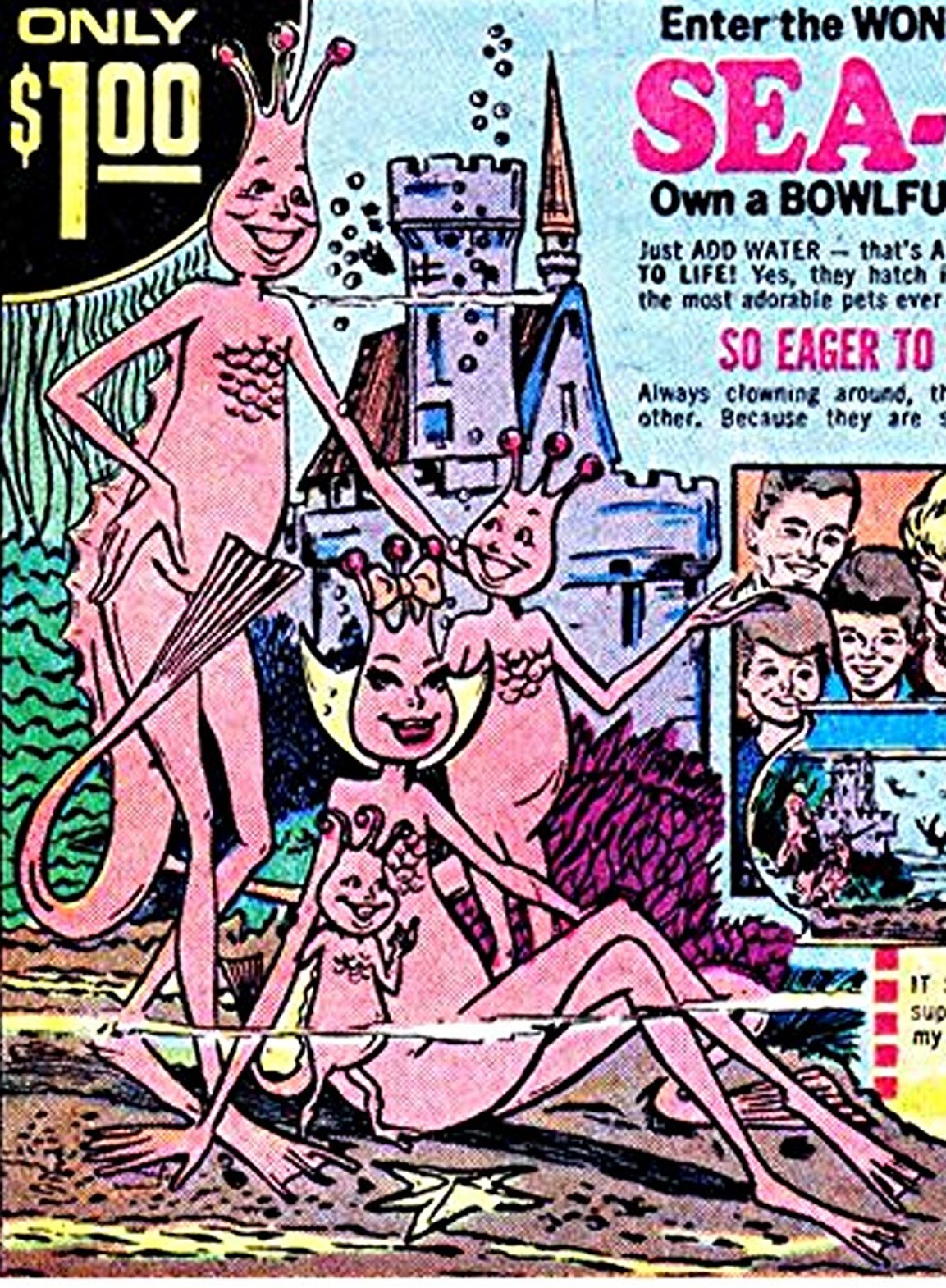
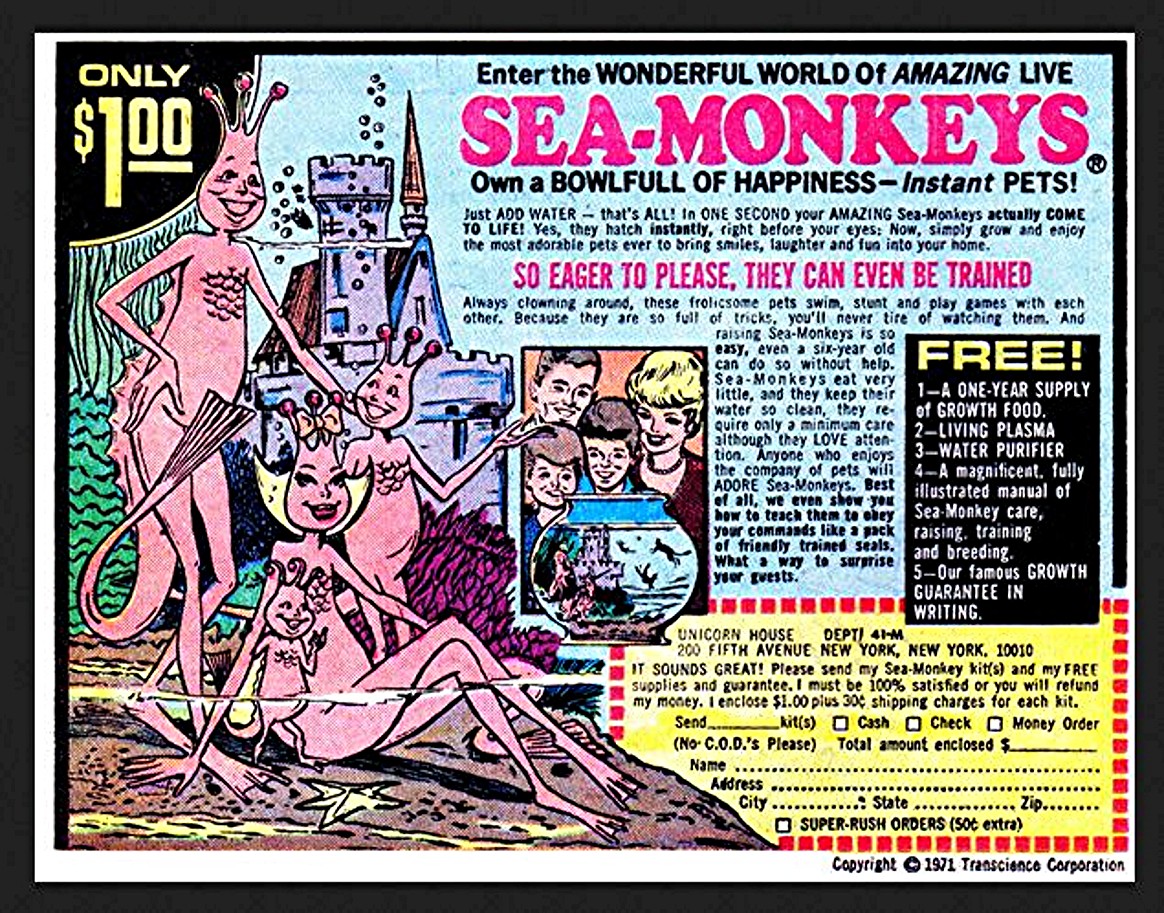
A mail-order advertisement for sea-monkeys that appeared in numerous American children's comic-books during the early 1970s - click picture to enlarge it for reading the advert (© Transcience Corporation / inclusion here strictly on Fair Use/non-commercial basis only)

As a child during the late 1960s and early 1970s, living in England, I enthusiastically supplemented my already-extensive reading of British comics with any American comic-books that I could find, especially ones published by Gold Key or Charlton that featured popular television cartoon characters from that time period. Moreover, browsing through them I not only enjoyed the comic strip stories themselves but also never failed to be equally captivated as well as wholly confused and thoroughly tormented in equal measure by a certain mail-order advertisement (reproduced at the beginning of this present ShukerNature blog article) that these comic-books frequently contained – captivated by the extraordinary entities that this advertisement offered for sale, yet confused by what seemed to be a self-evident fact that such entities couldn't possibly exist, and tormented because, as the comic-books were American and the mail-order advertisement required pre-payment in US dollars only ($1 plus 30c p&p), to be sent to an address in New York, USA, I couldn't readily purchase any of these entities directly myself and thence discover their true nature.

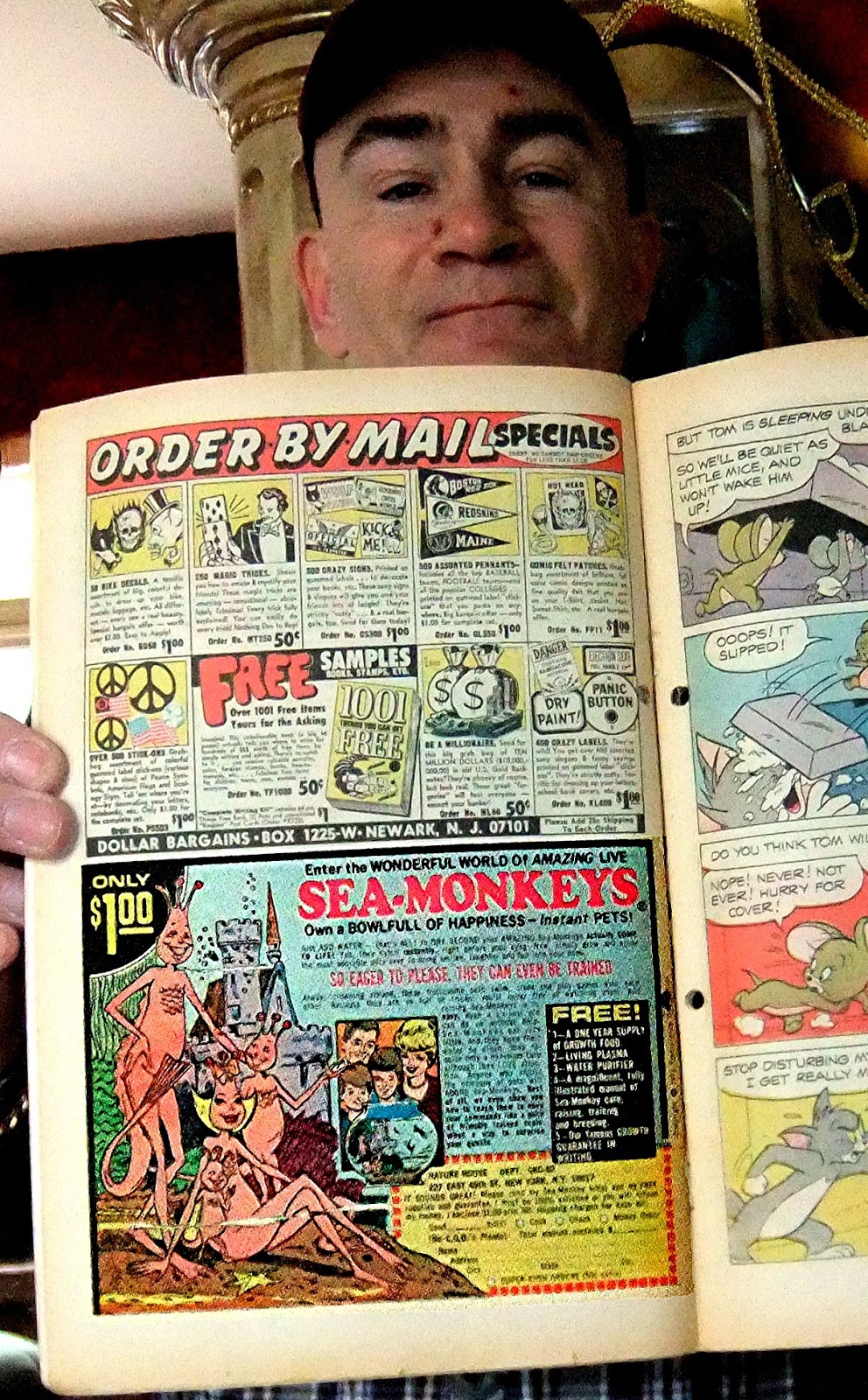
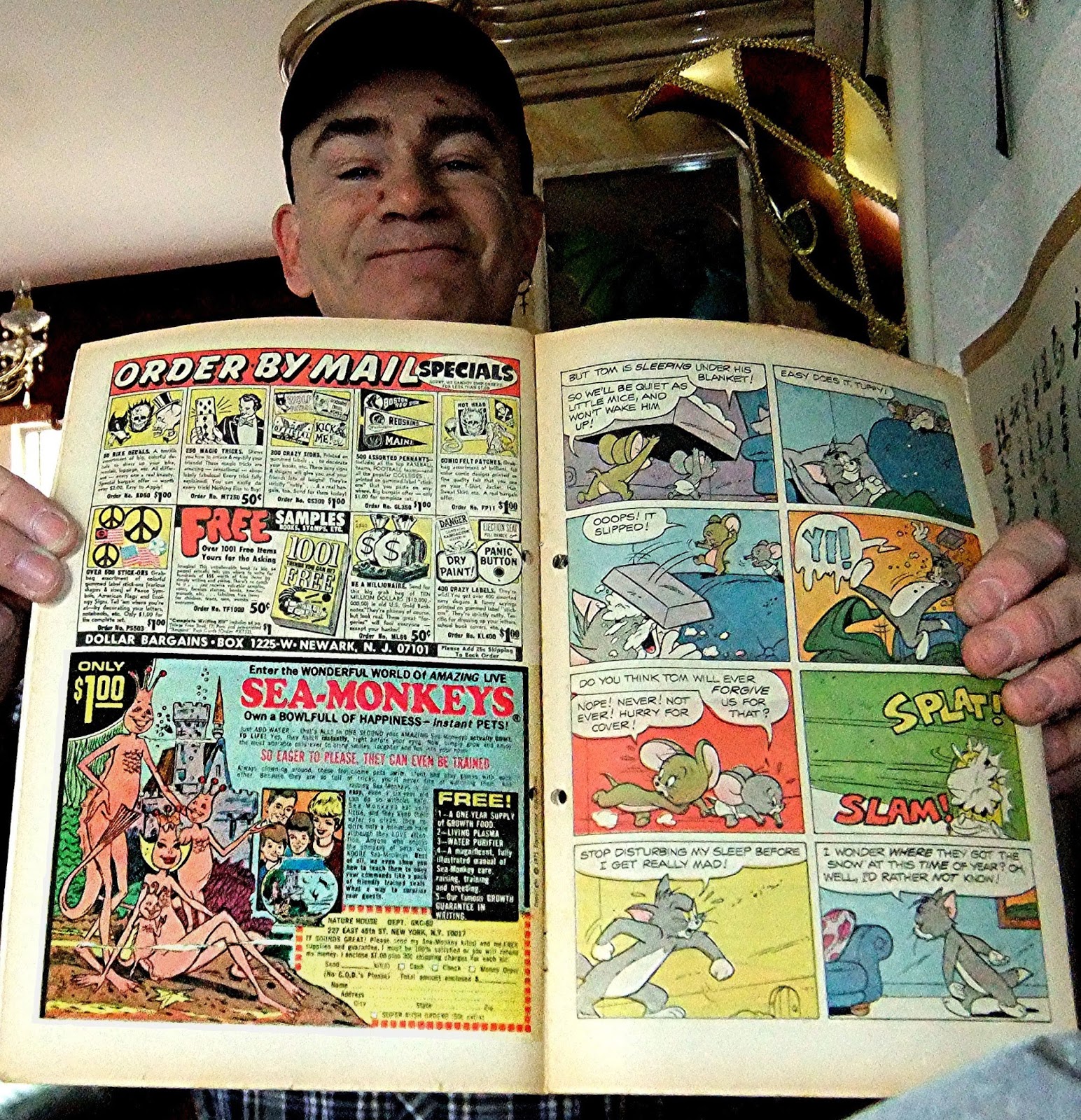
I still retain a representative selection of those comic-books from my childhood, and perusing some of them recently I was delighted to discover no fewer than three that actually contained this particular advertisement. Two of them were Tom and Jerry comic-books published by Gold Key, the issues in question being August 1972 (#265) and August 1973 (#273) respectively; the third was the November 1971 issue (#72) of Gold Key's Daffy Duck/The Road Runner comic-book.

Holding my August 1972 issue of Gold Key's Tom and Jerry comic-book open at the page containing the sea-monkeys advertisement – click picture to enlarge it for viewing the sea-monkeys advert in close-up detail (© Dr Karl Shuker/Gold Key/Metro-Goldwyn-Mayer Inc/Transcience Corporation / inclusion here strictly on Fair Use/non-commercial basis only)

As can be seen from this advertisement, the entities in question were referred to as sea-monkeys, and were depicted, astonishingly, as a family (father, mother, daughter, and young son) of tiny underwater-inhabiting humanoid beings, but sporting a long finned tail, normal fingered hands yet wholly webbed feet, three bauble-tipped spikes on top of their heads resembling a crown but seemingly constituting a physical part of their skull, a heavily-scaled chest in both male and female, plus a ridged back recalling that of a seahorse.

But that was not all. According to the advertisement, these incredible sea-monkeys hatched from eggs and came to life instantly when placed in water, and could even be trained to play games. Yet they allegedly required hardly any food or general maintenance, even keeping their water clean without any outside assistance.

As someone with a veritable library of wildlife books readily to hand even as a child, bought for me with great love over the years by my mother, my grandparents (my mother's parents), and my great-aunt, and whose precious information I'd hungrily devoured through time and constant re-reading in my relentless quest for ever more knowledge concerning animals (especially the more unusual ones), I was only too well aware that sea-monkeys did not feature in any of them, not by as much as a single sentence. (And because all of this took place many years before the internet was born, the world of instantly-accessible, near-infinite quantities of information that we all inhabit today – and which would surely have yielded the necessary details to solve the sea-monkey conundrum swiftly and conclusively – was nothing more than a sci-fi dream of the far-distant future back then.) So what on earth – or, more precisely, under the water – were these astonishing aquatic beings, these so-called sea-monkeys? How could they be explained? Various options came to mind.

Close-up of the sea-monkeys as portrayed in an early 1970s mail-order advertisement (© Transcience Corporation / inclusion here strictly on Fair Use/non-commercial basis only)

For instance: might it be possible, I wondered, that the entire sea-monkey scenario was simply a hoax – perhaps an ingenious means of enticing naïve and credulous youngsters reading the sea-monkey mail-order advertisement in their comic-books to send off money in the hope of purchasing miraculous little beings that in reality didn't exist, meaning therefore that the youngsters never received any sea-monkeys nor saw their money again either? Or could it be some form of highly imaginative publicity campaign for an entirely different product, but, if so, what might that product be? I even pondered over the prospect that perhaps sea-monkeys were indeed real but constituted a novel life-form that had somehow been created artificially by scientists (having said that, please bear in mind that I was still only a child back then, and one with a very vivid imagination to boot!).

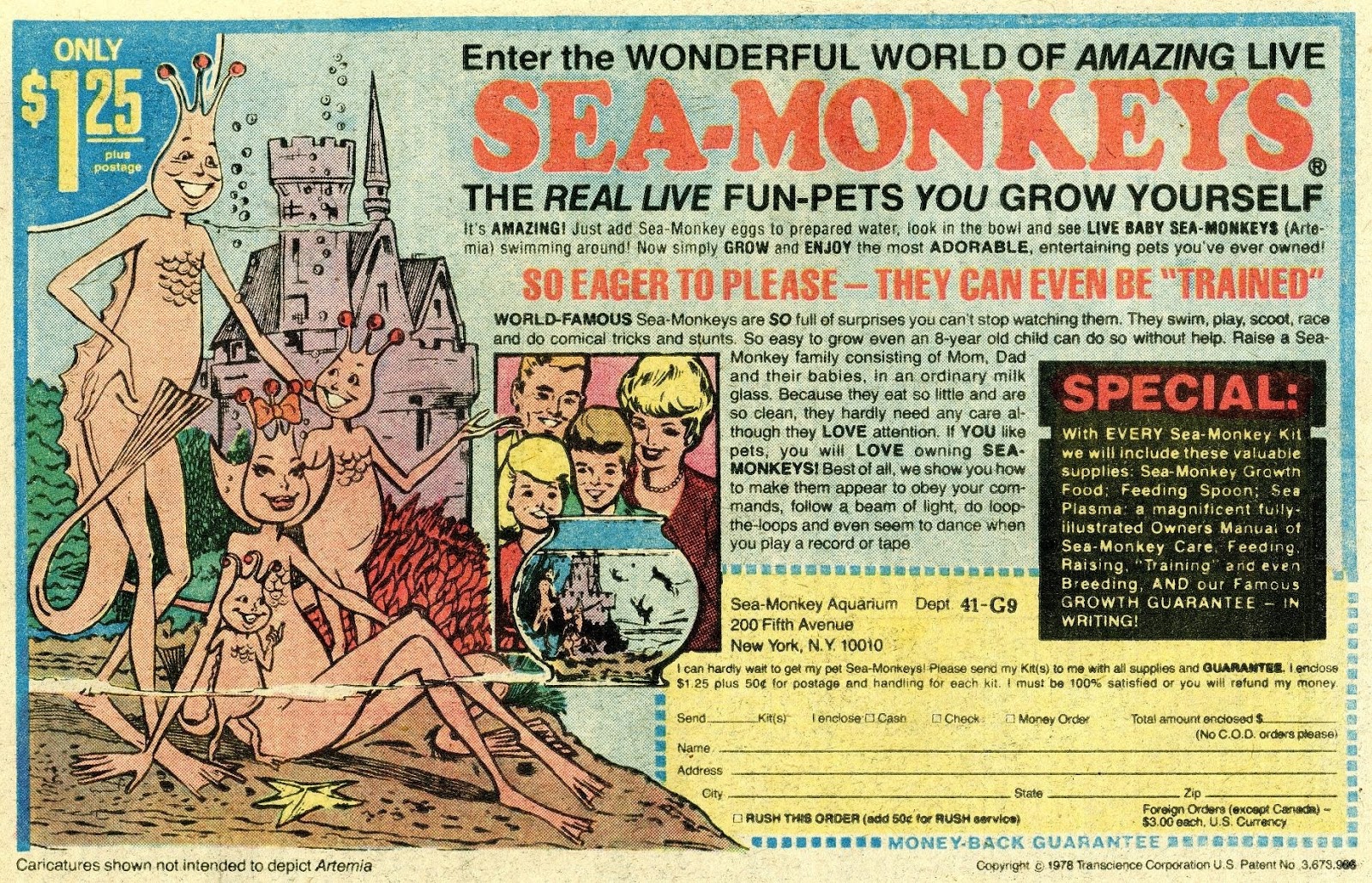
It took several years, but during the mid-1970s I finally discovered the answer to the riddle of the sea-monkeys, an answer so long awaited by me. One day, I happened to spot in an American comic-book a version of the sea-monkey advertisement that I had never seen before. True, the image of the sea-monkeys was exactly the same as before, and the details concerning them were much the same too (albeit slightly reworded and presented in a somewhat different layout, and also incorporating a minor increase in required pre-payment for the sea-monkeys, from $1 to $1.25, plus 50c p&p). But what made this particular version of the advertisement so significant to me was that it contained a small yet very telling amendment.

As can be seen below in the following reproduction of this amended advertisement, a brief disclaimer was present in small print along the bottom edge of the advert, which read: "Caricatures shown not intended to depict Artemia". With those fateful words, the mystery that (at least for me) had long surrounded the sea-monkeys was instantly and comprehensively dispersed – the cat was finally out of the bag, or, to quote a more zoologically apt metaphor, the shrimps were finally in the net!

A 1976 comic-book advertisement for sea-monkeys that included a disclaimer which provided an answer to the riddle of these perplexing beings' true nature - click picture to enlarge it for reading the advert (© Transcience Corporation / inclusion here strictly on Fair Use/non-commercial basis only)

For not only had the advertisement's whimsical sea-monkey illustrations been exposed by the disclaimer as being merely caricatures rather than accurate representations of these entities' true appearance, the sea-monkeys themselves had been unmasked, having been shown not to be entities in any humanoid sense of the word. Instead, as unequivocally identified in the disclaimer, they were Artemia – i.e. brine shrimps!

Veritable living fossils inasmuch as they differ very little in overall morphology from their Triassic ancestors dating back in the fossil record to over 200 million years ago, brine shrimps inhabit inland saltwater lakes (but not marine habitats) and are of worldwide distribution. Measuring little more than 1 cm in total length (females are slightly larger than males), and often pink in colour, they consist of eight separate species all housed within the single genus Artemia (of which the most familiar is A. salina), and belong to the taxonomic class of crustaceans known as branchiopods. These also include among their numbers those fellow living fossils the tadpole shrimps Triops and Lepidurus, as well as the water fleas (e.g. Daphnia), fairy shrimps, and clam shrimps.

Brine shrimps possess a typical primitive crustacean body design, composed of head, thorax, and a lengthy slender abdomen (often colloquially termed the tail), the body itself usually consisting of 19 segments, of which the first eleven (constituting the thorax) each bears a pair of broad leaf-like limbs. In addition, the long abdominal section ('tail') sports at its tip a pair of slender, vaguely fin-like structures called furcae. The head bears a pair of large laterally-sited compound eyes on stalks, plus a third medial eye that is the only eye present in brine shrimp larvae (nauplii). It also possesses two pairs of antennae (in the male, the second pair is modified into greatly-enlarged clasping organs for gripping the female during mating), and three pairs of jawparts (mandibles, maxillulae, and maxillae).

19th-Century engraving of an adult male Artemia salina brine shrimp, revealing the composition of its body and also showing its greatly-enlarged claspers, modified from its second pair of antennae (public domain)

Yet despite the fact that, fin-bearing 'tail' notwithstanding, brine shrimps clearly look nothing whatsoever like the advertisement's delightful yet entirely fanciful sea-monkey illustrations that depict the latter entities as underwater finned humanoids, these small crustaceans do share one major, fundamental similarity with the sea-monkeys as described in this advert.

Under normal conditions, adult female brine shrimps ovulate every 140 hours, and their eggs hatch almost instantly when placed into water with favourable salinity levels (25-250 g/l, with 60-100 g/l being the optimal range, brine shrimps being able to withstand much higher salinity concentrations than most other animals). This activity validates the sea-monkey advertisement's claim that the latter's eggs will hatch as soon as placed in water – in other words, instant life (which was the original name given to sea-monkeys before their simian moniker was dreamed up – see later in this article).

But that is not all. If confronted by unfavourable salinity levels, female brine shrimps will not produce normal eggs but will instead produce metabolically-inactive ones known as cysts, which are coated externally with a protective brown-coloured covering of chorion, enabling them to remain dormant for up to 2 years, even when exposed to such extreme conditions as immersion in liquid air at temperatures as low as -190°C, or in boiling water for up to 2 hours. This ability to remain in suspended animation for a prolonged period of time is known as cryptobiosis. Once placed in favourable surroundings, however, the cysts will hatch within a few hours. Needless to say, such hardy, virtually indestructible creatures that are so easily reared make ideal pets for young children who possess little if any practical pet-keeping experience – a simple truth that ultimately inspired the whole sea-monkey concept.

A brine shrimp cyst, in which this crustacean undergoes an extended period of suspended animation or cryptobiosis (public domain)

In addition, brine shrimps are extremely active, energetic swimmers, another characteristic guaranteed to engage and hold the attention of youngsters. Indeed, in his famous three-volume Illustrated Natural History published in 1863, the Reverend J.G. Wood included a paragraph that perfectly captures the very lively, animated behaviour of brine shrimps, readily explaining their continuing popularity as pets for children:

"The movements of this little creature are most graceful. It mostly swims on its back, its feet being in constant motion, and its course directed by means of its long tail. It revolves in the water, bends itself into varied curves, turns fairly over, wheels to the right or left, and seems thoroughly to enjoy the very fact of existence."

As for being trainable: brine shrimps are actively attracted to light, swimming towards it, so if a narrow beam is shone from a torch into a large tank or aquarium containing sea-monkeys, and then moved around inside it, they will follow the beam's movements.

Yet even after I finally discovered during the mid-1970s that sea-monkeys were brine shrimps, additional details concerning the sea-monkey scenario remained undisclosed to me for many years – until the internet's vast resources of online information presented me at long last with the history and background behind these most unexpected yet exceedingly popular pets, and which I am now summarising as follows.

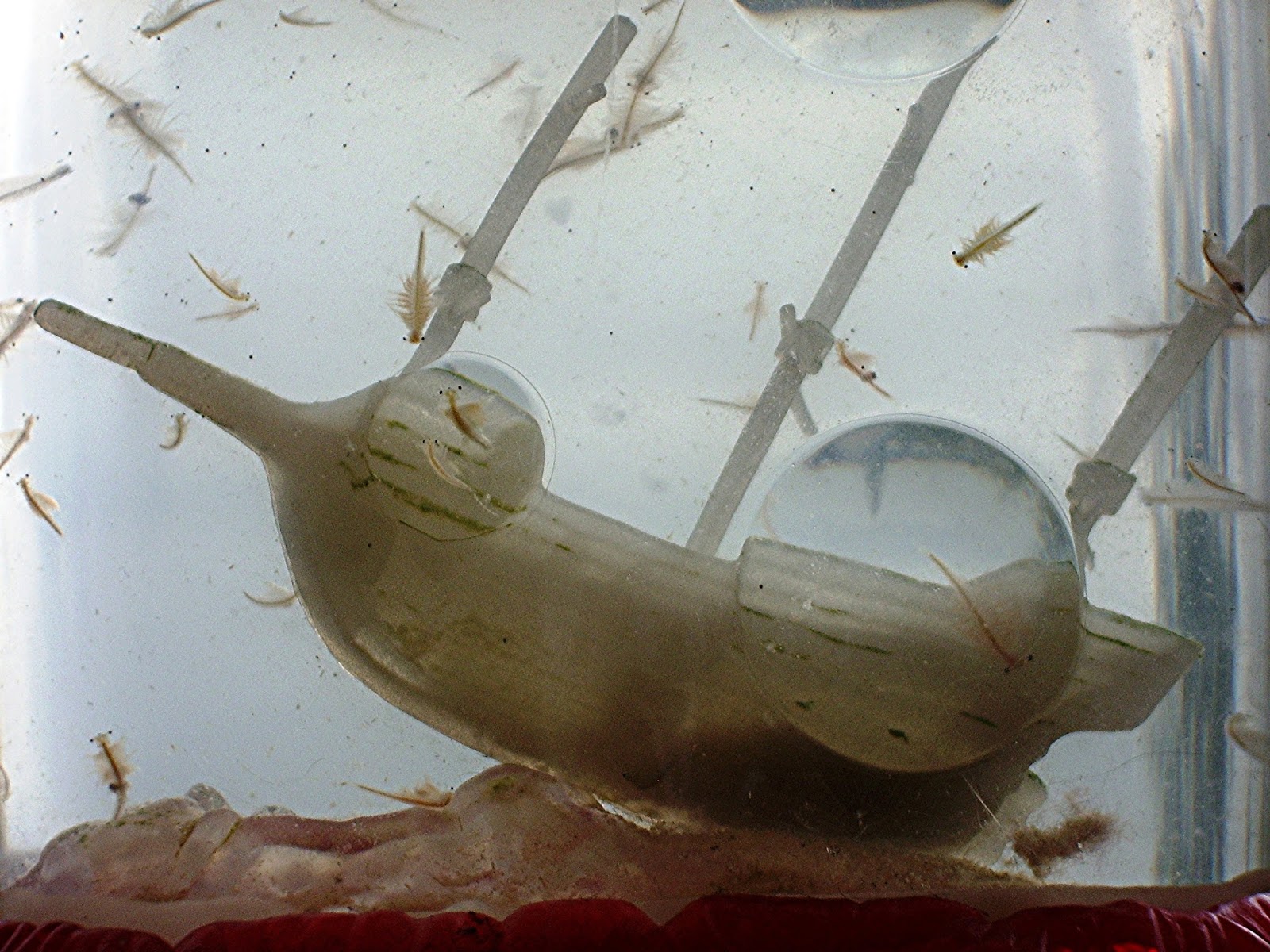
Brine shrimp 'sea-monkeys' swimming in an aquarium (public domain)

Long before the advent of sea-monkeys, brine shrimp were (and still are) popularly sold as pet food by pet shops, and in 1957, after reputedly encountering some brine shrimp in a pet shop , Harold von Braunhut came up with the idea of using them as 'instant life' – believing (correctly, as it turned out) that the spectacle of brine shrimps instantly hatching and swimming around in an aquarium when their eggs were added to water would prove popular among children. After developing a special mix of compounds, with the assistance of microcrustacean expert Dr Anthony D'Agostino, that would incite this dramatic reaction when brine shrimp eggs were dropped into tap water (tap water normally being far less salty than the water normally inhabited by these crustaceans), von Braunhut began marketing brine shrimps as pets during the early 1960s under the name 'Instant Life'. However, in 1964 he changed this to the more intriguing, curiosity-inciting 'Sea-Monkeys' moniker, the shrimps' long tails supposedly reminding him of monkeys' tails.

Moreover, these brine shrimps were not just any old brine shrimps. Von Braunhut and D'Agostino had previously spent a considerable time engineering via cross-breeding methods a new, special variety of brine shrimp that was not found in nature but which lived longer, grew larger, and was physically tougher than those that were. Eventually they achieved success, creating a very sturdy hybrid that they formally dubbed Artemia NYOS (NYOS referring to the New York Oceanic Society's Montor, Long Island, laboratory where it was developed). The classic sea-monkey was born!

Unfortunately, brine shrimps (hybrid or otherwise) are not the most alluring of creatures in basic appearance, so von Braunhut soon hired acclaimed comic-book artist Joe Orlando to depict them as the irresistibly charming mini-humanoids with fins and tails that have been synonymous with the sea-monkey name ever since. Yet another highly ingenious, ultra-successful idea conceived early on by von Braunhut was to sell sea-monkeys via mail-order using Orlando-illustrated advertisements placed in countless American children's comic-books year after year, beginning in 1962 – thereby directly and intensively targeting their prime purchasers, American children. And the rest, as they say, is history.

Sea-monkey and brine shrimp (illustration copyright holder unknown to me / inclusion here strictly on Fair Use/non-commercial basis only)

Harold von Braunhut died in 2003, but his legacy lives on, with the sea-monkey pet industry that he founded over 50 years ago remaining just as popular today as it ever was, selling not only sea-monkeys themselves (in their billions since 1957) but also a vast, highly diverse collection of accessories – everything from the Sea-Monkey Ocean Zoo, the Sea-Monkey Circus, and the Deluxe Sea-Monkey Speedway to fully-functional watches containing sea-monkeys swimming around inside their dials.

Sea-monkeys have also appeared in many top-rated television shows, including The Simpsons, South Park, American Dad, Desperate Housewives, and Roseanne. In 1992, they even inspired an 11-episode television series of their own entitled The Amazing Live Sea-Monkeys, featuring actors as human-sized sea-monkeys; as well as a video game, The Amazing Virtual Sea-Monkeys, released during the early 2000s. In 2012, celebrated American poet Campbell McGrath published a book of poems entitled In the Kingdom of the Sea Monkeys, which contained one poem about living in the sea-monkey kingdom depicted by Orlando in the sea-monkey advertisements (my thanks to Facebook colleague John Callahan for this info).

And over 400 million sea-monkeys were sent up into space with American astronaut John Glenn for nine days back in 1998, for any effects upon these tiny creatures' eggs resulting from exposure to radiation, weightlessness, and gravitational force upon re-entry to be studied. Eight weeks after their return to Earth, however, the eggs hatched normally and yielded apparently normal brine shrimps too, having been seemingly unaffected, therefore, by their extraterrestrial experience.

My still-unopened sea-monkey 'starter pack' (© Dr Karl Shuker/Transcience Corporation / inclusion here strictly on Fair Use/non-commercial basis only)

Finally: although the breadth of the vast Atlantic Ocean, a conflict of currencies, and a distinct lack of financial expertise on my part as a child in 1970s England all originally stifled my desire to purchase some sea-monkeys from their American source as given in the comic-book advertisements, several years ago I was delighted to discover that these illusive creatures could now be purchased directly in England.

Consequently, I soon bought an all-in-one sea-monkey 'starter pack' – containing sea-monkey eggs, nutrients, water purifier, magnifier, and even a feeding spoon – but I have never even opened it, let alone got around to 'growing' and nurturing any of these animals in an aquarium. Why not?

I suppose the answer is that because I now know exactly what sea-monkeys are (nothing more than brine shrimps), and what they are not (incredible underwater mini-humanoids with fins!), the magic that formerly surrounded them has gone. Sometimes, just as English poet Thomas Gray so succinctly expressed it way back in 1742: "Where ignorance is bliss, 'tis folly to be wise".

Another look at my Tom and Jerry comic-book containing the early 1970s version of the sea-monkeys advertisement – click picture to enlarge it for viewing the advert in close-up detail (© Dr Karl Shuker/Gold Key/Metro-Goldwyn-Mayer Inc/Transcience Corporation / inclusion here strictly on Fair Use/non-commercial basis only)