Dr KARL SHUKER

Zoologist, media consultant, and science writer, Dr Karl Shuker is also one of the best known cryptozoologists in the world. He is the author of such seminal works as Mystery Cats of the World (1989), The Lost Ark: New and Rediscovered Animals of the 20th Century (1993; greatly expanded in 2012 as The Encyclopaedia of New and Rediscovered Animals), Dragons: A Natural History (1995), In Search of Prehistoric Survivors (1995), The Unexplained (1996), From Flying Toads To Snakes With Wings (1997), Mysteries of Planet Earth (1999), The Hidden Powers of Animals (2001), The Beasts That Hide From Man (2003), Extraordinary Animals Revisited (2007), Dr Shuker's Casebook (2008), Karl Shuker's Alien Zoo: From the Pages of Fortean Times (2010), Cats of Magic, Mythology, and Mystery (2012), Mirabilis: A Carnival of Cryptozoology and Unnatural History (2013), Dragons in Zoology, Cryptozoology, and Culture (2013), The Menagerie of Marvels (2014), A Manifestation of Monsters (2015), Here's Nessie! (2016), and what is widely considered to be his cryptozoological magnum opus, Still In Search Of Prehistoric Survivors (2016) - plus, very excitingly, his four long-awaited, much-requested ShukerNature blog books (2019-2024).

Dr Karl Shuker's Official Website - http://www.karlshuker.com/index.htm

IMPORTANT: To view a complete, regularly-updated listing of my ShukerNature blog's articles (each one instantly clickable), please click HERE!

IMPORTANT: To view a complete, regularly-updated listing of my published books (each one instantly clickable), please click HERE!

IMPORTANT: To view a complete, regularly-updated listing of my Eclectarium blog's articles (each one instantly clickable), please click HERE!

IMPORTANT: To view a complete, regularly-updated listing of my Starsteeds blog's poetry and other lyrical writings (each one instantly clickable), please click HERE!

IMPORTANT: To view a complete, regularly-updated listing of my Shuker In MovieLand blog's articles (each one instantly clickable), please click HERE!

IMPORTANT: To view a complete, regularly-updated listing of my RebelBikerDude's AI Biker Art blog's thematic text & picture galleries (each one instantly clickable), please click HERE!

Search This Blog


PLEASE COME IN, I'VE BEEN EXPECTING YOU...

PLEASE COME IN, I'VE BEEN EXPECTING YOU...
WELCOME TO SHUKERNATURE - ENJOY YOUR VISIT - BEWARE OF THE RAPTOR!


Showing posts with label aliens. Show all posts

Friday, 4 September 2015

CRYPTO-SELFIES! IN THE PICTURE WITH SOME SERIOUSLY WEIRD – BUT WONDERFUL – WILDLIFE


With E.T. – how could I not take pity on this errant extraterrestrial and bring him back home with me? In any case, he must be happy here – he hasn't phoned home once, which is just as well, bearing in mind the cost of intergalactic telephone calls these days! (© Dr Karl Shuker)

Over the years, I've found myself sharing space in photographs – selfies, as they'd be called nowadays – with some exceedingly strange entities (and those are just my friends!). But seriously, browsing through my albums recently I came upon a considerable number featuring me alongside some truly weird – but indisputably wonderful – wildlife. So here, as one of my more light-hearted ShukerNature contributions, and the first of an occasional series, is a dozen of my most memorable crypto-selfies, annotated with a bountiful abundance of decidedly (ir)relevant information…

Alongside a black cheetah statue at Colchester Zoo, in Essex, England, which I visited in 2013; as noted in my books Mystery Cats of the World and Cats of Magic, Mythology, and Mystery, a few records of all-black (melanistic) cheetahs are indeed on file, including a specimen spied in the company of a normal cheetah by Lesley D.E.F. Vesey-Fitzgerald in Zambia during the first half of the 20th Century, and another one sighted in Kenya's Trans-Nzoia District by H.F. Stoneham in 1925 (© Dr Karl Shuker)

With one of the famous 19th-Century dinosaur statues at Crystal Palace Park in Bromley, London, which I visited in 2009; created by famous sculptor Benjamin Waterhouse Hawkins (1807-1894) and totally outdated now, this one is meant to be a Megalosaurus, but its reconstruction was guided by the popular yet erroneous belief current at that time that dinosaurs resembled giant lizards (© Dr Karl Shuker)

Holding a Brazilian were-pig skull – hailing from Rio de Janeiro, this is the skull of a wild boar that has been intricately decorated to resemble the supposed appearance of a Brazilian were-pig's head (© Dr Karl Shuker)

At Drayton Manor Park and Zoo, in Staffordshire, England, standing somewhat warily alongside a disconcertingly life-like, life-sized replica of North America's late Pliocene/early Pleistocene terror bird Titanis walleri, which may have stood up to 8 ft tall – check out my book The Menagerie of Marvels for an extensive chapter documenting the history of these flightless but fleet-footed and sometimes truly gargantuan carnivorous birds (© Dr Karl Shuker)

With an acklay – when I purchased this model at a market a few years ago, I had no idea what the creature was that it represented, but thanks to some knowledgeable sci-fi enthusiast friends on Facebook I soon learnt that it was an acklay, a huge non-sentient carnivore up to 11.5 ft tall, hailing from the planet Vendaxa in the Star Wars canon's universe (© Dr Karl Shuker)

Alongside a life-sized animatronic model of the feathered dinosaur Citipati at Bristol Zoo, England, in 2013; an oviraptorid theropod from Mongolia's Late Cretaceous period, Citipati was named after a pair of murdered meditating monks from Tibetan Buddhist folklore, it possessed a large toothless beak, and it stood as large as a present-day emu; in this particular reconstruction, it looks decidedly cassowary-like (© Dr Karl Shuker)

There I was, minding my own business walking round the small West Midlands, England, town of Cradley Heath, when, happening to step inside a sci-fi/comic shop, who should I encounter there but the Predator! I can only assume that my trusty leather biker jacket helped to conceal me from its thermal imaging capability long enough for me to get this photo snapped of me alongside it; if you're wondering why the photo is a little blurry, it's because the (ex) person taking it for me suddenly realised that unlike me he wasn't wearing anything to cloak his thermal image – I won't tell you what happened to him next, as I don't want to give you nightmares – suffice it to say that at least it kept the Predator occupied long enough for me to make my excuses and exit stage right! (© Dr Karl Shuker)

Face to face with a life-sized Tyrannosaurus rex model at a dedicated T. rex exhibition held at Birmingham Museum & Art Gallery in the West Midlands, England, during 2010 – it's not often that you get the chance to stare down a T. rex, although in this particular instance the only thing that I seemed to be staring down was its nostrils; Jurassic Park claimed that as long as you stood perfectly still, a T. rex would be unable to detect you, so what better time to put this claim to the test?? © Dr Karl Shuker)

Holding a cast of a 16-inch-long bigfoot (sasquatch) footprint discovered at Grays Harbor, in Washington State, USA, during 1982; I purchased this particular cast from veteran bigfoot researcher Prof. Grover Krantz during the early 1990s (© Dr Karl Shuker)

Sharing some quality time with a life-sized Moeritherium statue at London's Natural History Museum in 2014; this was a very early genus of proboscidean living during the Eocene epoch 37-35 million years ago in northern and western Africa, but dying out without giving rise to any modern-day elephant lineage; initially I was very puzzled that this statue's trunk seemed to have been rubbed so vigorously that much of its surface had lost its colour – why would this have happened? Then Facebook friend Adam Naworal reminded me that it was traditional to rub elephant statues for good luck, so that may well explain the otherwise anomalous case of the mutilated Moeritherium; fortunately, however, this doesn't seem to have traumatised him, as he seemed happy enough to be with me (© Dr Karl Shuker)

Alongside Singapore's iconic merlion fountain-statue in 2005; the merlion is a legendary lion-headed fish known worldwide as a symbol of Singapore, and it is epitomised by this magnificent 28-ft-tall statue created by sculptor Lim Nang Seng during 1971-1972, and relocated in 2002 to a promontory in Singapore's Merlion Park (© Dr Karl Shuker)

I hope that you've enjoyed this inaugural meander through my collection of crypto-selfies. Look out for further selections in future ShukerNature posts!


Thursday, 13 February 2014

HALF-HUMAN HALF-RABBIT HYBRID – THE TRAGIC TRUTH?


I have decided not to display the image under consideration in this present ShukerNature blog article, but it is available widely online - click here to view it if you so wish.

Over the years, certain online photos of bizarre but allegedly real entities have surfaced and resurfaced with monotonous regularity, in spite of repeated discrediting as hoaxes or misidentifications by cryptozoological researchers. I recently exposed ten of the most persistent offenders (click here), but at least most such photos are at worst tedious and at best somewhat amusing. However, there are certain others that are anything but amusing – on the contrary, they are both tragic and disturbing on account of what they truly depict, and are therefore in particular need of serious investigation and exposure. The photograph that is the subject of this present ShukerNature blog post is, I believe, a prime example of that latter category, which is why I feel it necessary to assess its credentials and credibility herewith.

As far as I have been able to discover, the photograph first began to attract serious online attention during November 2011, when it was circulated widely on Facebook and other social networking sites. The story accompanying it was that the depicted entity originated in Haiti (situated on the Caribbean island of Hispaniola), and that people there were actually fleeing their homes in terror because it apparently resembled a malign supernatural Haitian being known as a buck. Moreover, suggested/claimed identities by posters to the sites presenting it ranged wildly - from an aborted human foetus with developmental abnormalities, some form of grotesque mutation, or a photo-manipulated creation, to such bizarre notions as an alien baby, the aforementioned demonic buck, or a human-rabbit hybrid of either natural or artificial propagation.

(Worth noting, incidentally, is that in 2003 a team of Chinese scientists in Shanghai did succeed in creating human-rabbit chimaera cells in the laboratory by fusing human skin cells (contributing human nuclear DNA) with the egg cells of rabbits (contributing rabbit mitochondrial DNA), but these chimaeras were killed a few days later in order to retrieve embryonic stem cells, though it is not believed that viable foetuses would have resulted anyway, as humans and rabbits are far too distantly related taxonomically.)

After a few months, interest died down, then in November 2012 the photograph resurfaced and was recirculated widely online, but this time with a new back-story and an entirely different supposed provenance. It was even featured in serious, highly-respected media, such as Australia's Daily Telegraph, which reproduced the photo in an article released on 19 November 2012 (click here to access it). According to this source, the entity had been photographed not in Haiti but in the southwest African country of Namibia. Moreover, according to the story, a shooting party had encountered it foraging for food in dense jungle, and one of the party had shot but only wounded it, causing it to flee away into thick brush. However, the party succeeded in tracking it back to its nearby lair, where they found three other beings of the same kind. The wounded entity then attempted to attack the party, who shot it dead, but the other three beings escaped into the brush. The corpse of the dead entity was then taken back to the party's camp, and police took it away for a full forensic investigation. Needless to say, no follow-up reports revealing what this supposed investigation had discovered have been made public (at least not to my knowledge).

In February 2013 and also in October/November 2013, the photograph resurfaced yet again online, in sites such as Reddit and Triggspot, but now the provenance of its depicted entity had switched back to Haiti, though stories concerning it incorporated variations upon the Namibian plotline as well as the earlier lines of speculation from posters re human-rabbit hybrids or aliens.

And earlier this month (February 2014), a friend informed me that he had recently seen the photo being reported online with a third provenance - New Guinea.

So what is the truth about this contentious photograph and, most of all, what precisely does it portray? If we ignore for the time being the entity's bizarre head, and concentrate upon the rest of its body and what we can see of the person holding it, I think it most plausible that what we are looking at is either a newborn male human infant (possibly delivered by caesarean) or an extremely late aborted male human infant. The streaks of blood on its body would be normal and expected in either case, and the white waxy substance also present on its body would thus be vernix caseosa – a substance composed primarily of sebum, which begins to form upon the human foetus from around the eighteenth week of pregnancy. The infant's umbilical cord is readily visible hanging down the left side of its body (and thus seen on the right side in the photo, in which we are viewing the infant from the front), and using the size of the hand of the person holding it as a scale, the infant is the correct size for a newborn or late abort. In addition, the blue attire of the person holding the infant corresponds with hospital attire, as does the blue surgical glove worn by the person's hand.

So far, so straight forward. When examining the infant's head, however, matters become rather more complex. The infant's face is very distorted and/or mis-shaped, leading to two possibilities. This is either the result of photo-manipulation, i.e. a deliberate attempt to create a monstrous visage by computer-generated trickery; or, tragically, the infant's face is truly deformed, with maldeveloped eyes, nose, and mouth (fellow Fortean researcher Bob Skinner has opined that its mouth may be exhibiting a bilateral hare-lip condition, and I agree with him). One of its ears is also clearly visible, but apart from seeming a little large, this appears quite normal – in stark contrast to the grotesque length of what seems to be fleshy tissue emerging just above it and hanging downwards in a gross parody of a rabbit's ear. It is of course this grotesque structure that is responsible for the 'human-rabbit hybrid' claims – made by persons who evidently hadn’t noticed the infant's real, normal human ear!

What could this long fleshy expanse of tissue be? It is possible that it is not actually part of the infant's head at all, but is merely a section of the detached placenta that subsequently became attached to the infant's head during its delivery/abortion. Alternatively, it may be a portion of the infant's cranial tissue or even a portion of its brain if the cranium has been damaged during embryonic development and/or the brain has not developed correctly. There is a condition known as anencephaly, in which a sizeable portion of the brain, cranium, and skull cap do not develop, due to the rostral (anterior) neuropore - the temporary opening at the embryonic forebrain's extreme cephalic (rostral) pole - not closing during early embryogenesis (at approximately Day 25 in humans). Consequently, the portion of the brain that does develop is exposed and thus can theoretically emerge from the open, unprotected top of the skull, together with associated nervous tissue. However, the amount of flesh visible in the photograph seems more than might be expected if this were the case. Conversely, it is of course conceivable that part or all of this flesh is merely the product of photo-manipulation, to yield something reminiscent of a rabbit ear.

Finally, but most tragic of all: the positions of the infant's limbs (its right hand, incidentally, seems to have malformed digits), and also the expression on its face (if not added by photo-manipulation), are highly suggestive of the prospect that it was alive when the photograph was taken. This in turn makes the extremely rough, callous way in which it is being held even more heart-breaking.

Still requiring assessment is the location portrayed in the photograph. Might the latter have been snapped at a makeshift, impromptu field hospital in some remote tropical zone, which could also explain the presence of the bottle on the ground in the foreground? If not, then what else but photo-manipulation can plausibly reconcile the apparent presence of a correctly-attired hospital worker holding a newborn/late aborted infant in the middle of a jungle? (In the latter scenario, the bottle could have also been added via some deft, digital manipulation.) In any event, the stories of encountering this and similar entities in the jungle are obviously complete, nonsensical inventions that have been supplied to the media by person(s) unknown, as indeed has the photograph itself. I have been unsuccessful in tracing this controversial photograph's origin, and also in tracing any photos online that contain either the precise jungle scene in this photograph or the person standing behind the infant in it. So if, as seems most likely, these aspects of the photograph have indeed been incorporated into it from other sources, their origins currently remain unknown too.

However, I do feel it likely that the identity offered here by me for the entity is the correct one – a probably deformed newborn/aborted male human infant, alive when delivered but likely to have died from its condition shortly afterwards. I have no idea who could possibly have thought it novel or amusing to have created such a disturbing image, but I wholeheartedly believe it high time that this photograph be seen by all for what it truly is - a terrible indictment of humanity's inhumanity.

Consequently, I pray that this too-long-perused image's tragic little subject will now be left in peace, spared from any further attention of the freak-show variety, and granted the dignity in death that it was denied during its sad and all-too-brief span of life.

"Have pity on them all, for it is we who are the real monsters."

Dr Bernard Heuvelmans – On the Track of Unknown Animals


Sunday, 26 January 2014

PORTRAITS OF A POTOO – NEITHER AN AVIAN ALIEN NOR THE BIRD FROM HELL!


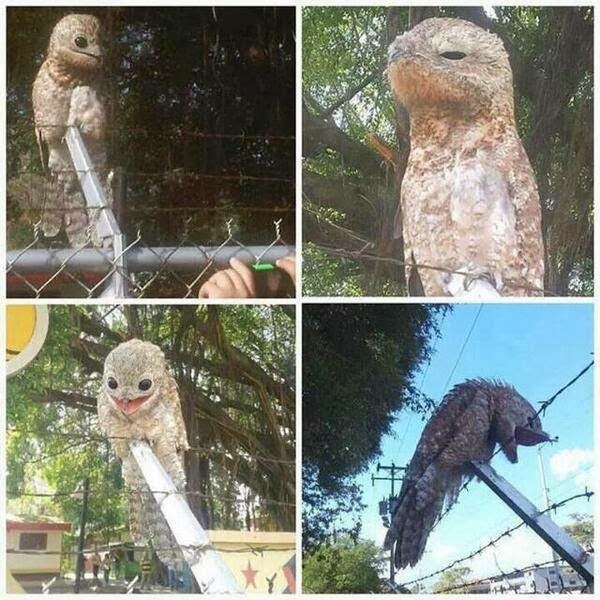
One of the four potoo photos discussed in this ShukerNature post (photo source unknown to me / inclusion here strictly on Fair Use/non-commercial basis only)

Facebook never disappoints me as a rich source of the exceedingly weird but also very wonderful when it comes to the animal world, and yesterday was no exception. During its early hours, I was browsing the recent posts of various FB friends when I came upon a quartet of photographs depicting a truly remarkable- (and macabre-) looking bird, equipped with a disproportionately huge mouth as well as large, unearthly black eyes. One of those four pictures opens this ShukerNature post, but here below are all four of them. Despite a prolonged internet search, I have been unable to uncover the identity of the person who snapped them.

The potoo photo quartet (photos' source unknown to me / inclusion here strictly on Fair Use/non-commercial basis only)

They had been posted by FB friend Michael J. Smith, who hoped that the bird portrayed in them was genuine, and I was happy to report that indeed it was.

The taxonomic order Caprimulgiformes contains five families, whose members are generally nocturnal and insectivorous. These families are:

Caprimulgidae (the nightjars, whip-poor-wills, and night hawks – of Old World and New World distribution)
Podargidae (the frogmouths – exclusively Old World)
Aegothelidae (the owlet-nightjars – exclusively Old World; and sometimes split off into an order of their own, Aegotheliformes)
Steatornithidae (the single species of oilbird – exclusively New World)
Nyctibiidae (the potoos – exclusively New World)

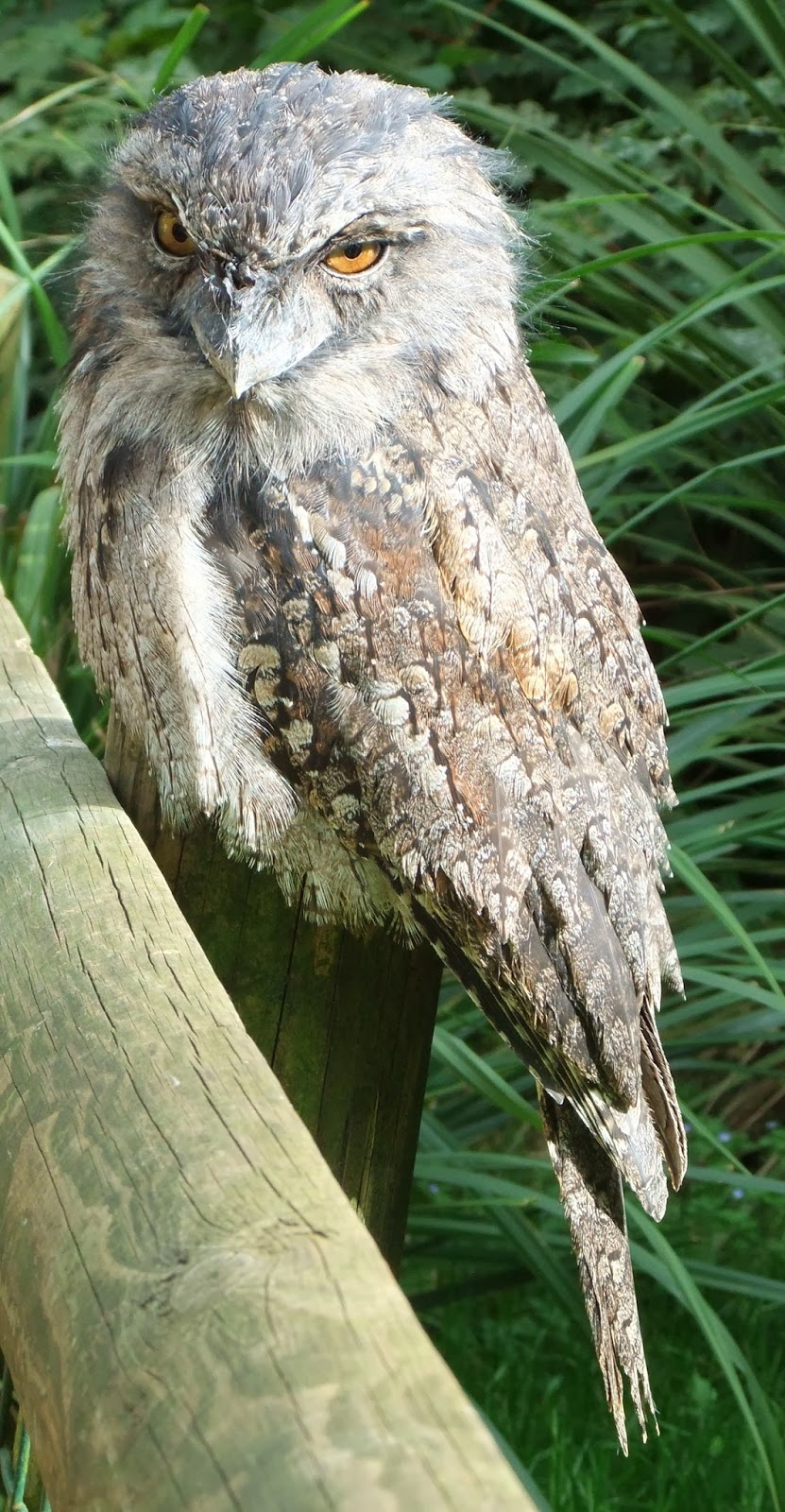
Looking at the four photos, I readily recognised the bird to be a potoo. True, there is a superficial similarity to the frogmouths, but having recently seen and photographed a living specimen of Australia's tawny frogmouth Podargus strigoides at very close range, I could tell the difference straight away.

Tawny frogmouth (© Dr Karl Shuker)

As a good rule of thumb, whereas both bird types have strikingly large mouths, those of potoos are much bigger than their beaks whereas those of frogmouths are much the same size as theirs. And as can be seen from the photo quartet, the bird depicted in them had a very small beak in proportion to its mouth.

Eager to discover the history of these photos, I spent some time searching for details online, but little could be found. They had apparently first attracted significant online interest just a couple of days earlier, when posted on the Reddit website, and had subsequently appeared on many others worldwide. However, I discovered that they had initially appeared much earlier, having traced one site that featured them in October 2013 and another that had featured them even further back, in mid-April 2013. On a Vietnamese website that I consulted (click here), it stated that the bird had allegedly been captured on the outskirts of a rural Venezuelan town, which if true provides further support for a potoo identity.

Judging from the comments on a range of other websites that I accessed, however, there has apparently been much wild speculation among non-ornithologists concerning the nature of this bird. Some contributors have voiced the opinion that it is an alien creature, or even a demonic entity, and others that it is an effigy or a taxiderm gaff (presumably one with a beak capable of opening and closing, judging from the differences in beak appearance present in the photos!) created specifically to fool or horrify its observers.

The common potoo (© Steve Gantlett/Guatemala International Birdwatching Encounter / inclusion here strictly on Fair Use/non-commercial basis only)

In reality, however, comparing the photos with confirmed potoo images online swiftly vindicated my opinion that it is merely a potoo, most probably the common potoo Nyctibius griseus (based upon both morphological and zoogeographical correspondence)

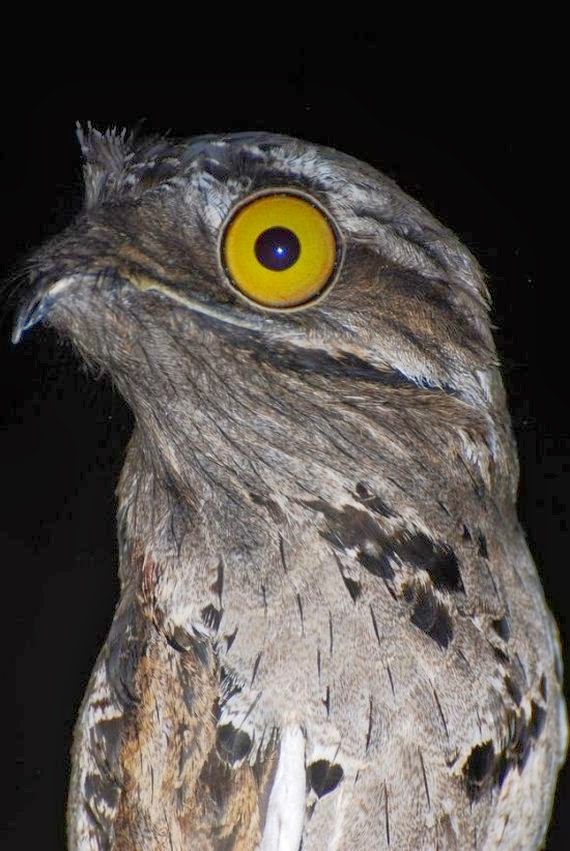
So is the mystery of the bird with the monstrously large mouth solved? Not quite. There is still the disconcerting matter of its uniformly black eyes to consider. This is because in the eyes of potoos, the black pupil is normally prominently ringed by a wide gold-coloured iris.

Potoo showing normal eye appearance (Barnorama / inclusion here strictly on Fair Use/non-commercial basis only)

Having said that, when I did a Google image search of photos depicting the eyes of potoos (click here), I discovered quite a few photos of specimens with entirely black eyes. So how can this puzzling discrepancy be explained?

Could it be merely a lighting effect – the eyes appearing dark when viewed in subdued light? Bearing in mind that all potoos are nocturnal, it is more probable, however, that the pupil can dilate sufficiently in subdued light to obscure the gold iris encircling it.

Judging from the range of eye states represented in the photos thrown up in the above-mentioned Google image search, I suspect that the latter hypothesis is the correct one, but if anyone out there can offer further information, I'd greatly welcome details here.

Epilogue: on 26 January 2014, Steve Caffyn in FB's Monster Talk group offered a thought-provoking third theory:

"I think some (maybe many) bird species' eye colours change with age. My own African Grey parrot Gizmo's eyes were entirely black as a baby. Then his iris changed to white after the first year and now he is eight the iris will go increasingly yellow with age."

Finally: if you think that potoos look somewhat ghoulish, just wait until you hear what they sound like! Click here for the eldritch utterances of a great potoo Nyctibius grandis.

Potoo showing very restricted gold iris and very dilated black pupil (Barnorama / inclusion here strictly on Fair Use/non-commercial basis only)


Tuesday, 2 October 2012

MY TOP TEN STRANGEST ALIENS - CLOSE ENCOUNTERS OF THE BIZARRE KIND!

West Virginia's bizarre 'Vegetable Man' entity (John A. Short, Alien Encounters, August 1997)

Exobiology - the study of life on other worlds, featuring speculation upon the morphological forms that such life may take, based upon their worlds' environmental constraints - has always fascinated me. So here, just for a change from considering cryptozoological topics and other subjects appertaining to life on our own planet, here is a look at what else may be sharing our universe and even visiting us from time to time...

The Gray or Grey may well be the most familiar form of alleged alien visitor on record, but it is by no means the only one. As revealed in Patrick Huyghe's invaluable Field Guide to Extraterrestrials (1997) and elsewhere, ETs apparently come in all shapes and sizes, yet most receive far less attention from researchers than the Gray. Consequently, here in no particular order is my personal top ten of the strangest alleged extraterrestrial life forms reported, all of which are truly alien - in every sense of the word!


UNIPODAL ALIEN ROBOTS?

One of the least humanoid categories of ETs ever reported must surely be the astonishing version reputedly encountered by Brazilian bus driver Antonio La Rubia at 2.20 am one morning in September 1977 while driving to work in Paciencia, Rio de Janeiro. After spying a huge hat-shaped vessel exceeding 200 ft in diameter hovering above a football field, La Rubia was abruptly immobilised by a beam of blue light, and then saw three decidedly futuristic robotic entities, who transported him inside the vessel. Here, he was subjected not only to the customary alien examination but also to a slide show of sorts, before being somewhat rudely ejected back into the street again, after which the craft disappeared.

Sketch by Antonio La Rubia of one of the unipodal entities that he claims to have encountered (APRO Bulletin)

This scenario may be a common one to ufologists, but La Rubia's abductors were decidedly uncommon in appearance. Each was about 4 ft tall, excluding the vertical antenna on top of a featureless head shaped like a rugby ball standing erect on its tip, and equipped with a horizontal belt of blue mirror-like structures encircling its diameter. Beneath its head, which had no neck, was a sturdy ovoid body covered in scales resembling dull aluminium. It also had a waist-high belt bearing a series of hooks holding syringe-like objects, plus two arm-like appendages that curved downwards but terminated in a point, lacking hands. Its body was borne upon a tall, slim, central pedestal, with a circular base at its tip.

 
THE DISEMBODIED BRAINS AT PALOS VERDES

Bodiless brains are not the most appetising of sights at the best of times, and certainly not when they float towards you and begin communicating telepathically as you sit in your car on a lonely Californian road at 2 am in the morning! Nevertheless, this bizarre scenario was supposedly experienced by two men in their early 20s, known pseudonymously as John Hodges and Peter Rodriguez, sometime in August 1971 at Palos Verdes Estates, California.

While walking towards their car, they had seen a diffuse white beam close by, and once inside the car their headlights had revealed two grotesque brain-resembling entities hovering in the air outside. Both were blue in colour, but whereas one was only the size of a softball, the other was about 18 in high, and bore a large bright red spot on its surface.

The two men lost no time in driving away, and Hodges took Rodriguez home, but in the classic abduction tradition, after reaching his own home Hodges discovered that he had mysteriously 'lost' two hours. Later, he recalled experiencing a dream-like state while in his car, during which he seemed to be in a room containing not only the larger of the two levitating brains but also several tall, grey, six-fingered, humanoid (yet non-human) entities. The brain informed him that Earth was being monitored because of its nuclear power; the humanoid entities claimed that they were from Zeta Reticulii, and that the brains were translators. They also voiced a number of prophecies, but these proved to be inaccurate.


THE CRAZY CRITTER OF BALD MOUNTAIN

This was the name applied by the local media to the incredible beast confronted by several shocked motorists during the evening of 17 November 1974 on Bald Mountain, situated approximately 20 miles east of Chehalis, in Washington State, USA. Three nights earlier, and only about 5 miles away, a UFO of the unidentified fiery object kind plummeted to earth, but this had attracted little publicity - until Seattle grocer Ernest Smith saw the 'crazy critter'.

According to Smith's description, cited in Jim Brandon's book Weird America (1978):

"...it was horse-sized, covered with scales and standing on four rubbery legs with suckers like octopus tentacles. Its head was football-shaped with an antenna sticking up...The thing gave off this green, iridescent light."

That glow was also spied by Mr and Mrs Roger Ramsbaugh from Tacoma, as they were driving by, and when they went closer to investigate, they were confronted with the same weird wonder, complete with antenna and suckered legs, that Smith had seen earlier.

Such reports as these soon attracted the attention of the local authorities, headed by Lewis County Sheriff William Wister, but some accounts claim that he was instructed by airforce and NASA officials not to continue his investigations, and his own team of county officials was replaced by what Brandon refers to as "a special NASA team, including a heavily armed military unit wearing uniforms with no insignia". Sounds familiar?

The green-glowing Crazy Critter (Tim Morris)

As for the crazy critter itself: this episode reminds me of a storyline greatly favoured by newspaper cartoonists (and as also imagined by Malcolm Smith in Bunyips and Bigfoots, (1996), in which the captain of a flying saucer is angrily reprimanding one of his crew members: "You fool! You know darned well that you should always keep the ship's mascot on a leash when you take it for a walk!".


THE FLYING SAUCER FAIRIES

Some researchers deem ETs to be fairies or other Little People who, keeping abreast of modern times, have traded in their traditional image of dancing merrily in elfin glades and hollow hills in favour of a more technologically-compatible lifestyle, flitting through the skies aboard flying saucers sporting a nifty turn of speed. Judging from the following incident, documented by Alfred Budden (Fortean Times, summer 1988), they may well have a point!

Standing in her garden at Rowley Regis, near Birmingham in the West Midlands, on the morning of 4 January 1979 after waving her husband off to work, Jean Hingley saw a large orange sphere hovering close to their garage's roof and emanating an appreciable amount of heat. As she watched, it turned white and floated nearer, hovering over her back garden.

Suddenly, she was shocked to see that her pet dog, Hobo, standing by her, had become paralysed (happily, he later recovered) - and was even more shocked when three small fairy-like beings quite literally, and audibly, 'buzzed' by her and into her house through the doorway. According to Budden's account, Hingley claimed that her unwonted (and unwanted!) visitors were each:

...about 3.5 ft tall, and dressed in a silvery tunic with six silver buttons down the front. They had large eyes like 'black diamonds' with a glittering lustre, set into wide white faces with no nose to speak of and a simple line for the mouth. Their heads were covered by transparent helmets like 'goldfish bowls', surmounted by small lights. Their limbs were silvery-green, ending in simple tapering points with no apparent hands or feet. They had large oval 'wings' which looked as if they were made of thin, transparent paper covered with dozens of glittering multi-coloured dots, like 'braille dots'. Each 'being' was surrounded by a halo, and numerous very thin streamers hung down from their shoulders. They hovered and flew about the room with their 'arms' clasped in front of their chests, while their 'legs' hung down stiffly. Their wings didn't flap like those of birds, but seemed to be for display and merely fluttered gently or occasionally folded inwards like a concertina. Their expression - "like a dead person's face" - never changed during the encounter, which lasted for about an hour.

During that hour, these 'space-age fairies' occasionally spoke to Hingley, but always in unison, and via a guttural, masculine voice. Often, however, when she attempted to speak with them, they would emit a very thin laser-like beam from their helmets' lights, directed onto her brow, which dazzled and paralysed her, and produced an intense burning sensation at first. They behaved in a mischievous manner, shaking her Christmas tree and jumping up and down on the sofa, but showed great curiosity about her newspapers, cassettes, and a picture of Jesus, and they often picked up small objects or simply touched them. Oddly, however, whenever they found themselves unable to do something, such as drinking water from a glass or answering certain questions, they chose to disable Hingley with their beam.

Drawing of one of the alien fairy entities that visited Jean Hingley (artist unknown)

Eventually, a very loud electronic beeping noise resounded from her back garden, and when Hingley looked she could see an orange-glowing craft there, oval in shape and about 8 ft long, with two luminescent portholes and an external antenna bearing a series of spokes arranged in a wheel-like shape. The space-fairies floated out of her house, each carrying a mince pie(!), and into their craft, which promptly took off, emitting as it did so a blue light from its antenna. As soon as they had gone, however, Hingley became convulsed with pain, and remained in a very distressed state for a number of hours, before becoming well enough to call her husband, a neighbour, and the police. Moreover, the burning mark left upon on her forehead by the entities' beam remained there for several months.

It is possible, as speculated by Budden, that this exceedingly bizarre encounter was really a hallucination, triggered somehow by the UFO, but the UFO was no hallucination - because her human visitors could clearly see a peculiar impression in the snow covering her back garden's lawn that closely resembled a tank's caterpillar track, about 8 ft long and symmetrical. In addition, several electrical gadgets in her house had stopped working, as if affected by an intense magnetic field, and the cassettes handled by the entities were now useless.


THE FLATWOODS MONSTER

For inducing sheer terror in its eyewitnesses, few ETs have matched the fearsome reputation of the 'Flatwoods monster', famously encountered by a party of children and adults while investigating a UFO report on 12 September 1952 at Flatwoods, West Virginia.

Likened by some of its eyewitnesses, a group of youngsters, to a meteor, the UFO had landed on top of a hill near Flatwoods, and some of them set off in its direction, to see if they could find it. Along the way, they were joined by a matron called Kathleen May (or Hill, in some accounts), her two sons, and a teenage National Guardsman, Gene Lemon.

As this amassed company drew nearer, they spied a huge pulsating globe or sphere, about 20 ft in diameter, and one of the eyewitnesses also noticed what he thought to be a pair of animal eyes, staring down at them from the branches of a tree close by. Shining his torch in the direction of these eyes, he and everyone else in the company were horrified to see an enormous figure, standing just beneath the tree's lower branches.

The Flatwoods Monster, based upon an eyewitness's drawing (Taishiro Kiya)

This macabre entity was 10-15 ft tall, and according to Mrs May it seemed to be dressed in a long cloak-like garb with a pointed hood, thus resembling the habit of a monk - but the face that stared out at them from inside the hood was certainly not that of any monk!

Instead, it was round in shape and blood-red in colour, with a pair of bulbous eyes that glowed with an eerie greenish-orange hue. And as the terrified group of UFO-seekers gazed at it, this weird apparition began to float slowly down the hill towards them, hissing!

Needless to say, everyone fled at once, and such was the horror of this experience that a number of the eyewitnesses were hysterical and violently sick for several hours afterwards. During the following day, the local newspaper's editor and a team of other investigators scoured the area where the 'monster' and the giant globe had been encountered, but both had disappeared. However, they did find some odd tracks on the ground, a patch of flattened grass, and a peculiar, irritating odour persisting just above ground level.


MUMMIES FROM SPACE!

Imagine a 5-ft-tall, neck-less, humanoid figure resembling an Egyptian mummy, with grey wrinkled skin of elephantine appearance and texture, a pair of disproportionately long arms whose hands resembled mittens (i.e. with a single thumb but no differentiated fingers), a pair of legs held together like a pedestal and terminating in two bulbous elephant-like feet, and a seemingly eyeless face sporting a pair of pointed retractile ears, a conical nose-like structure, a short slit of a mouth that never opens, and a terrifyingly blank expression.

Multiply this grim-looking apparition by three, then add the domed football-shaped buzzing craft, with two windows, two blue lights, an invisible door, and a highly-illuminated interior, from which they emerged - and the result is the living nightmare experienced by two terrified Mississippi fishermen, Charles Hickson and Calvin Parker, at the Pascagoula River, on the night of 11 October 1973. And their sighting of these sinister entities was only the beginning of their ordeal. For as the two men stood there, prisoners of the combined fear and fascination aroused by their incredible encounter, the 'mummies' floated up to them, seized hold of them, and physically immobilised them before carrying them into their craft.

Pascagoula monster, based upon eyewitness description

Once inside, the mummies subjected their human captives to a close physical examination, after which they returned them to the spot from where they had abducted them, then soared away through the sky inside their blue-lit vessel.


LOOK OUT - IT'S VEGETABLE MAN!

Never trust anyone whose body resembles the green, slender stalk of a plant, and who sucks out your blood through three 7-in-long fingers with needle-like tips and suction cups - that's what I always say! And Jennings Frederick would certainly agree, because he allegedly met just such a being while hunting one day in a West Virginia woodland during July 1968.

According to American paranormal researcher Brad Steiger, Frederick suddenly became aware of what he later described as "...a high-pitched jabbering, much like that of a recording running at exaggerated speed", yet which he could somehow understand, and which was informing him that it came in peace but needed medical assistance.

At the same moment, Frederick saw beside him the extraordinary quasi-botanical entity described above, with a semi-human face, long ears, yellow slanted eyes, and two stick-like arms. Before he had time to be surprised, however, he felt a pricking sensation in one of his hands, as if it had become entangled in some thorns - but when he looked, he discovered to his horror that the entity was draining blood from it, through its own fingers. Moreover, its eyes suddenly changed colour, becoming bright red and yielding a rotating, hypnotic effect that rendered its blood-sucking operation painless.

West Virginia’s Vegetable Man (Tim Morris)

A minute later, Frederick's enforced transfusion was over, and his mesmerising recipient fled, bounding away rapidly up a hill, each leap covering a distance exceeding 25 ft. Unfortunately for Frederick, however, once the entity had disappeared, the pain in his hand reappeared. And as he set off back home, he heard a strange humming sound, which he believed to be the entity's craft, transporting it back from whence it had come.

Frederick was so disturbed by his grotesque experience that he did not speak about it for several months. Some researchers have speculated that it may be a hoax, but those who have spoken to him seemed convinced that his account, albeit highly unusual, is genuine.


FLYING JELLY BAGS AHOY!

Not everyone can claim the dubious honour of having been abducted by a trio of flying jelly bags - an honour that Stig Rydberg and Hans Gustaffson would be more than happy to relinquish if they could somehow relive 20 December 1958 and arrange to be somewhere far away from the Swedish forest that they were driving through on that fateful day.

It was 3 am when they noticed a strange glow and then spotted a mysterious tripodal craft, over 12 ft long, resting nearby on the ground. Just in front of it were four extraordinary entities, each about 3 ft long, blue-grey in colour, and virtually amorphous, with no visible limbs, head, or any other recognisable features.

Likened to jelly bags, they were leaping around their craft at first, but when they somehow perceived the two men, three of these animate blobs swiftly approached them and attached their shapeless forms to them, yielding a powerful suction force as they strove to haul their frightened human hostages back towards their craft. In the ensuing struggle, the men could smell a vile stench emanating from their eerie antagonists, combining the overpowering odour of ether with the nauseating stink of burned sausage.

During Rydberg's frantic attempts to escape, one of his arms forced itself deep within the body of a blob, yet with no detrimental effect, either to him or to the blob. Nonetheless, his struggle eventually succeeded, and he raced back to the car, where he sounded the horn loudly, which so startled the blobs that they released Gustafsson, and fled back into their vessel, which duly rose up into the sky with a high-pitched noise and sped away. The most bizarre five minutes of the two men's lives were over.


THE TRIPODAL TERROR OF WABASH RIVER VALLEY

It was roughly 9.00 pm on 25 April 1972 near Enfield, in Indiana's Wabash River Valley - the scene of several reports around that time concerning strange lights observed in the sky, and, more recently, of some very peculiar tracks discovered by local war veteran Henry McDaniel in a nearby wood. These tracks each measured 3-5 in across, and contained six toe impressions, with a small hoof-like mark in the centre.

Consequently, when McDaniel's family heard a strange scratching sound on the outside of their home's back door, he cautiously looked out of a window, to find out what manner of animal was responsible. Even so, he did not really expect to see anything more remarkable than a stray dog, a neighbour's cat, or perhaps an inquisitive raccoon. In reality, however, what he did see was so incredible, and alarming, that he immediately grabbed hold of his shotgun and fired four rounds directly at it.

There, no more than 3 ft away from him, was a surrealistic entity, 4-5 ft tall, with a hairy dirty-grey body and disproportionately large head, staring at him through two pink reflective eyes, and standing upright like a human, but on three legs!

The alien 'Jake the Peg' that visited Henry McDaniel (John A. Short, Alien Encounters, August 1997)

Although one of McDaniel's shots hit this tripodal terror, it merely hissed and leapt away along a railway track close by, clearing 75 ft in three huge bounds - but it would be back.

A few days later, at around 3.00 am, McDaniel was woken up by his dogs, who were barking uncontrollably. Carefully opening his door, he looked out, and spied this intergalactic Jake the Peg standing by the railway line, looking at him. Now, however, it made no attempt to approach, and was not seen by McDaniel (or anyone else) again.


THE VENEZUELAN LITTLEFOOTS

It is well known that a number of ufological reports on file concern sightings of shaggy bipedal entities resembling North America's famous mystery man-beast, the bigfoot or sasquatch, in association with alleged UFOs and landed extraterrestrial spacecraft. However, the seemingly invulnerable troll-like category of alien encountered by Gustavo Gonzales and José Ponce while driving their truck from Caracas to Petare, Venezuela, during the early morning of 28 November 1954 could more aptly be referred to as a littlefoot.

Before reaching Petare, they encountered a huge glowing globe, hovering about 6 ft above the ground, which was virtually blocking the entire road ahead. Consequently, the two men got out of their truck to investigate, and as they approached the globe a furry bipedal being appeared, and began to approach them. Standing no more than 3 ft high, it was covered with stiff, bristly hair, and had large clawed hands and feet. Gonzales seized hold of this hirsute 'littlefoot', in order to take it to the police, and was surprised to find that the creature was exceedingly light. He was even more surprised, however, to discover how powerful it was - for with a single push from one of its paws, it effortlessly propelled Gonzales through the air, sending him sprawling onto the ground about 5 yards away.

Reconstruction of one of the Venezuelan littlefoots (Tim Morris)

By now, Ponce was running back down the road, towards the local police station, and as he did so he spied another two of these littlefoots, gathering rocks and carrying them aboard the sphere. The first littlefoot, however, angered by Gonzales's action, began savagely clawing him, but when Gonzales tried to defend himself by stabbing this creature with his knife, the blade made no impression on its body. Suddenly, a fourth littlefoot appeared, emerging from the sphere, and stunned Gonzales with a beam of light, enabling the others to go aboard and depart.

When the police had established that neither Ponce nor Gonzales were drunk, they gave them sedatives, and also confirmed that Gonzales bore a long red scratch on his side. Furthermore, several days later, a medical doctor came forward to announce that he had actually witnessed from a distance the attack upon Gonzales by the littlefoots, but had not intervened because he did not want to be the focus of publicity.

How can such an amazing diversity of alien forms as these – and the many others also on record – be explained? The initial assumption is that if any or all of them are indeed real (a big assumption in itself, of course), they clearly originate from totally different worlds, whether those worlds be planets or dimensions.

However, as Huyghe and other researchers have pointed out, these entities’ morphological differences may owe more to psychology than anatomy. Could it be, for instance, that the image that an alien eyewitness sees is not the true form of the alien in question but rather a false image placed in the eyewitness’s mind by the alien, thereby concealing the latter’s true self? An equally thought-provoking, obverse explanation is that the eyewitness is not seeing the alien as it actually is but rather as the eyewitness subconsciously chooses it to be.

It is often said that beauty is in the eye of the beholder, but who knows, perhaps the same is also true of alien morphology.

Head of the sinister 'Vegetable Man' alien (Tim Morris)
 
This ShukerNature blog post is excerpted from my book Dr Shuker's Casebook (2008), the chapter in question from which was in turn an expanded, updated version of an original article of mine published in the August 1997 issue of the now-defunct British magazine Alien Encounters and illustrated by John A. Short.