Dr KARL SHUKER

Zoologist, media consultant, and science writer, Dr Karl Shuker is also one of the best known cryptozoologists in the world. He is the author of such seminal works as Mystery Cats of the World (1989), The Lost Ark: New and Rediscovered Animals of the 20th Century (1993; greatly expanded in 2012 as The Encyclopaedia of New and Rediscovered Animals), Dragons: A Natural History (1995), In Search of Prehistoric Survivors (1995), The Unexplained (1996), From Flying Toads To Snakes With Wings (1997), Mysteries of Planet Earth (1999), The Hidden Powers of Animals (2001), The Beasts That Hide From Man (2003), Extraordinary Animals Revisited (2007), Dr Shuker's Casebook (2008), Karl Shuker's Alien Zoo: From the Pages of Fortean Times (2010), Cats of Magic, Mythology, and Mystery (2012), Mirabilis: A Carnival of Cryptozoology and Unnatural History (2013), Dragons in Zoology, Cryptozoology, and Culture (2013), The Menagerie of Marvels (2014), A Manifestation of Monsters (2015), Here's Nessie! (2016), and what is widely considered to be his cryptozoological magnum opus, Still In Search Of Prehistoric Survivors (2016) - plus, very excitingly, his four long-awaited, much-requested ShukerNature blog books (2019-2024).

Dr Karl Shuker's Official Website - http://www.karlshuker.com/index.htm

IMPORTANT: To view a complete, regularly-updated listing of my ShukerNature blog's articles (each one instantly clickable), please click HERE!

IMPORTANT: To view a complete, regularly-updated listing of my published books (each one instantly clickable), please click HERE!

IMPORTANT: To view a complete, regularly-updated listing of my Eclectarium blog's articles (each one instantly clickable), please click HERE!

IMPORTANT: To view a complete, regularly-updated listing of my Starsteeds blog's poetry and other lyrical writings (each one instantly clickable), please click HERE!

IMPORTANT: To view a complete, regularly-updated listing of my Shuker In MovieLand blog's articles (each one instantly clickable), please click HERE!

IMPORTANT: To view a complete, regularly-updated listing of my RebelBikerDude's AI Biker Art blog's thematic text & picture galleries (each one instantly clickable), please click HERE!

Search This Blog


PLEASE COME IN, I'VE BEEN EXPECTING YOU...

PLEASE COME IN, I'VE BEEN EXPECTING YOU...
WELCOME TO SHUKERNATURE - ENJOY YOUR VISIT - BEWARE OF THE RAPTOR!


Showing posts with label owl. Show all posts

Tuesday, 21 January 2025

SHEDDING LIGHT UPON THE MYSTERY OF LUMINOUS BIRDS - Part 1: OWLS AND FOWLS AND HERONS THAT GLOW!

 
Is this what a luminous or glowing owl would look like?

 THE LUMINOUS OWL

A marvellous fowl is the luminous owl,
It glitters and glisters and gleams.
It lights up the night in its shimmering flight,
A vision of wonder and dreams.

Dr Karl Shuker – from my Star Steeds and Other Dreams poetry blog

Anomalous phenomena come into and go out of fashion very much like fashions themselves, and the concept of luminous birds, especially owls, is no exception. Throughout ancient and medieval history, it was very much a subject for discussion among writers and scholars. Moreover, there seems to have been a traditional, longstanding belief in many rural areas across the world but notably in Britain, continental Europe, North America, and Australia, that owls glow. Indeed, 'glimmer gowk' is included in Charles L. Hett's engrossing avian dictionary A Glossary of Popular, Local and Old-Fashioned Names of British Birds (1899) amongst the popular monikers for any British owl.

Nevertheless, during the past century this intriguing subject has slipped into virtual obscurity. Indeed, notwithstanding the countless eyewitness reports and vast body of documentation relating to luminous birds in the past, certain modern-day skeptics breezily dismiss it as a mere myth, a credulous fragment of countryside folklore confined and duly consigned to bygone pre-scientific times, and thence long since discounted. As will now be shown, however, via the selection of cases documented in my exclusive two-part survey here on ShukerNature, the reality is very different. Something much more tangible than fanciful folklore appears to be involved here – but what?

 
What a spectacular sight a glowing owl would be!

One of the first coverages of this intriguing phenomenon that I ever read was an article by Count Louis de Sibour entitled 'The Existence of Luminous Birds', originally published by the periodical Knowledge (New Series) in September 1913, and subsequently collated by William R. Corliss in Incredible Life: A Handbook of Biological Mysteries (1981), one of his many invaluable compendia of scientific accounts documenting wildlife anomalies and curiosities. In his article, de Sibour commented:

Few students delve deeply in natural history without encountering the topic of luminous birds, and the pros and cons of the subject are developed by the reader with a frequency that tests the credulity of any superficial investigator.

Indisputably, it has exerted a great fascination for any scientist willing enough to examine and take seriously the myriad mysteries of unnatural history; but before continuing with my own investigation of it here, I need to present a few definitions in order to prevent the all-too-common confusion of certain relevant scientific terms:

Incandescence is the emission of visible light from a substance heated to a high temperature. In contrast, luminescence is the emission of visible light (and sometimes other types of electromagnetic radiation too) from a substance as a result of any non-thermal energy-releasing process. If the luminescence ceases as soon as the energy source is removed, this is termed fluorescence; but if the luminescence persists (after-glow), this is termed phosphorescence and is the type of luminescence seemingly exhibited by luminous aka glowing birds. Also requiring a definition here is bioluminescence – namely, the biochemical creation and emission of light by certain types of living organism (known from such forms as fireflies, glow-worms, and various deepsea fishes, plus some plants, fungi, and bacteria – but not birds…officially).

Pliny the Elder, stipple engraving by F.W. Bollinger (© wellcomeimages.org/Wikipedia –
CC BY 4.0 licence)

As noted by de Sibour in his article, luminous birds have a very considerable documented history, dating back at least as far as the time of the celebrated Roman author/naturalist Pliny the Elder (23/24 AD-79 AD). He mentioned one unnamed example briefly in Volume 3, Book 10 of his encyclopaedic 10-volume, 37-book magnum opus Historia Mundi Naturalis (Natural History of the World), stating: "In the Hercynian Forest, in Germany, we hear of a singular kind of bird, the feathers of which shine at night like fire". The Hercynian Forest was the huge ancient tract of dense woodland that in Roman times stretched across western Central Europe from northeastern France to the Carpathian Mountains but which exists today only in the form of fragmented, relict expanses. It was said to be home to many wonders, including a bona fide unicorn supposedly seen by none other than Julius Caesar (click here to read my ShukerNature article dealing with it).

Pliny's account of this mysterious luminous bird (and much else too from his above-cited multi-volume tome) was regurgitated two centuries later by Latin geographer/compiler Clarius Solinus, in Chapter 20 of his own major work, De Mirabilibus Mundi (On the Wonders of the World – also subsequently republished in a greatly revised edition entitled Polyhistor). Moving forward a millennium, Pliny's report of a luminous tyoe of bird was again recycled in an extensive work. This time it was De Animalibus, written by the 13th-Century German monk and scholar Albertus Magnus (1208-1280), and finally published in 1478 following the invention of the printing press.

 
Conrad Gesner, by Tobias Stimmer, 1564 (public domain)

Moreover, the year 1555 saw the publication of the very first treatise devoted totally to luminescence in animals. Entitled De Lunariis, and written by Swiss naturalist/physician Conrad Gesner (1516-1565), it not only included reports of luminous birds and many other types of phosphorescent fauna dating back to ancient times but also incorporated accounts of glowing plants (click here to read a ShukerNature article of mine dealing with anomalous light-emitting flowers) and even luminous stones.

An even greater work on luminescent animals appeared in 1647 – a mighty three-volume publication authored by Danish scientist Thomas Bartholin (1616-1680) entitled De Luce Animalium, of which its third volume was devoted entirely to glowing birds. Some of these were wholly mythical, such as the Egyptian phoenix, the incendiaria avis or incendiary bird (which set on fire any tree or house upon which it perched), and the caladrius (according to Roman mythology, a snow-white bird with healing powers), but allegedly real examples were also included.

 
Egypt's coruscating phoenix (image created by me using MagicStudio)

Worth mentioning is that only a few years earlier, in 1641, a number of glowing fowls had attracted so much attention at a market in Montpellier, France, that even the distinguished French nobleman Henri de Bourbon (1552-1588), 2nd Prince of Condé, paid a special visit to observe them there. One, a cockerel, was killed in order to examine it more closely, and according to Bartholin it: "shone on all parts of his body with a remarkably strong light". That same year, a glowing hen was displayed at a market in Montebello, which "shone like a ball of white fire", inspiring Bartholin to opine somewhat drily: "It is a pity that the cock did not meet the hen; for we might then have obtained a breed of incandescent fowls"!

More recently, England, the Pyrenees, and the Vosges appear to be European regions from which accounts of luminous birds have emerged – with the most commonly reported bird types being owls (particularly barn owls) and herons. In some of these cases, they have been directly identifiable as birds, albeit ones that glow, usually white, pale yellowish-green, or reddish-yellow in colour; in certain other cases, the manner of their flight has identified them as birds.

 
How an owl glowing pale yellow may look

The 'flap' of luminous owl sightings that occurred during 1907-1908 near the hamlet of Twyford in Norfolk, eastern England, is possibly the most famous, and last, to attract mainstream public and scientific attention, and has been widely documented, albeit with many variations and inaccuracies. Happily, however, a comprehensive, scrupulously-researched article entitled 'The Luminous Owls of Norfolk', prepared by veteran Fortean chronicler David W. Clarke, was published in 1994 within the inaugural volume of Fortean Studies, the short-lived scholarly journal of the longstanding British mysteries magazine Fortean Times, so this is the source that I have consulted when producing my own coverage here.

Back in 1897, gamekeeper Fred Rolfe saw on several successive evenings near King's Lynn in Norfolk an eerie bright blue light flying overhead. Finally, he was able to shoot it with his gun, and after it plummeted to the ground he discovered that it was a half-starved barn owl in very poor condition. The barn owl Tyto alba is a species well-known for its virtually pure-white plumage but which has not been formally confirmed scientifically to visibly glow. This incident remained uncirculated until January 1908, when Rolfe made its details public following numerous sightings of one or more glowing owls having been reported close to Twyford and the nearby Norfolk village of Foulsham during early and late 1907, as well as January 1908.

 
A normal, non-glowing barn owl (© Yu Moskalenko/Wikipedia – CC BY-SA 4.0 licence)

When making public the following information regarding Norfolk's glowing owl(s) during the early 20th Century, English naturalist Digby Piggott revealed that after visiting the specific locations in question during December 1907, he had received it directly from Foulsham-residing fellow naturalist and principal eyewitness R.J.W. Purdy.

Purdy had informed Piggott that while in the company of various other eyewitnesses, including his own son as well as a Mr Spencer, he had experienced several sightings of a glowing owl in flight near Twyford and Foulsham. The first sighting had taken place on 3 February 1907, with several more of what may (or may not) have been the same individual bird occurring during December 1907 and January 1908. Likening it in overall appearance to a lamp or lantern, Purdy recalled that on one occasion its luminescence was so powerful that even the branches among which it had perched were illuminated, and that its irradiance was comparable to that of a bicycle lamp seen 300-400 yards away!

Further observations of this remarkable owl by Purdy and other eyewitnesses suggested that its luminescence was confined to its breast, because its brightness was less powerful when it flew directly away from them, i.e. when only its back, wings, and tail were visible to them. Throughout the time period spanning these sightings, this owl's luminescence showed no sign of diminishing. Purdy identified the bird as 'Strix flammea', which today as Asio flammeus is the binomial name for the short-eared owl. Confusingly, however, it is also the name given erroneously by Linnaeus in 1766 to the barn owl, and it seems from his accounts that it was indeed the barn owl that Purdy was referring to in relation to his sightings. During this same period, moreover, sightings of a comparable creature were also being reported on a nightly basis elsewhere in Norfolk, at the Haddiscoe marshes nearly 30 miles southeast of Twyford, as documented at that time by renowned English ornithologist J.H. Gurney in the British periodical The Zoologist. Please consult David Clarke's article for an extensive coverage of individual eyewitness accounts from this 'flap', as well as Vol. 8 (spanning the years 1904-1909) of the Transactions of the Norfolk Naturalists' Society, and Vol. 66 (1908) of The Zoologist.

 
A short-eared owl in flight (© Stephan Sprinz/Wikipedia – CC BY 4.0 licence)

During the early 1920s, this phosphorescence phenomenon received renewed media attention following some additional sightings, but perhaps the most famous example from that time period remained unreported for almost 30 years, until the eyewitness in question, John Welman, documented it in an article entitled 'Forbidden Valley, which was published by Blackwood's Magazine in September 1948. Welman had been visiting a lake in Anatolia, Turkey, with a companion named Merrick when they beheld an incredible sight:

A luminous blob appeared on a hillside far away and wavered fitfully like a bicycle lamp seen at a distance on a windy night…It swung round a clump of trees about 200 yards away, and came winging, swiftly and silently, towards us. It was a bird. At least, it had the shape of a bird, and flew; but surely no mortal bird ever glowed, as this one did, with the incandescence of a gas-mantle [a nitrate-soaked fabric bag that produces a bright white light when heated by a flame; used in lanterns, gas lamps, and some oil lamps]. It looked enormous, though I do not say it was; such sudden brilliance rushing headlong at one out of the ambient dark, may have exaggerated its real size. That it flew like a bird and shone like a lamp were more certain impressions accepted by my startled mind. And when it came nearer, I saw that every feather of its plumage glittered with tiny points of light, a kind of frosted fire which, without the power to dazzle, was bright enough to illuminate the branches of a tree through which it passed. Its wide, luminous wings seemed to beat the air without disturbing it, for they made no sound whatever. I found myself gripping Merrick's arm and cowering down as it approached looming bigger and brighter every instant, until, seeming about to fly right in among us, it swerved aside and shot up in an arc to pass above our heads.

 
A glowing barn owl as bright as a lantern!

The barn owl is native to Turkey (and much else of the world too), and although Welman's above account provides scant details to assist in identifying the luminous bird taxonomically, the facts that its wing beats made no sound (a famous characteristic of the barn owl when seeking prey at night) and that although appearing enormous to the startled eyes of Welman  it was nonetheless small enough to be able to fly between the branches of a tree collectively suggest that it may indeed have been a barn owl.

A number of notes on the subject of glowing birds had been published in the Revue Français d'Ornithologie by French ornithologist Louis Ternier using information supplied to him by Gurney regarding the Norfolk sightings, as well as some eyewitness reports emanating from northern Spain, and serious scientific attention had also been focused upon the subject by Dr W.L. McAtee of the U.S. Fish and Wildlife Service. By the mid-1940s, McAtee had accumulated a sizeable dossier of eyewitness reports appertaining to glowing birds as diverse taxonomically as owls, night herons, and even Australian finches, which he published as an extensively-referenced article in the July 1947 issue of the American Midland Naturalist.

Evidently, sceptics notwithstanding, the phenomenon of luminous birds is genuine, but how can it be explained? Five principal potential solutions have been suggested by amateur naturalists and professional scientists alike down through the ages, and these are all discussed in Part 2 of this exclusive two-part ShukerNature review, so please click here to read it.

NB – All images of luminous owls included here were created by me using Grok X1.

 
Even normal, non-glowing barn owls can sometimes appear ghostly white in certain lights (© LeeGer/Wikipedia – CC BY-SA 3.0 licence)


Sunday, 30 January 2022

CAUGHT ON THE HOP BY PHANTOM KANGAROOS AND OTHER OUT-OF-PLACE MYSTERY MACROPODS: Part 3 – FURTHER IDENTITIES, AND FURTHER AFIELD

 
Artistic representation of a devil monkey – is North America home to an undiscovered species of macropod, or macropod-like mystery beast? (© William M. Rebsamen)

For the cryptozoologist, the most perplexing of all American phantom kangaroo reports (click here and here to read a selection of these as documented in Parts 1 and 2 of this three-part ShukerNature article) must surely be those attributed to the Jersey devil. For although several accounts concerning the latter mystery beast allude to creatures bearing a superficial similarity to genuine macropods, such beasts additionally possess certain features that are anything but characteristic of Australia's most famous denizens. Such features include a tendency to emit bloodcurdling screams, as well as possessing hooves, horns, and wings.


SHRIEKS AND SCREAMS

The things with wings and the horrors with horns plus hooves evidently have nothing to do with kangaroos, phantom or otherwise, and therefore can be omitted from further discussion here forthwith. The remainder, conversely, appear to differ from typical macropods only with respect to their spine-chilling shrieks. In actual fact, America possesses certain known creatures famed for their ability to produce these very same sounds.

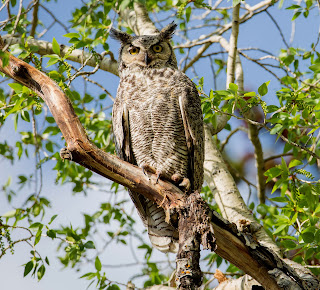
The two most notable species are the great horned owl Bubo virginianus and the puma Puma concolor. As it happens, although hunters and trackers had frequently reported personal observations of pumas producing these remarkably loud and eerie sounds, they were generally disbelieved by scientists – until official observations of such activity were recorded from various zoo specimens, as documented by C.A.W. Guggisberg in his comprehensive book Wild Cats of the World (1975) and subsequently expanded upon by me in my own, first book Mystery Cats of the World (1989).

 
Puma (top) and great horned owl (bottom) (public domain / Patrick Coin/Wikipedia – CC BY-SA 2.5 licence)

Thus it is probable that at least some reports of poorly-observed screaming critters can be explained in this way. Such a solution cannot, however, be applied to those reports in which the witness has distinctly observed a kangaroo-like creature shrieking at close quarters. Moreover, any ventriloquist puma or owl working in conjunction with a kangaroo stooge is much more likely to be found employed upon a Saturday morning cartoon show than wandering through America's countryside!

Evidently, the riddle of the screeching kangaroos will remain unresolved until a specimen can actually be obtained. However, there is one final mystery macropod identity (offered by several writers in the past as at least a theoretical possibility) that has so far not been investigated here, but which is particularly pertinent to this more aberrant, shrieking category of phantom kangaroo (because due to their weird vocals these latter cryptids cannot be so readily considered as straightforward escapees of known macropod species). The possibility in question, albeit exceedingly remote and radical, is that America harbours an unknown, indigenous species of macropod or macropod-like creature. Furthermore, such a form could actually have arisen via two completely different means.


THE CHATATA BIPED AND THE DEVIL MONKEY

Although today represented only by the didelphids (true opossums), caenolestids (rat/shrew opossums), plus a lone surviving species of microbiotheriid (monito del monte), and existing predominantly in Central and South America (a single didelphid species occurs as far north as the U.S.A.), in earlier times the marsupials were a very diverse group throughout the New World. South America in particular was once home to a number of sizeable forms, including the pouched sabre-tooth Thylacosmilus and the wolf-like borhyaenids that belonged to a now entirely extinct taxonomic order whose members were known as sparassodonts and were only very distantly related to all other South American marsupials.

Interestingly, by morphologically paralleling the placental wolves, the borhyaenids also called to mind Australasia's marsupial wolves, the thylacinids (of which the now 'officially' extinct Tasmanian wolf Thylacinus cynocephalus is the only modern-day representative). Indeed, these two latter marsupial groups were once deemed to be closely related. Following more recent research, however, it is nowadays recognised that this is not the case at all – their notable outward similarity arose instead through convergent evolution, due to their occupancy of the same ecological niche upon their respective continents.

If the Americas' pouched mammalian clan could produce a parallel to the Australasian marsupial wolves, could it also have produced a parallel to the Australasian macropods – and one, moreover, which (unlike the borhyaenids) has actually survived to the present day, in North America? Sadly, however, all of the scientific evidence currently available stands firmly against this possibility. Firstly, excluding only a few surviving didelphids all of North America's marsupials died out much earlier (and were much less specialised) than those of the New World's southern continent. So if an indigenous American macropod-like form had evolved and has possibly survived into the present day, one would expect sightings from South or even Central America rather than from the northern continent. Furthermore, no fossil remains of kangaroo-like beasts have ever been recorded from the Americas (known New World fossil marsupials have been carnivorous or insectivorous rather than herbivorous).

 
Holding some grapes, a Virginia opossum Didelphis virginiana, the USA's only known living marsupial species (public domain)

Worth noting for comparison purposes, however, is that despite the absence of geologically-recent coelacanth fossils, two living species do indeed exist. Consequently, an absence of recent fossils of a given animal group does not prove conclusively that no living representative of this group survives. Moreover, one discovery has occurred that may have particular bearing upon the veracity of this most intriguing (albeit highly unlikely) mystery macropod identity.

On 9 November 1891, New York City historian Prof. Albert Leighton Rawson published in the Transactions of the New York Academy of Sciences a short paper entitled 'The Ancient Inscription on a Wall at Chatata, Tennessee'. In this, Rawson described a mysterious wall-like structure lately excavated near Cleveland, in Bradley County, which was composed of red sandstone that bore many hundreds of inscribed symbols of unknown meaning and origin. Moreover, there was also evidence to suggest that attempts had subsequently been made to obliterate them, by covering them with cement and placing on top of this a layer of stone – all very strange.

Strangest of all, however, was the fact that certain of the symbols took the form of unusual animal types, not clearly identifiable with known American species. Of these, the most perplexing must surely be the very distinctive creature whose inscribed form is replicated here:

 
Exact reproduction of the inscribed form of the mystifying bipedal beast present on the Chatata Wall (public domain)

For whereas certainly not matching any 'official' New World animal, it closely corresponds with an 'unofficial' form – the American phantom kangaroo. Unlike known macropods, of course, the Chatata biped sports a beard-like structure hanging from its lower jaw, plus strange-looking hind feet. Such differences, however, could simply be due to artistic style. Also, if the Americas have indeed yielded their own macropod form, one would expect at least slight differences from the Australasian version – another reason for the 'beard' and feet?

The specific age of the inscriptions is unknown, but they would certainly seem to predate very considerably the last 200 years or so – when Australasian macropods first began to arrive in America bound for zoos, sideshow, and circuses, and from which escapees could subsequently infiltrate America's countryside.

Of course the Chatata biped may simply be a beast created by the inscriber's imagination. Nevertheless, is it not curious that it bears so close a resemblance to one of America's most puzzling modern-day mystery creatures, the phantom kangaroo? Tragically, however, no direct investigations of this carving or any others on the Chatata Wall can currently be undertaken, because, incredibly, the wall's exact location is no longer known! There is also a much-debated theory that its inscriptions may actually be nothing more than the casual, non-coordinated product of natural geological or palaeontological phenomena, but I cannot in any way comprehend how such precise, well-delineated forms could have been created by such random means.

 
Artistic reconstruction of the possible appearance of a devil monkey, based upon eyewitness descriptions (© William M. Rebsamen)

More than 20 years after I wrote the original version of this article (back in the mid-1980s), a new and very different but no less intriguing cryptozoological connection to America's phantom kangaroos was postulated – this time by Loren Coleman and fellow American mysteries researcher Patrick Huyghe in their book The Field Guide to Bigfoot, Yeti, and Other Mystery Primates Worldwide (1999). Even though I have otherwise largely refrained from including updates, this highly intriguing identity certainly deserves mention here.

They proposed that at least some of America's reported mystery macropods are not macropods at all but actually constitute an undiscovered species of indigenous primate, a giant simian to be precise, that Coleman and another of his co-researchers, Mark A. Hall, have dubbed the devil monkey. Here is how Coleman and Huyghe described this postulated cryptid in their book:

They appear to be a kind of giant baboon that moves by saltation, leaping as do kangaroos – and are often mistaken for them. Due to their size [standing up to 5 ft tall according to a reconstruction of this cryptid's possible appearance included alongside its verbal description] and means of locomotion, they have evolved a large flat foot with three rounded toes. Immature Devil Monkeys resemble marsupials such as wallabies due to convergent evolution but this similarity diminishes as they mature.

A fascinating if entirely speculative proposal, because as yet there is no known fossil evidence to confirm the prior existence of any type of endemic primate in continental North America (other than our own species in modern times, of course), thereby reducing the likelihood that any such creatures exist here today.]

 
A more baboon-like interpretation of the devil monkey's possible appearance, should it actually exist (© William M. Rebsamen)


OAHU'S ROCK WALLABIES

The second way in which America could possess its very own, separate macropod form can be illustrated by the startling case of the distinctive form of rock wallaby unique to the Hawaiian island of Oahu. As noted in 1982 within a Science Digest news report, a single pair of Australian brush-tailed rock wallabies Petrogale penicillatus escaped from a zoo on Oahu in 1916. They were never caught, and subsequently reproduced in the wild, their offspring in turn mating amongst themselves, until a sizeable population of several hundred wallabies was established (although this has since declined to a present-day total of only 40 or so specimens).

Furthermore, in the early 1980s, when studying these most unusual additions to the Oahu fauna, American biologist Dr James Lazell claimed that they now differed so considerably both in body size and in colouration from their original Antipodean ancestors that they actually appeared to have evolved into a totally separate subspecies – unique to Oahu. Such rapid evolutionary divergence from the original form (less than 60 years in the case of the Oahu wallabies) is particularly common amongst very small populations of creatures isolated from all other intraspecific individuals – a phenomenon termed genetic drift. Furthermore, as Lazell noted in Science Digest, dramatic deviations will occur if the original organisms possess any marked genetic irregularities.

 
Brush-tailed rock wallabies (© Mark Hodgins and Doug Beckers/Wikipedia – CC BY-SA 2.0 licence)

[It should be pointed out, however, that a detailed molecular genetic analysis of the Oahu wallaby population conducted by Drs Mark D.B. Eldridge and Teena L. Browning, and published by the Journal of Mammalogy in 2002, refuted previous suggestions that these Hawaiian specimens now constituted a separate taxon.]

If, as seems probable, many of the reported 'normal' macropods sighted across America are descendants of original escapees that survived and multiplied in the wild, might it be possible that at least some of these have evolved (or are evolving) into separate taxa from their captive ancestors? In other words, could America genuinely possess its own indigenous macropod form, albeit of accelerated modern-day rather than traditional prehistoric evolutionary origin? It is to be hoped that whenever living macropods are captured in the wilds of North America, precise genetic and protein analyses will be undertaken to discover conclusively their taxonomic identity and reveal whether such an exciting phenomenon is indeed occurring here.


NEW ZEALAND'S KAWAU WALLABIES

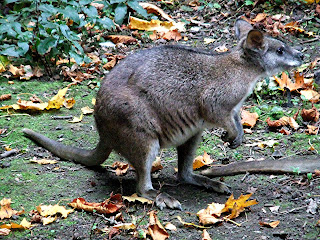
Also well worth noting at this point is a comparable wallaby-themed situation on a small New Zealand island to that on Oahu. The white-throated (parma) wallaby Notamacropus (=Macropus) parma is a very handsome animal, dark brown on top, white underneath, with a black stripe running from its neck to midway down its back. It was once plentiful in the Illawarra and Cambewarra mountainous areas of southern New South Wales, Australia, but as a result of its woodland habitat's wholesale clearance by humans, its numbers rapidly dwindled. By 1932, this attractive mammal was considered extinct.

In 1966, however, it made a reappearance that was particularly unexpected – due to the specific locality in which its reappearance took place, which was not in Australia at all, but instead in New Zealand, on a 500-acre island called Kawau, sited 30 miles north of Auckland on North Island. New Zealand is a country famed for having just two species of native mammal, both of which are bats. So how could the existence on a small New Zealand island of an allegedly-extinct Australian wallaby be explained? For once, the answer was quite straightforward.

 
A white-throated (aka parma) wallaby (© Dr Karl Shuker)

In 1870, settlers had released several white-throated wallabies from Australia onto Kawau, just as they had earlier introduced many other non-native animals onto New Zealand's two principal islands. The wallabies had thrived, and multiplied, so that a healthy population now existed there (alongside those of four other wallaby species also brought here from Australia at various times). And of interest, they are markedly smaller in body size than the original introduced stock, indicating insular evolution has taken place here too, as on Oahu.

To safeguard this species' future, some of the island's white-throated wallabies were sent to zoos around the world to initiate captive populations (which has been a great success), just in case disease or some other threat should decimate the Kawau colony. Not long afterwards, moreover, it was rediscovered on mainland Australia too, by G.H. Maynes, who located some notable forest-dwelling populations in an expanse of land stretching from the Hunter River to the Clarence River in northeastern New South Wales, thereby greatly increasing its survival chances in the wild too.


NATURALISED WALLABIES IN BRITAIN

This whole subject also has great bearing upon creatures far closer to home for me – namely, within the British Isles. For it is well known that established populations of naturalised Bennett's wallaby Notamacropus rufogriseus officially exist in Britain.

As detailed by Sir Christopher Lever in his definitive book The Naturalised Animals of the British Isles (1977), one such population was long located within heather moorland, scrub, and woodlands in the Peak District of Derbyshire and Staffordshire, England, descended from five macropod escapees from a private zoo near Leek during World War II. Sadly, however, this population seems nowadays to have all but died out, due to a succession of harsh winters, although occasional sightings of single specimens are still reported here.

 
A shy Bennett's wallaby (© Dr Karl Shuker)

Another documented British wallaby population exists in the St Leonard's Forest and Worth Forest area south of Crawley New Town in northern Sussex, England, and may have been similarly established by wartime escapees, this time from Leonardslee Park near Horsham. There is even a famous wallaby population on Inchconnachan, one of the islands in Scotland's Loch Lomond. These are descended from some specimens that were introduced there during the 1940s by Lady Arran Colquhoun, and Inchconnachan itself is popularly referred to colloquially as Wallaby Island.

In view of the Oahu wallabies, is it conceivable that in time to come these British naturalised wallabies will evolve into at least a phenotypically-distinct form, visually distinguishable from their escapee ancestors? Truly a most stimulating thought, and one made even more tantalising by the fact that prior to their population crash the Peak District wallabies had already yielded some individuals differing markedly in colouration from the original escapees. Moreover, in recent years a number of albino wallabies have been reported in the wild from various disparate localities across Great Britain.

 
An albino Bennett's wallaby (© Dr Karl Shuker)

Intriguingly, reports have also been filed involving British sightings of macropods in locations other than those officially confirmed to be occupied by populations. In some cases, such reports are known to have been caused by lone escapees from captivity nearby; in others, an individual from one of the official naturalised populations may simply have strayed elsewhere.

However, a fair few reports exist that cannot be satisfactorily explained by either of these answers, leading to the prospect that other, currently unconfirmed populations of escapee descendants may exist in Britain. Take, for example, the Oxfordshire outbreak of August 1985:


ELUDING CAPTURE

On 14 August 1985, student Greg Caswell gave chase to a wallaby spotted bounding along the Benson to Crowmarsh road in south Oxfordshire, England, while he was driving home late that evening, but he didn't catch it. Although two or three wallabies were known to have escaped before Christmas 1984 from the McAlpine estate near Fawley (about 8 miles from Crowmarsh), these were all thought to have been killed in road accidents (Fortean Times, winter 1985). On 24 or 25 August, a drowned wallaby was discovered in a private pool at Crowmarsh – possibly the individual that had eluded capture by Greg just over a week earlier (Oxford Mail, 28 August).

A few days before that find, and at least 30 miles north-west of Oxford, Julia Brooks of Chipping Campden, Gloucestershire, had been surprised to observe a wallaby in her garden eating food scraps put out for the birds; and on 25 August, workers on the Cornbury Park estate (about 15 miles south­east of Chipping Campden) sighted a macropod in nearby fields, but they claimed that it was 5-6 ft tall, grey-coloured, and was identified emphatically by them as a kangaroo, not a wallaby (Fortean Times, winter 1985).

 
Might it have been an eastern grey kangaroo Macropus giganteus, like this individual? (© Danielle Langlois/Wikipedia – CC BY-SA 3.0 licence)

Thus it seems that this latter, much larger beast was not the same macropod that Brooks had spied. On 17 September, the Oxford Mail reported that Police Constable Jon Badrick from Chipping Norton had been assigned to capture his town's mystery macropod(s), and he revealed that the wallaby may have once belonged to a Dennis Washington who kept wallabies at Middle Barton – although whether any of his had in fact escaped was not mentioned. Moreover, on 6 October London's Mail on Sunday newspaper actually published a photograph of a wallaby eluding capture by a Chipping Norton policeman. Yet whether any macropods from this hotbed of hopping activity were ever caught is unknown – like so many cryptid sagas, after a blaze of publicity Oxfordshire's mystifying marsupials simply faded from the news.

Less than two years later, a wallaby was being pursued by the Royal Ulster Constabulary after having been spotted near to Belfast Zoo in Northern Ireland, but it was not revealed whether this specimen had in fact escaped from the zoo (Sandwell Express and Star, 30 April 1987). Similarly, another wallaby of uncertain origin was also being sought by police after having been spotted hopping down the Weymouth to Wareham road in Dorset, southwestern England, by an ambulance crew (Sandwell Express and Star, 14 August 1987).

 
As demonstrated here by the individual standing between (but further back than) my mother Mary Shuker and myself at a farm in Melbourne, Australia, adult kangaroos can be well over 5' tall (I am 5'10" but by standing nearer to the camera than the kangaroo was, I appear much taller than it was, due to forced perspective) (© Dr Karl Shuker)

Naturalised kangaroo (as opposed to wallaby) populations are not supposed to exist anywhere in the British Isles, which makes the Cornbury Park specimen a notable puzzle. Even more bizarre, however, is the Lancashire creature observed one afternoon in 1967 by David Rees at the edge of a wooded area called Freshfields near Southport, England – an incident recalled by him in Fortean Times (summer 1980). For this animal, described by Rees as being a kangaroo, was at least 8 ft tall, with a rusty-brown pelage. Its most surprising feature, however, was its gait. Rees reported that after viewing him, the creature "...turned around and walked into the undergrowth and out of sight". Enquiries to local police failed to ascertain its origin.

Although, as stated by Dr Alyson Lander of New South Wales, Australia, in a follow-up letter (Fortean Times, Summer 1981), its colour matched that of a male red kangaroo (albeit an exceedingly tall one), no modern-day species of macropod moves by walking. Not only the origin but also the zoological identity of this animal thus remains a mystery.


ENORMOUS RABBIT-LIKE MYSTERY BEASTS DOWN UNDER

Continental Europe is not immune to phantom kangaroos either. A selection of reports concerning the French equivalent of America's 'normal' category of such beasts appeared in Fortean Times (spring 1987), courtesy of Jean-Louis Brodu. Additionally, in September 1985 one or more kangaroos were frightening villagers in northern Hungary; a Hungarian Sunday newspaper applied the escapee theory as an explanation (Fortean Times, winter 1985).

Inevitably, tales of phantom kangaroos have also been recorded from the original homeland of all marsupial hoppers – the vast island continent of Australia. However, the Antipodean brand of mystery macropod makes even the mighty 6-7-ft-tall red kangaroo, capable of 10-ft-high bounds, look positively puny in comparison. For in the arid desert land constituting the dry heart of Australia, reports from gold-prospectors and other occasional travellers to these inhospitable zones have spoken of enormous rabbit-like beasts that disappear in a single bound. Furthermore, some accounts refer specifically to "kangaroos 12 feet high".

 
Sthenurus depicted in walking pose (© Brian Regal/Wikipedia – CC BY 2.5 licence)

Consequently, in his classic cryptozoological book On the Track of Unknown Animals (1958), Dr Bernard Heuvelmans boldly suggested that these may actually be surviving representatives of Australia's giant Pleistocene macropods. Grazers such as Procoptodon and browsers such as Sthenurus attained heights of 10 ft.

However, in recent years anatomical studies based upon their fossil remains have indicated that these bipedal giants most likely moved not by bounding but instead by walking. In any event, the possibility that such massive marsupials still exist is one that may never be investigated fully, due to the daunting conditions that must be faced by anyone penetrating these environmentally hostile regions.


FINAL THOUGHTS

It is clear that the creatures hitherto classed as phantom kangaroos actually constitute a diversity of different animal types, of which only the 'normal' category is likely to feature genuine macropods. Consequently, usage of the term 'phantom kangaroo' should be restricted hereafter to this single specific group. It is also evident that public awareness concerning the phenomenon of mystery macropods has been stimulated in particular by the extensive investigations of Loren Coleman and David Fideler, and the unstinting documentation of reports by Fortean Times. It is hoped that their efforts will be ultimately rewarded by unequivocal solutions to this most curious cryptozoological conundrum.

In the meantime, however, whenever you put out scraps for the birds, don't forget to check whether the bipeds eating them include not only winged and feathered examples but also some pouched and furred ones!

Finally, be sure to click here and here in order to read Parts 1 and 2 of this ShukerNature article – you know it makes sense!

 
Rolling back the years – how I looked way back in the mid-1980s when I wrote the original version of this article at the very beginning of what has become for me a lifelong and exceedingly enjoyable cryptozoological career (© Dr Karl Shuker)