Dr KARL SHUKER

Zoologist, media consultant, and science writer, Dr Karl Shuker is also one of the best known cryptozoologists in the world. He is the author of such seminal works as Mystery Cats of the World (1989), The Lost Ark: New and Rediscovered Animals of the 20th Century (1993; greatly expanded in 2012 as The Encyclopaedia of New and Rediscovered Animals), Dragons: A Natural History (1995), In Search of Prehistoric Survivors (1995), The Unexplained (1996), From Flying Toads To Snakes With Wings (1997), Mysteries of Planet Earth (1999), The Hidden Powers of Animals (2001), The Beasts That Hide From Man (2003), Extraordinary Animals Revisited (2007), Dr Shuker's Casebook (2008), Karl Shuker's Alien Zoo: From the Pages of Fortean Times (2010), Cats of Magic, Mythology, and Mystery (2012), Mirabilis: A Carnival of Cryptozoology and Unnatural History (2013), Dragons in Zoology, Cryptozoology, and Culture (2013), The Menagerie of Marvels (2014), A Manifestation of Monsters (2015), Here's Nessie! (2016), and what is widely considered to be his cryptozoological magnum opus, Still In Search Of Prehistoric Survivors (2016) - plus, very excitingly, his four long-awaited, much-requested ShukerNature blog books (2019-2024).

Dr Karl Shuker's Official Website - http://www.karlshuker.com/index.htm

IMPORTANT: To view a complete, regularly-updated listing of my ShukerNature blog's articles (each one instantly clickable), please click HERE!

IMPORTANT: To view a complete, regularly-updated listing of my published books (each one instantly clickable), please click HERE!

IMPORTANT: To view a complete, regularly-updated listing of my Eclectarium blog's articles (each one instantly clickable), please click HERE!

IMPORTANT: To view a complete, regularly-updated listing of my Starsteeds blog's poetry and other lyrical writings (each one instantly clickable), please click HERE!

IMPORTANT: To view a complete, regularly-updated listing of my Shuker In MovieLand blog's articles (each one instantly clickable), please click HERE!

IMPORTANT: To view a complete, regularly-updated listing of my RebelBikerDude's AI Biker Art blog's thematic text & picture galleries (each one instantly clickable), please click HERE!

Search This Blog


PLEASE COME IN, I'VE BEEN EXPECTING YOU...

PLEASE COME IN, I'VE BEEN EXPECTING YOU...
WELCOME TO SHUKERNATURE - ENJOY YOUR VISIT - BEWARE OF THE RAPTOR!


Showing posts with label white dodo. Show all posts

Thursday, 19 April 2018

DEMYSTIFYING THE DODO OF NAZARETH


An adult female specimen of the dodo's closest relative, the Rodrigues solitaire, as drawn in 1708 by French explorer François Leguat and thereby constituting the only illustration of this now-extinct flightless species prepared by someone who directly saw it in the living state (public domain)

The Indian Ocean's Mascarene archipelago – of which the islands of Mauritius, Réunion, and Rodrigues are its largest, principal members – has acquired everlasting fame as the former home of one of the world's most celebrated and curious subfamilies of extinct birds. I refer, of course, to those flightless hook-billed pigeons of gargantuan stature and grotesque appearance known to zoologists as Raphinae but to everyone else as the dodos and solitaires.

Indeed, the dodo of Mauritius, Raphus cucullatus (the still commonly-applied but obsolete genus Didus being a junior synonym of Raphus), has become the modern-day epitome of obsolescence. "As dead as the dodo" is the ultimate phrase used to describe anything, avian or otherwise, that is irrevocably dated, destroyed, or deceased.

The most ironic aspect of the dodos' extinction is that at one time there was every opportunity to save them. Quite a number of dodos were brought back to Europe, and unlike so many of the tropics' much more delicate avifauna they appeared to be physiologically robust.

Indeed, as David Day pertinently remarked in The Doomsday Book of Animals (1981), any birds that could survive the rough sea voyages of the 17th Century had to be tough. (There is even a confirmed record of a living dodo that reached the Japanese city of Nagasaki in 1647, which is the last recorded dodo specimen in captivity.)

Sir John Tenniel's famous illustration of Alice with the Dodo and other caucus race competitors, from Alice's Adventures in Wonderland (1865); modern, zoological reconstructions of the dodo favour a sleeker, less plump appearance for it (public domain)

Furthermore, some apparently survived for a number of years in their new European homes. If serious attempts had been made to save them by captive breeding, the existence of these Alice-in-Wonderland birds within today's parklands and gardens may well have been a firm reality instead of an intangible romantic fantasy. Yet no such attempt was made.

Instead, the Mauritius dodo is generally believed to have died out in or around 1681. Moreover, this species' Mascarene relative - the still-sizeable but rather more streamlined solitaire of Rodrigues, Pezophaps solitaria - apparently followed it into oblivion by the latter part of the 18th Century.

A third once-recognised species, the Réunion solitaire Raphus solitarius, which died out at much the same time as its Rodrigues namesake, is nowadays deemed to have been a species of ibis, not a dodo or solitaire at all, and has been reclassified accordingly.

Moreover, a fourth erstwhile species, Réunion's supposed white dodo Victoriornis imperialis, has been thoroughly traduced and entirely discredited taxonomically. I plan to document these two discounted forms in a future ShukerNature article.

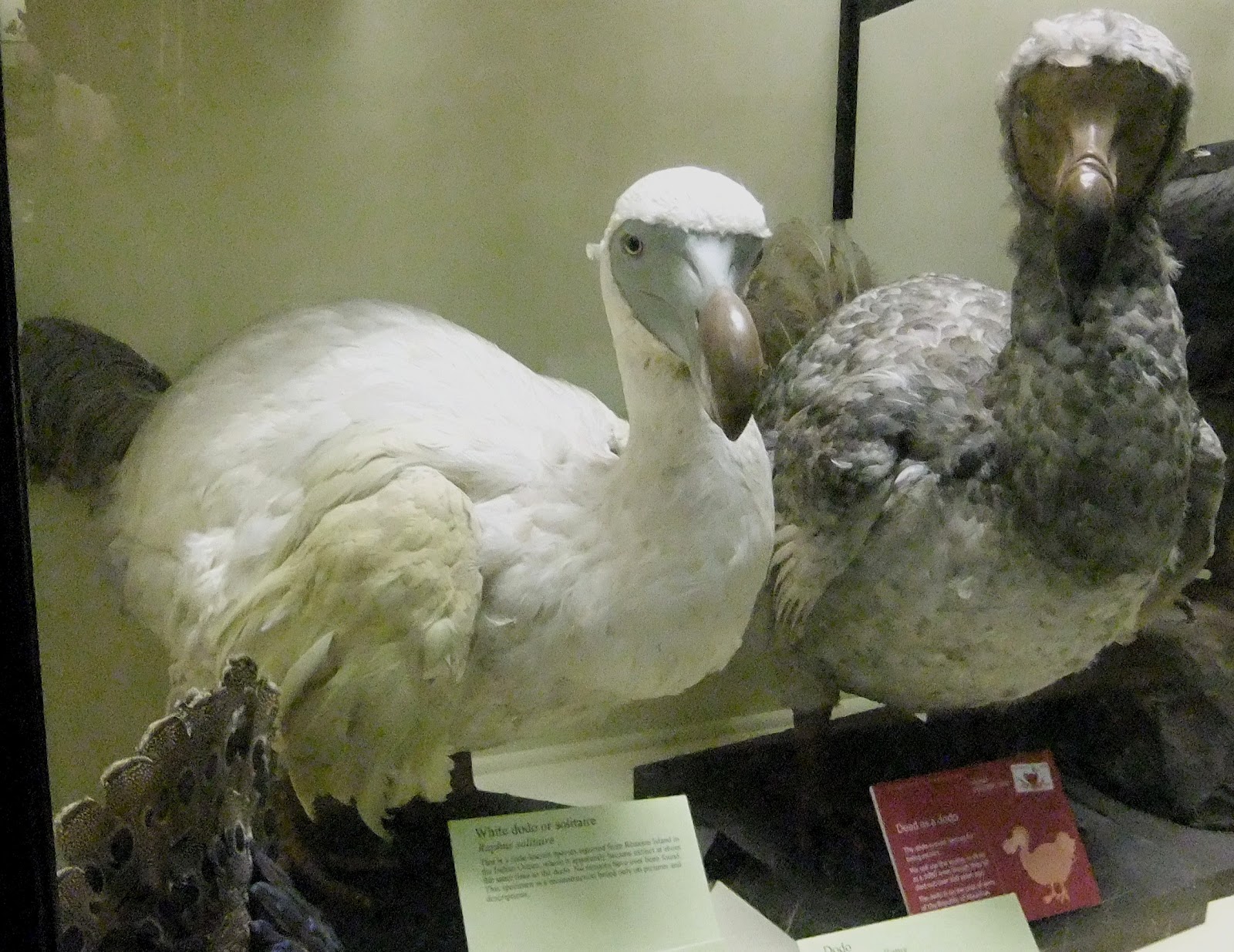
Life-sized models of the Réunion white dodo (confusingly labelled alternatively as the solitaire, which on Réunion was a separate but equally non-existent raphine species) and the Mauritius dodo at Tring Natural History Museum (© Dr Karl Shuker)

Even so, is it possible that some raphine representatives survived beyond these officially-recognized dates of extinction, persisting instead into much more recent times? Let us consider the intriguing if highly-convoluted case of the Nazareth dodo.

Although Mauritius, Réunion, and Rodrigues are without doubt the largest and best known Mascarene islands, they are not the only ones contained within this particular Indian Ocean archipelago. To the north of its major trio lie many far smaller and much less familiar islets and banks. Indeed, most of these have never been explored or even inhabited by humans. Yet at least one could be of considerable significance to the possibility of recent dodo survival.

In 1638, French explorer François Cauche led an expedition to Mauritius and later wrote a detailed account of his adventures. In it, he referred to "oiseaux de Nazaret" ('birds of Nazareth') in relation to dodos. Consequently, several subsequent books included mention of a new species - Didus nazarenus – the Nazareth dodo. But where was Nazareth? What exactly did it mean? Was it the name of some mysterious island? Or could it have been merely a mistranslation of some descriptive phrase used in connection with ordinary dodos? It was all most bewildering.

In his book The Lungfish and the Unicorn (1941), republished in expanded form as The Lungfish, the Dodo and the Unicorn in 1948, Willy Ley, a German-born scientist and science writer much interested in cryptozoology (or what he quaintly referred to as 'romantic zoology'), re-examined the confusing case of the Nazareth dodo. He favoured the last-mentioned explanation as the most likely solution.

My copy of Willy Ley's book The Lungfish, the Dodo and the Unicorn (© Dr Karl Shuker/Viking Press)

The first European explorers of Mauritius were Dutch, and these had referred to the dodos as "Walghvogel" ('nauseating birds'), on account of their less-than-tasty flesh. Ley observed that the translation of this into French was "oiseaux de nausée", which sounds similar to "oiseaux de Nazaret".

Added to this is the fact that Ley could find no evidence (at first) for the existence of a Nazareth Island - except for a few ancient maps carrying the name, and he dismissed its presence on these maps as nothing more than a synonym for one of the major Mascarene islands. However, the position of 'Nazareth Island' as marked on these did not correspond with the known location of any of the major Mascarenes - a puzzling inconsistency that Ley explained away as cartographical inaccuracy.

And so, according to Ley, Cauche had mistaken "oiseaux de nausée" for "oiseaux de Nazaret", with Nazareth being nothing more than an alternative name for one of the three principal Mascarenes. All of this seemed eminently plausible - until, as he would reveal in his later book Exotic Zoology (1959), Ley discovered that a 'Nazareth Island' totally separate from these latter islands really did exist.

It turned out that this was the name that early Portuguese sailors had given to a tiny islet called the Île Tromelin. Of 54° 25' E longitude and 15° 51' S latitude, this is a remote diminutive island (less than three miles long) lying approximately 375 miles northwest of Mauritius, 250 miles east of Madagascar, and sited within the Mascarene Basin. Even more stimulating than his identification of Tromelin as the mysterious 'Nazareth Island', however, was Ley's discovery that the 19th-Century Dutch zoologist and dodo expert Dr Anthonie Cornelius Oudemans (who was also a diligent if derided chronicler of sea serpent reports – click here) had suggested that Tromelin may be worth exploring in search of fossil (and even living) dodos!

Willy Ley (public domain)

As he noted in a full report in his book Searching For Hidden Animals (1980), veteran cryptozoologist and university-based biochemist Prof. Roy Mackal had followed up the history of the Nazareth dodos and Ley's corresponding researches very closely. Consequently, intrigued by the zoological potential ascribed to Tromelin by Oudemans, Prof. Mackal set out to learn more about this mysterious islet.

He discovered from a nautical chart depicting the isle (and produced from a Madagascan survey of the area carried out in 1959) that its only links with humanity were its ownership by France and its possession of a small airstrip plus a meteorological station (apparently of automatic type). Nothing seemed to be known of its wildlife.

Thanks to the vast information resources that have been made readily available via the internet in the decades that have passed since Mackal's book was published, conversely, this latter statement is no longer true.

As confirmed by a factsheet devoted to Tromelin produced and updated by BirdLife International (click here to access it), we now know that this tiny isle, currently an unmanned nature reserve but with four permanent staff in attendance at the meteorological station, is home to two significant populations of seabird – the masked booby Sula dactylatra and the red-footed booby S. sula. It is also used for roosting purposes by frigate birds (two different species of which formerly bred here), but according to the factsheet there are no resident land birds. There are, however, brown rats, which have reached the isle via ships, and which have to be poisoned periodically in order to keep their numbers down.

Roelant Savery's beautiful painting 'Landscape with Birds', produced in 1628, which includes among its diverse avian array a dodo, standing just in front of a cassowary and to the immediate left of a heron (public domain)

Coupling the existence here of rats (infamous on certain other islands for their baneful effects upon flightless birds) with the no-doubt-watchful, attentive presence of the meteorological station's staff, it would seem unlikely, therefore, that any relatively large and flightless species of bird, let alone anything as potentially distinctive as a dodo relative, could survive here undetected.

Many other comparably tiny and insignificant islets exist in this area, however, most of which remain scientifically unexplored or unnoticed. As Mackal noted, this is no doubt due at least in part to the existence of treacherous reefs and shoals that would make any attempt at landing on these islands hazardous in the extreme.

Almost 40 such islands, all of which are less than half a square mile in area, make up the Cargados Carajos Shoals (aka Saint Brandon), which are primarily fishing stations. Then there are the two Agaléga Islands, connected by a sandbar and covered with coconut palms, and again used for fishing. But what of their wildlife? Seabirds and turtles constitute the most familiar inhabitants of the Cargados Carajos Shoals, whereas the Agaléga Islands are famed for their very own subspecies of day gecko, Phelsuma borbonica agalegae, found nowhere elsebut might there be other, more elusive species here too, still evading scientific detection? Having said that, the invasion of some of these islands by rats, rabbits, and chickens doesn't bode well for any such species. Then again...

Relative to the Cargados Shoals, Mackal reported that as many as a dozen of these islands may house zoological and botanical surprises. Could these include living relatives of the dodo, unknown to the zoological world? It seems very unlikely, but let us hope, nevertheless, that other scientists will follow Mackal's lead, and investigate in detail some of the major Mascarenes' minor neighbours. Who knows for certain what the zoological rewards may be?

Even more exotic than the Nazareth dodo, my very own blue dodo! (© Dr Karl Shuker)


Saturday, 22 September 2012

THE STUFFED DODO THAT WAS A NO-NO!

A recently-discovered 17th-Century Dutch illustration of the dodo

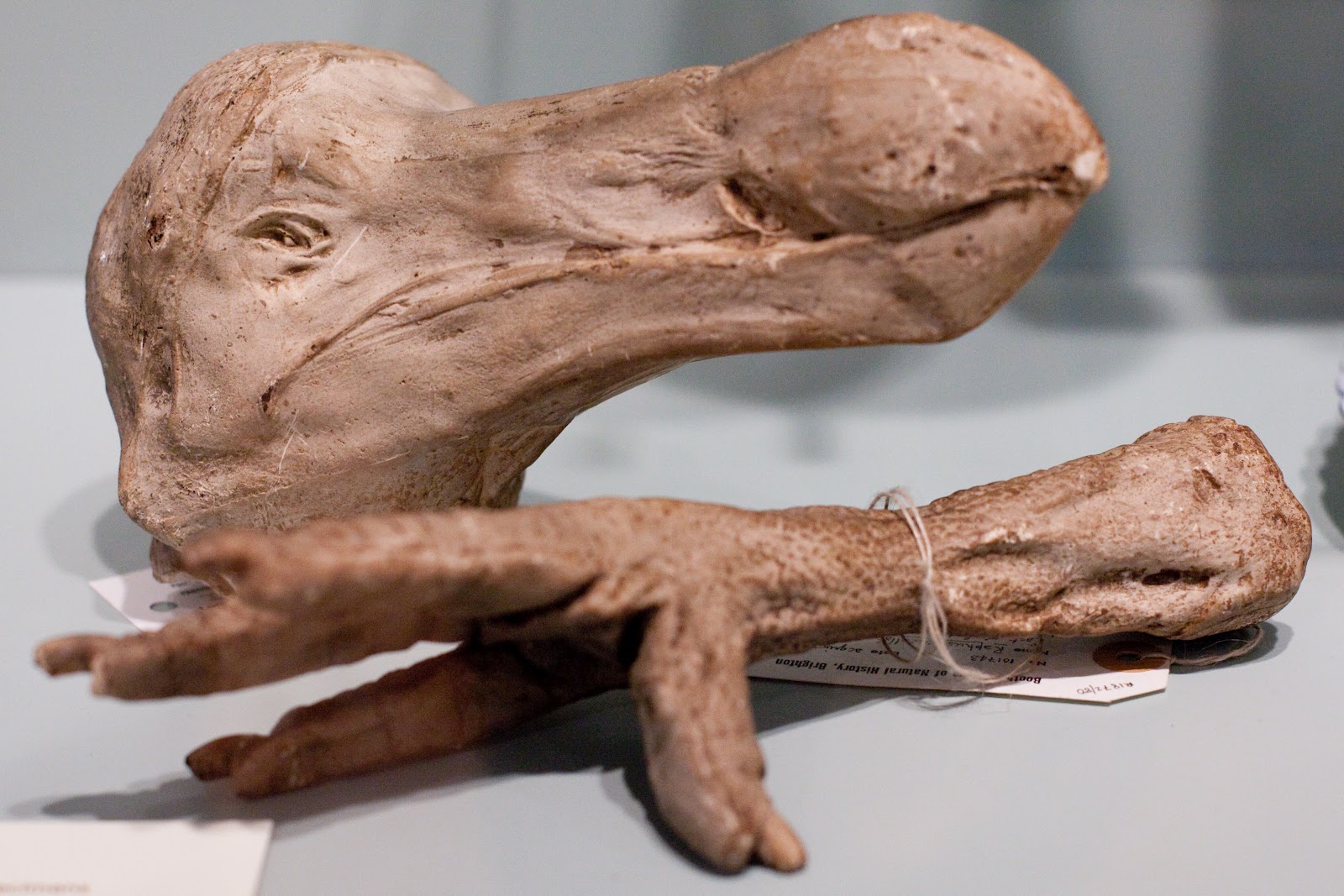
One of the most (in)famous stories in zoological museum history is how the world’s only stuffed specimen of the dodo Raphus cucullatus - Mauritius's best-known species of extinct bird - was allegedly discarded and burnt on 8 January 1755 on the orders of a committee of trustees at Oxford’s Ashmolean Museum because they considered it looked tatty, and how an assistant had the foresight to rescue its head and one of its feet before the flames reached them. As will be revealed later however, this story is spurious. What is true, conversely, is that those precious relics were later transferred to the University Museum of Zoology, where they are now among its most prized specimens.


Plaster casts of the preserved Oxford dodo head and a now-lost preserved dodo foot formerly held at Brighton's Booth Museum of Natural History (Ed Schipul/Wikipedia)

Being well aware of this, I was nothing if not startled by an email published on 16 March 2008 in the Sunday Mirror newspaper’s ‘Treasure Hunters’ column, compiled by TV antiques and collectables expert James Breese. The email in question was from a Ray Holmes (no address or location details given), in which he asked Breese to tell him the likely worth of what he described as a stuffed dodo in near-perfect condition, owned by him and preserved inside a domed glass case, which had originally been acquired by an ancestor of his sometime during the mid-1600s.

In reply, Breese rightly pointed out that if a genuine stuffed dodo did indeed exist anywhere, it would be priceless both in value and in scientific importance. However, he also revealed that fake dodos have been produced by taxidermists (notably Rowland Ward Taxidermy Studios of London, who manufactured several during the early 1900s), created by using feathers and tissues from other birds, and opined that this is very probably the explanation for Holmes’s dodo.

Nevertheless, the fact that the latter specimen apparently dated from the mid-1600s – a period when the dodo was still alive (this species’ official extinction date is traditionally given as 1681, though recently a slightly later date has also been proposed) – was significant enough in Breese’s view for him to suggest that Holmes should take his dodo to a museum for a closer inspection.


Facsimile taxiderm specimens of the Reunion white dodo (a species now known never to have existed!) and the Mauritius dodo at Tring Natural History Museum (Dr Karl Shuker)

Although I strongly suspected it was a fake, I certainly agreed with Breese's suggestion that it should be professionally examined. After all, albeit highly unlikely, if by any chance it actually was the real thing, a complete, near-perfect, genuine stuffed dodo would be one of the greatest zoological finds of modern times – almost as amazing as discovering a living, breathing dodo! Consequently, after documenting this intriguing episode in one of my Alien Zoo columns for Fortean Times a few months after the Sunday Mirror's original report, I requested anyone with additional information concerning this or other stuffed dodos to contact me.

As a result, I received several communications from dodo author-historian Anthony Cheke, who not only supported my suggestion that it was a fake but also provided further insights into this intriguing subject, and which he has kindly permitted me to document here.


Flemish artist Roelandt Savery's famous dodo painting from 1626 (which also features two mystery macaws – click HERE for details)

Most significantly, the methods of preservation available during the 17th Century were so poor that there are no stuffed birds from that time period still in existence anywhere – they have all long since rotted away or been eaten by insects. As stated by Anthony to me:

"In the 17thC (i.e. 1600s) skins were just cleaned and dried (rarely stuffed) without preservative - or any they used was short-lived. So the specimens simply over time succumbed to moths and mites, only the hard bits generally surviving (i.e. beaks, bones, antlers, carapaces etc.). Very few survived as far as the mid-18thC, the decaying dodo [at Oxford’s Ashmolean Museum] was a late survivor, and the Ashmolean dumped ALL their remaining 17thC specimens at the same time as the dodo [1755]... - [museums/cabinets of curiosities] didn't even invent pickling specimens in alcohol until the mid-1660s! As far as I know there are NO 17thC specimens intact anywhere, and very few that pre-date the mid-1700s - most of the huge (former) royal collection in Paris (including almost all of Brisson and Buffon's types) was destroyed around 1800 when they tried to save it by fumigation, but the sulphur fumes damaged the specimens more than the bugs they were trying to kill!...The stuffed dodo in Prague was at some point reduced to just a skull and some bones that still survive. Two more in Oxford's Anatomy School disappeared around 1750."

Further details can be found in Anthony’s authoritative book Lost Land of the Dodo: The Ecological History of Mauritius, Reunion and Rodrigues (2007), co-authored by Dr Julian Hume.

In short, as suspected from the beginning, the dodo owned by Ray Holmes is undoubtedly a later, facsimile dodo, constructed from the skin and feathers of other, non-dodo species of bird (goose feathers is a popular choice).


Dodo portrayed on a postage stamp issued by Mauritius in 1965 (Dr Karl Shuker)

Anthony also provided some little-known but interesting mitigating evidence in relation to what has traditionally been portrayed as a rash act by the Ashmolean Museum's trustees in discarding its dodo:

"On the Oxford specimen, you have to remember that in 1755 they didn't know they had the only specimen, and equally didn't know it was extinct (that wasn't first mooted until 1784 - in France)."

Moreover, even the oft-reported account of how it was wilfully destroyed seems now to have been at the very least an exaggeration or distortion of the true facts, and at most a downright lie. Here is what Dr Julian Hume and two co-workers wrote on this delicate subject in a 2006 dodo paper published in the Bulletin of the British Ornithologists Club:

"There was a long-held belief that this, by then unique, stuffed Dodo was thrown onto a fire in 1755, and that only the head and a foot were rescued from the flames...In fact, its removal from exhibition was a curatorial decision made to preserve what was left of the by then highly degraded specimen (Ovenell 1992). The salvaged remains included the skin of the head, some feathers and a foot."

The final nail in this now-clearly-suspect account's coffin was provided by another dodo researcher, Jolyon Parish, who disclosed the following information in an email to me of 2 December 2010:

"Regarding the Oxford dodo, the head and left foot were saved by the same person as removed it from display (George Huddesford). There is no evidence that the specimen was burned and it is only recorded that they were removed from display, as decreed by Ashmole’s statute, following a meeting of the Vice-Chancellor (Huddesford, who was also Keeper of the Museum) and the Visitors in January 1755."

And so another favourite story from the history of zoology proves to have been just that – a fable that had tenaciously persisted into the present day, unlike, tragically, its long-demised subject, the dodo.

Some of my dodo figures (Dr Karl Shuker)

And finally: The last preserved dodo may be long gone, but thanks to coelacanth discoverer Marjorie Courtenay-Latimer's great-aunt Lavinia, there may still be one surviving dodo egg. Lavinia had received it from a family friend who worked as a sea captain and frequently travelled between South Africa and Mauritius, where he claimed to have found the egg in a swamp. In 1915, she in turn gave it to her grand-niece Marjorie, who later became the curator of South Africa's East London museum - to where she famously returned from the docks one December afternoon in 1938 with the very oily but zoologically priceless body of the first scientifically-recorded specimen of a living species of coelacanth.

In August 2010, the museum's present curator, Mcebisi Magadla, announced plans for a tiny sample to be removed from the egg in order for its DNA to be tested, and thus determine conclusively whether it truly is a dodo egg – or whether, as several dodo researchers have suggested or suspected, it is nothing more exciting than an ostrich egg.

As yet, however, I have not learnt whether such a test has been conducted, or, if it has been, the result. So if any reader does have information concerning this, I'd be very pleased to hear from you!

Not a dodo egg but rather an egg-dish in the shape of a dodo! (Dr Karl Shuker)